By Brenda S. Cox
“My idea of good company, Mr. Elliot, is the company of clever, well-informed people, who have a great deal of conversation; that is what I call good company.”–Anne Elliot, Persuasion
Every year, JASNA (the Jane Austen Society of North America) holds a wonderful Annual General Meeting. “Meeting” doesn’t sound very exciting, but JASNA AGMs are the highlight of the Jane Austen year for many of us in North America. Over a period of about five days, we get to meet with hundreds of other Janeites, enjoying plenty of “good company,” enjoying old friends and making new ones. We also get to hear plenaries from top experts in the world and breakout sessions on many fascinating topics. Plus, we enjoy fun workshops, tours, a ball, and much more.

On Oct. 16-20 of this year, 660 JASNA members attended the AGM in person, including 30 students, plus 63 companions and 160 virtual participants. 20% were first-time participants. About 90% were women, about 10% men. The topic was “Austen, Annotated: Jane Austen’s Literary, Political, and Cultural Origins.” A wide area. But right up our alley here at “Jane Austen’s World.” This conference touched on many areas of the context of Austen’s life and writings, which gave participants new insights into her novels.
Plenary Talks
The wonderful plenary talks included:
- “‘So Potent and So Stimulative’: Jane Austen’s Reading” by Susan Allen Ford, author of What Jane Austen’s Characters Read and Why?—Ford explored with us how Austen’s reading influenced Mansfield Park. She has identified 43-51 titles that influenced that novel alone! These include Mary Brunton’s evangelical novel Self-Control and Austen’s cousin Edward Cooper’s sermons. Personally, I found this a wonderful lead-in to my own breakout session on “Jane Austen and the Evangelicals.” I’ll be reviewing Susan’s book for you before long; it’s full of great insights.
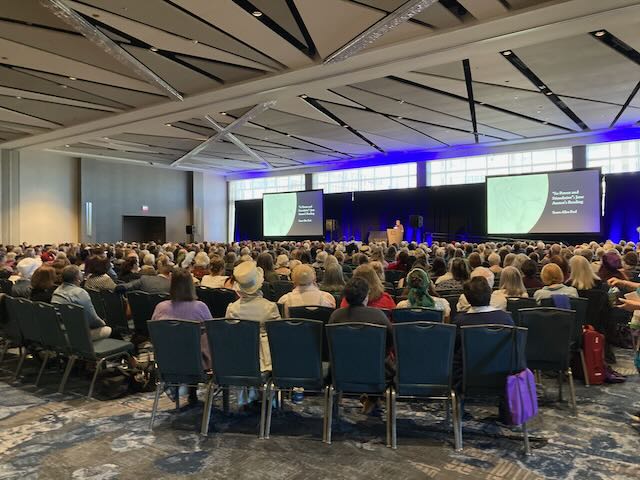
- “Was Austen Political?” by Amanda Vickery, author of The Gentleman’s Daughter: Women’s Lives in Georgian England—Vickery explained to us women’s limited roles in “public business” (politics) at the time. She told us that heiresses and rich widows, like Mrs. Jennings and Lady Catherine, might influence their tenants to vote for a certain MP. They might also choose the parish clergyman, important in local government. Upper-class wives might be political hostesses, giving them influence as well. Women were also involved in the abolition movement. Jane Austen was observant and attentive, making subtle references to the movements of her day.
- “‘The Capital Pen of a Sister Author’: Reading Frances Burney with Jane Austen,” by Peter Sabor, editor of the Juvenilia in the Cambridge edition of Austen’s works—We learned about the Burney novels that Austen loved: Evelina, Cecilia, and Camilla, and how Austen referred to them in her letters and in Northanger Abbey. She even “subscribed” to Camilla, supporting it as a sort of eighteenth century Kickstarter backer.
- Patricia A. Matthew, whose current work-in-progress is “‘And Freedom to the Slave’: Sugar, Gender, and the History of the Novel,” talked about women and the sugar boycott which helped get British slavery abolished. She also told us about the new “Race & Regency Lab.” George Austen’s first cousin, John Cope Freeman, owned a plantation in Jamaica. Maps of the plantation, shown on the website, provide information on the enslaved people there and the plots of land they cultivated for themselves or others.
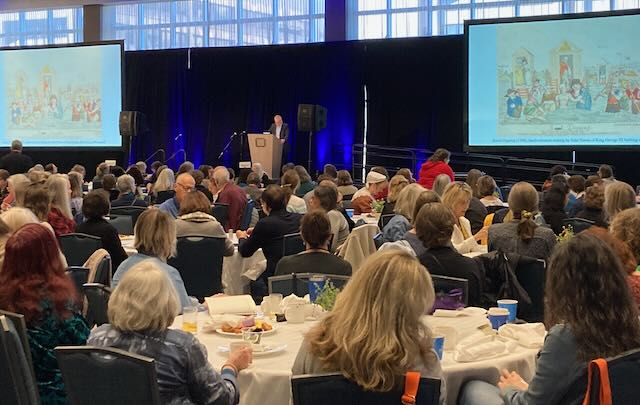
- “Jane Austen and the Jurassic,” by Thomas Keymer, author of Jane Austen: Writing, Society, Politics, gave a scientific plus literary slant on the time period. During our final brunch, Keymer focused on fossil discoveries at Lyme Regis, including those by Mary Anning and Elizabeth Philpot. Austen’s novels include brief references to fossils: Fanny’s amber cross was fossilized, Elizabeth Bennet plans to pick up “petrified spars,” and in Persuasion we hear of changes in the landscape at Charmouth and Pinny, which revealed fossils. Keymer posited that the real “fossils” in Persuasion are Sir Walter Elliot and Lady Dalrymple and her daughter. And, by the way, Charles Darwin knew Persuasion practically by heart, and called the captain of the Beagle a “Captain Wentworth.”
Breakout Sessions
Honestly, though, my favorite sessions were the breakouts. Five great choices were offered for each of five session times. It was so hard to decide that I paid extra to get recordings of some of them afterwards. As I mentioned, I spoke in one of them. I was opposite Dr. Ben Wiebracht and his students, who were the JASNA New Voices Speakers for this year. They spoke about their Doctor Syntax book, which I reviewed last month. I got to hear a recording of the talk, which was full of great information about this very popular author of Austen’s time.
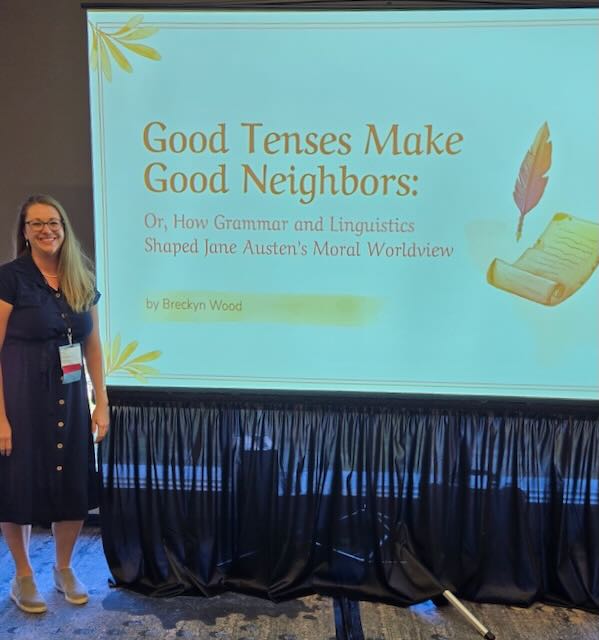
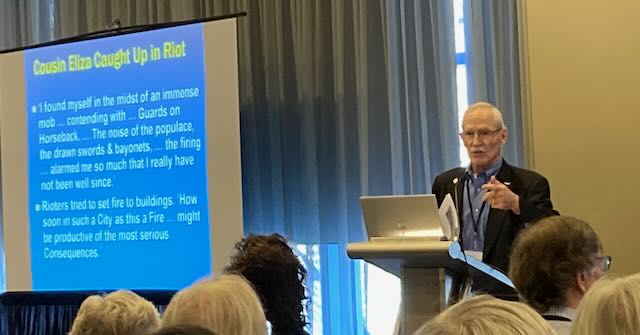
Other highlights for me were my friend Breckyn Wood’s talk on how grammar and linguistics shaped Austen’s moral worldview, Roger Moore’s session on Jane Austen’s clergymen and their literary ancestors, Lona Manning’s discussion of charity in Emma compared to charitable heroines in other novels of the time, and Deb Barnum’s pictures of books Jane Austen owned. Linda Zionkowski spoke about the “whiners” of Austen’s novels, comparing them with a popular book on complaint, and Collins Hemingway told us about riots and insurrections of Austen’s time. I wish I could have gone to all the breakout sessions!
Fortunately, many of the plenary and breakout talks will be covered in articles in upcoming issues of Persuasions (available to all JASNA members) and Persuasions On-Line (available to everyone).
Fashion, Crafts, Music, and Dance
Of course when we celebrate Jane Austen, there’s lots of “fun stuff” as well. I got to make ribbon flowers and an evening headdress. Other workshops taught how to make a corset, a handbound book, and a turban.
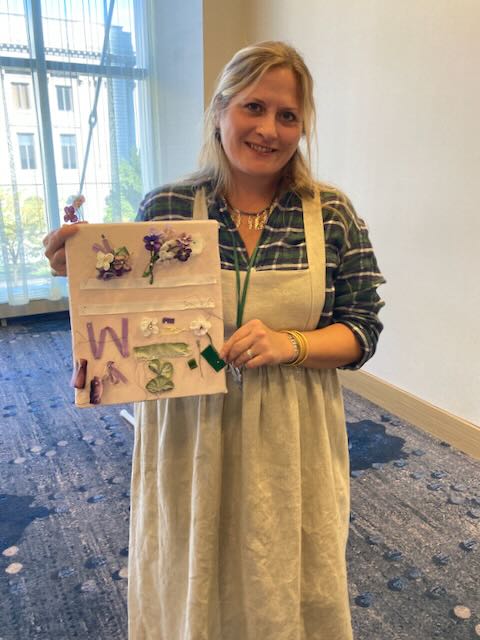
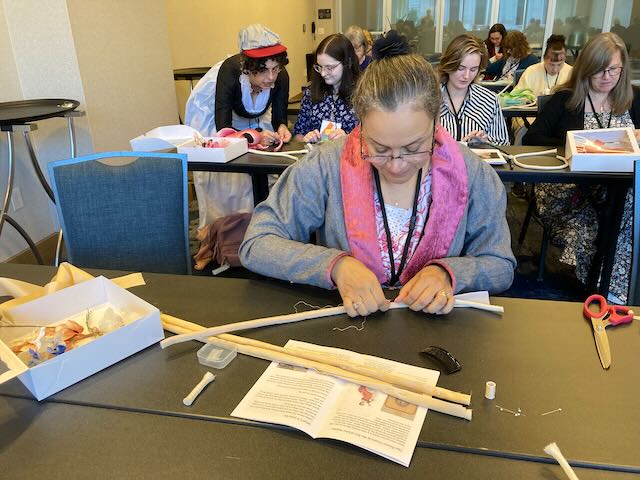
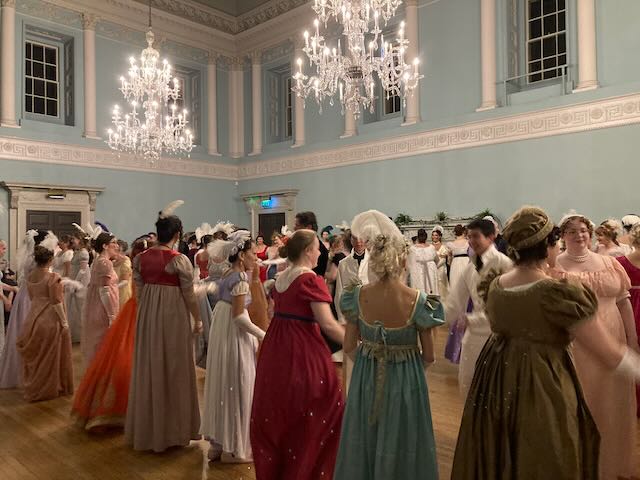
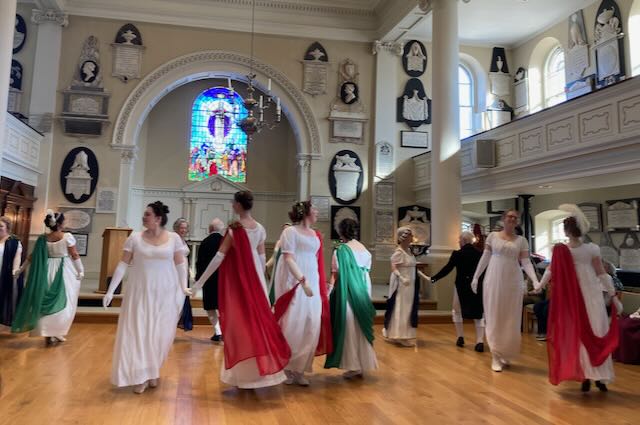
Dance workshops prepared us for the Ball, which was great fun.
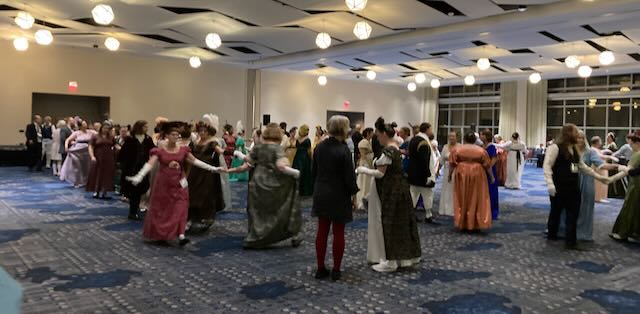
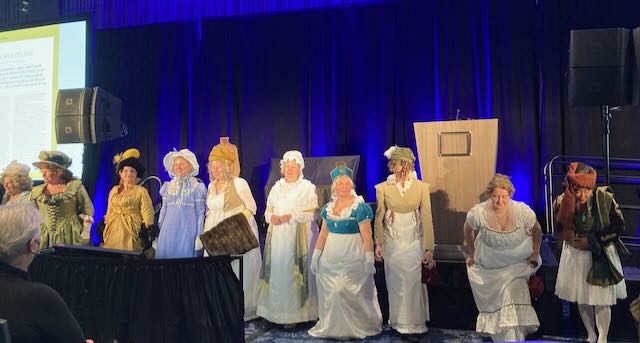
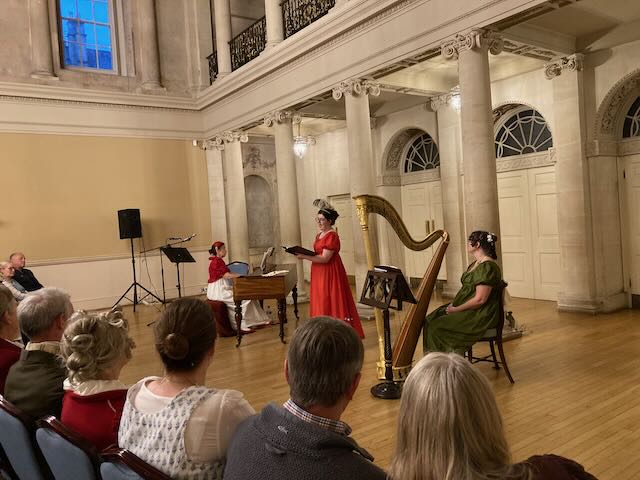
Gillian Dooley and Laura Klein gave a wonderful concert of music Jane Austen owned. In another special session, Hilary Davidson showed us what Jane Austen wore. A fashion show followed, where JASNA members wore gowns they had made. They promenaded in the order such gowns would have been worn in history, with historical background for each. A bingo game followed, and I won a copy of Hilary Davidson’s gorgeous book, Jane Austen’s Wardrobe. (Rachel reviewed that for us last year.)
Extras
Shopping: As always, the Emporium offered everything from a splendid selection of books (thank you, Jane Austen Books!), to t-shirts, gowns, headdresses, and ribbons, to handmade paper and calendars giving Austen events from the novels and letters for each day of the year. (Thank you, Wisconsin region–I love those calendars.) Looking for Christmas presents, anyone?
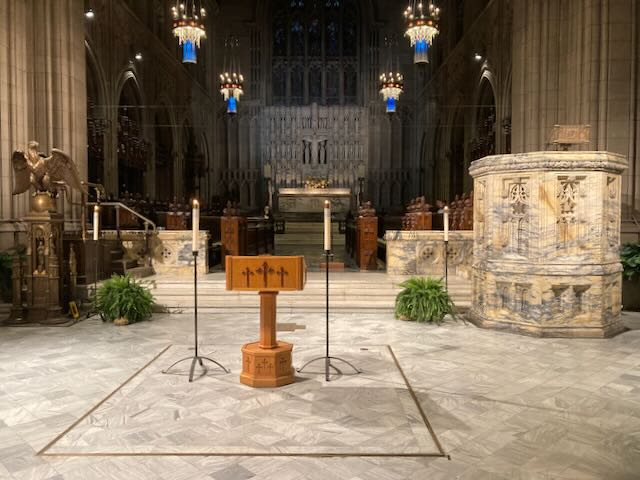
Church: I was delighted that this year we could attend Evensong at beautiful Trinity Cathedral nearby. Most people didn’t dress up in Regency gear for it, as it was very cold outside, but many of us worshiped together for Evensong, similar to the way Jane Austen worshiped in her Anglican churches.
Tours and Local Events: Tours were offered to local sites, such as the Cleveland Museum of Art and downtown Cleveland. Tickets were also available for a play, concerts, and a dinner cruise.
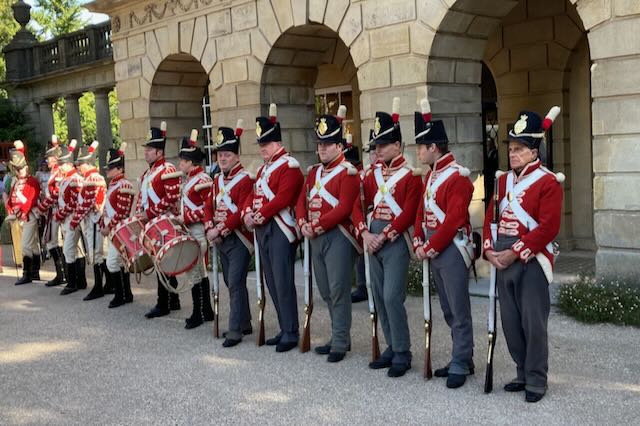
Military: Two special sessions brought in the military. One was held outside, with Napoleon and a horse, and one was inside, a talk on the Battle of Lake Erie.
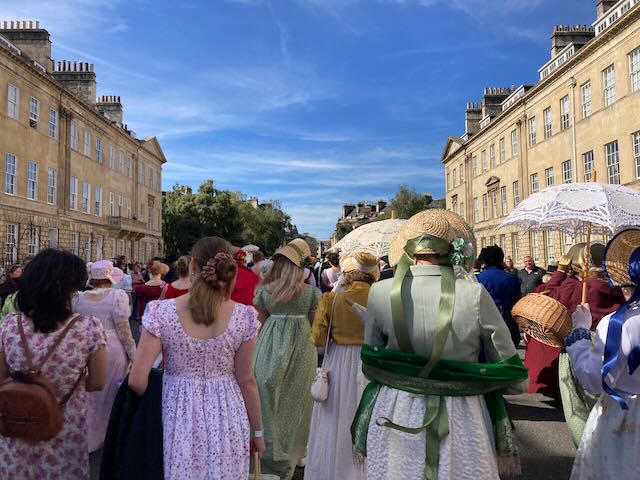
A banquet, brunch, and promenade gave us more chances to mix with other Janeites at the conference. A wide variety of other special sessions and interactive stations offered something for everyone.
One first-time participant and vendor from my region, who runs Jane Austen Treasures, said this AGM was one of her “best life experiences ever.” Another participant, who has attended many AGMs, said it is always “the most magical time,” where she feels like she is “walking around in fairyland. . . . Say hello to anybody, and you’re going to have a fantastic conversation.” A different first-timer added, “It was so fun! . . . When else can you be surrounded by so many intelligent, well-read, interesting, kind, funny, warm people?”
Next year’s JASNA AGM will be in Baltimore, Oct. 10-12, 2025. The theme is “Austen at 250: ‘No check to my genius from beginning to end.’” We’d love to see you there!








 Jane Austen's World