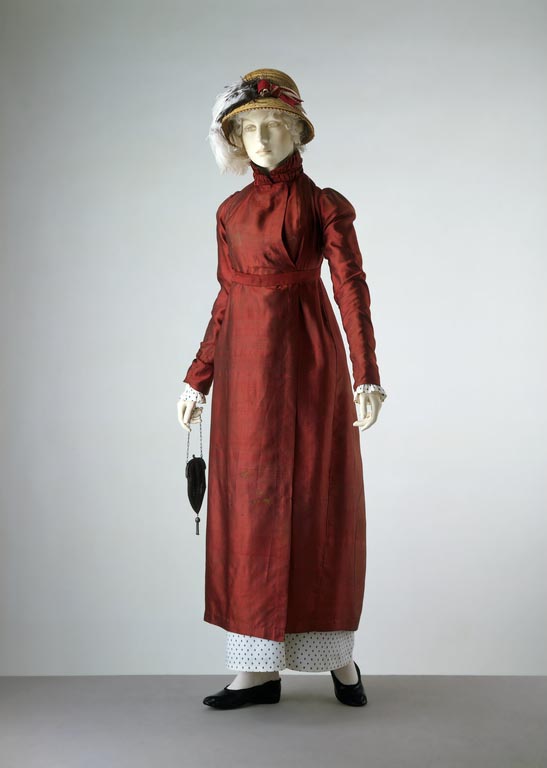
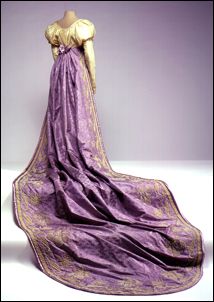
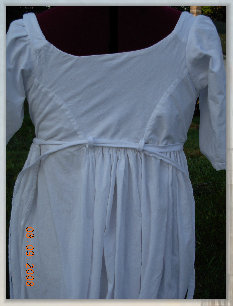
Nineteenth Century Fashions: A Compendium offers a breathtaking series of thumbnails of 19th Century fashions from museum collections and websites around the world. The images are not original. In fact, a score of them have already been discussed on this site, such as the images from the Kyoto Costume Institute. Click on the link, then click on the years that interest you. Enjoy!
Posts Tagged ‘Regency Fashion’
Seen Over the Ether: A Fabulous Fashion Site
Posted in Fashions, jane austen, Jane Austen's World, Regency Life, Regency style, Regency World, tagged Regency Fashion on November 7, 2008| 2 Comments »
Seen over the Ether: The Lady’s Magazine
Posted in Fashions, jane austen, Regency Life, Regency World, tagged Cathy Decker, regency dress, Regency Fashion, The Lady's Magazine 1790 - 1825 on October 7, 2008| 1 Comment »
The Lady’s Magazine: or entertaining companion for the fair sex, appropriated solely to their use and amusement could be purchased for six pence per copy. Started in August, 1770 by London bookseller John Coote and publisher John Wehble, the magazine was a typical late Georgian publication that included coloured engravings, literary contributions, fashion notes, embroidery patterns and sheet music. The following description of The Lady’s Magazine can be found on the Adam Matthews Publications site:
The Lady’s Magazine was “the first objective and professional effort to create a magazine acceptable for women” (Cynthia White, ‘Women’s Magazines, 1693-1968’) and combined advice, poetry, short stories, reader’s letters, criticism, news, fashion reports and articles on leading women of the day. It is a major source for scholars of gender studies and for all those interested in:
- Women’s writing.
- Gothic tales and popular readership.
- Changes in the ambitions and interests of women.
- Role models, conversation, sensibility and politeness.
- The education of women and the cult of appearances.
- Cathy Decker’s splendid site includes volumes of The Lady’s Magazine from 1790- 1825.
- The issue from January 1796 features a series of spectacular fashion plates.
Regency Undergarments: A Modern Perspective
Posted in Fashions, jane austen, Regency style, Regency World, tagged Making a regency gown, Mantua Maker, marjorie gilbert, Regency Fashion, regency undergarments on September 15, 2008| 3 Comments »
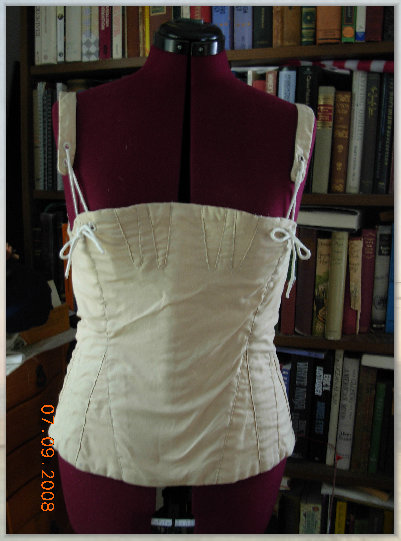
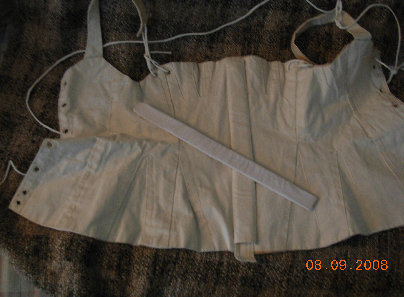
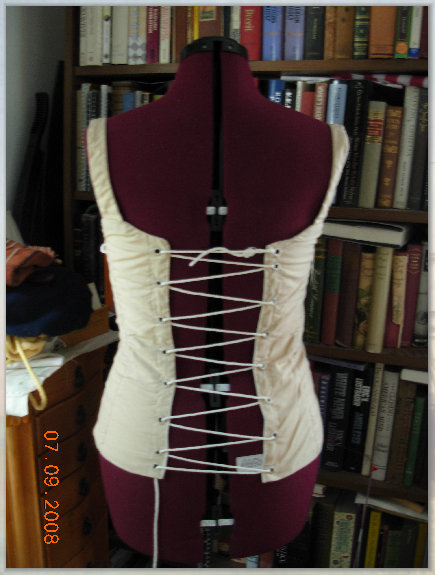
Vic: You mentioned choosing a neutral color for under the muslin dress, since the fabric was thin and rather see-through. Didn’t the stays feel a bit bulky? How do the busks feel when you wear the stays? Do they restrict your movement in bending over? Why did you choose this pattern?
Marjorie: The stays don’t feel bulky at all, especially when they’re tightly laced. There’s only one busk that is made up of two Sherwin William paint stirrers wrapped tightly in muslin. This is because though the paint stirrers had the necessary 14 inches in length, they didn’t have the thickness or stiffness I needed. We saw a busk that Herman Melville brought back from his time spent on the whaling ship while visiting the Maine Maritime Museum. His was made of whalebone and was scrimshawed. Mine is more modest and cost $0.00. Because the busk is padded by the muslin and the busk pocket, it doesn’t feel bad at all. If anything, it encourages a more upright posture. It is a little more difficult to bend over.I chose the pattern for the stays because Deb Salisbury, the Mantua Maker, recommended it. Because the gown I chose to make spanned the Empire and Directoire period, the stays that would have been worn with it would have been Regency rather than Georgian. Apparently, as Deb informed me, Georgian stays made one flatter, while the Regency stays encourage more north and south action, if you know what I mean.
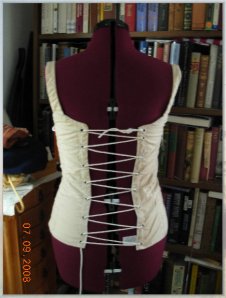
Vic: An actress once said in an interview that when you put on an authentic costume with all the undergarments and accessories, you become a different person and that your actions become informed by the garment itself. Do you take on a different persona as well when you don your outfit?Marjorie: I find that I walk more slowly and stand straighter when wearing the gown and the stays. I don’t necessarily feel like a different person because I wear the gown mainly to book signings where I am focused more on engaging all and sundry in conversation and trying to sell them in my book.
Vic: Delicately speaking, how difficult is it to, er, relieve oneself when one is so trussed up and when one has to deal with a train and all that fabric?
Marjorie: As to the necessities: I always empty my bladder before getting dressed in the stays and the gown. So far, I haven’t needed to use the necessities while wearing them.
Vic: Who acts as your ladies maid in tying up the laces and how long does it take you to get into the outfit?
Marjorie: My husband has that office.
Putting on the stays took a while because I had tried to use grommets for the eyelets instead of hand finishing them. While my husband tried to thread the lacing through the holes, grommets fell like rain, and we discovered that the length of lacing was too short. We had to start all over with another piece of string. (My lacing is a roll of cotton [?] string that was here when we moved into the house). Now that I hand finished all the eyelets and we know what length the lacing should be, the whole process should be far easier. The other portion that takes a while is craning my neck down so that I can pin up the bodice piece in such a way that the pins themselves aren’t visible. Very tricky. The day I wore the stays with a gown (for a book signing in Penn Yan New York) it took about twenty minutes to get ready, not including putting my hair in a bun. When I wore the gown without the stays, it took 15 minutes in all, including putting up my hair in a bun.
Vic: We know that the upper crust had help. How did the ordinary woman get in and out of her stays? Or was the wearing of stays and busks an aristocratic affectation? Did the lower classes simply contend themselves with wearing chemises?Marjorie: I think that the lower classes had help also. Maids would help each other, a mother would help her daughter, and vise versa. The fashion rather required something like stays beneath it to help give the gown its shape. I found this google book resource that might help answer the question. There were some front lacing stays, but for the most part, the stays laced in the back. While it’s possible to put them on by yourself, it’s tricky.
Vic: Thank you, Marjorie, for your insightful interviews. You’ve given us much to think about.
Inquiring readers who would like to learn more about Marjorie’s gown and stays, and how the gown is put together can click on Marjorie’s sites below.
Marjorie Gilbert
author of THE RETURN, a historical novel set in Georgian England
Click here for more information on the topic:
On Personal Decoration, 1811
Posted in Fashions, jane austen, Regency style, tagged A Lady of Disintinction, Regency Fashion, The Mirror of Graces on August 29, 2008|
A woman of principle and prudence must be consistent in the style and quality of her attire; she must be careful that her expenditure does not exceed the limits of her allowance. She must be aware, that it is not the girl who lavishes the most money on her apparel, that is the best arrayed. Frequent instances have I known, where young women with a little good taste, ingenuity, and economy, have maintained a much better appearance than ladies of three times their fortune. No treasury is large enough to supply indiscriminate profusion; and scarcely any purse is too scanty for the uses of life; when managed by a careful hand. – by a Lady of Distinction, The Mirror of Graces, 1811, p 69 -70
Some things never change. A little further on the Lady writes:
Hence, we see, that hardly any woman, however related, can have a right to independent, uncontroled expenditure; and that, to do her duty in every sense of the word, she must learn to understand and exercise the graces of economy. This quality will be a gem in her husband’s eyes; for, though most of the money-getting sex like to see their wives well-dressed, yet, trust me, my fair friends, they would rather owe that pleasure to your taste than to their pockets! (p 70-71)
- This book and other equally interesting period books can be ordered at R.L. Shep Publications
The Regency Gentleman: Neckwear
Posted in Dandy, Fashions, jane austen, Regency Life, Regency style, tagged Beau Brummell, cravats, neckcloths, Regency Dandy, regency dress, Regency Fashion, Regency gentleman, regency neckcloths on August 15, 2008| 10 Comments »
The cravat rose in popularity during an an age when cleaning dirty linen and ironing clothes presented an enormous challenge. Influenced by Beau Brummell’s penchant for wearing simple clothes and snowy- white cravats, these intricately-tied neckcloths became all the rage among the gentleman of the upper crust. The lower classes, for lack of servants and resources, wore a simpler version of the neckcloth in the form of a square folded and tied around the neck.
Men’s neckcloths hark back to ancient traditions in Egypt, China, and Rome where these pieces of cloth denoted a man’s social status. During the Elizabethan period a high ruffed neckline forced a stiff posture and confined movement, which only the leisure class could afford to adopt. Servants, tradesmen and laborers had to wear more functional clothing in order to perform their duties. During the mid-17th century the French adopted the fashion of neckerchiefs after seeing Croatian mercenaries wear them. The French courtiers began sporting neckcloths made of muslins or silk and decorated with lace or embroidery. These soft cloths were wrapped around the throat and loosely tied in front.
The cravat as seen in Regency portraits attained its distinctive appearance under Beau Brummell’s expert fingers and experimentation with his valet. Brummell’s philosopy of simple menswear was in stark contrast to the dandified Macaroni who pranced about in wigs, lace, and embroidered waistcoats. In Beau Brummell, His Life and Letters (p 50), Louis Melville writes:
“Brummell’s greates triumph was his neck-cloth. The neck-cloth was then a huge clinging wrap worn without stiffening of any kind and so bagging out in front. Brummell in a moment of inspiration decided to have his starched. The conception was, indeed, a stroke of genius. But genius in this case had to be backed by infinite pains. What labour must Brummell and his valet, Robinson – himself a character – have expended on experiment to discover the exact amount of stiffening that would produce the best result, and how many hours for how many days must they have worked together – in pivate – before disclosing the invention to the world of fashion. Even later, most morning could Robinson be seen coming out of the Beau’s dressing room with masses of rumpled linen on his arms – “Our failures” – he would say to the assembled company in the outer room.
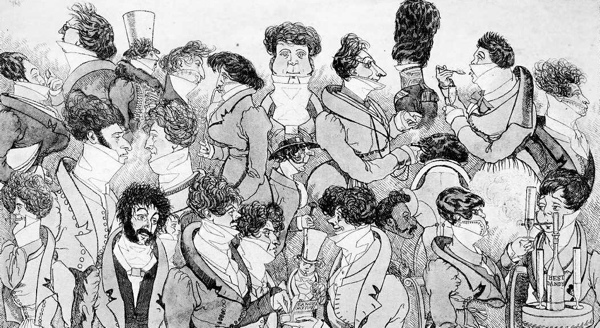
Regency dandies who wore enormous cravats that prevented movement of their necks – similar to the effect Elizabethan ruffs had – were known as les incroyables or the “incredibles”. Can you spot them in the contemporary cartoon below? To learn about the social implication of extreme fashion in pre-Napoleonic France, click on this link and read Les Incroyables et Merveilleusses: Fashions as Anti-Rebellion.
- Regency Reproductions: Scroll down to read about neck cloths. Includes a free cravat pattern and illustrations of how to tie a neckcloth.
- Colonial Gentleman’s clothing: Glossary of Terms
- Francis Morris, “An Eighteenth Century Rabat”, The Metropolitan Museum of Art Bulletin, Vol. 22, No. 2 (Feb., 1927), pp. 51-55 (article consists of 5 pages)
Middle illustration from H. Le Blanc’s The Art of Tying the Cravat.