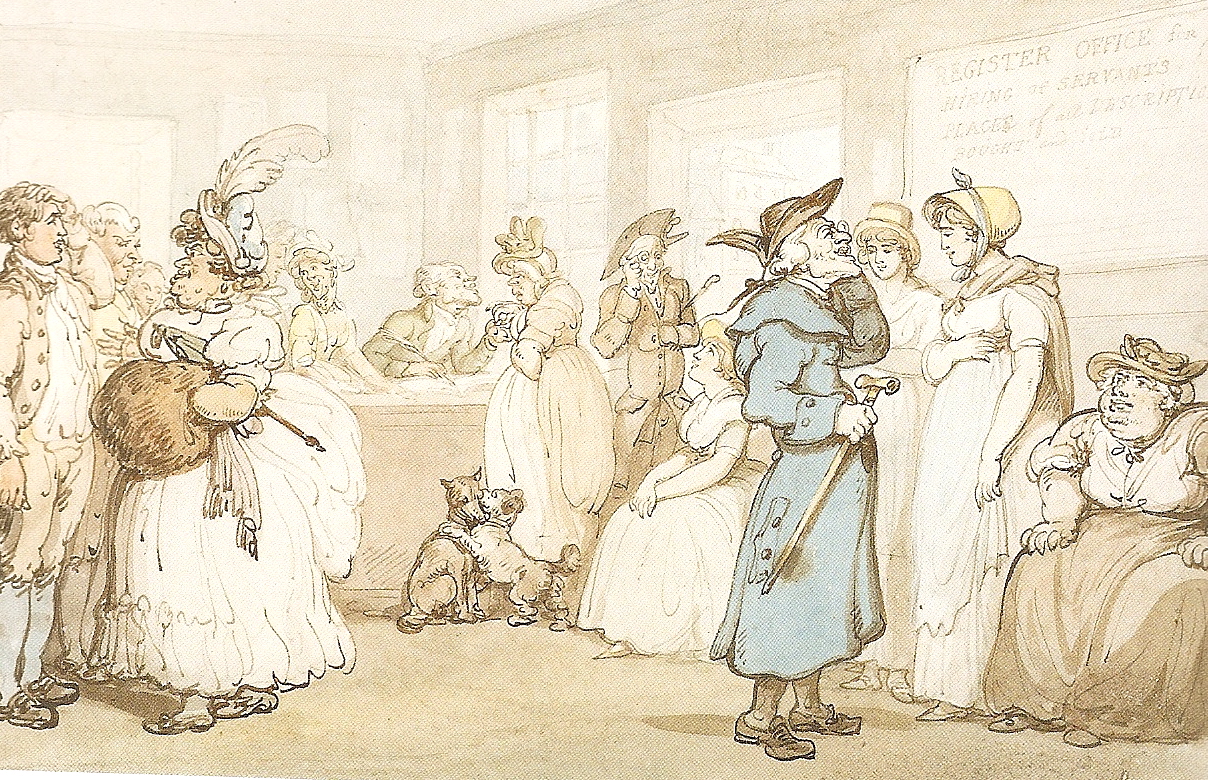
Register Office for the Hiring of Servants, Thomas Rowlandson, c. 1800-05
Contrary to the image of a faithful servant who spends the better part of his life in service to his master, the domestic trade was in reality a transitory one. Servants could be hired and asked to start within a day. They could also be fired on the spot without references.
Servants came and went at a great rate; in the late seventeenth and early eighteenth centuries, ‘most men had left service before they were forty. This was partly because employers did not want middle -aged footmen or valets, but also because servants themselves tended to see the work as part of the life-cycle rather than a career for life.’ – *Below Stairs, p 95
In Memoirs of an Eighteenth-Century Footman, John MacDonald writes: “When I had been a week in London, I met the Irish Chairman that carried Mr Hamilton and Major Joass when in London. I said to him, ‘Do you hear of any place for me?’ ‘By G-d, Johnny, I do; go to Major Libbelier; he lodges at a hair-dresser’s in Lower Grosvenor Street; go to him, Johnny, early tomorrow morning.’ I went – the maid told him I was below. ‘Call him up.’ ‘Well, sir, what are your commands?’ ‘Where you ever in Ireland?’ ‘Look to my recommendations.’ ‘I know Colonel Skeene, and Major Joass in particular. Then you have been through Ireland?’ ‘I have, sir.’ ‘Very well, I’ll give you fourteen shillings a week; and if I go to Ireland, I’ll give you sixpence more a day on the road.’ I dressed him and he was pleased.”
The best way to hire a servant was to find one through an advertisement. A personal character, reference, testimonial or note written by a former employer was essential before taking someone on.
It is not a safe plan to go to a Registry unless you know all about it first, though there are some which are really trustworthy. But a servant who once finds his or her way to a Registry Office is almost always unsettled, and no sooner in a place than looking out for another. The average London wages may be set down as: Butlers, £40 to £100; Footmen, £20 to £40; Pages, £8 to £15; Cooks, £18 to £50; House. maids, £10 to £25; Parlour-maids. £12 to £30; “General Servants,” Anglice Maids of all Work, £6 to £15. [Note: these are 1840’s wages.] A month’s notice required before leaving or dismissing; but in the latter case a month’s wages (and board wages if demanded) will suffice. For serious misconduct a servant can be discharged without notice. When left in town, additional board wages will be required at the rate of about 10s. per week. Victorian London – Dickens
Read about the working conditions of servants in my previous posts. Click here
*Source: Below Stairs: 400 Years of Servants’ Portraits, Giles Waterfield, anne French, with matthew Craske, Foreword by Julian Fellowes, National Portrait Gallery, London, 2003.


.jpg)
.jpg)








 Jane Austen's World