Feeds:
Posts
Comments

Archive for 2006

Yule Log


An enormous log of freshly cut wood called the Yule log was fetched and carried to the house on Christmas Eve. In England it was the custom to burn the log for the twelve days of Christmas, from Christmas eve on December 24th to Epiphany on January 6th.

The Yule Log was originally burned in honor of the gods and to bring good luck in the coming year. Since ancient times, the yule log ceremony celebrated the sun during the winter solstice. The log was chosen from a massive tree that required hauling by a team of horses or oxen. Tom Larson writes, “On or about Christmas eve, a big log was brought into a home or large hall. Songs were sung and stories told. Children danced. Offerings of food and wine and decorations were placed upon it. Personal faults, mistakes and bad choices were burned in the flame so everyone’s new year would start with a clean slate.”

Learn more about the origins of the Yule Log at the following sites:

The Yule Log

The Yule Log by Tom Larson

Read Full Post »

Christmas Pudding

Illustration from Jane Austen Magazine
Christmas Pudding is considered a staple in a traditional English Christmas meal. The pudding has been around since the middle ages and was then known as mince pie. In her article about these puddings, Sarah Lane writes, “In 1714, King George I re-established pudding as part of the Christmas feast even though the Quakers strongly objected. Meat was eliminated from the recipe in the 17th century in favor of more sweets, and people began sprinkling it with brandy and setting it aflame when serving it to their guests. The Christmas pudding was not a tradition in England until it was introduced to the Victorians by Prince Albert. By this time the pudding looked and tasted as it does today. ”

For more about the Christmas Pudding, click here.

Mrs. Beeton’s Recipe:

Ingredients:

Check recipe for shopping/store cupboard purposes and grease 1 basin.
5 oz breadcrumbs
4 oz of plain flour
4 oz chopped suet or modern day equivalent
4 oz currants
4 oz raisins
4 oz soft brown moist sugar
2 oz candied peel – Cut your own or use ready cut
2 oz raw grated carrot
1 teaspoon grated rind of lemon
half salt spoon nutmeg grated
1 good teaspoonful baking powder
about quarter pint of milk
2 eggs


Directions:

Mix all the dry ingredients together except the baking powder.
Add the beaten eggs and sufficient milk to moisten the whole, then cover, and let the mixture stand for about an hour.
When ready stir in the baking powder, turn into a greased mould or basin, and boil for 6 hours or steam the plum pudding for about 7 hours.
Serve with a suitable sauce. Time 6 to 7 hours.
Sufficient for 9 persons.

For more about Christmas during the regency period, click on
The Regency Christmas Feast,
Christmas Pudding from Jane Austen Magazine, and

Christmas at Carlton House. Excerpt from that site:

Fun Fact:Christmas puddings and cakes traditionally had to be prepared by the Sunday before Advent in order to be considered ready for Christmas. They were thought to improve upon keeping. Oddly enough, the day became known as “Stir Up Sunday,” not because of the great deal of stirring done to prepare the victuals, but because of the collect for the church service that day: “Stir up we beseech thee, O Lord, the wills of thy faithful people…”

Read Full Post »


In Xanadu did Kubla Khan
A stately pleasure-dome decree :
Where Alph, the sacred river, ran
Through caverns measureless to manDown to a sunless sea.

So twice five miles of fertile ground
With walls and towers were girdled round :
And there were gardens bright with sinuous rills,
Where blossomed many an incense-bearing tree ;
And here were forests ancient as the hills,
Enfolding sunny spots of greenery.

–Samuel Taylor Coleridge


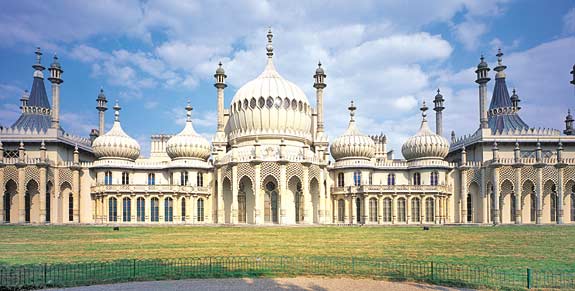
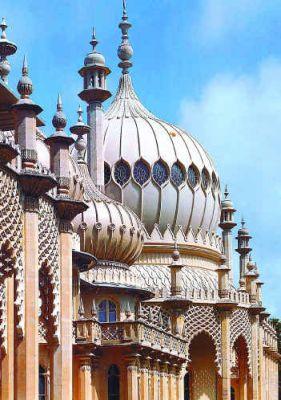
When I visited

Brighton Pavilion in Brighton, a charming seaside town in Sussex’s South Downs, I found it more beautiful and fantastic than the drawings, paintings, and photos I’d seen. The building, rebuilt between 1815-1822 by John Nash, the Prince Regent’s architect, is starkly white and stands in the center of town. Approaching it on foot, one is astounded by the intricacy of the architectural details, from the exterior domes, spires, and columns, to the interior with its gothic touches, fantasy rooms, and exquisite color combinations and patterns.

The Prince Regent was known for his excesses and expensive tastes, and his architect John Nash succeeded in fulfilling the Prince’s most outrageous wishes. The Gothic Revival was in full swing during the Regency Era, including the love for all things mid-Eastern, Chinoise, and Arabian. This Arabian Nights fantasy in stone has been well documented in picture books and on the web. I will merely point out a few spectacular rooms and some of the details that struck me as being particularly beautiful or unusual.

The kitchen, a cavernous room created to comfortably accommodate the Prince’s idea of an intimate dinner, is depicted on this web page. Click here and scroll down to the kitchen. You can also see a panoramic view of the kitchen on the page if you have a real player. It was not unusual for the Prince to throw a banquet with 36 courses, hence the kitchen was designed to accommodate the scores of cooks and enormous amounts of food stuffs and ingredients required to prepare these foods.

The long gallery is indeed long. The colors are riotous, and one feels as if one is traipsing through a fantasy land.

On the left is a picture of John Nash’s long gallery. On the right is a photograph of the long gallery today.

The banquet room also lingers in my memory, with its long, long banqueting table, the exquisite details in the ceiling, and the fantastic carved dragons peeping out from chandeliers disquised as palms.


Salon & Music Room

Images of Brighton in the 19th Century:
Evening Gathering at Brighton Pavilion in the Yellow Room


Brighton, a seaside resort

Read Full Post »

The Scullery Maid

Why describe the lowliest of the servants in a Regency household first? Because heretofore so much has been written about the butler and the housekeeper, who, along with the stewart, stand on top of the servant food chain. We know them by heart and they are no longer mysterious.

A scullery maid’s life was generally one of drudgery and servitude, She arose very early in the morning (often at 5:00 or 6:00 a.m.) and after a day of scrubbing and carrying water and heavy pots, she would stumble into her simple attic bed at 10:00 p.m.

According to PBS’s Manor House, the Scullery Maid’s Daily Duties include the following (Granted, the Edwardian Period comes well after the Regency Period, but in respect to servant duties time moved slowly and the customs of great houses changed just as slowly. The wages would have been different, though the daily schedules remained largely the same) :

Morning Duties

You must rise at six o’clock and wash and dress, with your hair tied neatly back beneath your cap.

Your bed must be made and you must be downstairs at work within half an hour of waking.

You first task of the day is to stoke the Kitchen range to a good heat, to boil water for early morning tea.

You must then empty the chamber pots of all the female Servants, and wash them around with a vinegar soaked rag kept only for this purpose.

You should also assist the Lower Servants in preparing the early morning tea for the Upper Servants.

You must then set about cleaning the Kitchen passages, the Pantries, the Kitchen and Scullery.

When the Chef de Cuisine arrives in the Kitchen at half-past seven you will be expected to curtsey and bid him “Good Morning”.

At a quarter-to eight you should lay the table in the Servants’ Hall for Breakfast.

Breakfast is served in the Servants’ Hall at a quarter past eight. You should clear the table afterwards and wash the dishes.

At a quarter-past nine you must appear in a presentable state, attired in a clean apron, for Morning prayers in the Main Hall. This is the only time that it is acceptable for you to be seen above stairs, and it is compulsory for all members of Staff to attend.

Your duties resume in the Kitchen at ten o’clock, when you must wash up all the dishes from the Servants’ Breakfast, as well as the pans and kitchen utensils used in preparing both the Servants’ and Family’s Breakfasts.

At half-past ten you should lay the table in the Servants’ Hall for tea.

At eleven o’clock tea is served in the Servants’ Hall. You should clear the table afterwards and wash up.

You should then assist the Kitchen Maid and Chef with preparations for the Servants’ Dinner and Family’s Luncheon, should they require you to.

You must ensure the Kitchen is kept spotless at all times and continuously wash up after both the Chef de Cuisine and the Kitchen Maid as they make their preparations.

At Midday you are to take your Dinner in the Kitchen with the Kitchen Maid so that you may watch over the Family’s Luncheon, whilst the Chef takes his Dinner in the Servants’ Hall with the other Servants. The Second Footman will lay the table, serve, and clear away the dirty dishes.

Afternoon Duties

Your duties resume at one o’clock when you must begin washing up after the Servants’ Dinner, and the Family’s Luncheon.

Providing your work is done, you may have one hour at your leisure between half-past two and half-past three.

At half-past three you should lay the table in the Servants’ Hall for Tea.

Tea is served in the Servants’ Hall at four o’clock, you should clear the table afterwards.

At half-past four, you should resume your duties in the Kitchen, washing up after the Servants’ Tea and the utensils used in preparation for the Family’s Tea.

You must assist the Kitchen Maid with any food preparation for the Family’s dinner and Servants’ Supper and continuously wash up any pots and pans used.

After the Family’s Dinner has been served you must clean the Kitchen Passages, Pantries, Scullery and Kitchen.

Supper is served in the Servants’ Hall at half-past nine. The Second Footman is to lay the table, serve, and clear away afterwards.

Providing you work is done, from half past nine until you are required to go to bed, you may enjoy your leisure.
The duties of a scullery maid were physically demanding and never stopped during the day. She cleaned the kitchen floor as well as stoves, sinks, pots and dishes. The young maids lit bedroomfires first thing in the morning, and carried heavy buckets of warm water up the stairs for bathing. Below is a description from The Servants by Ellen Micheletti

“There were several kinds of maids – chambermaids, parlormaids and maids-of-all-work. These young women were the ones who swept, dusted, polished, cleaned, washed, fetched and carried from early morning till late at night. In Frank Dawes’ book Not In Front of the Servants, he gives a schedule of the week for maids that has them working from 6:30 am till 10:00 pm with one half-day off a week. They had to do all the cleaning and polishing with none of the labor saving devices we take for granted. There was no such thing as polish for instance. Furniture polish was made from linseed oil, turpentine and beeswax. Carpets had to be brushed by hand, lamps had to be cleaned and filled and fires had to kept lit and tended. This necessitated maids lugging large amounts of coal up flights of stairs to all the fireplaces, and a large estate could have many, many fireplaces.”

In this audio clip, a former scullery maid describes her job, which she likens to a form of slavery. (Click on the bold words to listen.) From the descriptions from several sources, I surmise that a scullery maid’s job description remained the same for several centuries, including the Georgian, Regency, Victorian, and Edwardian Eras. A modest household could often only afford a maid of all work. Such a servant worked alongside her mistress and led a hard life indeed.

On this website, Hitchingbrook House: Life in an Edwardian Countryhouse describes in great detail the rules for servants as well as a typical day in 1901. Click on the bold words to enter the website.

Read Full Post »


Jane Austen’s characters attended assemblies, routs, and parties so often that one is left to wonder: Did these people never stay home?

When the social whirl was in full swing during the London social season, a well-connected, rich, well-born, or idle person could attend several gatherings in one night. Here is a first-hand description of an assembly by Louis Simond, a transplanted Frenchman in America, inveterate traveler, and author of An American in Regency England (p. 31):

“Great assemblies are called routs or parties; but the people who give them, in their invitations only say, that they will be at home such a day, and this some weeks beforehand. The house in which this takes place is frequently stripped from top to bottom: beds, drawers, and all but ornamental furniture is carried out of sight, to make room for a crowd of well-dressed people, received at the door of the principal apartment by the mistress of the house standing, who smiles at every new comer with a look of acquaintance. Nobody sits; there is no conversation, cards, no music; only elbowing, turning, and winding from room to room; then, at the end of a quarter of an hour, escapting to the hall door to wait for the carriage, spending more time upon the threshold among footmen than you had done above stairs with their masters. From this rout you drive to another, where, after waiting your turn to arrive at the door, perhaps, half an hour, the street being full of carriages before the house–then every curtain, and every shutter of every window wide open, shewing apartments all in a blaze of light, with heads innumerable, black and white (powdered or not), in continual motion. This custom is so general, that having, a few days agao, five or six persons in the evening with us, we observed our servants had left the windows thus exposed, thinking, no doubt, that this was a rout after our fashion.”

Indeed, with such a throng of people inside an enclosed space and candles blazing on hot spring and summer nights, the rooms would have been stifling. Had the windows and doors not been kept open, the heat and lack of fresh air would have been insufferable. People often needed to step outside to the terrace or gardens to gain some relief from candle smoke, body odor, and fetid air.

As you can see from this illustration of the Assembly Room in Bath by Thomas Rowlandson, the public assemblies also provided opportunities for dancing. One must surmise that private and public assemblies differed in character. The size of a hostess’s house and her budget must also have dictated whether she could also provide music and dancing at her gathering.

Read Full Post »

« Newer Posts - Older Posts »