Dear Reader: This is the second post in the Bath series for Northanger Abbey, which is being featured this month on Austenprose. My first post about the Pump Room sits here.
Catherine circulating through the crush at the Assembly Rooms
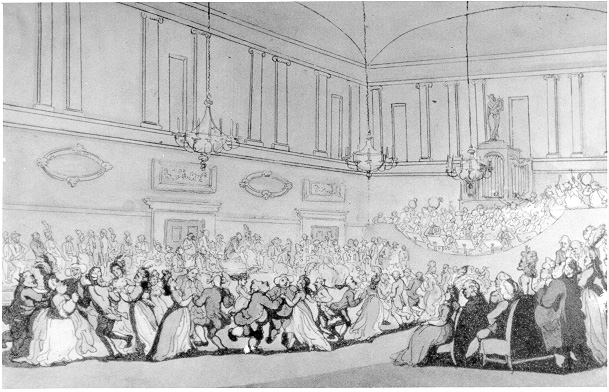
Mrs. Allen was so long in dressing that they did not enter the ballroom till late. The season was full, the room crowded, and the two ladies squeezed in as well as they could. As for Mr. Allen, he repaired directly to the card-room, and left them to enjoy a mob by themselves. With more care for the safety of her new gown than for the comfort of her protegee, Mrs. Allen made her way through the throng of men by the door, as swiftly as the necessary caution would allow; Catherine, however, kept close at her side, and linked her arm too firmly within her friend’s to be torn asunder by any common effort of a struggling assembly. But to her utter amazement she found that to proceed along the room was by no means the way to disengage themselves from the crowd; it seemed rather to increase as they went on, whereas she had imagined that when once fairly within the door, they should easily find seats and be able to watch the dances with perfect convenience. But this was far from being the case, and though by unwearied diligence they gained even the top of the room, their situation was just the same; they saw nothing of the dancers but the high feathers of some of the ladies. Still they moved on—something better was yet in view; and by a continued exertion of strength and ingenuity they found themselves at last in the passage behind the highest bench. Here there was something less of crowd than below; and hence Miss Morland had a comprehensive view of all the company beneath her, and of all the dangers of her late passage through them. It was a splendid sight, and she began, for the first time that evening, to feel herself at a ball: she longed to dance, but she had not an acquaintance in the room. Mrs. Allen did all that she could do in such a case by saying very placidly, every now and then, “I wish you could dance, my dear—I wish you could get a partner.” For some time her young friend felt obliged to her for these wishes; but they were repeated so often, and proved so totally ineffectual, that Catherine grew tired at last, and would thank her no more. – Chapter 2, Northanger Abbey, Jane Austen

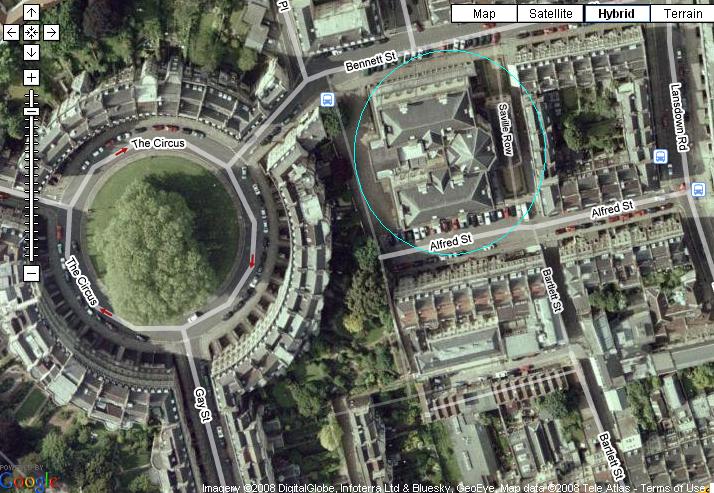
Assembly Room near the Circus; You can see the dome of the Octagon Room from the air, near Bennet Street and Saville Row.
Poor Catherine, how frustrated she must have felt decked out in her new finery and forced to watch others dance and enjoy themselves. Etiquette deemed that at a public assembly no young lady could dance with a partner unless they had been properly introduced. Because Mrs. Allen had no acquaintances in Bath, Catherine had to sit on the sidelines. If the ball had been private, she could have danced with any of the gentlemen who solicited her for a set. On another evening, in the Lower Assembly Rooms (located near Bath Abbey), Henry Tilney would arrange for the Master of Ceremonies to formally introduce them. But for now, in the Upper Rooms (which were situated near the Circus), Catherine would have to remain at her chaperone’s side.

Ballroom
Public assemblies were a way for young couples to meet a potential partner from outside their immediate social circle. One purchased a subscription for a series of balls (which included supper) or for the entire season.
“SUBSCRIPTIONS and ADMISSION. Pierce Egan, Walks Through Bath, 1819
“(Dress Balls.)
5. “That a subscription of 1l. 10s. to the Dress Balls shall entitle the subscriber to three tickets every ball-knight; one for the subscriber, not transferable, and two for ladies. These two latter tickets will be transferable, on being endorsed by the subscriber, without which form the bearer will not be admitted. A subscription of 15s. shall entitle the subscriber to one ticket, not transferable.
“(Cotillon Balls.)
6. “That a subscription of 1l. to the Cotillon Balls shall entitle the subscriber to one ticket every ball-night: this ticket not transferable.
7. “That no person whatever be admitted into the Ball-Rooms without a ticket; nor any visitor or stranger, unless he shall previously have inserted his name and place of abode in a book to be kept for that purpose, under the controul of the Master of Ceremonies.
8. “The subscribers are respectfully requested to observe that their subscriptions cease when they leave Bath; and it would be of much public utility, if they would be pleased to give notice at the Rooms of their departure, which would prevent their tickets being improperly used.
The crowds as described by Jane Austen at the Upper Rooms, the newest and largest Assembly Rooms in Bath, were a crush. Balls were held twice a week and attracted from 800 to 1,200 guests at the height of the season, which drew to a close in May. Because the social whirl was so popular in this fashionable spa city, the Upper Rooms and Lower Rooms held dances on different evenings so that visitors would have a chance to attend them every night they were offered.
The following Rules and Regulations, published by the Master of the Ceremonies, are hung up in the NEW ASSEMBLY ROOMS. Pierce Egan, Walks Through Bath, 1819
The public amusements during the season are as follow:—-
Monday Night……..Dress Ball.
Wednesday Night……..Concert
Thursday Night……..Fancy Ball.
Friday Night……..Card Assembly.
Beau Nash, the arbiter of taste and fashion in the 18th century, was the first Master of Ceremonies to preside over the Assembly Rooms. His rules and regulations allowed for people of different rank and distinction to mingle at the public assemblies. He reprimanded those who invoked social precedence in dance and prevented those who threw private parties and balls from creating an atmosphere of exclusion. By 1819, the city’s reputation as a fashionable resort for the rich had waned, but the city was still a quite popular destination, especially with the rising middle classes.

Upper Assembly Room Entrance
The Upper Rooms, designed by John Wood the younger, were opened in 1771. While the exterior was plain, the buildings were beautiful on the inside. Five enormous crystal chandeliers hung over the dancers in the ballroom, casting their golden candle light over the assembly. Tall ceilings provided air circulation and second story windows afforded privacy. Constance Hill writes in Jane Austen: Her Homes and Her Friends:
“Rauzzini” in his tie-wig, conducting his famous band in the musicians’ gallery. We seemed to hear the strains of their music accompanied by the tread of the dancers’ feet. “The Monday dress-ball,” says a contemporary writer, “is devoted to country dances only. At the fancy-ball on Thursday two cotillions are danced, one before and one after tea.” This fancy-ball was not a bal costumé, but simply an occasion on which the stringent rules regulating evening dress were relaxed. “In the height of the season,” continues our author, “there are generally twelve sets, and as the ladies, on this occasion, exert their fancy to the utmost in the display of their shapes and their dress, the spectacle is magnificent.” The ladies, we read, wore comparatively short skirts for the cotillion with their “over-dresses picturesquely looped up.” Does not this remind us of Isabella and Catherine “pinning up each other’s train for the dance”?
Bath’s music culture was quite sophisticated, and many people took music lessons from musicians who lived in Bath or who came to visit:
“Despite a decline since its peak of popularity in the 1790s, the town still remained the wealthiest and most important of England’s resorts, and its musical culture was second only to that of London. The main concert venue was the Upper Rooms (the present Assembly Rooms) in Bennett street, where the veteran castrato Venanzio Rauzzini presided over a series of concerts in which local musicians were joined by leading players and singers from London.” Samuel Wesley, Philip Olleson, p. 87.
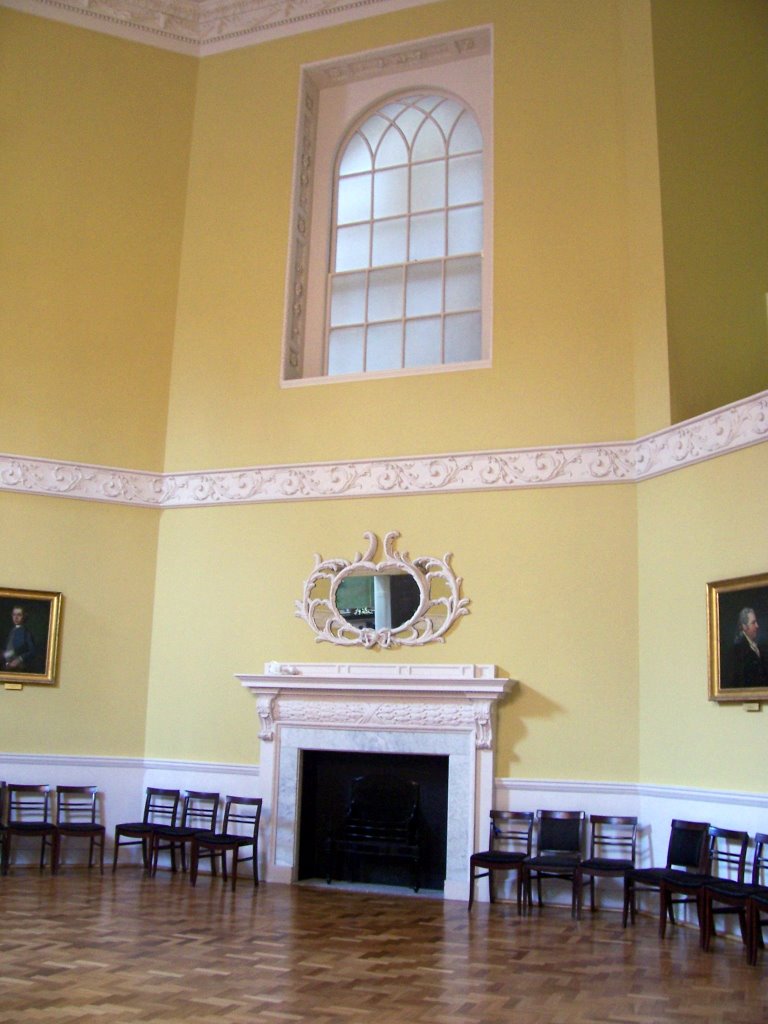
Octagon Room
As soon as Catherine Morland and the Allens arrived at the Upper Rooms, Mr. Allen excused himself to play cards. Tables were set up in the Card Room. The Octagon Room, a handsome domed room, served as a passageway to the ball-room, the card-room, the tea-room, and the vestibule, through which the assembled company could circulate, flirt, dance, and gossip. The Octagon Room would also serve as a meeting room or music room, as in Persuasion when Lady Dalrymple hosted a concert. (See a site plan of the Assembly Rooms here.)
Dances were proscribed by the master of ceremonies, who presided over the ball and who decided on which dances would be performed and in what order. A gentleman could not reserve more than two dances with a lady for the evening, and when he did, it was understood that he was interested in her. If a lady reserved more than two dances with a gentleman, she was considered “fast.” As Henry Tilney said to Catherine, men have the power of choice in the Regency ball; ladies have only the power of refusal.(PEERS, Historic Regency Etiquette.)
Today the Assembly Rooms are still available for special occasions. Visitors to Bath can view them (for a cost, of course), and visit the Museum of Costume afterward.
Click Here for Additional Links On the Topic
- See a panoramic view of the Assembly Rooms off Saville Row and Bennet Street, Bath 360.
- Bath Images
- Royal Crescent Society, Bath
- Bath Assembly Rooms
- Bath YMCA
- Bath: More than a Guide
- Dance Cards
- Fabled Footprints in the Streets of Bath
- History of Georgian Bath
- The Image of Georgian Bath, 1700-2000, Peter Borsay, 2000
- This blog’s archived posts about Bath
Image: Comforts of Bath, Rowlandson, Dancing







 Jane Austen's World
What a wonderful post. I look forward to reading more about Bath.
[…] proper etiquette of dancing in Regency Bath, in this excellent article by Ms. Place’s (Vic), Dancing in Regency Bath: Upper Assembly Rooms at Jane Austen’s World as she offers her second installment during Go Gothic with Northanger […]
What a fascinating post!
I always learn so much by reading your informative posts! I love them! Thank you!
[…] read of Northanger Abbey, the guest bloggs this week by Margaret Sullivan (Mags) on Henry Tilney, Vic (Ms. Place) on dancing in Bath, and fashion in the 2 Northanger movie adpataions by Kali Pappas. Be sure to […]
I love your posts on Bath but they always make me pine to go back!
(I know I’m lucky to have gotten there in the first place)
[…] Place at Jane Austen’s World has several posts on Bath (on bathing and dancing, in that order…), to accompany Laurel Ann’s NA […]
[…] reader, If you will recall in last week’s post about the Upper Assembly Rooms in Bath, poor Catherine Morland had to sit out the dance, having made no acquaintance with any gentleman. […]
[…] disgorge passengers, who would then be announced by the butler as they entered inside. Jane Austen described a crush in the Upper Assembly Rooms in Bath as Mrs. Allen and Catherine Morland made their way around the rooms, and such a situation was […]
[…] to ensure the quality of those who gained admittance. The most aristocratic was Almacks while Jane Austen’s books describe the famous Bath Assemblies and more humble affairs at provincial […]
[…] Dancing in Regency Bath […]
I am currently reading Northanger Abbey for the first time and am finding your comments on the social customs of the era most valuable. Thank you!
[…] Here I found some interesting tidbits on the Upper Rooms: […]