• Home
  • Audio/Podcasts
  • Austensites
  • AV/E-Texts
  • History
  • JA Novels & Bio
  • Links
  • Original Sources/19th C. Texts
  • Social Customs During the Regency
  • Teacher/Student
  • Writer/Literature Resources

Jane Austen's World

This Jane Austen blog brings Jane Austen, her novels, and the Regency Period alive through food, dress, social customs, and other 19th C. historical details related to this topic.

Feeds:
Posts
Comments
« Why Petticoats and Chemises Were Worn Under Regency Gowns
English Dining Room, 1770-90: Thorne Miniature Room »

Urea, a 17th & 18th Century Spot Remover: Or Pee as a Cleansing Agent

November 19, 2010 by Vic

Copyright @ Jane Austen’s World

Before that you suffer it to be washed, lay it all night in urine, the next day rub all the spots in the urine as if you were washing in water; then lay it in more urine another night and then rub it again, and so do till you find they be quite out.
Hannah Woolley, The Compleat Servant-Maid, 1677
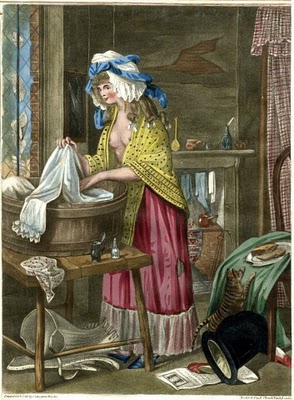
The Last Shift, Carrington Bowles

Urine for spot cleaning? Yes, you read the first word correctly.  Since the middle ages, professionals belonging to guilds manufactured soap and candles, for both products required tallow. They traditionally manufactured soaps from sodium or potassium salt or alkalis present in plant materials, and boiled the ingredients with animal fat. In the 19th century, it was discovered how to make caustic soda from brine. Soap makers no longer relied on cut wood to make soap and the cleaning industry was never the same again.

Before innovations during the Industrial Revolution changed laundry day forever, it was generally known that that alkaline substances, such as bleach or ash, dissolved or disintegrated stains and soils, enhancing the water’s ability to clean clothes.

Urine is alkaline, and since the days of ancient Rome, this by-product of the human body was used as a bleaching agent. “Pecunia non olet — money does not stink”,  Emperor Vespasian reportedly said when he started taxing this trade.*

Yes, urine stinks. But so do bleach and vinegar, a weak acid. The stinking ingredient that turns us off and that makes urine such a good cleaning agent – ammonia – is a substance that our modern cleaning products include in abundance.**  Eighteenth century English wool manufacturers used both urine and sheep or pig manure for washing. In addition, urine also sets dye. (The seller of my beautiful little handmade rug from Turkey cautioned that its vegetable dyes were set with goat urine. Twenty years after its purchase, the rug no longer smells, but its fragile colors must be vigilantly protected from direct sunlight.)
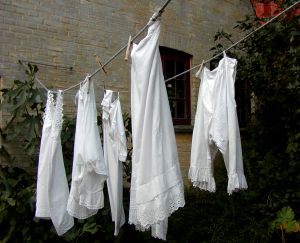
As recently as the early 20th century, urine was collected in barrels in Japan and fermented for use in laundering. The Japanese threw the contents of their slop jar into the barrel, then separated the feces from the liquid urine. The feces were used as fertilizer to enrich the soil, and the urine was collected by laundry shops, who fermented the liquid and used it  as a bleaching agent by pounding it into the cloth. – Edible Soap, A Harmless Natural Soap for the Family. It is the fermentation process that probably made urine safe to handle, much like fermented beer or distilled alcohol were safe to drink in the days before sterilization.
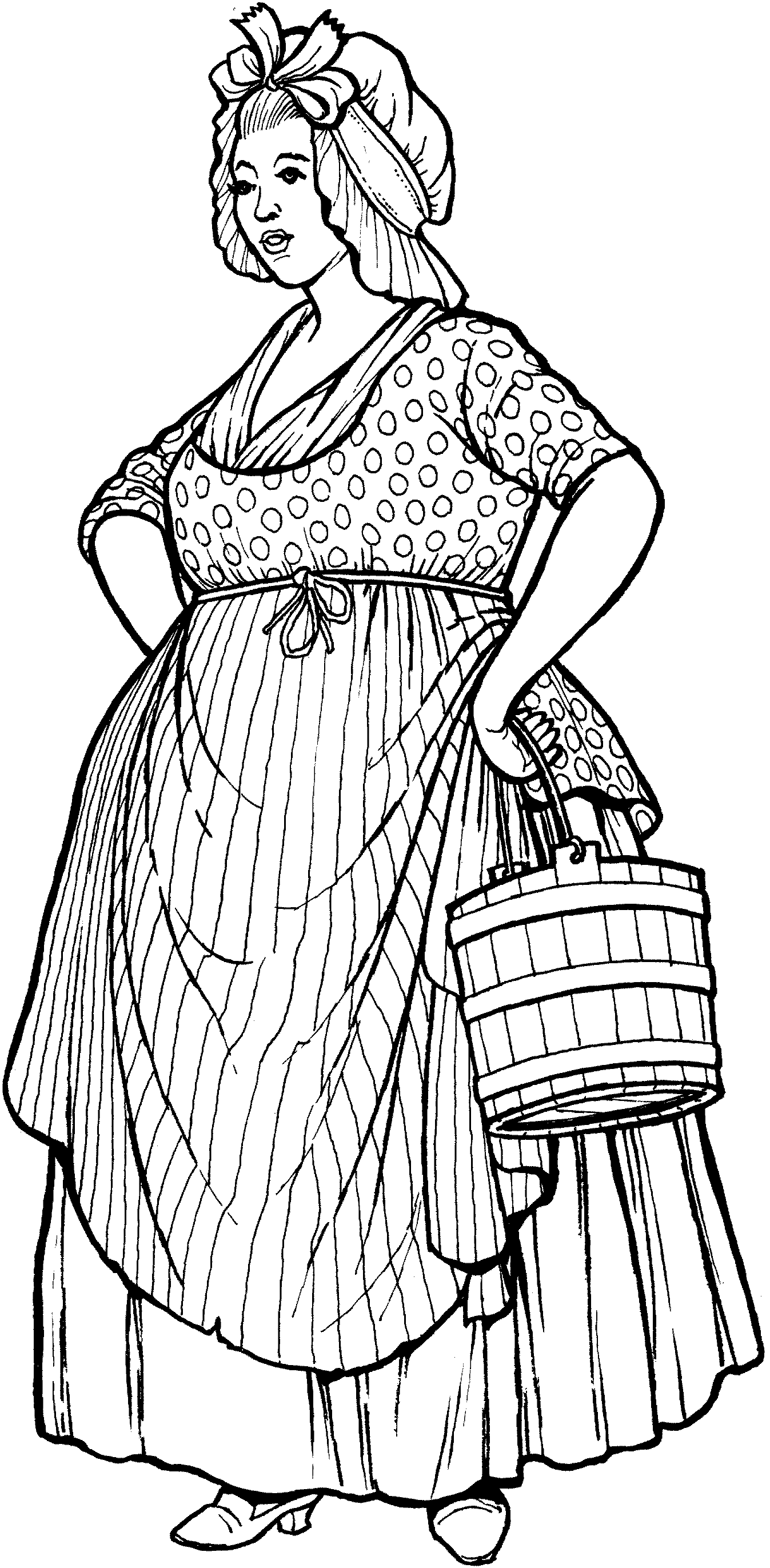
Urine from the animal of choice was also used to improve the complexion. Samuel Pepys’ wife decided to try the urine of puppies (‘puppy-dog water’), for instance, in March 1664 (Diary of Samuel Pepys). This may have been less foolish than spending a hundred bucks on a small pot of modern-day moisturiser, since the ‘active’ ingredient in urine is urea, and urea creams are inexpensive, effective and regularly recommended by dermatologists. – The Thirteenth Depository: A Wheel of Time Blog

This YouTube video uses urine to demonstrate that it is as powerful a cleanser as commercial products.

More on the Topic

  • The Gentle Woman’s Companion, 1678, Electronic Book
  • The British Housewife, Gilly Lehmann
  • The Whole Duty of a Woman, A Guide to the Female Sex, 1695
  • The Country Housewife’s Family Companion
  • Colonial Soap Making: Its History and Techniques
  • Pioneer Soap Making

*The Historical Development for Washing Laundrys

**Pepys Diary

Share with others:

  • Click to email a link to a friend (Opens in new window) Email
  • Click to print (Opens in new window) Print
  • Click to share on Facebook (Opens in new window) Facebook
  • Click to share on Reddit (Opens in new window) Reddit
  • Click to share on X (Opens in new window) X
  • Click to share on Pinterest (Opens in new window) Pinterest
  • Click to share on Tumblr (Opens in new window) Tumblr
  • Click to share on LinkedIn (Opens in new window) LinkedIn
Like Loading...

Related

Posted in 18th Century England, Georgian Life, jane austen, Regency Life, Regency Period, Regency World | Tagged 18th century spot remover, history of soap, Regency beauty regiment, regency laundry, Urine as bleach, urine cleanser | 13 Comments

13 Responses

  1. on November 19, 2010 at 12:52 Tara Fly's avatar Tara Fly

    Wow. I’m speechless. ….
    Thank you, Vic, for such an enriching, informative article… which blessedly doesn’t stink. :)


  2. on November 19, 2010 at 13:10 Lorraine's avatar Lorraine

    i must say yippee for clorox!
    also…i watched a couple of other human guinea pigs after this….the one on leeches could fit with this period too!


  3. on November 19, 2010 at 13:35 Elizabeth K's avatar Elizabeth K

    Old wives tale that has been in my family for as long as I can remember – and, I worked for a dermatologist, heard it there as well, for getting rid of warts, apply urine for a couple of weeks and it will dissolve the wart.
    A most interesting post today!!!


  4. on November 19, 2010 at 14:17 Vic's avatar Vic

    I heard that urea works well for curing athlete’s foot too!


  5. on November 19, 2010 at 16:54 Suzan's avatar Suzan

    Ok I’m sure it’s based on science…it still just sounds horrible. After all cloth diapers and training panties get urinated on regularly and they don’t seem so clean…..
    Mind expanding…your research is truly…mind expanding.


  6. on November 19, 2010 at 16:55 Tony Grant's avatar Tony Grant

    Just love it when you talk dirty, Vic.

    At the beginning of the trench warfare in WWI when the Germans exploded cannisters of deadly gas over British trenches this is one of the first deterrents explained,

    “Even at Second Ypres, Germany, still unsure of the weapon’s effectiveness, only issued breathing masks to the engineers handling the gas. At Ypres a Canadian medical officer, who was also a chemist, quickly identified the gas as chlorine and recommended that the troops urinate on a cloth and hold it over their mouth and nose.”


  7. on November 19, 2010 at 17:01 Lauren's avatar Lauren

    Yes, I watched the whole video. Very funny Vic!


  8. on November 19, 2010 at 17:06 phoebe's avatar phoebe

    My mother-in-law, a firm believer in ‘old wives tales’ while holding our first born on her lap volunteered to change her wet nappie. She whipped it off and wiped our daughter’s face with it chattering away that it would give her a good complexion because she was breastfed.

    Need I tell you how we felt – I thought I would drop over!! This was in 1975 (the olden days, right). When people compliment her on how lovely she is, I always whisper in her ear, ‘thanks to Nana’.


  9. on November 20, 2010 at 08:15 Liana's avatar Liana

    Oh wow, there is just so much I learn from this blog. More than History classes anyway.;) urine as a cleansing product? Just, well, I wonder why we emit it, if its so useful?

    Thanks for another amazing post Vic.


  10. on November 20, 2010 at 15:42 Amused's avatar Amused

    Holy crap or should I say urine, I had no idea! I’m pretty sure, now that I know this I will never use it but still it’s a funny trivia fact. Too interesting!


  11. on November 30, 2010 at 14:15 Susan's avatar Susan

    Yuck! I guess one of the advantages of living in the here and now is the invention of bleach :)


  12. on December 16, 2010 at 01:26 Baby Jane Austen’s First Two Years: Happy 235th Birthday, Jane! « Jane Austen's World

    […] Babyies wore linen clouts, the 18th century form of a thick cloth diaper, which was pinned with straigtht pins (ouch) or tied with with lacings. The clout was covered by a pilcher, a garment that offered another layer of protection. Today’s pilcher has a plastic lining to prevent urine from leaking through. (Do recall from a previous post, that the 18th century attitude towards urine was different than ours in that urea was regarded as a disinfectant.) […]


  13. on March 30, 2011 at 14:56 Fawlty Regency London – Oh, What a Stench! Part One « Jane Austen's World

    […] For those who are equally as fascinated with topics of an earthy nature as I am, here’s another post: Urea, a 17th & 18th Spot Remover, or Pee as a Cleansing Agent […]


Comments are closed.

  • Enter your email address to subscribe to this blog and receive notifications of new posts by email.

    Join 7,248 other subscribers
  • 2025 AGM in Baltimore

  • Items of Interest

  • Blog Stats

    • 18,375,781 hits
  • Follow Jane Austen's World on WordPress.com
  • RECOMMENDED BOOKS AND RESOURCES

  • Fashionable Goodness: Christianity in Jane Austen's England is now available! By JAW contributor Brenda S. Cox. See Review. Available from Amazon and Jane Austen Books.
  • We also recommend JAW contributor Rachel Dodge's devotionals based on Jane Austen's prayers and classic literature. Reviews:
    Praying With Jane: 31 Days Through the Prayers of Jane Austen
    The Anne of Green Gables DevotionalThe Little Women Devotional
    The Secret Garden Devotional
  • The Tour of Doctor Syntax. Edited by Ben Wiebracht. Read the review of the book at this link. Click to order the book on Amazon US or Amazon UK or Jane Austen Books
  • FREE Student Membership to JASNA

    Available through December 31st, 2025. Click on image for details, and share this poster with other teachers and students!

  • The Obituary of Charlotte Collins by Andrew Capes

    Click on image to read the story.

  • Comments

    “My idea of good company…is the company of clever, well-informed people, who have a great deal of conversation.” – Jane Austen, Persuasion


    Gentle readers: Please feel free to post your comments and continue the conversation! Due to SPAM, we will no longer accept comments on posts after 30 days of publication. In some instances, links will be removed from comments as well.

  • Administrators and Contributors

    Vic Sanborn, founder of this blog, is supported by a team of talented and knowledgeable writers about Jane Austen and the Regency era. They are:

    • Brenda Cox
    • Rachel Dodge and
    • Tony Grant, who now contributes his photos from London and England

    Click on their names to enter their own blogs.

    In addition, we thank the many experts and authors who frequently contribute their posts and opinions, and who continue to do so freely or at our request.

  • Pin It!

    Follow Me on Pinterest
  • Top Posts

    • Exploring Jane Austen's Prayers
      Exploring Jane Austen's Prayers
    • Cassandra Writes About Jane Austen's Death, July 18, 1817
      Cassandra Writes About Jane Austen's Death, July 18, 1817
    • Regency Fashion: Men's Breeches, Pantaloons, and Trousers
      Regency Fashion: Men's Breeches, Pantaloons, and Trousers
    • Highclere Castle Floor Plan: The Real Downton Abbey
      Highclere Castle Floor Plan: The Real Downton Abbey
    • Men's hair styles at the turn of the 19th century
      Men's hair styles at the turn of the 19th century
    • Jane Austen’s Christmases
      Jane Austen’s Christmases
    • Social Customs During the Regency
      Social Customs During the Regency
    • Pictorial History of Regency Hairstyles
      Pictorial History of Regency Hairstyles
    • In Jane Austen’s Own Words: Economic Sense and Sensibility
      In Jane Austen’s Own Words: Economic Sense and Sensibility
    • Jane Austen’s Favourite Brother, Henry: An Interview with the Author, Christopher Herbert
      Jane Austen’s Favourite Brother, Henry: An Interview with the Author, Christopher Herbert
  • Recent Posts

    • Coming Soon: Birthday Tales for Jane Austen’s 250th
    • Book Review: The Austens, by Sarah Emsley
    • Praying with Jane Audiobook with Amanda Root
    • Book Review: The Worlds of Jane Austen: The Influences and Inspiration Behind the Novels
    • Books Purchased at the 2025 AGM in Baltimore
  • Links to Jane Austen Blogs

    Click here to enter the page. Topics include Regency fashion, historic foods, Jane Austen societies, British sites, related topics. Click on image.

  • May we suggest?

  • Unknown's avatarHello, my name is Vic and I live in Maryland, USA. I have adored Jane Austen almost all of my life. I am a proud lifetime member of the Jane Austen Society of North America. This blog is a personal blog written and edited by me and my team. We do not accept any form of cash advertising, sponsorship, or paid topic insertions. However, we do accept and keep books and CDs to review.

    If you would like to share a new site, or point out an error, please email us. (Yes, we are fallible. We'll own up to our mistakes and will make the corrections with a polite smile on our faces.) Write us at

    gmailbw

    Thank you for visiting this blog. Your comments and suggestions are most welcome.

  • Project Gutenberg: eBook of Stage-coach and Mail in Days of Yore, Volume 2 (of 2), by Charles G. Harper

    STAGE-COACH AND MAIL IN DAYS OF YORE: A PICTURESQUE HISTORY
    OF THE COACHING AGE, VOL. II, By CHARLES G. HARPER. 1903. Click on this link.


  • Top Posts & Pages

    • Exploring Jane Austen's Prayers
    • Cassandra Writes About Jane Austen's Death, July 18, 1817
    • Regency Fashion: Men's Breeches, Pantaloons, and Trousers
    • Highclere Castle Floor Plan: The Real Downton Abbey
    • Men's hair styles at the turn of the 19th century
    • Jane Austen’s Christmases
    • Social Customs During the Regency
    • Pictorial History of Regency Hairstyles
    • In Jane Austen’s Own Words: Economic Sense and Sensibility
    • Jane Austen’s Favourite Brother, Henry: An Interview with the Author, Christopher Herbert
  • Tour Chawton Cottage on YouTube

  • Disclaimer: Our team makes no profit from this blog. We may receive books (physical or digitized) for review purposes.

  • Copyright Statement: © Jane Austen's World blog, 2009-2024. Unauthorized use and/or duplication of this material without express and written permission from this blog’s author and/or owners is strictly prohibited. Excerpts and links may be used, provided that full and clear credit is given to Jane Austen's World with appropriate and specific direction to the original content.

Blog at WordPress.com.

WPThemes.


  • Reblog
  • Subscribe Subscribed
    • Jane Austen's World
    • Join 7,248 other subscribers
    • Already have a WordPress.com account? Log in now.
    • Jane Austen's World
    • Subscribe Subscribed
    • Sign up
    • Log in
    • Copy shortlink
    • Report this content
    • View post in Reader
    • Manage subscriptions
    • Collapse this bar
 

Loading Comments...
 

    %d

