• Home
  • Audio/Podcasts
  • Austensites
  • AV/E-Texts
  • History
  • JA Novels & Bio
  • Links
  • Original Sources/19th C. Texts
  • Social Customs During the Regency
  • Teacher/Student
  • Writer/Literature Resources

Jane Austen's World

This Jane Austen blog brings Jane Austen, her novels, and the Regency Period alive through food, dress, social customs, and other 19th C. historical details related to this topic.

Feeds:
Posts
Comments
« Review: A Gentleman of Fortune: or, the Suspicions of Miss Dido Kent, By Anna Dean
Letter written by Jane Austen, April 1, 1816 »

Fawlty Regency London – Oh, What a Stench! Part One

March 30, 2011 by Vic

Copyright @ Jane Austen’s World.  Looking back 200 years (the precise date that the formal Regency era began was 1811) we tend to view Jane Austen’s Regency world wearing rose-tinted glasses.
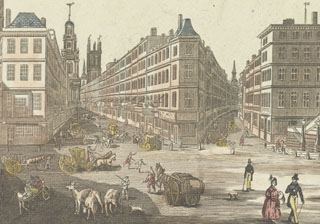
Early 19th century London street scene

Imagine the traffic in London back then:

In July 1811,

it appears that there passed over Blackfriars bridge in one day: 61,069 foot passengers, 533 waggons, 1,502 carts and drays, 990 coaches, 500 gigs and taxed carts, and 822 horses. On the same day, July 1811, there passed over London bridge: 89,640 foot passengers, 1,240 coaches, 485 gigs and taxed carts, 769 waggons, 2,924 carts and drays, and 764 horses.  – Leigh’s new picture of London: or A view of the political, religious, medical, literary, municipal, commercial, and moral state of the British metropolis (Google eBook), 1827, p. 251

Then imagine the animal droppings. I have not the mathematical wherewithal to calculate how much manure and urine these vast numbers of animals traversing London’s streets would generate on an average day, but I do know this: when a horse feels the need to relieve itself, it does so on the spot, releasing the end result of its digestion in a most spectacular fashion.
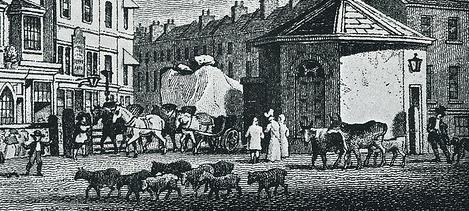
London, detail of Islington toll gate

And thus London’s streets were littered with dung. Not only did horses generously contribute their feces to London’s throroughfares, but so did the vast number of feral dogs and cats roaming the streets, and the cattle, goats, sheep, pigs, and fowl that were driven to London’s markets. Add on a hot summer’s day the smell of slops that were carelessly tossed out of windows, and the stench of contaminated water, backed-up sewers, over-filled privies, and rotting garbage, and you get the drift. The assault on one’s olfactory nerves must have been overpowering.

The rich had a choice – they left London in droves at the end of the Season to wile away the summer on their country estates. But those who were left behind had to suffer the fetid stench of thousands of evacuations that cooked in the heat and turned into gaseous rot. (I traveled through a similar malodorous area when driving past the slums of Jakarta one summer.)
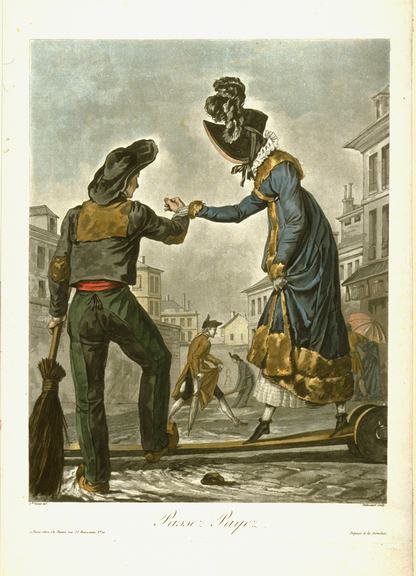
Streetsweeper assists a lady crossing the street, 1818, after Vernet. Image @Wikimedia.

Rain showers did not help much to relieve the situation. By 1841, when the metropolis was vastly larger, Henry Mayhew calculated that the refuse from butchers that washed into rain water approximated 24,000,000,000 gallons per annum. As for dung, let’s face it, wet poo sticks like glue, and once the offending substance adhered to boots and shoes, the unfortunate wearer would trod the vile stuff into carriages and on door stoops, which is why boot scrapers were essential.

Sunny weather was not much more helpful, for when poo baked and dried on dusty streets, it tended to crumble and turn into dust. A brisk wind would blow odiforous grit under door crevaces and through open windows, landing on furniture, floors, curtains, rugs, and hanging laundry. A person walking along the streets on a blustery day, would have it blown onto their clothes and in their hair. (Let’s not even imagine how much of these offensive granules landed on their faces and inside their mouths and noses! Achoo!)
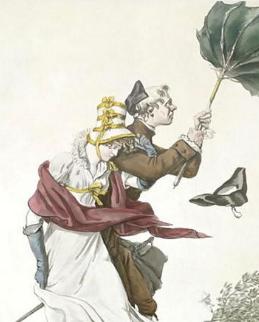
Carle Vernet, detail of a gust of wind

As for hygienic habits, if English Regency gentlemen felt comfortable urinating in chamberpots in the diningroom after dinner in full view of their companions, one can imagine that they thought nothing of relieving themselves in back alleys. And where were the poor urchins who lived on the streets supposed to “go”? Or the individuals crammed into overcrowded tenements who shared a common privy with hundreds of others and who, due to pressing circumstances, could NOT wait?
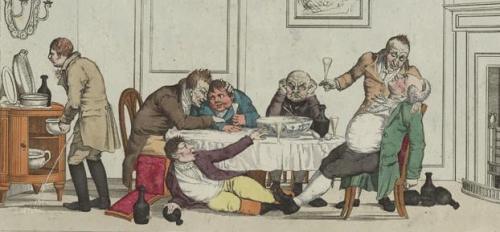
If peeing in front of others (left) near food stuffs inside one's home was permissable, one can only imagine the habits of this gentleman outside of a tavern.

There were attempts to combat these continual eliminations and excretions by animals and humans, which will be discussed in the next Fawlty Regency London post. Until next time, gentle reader, I am signing off. I hope I have not offended your tender sensibilities (or activated your gag reflexes) too much. Part 2 of this fascinating series will discuss The Removers, or those who worked tirelessly to keep London smelling as fresh as a daisy (well, at least like day old cat litter).

For those who are equally as fascinated with topics of an earthy nature as I am, here’s another post: Urea, a 17th & 18th Spot Remover, or Pee as a Cleansing Agent


Share with others:

  • Click to email a link to a friend (Opens in new window) Email
  • Click to print (Opens in new window) Print
  • Click to share on Facebook (Opens in new window) Facebook
  • Click to share on Reddit (Opens in new window) Reddit
  • Click to share on X (Opens in new window) X
  • Click to share on Pinterest (Opens in new window) Pinterest
  • Click to share on Tumblr (Opens in new window) Tumblr
  • Click to share on LinkedIn (Opens in new window) LinkedIn
Like Loading...

Related

Posted in 19th Century England, jane austen, Jane Austen's World, Regency Life, Regency London, Regency World | Tagged 19th c. London streets | 13 Comments

13 Responses

  1. on March 30, 2011 at 15:31 Melody's avatar Melody

    Oh my god! This must have been terrible but I had never imagined that dung could be so interesting!


  2. on March 30, 2011 at 16:17 Jean | Delightful Repast's avatar Jean | Delightful Repast

    Well, Vic, you’ve done it again–pulled the rose-colored glasses right off of my face! I should thank you for these doses of reality that make me more appreciative of the times in which we live. But can I hold onto my illusions about the glories of London in the 1960s?


  3. on March 30, 2011 at 17:47 BookLady Deb's avatar Janeite Deb

    Pugh!


  4. on March 30, 2011 at 20:14 Martha's avatar Martha

    Eye opening. Truly. Oh my.

    I’ve often wondered about those men with the chamber pots- people’s sensibilities and expectations were certainly different than today in those regards!

    Thanks for another, um, interesting post!


  5. on March 30, 2011 at 21:17 Karen Field's avatar Karen Field

    Wow, you certainly did removed some of the romance I have about a time long ago. That was fascinating. My best comparison that I can come up with is Williamsburg, Va, because it tries to give visitors the actual feel of 1775 or so. If they made it totally realistic, they’d have to import the actual smells. There are a few coaches that cover the streets so there is just a tiny scent but you usually don’t notice it. I’ll have to try to remember that the next time I go.

    I’ve also been given to understand that people didn’t drink water because they thought it was unhealthy. I’ve always thought that was silly but, given your post above, I’m rethinking that. How many diseases and deaths happened because of the contaminated water? Yuck, says the woman drinking her water from a bottle!

    Excellent post!


  6. on March 30, 2011 at 22:04 gail m.'s avatar gail m.

    For a really great descripton of the pooy situation in London and England I can suggest a great book,At Home, by Bill Bryson. If you can believe it, he makes the above seem mild. yuk!


  7. on March 31, 2011 at 03:32 Shannon Winslow's avatar Shannon Winslow

    No indoor plumbing or proper sewer systems, piles of manure littering the streets, primitive medical care, one woman in three dying in childbirth – plenty of reasons we don’t really want to live in Regency England. I prefer the sanitized and romanticized version, even though I know it’s a fairy tale.


  8. on March 31, 2011 at 08:27 Lanternativa's avatar Lanternativa

    A very good article. Need more like this one.


  9. on March 31, 2011 at 10:44 Heloise's avatar Heloise

    Indeed, it was very eye opening! But, yet, a very good article… I confess I laughted more than once!
    Although, for my own sake, I´ll keep the Austen version of all of that! ;)


  10. on March 31, 2011 at 14:02 bethtrissel's avatar bethtrissel

    What a super post. The stench must have been unimaginable and I live on a farm. Thanks for all the great info. You have a wonderful blog.


  11. on March 31, 2011 at 15:01 Anna's avatar Anna

    Blimey, Jane Austen really did paint a pretty picture of Georgian England in her novels! We hardly ever get to imagine all this stuff, which was certainly commonplace and normal of her day. I don’t want to think about those particles flying in the air… ugh!


  12. on April 1, 2011 at 12:38 Lynn's avatar Lynn

    Well, that does sound pretty bad & does explain why the upper crust left town! I have a question – how did they take care of their teeth? I have watched “Lost in Austen” abit & the salt-birch twigs-chalk thing was brought up for dental care… how did that work out???? Thanks for all the information!


  13. on January 7, 2013 at 22:58 Nikki E.'s avatar Nikki E.

    Awesome post! Do you have any info on the last picture – the “peeing in the dining room” one? I saw it in a presentation but cannot remember the artist or title. Thank you!!


Comments are closed.

  • Enter your email address to subscribe to this blog and receive notifications of new posts by email.

    Join 7,246 other subscribers
  • 2025 AGM in Baltimore

  • Items of Interest

  • Blog Stats

    • 18,382,940 hits
  • Follow Jane Austen's World on WordPress.com
  • RECOMMENDED BOOKS AND RESOURCES

  • Fashionable Goodness: Christianity in Jane Austen's England is now available! By JAW contributor Brenda S. Cox. See Review. Available from Amazon and Jane Austen Books.
  • We also recommend JAW contributor Rachel Dodge's devotionals based on Jane Austen's prayers and classic literature. Reviews:
    Praying With Jane: 31 Days Through the Prayers of Jane Austen
    The Anne of Green Gables DevotionalThe Little Women Devotional
    The Secret Garden Devotional
  • The Tour of Doctor Syntax. Edited by Ben Wiebracht. Read the review of the book at this link. Click to order the book on Amazon US or Amazon UK or Jane Austen Books
  • FREE Student Membership to JASNA

    Available through December 31st, 2025. Click on image for details, and share this poster with other teachers and students!

  • The Obituary of Charlotte Collins by Andrew Capes

    Click on image to read the story.

  • Comments

    “My idea of good company…is the company of clever, well-informed people, who have a great deal of conversation.” – Jane Austen, Persuasion


    Gentle readers: Please feel free to post your comments and continue the conversation! Due to SPAM, we will no longer accept comments on posts after 30 days of publication. In some instances, links will be removed from comments as well.

  • Administrators and Contributors

    Vic Sanborn, founder of this blog, is supported by a team of talented and knowledgeable writers about Jane Austen and the Regency era. They are:

    • Brenda Cox
    • Rachel Dodge and
    • Tony Grant, who now contributes his photos from London and England

    Click on their names to enter their own blogs.

    In addition, we thank the many experts and authors who frequently contribute their posts and opinions, and who continue to do so freely or at our request.

  • Pin It!

    Follow Me on Pinterest
  • Top Posts

    • Exploring Jane Austen's Prayers
      Exploring Jane Austen's Prayers
    • Cassandra Writes About Jane Austen's Death, July 18, 1817
      Cassandra Writes About Jane Austen's Death, July 18, 1817
    • Highclere Castle Floor Plan: The Real Downton Abbey
      Highclere Castle Floor Plan: The Real Downton Abbey
    • Regency Fashion: Men's Breeches, Pantaloons, and Trousers
      Regency Fashion: Men's Breeches, Pantaloons, and Trousers
    • Men's hair styles at the turn of the 19th century
      Men's hair styles at the turn of the 19th century
    • Happy 250th Birthday, Jane Austen!
      Happy 250th Birthday, Jane Austen!
    • More Birthday Events for Jane Austen!
      More Birthday Events for Jane Austen!
    • Sense and Sensibility, 1995 & 2008: Marianne’s Illness
      Sense and Sensibility, 1995 & 2008: Marianne’s Illness
    • In Jane Austen’s Own Words: Economic Sense and Sensibility
      In Jane Austen’s Own Words: Economic Sense and Sensibility
    • Social Customs During the Regency
      Social Customs During the Regency
  • Recent Posts

    • More Birthday Events for Jane Austen!
    • Happy 250th Birthday, Jane Austen!
    • Coming Soon: Birthday Tales for Jane Austen’s 250th
    • Book Review: The Austens, by Sarah Emsley
    • Praying with Jane Audiobook with Amanda Root
  • Links to Jane Austen Blogs

    Click here to enter the page. Topics include Regency fashion, historic foods, Jane Austen societies, British sites, related topics. Click on image.

  • May we suggest?

  • Unknown's avatarHello, my name is Vic and I live in Maryland, USA. I have adored Jane Austen almost all of my life. I am a proud lifetime member of the Jane Austen Society of North America. This blog is a personal blog written and edited by me and my team. We do not accept any form of cash advertising, sponsorship, or paid topic insertions. However, we do accept and keep books and CDs to review.

    If you would like to share a new site, or point out an error, please email us. (Yes, we are fallible. We'll own up to our mistakes and will make the corrections with a polite smile on our faces.) Write us at

    gmailbw

    Thank you for visiting this blog. Your comments and suggestions are most welcome.

  • Project Gutenberg: eBook of Stage-coach and Mail in Days of Yore, Volume 2 (of 2), by Charles G. Harper

    STAGE-COACH AND MAIL IN DAYS OF YORE: A PICTURESQUE HISTORY
    OF THE COACHING AGE, VOL. II, By CHARLES G. HARPER. 1903. Click on this link.


  • Top Posts & Pages

    • Exploring Jane Austen's Prayers
    • Cassandra Writes About Jane Austen's Death, July 18, 1817
    • Highclere Castle Floor Plan: The Real Downton Abbey
    • Regency Fashion: Men's Breeches, Pantaloons, and Trousers
    • Men's hair styles at the turn of the 19th century
    • Happy 250th Birthday, Jane Austen!
    • More Birthday Events for Jane Austen!
    • Sense and Sensibility, 1995 & 2008: Marianne’s Illness
    • In Jane Austen’s Own Words: Economic Sense and Sensibility
    • Social Customs During the Regency
  • Tour Chawton Cottage on YouTube

  • Disclaimer: Our team makes no profit from this blog. We may receive books (physical or digitized) for review purposes.

  • Copyright Statement: © Jane Austen's World blog, 2009-2024. Unauthorized use and/or duplication of this material without express and written permission from this blog’s author and/or owners is strictly prohibited. Excerpts and links may be used, provided that full and clear credit is given to Jane Austen's World with appropriate and specific direction to the original content.

Blog at WordPress.com.

WPThemes.


  • Reblog
  • Subscribe Subscribed
    • Jane Austen's World
    • Join 7,246 other subscribers
    • Already have a WordPress.com account? Log in now.
    • Jane Austen's World
    • Subscribe Subscribed
    • Sign up
    • Log in
    • Copy shortlink
    • Report this content
    • View post in Reader
    • Manage subscriptions
    • Collapse this bar
 

Loading Comments...
 

    %d
