This post features the recollections about a severely cold winter in 1794/95 by three Englishmen: Rutland squire, Thomas Barker, the Rev James Woodforde, a country parson whose diary (1759-1802) provides valuable first hand insights, and an event described by Matthew Flinders, listed in the Lincolnshire Archives. Interestingly, their observations, which read like today’s text messages, will intrigue the modern reader.
The weather in central England during the fall of 1794 started out warmly. Barker recorded:
“The autumn though wet was mild; swallows and martins did not go away till about October 18; the autumnal flowers continued till December, anemones were then in flower; winter and spring flowers were forward, and the leaves of the spring crocus appeared.”
Reverend James Woodforde came to Weston Longville, a small village north of Norwich, in 1775 and remained as rector until his death in 1803. During this time he kept a diary of his life as a country parson. While he mostly focused on parish visits, food, and the people and villages in his surroundings, he concentrated many of his observations on the weather from October to March 1794/95. His descriptions dovetailed nicely with Barker’s notes. In the next two passages Woodforde also mentioned the rains in October and flowers in November:
“The Rain that Fell yesterday [October 6] rose the Water at Foxford & East Mills quite high, Nancy very much alarmed and frightened therewith as it came almost into our little Cart.”
and
“Nov. 30, Sunday …. Mem. a Primrose in my Garden in full bloom, seen by myself and my Niece.”
Thomas Barker then referred to the sudden change in the balmy weather:
“But in the latter half of December the scene altered, and the frost began; it was a mixture of severe and moderate frost, falling and melting snows, and floods, with hard frost and breaks; the beginning of a very severe winter … for a quarter of a year, yet now without a thawing day or two now and then in January…”
Pastor Woodforde wrote a sequence of descriptions on weather events and how they impacted his life. One gains a visceral sense of how the intense and unrelenting cold invaded houses and affected the inhabitants down to their bones.
Dec 25, Thursday, X-mas day….It was very cold indeed this Morning, and the Snow in many Places quite deep, with an E. Wind. About 11. this Morning I walked to Church and read Prayers & administered the Holy Sacrament. Had but few Communicants the Weather was so bad….The Weather being so severely cold, which I could never escape from feeling its effects at all times, affected me so much this Morning, that made me faint away…..Mr Howlett after Service, very kindly offered to drive me home in his Cart, but as I was better I declined it, however hope that I shall not forget his civility….
and
Jan. 15, Thursday….Got up this morning very bad indeed in the Gout in my right foot….The Weather Most piercing, severe frost, with Wind & some Snow, the Wind from the East and very rough…I had my bed warmed to night & a fire in my bed-Room….Obliged to put on my great Shoe, lined with flannel. The Weather very much against me besides.
and
Jan. 21, Wednesday….The last Night, the most severest yet, extreme cold. So cold that the Poultry kept in the Cart-Shed and obliged to be driven out to be fed….

Jan. 23, Friday….The Weather more severe than ever, it froze apples within doors, tho’ covered with a thick carpet. The cold to day was the severest I ever felt. The Thermometer in my Study, with a fire, down to No. 46….
and
Jan. 25, Sunday….The Ice in the Pond in the Yard which is broke every Morning for the Horses, froze two Inches in thickness last Night, when broke this morning.
The pastor also wrote that a terrible storm took the thatch off the barn and stripped the tiles from his roof. On the 28th he described a “very severe frost indeed. It freezes sharply within doors,” and he related the sad news of two women who “froze to death Saturday last going home from Norwich market to their home.”
Early February provided a smidgen of hope:
Feb. 8, Sunday…..Weather much altered, very foggy and a cold Thawe, with very small Rain, all the whole day. I hope to God that now We shall no more have any severe Frosts this Year…
Woodforde’s hopes were premature, however. Thomas Barker observed that a thaw for four or five days from February 8 to 12:
“…took away a great part of the snow, and made a greater flood than any remembered, which did more damage to the bridges all over the kingdom than was ever known yet without taking away all the ice and snow; the frost returned again as hard as before, and with a less break near the end of February …”
The Lincolnshire Archives provides a description from Matthew Flinders, who wrote about the abnormal winter and great flooding as the snow melted. His observations add dimension to Barker’s and Woodforde’s writings, for he referred to the misery that farmers and peasants must have felt. He also mentioned the war raging in the background, which affected all Englishmen during this period.:
“…This has been the severest winter in these climates known in living memory… the snow began at Xmas Eve – and continued with intervals most of the time. I think I may say more has fallen than in the last 7 years together and several times more on the ground, than has been since the great snow in 1767 when it was a yard deep on the level… very great damage has been done on the breaking up of the frost by the floods – numbers of bridges being broke down, and large tracts of land overflowed – no such flooded known since the memorable year 1764. Great injury done to the farmers – much sowed wheat destroyed & the poor much distressed – tho’ there were very liberal subscriptions in many towns. This added to the distress occasioned by the War – has given the times an alarming aspect w’ch I hope God in his good time will remove.” [Lincolnshire Archives] – Extreme weather events in focus: White Christmases
The flooding was ruinous to the winter crops. Pastor Woodforde also worried that the poor people would suffer from the effects.
More recently, John Kington from the University of East Anglia states that the cold in January 1795:
…was exceptionally severe, it was not until Christmas Eve 1794 [as previously related] that the very cold conditions set in The frost then lasted, but without breaks, until late March. The cold was most intense in January, which resulted in the coldest January (-3.1°C) in the Central England Temperatures series (Manley 1974). – The Severe winter of 1794/95 in England, Climatic Research Unit, University of East Anglia, Norwich
An article in The Guardian dated Jan 01, 2022 provides the following information about the cold’s impact on people:
The coldest January since 1659, when records began in England, was in 1795 when rivers including the Thames and Severn froze over. The temperature barely rose above freezing all month.
and
Country parsons, who fed poor people at Christmas, gave them a shilling each to buy food for January. Grain was in already in short supply because of a dry summer and hunger became so widespread that the following spring there were bread riots. (Read more on this topic later in this post.)
The thaw previously mentioned on February 8 by Parson Woodforde and Thomas Barker resulted in floods that devastated lands in Norwich, near the Pastor’s parish, but also farther west in Shrewsbury. Shrophsire Star.com features a facsimile of the news published on February 13, 1795. The following information are excerpts from that facsimile, which you can read in full at this link to the article.
In consequence of the sudden thaw after so long a frost, the Severn has overflowed its banks to a higher degree than ever was known in the memory of man. This town is, therefore now nearly an island; neither the Mail-Coach or any other carriages could get out of town on Wednesday morning, the water being so deep at both the bridges….
and
…Great quantities of timber have been carried away by the violence of the flood; several houses are fell in, and the furniture entirely swept off;…the inhabitants….cannot leave their habitations but by boats; a number of horses, cattle and pigs have been drowned…
and
Great praise is due to several humane Gentleman, who were active in assisting the poor people whose dwellings were inundated. Several boats loaded with fresh meat, bread and cheese, etc. were sent for the relief of such poor persons who could not leave their habitations, and which was given to them thro’ their chamber windows.
The flooding did not reflect the full extent of the damage from the east of central England to the west, for the “thaw” did not last. A cold spell ten days later froze the Severn to such an extent that John Kington wrote:
On the 23rd [of January], the Severn [river] was frozen and a printing press, after the fashion set on the Thames, was set up on the ice.
The River Severn, which is the longest river in England, experienced thick frosts during the “mini” ice age of the 16th, 17th, and 18th centuries. By 1795 at least ten frost fairs were held on the Thames River. Communities along the Seven, while not as organized as those along the Thames, held frost fairs in 1620, 1622, 1795, and lastly in 1855. – Wyre Forest Net
Despite the hardships from the hard freezes, these “frost fairs” provided winter entertainments in the form of food tents, sports, and games. Paper souvenirs were printed on the ice. They all but shouted for posterity — “I was at the Frost Fair at the Severn in 1795!” These mementos could be simple or more elaborate, depending on the amount of money the fair goer could afford to spend. The image below of a Frost Fair on the Thames River shows a long line of revelers waiting at the printing press for their choices. Other images in the links provided below depict simple or more elaborate souvenirs saved by fair goers.
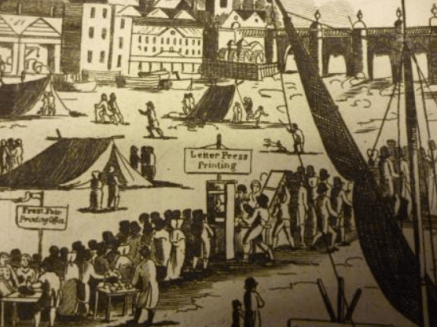
Close up of a printing press set up on ice on the Thames River.The British Library, Printing on Ice
This link leads to four affordable paper souvenirs printed on a sheet. Click to view. This elaborate Frost Fair souvenir was printed in 1740. Click here.
In his Memoir of that winter, Pastor Woodforde did not mention a Frost Fair, but he continued to observe the weather in his diary. On Feb. 18 he wrote:
Wednesday….Very hard Frost, with strong Easterly Winds, a black Frost*. Every Vegetable seems affected by it. A cold this day almost, as any this Winter. I felt it before I got up this Morning, pain within me. It froze very sharp within doors all the day long. Dinner to day odds and ends, but very good. Had a fire again in My bedchamber to night, tho’ I had left if off some time, bitter cold to night.
*a dry, non visible killing frost that turns vegetation black (Oxford Languages)
Feb. 20, Friday….This Day is said to be this most cutting this Winter. It snowed the whole Day, but small & very drifting. The cold this day affected us this day so much that it gave us pains all over us, within & without and were even cold tho’ sitting by a good fire….
and
Feb. 22, Sunday….Severe, cold Weather still continues, froze again within doors. In the Afternoon some Snow. I am afraid now that we shall have more of it–The New Moon being now three Days old, and no appearance of a change.
The weather was unrelenting. Pastor Woodforde went on to say that although he meant to make an appearance at church, the weather continued on so severely and with so much snow on the ground that he “sent word to my Parishioners that there would be no service.”
His journal mentioned only one final entry in my edition of his memoirs regarding these severe winter events:
March 13, Friday….Ground covered with Snow this Morning, having a great deal of Snow in the Night. The Morning was fair but Air very cold. A 4th Winter….
A fourth winter indeed. Thomas Barker picked up the narrative:
… it continued into March. It was in general a calm frost, with vast quantities of snow coming and going, so that though it was pretty thick at times, it never lay so deep as it sometimes does. But perhaps some of the deep pits of snow and beds of ice were not entirely gone at the end of March.”
The effects of this cold weather on the populace did not end with a warming spring.
“Grain was already scarce thanks to a hot and dry summer in 1794, but Britain was at war with revolutionary France, too, which disrupted imports and raised food prices even higher. The Gentlemen’s Magazine, a popular periodical from the time, warned of “unprecedented inclemency” – How British people weathered exceptionally cold winters, University of Liverpool Research News, 04 January 2021
Some rich landowners feared an uprising due to the scarcity of food, bread, and fuel.
Land agent William Gould’s diary entry for January 21 1795 notes that he was instructed to give money, coal, beef and bread to the hungry around the Duke of Portland’s Welbeck estate in Nottinghamshire. Elsewhere in the county, Reverend Samuel Hopkinson bought peat turf (a kind of fuel) to distribute to the poor on behalf of Earl Fitzwilliam. – University of Liverpool Research News, 2021
Even with this ‘minimal’ support, the general populace suffered and bread riots ensued the following spring.
More resources:







 Jane Austen's World
In New England when bitter cold hit, whole families just went to bed together in all their clothes, generally in the kitchen where there was the largest fireplace.
Yes, so true! Thank you for stopping by. My “first hand reports” were all written by men who paid little attention to domestic matters. I’ve written many posts on this topic. My Dutch forefathers, some of whom were farmers, had their houses attached to the cow barn. The heat from those enormous animals certainly added to the warmth on a cold winter’s night.
Some of my favorites posts include the following:
These four posts address those winter moments in times past. You will find methods still used today when storms and events cut off our electrical grids.
Snow Sports and Transportation in the Regency Era https://janeaustensworld.com/2010/12/27/snow-sports-and-transportation-in-the-regency-era/
Keeping Warm in the Regency Era: Part One https://janeaustensworld.com/2009/01/21/keeping-warm-in-the-regency-era-part-one/
Ways to Keep Warm in the Regency Era: Part Two https://janeaustensworld.com/2009/02/03/ways-to-keep-warm-n-the-regency-era-part-2/
1814 Frost Fair https://janeaustensworld.com/2007/12/03/1814-frost-fair/
So cold that apples froze inside the house. Wow! Twenty years later, 1814, was the next big freeze, which included the last Thames Frost Fair. I’ve always wondered how it was that no one noticed that same winter when Fanny Price came downstairs w/blue lips from her room lacking a fire. …
Thank you for that detail! I wish I had the time to root out these gems in Austen’s novels and letters. One can imagine how far Fanny’s attic room was from the nearest fire, even though she chose it for privacy, if I recall.
Thanks so much for the links on keeping warm! And yes, cows would be a big help.
Gosh, Vic…and I was feeling bad because I shoveled a couple of inches of snow Saturday. This article should make us all thankful for central heating. Very interesting and a very sad but thanks for putting our lives in perspective.
The coldest I ever felt was when my then husband and I would “camp” out on our new lakeside property in early April. The only structure standing there was a wood hut. It had no electricity or insulation. Cold winds whistled through the boards. No amount of blankets heaped on top of our sleeping bags, socks and gloves and caps could keep me warm when night temps dipped below freezing. My husband relished these “camping” weekends. My smaller body took hours to stop shivering in front of our morning fire. I empathize with everyone in this world who have no choice but to put up with such conditions. I also understand that it in days of yore it was common for families to huddle together in beds to preserve body heat and I imagine this still happens today.
A great article Vic. When we were children at school we learned about the frost fairs on The Thames in our history lessons.
You have been doing some great research to find these references. Yiou have inspiredme to have a search. Amanda Vickery, in her book ,”BEHIND CLOSED DOORS at home in Georgan England,” uses lots of journals from the time in her research. There is nothing like having first hand accounts. Have you read “The Natural History of Selborne,” by Gilbert White ? It is a must read for any Janeite.
I wrote a blog post about Selborne when Clive, a friend of mine, and I visited. White describes the weather conditions too.
Now with IA scraping the internet and jumbling all the facts willy nilly, it’s even more important for us to “scrape”original sources and present the actual voices of the past. It’s time consuming, and I’m not saying I’m a great scholar (far from it), but I find that the newspapers of the past provide the most fascinating information of all.
Just realised Vic. Ha! Ha! I wrote that post about Selborne for Jane Austens World. I am getting old, Vic. You must put up with me.
Here is the post, Tony. I have a very slim Gilbert White journal but could not find it for this post. Unfortunately, since my move, my systematic method of placing books on my shelves is still in disarray! Click link here.
Brr…
My grandparents had a house with no central heat, and it was cold there in the winter if you weren’t in the room with the woodstove. We slept under a lot of quilts. And, in my early years, they did not have indoor plumbing.
I know it’s nothing compared to the living conditions of the late 18th Century, but it does give me a small idea of what it was like.
denise