Ah, holiday gatherings! December is an historic month to celebrate good cheer and good will towards family, friends, and neighbors – this means inviting guests for food, drink, music, games, and entertainments. During Austen’s time, the hosts at houses or assemblies traditionally provided refreshments for their guests. Centuries later we still follow these wonderful customs. This post concentrates on popular drinks prepared for the ladies in the Regency era.
The Darking Hundred describes the drinks most popular during this time – Food, Part the Third: What People Drank, Darking Hundred
“Cordials were popular for social occasions—ratafia, orgeat, negus, and punch among others. Ratafia used a base of distilled spirits into which aromatics were infused, often almonds or fruit pits, and the brew was then sweetened. Orgeat was a syrup made with sugar, orange flower water, and almond that was added to distilled spirits. Negus used a base of sherry or port, to which were added hot water, sugar, nutmeg, and lemon; it was considered an appropriate drink for men or women.“
Regency Drinks
According to history, the patronesses of Almack’s served watered down drinks of orgeat and ratafia, since both of these refreshments were deemed acceptable for ladies. The drinks remained syrupy sweet. Men in general arrived at this strictly exclusive event already soused from having drunk hard liquor at their clubs or at home. Syrupy sweet, watered down drinks would not have tempted them.
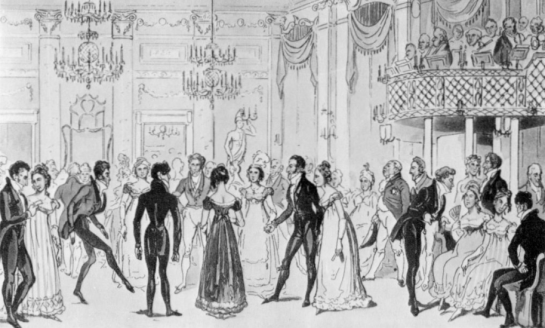
A Ball at Almack’s Assembly Rooms in London, 1821, Version of illustration from the “Tom and Jerry” book (1821) by George CruikshankWikipedia
“There was a balcony at one end where the small orchestra were seated. Refreshments (such as they were) were deliberately (revoltingly) mediocre: weak lemonade or orgeat or ratafia, dry biscuits and day-old brown bread and butter. – Almack’s – it’s not quite what you think…
In no particular order, the drinks served in public assemblies and at festive gatherings were:
Orgeat
This light, sweet drink was considered appropriate for debutantes. While orgeat was not mentioned by Jane Austen, it was popular in her time. Pronounced or-zat, readers of Georgette Heyer novels can easily associate this drink with the watered down refreshments described at Almack’s that were considered too syrupy for male tastes.
Author Sharon Lathan provides a fascinating insight into the history of orgeat, which was once made with barley. The syrup can be purchased today to satisfy a variety of tastes.
“Orgeat syrup, made with almond extract, sugar, and orange flower water, was (and still is) added as a flavoring to punch, coffee, or cocktails. I wouldn’t want to drink this milky liquid by itself, and a little bit goes a long way (we usually only use 1/4 ounce per cocktail). Some drinks were made like orgeat lemonade. Orgeat lemonade would have been orgeat syrup, lemonade and soda water, and might well have been the sort of drink served at Almack’s. and orgeat (distilled from barley or almonds with orange flower water, considered to be a light refreshing drink), Almack’s Assembly Halls – LLWiki
Orgeat was once made with bitter almonds, which in large quantities contained cyanide. The drink could be lethal. Today’s recipes are made with sweet almonds, which reduce the levels of hydrocyanic acid, and are considered safe, except for individuals with allergies. Wikipedia
The Spruce Eats offers a modern orgeat recipe. Here’s the link: Orgeat Syrup Recipe
Negus
Negus was an English drink popular in the 18th and 19th centuries. It was an “extremely popular party drink throughout Georgian and early Victorian times.” — The Jane Austen Cookbook, Maggie Black & Deirdre Le Faye)” Click on this link.
Austen mentioned negus in The Watsons:
“As Tom Musgrave was seen no more, we may suppose his plan to have succeeded, and imagine him mortifying with his barrel of oysters in dreary solitude, or gladly assisting the landlady in her bar to make fresh negus for the happy dancers above.” – The Watsons
Interestingly, during the early Regency era negus and white soup were expected to be served near midnight at balls, such as the one at Netherfield Park. Here’s Martha Lloyd’s recipe for the soup.
One can imagine the aftermath of the dinner in Emma, when the guests, because of Mr Woodhouse’s panic, quickly departed from the Weston’s party due to a smidgen of fallen snow. Did anyone receive a comforting drink of negus before they hastened into their carriages, I wonder? Mr Elton perhaps?
Negus still figured prominently in Victorian times. Charles Dickens in “A Christmas Carol” mentioned old Mr Fezziwig:
“There were more dances, and there were forfeits, and more dances, and there was cake, and there was negus, and there was a great piece of cold roast, and there was a great piece of cold boiled, and there were mince pies and plenty of beer.” – Negus – vintage cookbook shelf
Over time, negus morphed into a children’s drink . Yet it still contained alcohol!!. No longer fashionable, the beverage had become similar to mulled wine, as this recipe in Mrs Beeton’s Book of Household Management attests, and it was made with a variety of ingredients.
“Negus does have striking similarities to mulled wine — with interchangeable main ingredients of red wine/port, nutmeg, sugar, and citrus like lemon juice or orange zest. So, it seems, the most striking and significant difference between the two popular warm sips is the addition of hot water to the negus recipe – A Short History of Negus, the Mulled Wine Beverage of Yesteryear | VinePair
Ratafia
Ratafia was another beverage deemed suitable for ladies. Its preparation began in December, with the concoction ready to drink in mid-February. Abigail Reynolds writes:
“…along with lemonade, orgeat, and punch, so I assumed it was similarly low in alcoholic content. Silly me! It’s a liqueur made of brandy with fruit, spices, and crushed fruit pits steeped in it for 1-2 months, then filtered and sweetened with large amounts of sugar. The sweetness and fruitiness meant that men didn’t touch the stuff, but if you think about that recipe for a minute, you’ll realize it’s nothing more than slightly diluted flavored brandy. – Austen Variation, Abigail Reynolds, – Ratafia is Not for Sissies
In her excellent blog, Lesley-Anne McLeod wrote:
“The Professed Cook” has a section titled Des Ratafiats or Of sweet Drams or Cordials. It includes some ten recipes for different versions of ratafia. They all begin with brandy and they all take thirty to forty days to prepare and infuse. The adventurous cook, it seems, can add almost anything to the brandy. Some of the ingredients listed in “The Professed Cook” include walnuts, quinces, orange-flowers, juniper-berries, lemon-peel, anise seeds and apricots. Plenty of sugar is included and three spices in these receipts in particular–coriander, cinnamon and cloves.” – Lesley-Anne McLeod, Ratafia, The Lady’s Choice
Ratafia, was either distilled or with an infusion of fruits and spices. The drink had an alcoholic base of Marc brandy and grape juice. A liqueur routinely made in December, could be ready to serve two months later on Valentine’s Day. A recipe for dark brown ratafia suggested that it be stored in an oak barrel for at least two years. — Gin Affair Champagne Punch – Bridgerton Cocktail
At the end of an evening:
In Austen’s day, often after a local assembly ball, a neighbor’s party, or a return from the opera or theatre in town, supper was served quite late. People would gather to eat or drink before returning home in the wee hours of the morning. White soup was served, as well as negus, which was prepared a half hour before guests left for home.
More on the topic:







 Jane Austen's World
The thoroughness of Vic’s presentations as well as her natural writing ability is much appreciated. As Jane Austen novels are reread there are nagging questions that pop up but stay in the subconscious; Vic manages to ferret them out. Thanks always for a very satisfying read.
Anne E
“Blush”! Thank you for your kind words. I do wish I had an editor to help with my writing, but, yes, I do like to delve into the customs and manners of Austen’s contemporaries (with the help of fellow writers). Have a lovely Holiday Season and a wonderful New Year’s celebration!
How fascinating. I knew about a couple of the drinks from books, but not the others. Thanks for the history.
Merry Christmas!
Denise
Denise, I’ve read many books that mentioned these drinks but never knew what they were made of and why some were deemed suitable for ladies and most were eschewed by men. Have a lovely New Year’s celebration with your family!
In the BBC series “Jane Eyre” with amazingly handsome actor, Timothy Dalton (portrayed Mr. Rochester) the cocktail Negus is given to Jane Eyre when she first arrives at the estate and sits with the housekeeper to learn what she can about Mr. Rochester before she has formally met him. The entire series is free on YouTube and I love it! It is THE best rendition of the novel in all well-done, lengthy parts (eleven!). Simply beautiful staging, etc.
I agree, Robin. This version with the delectable Timothy Dalton was one of my favorite. I also prefer the lengthier film treatments of classic novels, for most stay true to the author’s intention. While I enjoy 90-minute or 2-hour treatments, most ignore many plot developments that are crucial to the plot. Thank you for stopping by.