This Jane Austen blog brings Jane Austen, her novels, and the Regency Period alive through food, dress, social customs, and other 19th C. historical details related to this topic.
Gentle Reader: This Father’s Day weekend, I salute Jane Austen’s father, George Austen. This post, which I wrote three years ago, has been resurrected and updated for this occasion.
Rev. George Austen was by all accounts a handsome man. Anna LeFroy, Jane’s niece wrote,
I have always understood that he was considered extremely handsome, and it was a beauty which stood by him all his life. At the time when I have the most perfect recollection of him he must have been hard upon seventy, but his hair in its milk-whiteness might have belonged to a much older man. It was very beautiful, with short curls about the ears. His eyes were not large, but of a peculiar and bright hazel. My aunt Jane’s were something like them, but none of the children had precisely the same excepting my uncle Henry.”
George Austen was born in 1731. His mother died in childbirth and his father died a year after marrying a new wife, who did not want the responsibility of taking care of the young lad. George then lived with an aunt in Tonbridge and earned a Fellowship to study at St. John’s. Smart, ambitious, and self-made (with the support of his uncle Francis), he received a Bachelor of Arts, a Master of Arts, and a Bachelor of Divinity degree at Oxford. Considered good looking all his life, he was called “the handsome proctor” as he worked as an assistant chaplain, dean of arts, and Greek lecturer while going to school.
George first met Cassandra Leigh in Oxford when she was visiting her uncle Theophilus, a renowned scholar. After marrying Cassandra in Bath, George became rector in several country parishes, including Steventon. The family grew by leaps and bounds, and eventually he and Cassandra had six sons and two daughters.
Shortly after Jane was born, her father said: “She is to be Jenny, and seems to me as if she would be as like Henry, as Cassy is to Neddy.” But the little girl was known as Jane all her life.
By all accounts George and Cassandra Austen had a happy marriage. His annual income from the combined tithes of Steventon and the neighboring village of Deane was modest. With so many mouths to feed, the family was not wealthy. To augment the family income, George Austen opened a boarding school at Steventon Rectory for the sons of local gentlemen, and sold produce from his farm.
George Austen presents his son Edward to the Knights, who adopted him. This was a common practice in that era. Image from Chawton House.
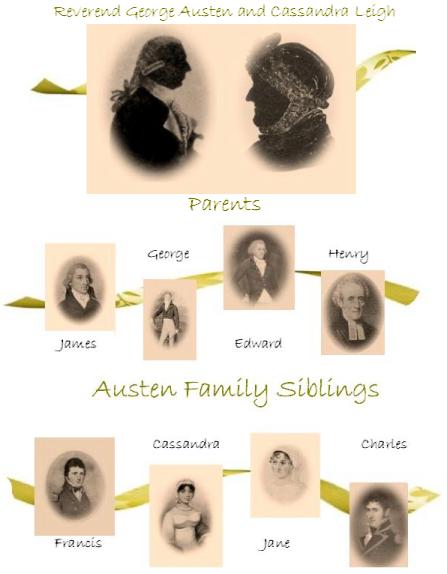
Rev. Austen, a doting father to all his children, encouraged Cassandra and Jane to read from his extensive library, and taught his boys in his boarding school. For entertainment, the family read to each other, played games, and produced poetry, novels, and plays. James, the eldest son, an accomplished writer and poet, was considered to be the “writer” of the family, especially by his mother, Cassandra, who doted on him. George Austen was proud of his youngest daughter’s accomplishments, and tried to get First Impressions, the first draft of Pride and Prejudice published. The “Memoir of Jane Austen” by Edward Austen-Leigh contains a letter from George Austen to Mr. Cadell, publisher, dated November 1797, in which he describes the work as a “manuscript novel comprising three volumes, about the length of Miss Burney’s ‘Evelina'” and asks Mr. Cadell if he would like to see the work with a view to entering into some arrangement for its publication, “either at the author’s risk or otherwise.” Unfortunately, nothing came of this query, but P&P became hugely popular among the friends and family who read it before it was published. The original 3-part manuscript no longer exists, and a much shorter form of the novel was finally published in 1813, long after George’s death and only four short years before Jane’s fatal illness. Rev. George Austen died unexpectedly in Bath on January 1, 1805, where the Austen family had moved after living in Steventon for over 30 years. This move did not sit well with Jane, who, as legend goes, fainted when she learned that the family was moving to Bath. (The silhouettes above are of George and Cassandra, who had not aged well). Rev. Austen did not linger long after falling ill, and on January 21, Jane Austen would write sorrowfully to her brother, Frank, one of two sailors in the family:
“We have lost an excellent Father. An illness of only eight and forty hours carried him off yesterday morning between ten and eleven. His tenderness as a father, who can do justice to?” – Sir Francis William Austen
Rev. Austen was buried in St. Swithin churchyard in Bath. The inscription on his grave reads:
Under this stone rests the remains of
the Revd. George Austen
Rector of Steventon and Deane in Hampshire
who departed this life
the 1st. of January 1805
aged 75 years.”
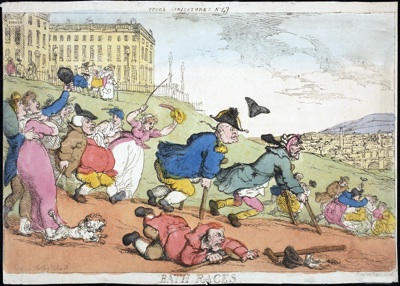
In 1798, the famous caricaturist Thomas Rowlandson drew The Comforts of Bath, a series of satiric drawings. The cartoons were used to illustrate the 1858 edition of the New Bath Guide, written by Christopher Anstey and first published in 1766.* Rowlandson depicted both the social and medical scene in Bath just before the period described by Jane Austen in Northanger Abbey and Persuasion, and by Georgette Heyer in her Regency romances.
The Portrait, Comforts of Bath, 1798, Thomas Rowlandson
In this post I combined Rowlandson’s images with excerpts from an 1811 guidebook, A new guide through Bath and its environs By Richard Warner. The scenes depict the use of mineral water therapy for the invalids who flocked to Bath, a city whose fashionable post-Nash reputation was already well past its prime and whose medical men were generally regarded as quacks or, worse, “potential murderers”. The rotund gentleman in front and center of all these scenes (who undoubtedly suffered from gout, a painful rich man’s disease), was conjectured to be based after Tobias Smollet’s Mr. Bramble. In the pictorial’s subtext, notice how “Mr. Bramble’s” young wife (companion or daughter) flirts with the young officer who boldly woos her (Image above). Even while satirizing them, Rowlandson gets the social details just right. Underneath each image sits a quote from the guidebook.
King Bladud's Bath, Comforts of Bath, Rowlandson
It is fit for the patient when he goeth into the bath to defend those parts which are apt to be offended by the bath, as to have his head well covered from the air and wind and from the vapours arising from the bath, also his kidneys if they be subject to the stone, anointed with some cooling unguents as rosatum comitiffs infrigidans Galeni Santo linum &c. Also, to begin gently with the bath till his body be inured to it, and to be quiet from swimming or much motion which may offend the head by sending up vapours thither at his coming forth, to have his body well dryed and to rest in his bed an hour and sweat, etc.” – A New Guide Through Bath, 1811
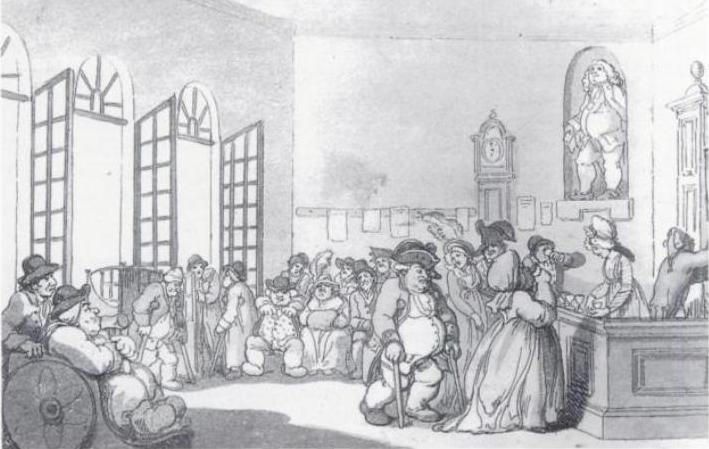
The Pump Room, The Comforts of Bath, 1798, Rowlandson
The new Pump Room supplied water from a covered pump. Before the room was built, the populace drank the waters in the open air. But the new rooms allowed them to
… take the exercise prescribed to them sheltered from the inclemency of the weather. The work was accordingly begun in 1704, finished two years afterwards, and opened for the reception of the company under the auspices of Mr Nash, who had just then become the Arbiter Elegantiarum of Bath…A New Guide Through Bath, 1811
Black and White detail of above print
In the year 1751 [The Pump] Room was enlarged. Accommodated with a beautiful Portico stretching from it in a northern direction in 1786, and adorned with superb Western Frontispiece in 1791, The Corporation further beautified the city in 1796 by taking down the old Pump Room entirely and building on its site the much larger and more magnificent edifice known at present by that name…A New Guide Through Bath, 1811
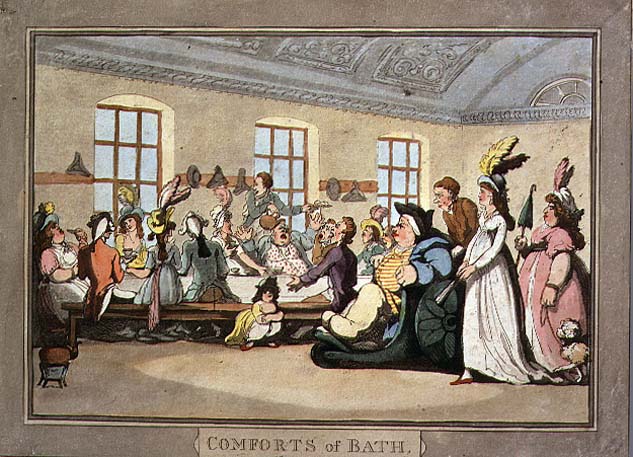
Public Breakfast, The Comforts of Bath, 1798, Rowlandson
Pertaining to the construction of the Harrison rooms and the Assembly Rooms:
Temporary booths had hitherto been the only places in which the company could drink their tea and divert themselves with cards, but Mr Harrison, a man of spirit and speculation, perceiving that a building of this nature was much wanted and would probably make him a very suitable return, undertook at the suggestion of Mr Nash to erect a large and commodious room for the purpose of receiving the company. The succes of this attempt induced a similar one in the year 1728, when another large room was built by Mr Thayer. A regular system of pleasurable amusements commenced from this period, and the gay routine of public breakfasts, morning concerts, noon card parties, evening promenades, and nocturnal balls rolled on in an endless and diversified succession. –A New Guide Through Bath, 1811
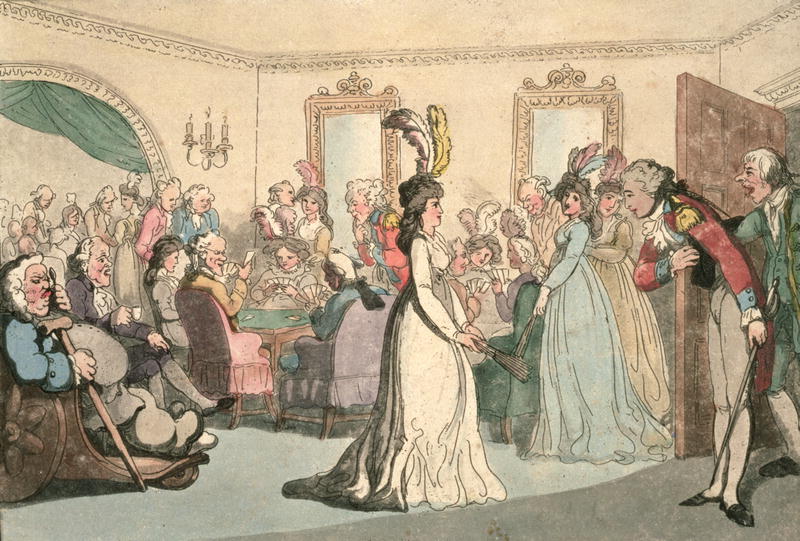
Company at Play, The Comforts of Bath, Rowlandson
Rules card games:
That no persons be permitted to play with cards left by another party; That no hazard or unlawful game of any sort be allowed in these Rooms on any account whatever nor any cards on Sundays...A New Guide Through Bath, 1811
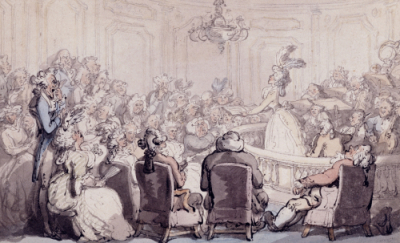
The Concert, Bath Chambers, Rowlandson
For music sweet music has charms to controul; And tune up each passion that ruffles the soul; What things have I read and what stories been told; Of feats that were done by musicians of old – The New Bath Guide, 1779
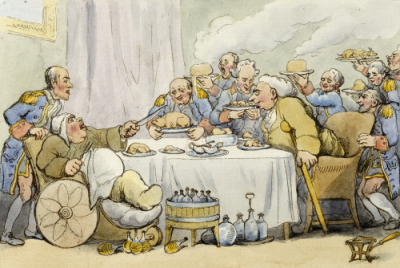
Dinner, Comforts of Bath, 1798
Bath has little trade and no manufactures; the higher clafles of people and their dependents conftitute the chief part of the population, and the number of the lower clafles being but fmall…A New Guide Through Bath, 1811
Dear reader, If you will recall in last week’s post about the Upper Assembly Rooms in Bath, poor Catherine Morland had to sit out the dance, having made no acquaintance with any gentleman. Luck was on her side later in the week when she and Mrs. Allen visited the Lower Rooms:
They made their appearance in the Lower Rooms; and here fortune was more favourable to our heroine. The master of the ceremonies introduced to her a very gentlemanlike young man as a partner; his name was Tilney. He seemed to be about four or five and twenty, was rather tall, had a pleasing countenance, a very intelligent and lively eye, and, if not quite handsome, was very near it. His address was good, and Catherine felt herself in high luck. There was little leisure for speaking while they danced; but when they were seated at tea, she found him as agreeable as she had already given him credit for being. He talked with fluency and spirit – and there was an archness and pleasantry in his manner which interested, though it was hardly understood by her. After chatting some time on such matters as naturally arose from the objects around them, he suddenly addressed her with – “I have hitherto been very remiss, madam, in the proper attentions of a partner here; I have not yet asked you how long you have been in Bath; whether you were ever here before; whether you have been at the Upper Rooms, the theatre, and the concert; and how you like the place altogether. I have been very negligent – but are you now at leisure to satisfy me in these particulars? If you are I will begin directly.” – Chapter 3, Northanger Abbey, Jane Austen
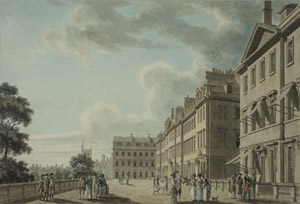
South Parade, Thomas Malton, 1775
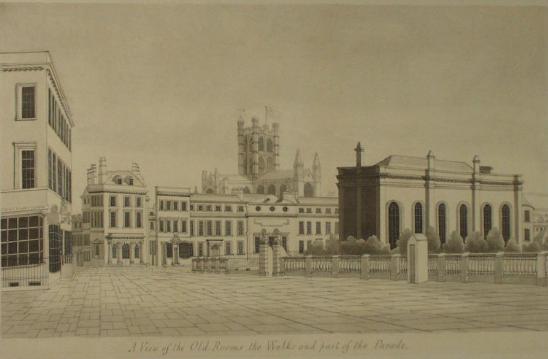
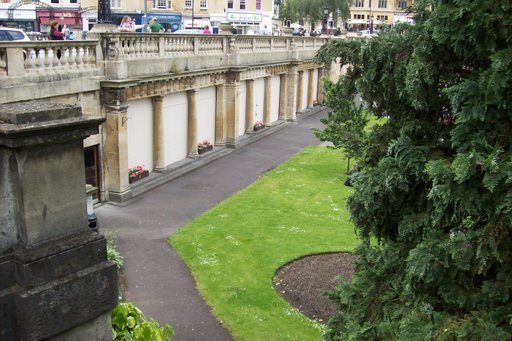
The lower rooms, built in 1708, were Located on Terrace Walk near beautiful South Parade off the banks of the Avon River. James King, the Master of Ceremonies who introduced Henry Tilney to Catherine Morland, was an historic figure who actually performed as Master of Ceremonies in the lower rooms from 1785 to 1805. He then became M.C. of the upper rooms, which had recently been built in the newer more fashionable neighborhood uptown near The Circus. The Lower Assembly rooms sat in the older city center lower down, hence the distinction between upper and lower rooms.
The lower rooms were used during the day for promenading and visiting and at night for dancing. Beautiful stone walks and terraces surrounded the building, which encouraged people to gather to see and be seen, and dawdle away a few pleasant hours.
Lower Assembly Rooms (right) at Terrace Walk (With Bath Abbey in the distance), Benjamin Morris, late 18th century.
As with my previous posts about Bath in conjuntion with Austenprose’s celebration of Northanger Abbey, I shall feature a series of quotes from original sources that will help to illuminate what Bath, its people, and the Lower Rooms were like during the latter part of the 18th century.
The role of Master of Ceremonies was narrowly defined. He presided over social functions, welcomed newcomers, and enforced an official code of regulations designed to preserve decorum and promote social interaction. For this treason, the Master of Ceremonies was often referred to as the “King,” because his social authority within the city of Bath was regarded as absolute.” Psychosocial Spaces: Verbal and Visual Readings of British Culture, 1750-1820, Steven J. Gores, p 71
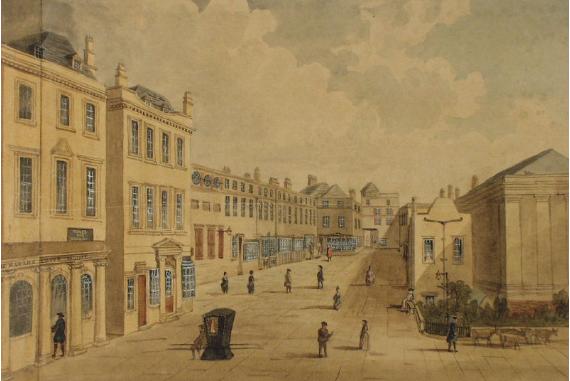
Walks and Old Assembly Room, 19th c. copy of a painting
The above image from the Victoria Art Gallery in Bath shows the beautiful Terrace Walk made of bath stone around the lower rooms and the shops that faced the walk. Wiltshire’s Assembly Rooms, the building on the left with the three arched windows, did not survive competition with the Upper Assembly and was demolished.
Constance Hill, Jane Austen’s 19th Century biographer, provides a vivid description of the Lower Rooms in this passage:
Beau Nash in Bath
It was at a ball in the Lower Rooms, we remember, that Henry Tilney was first introduced to Catherine Morland, and that when he was “treating his partner to tea,” he laughingly accused her of keeping a journal in which he feared he should make but a poor figure. “Shall I tell you,” he asks, “what you ought to say? I danced with a very agreeable young man introduced by Mr. King; had a great deal of conversation with him; seems a most extraordinary genius.” This Mr. King was, it seems, a real personage. He was Master of the Ceremonies at the Lower Rooms, from the year 1785 to 1805, when he became Master of the Ceremonies for the Upper Rooms. A code of rules compiled by him was used for about thirty years. One of these rules, originally laid down by Beau Nash, forbade gentlemen to wear boots in the rooms of an evening. It is said that when a country squire once attempted to defy [Page 114]this rule, in the days of the King of Bath, Beau Nash asked him why he had not brought his horse into the ball-room, “since the four-footed beast was as well shod as his master.”
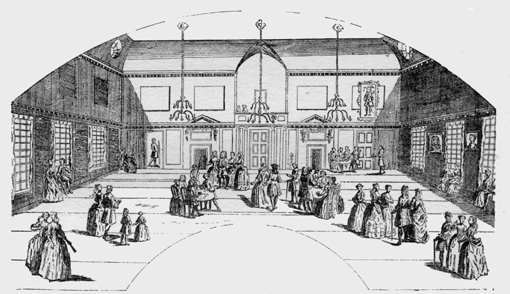
The ball-room was used during the daytime as a promenade, for which it was well suited from its size and pleasant situation; its windows commanding extensive views of the Avon winding amidst green meadows and flanked by wooded hills. The accompanying reproduction of an old print taken from a design for a fan, shows the ball-room when used for this purpose. It was the fashion also for the company to invite each other to partake of breakfast at the Lower Rooms after taking their early baths or first glass of water.
It was in the year 1820 that these old Assembly Rooms were burnt to the ground. They had been founded by the great Beau Nash himself, and had flourished for more than a hundred years. Jane Austen:Her Homes and Her Friends, Constance Hill
The Lower Rooms, Bath, from an old print of a fan design
The dances called out by the Master of Ceremonies would have been those that were popular during the period, such as the one shown in this YouTube Clip of a dance scene with Catherine Morland and Henry Tilney in the 2007 ITV NA adaptation. Dress balls were offered every Friday in the Lower Rooms, when the Upper Rooms were closed; Fancy balls were scheduled every Tuesday. One of Nash’s edicts, which was still enforced during Jane Austen’s day, was that dancing was to “begin as soon as possible after six o’clock, and finish precisely at eleven, even in the middle of a dance.” (Lane, p 77.)
The dances that were popular at the beginning of the 19th century were those that had been popular at the end of the 18th century; the Minuet, Cotillions, and Country Dances. With the arrival of the waltz in the teens, we see the beginning of the modern ballroom era. Until this time social dances done by couples were done with limited physical contact; the gentleman and lady barely touched hands. The waltz however was done with a couple in a close embrace, the gentleman’s hand around the lady’s waist as they continually spun around the ballroom together. This intimate “waltz position” was initially shocking to a society where close physical contact with a member of the opposite sex, especially in public, was nothing short of scandalous. – From “Elements of the Art of Dancing”, Alexander Strathy, 1822
Bath’s glittering social whirl changed rapidly towards the end of the 18th Century at a time when the cost of the war ground Bath’s expansion to a halt. This Georgian guidebookdescribes Bath at the height of its glory:
No place in England, in a full season, affords so brilliant a circle of polite company as Bath. The young, the old, the grave, the gay, the infirm, and the healthy, all resort to this place of amusement. Ceremony beyond the essential rules of politeness is totally exploded; every one mixes in the Rooms upon an equality; and the entertainments are so widely regulated, that although there is never a cessation of them, neither is there a lassitude from bad hours, or from an excess of dissipation. The constant rambling about of the younger part of the company is very enlivening and cheerful. In the morning the rendezvous is at the Pump-Room;–from that time ’till noon in walking on the Parades, or in the different quarters of the town, visiting the shops, etc;–thence to the Pump-Room again, and after a fresh strole, to dinner; and from dinner to the Theatre (which is celebrated for an excellent company of comedians) or the Rooms, where dancing, or the card-table, concludes the evening. – (Christopher Anstey, The New Bath Guide, or, Useful Pocket Companion, 1799)
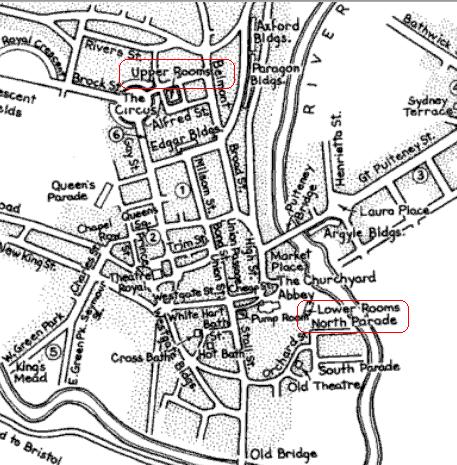
Detail of a map of Bath, c. 1800
In the above map detail, you can see the position of the lower rooms in relation to the upper rooms. As the new century progressed, the middle classes, invalids, and people seeking to retire began to replace the aristocrats who had lent such glitter to the social whirl. Sir Walter Elliot, if you recall, chose to remove his household to Bath where he could still lord it over others as a man of consequence. As an impoverished and lesser peer in London, he would have led a life of relative obscurity, which his enormous ego could not abide. The social changes in Bath, along with new anti-gambling laws and the death of Beau Nash, led to the city’s decline in social caché.
Physical expansion came to an abrupt halt in 1793 with the financial crisis brought on by the war with France. This led directly to several schemes going unfinished, most notably perhaps Great Pulteney Street, the suburbs of which were never built, leaving the main street in relative isolation. When stability returned in the 1820s, building energy was channelled into the newly popular semi-detached villas. The population continued to grow quickly and Bath’s reputation became that of a quiet refined resort, in architecturally excellent surroundings. City of Bath World Heritage Management Plan
Due to Beau Nash’s edicts as social arbiter, Bath was known for its egalitarianism, where classes from the various social orders could mix and mingle. The ambitious Thorpes were particularly aware of this fact, and Isabella and John kept their eyes out for the most likely prospects. Not everyone thought that gentry rubbing shoulders with tradesmen was such a good idea. Matthew Bramble, a late 19th century poet, wrote archly:
Distinction of rank, in a moment is gone,
And all eager for tea, in one mass, now move on;
And Mistress O’Darby the dealer in butter,
Now sweats by the side of the sweet lady Flutter,
Who would certainly faint, but her senses so nice,
Are supported by smelling fat Alderman Spice.”
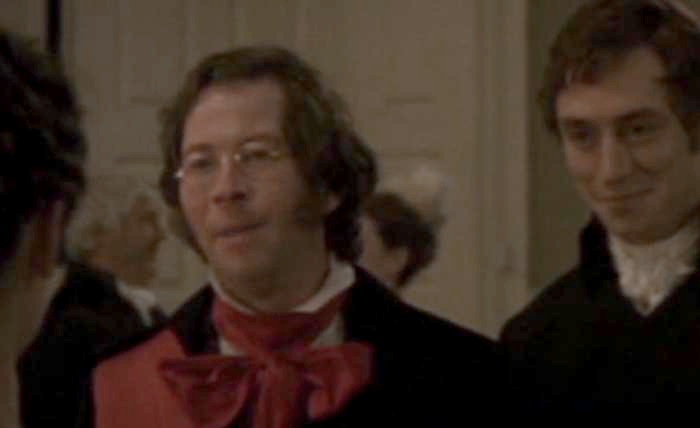
Miles Breen as James King, Master of Ceremonies in 2007 Northanger Abbey
Jane Austen mentioned James King as Master of Ceremonies in the Lower Assembly Rooms, which forcibly reminds us that Northanger Abbey , while written in 1798 or 1799 (according to Cassandra), was not published until after her death. For full details, read my post: The Long Publishing Journey of Northanger Abbey. In the passage below, noted Jane Austen scholar Deirdre Le Faye points out the changes in Bath between the time when the novel was written and when it was eventually published:
Apart from these two additions, it is clear from the tone of the text that it still dates to the turn of the century. By 1816 ladies had ceased to pile their hair up into huge powdered ‘heads’, muslins were no longer a novelty fabric worthy of discussion, and the Bath assembly rooms were no longer quite so smart – the city had become less of a fashionable holiday resort and marriage-mart, and more of a residential retreat for invalids, elderly spinsters and widows, bachelors and widowers, the atmosphere which Austen creates in Persuasion. James King had retired as Master of Ceremonies in the Lower Rooms in 1805, and it would have been easy enough for Austen to change this name if she were attempting to update the story. Likewise, she mentions ‘Union-passage’ in the centre of Bath, but does not mention the larger Union Street, which opened in 1807. In any case, the novel’s structure could not easily have accommodated any large-scale revisions; Austen pins both her plot and her characters so tightly to parodies of the conduct novel and the gothic romance that to change any of this would require substantial rewriting. It can therefore be assumed that the text as we now have it is substantially as it was in 1803. Northanger Abbey the Cambridge Edition of the Works of Jane Austen, Jane Austen, Deirdre le Faye, excerpt
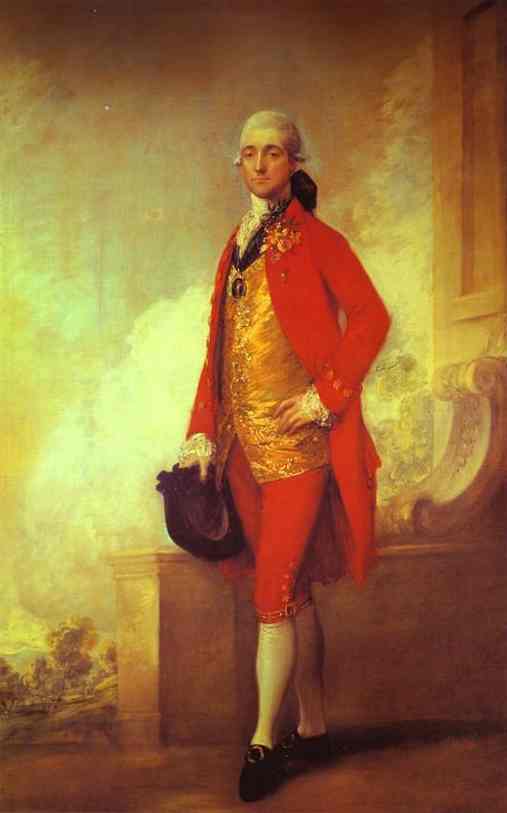
During the 18th Century, both the Lower and Upper Assembly rooms were able to attract enough visitors to keep profits healthy for each establishment, but the Lower Assembly rooms were small in comparison to the larger more modern Upper Rooms and situated in an inconvenient part of town. With time they fell into disuse. The competition between the two assembly rooms was not as harmonious as one first supposes. When the Upper Rooms were built, there was an attempt by the Master of Ceremonies who replaced Beau Nash, Captain William Wade, to preserve the order of things and to divide the competing markets. However, the builders of the new assembly rooms saw no need to adhere to an arbitrary set of rules, and they placed the following notice in the Bath Chronicle:
Captain William Wade by Thomas Gainsborough, 1771
They (the Proprietors) beg leave to declare, that as they cannot think it reasonable that they should submit the management of their property and servants to any set of men, much less can they be willing to submit the control of them to an individual. They always have been, and still are willing to allow, to a Master of Ceremonies, every power and authority requisite to preserve and promote order, decorum and regularity at the public amusements held at their rooms; but they must ever think it necessary to determine for themselves, what use shall be made of their property, and what servants shall take care of it. (Bath, 1680-1850, p. 222)
The proprietors of the new assembly rooms then declared that their rooms would be open every evening except Fridays and alternate Sundays. They also announced that a ball would be held every Monday and a concert every Thursday. The small old-fashioned lower rooms simply could not compete. When they burned to the ground in 1820 they were not replaced, and today only a remnant of their former glory remains.
Dear Reader: This is the second post in the Bath series for Northanger Abbey, which is being featured this month on Austenprose. My first post about the Pump Room sits here.
Catherine circulating through the crush at the Assembly Rooms
Mrs. Allen was so long in dressing that they did not enter the ballroom till late. The season was full, the room crowded, and the two ladies squeezed in as well as they could. As for Mr. Allen, he repaired directly to the card-room, and left them to enjoy a mob by themselves. With more care for the safety of her new gown than for the comfort of her protegee, Mrs. Allen made her way through the throng of men by the door, as swiftly as the necessary caution would allow; Catherine, however, kept close at her side, and linked her arm too firmly within her friend’s to be torn asunder by any common effort of a struggling assembly. But to her utter amazement she found that to proceed along the room was by no means the way to disengage themselves from the crowd; it seemed rather to increase as they went on, whereas she had imagined that when once fairly within the door, they should easily find seats and be able to watch the dances with perfect convenience. But this was far from being the case, and though by unwearied diligence they gained even the top of the room, their situation was just the same; they saw nothing of the dancers but the high feathers of some of the ladies. Still they moved on—something better was yet in view; and by a continued exertion of strength and ingenuity they found themselves at last in the passage behind the highest bench. Here there was something less of crowd than below; and hence Miss Morland had a comprehensive view of all the company beneath her, and of all the dangers of her late passage through them. It was a splendid sight, and she began, for the first time that evening, to feel herself at a ball: she longed to dance, but she had not an acquaintance in the room. Mrs. Allen did all that she could do in such a case by saying very placidly, every now and then, “I wish you could dance, my dear—I wish you could get a partner.” For some time her young friend felt obliged to her for these wishes; but they were repeated so often, and proved so totally ineffectual, that Catherine grew tired at last, and would thank her no more. – Chapter 2, Northanger Abbey, Jane Austen
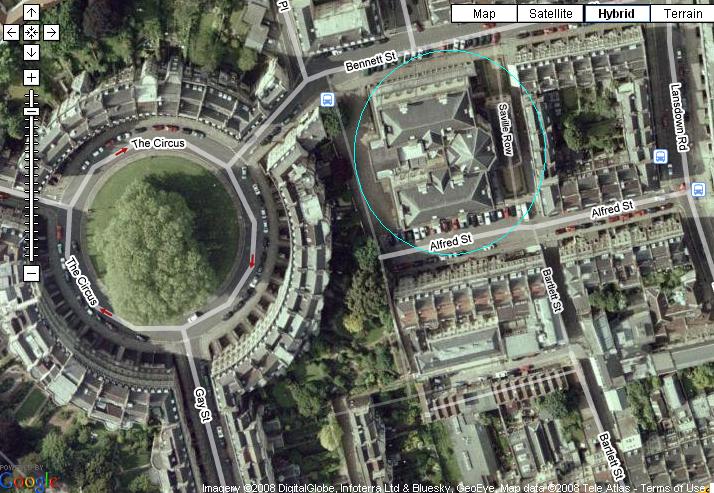
Assembly Room near the Circus; You can see the dome of the Octagon Room from the air, near Bennet Street and Saville Row.
Poor Catherine, how frustrated she must have felt decked out in her new finery and forced to watch others dance and enjoy themselves. Etiquette deemed that at a public assembly no young lady could dance with a partner unless they had been properly introduced. Because Mrs. Allen had no acquaintances in Bath, Catherine had to sit on the sidelines. If the ball had been private, she could have danced with any of the gentlemen who solicited her for a set. On another evening, in the Lower Assembly Rooms (located near Bath Abbey), Henry Tilney would arrange for the Master of Ceremonies to formally introduce them. But for now, in the Upper Rooms (which were situated near the Circus), Catherine would have to remain at her chaperone’s side.
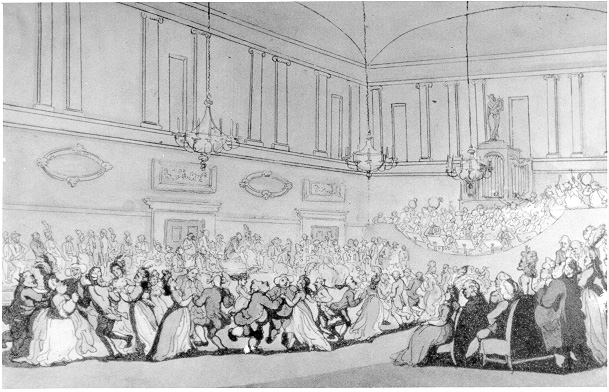
Ballroom
Public assemblies were a way for young couples to meet a potential partner from outside their immediate social circle. One purchased a subscription for a series of balls (which included supper) or for the entire season.
5. “That a subscription of 1l. 10s. to the Dress Balls shall entitle the subscriber to three tickets every ball-knight; one for the subscriber, not transferable, and two for ladies. These two latter tickets will be transferable, on being endorsed by the subscriber, without which form the bearer will not be admitted. A subscription of 15s. shall entitle the subscriber to one ticket, not transferable.
“(Cotillon Balls.)
6. “That a subscription of 1l. to the Cotillon Balls shall entitle the subscriber to one ticket every ball-night: this ticket not transferable.
7. “That no person whatever be admitted into the Ball-Rooms without a ticket; nor any visitor or stranger, unless he shall previously have inserted his name and place of abode in a book to be kept for that purpose, under the controul of the Master of Ceremonies.
8. “The subscribers are respectfully requested to observe that their subscriptions cease when they leave Bath; and it would be of much public utility, if they would be pleased to give notice at the Rooms of their departure, which would prevent their tickets being improperly used.
The crowds as described by Jane Austen at the Upper Rooms, the newest and largest Assembly Rooms in Bath, were a crush. Balls were held twice a week and attracted from 800 to 1,200 guests at the height of the season, which drew to a close in May. Because the social whirl was so popular in this fashionable spa city, the Upper Rooms and Lower Rooms held dances on different evenings so that visitors would have a chance to attend them every night they were offered.
The following Rules and Regulations, published by the Master of the Ceremonies, are hung up in the NEW ASSEMBLY ROOMS.Pierce Egan, Walks Through Bath, 1819
The public amusements during the season are as follow:—-
Beau Nash, the arbiter of taste and fashion in the 18th century, was the first Master of Ceremonies to preside over the Assembly Rooms. His rules and regulations allowed for people of different rank and distinction to mingle at the public assemblies. He reprimanded those who invoked social precedence in dance and prevented those who threw private parties and balls from creating an atmosphere of exclusion. By 1819, the city’s reputation as a fashionable resort for the rich had waned, but the city was still a quite popular destination, especially with the rising middle classes.
Upper Assembly Room Entrance
The Upper Rooms, designed by John Wood the younger, were opened in 1771. While the exterior was plain, the buildings were beautiful on the inside. Five enormous crystal chandeliers hung over the dancers in the ballroom, casting their golden candle light over the assembly. Tall ceilings provided air circulation and second story windows afforded privacy. Constance Hill writes in Jane Austen: Her Homes and Her Friends:
“Rauzzini” in his tie-wig, conducting his famous band in the musicians’ gallery. We seemed to hear the strains of their music accompanied by the tread of the dancers’ feet. “The Monday dress-ball,” says a contemporary writer, “is devoted to country dances only. At the fancy-ball on Thursday two cotillions are danced, one before and one after tea.” This fancy-ball was not a bal costumé, but simply an occasion on which the stringent rules regulating evening dress were relaxed. “In the height of the season,” continues our author, “there are generally twelve sets, and as the ladies, on this occasion, exert their fancy to the utmost in the display of their shapes and their dress, the spectacle is magnificent.” The ladies, we read, wore comparatively short skirts for the cotillion with their “over-dresses picturesquely looped up.” Does not this remind us of Isabella and Catherine “pinning up each other’s train for the dance”?
Bath’s music culture was quite sophisticated, and many people took music lessons from musicians who lived in Bath or who came to visit:
“Despite a decline since its peak of popularity in the 1790s, the town still remained the wealthiest and most important of England’s resorts, and its musical culture was second only to that of London. The main concert venue was the Upper Rooms (the present Assembly Rooms) in Bennett street, where the veteran castrato Venanzio Rauzzini presided over a series of concerts in which local musicians were joined by leading players and singers from London.” Samuel Wesley, Philip Olleson, p. 87.
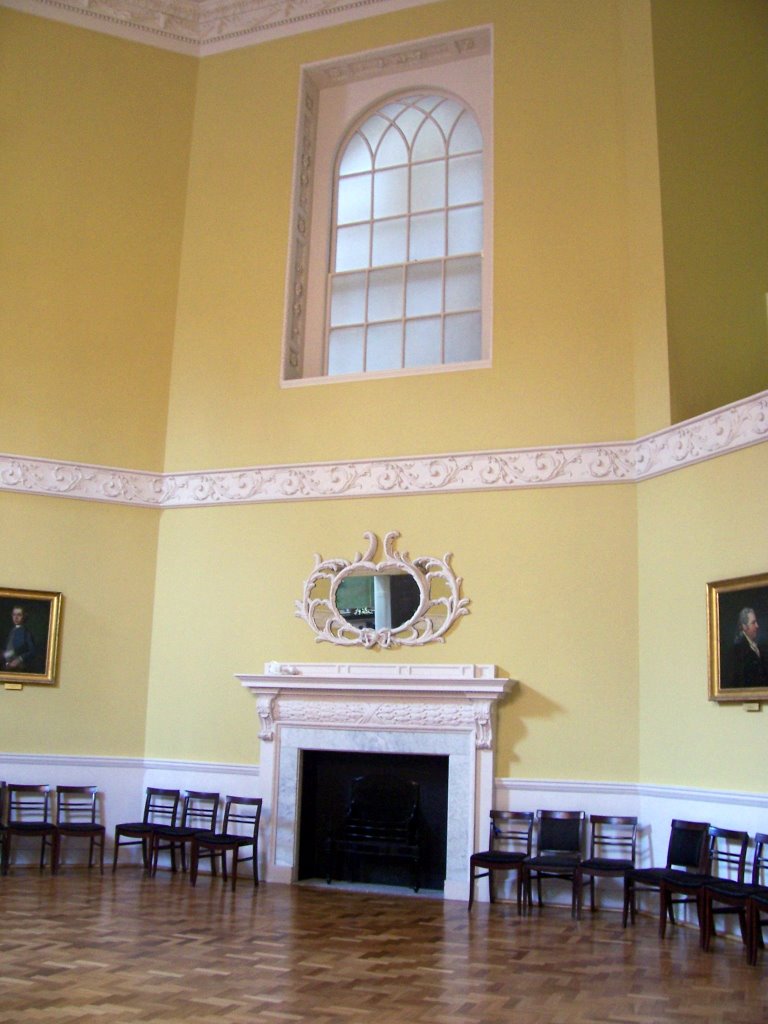
Octagon Room
As soon as Catherine Morland and the Allens arrived at the Upper Rooms, Mr. Allen excused himself to play cards. Tables were set up in the Card Room. The Octagon Room, a handsome domed room, served as a passageway to the ball-room, the card-room, the tea-room, and the vestibule, through which the assembled company could circulate, flirt, dance, and gossip. The Octagon Room would also serve as a meeting room or music room, as in Persuasion when Lady Dalrymple hosted a concert. (See a site plan of the Assembly Rooms here.)
Dances were proscribed by the master of ceremonies, who presided over the ball and who decided on which dances would be performed and in what order. A gentleman could not reserve more than two dances with a lady for the evening, and when he did, it was understood that he was interested in her. If a lady reserved more than two dances with a gentleman, she was considered “fast.” As Henry Tilney said to Catherine, men have the power of choice in the Regency ball; ladies have only the power of refusal.(PEERS, Historic Regency Etiquette.)
Today the Assembly Rooms are still available for special occasions. Visitors to Bath can view them (for a cost, of course), and visit the Museum of Costume afterward.
Fashionable Goodness: Christianity in Jane Austen's England is now available! By JAW contributor Brenda S. Cox. See Review. Available from Amazon and Jane Austen Books.
Available through December 31st, 2025. Click on image for details, and share this poster with other teachers and students!
The Obituary of Charlotte Collins by Andrew Capes
Click on image to read the story.
Comments
“My idea of good company…is the company of clever, well-informed people, who have a great deal of conversation.” – Jane Austen, Persuasion
Gentle readers: Please feel free to post your comments and continue the conversation! Due to SPAM, we will no longer accept comments on posts after 30 days of publication. In some instances, links will be removed from comments as well.
Administrators and Contributors
Vic Sanborn, founder of this blog, is supported by a team of talented and knowledgeable writers about Jane Austen and the Regency era. They are:
Tony Grant, who now contributes his photos from London and England
Click on their names to enter their own blogs.
In addition, we thank the many experts and authors who frequently contribute their posts and opinions, and who continue to do so freely or at our request.
Click here to enter the page. Topics include Regency fashion, historic foods, Jane Austen societies, British sites, related topics. Click on image.
May we suggest?
Hello, my name is Vic and I live in Maryland, USA. I have adored Jane Austen almost all of my life. I am a proud lifetime member of the Jane Austen Society of North America. This blog is a personal blog written and edited by me and my team. We do not accept any form of cash advertising, sponsorship, or paid topic insertions. However, we do accept and keep books and CDs to review.
If you would like to share a new site, or point out an error, please email us. (Yes, we are fallible. We'll own up to our mistakes and will make the corrections with a polite smile on our faces.) Write us at
Thank you for visiting this blog. Your comments and suggestions are most welcome.
Project Gutenberg: eBook of Stage-coach and Mail in Days of Yore, Volume 2 (of 2), by Charles G. Harper
STAGE-COACH AND MAIL IN DAYS OF YORE: A PICTURESQUE HISTORY
OF THE COACHING AGE, VOL. II, By CHARLES G. HARPER. 1903. Click on this link.


 Rev. George Austen died unexpectedly in Bath on January 1, 1805, where the Austen family had moved after living in Steventon for over 30 years. This move did not sit well with Jane, who, as legend goes, fainted when she learned that the family was moving to Bath. (The silhouettes above are of George and Cassandra, who had not aged well). Rev. Austen did not linger long after falling ill, and on January 21, Jane Austen would write sorrowfully to her brother, Frank, one of two sailors in the family:
 More on the topic:














 Jane Austen's World