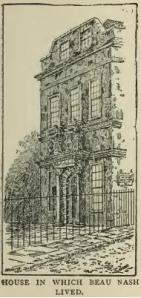
 In 1900 Jolly and Sons Drapers, of Milsom Street, Bath, published this charming 72-page Handy Guide to The City of Bath, with illustrations. Click on the link to find it in PDF format on the American Libraries Internet Archive. Not only does this guidebook describe the history of Bath and its major institutions, sights, and environs, but you will also be treated to the history of Jolly and Sons Drapers.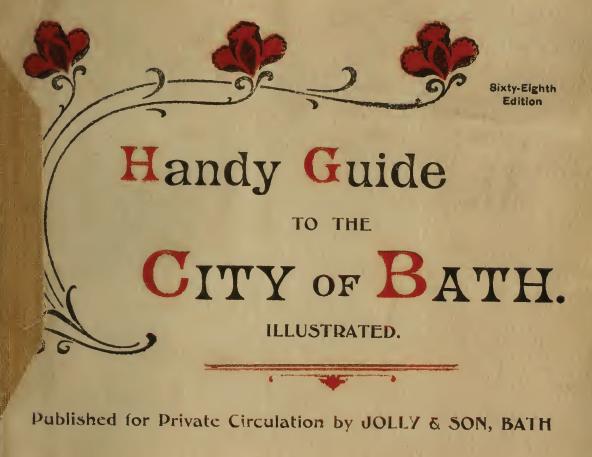
Archive for the ‘Bath’ Category
Handy Guide to The City of Bath – A Vintage Guide Book
Posted in Architecture, Bath, jane austen, Jane Austen's World, tagged Bath Guide Book, Georgian Bath, Handy Guide to the City of Bath, Jolly and Sons Drapers, Milsom Street, Regency Bath on October 13, 2008| 1 Comment »
Crazy About Jane: Northanger Abbey
Posted in Bath, jane austen, Jane Austen videos, Popular culture, Regency Life, Regency World, tagged Bath Film Festival, Crazy About Jane on October 12, 2008| 3 Comments »
 Crazy About Jane is “a must have for Jane Austen fans. This unique documentary made by Bath based film makers Nautilus Moving Image, provides a rare opportunity to meet the fascinating people behind the festival,including the Festival Director David Lassman. David was famously rejected by publishing houses after submitting an almost exact copy of Jane’s most famous novel ‘Pride and Prejudice’ under the pseudonym ‘Alison Laydee’ after Austen’s early pseudonym ‘A Lady’.
Internationally celebrated artist Kim Hicks is also featured performing an extract from her widely acclaimed one woman Jane Austen show.” Kim Hicks delivers two short extracts from Northanger Abbey in two YouTube videos.
- In this link two friends perambulate in the Pump Room
- In this link, Mr. Tilney is on his way to Northanger Abbey with Catherine.
- Click here to view all the Crazy About Jane YouTube videos.
- Click here to Go Gothic With Northanger Abbey at Austenprose
Quote from the Crazy About Jane website.
The Pump Room’s Little-Known and Well-Known Facts
Posted in Bath, jane austen, Regency Life, Regency style, Regency World, tagged King's Spring, Pump Room, Regency Bath on October 6, 2008| 18 Comments »
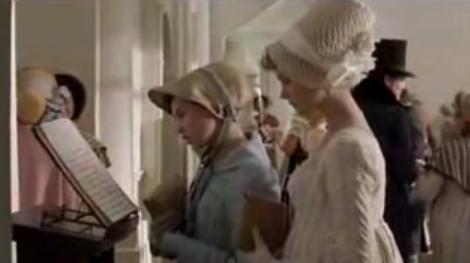
Visitor's Book, Pump Room
With more than usual eagerness did Catherine hasten to the Pump-room the next day, secure within herself of seeing Mr. Tilney there before the morning were over, and ready to meet him with a smile; – but no smile was demanded – Mr. Tilney did not appear. Every creature in Bath, except himself, was to be seen in the room at different periods of the fashionable hours; crowds of people were every moment passing in and out, up the steps and down; people whom nobody cared about, and nobody wanted to see; and he only was absent. “What a delightful place Bath is,” said Mrs. Allen as they sat down near the great clock, after parading the room till they were tired; “and how pleasant it would be if we had any acquaintance here.” Jane Austen, Northanger Abbey Chapter IV
Gentle readers, before you continue please be aware that this post features a series of vignettes and memories from people who wrote their recollections about the historic Pump Room in Bath, so prominently mentioned in Northanger Abbey during Catherine Morland’s visits there with her benefactors, the Allens. In honor of Austenprose’s coverage of Northanger Abbey for the month of October, I have gathered observations about the Pump Room that were placed online from periodicals and journals of Jane Austen’s time. Please enjoy the reviews of Jane’s contemporaries and predecessors:
In 1678 a single woman named Celia Fiennes journeyed to Bath and wrote in her journal:
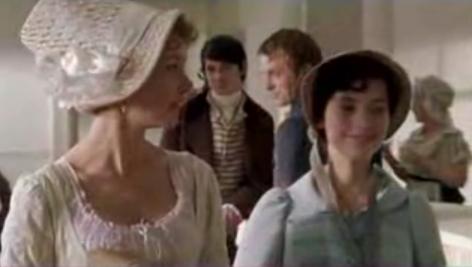
Promenade in the Pump Room, Isabella Thorpe and Catherine Morland
All the baths has the same attendance, the Queen’s bath is bigger than the other three but not a neare so big as the King’s, which do run into each other and is only parted by a wall and at one place a great arch where they run into each other; the Queen’s bath is a degree hotter than the Cross bath, and the King’s bath much hotter; these have all gallery’s round and the pump is in one of these galleryes at the Kings bath which the Company drinks of; its very hot and tastes like the water that boyles eggs, has such a smell, but the nearer the pumpe you drinke it the hotter and less offencive and more spiriteous. (Celia Fiennes (1662-1741), was a grand-daughter of Lord Saye and Sele. It was not unusual for single ladies to travel about the country during the 1600s. Her journal was not published until 1688.)
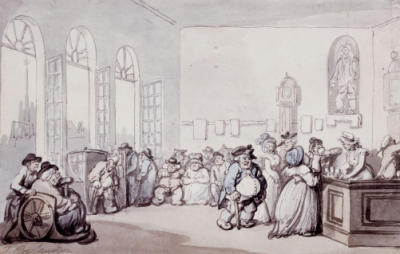
The Comforts of Bath, Rowlandson, The Pump Room, 1798
Since Roman times, Bath’s hot mineral springs have pumped a quarter of a million gallons of spring water a day at a steady temperature of 49°c. In 1708, Thomas Harrison built the Bath Assembly House, for which the public paid fees to dance and gamble. During mid-18th to early 19th century, Bath’s population exploded from 2,000 to 38,000, becoming the eighth largest city in England by 1801. Three men – Ralph Allen, post master; John Wood, architect; and Beau Nash, fashion and social arbiter – contributed to this up and coming city’s popularity with the leisure classes. Developer John Wood followed the Palladian concept of the architectural ideal, constructing magnificent squares, parades, and buildings out of softly-hued, beautiful honey-coloured Bath stone. Ralph Allen contributed much of his personal fortune to Bath’s rebuilding, and Beau Nash organized Bath’s social life and balls, bringing in musicians from London, exerting his influence as a dandy, and becoming a leader of fashion. The original Pump Room, erected in 1706, quickly became too small for the increasing numbers of visitors. It was enlarged in 1751, a new portico was added in 1786, and a new frontage was constructed in 1791. Even so, the renovations were inadequate. An entirely new room that was eighty-five feet long, forty-six feet wide, and thirty-four feet high was constructed in 1796.
“It was in digging for the foundation of this building that the valuable and interesting remains of the Roman temple of Minerva were discovered. So far did the new buildings surpass those of the old town in architectural beauty that steps were taken in 1789 for modernizing and improving it, and an Act of Parliament was obtained empowering the Corporation to raise the Sum of 80,000 upon their estates and other securities for the purpose of improving the city by the erection of new streets and widening of others. It was under the powers of this Act that the present pump room, Union street, Bath street, and Hot Bath street were erected, Cheap street widened and other improvements effected.” The Gentleman’s Magazine
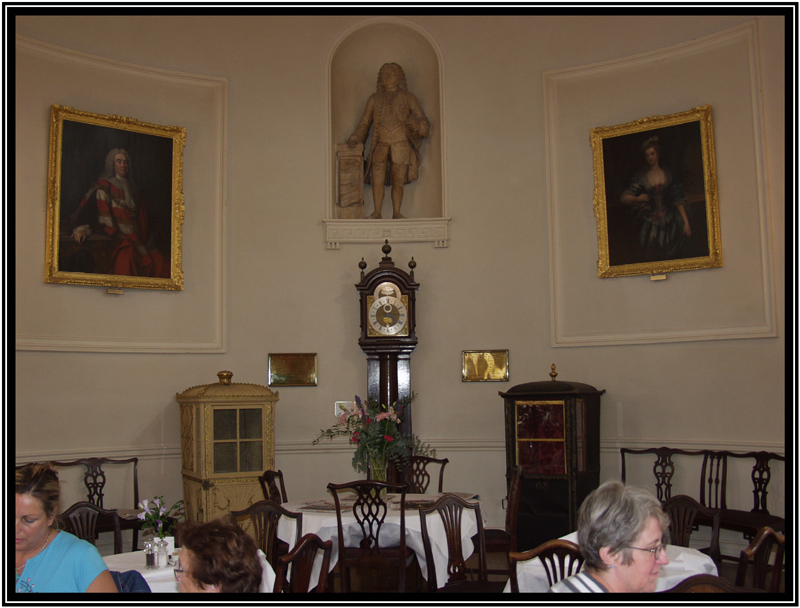
Statue of Beau Nash in the Pump Room
Visitors promenaded up and down the great room, and drank the waters from eight or nine in the morning until three in the afternoon. The main spring that feeds the fountain “is in the centre of the King’s Bath where it is retained in a large leaden cistern at the bottom from which pipes conduct the water used for drinking the principal of which conveys it to the fountain of the pump room and most certainly an uninformed spectator would suppose that the identical liquid was drunk in which the people were bathing.” The British Magazine
“In the Pump Room itself, an orchestra played while visitors drank the obligatory quantity of the water. Lydia, in Smollett’s novel Humphrey Clinker, describes the experience: “The noise of the music playing in the gallery, the heat and flavour of such a crowd, and the hum and buzz of their conversation, gave one the headache and vertigo&.” (The gallery in question, reached by a ladder, was semi-circular and contained five musicians led by a trumpeter). The Bath Herald in 1799 was rather more enthusiastic: “The Pump Room Band is one of the oldest and best establishments of this place; it draws visitor and inhabitant to one general place of morning rendezvous, whilst the inspiring melody of the Orchestra spreads a general glow of happiness around.” Bath Baroque
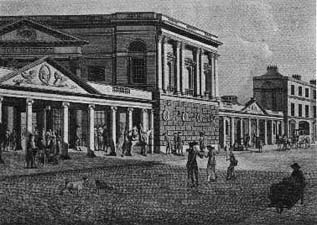
In 1811 a Canadian visitor visited Bath and described the Pump Room in his journal:
The gentlemen dressed in breeches stockings and cocked hats; the ladies in the most superb manner – pelisses laced with gold cords and Hussars’ hats, having three circles of gold cord round them with two great tassels of gold upon the left side. What is called a reticule, which contains their pocket-handkerchief and work, is hanging by a gold chain to the arm, and is fringed with gold. I went to the Pump Room, which is very large and grand. On one side is the pump, where a woman stands and distributes old King Bladud’s waters to old and young, sick and ill. An old duchess of eighty and a child of four were both drinking the waters while I was there. I had a glass; it is very hot and tastes very mineral. At one end of the room is an orchestra, where bands of music are continually playing. The company at the same time walking up and down in crowds, not minding the music, but buzzing like merchants on ‘change. At the end of each tune they clap their hands and kick up or not for what they don’t know. – The Early Days of the Nineteenth Century in England, 1800-1820 1800-1820. By William Connor Sydney

Pump Room with Chandelier and Music Gallery
The baths to which the city chiefly owes its celebrity and wealth are five in number: the King’s bath ,the Queen’s bath ,the Hot bath, the Cross bath ,and the Kingston bath, the last of which is the property of Earl Manvers. The others are the exclusive property of the corporation, who retain the management of them and from them and the profits of the Pump room obtain an income of about 1,500 a year. The revenue from the Pump room is derived from subscriptions for drinking the waters. The Pump room is an elegant and spacious hall built in 1797 for a promenade for the company and for drinking the waters it is 85 feet long 48 wide and 34 high the ceiling being supported by elegant Ionic pillars having at the cast end a statue of the celebrated Beau Nash who first officiated as master of the ceremonies. The baths are of course provided with all the appliances which luxury or sensitiveness can desire .The Hot bath derives its name from the superior heat of its waters, which average about 117 of Fahrenheit. The British Gazetteer, Political, Commercial, Ecclesiastical, and Historical Showing the Distances of Each Place from London and Derby-gentlemen’s Seats-populations … &c. Illustrated by a Full Set of County Maps, with All the Railways Accurately Laid Down … By Benjamin Clarke

Palmer, Pump Room, 1804
One spring supplies the fountain in the Grand Pump Room, the King’s Public and Private Baths, the large tepid swimming bath, and the New Royal Private Baths adjoining the Pump Room Hotel, and the baths of the Mineral Water Hospital. A continual flow of the mineral water coming straight from the spring is supplied by a fountain in the Grand Pump Room. Formerly the internal treatment was much in vogue and large quantities of the hot water were ordered or taken without orders. At present the amount usually drunk is from four ounces to half a pint twice a day. The Climates and Baths of Great Britain Being the Report of a Committee of the Royal Medical and Chirurgical Society of London By Royal Medical and Chirurgical Society of London, Robert Barnes, J. Mitchel Bruce, William Ewart, William Murrell
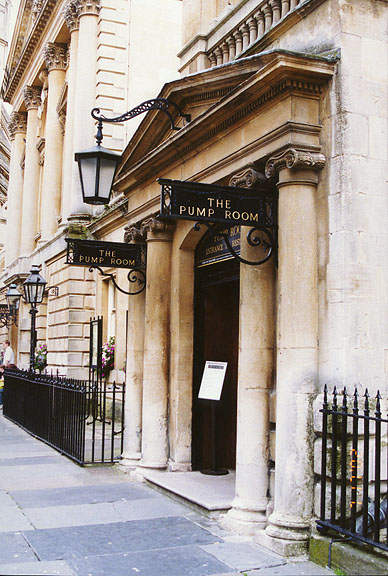
Entrance to the Pump Room
A year before her death in 1818, Queen Charlotte stayed in a house in Sydney Place.
“A house was taken for her at 93 Sydney Place, and lavishly equipped; and a second house at 103 Sydney Place was reserved for her entourage, and for the Duke of Clarence, who arrived in the city on the same day. Bath welcomed the royal party enthusiastically and a contemporary, after describing the decorations, noted that, ‘tho the streets were crowded to an excess, not the least riot or confusion appeared; nor were groups of well-dressed females annoyed in their perambulations by the throwing of squibs or the firing of guns‘.”
Shortly after her arrival, the Queen’s granddaugher died in childbirth. After the funeral, the seventy-three year-old Queen returned to Bath for nearly a month. Queen Charlotte in Bath.
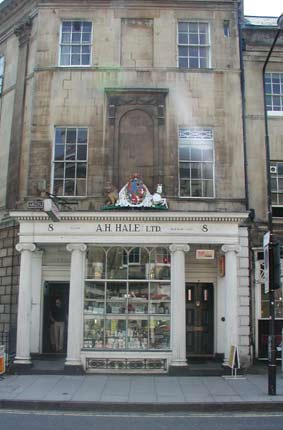
The House Where Queen Charlotte Stayed
“Her Majesty occupied a large house in Sydney Place. She daily passed in a sedan chair to the Pump Room and graciously as well as gracefully acknowledged the obeisances of those who assembled to behold her.” Historic Houses in Bath, and Their Associations By Robert Edward Myhill Peach.
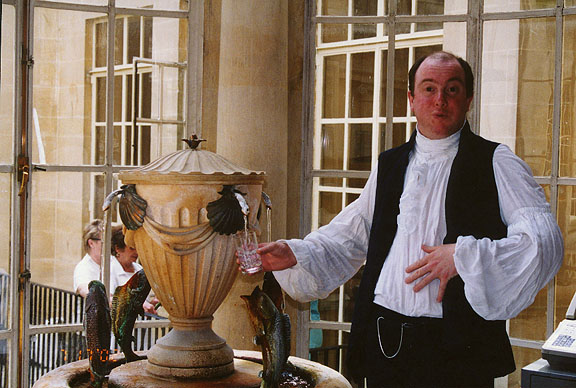
Taking warm mineral waters from the King
Bath Timeline (1714-1820)
1738–Start of the construction of The Royal Mineral Water Hospital reflected a new period of faith in the healing properties of the waters. It is also notable as the only building on which the three men most responsible for the construction of Georgian Bath–John Wood the Elder, Beau Nash and Ralph Allen–collaborated. While the beneficial and healing properties of the water have always been acknowledged, modesty and decency have not always been inherent in Bath’s “spa culture.” John Wood the Elder writes at this time: “The Baths were like so many Bear Gardens, and modesty was entirely shut out of them; people of both sexes bathing by day and night naked.”
1777–Hot Bath rebuilt to the design of John Wood the Younger.
1783-98–Cross Bath rebuilt and then enlarged.
1788–New Private baths (now demolished) built between King’s Bath and Stall Street.
1790s–Great Pump Room built. While excavating the foundations for the new Great Pump Room, many of the
first finds relating to the Roman Temple were made.
1798–The publication of “The Comforts of Bath,” a satirical view of life in Bath, reflects the infamous lifestyle of elements of Georgian society. The Pump Rooms and the baths were the center of much revelry throughout this period when Bath became known as the “premier resort of frivolity and Fashion – Bath: A World Heritage Site
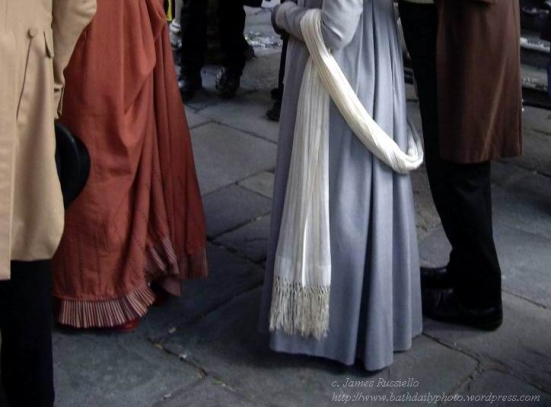
2007 Persuasion actors filing into the Pump Room, Bath Daily Photo
- Beethoven Minuet in G played in the Pump Room, Bath by Jools Scott
- The Pump Room, Jane Austen Sequels
- May in Regency Bath, Jane Austen Centre
- King’s Spring, Bath
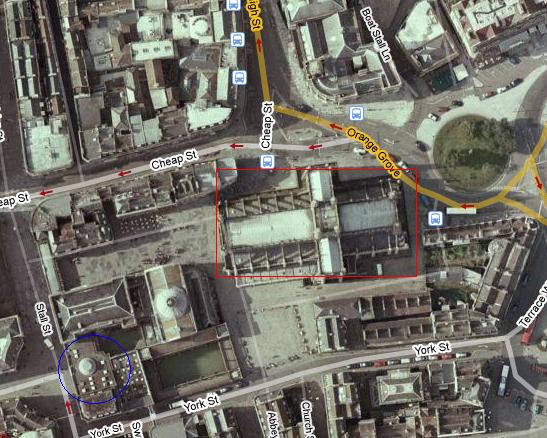
Google Map: Pump Room (blue Circle) and Bath Abbey (Red Rectangle)
Interactive Maps of Regency London and Bath
Posted in Bath, jane austen, Mayfair, Regency London, Regency World, tagged Green Park, Interactive Maps, Pall mall, Wikimapia on September 2, 2008| 1 Comment »
Ah, London. If I were rich, I would visit this city every month. So I shall simply have to rely on interactive maps and panoramic views to satisfy my yearnings. Wikimapia is an online collaborative mapping system that combines google maps with a wiki system, allowing users to add information. Click here to see an interactive image of a portion of London that shows Hyde Park, Mayfair, and Green Park. The square grids provide detailed information about the mapped area when you move your cursor over them.

Static map of Green Park, The Mall, and Victoria Monument, London
The exciting part about this project is that if you have visited this part of the world (or better yet, live there) you can add your knowledge about a particular area. This interactive image depicts Green Park and Pall Mall. You can see Buckminster Palace at the lower left, the Victoria Memorial and the Mall leading from it, and St. James’s Palace in the upper right. To view greater details I keep clicking on the images until I see such details as people walking in the park and cars parked in the streets. Amazing.
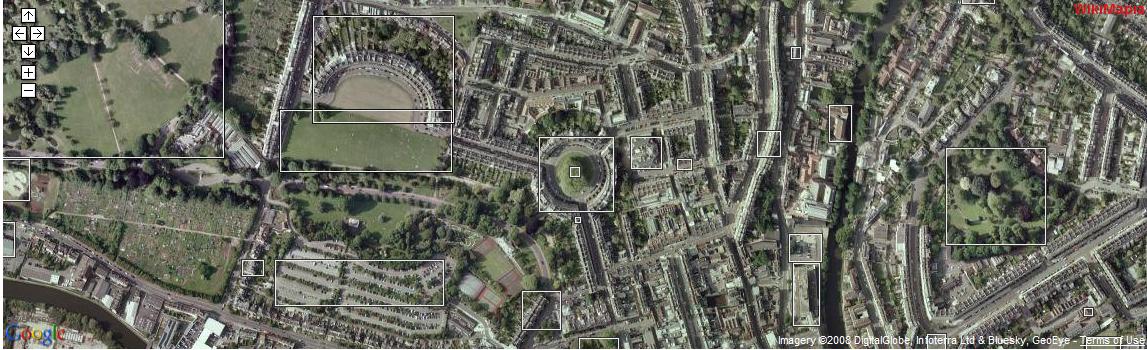
Static map of Bath, England
Let’s not forget Jane Austen and her world. This link leads to an interactive map of an arial view of Bath, England, and this link leads to an interactive close up of Pulteney Bridge (see static map below. The details are so fine that you can see cars parked on the streets. Spectacular.
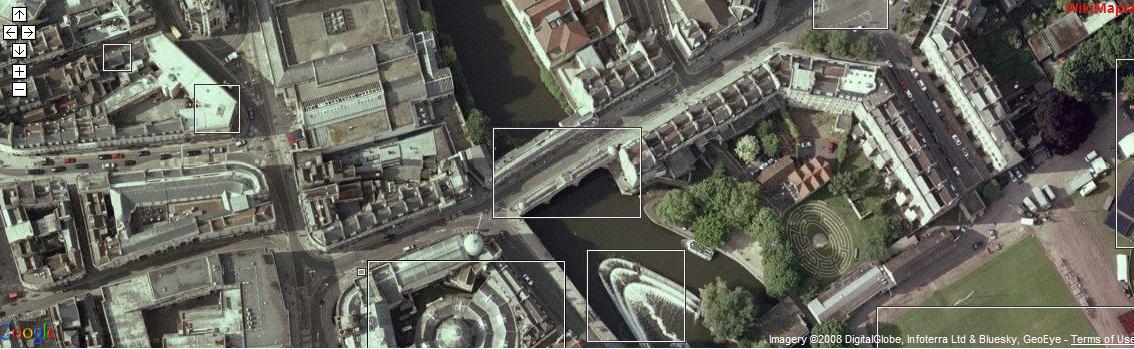
Pultney Bridge, static map
Assembly Rooms, Bath
Posted in Bath, jane austen, tagged Assembly Rooms, crystal chandeliers, Regency Bath, restoration of Assembly Room chandeliers, Upper Assembly Rooms Bath on August 17, 2008| 6 Comments »
Catherine too made some purchases herself, and when all these matters were arranged, the important evening came which was to usher her into the Upper Rooms. Her hair was cut and dressed by the best hand, her clothes put on with care, and both Mrs. Allen and her maid declared she looked quite as she should do. With such encouragement, Catherine hoped at least to pass uncensured through the crowd. As for admiration, it was always very welcome when it came, but she did not depend on it. – Jane Austen, Northanger Abbey
 Jane Austen fans are familiar with the assembly room scenes in Northanger Abbey, where Catherine Meets Mr. Tilney (1986 film). In the recent 2007 ITV NA production, Catherine and Mrs. Allen encounter a crush in the Upper Assembly Rooms, and they had to push through the throng to make it to the ballroom where Catherine had difficulty seeing the dancers. Although they were surrounded by people, no one talked to Catherine or Mrs. Allen because they had received no proper introductions. Henry Tilney fixed the problem by asking the Master of Ceremonies to formally introduce him to Catherine and her escort.
The Upper Assembly Rooms (top) as Jane knew them remained essentially unchanged during Constance Hill’s day, but by the time she wrote her 1923 biography of Jane, the Lower Rooms no longer existed. Miss Hill wrote in Jane Austen: Her Homes and Her Friends:
 The portion that remains of the lower rooms
The old Assembly or Lower Rooms no longer exist, having been destroyed by fire many years ago. The author of a Bath Guide which appeared early in the century, speaks of them as situated “on the Walks leading from the Grove to the Parades,” and as containing “a ball-room ninety feet long, as well as two tea-rooms, a card-room,” and “an apartment devoted to the games of chess and backgammon”; and tells us that they were “superbly furnished with chandeliers, girandoles, &c.” – For Constance’s delightful description of a gathering in the Assembly Rooms, please click on this link.
The Upper Assembly Rooms’ irreplaceable crystal chandeliers were taken down and kept in safe storage during World War II. This foresight paid off, for the rooms were bombed by the Germans in 1942. They were restored in 1988-1991, almost fifty years later, by R. Wilkinson & Sons of London. The process of lowering them and cleaning them is laborious and precise, as the photograph below attests.

According to the Fashion Museum in Bath’s website, “The chandeliers in the three rooms are each an average height of eight feet and they are made of Whitefriars crystal from the Whitefriars Glassworks in London.” The ballroom chandeliers were originally lit by forty candles each.
For more information about the Assembly Rooms and their crystal chandeliers, click on the posts below:
- Bath: Constance Hill: Jane Austen: Her Homes & Her Friends (John Lane The Bodley Head, 1923) by Constance Hill.
-
Join 7,216 other subscribers
-
2025 AGM in Baltimore
-

-
Items of Interest
Blog Stats
- 18,528,608 hits
- Follow Jane Austen's World on WordPress.com
-
RECOMMENDED BOOKS AND RESOURCES
-

Fashionable Goodness: Christianity in Jane Austen's England is now available! By JAW contributor Brenda S. Cox. See Review. Available from Amazon and Jane Austen Books. 
We also recommend JAW contributor Rachel Dodge's devotionals based on Jane Austen's prayers and classic literature. Reviews:
Praying With Jane: 31 Days Through the Prayers of Jane Austen
The Anne of Green Gables DevotionalThe Little Women Devotional
The Secret Garden Devotional
The Tour of Doctor Syntax. Edited by Ben Wiebracht. Read the review of the book at this link. Click to order the book on Amazon US or Amazon UK or Jane Austen Books FREE Student Membership to JASNA
Available through December 31st, 2025. Click on image for details, and share this poster with other teachers and students!

The Obituary of Charlotte Collins by Andrew Capes

Click on image to read the story.
Comments
“My idea of good company…is the company of clever, well-informed people, who have a great deal of conversation.” – Jane Austen, Persuasion

Gentle readers: Please feel free to post your comments and continue the conversation! Due to SPAM, we will no longer accept comments on posts after 30 days of publication. In some instances, links will be removed from comments as well.
Administrators and Contributors
Pin It!

Top Posts
-
Recent Posts
Links to Jane Austen Blogs
May we suggest?
Hello, my name is Vic and I live in Maryland, USA. I have adored Jane Austen almost all of my life. I am a proud lifetime member of the Jane Austen Society of North America. This blog is a personal blog written and edited by me and my team. We do not accept any form of cash advertising, sponsorship, or paid topic insertions. However, we do accept and keep books and CDs to review.
If you would like to share a new site, or point out an error, please email us. (Yes, we are fallible. We'll own up to our mistakes and will make the corrections with a polite smile on our faces.) Write us at

Thank you for visiting this blog. Your comments and suggestions are most welcome.
Project Gutenberg: eBook of Stage-coach and Mail in Days of Yore, Volume 2 (of 2), by Charles G. Harper
STAGE-COACH AND MAIL IN DAYS OF YORE: A PICTURESQUE HISTORY
OF THE COACHING AGE, VOL. II, By CHARLES G. HARPER. 1903. Click on this link.
Top Posts & Pages
- Men's hair styles at the turn of the 19th century
- Regency Fashion: Men's Breeches, Pantaloons, and Trousers
- Goodnestone and Holy Cross Church (Jane Austen's Family Churches)
- Regency Hygiene: The Bourdaloue
- Pictorial History of Regency Hairstyles
- Highclere Castle Floor Plan: The Real Downton Abbey
- Dancing at the Netherfield Ball: Pride and Prejudice
- Jane Austen’s Regency Women: A Day in the Life, Part 1
- The Servant's Quarters in 19th Century Country Houses Like Downton Abbey
- Social Customs During the Regency
Tour Chawton Cottage on YouTube
-
Disclaimer: Our team makes no profit from this blog. We may receive books (physical or digitized) for review purposes.
-
Copyright Statement: © Jane Austen's World blog, 2009-2024. Unauthorized use and/or duplication of this material without express and written permission from this blog’s author and/or owners is strictly prohibited. Excerpts and links may be used, provided that full and clear credit is given to Jane Austen's World with appropriate and specific direction to the original content.




 Jane Austen's World