Feeds:
Posts
Comments

Archive for the ‘Biography’ Category

Copryright (c) Jane Austen’s World. Post written by Tony Grant, London Calling.

For four days last week, I was working in a school in Staines near Heathrow Airport. To get there from Wimbledon I had to drive past David Garrick’s Villa and his temple to Shakespeare, at Hampton on The Thames.
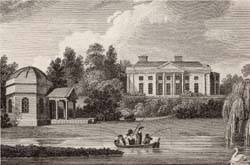
Garrick's Villa, 1783

David Garrick was an 18th century actor, playwright and owner of Drury Lane Theatre. He was innovative, and the forerunner of a new acting style. He was regarded as the greatest actor of his time and arguably is one of the great actors of all time. He had a profound interest in Shakespeare. It is easy to see connections between David Garrick and his career and the career and  driven personality of Dickens. Perhaps they are both a mirror in which we can see something of ourselves.

Garrick

David Garrick was the second son of Peter and Arabella Garrick. He was born at The Angel Inn in Hereford on the 19th February 1717. For a while he was the pupil of Samuel Johnson at the little school at Edial near Lichfield. In 1773 Garrick and Johnson went to London together both with little money to support them. Garrick at first worked as a salesman in his family’s wine firm. However he turned to playwriting and acting. He write a version of, “Lethe,” that was used by Henry Giffard’s company at Drury Lane. He then joined Giffard’s company and worked at the theatre in Tankard street in Ipswich. At first Garrick took the stage name of Lyddall. On the 19th October 1741 he played Richard III at Goodman’s Fields Theatre in East London. He was an overnight sensation.
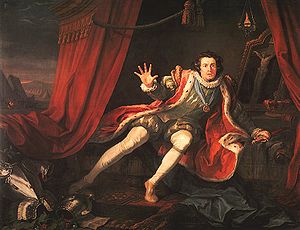
David Garrick as Richard III, 1745. William Hogarth

His acting style was new and innovative. He began a more naturalistic style. Rather than use the exaggerated bombastic style that was popular. On 28th November that year he got rid of his stage name and began to use his real name. His real name appeared on the posters advertising, “The Orphan,” in which he played the character, Chamont.. As a sign of his meteoric rise to fame within two months William Pitt decalerd that the 22 year old Garrick was the best actor the British stage had ever produced. Garrick became the dominant force in British theatre from then on.
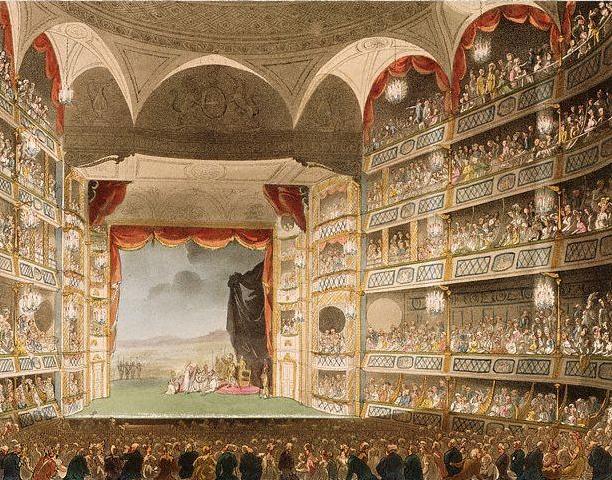
Drury Lane 1808

In 1747 with a new partner, James Lacey he took over the management of Drury Lane Theatre. For 29 years he directed repertory company in Europe. He developed new rehearsal techniques and discipline. His ideas included analysing characters, restoring the original texts of Shakespeare. Much of Shakespeare’s plays in the 18th century had been written in a bombastic and alliterative style. He didn’t always keep to Shakespeare’s original texts himself. He did tend to leave out bits and add bits to emphasise the character he was playing. Garrick was one of the leading playwrights of his day and wrote The Clandestine Marriage, Cymon, The Lying Valet and The Guardian. Garricks influence became the yardstick by which all other acting and drama was measured throughout Europe.
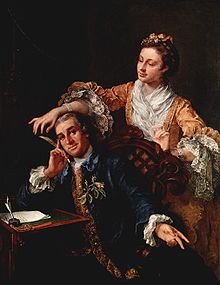
William Garrick and his wife, Eva Maria Vegel, by William Hogarth

In 1749 Garrick married the Viennese dancer, Eva Maria Vegel. They had no children and she outlived him by 43 years.They were so famous the crowned heads of Europe, the nobility and the leading figures of the London literary, art and social circles came to visit him.He owned residences at No 27 Southampton Street in Covent garden, in the Sdelphi, and his villa at Hampton on The Thames.You can imagine the elite of Europe coming to Hampton to visit garrick at his Thameside retreat, walking by The Thames, visiting his temple to Shakespeare and rowing out to the aits (river islands) Garrick owned along his stretch of the river to have sylvan parties in a beautiful natural surround.
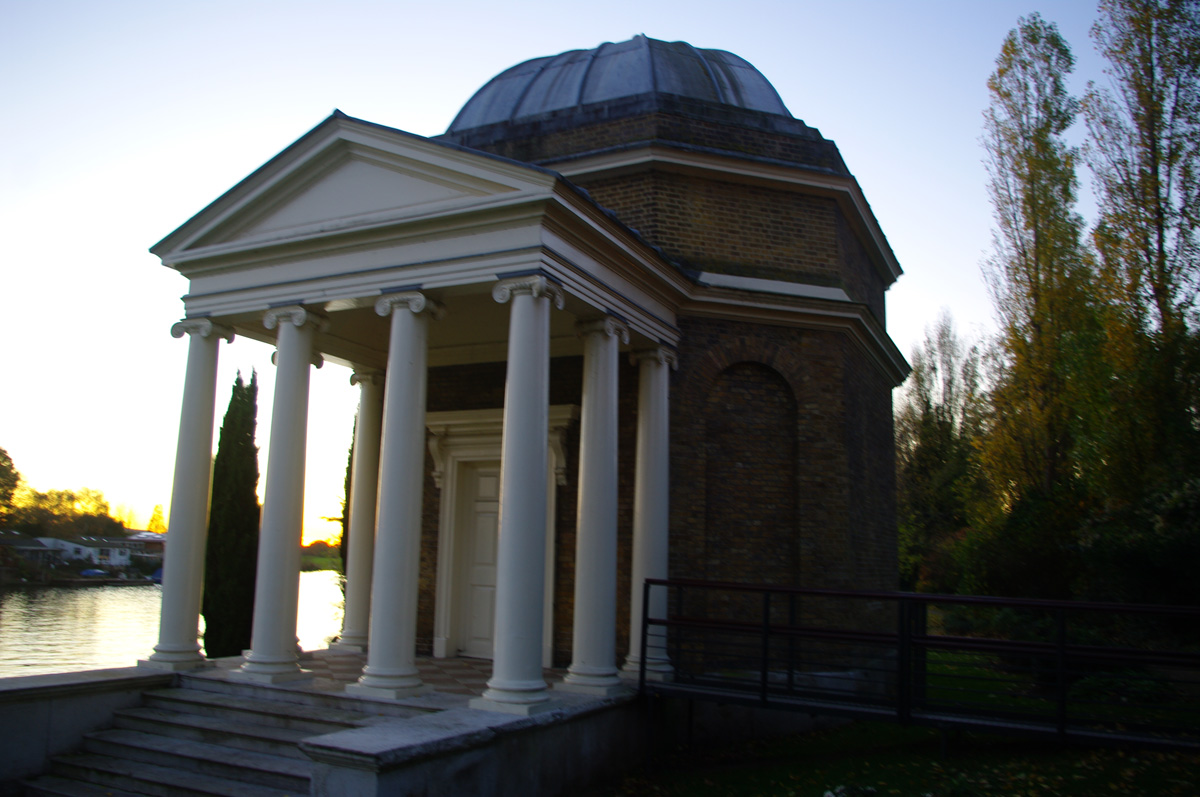
Garrick's temple close up. Image @Tony Grant

Garrick gave up Drury Lane and made his last performance at Drury Lane during a series of final performances in June 1776. He died in his house in the Adelphi on 20 th January 1779. He was buried at Poets Corner, Westminster Abbey.
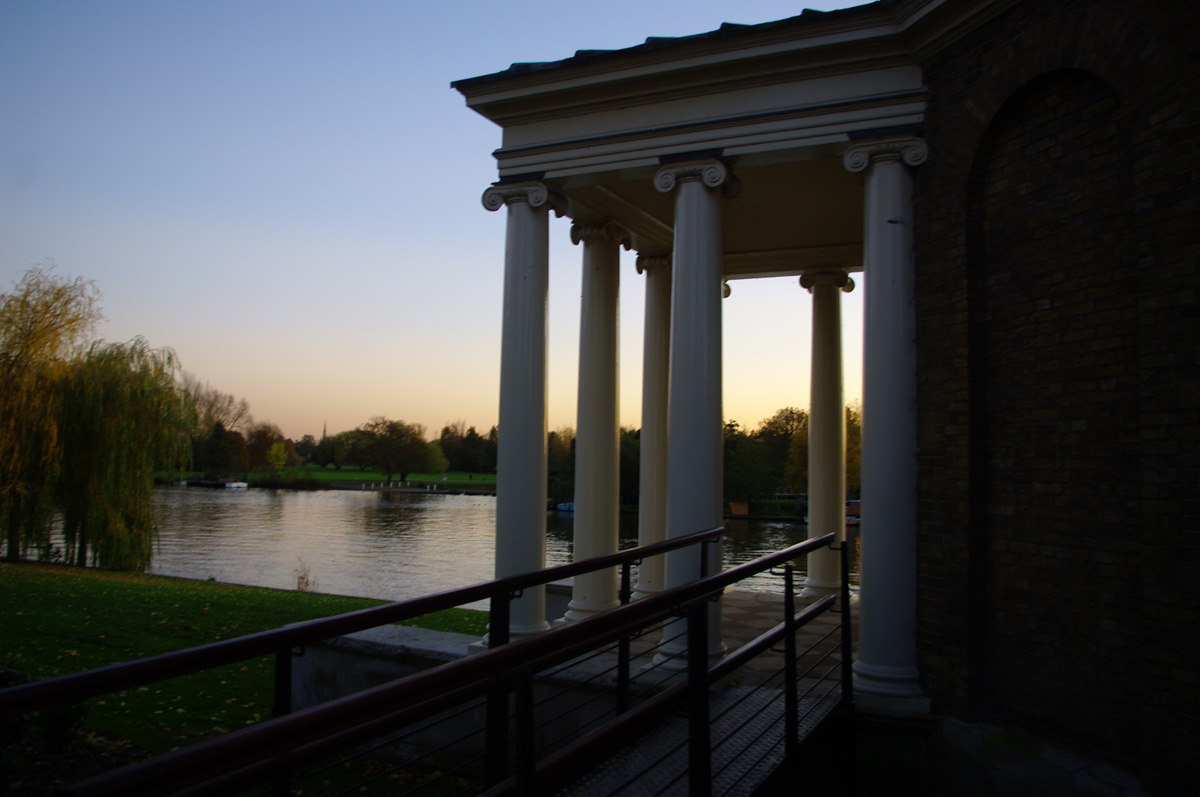
View of the Thames from the Temple. Image @Tony Grant

Gentle reader: This is the first of two articles about David Garrick by Tony Grant. The second will concentrate on the actor’s beautiful house and temple on the Thames.

Read more about the topic

Read Full Post »

Born December 16, 1775

WIN one of six Jane Austen NAXOS books on tape by leaving a comment on Jane Austen Today. Click on the link for an opportunity to win a high quality audio book.

Also win a two-pack of Jane Austen note cards and Christmas cards on Austenblog.

Read Full Post »


Often a journey is more pleasant if one slows down and savors it. I had hoped to review Lori Smith’s book, A Walk With Jane Austen: A Journey into Adventure, Love & Faith, in one fell swoop, but my busy summer schedule would not allow it. This was to my benefit. Everywhere I went I took Lori’s manuscript with me, like a comfortable friend. I discovered that this is no facile book to be read quickly, for Lori investigates such important concepts as faith, morality, and the decisions that change one’s life and set one on a different path.

In fact, this book resonated deeply with me, a fallen Catholic girl. Like Lori, I stayed in a monastery. Last week I was a guest of the Benedictine nuns for two nights, and experienced the same sense of peace that Lori describes in Alton Abbey, the monastery she stayed in when she visited Steventon (above) and Chawton Cottage. But unlike Lori’s silent monks, my nuns chattered like magpies and lived in the moment, working in the real world to bring home the bacon.

Lori describes her visits to Jane’s homes vividly, including Edward Austen-Knight’s Wedgewood china (above) with its geometric pattern of purple and gold around the edge, which he chose in London when Jane was with him. In fact, Lori weaves the personal details of Jane’s life and the details of her own past and present seamlessly in her exquisitely crafted journal.

We learn about the love the two elder Austens had for each other, and what a close-knit family they had created; how Henry championed Jane’s career and bragged about his sister’s authorship; how Edward waited just a tad long to invite his mother and sisters to live in Chawton Cottage; how close Jane felt to Anne Lefroy, who was 27 years her senior; and which character flaws Jane might have had in common with the spoilt and indulged Emma, whose picnic at Box Hill (below) resulted in Mr. Knightley scolding her for humiliating poor Miss Bates.

My favorite section in Part II is Lori’s description of the British Library. Its fascinating contents were a revelation on her part (See the previous post), especially the variety of rare and original manuscripts. This section of the books ends with Lori’s visit to Godmersham Park (below). She describes a horrendous journey on the A road that ended with the kind gesture of a cabby and a breathtaking view of Edward’s fabulous mansion. Lori’s next stop is Winchester, which begins the last part of the book. I can’t wait to read it.

Read Full Post »

On the anniversary of Jane Austen’s death – she died 190 years ago today – I thought I would put a different spin on things and celebrate her life. Jane means so many things to so many people, and her popularity, instead of diminishing, increases each year. What is it about Jane that attracts so many to her? It seems that every time we turn around, another book about Jane’s life sits on a shelf in a book store and she is more popular than ever.

In her new book, A Walk With Jane Austen, author Lori Smith describes the first time she encountered Jane Austen in college. She discovered Pride and Prejudice in a used book sale, and so, over Christmas break, her love affair with Jane Austen began. My own relationship with Jane’s novels started during my fourteenth summer. Like Lori I have read Jane’s marvelous words ever since. But I digress. This post is meant to be a review of Lori’s quest to strengthen her relationship with Jane and, in doing so, gain a better sense of her own life, which was whirling out of kilter.

During a critical juncture in Lori’s life when she faced a personal crisis, she chose to do what many of us yearn to do but few actually dare, which is to leave everything behind and embark on a life altering journey. Lori’s account about her search for Jane is written on several levels, as a memoir and personal journey of faith and discovery, as a search for the places where Jane Austen lived and trod, as a straightforward history of Jane’s life, and as a way to deepen her understanding of the author.

One January not long ago Lori gave her notice at work. “In February I walked away from meetings and coffee breaks and lunch breaks and paid vacation and health insurance to the gloriously terrifying world of writing full-time.” Lori did not choose an easy road when she decided to walk with Jane Austen. Writing a memoir might seem straightforward on the surface, but…

There are enormous difficulties in reconstructing anyone’s life, for however copious the evidence of letters, diaries, journals, and eye witness accounts, there is always the problem of interpretation, of the subjectivity of witnesses, and of the basic contradictoriness of the human being. Moods and emotions are volatile, but when recorded on the page are often forced by posterity to carry a much greater weight than was ever intended by their author. The Art of Writing Biography

Lori’s journey is deeply personal, but one she willingly shares with her readers. The first chapter ends with her heading for Oxford, the city where Jane’s parents met and married.

I plan to review Lori’s book chapter by chapter. The book, published by Waterbrook Multnomah Publishing Group, a Division of Random House, Inc., will be available this fall. Click here to visit Lori’s blog.

Click here for my post about Jane’s last illness.

Read Full Post »

During her short life, Jane Austen was a prolific writer of letters, yet few survive. It is widely known that a majority of Jane’s letters were burned by her sister Cassandra and destroyed by other members of her family. Their reasons were varied. This excerpt from Jim and Ellen Moody’s website: English and Continental Literature, discusses the destruction of these letters and the reasons for it:

Not all the Austens of Jane’s generation and increasingly fewer who belonged to the later generations wanted the family’s private papers destroyed. It was not Jane but Cassandra who burnt ‘the greater part’ of Jane’s letters, and she only committed them to the fire when in 1842 she understood her own death could not be far off. Jane’s letters to Eliza and Henry and hers to them were left in Henry’s hands, and they have not survived. However, Frank, throughout a long mobile life, carefully preserved Jane’s letters to his first wife, Mary Gibson, and her packets of letters to himself and to Martha Lloyd (who became his second wife). It was Frank’s youngest daughter, Fanny-Sophia, who destroyed these and she did so after her father’s death (Family Record, p. 252). She acted without consulting anyone beforehand because by that time mores had changed and other of Frank’s children and grandchildren would have objected. Happily Philadelphia Walker had no direct descendants who felt their reputations or self-esteem put at risk by the existence of Eliza’s letters to her, and she lived long enough so that upon her death these letters fell into the hands of someone disinterested enough to save them, though in a somewhat mutilated state. A record of Jane Austen’s great-grandmother, Elizabeth Weller Austen’s steady courage, which enabled Jane’s branch of the family to maintain the status of gentleman and amass wealth and prestige, survives in a seventeenth century manuscript because several generations of Austens who descended from her second oldest son, the attorney, Francis Austen of Sevenoaks, preserved it (Austen Papers, p. 2).

As a result of the destruction of Jane’s own words, biographers have over the years come to widely different conclusions about Jane’s thoughts and motives. Ellen Moody outlines some of these varying interpretations in the link I have provided.

To read Jane’s letters, click on the following sites:

Read Full Post »

« Newer Posts - Older Posts »

