Feeds:
Posts
Comments

Archive for the ‘Book review’ Category

Volz BookInquiring readers,

My apologies to author Jessica Volz–who contacted me weeks before the COVID-19 lockdown about her book–for posting my review of her book several months late. She has been so patient that I must thank her for her graciousness. – Vic Sanborn

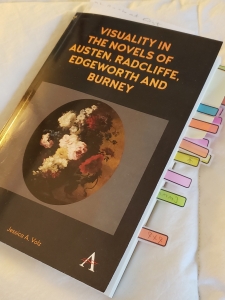
The highly interesting and informative Visuality in the Novels of Austen, Radcliffe, Edgeworth and Burney, is no fast walk in the park as far as reading goes, but it is worth the effort since it is filled with new and insightful information. One cannot skip or skim to learn about the way Austen and female writers of her era used visuality in language to communicate hidden meaning. In order to understand how visual language transmitted women’s emotions, issues, and areas of concern in a patriarchal society, I digested Dr. Volz’s words and reflected on how her observations helped me to reassess my understanding of the hidden language these 18th and 19th century authors used.

In her book, Dr. Volz studied the novels of four authors published between 1778 and 1815. Three of those novelists, Radcliffe, Edgeworth, and Burney, enjoyed recognition during Austen’s life, while Austen ultimately found lasting fame as a literary giant. This was a time when women’s views on their rights shifted, greatly helped by the Enlightenment’s campaign for human rights, the influence of the French Revolution in questioning conventional perceptions of women, and Mary Wollstonecraft’s revolutionary writings. Wollstonecraft wanted male-dominated females to attain power over themselves. While this emancipation would take a longer time than she even envisioned, Wolstonecraft influenced contemporary women authors to employ an approach that “concealed their resistance within an artful narration.” (1. Volz, p. 210.)

Volz’s findings found that in a patriarchal society, when women were expected to behave modestly and correctly and use phrases that were acceptable to their male relatives and husbands, female authors found a linguistic end-around through visual references. They:

…focused on ways their texts reveal the authors’ approaches to issues explored or suggested in the novels, including “women’s difficulties, polite society’s anxieties and the problems inherent in judging by appearances.” – (2. Painting With Words, Claire Denelle Cowart, JASNA, 2019.)

Thus, while the novels written by these four authors seemed to outwardly conform to societal standards, their heroines thought for themselves.

While the forms and functions of visuality that women novelists employed to their rhetorical advantage vary, they channeled their thoughts through several distinct visual pathways: visible and ‘invisible’ likenesses, architectural metaphors, the ‘made-up’ social self and communicating countenances.” (Volz, p. 212)

This review discusses some ways in which Dr. Volz examines how Austen employed the forms and functions of visuality. When she sent me her book, she was correct in predicting that I would be the most affected by the chapter that discussed Jane Austen. I’ll start with my first (and still favorite) Austen novel, Pride and Prejudice, and heroine, Elizabeth Bennet.

Elizabeth Bennet, Pemberley, and Mr. Darcy

While Dr. Volz discusses Pemberley well into Chapter 1, I did not begin to truly understand her analysis of Austen’s visuality until I reached this section. I knew Elizabeth Bennet was my favorite fictional heroine from almost the moment I met her at the age of fourteen. Lady Catherine deBourgh expressed the 18th century attitude towards women when she accused Elizabeth of being obstinate and headstrong. In other words, she was not the right sort of lady, especially not for Mr. Darcy.

On that first reading, I instantly understood that Elizabeth’s feelings towards Mr. Darcy were transformed as she walked along the beautiful grounds of Pemberley, viewed the house from afar in its perfect setting, moved throug its exquisite interior, listened to the raptures of his housekeeper as she described her master’s kindnesses, compared a miniature of his youthful self to Mr. Wickham’s (whose actions, as related by the housekeeper, described a cad), and then finally studied a large painted portrait of Mr. Darcy that to Elizabeth seemed true to life and captured her new understanding of his essence.

The architectural metaphors that Volz mentioned explain much in this description of Elizabeth’s leisurely ramble with the Gardiners along Pemberley’s grounds:

They gradually ascended for half a mile, and then found themselves at the top of a considerable eminence, where the wood ceased, and the eye was instantly caught by Pemberley House, situated on the opposite side of a valley, into which the road with some abruptness wound. It was a large, handsome, stone building, standing well on rising ground, and backed by a ridge of high woody hills;—and in front, a stream of some natural importance was swelled into greater, but without any artificial appearance. Its banks were neither formal, nor falsely adorned. Elizabeth was delighted. She had never seen a place where nature had done more, or where natural beauty had been so little counteracted by an awkward taste. They were all of them warm in her admiration; and at that moment she felt that to be mistress of Pemberley might be something!” (Pride and Prejudice)

As she views Pemberley’s grounds, Elizabeth can see herself living in this natural setting as its mistress, but she realizes with some sadness that this is no longer possible. To her regret, she rejected Mr. Darcy’s proposal based on her first impressions. Now that she sees him through a new lens, she recognizes how much their tastes and inclinations have in common. Moreover, she understands that Darcy, like his estate, Pemberley, has no artifice.

The lack of artifice is also how Mr. Darcy views Elizabeth – early in their association, he admires her expressive eyes and the liveliness of her character, which gave her a natural beauty much like the estate grounds he loves.

But no sooner had he made it clear to himself and his friends that she had hardly a good feature in her face, than he began to find it was rendered uncommonly intelligent by the beautiful expression of her dark eyes.” (Pride and Prejudice)

Austen also emphasized Darcy’s admiration of Elizabeth’s unorthodox, unladylike walk to Netherfield, which “improved her figure’s picturesque quality and intensified the expressiveness of her eyes.” (Volz, p. 60). His appreciation echoes the ideal of the picturesque in writings by Johann Kaspar Lavater (a Swiss physiognomist, philosopher, and theologian) and William Gilpin in his Observations Relating Chiefly to Picturesque Beauty (1786) which appreciated the irregular features of a person, place, or setting and that “gave them a certain charm and made them desirable subjects for painting.” (Ibid)

JaneAustenSilhouette-Wikimedia

Image, Wikimedia Commons

Volz writes much more about the mastery in which Austen unites Elizabeth and Darcy through visible and invisible likenesses and architectural metaphors. Yet Austen is known for her austere descriptions of person, place or thing. How does this reconcile with visuality? One of the best-known images of Austen is a silhouette used by Jane Austen societies the world over. Early in her book, Volz mentions Austen’s affinity and familiarity with silhouettes. Like her contemporary profilists, “Austen sought to produce verbal ‘shades’ that ‘”convey the most forcible expression of character.”’ (3. Marsh & Hickman, Shades from Jane Austen.)

Austen’s habit of eschewing detail when describing characters’ appearance indicates her preference for using a single telling line that, like the silhouette, supplies ‘infinite expression’ though a profile that is not overshadowed by the particulars within it.” (Volz, p. 36)

For me, this explains Austen’s spare use of details and how this writing style encourage the readers’ imaginations to take hold. As I age, I find new depths in her plots, whose meanings change as my perceptions of the world (and knowledge of her era) change. For example, as a young girl/woman, I couldn’t stand or understand Mrs. Bennet, and found her an irritating though comic character. The more I studied Austen’s era and the circumscribed lives women were forced to live, my sympathy for Mrs. Benne’s poor nerves and her quest to find husbands for her five daughters increased, while my patience with Mr. Bennet (though I never stopped appreciating his wit) waned.

Volz writes that “Austen’s use of an aesthetic vocabulary of character in her fiction directs the reader’s attention to the act of viewing and its ultimate subjectivity in creating couples united in their affections.” So true, but Austen does this so economically and so masterfully, that I am constantly astounded and motivated to reread her novels.

Elinor Dashwood and Lucy Steele

In Sense and Sensibility, Volz traces the evolution of Elinor’s certainty that Edward Ferrars favors her against her painful, but inexorable understanding that he is engaged to Lucy. The proof is supplied through physiognomic means in the form of a miniature likeness of Edward that he gave to his intended. Does this miniature prove that he loves her? Elinor isn’t sure. While devastated, she is a skillful observer, as painters often are. Why do he and Lucy only see each other twice a year? And why, she wonders, did Lucy never give him her picture?

This plot in Sense and Sensibility reads like a mystery, with Austen using visuality clues to lead Elinor/us to the realization that, by not giving Edward her visual likeness, Lucy’s attachment is tenuous at best. In Lavater’s opinion, a portrait is “more expressive than nature.” One can then deduce that a ring with a lock of Lucy’s hair means little compared to an actual likeness. Elinor can discern no real affection in Lucy’s body language or demeanor towards Edward, but this knowledge gives her no comfort. Only a woman is allowed to end an engagement and Edward is too honorable to go against convention. At the end of the novel, Elinor’s intuition proves to be correct and Edward, unceremoniously dumped by Lucy in favor of his brother, is free to declare himself to the woman he loves.

Emma Woodhouse and Harriet Smith

When it comes to the heroine that no one but Austen will much like, Volz explains that Emma is “as much of a product of Highbury as she is a shaper of it.” (Volz, p. 79). Emma’s status, while high in the ranks of Highbury society, does not detract from the dullness of her daily life as a modest female. In her twenty-one years, she hasn’t visited London, a mere few hours drive away in a carriage, or a seaside resort, or even Box Hill (until the famous scene at the end of the novel). After Miss Taylor became Mrs. Weston, a bored Emma (who took credit for uniting Mr. Weston with her governess) looks for another “project.” When her thoughts turn to Harriet Smith, her imagination and manipulation take over. She will mold Harriet into her vision of a young lady with prospects, even though Harriet is the natural daughter of an unknown somebody.

A famous scene in the novel centers on Emma painting a portrait of Harriet. Volz describes this portrait as an example of the heroine’s self-delusions (the likeness depicts Harriet as Emma would like her to be), and that the friendship among the two women represents something other than themselves. “Emma has redrawn Harriet’s character, which now ‘acts’ as improperly as the eye and hand that have shaped it.” (Volz, p. 80) Needless to say, Emma’s portrayal of Harriet has more to say about the painter than the sitter.

From the start of the alliance, the reader understands that this friendship is woefully out of balance. A weak mouse stands little chance against a powerful cat, and so Emma’s machinations blindly continue, but after Harriet reveals her love for Mr. Knightley, which she (unbelievably) thinks is reciprocated, Emma finally sees ‘the blinders of her own head and heart,’ although Emma feels sorrier for herself in her self-deception than she feels for her deluded friend. “Austen’s visual technique stages for the reader the dramatic shift in the heroine’s vision and perceptions.” (Ibid.) This is true, but Austen’s young heroine still has much to learn before the story ends.

In this section, Volz provides more interesting observations about the Emma/Mr. Knightley relationship, which readers will find equally fascinating.

Fanny Price and Mansfield Park

My final thoughts about Volz’s book are about her analysis of Fanny Price. Fanny’s journey as a young girl transported to a strange new house is demonstrated by the rooms she lives in. At first the lonely child cries herself to sleep, but as the novel progresses, the rooms she occupies within the house, first as an outsider and then as an accepted member of the household, correspond with her emotional growth. The more comfortable Fanny feels in her adopted home, the more she blossoms. Fanny’s “acquisition of a new private space within Mansfield serves as a metaphor for her progress towards social acceptance.” (Volz, p. 76)

When Fanny is banished to live with her parents in Portsmouth, she learns how much she has changed and grown. “Aesthetic contrasts teach the heroine and the reader to see that Mansfield’s values are diametrically opposed to those at Portsmouth, with its crowded, agitating interior.” (Ibid.) Mansfield Park has become Fanny’s home, and within it she shines both outwardly and inwardly.

Austen’s evolving views towards ideal landscapes are personified in her descriptions of Pemberley and Mansfield Park:

Whereas Elizabeth’s raptures over Pemberley’s physiognomic display highlight the place’s picturesque irregularity, here [in Mansfield Park], Austen defers to the presentation of organized beauty and agreeable symmetry, implying her own changed view of landscape design.” (Volz, p. 77)

Water at Wentworth, Humphry Repton. The second image shows the improvements to the scene

Water at Wentworth, Humphry Repton. The second image shows the improvements to the scene

This is not surprising, since one of the premier landscape architects at the time that Austen wrote  Mansfield Park was Humphry Repton, whose work Jane prominently mentions in the novel. Repton’s habit of removing irregularities from a landscape can be viewed in his red books, in which he presented before and after watercolors of his designs to his clients. The “after” watercolors remove any impediments to a perfect view or irregularities (by cutting down trees or adding features, such as a pond or a Palladian bridge).

I should also mention that Volz’s thorough examination of Austen’s visual aesthetic includes the author’s use of free indirect discourse (FID), which characterizes Austen’s writing. Approximately 20-30% of Austen’s narration is FID, in which both the narrator and a character are speaking at once.

Outside of direct dialogue, free indirect discourse is the most common, economical, and sophisticated way novels relay information about thoughts and speech. […] Austen’s employment of FID was revolutionary, for while earlier authors had used it to some degree, it remained to Austen to take advantage of the wide range of how FID could be deployed to manipulate our ironic understanding of her characters.” (4. Mooneyham White, Discerning Voice Through Austen, JASNA)

In our day and age, many readers no longer recognize the subtleties that 18th/19th century readers understood when reading novels by contemporary female authors. Dr. Volz’s observations help us to analyze their subtext and, in my case, prompted me to rethink my earlier reactions to Austen’s characters.

One can use Dr. Volz’s observations in analyzing other Austen characters on our own – Anne Elliot, Admiral and Mrs. Croft, and Henry Tilney, to mention a few. Austen scholars and Austen fans who have delved deeply into her characters’ lives and the history of Regency England will find this book fascinating and a useful reference in their libraries.

Image of Dr. Volz from Nineteenth-Century Studies Association

Image of Dr. Volz from Nineteenth-Century Studies Association

About Dr. Jessica A. Volz:

Dr. Jessica A. Volz of Denver, Colorado is an independent British literature scholar and international communications strategist whose research focuses on the forms and functions of visuality in late eighteenth- and early nineteenth-century women’s novels. Her latest book, Visuality in the Novels of Austen, Radcliffe, Edgeworth and Burney (London and New York: Anthem Press, March 2017), discusses how visuality — the continuum linking visual and verbal communication — provided women writers with a methodology capable of circumventing the cultural strictures on female expression in a way that concealed resistance within the limits of language. The title offers new insights into verbal economy and the gender politics of the era spanning the Anglo-French War and the Battle of Waterloo by reassessing expression and perception from a uniquely telling point of view.

Dr. Volz holds a Ph.D. in English from the University of St. Andrews and a B.A./M.A. in European Cultural Studies and Journalism from Boston University. She was recently named an ambassador of the Jane Austen Literacy Foundation, which was created to harness the global passion for Jane Austen to fund literacy resources for communities in need across the world. Dr. Volz has also served as the editor of two Colorado legal publications and as a translator for a number of Paris-based companies. In her spare time, she enjoys planning tea parties and plotting novels.

References:

1. Volz, Jessica A. Visuality in the Novels of Austen, Radcliffe, Edgeworth and Burney. Anthem Press, Anthem Nineteenth-Century Series, 2020. Print. ISBN:13-978-1-78527-253-0 (pbk).

2. “Painting with Words,” Visuality in the Novels of Austen, Radcliffe, Edgeworth and Burney, Jessica A. Volz. Review by Claire Denelle Cowart, JASNA News, 2019. PDF document downloaded May 18, 2020: file:///C:/Users/18046/Downloads/JASNANews_Summer2019_BookReviews.pdf

3. Hickman, Peggy and Marsh, Honoria, Shades from Jane Austen, London: Parry, Jackman 1975, xv-xxii.

4. Mooneyham White, Laura, Discerning Voice through Austen Said: Free Indirect Discourse, Coding, and Interpretive (Un)Certainty, Jane Austen Society of North America, Volu. 37, No1—Winter 2016, Downloaded May 20, 2020: http://jasna.org/publications/persuasions-online/vol37no1/white-smith/

Additional:

Coffee, Tea and Visuality: The Art of Attraction in ’‘Pride and Prejudice’, Jessica A.Volz, Jane Austen Literacy Foundation, February 22, 2017, Downloaded May 18, 2020:https://janeaustenlf.org/pride-and-possibilities-articles/2017/2/21/issue-8-coffee-tea-and-visuality

Edmundson, Melissa, “A Space for for Fanny: The Significance of Her Rooms in Mansfield Park,” Persuasions On=Line, Jane Austen Society of North America, V. 23, No.1 (Winter 2002), Downloaded 5/20/2020: http://www.jasna.org/persuasions/on-line/vol23no1/edmundson.html

Lavater, Johann Casper. Essays on Physiognomy: For the Promotion of the Knowledge and the Love of Mankind. Illustrated by more than eight hundred engravings accurately copied; and some duplicates added from originals. Executed by or under the inspection of, Thomas Holloway. Translated from the French by Thomas Holdcroft. 3 vols. 5 bks. London: John Murray 1789-98.

Oesteich, Kate Faber, “Jessica A. Volz – Interview,” Nineteenth-Century Studies Association (NCSA), May 10, 2017. Downloaded May 18, 2020: https://ncsaweb.net/2017/05/10/jessica-a-volz/

Purchase the book:

Read Full Post »

Inquiring readers,

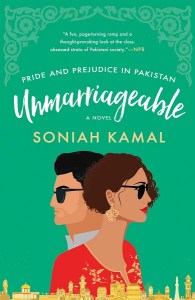
Unmarriageable new paperback edition cover

Unmarriageable, new paperback edition out on February 5

Soniah Kamal has written a fascinating version of Pride and Prejudice set in Pakistan, Unmarriageable. The book has become very popular in a wide variety of circles, and, almost a year after its appearance, the author is still busy meeting with book clubs and speaking at book festivals and conferences.

Soniah calls Unmarriageable a parallel retelling of Pride and Prejudice since it includes all the characters and plot points of the original book, albeit in a different setting. Elizabeth became Alysba Binat, an English literature teacher in a British School in Pakistan, and Darcy became Valentine Darsee, wealthy head of the British School Group.

I’ve read the book twice, and enjoyed it very much each time! I asked Soniah to tell us more about her book.

Brenda S. Cox: How have Jane Austen fans responded to Unmarriageable? I know you spoke about it to the Georgia chapter of the Jane Austen Society of North America (JASNA).

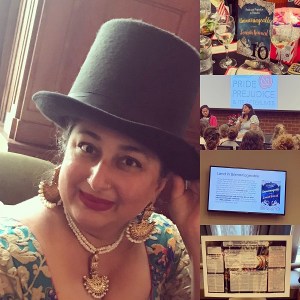
Author Soniah Kamal, photo by Indus Kamal Wasti

Author Soniah Kamal, photo by Indus Kamal Wasti

Soniah Kamal: You know I’m a huge Jane Austen fan myself and I actually ran a special book club for all six novels during the 200th commemoration year, so I know Janeites and how revered Jane Austen is. Austen connoisseurs aren’t hesitant about expressing their opinion when they don’t like something, and so I really wondered how Unmarriageable would be received, considering what I’d set out to do. My first taste was at the Georgia JASNA meeting for which they’d decided to read Unmarriageable and I was going to be interviewed. I was so nervous when I saw the full room and then, when I stepped in, everyone stood up and clapped, and I realized I’d been holding my breath–that validation was really, really gratifying and the best endorsement. Some of the members told me that they’d been hesitant to read Unmarriageable because they weren’t very fond of takes on Austen’s novels, but that they loved Unmarriageable.

I think Unmarriageable has resonated so amazingly with Janeites because they’re reading it for Jane Austen, they know Pride and Prejudice, and so when I mention real characters like Harris Bigg-Wither and Thomas Fowle, they get it. When I discuss Jane Austen in Unmarriageable, it’s fun and extra. They see the little inside jokes. When I bring up that Darcy’s wet T-shirt scene is not in the novel, they appreciate that stuff–it’s like diving into a really rich cake for them, I think.

One of the loveliest things I’ve heard so far from Janeites is that in reading Unmarriageable, because it is a parallel retelling, it’s as if they are reading Pride and Prejudice for the first time and it’s bringing back all their joy in reading Austen for the first time. So that was lovely unexpected feedback. And then another one was that readers who have never read Pride and Prejudice or Austen have picked up Unmarriageable, and then they are going to read Pride and Prejudice through that. Never did I think that my book would be a gateway for readers to get to Pride and Prejudice; I always thought obviously it would be the other way around.

Soniah at the Jane Austen Summer Program in North Carolina

Soniah at the Jane Austen Summer Program in North Carolina

Since the Georgia JASNA meeting, I’ve been invited by the Northern California JASNA Chapter to deliver Jane Austen’s Birthday Toast, and I spoke at the Jane Austen Summer Program in North Carolina. I will be the 2020 Keynote Speaker at the Jane Austen Festival in Louisville, Kentucky, as well as a featured Plenary Panelist at the 2020 JASNA AGM in Cleveland.

If you are a Janeite you will get a lot of the “Easter eggs” and inside jokes in Unmarriageable, and if you’re not, it’s a stand-alone novel in its own right.

Brenda: What kind of “Easter eggs” will Janeites discover in Unmarriageable?

Soniah: In Unmarriageable I put Easter eggs in for all the novels. So the quote which opens Unmarriageable is itself a variation of Austen’s opening sentence in Pride and Prejudice as well a nod to the beginning of Mansfield Park. Mansfield Park opens with three sisters and the directions their lives take based on who they marry, and so Unmarriageable opens with: “It is a truth universally acknowledged that a girl can go from pauper to princess or princess to pauper in the mere seconds it takes for her to accept a proposal.” In Unmarriageable, the discussion about books from the Western and Eastern traditions is a nod to Northanger Abbey which I see as Austen’s book about books. Emma comes up because Valentine Darsee asks Alys who her favorite hero is and she says Mr. Knightley, and you’ll have to read Unmarriageable to find out why that’s so. Mr. Knightley is my favorite character, too. Persuasion comes through in my making Jena (Jane) and Alys (Elizabeth) older than Valentine Darsee (Darcy) and Bungles (Bingley). Sense and Sensibility is the most obvious, when Alys thinks that Bungles carrying Jena is like Willoughby carrying Marianne when Marianne slips. But she realizes that didn’t go well, because they did not enjoy a happy ending. I would have done Lady Susan and the rest also, but I thought, this could go on forever!

Brenda: Why a parallel retelling?

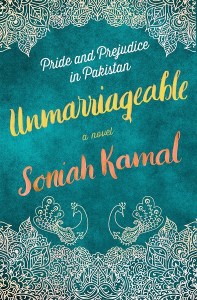
Unmarriageable, hardback cover

Unmarriageable, hardback cover

Soniah: As I say in the essay included with the novel, I needed to give myself an identity inclusive of both my Pakistani culture as well as the English language I grew up in, which is a linguistic legacy of Empire, of colonialism, and comes with all the complications of that. If I had written an “inspired-by” rather than a parallel, I would have had Jane divorced and with a kid, Lydia would have ended up not married and pregnant, I would have gone my own different way and allowed my characters to be different. But it wasn’t an inspired-by; my intent was to literally write Pride and Prejudice in Pakistan through a postcolonial lens. So the basic characters of each character are all the same, I didn’t deviate from anything. In fact, the challenge was how not to deviate from Pride and Prejudice and still make it my own. Let me tell you, on the face of it, it might seem simpler to write a parallel retelling, but really to stick within the boundaries of what your source material has given you was tough.

For those who don’t know Austen, a lot of them think any story where the main characters bicker is Pride and Prejudice, in which case everything on earth is Pride and Prejudice! What book or movie doesn’t have a romance, and where do the protagonists not bicker? I actually don’t think of Austen as a romance writer. None of her novels start out with boy meets girl, or end with proposals and elaborate marriage scenes per se. In fact, Austen glosses over both. She seems least bothered with love stories. For me, she’s a social satirist interested in exposing the hypocrisies and pretensions of her time and exploring the choices women, and even men, had and the lives women were able to fashion for themselves at a time when marriage was a financial necessity.

Brenda: Several of your characters are similar to, but somewhat different from, the original characters. Why did you choose to make Kaleen (Mr. Collins) a physician, rather than a clergyman like Mr. Collins? Perhaps he could have been a Muslim cleric?

Soniah: Islam has no clergy like in Christianity and each Muslim’s relationship is directly with God. However, there are mullahs who are schooled in Islam and the Quran. In Pakistan, traditionally the mullah class comes from the poorer, lower rungs of society and would not have been readily welcomed by the likes of Beena dey Bagh (Lady Catherine de Bourgh) into her drawing room. Therefore, it was a social class decision to make Kaleen a doctor who would be treating Annie (Anne de Bourgh) and therefore get an in with the family.

Brenda: Sherry Looclus (Charlotte Lucas), who marries Kaleen, seems to do much better in Unmarriageable than she does in Pride and Prejudice. Why is that?

Soniah: I think Charlotte deserves just as much respect as Elizabeth does, even though one marries Mr. Collins and one marries Darcy. Charlotte’s my favorite character because she’s really independent. I think Austen sometimes gives short shrift to Charlotte’s intelligence. Charlotte is very much a modern heroine for me, since she literally decides what is best for her life and then makes it happen. There’s one sentence in Pride and Prejudice where Charlotte sees Mr. Collins coming down the lane and she orchestrates accidentally running into him, but we don’t see the proposal, next thing we know they’re getting married. Charlotte’s made a huge decision by marrying Mr. Collins: she’s going to inherit Longbourn, she’s not languishing at her dad’s house, she’s dining with Lady De Bourgh; for her time period, given that she had could not work for an income, she’s made a wise choice for her life/financial security. At the end of Pride and Prejudice, Charlotte is pregnant, and I think that also shows a life that is moving on and not static like her life as an aging spinster at her father’s house had been. The first time I read Pride and Prejudice I was a teenager, and like most teenagers, friends and their opinions could matter so much. But even though Elizabeth is horrified at Charlotte’s marrying Mr. Collins, Charlotte is not swayed. She does not succumb to peer pressure. She knows her mind, she knows what is best for her, and she is not influenced by her friend. I admired that. Charlotte is one strong, practical, independent, progressive modern woman and I wanted to show the full extent of that in Unmarriageable.

As for Elizabeth and her choices within the time period, for us modern readers she comes across as wonderful. But for Austen’s time period she’s rather unpractical because she does not secure Longbourn for her family, or immediately marry the wealthy suitor who would have again secured a roof over her head for herself and her mother and sisters. As modern readers, we respect that Elizabeth says no to Darcy because he’s really pompous and full of himself and we respect that she doesn’t marry someone just because it’s practical and he’s wealthy; we appreciate that she has more important values than wealth. But in her time, that was being foolish, and her father was being very foolish, too. We like Mr. Bennet because he comes across as a strong dad who says my daughter will not marry Mr. Collins. But in the realities of their time, he’s just set his family up for destitution since, in the event of his death, he can’t afford to take care of them. As modern readers we’re really happy that Elizabeth marries for love and that Darcy’s money plays no part in it. However, as much as we like to think that money shouldn’t and doesn’t matter, imagine that there are two Mr. Darcys exactly alike; however, one has a lot of money and the other has none. Now, which Darcy would you advise Elizabeth to marry? In Mansfield Park, Austen offers a window into the prospects of marrying into different financial classes through choices Lady Bertram, Mrs. Norris and Mrs. Price make.

Brenda: Yes, if Darcy had been poor, Elizabeth might have ended up like Fanny Price’s parents in Mansfield Park, marrying for love and ending in poverty. You said earlier that the opening of Unmarriageable was like Mansfield Park. In Unmarriageable, Alys and Jena’s father, Bark Binat, has married beneath him and fallen on hard times, while his brother married well and is wealthy. How is that like Mansfield Park?

Soniah: It’s the princess and pauper quote above, a direct nod to Mansfield Park since in the opening of Mansfield Park we see three sisters who marry Sir Thomas Bertram, Mr. Norris the clergyman, and Lieutenant Price. One marries wealth, one stability, one squalor. But Austen in those first paragraphs of Mansfield Park captures the traditional state of women across time, and even today for many from traditional cultures where a man is expected to fulfill his traditional role of paying the bills, etc. Who you marry is often going to determine whether you end up vacationing at all, and whether it will be in France or the beach in Destin (laughing). It’s that simple. Of course, now we have the modern complication of women being able to afford their own vacations, and thankfully that makes a big difference in our choices.

Mansfield Park also gets into religion, Edmund who’s going to be a clergyman, and Mary doesn’t think that’s good, and Edmund gives Fanny a cross to wear. It’s Austen’s most religious novel. And it really goes deeply into her values and ethics. Mansfield Park is my favorite novel just because she dives deeply into the meaning of family in that novel. She really skewers family values in Mansfield Park. It’s her grimmest and most realistic novel. But even within Mansfield Park there’s so much humor.

Brenda: In an essay at the end of your book, you tell us, “I first immersed myself in Jane Austen’s Pride and Prejudice when I was sixteen years old. As interesting as its marriage plot was, I was spellbound, rather, by Austen’s social criticism and how it was conveyed through her pithy wit. Here was a centuries-old English writer who may as well have been writing about contemporary Pakistani society. . . . I wanted to write a novel that paid homage to Jane Austen and Pride and Prejudice, as well as combined my braided identification with English-language and Pakistani culture, so that the ‘literature of others’ became the literature of everyone. Therefore, Unmarriageable.”

Soniah: Thank you, Brenda. The paperback edition of Unmarriageable (out Feb 5th) includes an updated version of that essay, as well as essays on how the fictional setting of Dilipabad got its name, why I named the characters as I did, questions for book clubs and more.

Brenda: Thank you, Soniah, for sharing your world with us, in a way that any Jane Austen fan can enjoy!

____________________

Image of Brenda Cox

Brenda S. Cox

Brenda S. Cox also loves Jane Austen. She is a member of the Jane Austen Society of North America (JASNA). She has written articles for its magazine, Persuasions On-Line, and presented at its national conference as well as regional meetings. She has done extensive research for her current work-in-progress, a nonfiction book entitled Fashionable Goodness: Christianity in Jane Austen’s England. Follow her on Facebook or on her blog, Faith, Science, Joy, and Jane Austen.

Follow Soniah Kamal on: Instagram Twitter FB www.soniahkamal.com

Unmarriageable: Jane Austen’s Pride & Prejudice in Pakistan, a novel–available everywhere. order

2020 Townsend Prize Finalist

A 2019 Book All Georgians Should Read

Financial Times: A 2019 Best Book Pick

NPR Code Switch 2019 Summer Read Pick

A New York Public Library Summer 2019 Reads Pick

BoobBub A 2019 Best Book

Library Reads Pick, January 2019

STARRED Review Publishers Weekly “must-read for devout Austenites.

STARRED Review Shelf Awareness “If Jane Austen lived in modern-day Pakistan, this is the version of Pride and Prejudice she might have written

STARRED Review Library Journal “enlightening and entertaining

An Isolated Incident, a novel–coming in the UK, July, 2020.

Townsend Award Finalist

KLF French Fiction Prize Finalist

Read Full Post »

“Cheap books make good authors canonical.” – Janine Barchas

lost book of jane austen barchasThe Lost Books of Jane Austen by Janine Barchas is a beautiful book – a bound hardcopy with almost one hundred color photographs of affordable, mass-produced novels that, outside of expensive hand pressed editions, contributed to Jane Austen’s ever-increasing fame. The detective work and scholarship that Dr. Barchas embarked on for a decade to find hundreds of inexpensive, disposable Jane Austen books to study their role in Austen’s rapidly growing popularity is awe inspiring.

Some readers may fear that such a well-researched, seemingly dry topic would be hard to follow. It is not. In fact,  Barchas’s tales about searching for unvalued books, many of which were tossed in a rubbish bin or shredded, and her forays in consulting census materials  and birth and marriage records to pursuit information about the books’ owners had me turning the pages.

After Jane Austen’s death in 1817, her popularity with the public lay fallow. In 1833, publisher Richard Bentley purchased the rights to her novels and introduced them at a lower price than the finer three-volume editions that were published during her time, when books cost as much as a week’s wages for ordinary people. The timing of these cheap publications coincided with the advent of train travel and innovations in the publishing business. Changes in printing, binding, paper making, and distribution led to inexpensive versions of Jane’s (and others’) novels.

During Austen’s life, print runs were large and costly, and not guaranteed to sell out. The new technology resulted in flat plates or stereotype plates that allowed for printing new orders as they were needed. Instead of publishing three volume novels, Bentley offered one book, which saved paper. By the 1840s, cheap paperback editions with advertisements printed inside targeted train travelers, bringing Austen’s work to the masses. (These days one can find paperback vending machines in public spaces abroad.)

In 1866, Bentley sold his plates at auction for all his standard novels. Stereotype plates were used by different publishers, since plates lasted 50 years or more. Interestingly, although the stereotype plates used in new publications remained the same, publishers like Routlidge proudly boasted that these were new editions, when only the book cover and papers changed. The interior print with layouts and page numbers remained the same, as chronicled by Barchas in her book. (Click to view slide show of page samples.)

Sense and Sensibility comparison pages of books printed decades apart from the same stereotype plate

Image 1.5, p. 18 – Opening page of central text of Sense and Sensibility in copies from figure 1.2 printed decades apart from the same stereotype plate.

Not all the economical books were tossed aside. Miss Sybil Daniell kept her copy of Sense and Sensibility, given to her by her father. Barchas traced details of the Daniell family through census and birth and death records. She also traced the lives of Miss Emma Morris, who owned a copy of Emma, and Charlotte M. Mills, the proud possessor of a copy of Northanger Abbey-Persuasion. Virginia Woolf was inspired by Austen’s words. She returned frequently to her heavily stained, cheap Austen novel copies for rereading. These are some of the books that lasted in private collections for Barchas to study.

The Lost Books of Jane Austen is so rich in history and detail that I could write a book reviewing it.  I’ll end this critique using my own cheap paper back copies, which I have preserved through eight moves since my purchase. My thoughts are inspired by the last chapter, “Pinking Jane Austen.”

Book covers of Emma, 1964 Washington Square Press Book. Pride and Prejudice, 1962, Airmont Book Classic. Persuasion, 1966, An Airmont Classic.

Emma, 1964 Washington Square Press Book. Pride and Prejudice, 1962, Airmont Book Classic. Persuasion, 1966, An Airmont Classic. Vic’s personal paperbacks.

After graduating from college, I was surprised to learn that there were male Austen fans, for during my youth and up to this day, aggressive niche marketing of Jane Austen novels targeted female students and women in general. Gender signaling used pink to subtly attract the female sex to Austen’s books, which were often found in the romance sections at bookstores. I had no idea I was being manipulated, since I thought I was reading the works of a masterful author. I kept these three so-called disposable paperback novels for the hours of pleasure they gave me in my youth. As you can see, the covers reflect the 1960’s – the era in which they were published. One might say they are tasteless. Elizabeth Bennet, looking like a glammed up Brontë heroine, wears heavy eye makeup, dark pink lipstick, and pink bows. A Victorian Emma sports painted pink cheeks and bright pink lips. Anne Elliot is a vision in Edwardian pink. Our mousy heroine has been given a dramatic make over, with heavy eye liner and luscious pink lips that would make a Kardashian drool. Her body is too enviable for words.

Inside all three books, the paper has yellowed and I’m afraid to open them for fear of breaking their spines. Nevertheless, these books will stay with me forever, which I think is one reason why Janine Barchas was able to find enough cheap books to trace over time – like me, many individuals who possessed them cherished them, regardless of their tawdriness.

I’ll keep Barchas’s lovely, informative book on my shelves for years to come. It’s the season for gift giving. I can think of no more appropriate gift for the bibliophile in your life than The Lost Books of Jane Austen.

Purchase Information

The Lost Books of Jane Austen, Janine Barchas, Johns Hopkins University Press

304 Pages

978-1-4214-3159-8 $35.00

Also available as an e-book

Purchase Links: Johns Hopkins University Press | Amazon | Barnes & Noble

Image of author Janine BarchasAuthor Bio:

Janine Barchas is the Louann and Larry Temple Centennial Professor of English Literature at the University of Texas at Austin. She is the author of Matters of Fact in Jane Austen: History, Location, and Celebrity and Graphic Design, Print Culture, and the Eighteenth-Century Novel. She is also the creator behind What Jane Saw (www.whatjanesaw.org).

Author articles:

Other reviews:

Tour schedule:

Monday, December 9th: Lit and Life

Tuesday, December 10th: A Bookish Way of Life

Tuesday, December 10th: Broken Teepee

Wednesday, December 11th: The Sketchy Reader

Thursday, December 12th: No More Grumpy Bookseller

Thursday, December 12th: Laura’s Reviews

Friday, December 13th: View from the Birdhouse

Monday, December 16th: Savvy Verse & Wit

Monday, December 16th: Austenprose – A Jane Austen Blog

Tuesday, December 17th: Blunt Scissors Book Reviews

Thursday, December 19th: Jane Austen’s World

Friday, December 20th: My Jane Austen Book Club

Friday, December 20th: Diary of an Eccentric

Read Full Post »

Sanditon by Jane Austen book coverAs almost all Jane Austen enthusiasts know, her unfinished novel, Sanditon, has been adapted for a limited television series by Andrew Davies. It aired on ITV in Great Britain in the fall and will be shown on PBS Masterpiece Classics starting January 12, 2020. It seems that after the first episode, Mr. Davies deviated from the complex world Jane Austen created to insert his male sensibilities into the plot, but I am getting ahead of myself. (More to come in January.) The intent of this review is a plea for Jane Austen fans to read Sanditon before watching the PBS series. You will be doing yourself a favor.

Oxford World Classics has published a new edition of Sanditon, which was edited by Austen scholar Kathryn Sutherland. This slim volume contains 71 pages of the unfinished manuscript, an introduction and informative note on the text, also by Professor Sutherland, a helpful chronology of Jane Austen’s life and publishing history, and explanatory notes.

Austen began the novel fragment in Chawton Cottage, January 27, 1817. On March 18, when she reached Chapter 12, she laid the manuscript aside, too ill to continue. She died in Winchester on July 18, 1817. As she wrote Sanditon, she must have known that she had little time left, for in her haste to set her ideas on paper, her words tumbled over the pages. She failed to divide her sentences into paragraphs and scratched out words and added phrases as she went along. Her dashes and mid-sentence capitalizations are telling, as are her misspellings. As I read the facsimile of the manuscript online, I was in awe to view a master writer at work at the height of her power.

Page 1-Sanditon

Page of a digitized version of the novel fragment of Sanditon, Jane Austen’s Fiction Manuscripts, Downloaded December 11, 2019

Sutherland edited Sanditon using Cassandra Austen’s copy of her sister’s handwritten manuscript. Cassandra had proofed her sister’s writing to some extent, inserting paragraphs, correcting the spelling (not all, for spelling rules were still fluid in the early 19th century), and generally cleaning the words up here and there. Sutherland kept much of Cassandra’s changes, but reversed a few of them. She describes this process in detail in her Notes to the Text, which I found utterly fascinating.

More fascinating is that Jane’s working title for the manuscript was The Brothers. There were three: Tom Parker, the eldest and an enthusiastic Sanditon sales promoter – to use a modern term – of the new seaside resort (based on Worthing, as some surmise); Sidney, the possible hero of the piece (the reader does not meet him until Chapter 12); and Arthur, the youngest brother and a confirmed but questionable hypochondriac who lives with his two sisters, Diana and Susan.

The reader meets Tom Parker first and he his the most fully fleshed brother of the three. While Sidney is described extensively by Tom and sister Diana, Austen does not provide the reader with a detailed description of the man, for she stopped writing her novel shortly after introducing him. The brothers are so different in character that it would have been fascinating to know how Austen intended to weave their story lines into her plot, or what her plot would have been, for that matter.

At the start of the novel we meet Tom and his wife, Mary. Tom is the dreamer who conceives of great prospects for Sanditon, a new and developing seaside resort. Mary is more sensible, but unable to temper her husband’s fanciful ideas and grandiose hopes for the future. When their carriage breaks down in the middle of nowhere on their way to Sanditon, Mr. Parker twists his ankle. They encounter Mr. Heywood, a gentleman farmer, who helps the Parkers out of their dilemma by providing hospitality under his roof until Mr. Parker’s injury mends. During the Parkers’ stay at the Heywood’s farm, Austen nimbly contrasts the traditional, settled way of life that the Heywoods represent with the progressive, more modern, and speculative future that Mr. Parker envisions,.

To thank the Heywoods for their hospitality, the Parkers invite one of their daughters, Charlotte, to return with them to Sanditon. Her early role in the novel is as an observer. Her sensible estimations echo our thoughts as we learn about Mr. Parker’s fulsome, at times unrealistic ideas about Sanditon’s bright future and of the people she encounters, such as Lady Denham, an imperious and self-important woman in the vein of Lady Catherine de Bourgh. I guffawed every time this rich woman, who owned a few asses, mentioned selling their milch for profit to new visitors to Sanditon.

Lady Denham’s nephew-in-law, Sir Edward Denham, is a vain, silly man who imagines he has exquisite literary taste, but Charlotte, the observer, concludes that the handsome Sir Edward does not by nature have a very strong head.  He does, however, consider himself a seducer and pursues Lady Denham’s comely companion, Miss Clara Brereton, a single woman of no means who must take care to preserve her reputation. Add to the mix Miss Lambe, a young West Indian heiress, who Jane introduces with tantalizing hints just before she laid the manuscript aside.

Finally, I was struck by Jane’s invention of Susan, Diana, and Arthur Parker, three hypochondriacs with the most ridiculous symptoms and “cures.” The satire in these passages is biting and without mercy. Diana, while suffering a variety of ailments, takes charge of situations, insinuates herself in other peoples’ concerns, and walks long distances vigorously in order to do both. One can only guess what went through Jane’s mind as she developed characters with imagined or exaggerated illnesses when her own medical situation was so dire. While writing these scenes, did she have her condition in mind, or her mother’s chronic ailments and physical complaints, a mother who ironically survived her by a decade?

This edition of Sanditon by Oxford University Press is a perfect gift for the Janeite in your life (or for yourself) this holiday season and I highly recommend it.

Look for more Sanditon posts in the near future!

Order the book:

Oxford University Press:

Sanditon, Jane Austen, Edited by Kathryn Sutherland, 2019 $5.95

Amazon: Kindle, Hardcover, Paperback

Sanditon, Jane Austen, Edited by Kathryn Sutherland

Kathryn Sutherland is the editor of Austen-Leigh’s Memoir of Jane Austen and Other Family Recollections and Jane Austen’s Teenage Writings for the Oxford World’s Classics. She has created a digital edition of Jane Austen’s Fiction Manuscripts (2012), the print edition published by Oxford University Press (OUP) in 2017. She is the author of Jane Austen’s Textual Lives: from Aeschylus to Bollywood (OUP, 2005).

PBS Masterpiece Theater: Sanditon. Click here for details.

First airing January 12, 2020

Also:

Jane Austen’s Satire on Hypochondria, Jocelyn Harris, Corpus: conversation about medicine and life, November 21, 2016


Read Full Post »

BrideofNorthangerBirchall

Inquiring readers: Author Diana Birchall has written her latest addition to the Austenesque fiction canon. This post is a review of Catherine Tilney’s (née Morland’s) continuing adventures in Northanger Abbey. No matter how hard Henry Tilney’s young bride tries to retain her calm, she somehow becomes entangled in yet another Gothic adventure.

As the novel opens, Henry Tilney and Catherine happily anticipate their wedding, but before the ceremony, Henry must share important information with his intended – that for generations the Tilney family has suffered a dreadful family curse which results in the wife of the eldest son meeting with an untimely end. Catherine quickly dismisses the idea, since Henry is the second son.

The happy couple are married surrounded by family and friends, absent General Tilney, who is still angered that his son wed an ordinary chit with only £3,000 to her name. Nevertheless, the young couple settle into connubial bliss in Woodston Parsonage, the lovely cottage Catherine fell in love with the moment Henry showed it to her. Even better, it is situated 20 miles or so from Northanger Abbey. Life is good for the young Tilneys until the couple visit General Tilney. During her visit at NA, Catherine sees a lady in grey at night wandering the halls. She fights fear in favor of logic, but then receives an ominous missive:

Bride of Northanger, beware the Maledict, that falleth upon you. Depart the Abbey in fear and haste, and nevermore return.”

And, so, the plot thickens, with Ms. Birchall bending, twisting, and turning it upside down until we readers becomes dizzy from guessing where the tale will end. Along the way, we are treated to an assortment of some of Austen’s finest characters. Birchall connects their stories to Austen’s by adhering to their psychological states, and personal quirks and behaviors in the original novel.

While paying homage to Austen, Birchall writes in her own light and lovely style. She characterizes John Thorpe as deliciously sleezy and slimy. His sister, Isabella, is still a slutty, scheming vixen. General Tilney is mean and avaricious and unpleasant all around. Captain Tilney feels no shame for his boorish behavior or lack of empathy for anyone. Eleanor Tilney is saccharinely sweet and nondescript. I found her viscount husband, Charles, much more interesting. As a budding Gilbert White, he studies butterflies with the same zest as Captain Tilney collects whores. We even meet the Allens in Bath, along with Catherine’s sister, Sarah, who lives with them.

To this mix, Birchall adds a dash of curses, and tales of mad monks and maledictions, and the mysterious lady in grey. The Bride of Northanger reminded me in many ways of Jane Eyre by Charlotte Brontë and Rebecca by Daphne du Maurier. This Austen variation is a perfect gift for a budding young Janeite (or yourself). After purchasing it, I recommend curling up on a sofa near a crackling fire for a few hours of blissful reading.

About Diana Birchall:

Diana Birchall worked for many years as a story analyst for Warner Bros Studios, reading novels to see if they would make movies. Reading popular manuscripts went side by side with a lifetime of Jane Austen scholarship, and resulted in her writing Austenesque fiction both as homage and as close study of the secret of Jane Austen’s style. She is the author of The Bride of Northanger, published by White Soup Press, Mrs. Darcy’s Dilemma and Mrs. Elton in America, both published by Sourcebooks, as well as In Defense of Mrs. Elton, published by JASNA, and hundreds of short stories.   Her plays have been performed in many cities, with “You Are Passionate, Jane,” a two person play about Jane Austen and Charlotte Bronte being featured at Chawton House Library.

Find out more about Diana by following her on Facebook and Twitter @Dianabirchall

The Bride of Northanger Blog Tour Banner Fina


Jane Austen’s World is part of the #Janeite Blog Tour of The Bride of Northanger, a Jane Austen Variation by Diana Birchall.

Learn more about the tour and follow the participating blogs.

The doyenne of Austenesque fiction, Diana Birchall, tours the blogosphere October 28 through November 15, 2019, to share her latest release, The Bride of Northanger. Thirty popular bloggers specializing in historical and Austenesque fiction are featuring guest blogs, interviews, excerpts, and book reviews of this acclaimed continuation of Jane Austen’s Gothic parody, Northanger Abbey.

The Bride of Northanger: A Jane Austen Variation, by Diana Birchall
White Soup Press (2019)
Trade paperback & eBook (230) pages
ISBN: ISBN: 978-0981654300

PURCHASE LINKS:

Amazon | Barnes & Noble | Goodreads

Thank you, Laurel Ann, for including me in this tour.

Read Full Post »

« Newer Posts - Older Posts »