Feeds:
Posts
Comments

Archive for the ‘Book review’ Category

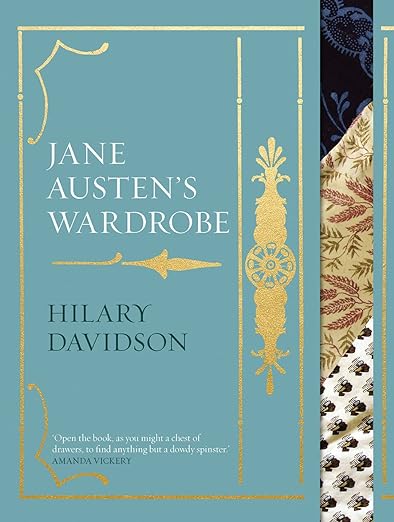
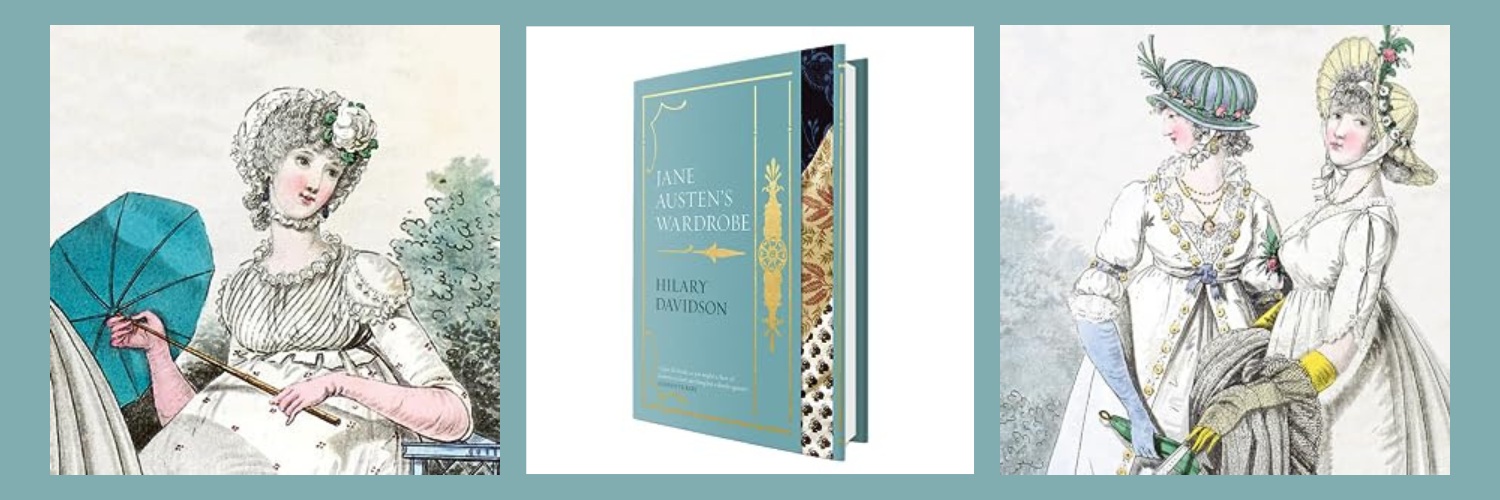
Dear readers, I have an exquisite new book to share with you today: Jane Austen’s Wardrobe by Hilary Davidson!

Filled with incredible photos and written information, it’s one of the most detailed books I’ve seen in a long time on this topic. Not only is it beautiful, it is filled with fascinating information on one of my most favorite topics.

This is my new favorite book on Jane Austen’s Regency Fashion. I know I’ll continue to pour over it for years to come!
Austen’s Wardrobe by Category

Within the pages of this lovely book, Davidson works her way through Austen’s personal wardrobe chronologically, from head to toe. Davidson’s system for cataloging Austen’s wardrobe is fascinating! For those of us who delight in a linear and/or chronological order to a wide and varied topic, Davidson definitely checks all the boxes.

First, she breaks all of Austen’s clothing down into the following categories:

  • Clothes Press: Gowns
  • Closet: Spencers, Pelisses and Outer Garments
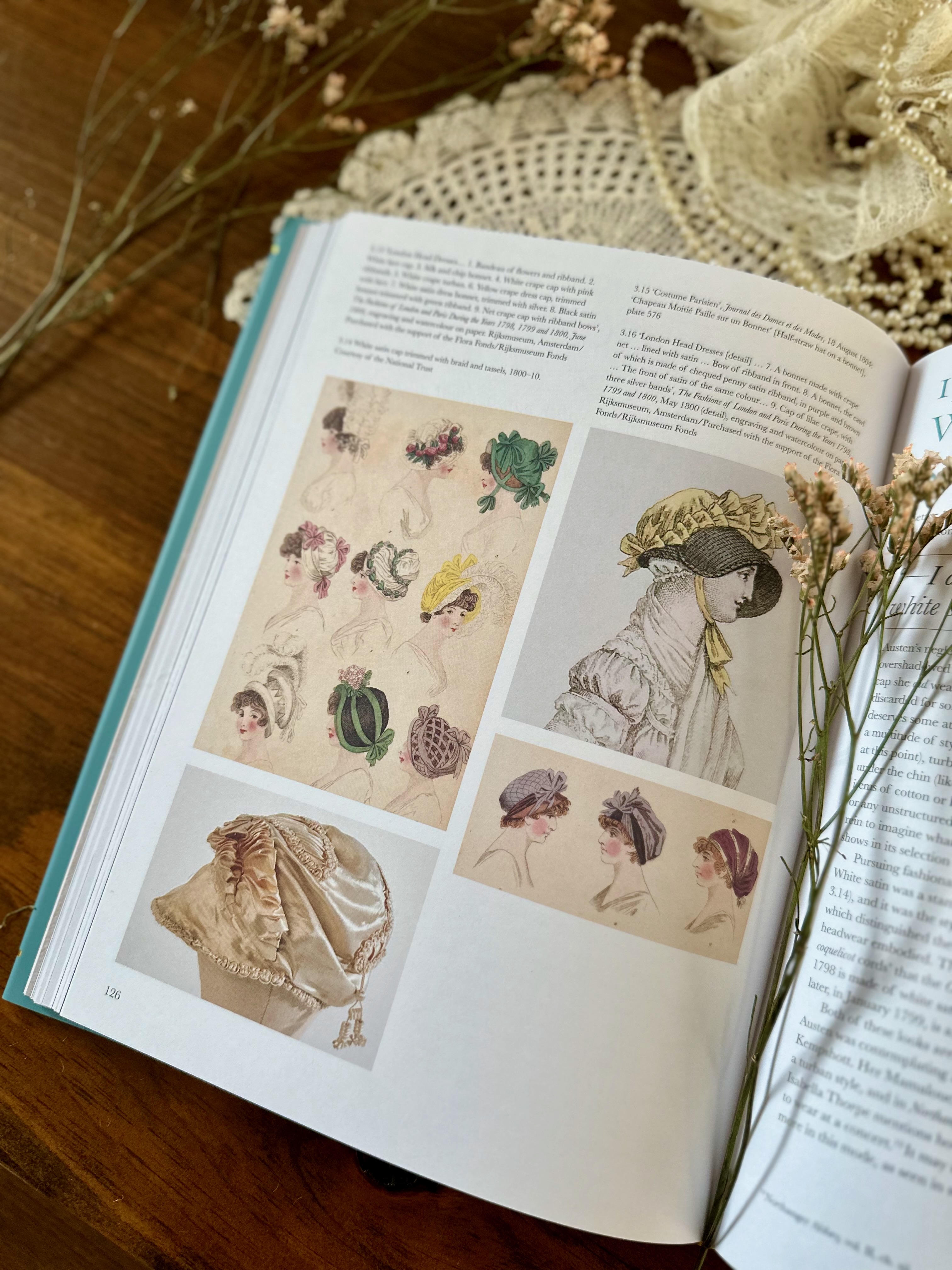
  • Band Box: Hats, Caps and Bonnets
  • Shelves: Shawls, Tippets, Cloaks and Shoes
  • Dressing Table: Gloves, Fans, Flowers, Trims and Handkerchiefs
  • Jewelery Box: Necklaces, Rings and Bracelets
  • Drawers: Undergarments and Nightwear

Davidson even includes several pages of sketches, descriptions, and explanations for Jane’s “Portrait Gown” – which I found completely engrossing.

Austen’s Letters Quoted

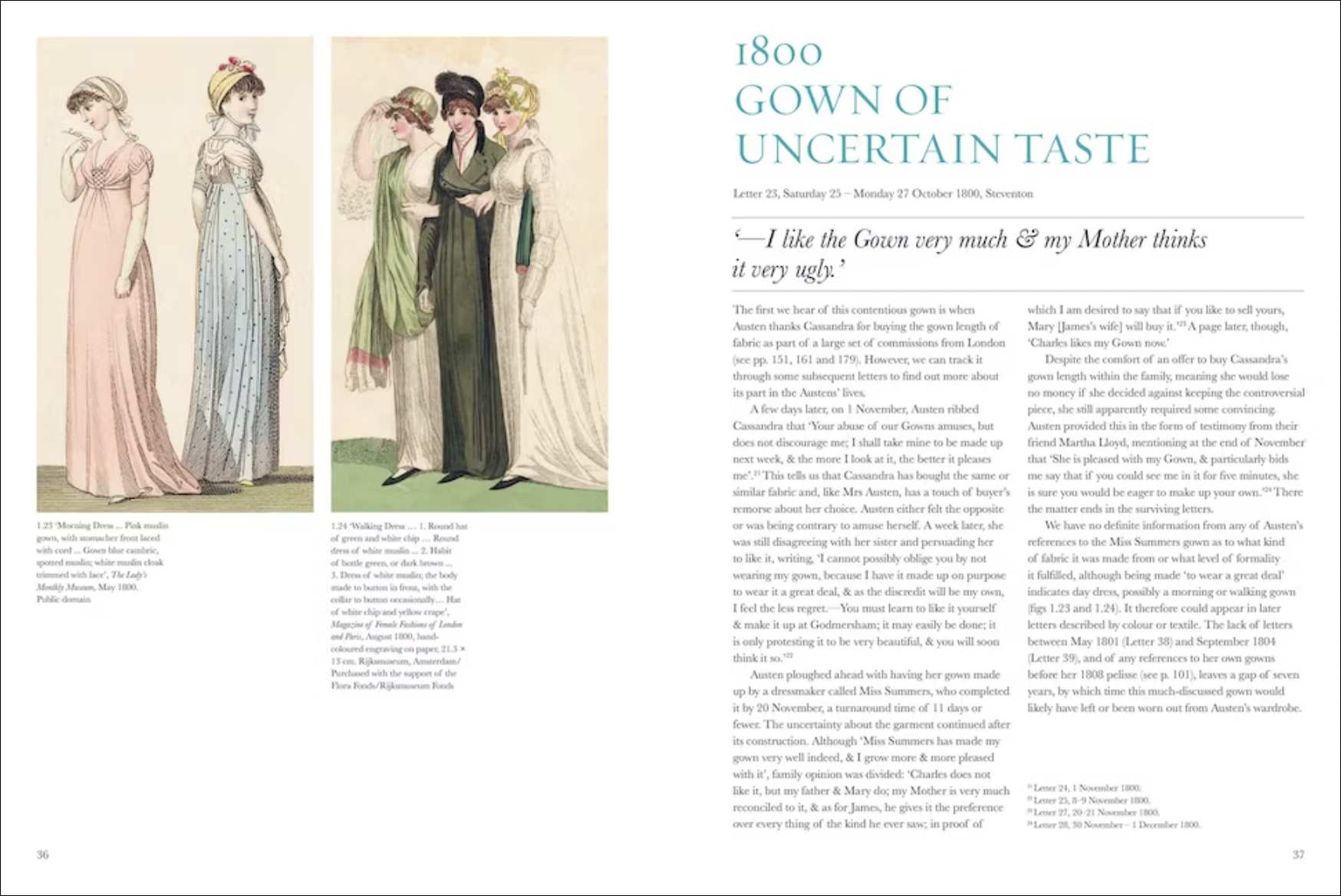
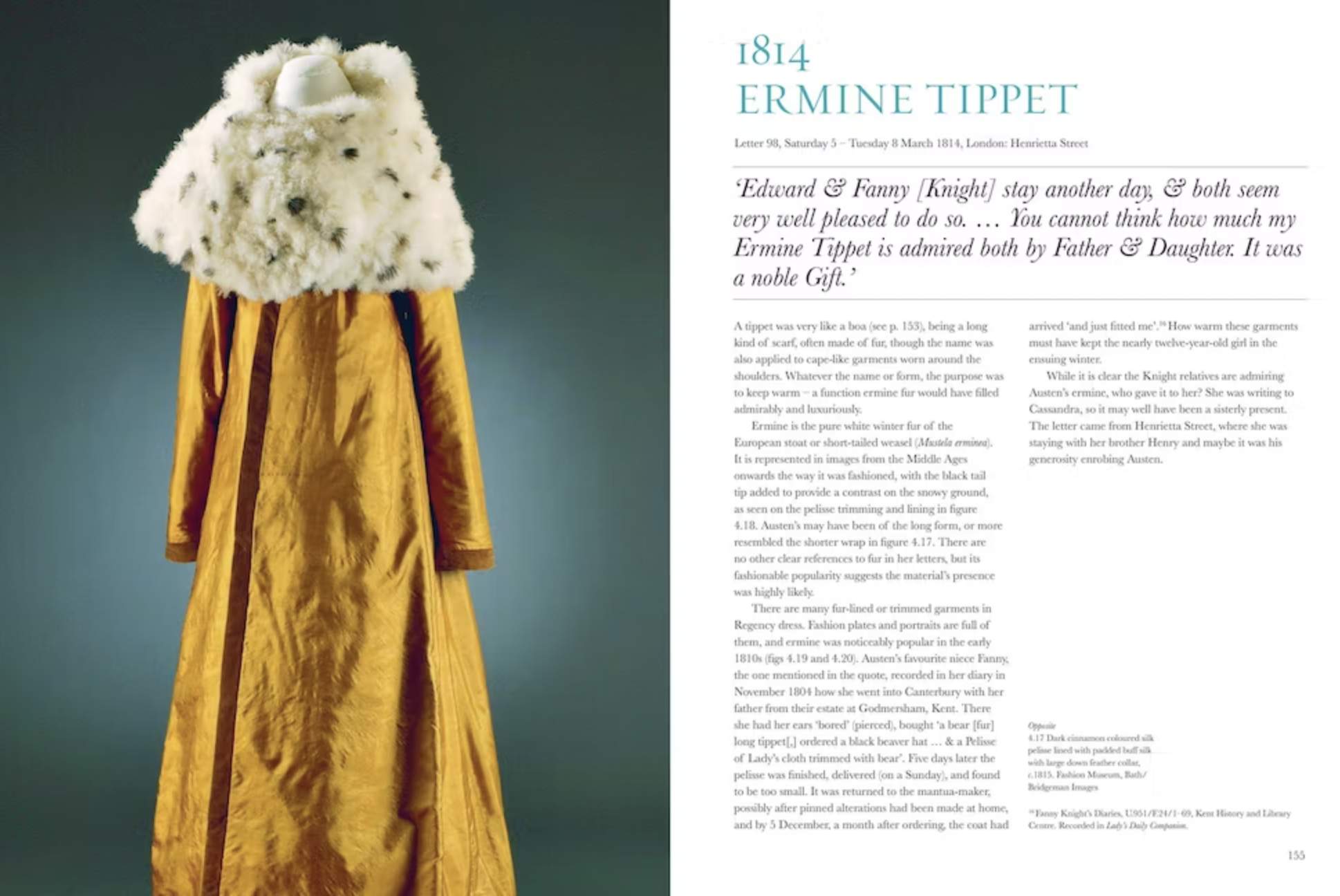
Next, Davidson utilizes Austen’s personal letters to explore every inch of Austen’s wardrobe, working her way through each category in chronological order. To do this, she shares one quote at time, citing portions of letters that mention Austen’s clothing. Then, for each article of clothing, every hat, and every piece of jewelry, she explains that quote in great detail and provides photos to aid our understanding.

For instance, Austen writes this in Letter 65:

“I can easily suppose that your six weeks here will be fully occupied, were it only in lengthening the waists of your gowns. I have pretty well arranged my spring & summer plans of that kind, & mean to wear out my spotted Muslin before I go. –You will exclaim at this–but mine has signs of feebleness, which with a little care may come to something.”

Tuesday 17 – Wednesday 18 January, 1809, Castle Square

Davidson provides photos of spotted muslin fabric swatches and a photo of a dress made of spotted muslin, dated 1805-10. Then she explains the muslin fabric, provides quotes from Austen’s novels about muslin dresses, and explains Austen’s quote. She goes over the dress styles, what was involved in “lengthening the waist” of a gown, the meaning of “worked” fabric, and the ins and outs of fragile fabrics of that time period, including how women used belts to cover holes in the fabric when a waist was lengthened.

I found this incredibly interesting because I’ve always been curious about Austen’s extensive quotes about her dresses and hats in her letters. The result is a delightful (and sometimes hilarious) tour through Jane Austen’s closet in her own words, with pictures and explanations to match!

Here are several more examples, provided by Yale University Press:
Informative and Beautiful

Like many of Austen’s heroines, this book is both intelligent and beautiful. Inside and out, this book is absolutely stunning. The photos provide a detailed look into Jane Austen’s clothing that is hard to find, especially all in one place. This book feels like a worldwide museum tour of all the most exquisite clothing artifacts from Austen’s time.

This is the perfect addition to any Jane Austen library – and it will look gorgeous on your coffee table!

Book Description

Hilary Davidson delves into the clothing of one of the world’s great authors, providing unique and intimate insight into her everyday life and material world.
 
Acclaimed dress historian and Austen expert Hilary Davidson reveals, for the first time, the wardrobe of one of the world’s most celebrated authors. Despite her acknowledged brilliance on the page, Jane Austen has all too often been accused of dowdiness in her appearance. Drawing on Austen’s 161 known letters, as well as her own surviving garments and accessories, this book assembles examples of the variety of clothes she would have possessed—from gowns and coats to shoes and undergarments—to tell a very different story.

The Jane Austen Hilary Davidson discovers is alert to fashion trends but thrifty and eager to reuse and repurpose clothing. Her renowned irony and wit peppers her letters, describing clothes, shopping, and taste. Jane Austen’s Wardrobe offers the rare pleasure of a glimpse inside the closet of a stylish dresser and perpetually fascinating writer.

About the Author

Hilary Davidson is a dress, textile and fashion historian and curator. Her work encompasses making and knowing, things and theory, with an extraordinary understanding of how historic clothing objects come to be and how they function in culture.

Hilary is equally skilled in analysing historical and archaeological material culture artefacts; presenting engaging, fascinating talks to diverse audiences; and producing influential academic research.

Her extensive experience includes:

  • Scholarly research
  • Lecturing, teaching and public talks
  • Broadcasting and journalism
  • Historic dressmaking

Hilary trained as a bespoke shoemaker in her native Australia before completing a Masters in the History of Textiles and Dress at Winchester School of Art (University of Southampton) in 2004. Since graduating, Hilary’s practice has concerned the relationship between theoretical and highly material approaches to dress history, especially in the early modern and medieval periods.

As a skilled and meticulous handsewer, she has created replica clothing projects for a number of museums, including a ground-breaking replication of Jane Austen’s pelisse. At the same time she lectured extensively on fashion history, theory and culture, on semiotics, and cultural mythologies, especially red shoes.

In 2007 Hilary became curator of fashion and decorative arts at the Museum of London. She contributed to the £20 million permanent gallery redevelopment opening in 2010, and curated an exhibition on pirates, while continuing to publish, teach and lecture in the UK and internationally. In collaboration with Museum of London Archaeology, Hilary began analysing archaeological textiles and continues to cross disciplines by consulting in this area in England and Australia. She also worked on the AHRC 5-star rated Early Modern Dress and Textiles Network (2007-2009) and from 2011 has appeared as an expert on a number of BBC historical television programmes, and as a frequent radio guest speaker in London and Sydney.

From 2012 Hilary worked between Sydney and London as a freelance curator, historian, broadcaster, teacher, lecturer, consultant and designer, while working on a PhD in Archaeology at La Trobe University, Melbourne. In addition to historical studies she has been a jewellery designer, graphic designer, photographer, gallerist, and worked in retail fashion and vintage clothing. In 2022 she moved to New York City to take up the role of Associate Professor and Chair of the MA Fashion and Textile Studies: History, Theory, Museum Practice at the Fashion Institute of Technology.

Hilary has taught and lectured extensively, including at the University of Southampton, Central St Martins, the University of Cambridge, the University of Glasgow, New York University London, The American University Paris, Fashion Design Studio TAFE Sydney and the National Institute of Dramatic Art (NIDA), Sydney. She speaks regularly at academic conferences and to the public. Her first monograph book was Dress in the Age of Jane Austen (2019) followed by Jane Austen’s Wardrobe in 2023. Her extensive publications can be found on Academia and ResearchGate.
To Order the Book:

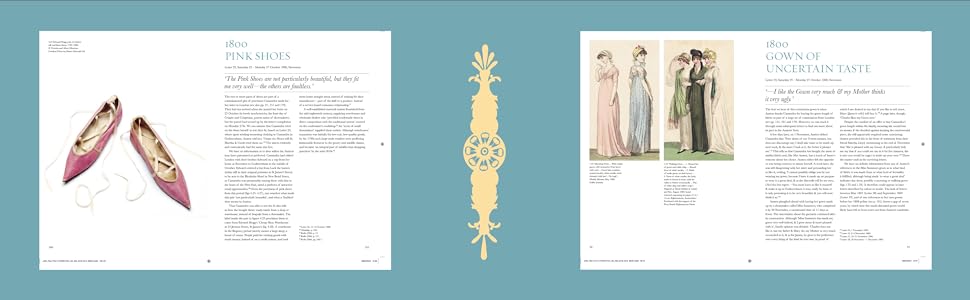
You can order the book by clicking HERE
or by clicking the image below:

Recommended Book Gift

I hope you’ve enjoyed this short tour of this stunning new book by Hilary Davidson. If you’re looking for a gift for a fellow Jane Austen fan, or if your friends or family members need an idea for a gift for you this holiday season, I highly recommend this one!
RACHEL DODGE teaches college English classes, gives talks at libraries, teas, and book clubs, and writes for Jane Austen’s World blog. She is the bestselling author of The Little Women DevotionalThe Anne of Green Gables Devotional and Praying with Jane: 31 Days Through the Prayers of Jane Austen. Now Available: The Secret Garden Devotional! You can visit Rachel online at www.RachelDodge.com.

Read Full Post »

I’m delighted to share with you a beautiful new book I think you’ll want by your side this fall as you settle down for a cozy read by the fire! It’s called Bygone: Musings and Poems from a Regency Hearthside by Hannah Linder.

Not only is it beautiful to behold, but it is also beautiful to read. Read on for a fun interview with Hannah and some of my own thoughts on her book!

Book Description:

Modern, Regency-Esque Love Poems from a Regency Novelist. Enjoy this hardback collection of whimsical thoughts and poems, perfect for fans of Jane Austen. Grab a cup of tea and immerse yourself in this gift book release, just in time for fall.

I had the great honor of writing an endorsement for this book:

In Bygone: Musings and Poems from a Regency Hearthside, Hannah Linder offers elegant, heartfelt verses for the discerning Regency soul. As words dance delicately across the page, you’ll soon hear the gentle rustle of silk and the subtle murmur of voices as you step back through time to the beauty and romance of a bygone era.”

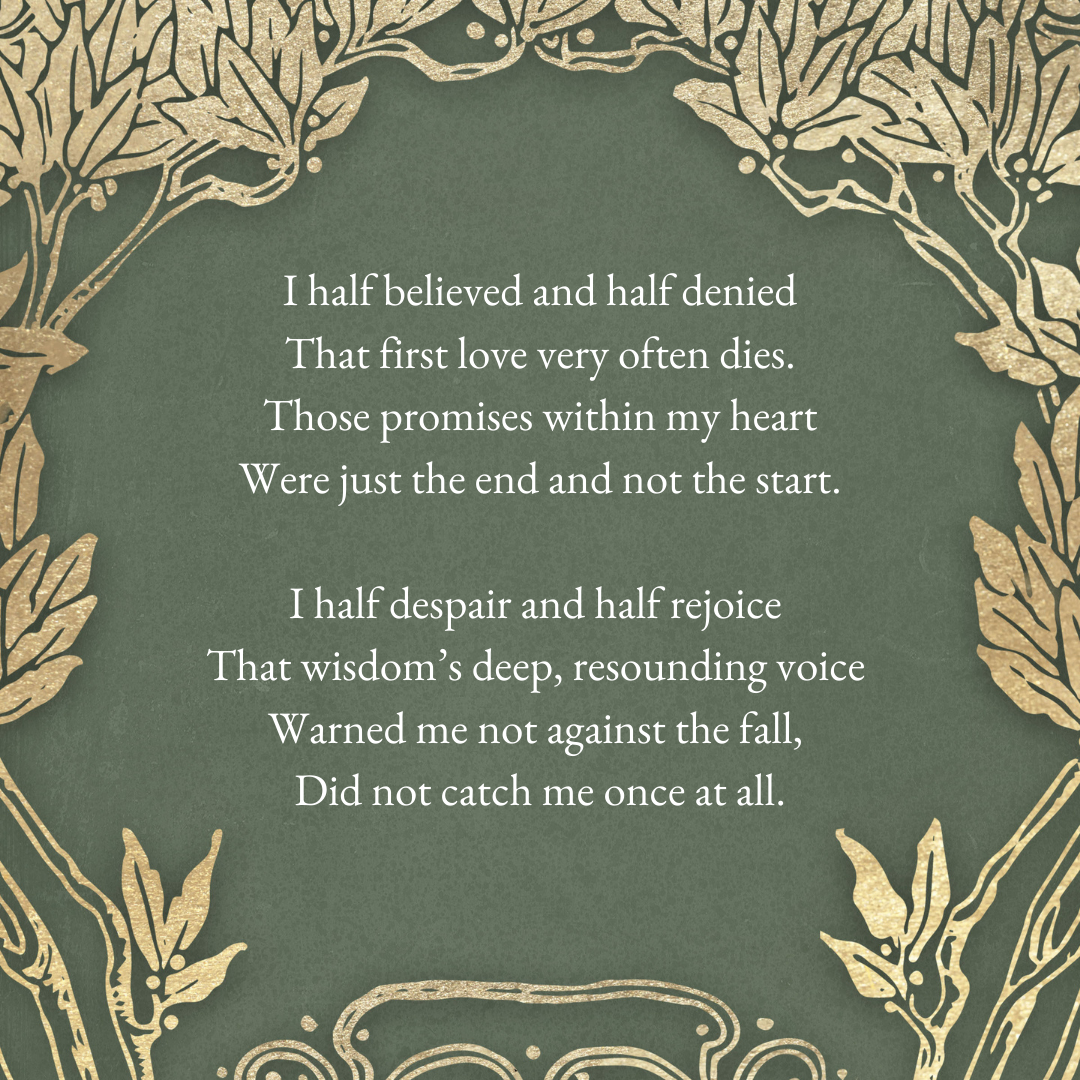
As you can see, I found myself in a very poetic mood after reading Hannah’s poems! Her words not only sweep you away to another time and place, but they are also food for the soul.

Interview with Hannah Linder

Hannah agreed to do an interview with me, and I enjoyed getting to know more about her and her writing and artistic background. She is an accomplished, creative, and talented person (I’m sure Austen would approve) with the same deep love for Austen and the Regency Era that all of us here at Jane Austen’s World share. I hope you enjoy our Q&A!

1. What is your background with poetry and what inspired you to write this book?

For years, I’ve enjoyed slipping off alone somewhere with an old poetry book, reading the stanzas out loud, or committing them to memory. I love the way poems play with words. The soothing sound. The cut of realization, throbbing at your chest, when you read something you always knew about life but never really pondered.

For years, I said I could not write poetry. I liked freedom best and writing in rhythms seemed too binding. Funny, isn’t it? Oftentimes the things we say we’ll never do are those we find ourselves doing. Now, writing poetry is an outlet. When emotions swell, I let them topple over and bleed into paper, each line a journal entry or a piece of what cries within me. Bygone is the collection of all my thoughts, dreams, and longings.

2. What are 2 of your favorite poems and what is the story behind each one?

Love You? is one that will always be special to me, because it reflects the heart of a wife who tries to explain to her husband all the ways she loves him. Love is not always flowers and moonlit dances and serenating music. Love, more often, is the simple things we do for each other. The life we live together.

Another favorite is Worth the While. This poem is a sweet reminder to slow down, be happy, and enjoy life as it comes.

3. When did you first discover Jane Austen and the Regency Era? 

My best friend, in my early teens, invited me over and introduced me to the 2005 Pride and Prejudice. From the moment Mr. Darcy walked through the foggy field with his coat billowing in the wind, I was hopelessly twitterpated. I have been in love with everything Jane Austen ever since.

4. Do you read Regency or Historical Fiction? If so, who are your favorite authors?

Absolutely! My all-time favorite Regency author is Michelle Griep. Her stories always keep me captivated.

5. What are your favorite 3 books you read in the last year?

This is such a hard question! I think Memory Lane by Becky Wade and Forgotten Secrets by Christy Barritt were among my favorite reads of the year.

6. Who do you picture reading the poems in this collection?

Anyone who loves the Regency Era, the sweetness of romance, the sing-song voice of poetry, or the sentimental things in life. Bygone would be a fun book to curl up with in a chair, near a hearth, with a steaming cup of tea.

7. What was your writing process for this collection? Where did you write these poems?

Anywhere, everywhere! Sometimes a thought or idea would strike me, and I would rush to write it down before I could forget. Other times, I’d just go wandering in a field, take a seat by the creek, and ponder on life until a poem came to me.

Bonus: Who is your favorite Jane Austen hero? Who is your favorite villain?

Absolutely, hands down, the wonderful Mr. Darcy. Though Mr. Knightly would be a close second. And villain, hmm…perhaps Mr. Wickham. He’s so charmingly deceitful and such a layered character. Jane Austen was so masterful.

About the Author

Hannah Linder resides in the beautiful mountains of central West Virginia. Represented by Books & Such, she writes Regency romantic suspense novels filled with passion, secrets, and danger. She is a four-time Selah Award winner, a 2023 Carol Award semi-finalist, and a member of American Christian Fiction Writers (ACFW). Also, Hannah is an international and multi-award-winning graphic designer who specializes in professional book cover design. She designs for both traditional publishing houses and individual authors, including New York TimesUSA Today, and international bestsellers. She is also a self-portrait photographer of historical fashion. When Hannah is not writing, she enjoys playing her instruments—piano, guitar, ukulele, and banjolele—songwriting, painting still life, walking in the rain, and sitting on the front porch of her 1800s farmhouse.

To follow her journey, visit hannahlinderbooks.com.

Hannah’s Links

If you’d like to follow along with Hannah’s other literary and artistic ventures, here are a few ways to find her online:

Purchase Bygone

You can purchase Bygone by Hannah Linder HERE!

I hope you enjoyed learning more about Hannah and her beautiful new book! Which Jane Austen character do you think would be most likely to read poetry? Which would be most likely to write poetry?


RACHEL DODGE teaches college English classes, gives talks at libraries, teas, and book clubs, and writes for Jane Austen’s World blog. She is the bestselling author of The Little Women DevotionalThe Anne of Green Gables Devotional and Praying with Jane: 31 Days Through the Prayers of Jane Austen. Now Available: The Secret Garden Devotional! You can visit Rachel online at www.RachelDodge.com.

Read Full Post »

Reviewed by Brenda S. Cox

At the 2022 JASNA AGM, Renata Dennis (head of JASNA’s Diversity Committee*) virtually interviewed author Uzma Jalaluddin. Uzma came across as friendly, passionate, and joyful. As I left the room, I overheard one participant saying, “Uzma seems like someone I could be friends with,” and I felt the same. That session encouraged me to go back and reread Uzma’s novel Ayesha at Last (a variation on Pride and Prejudice), and also to read her newest book, Hana Khan Carries On (a variation on You’ve Got Mail).

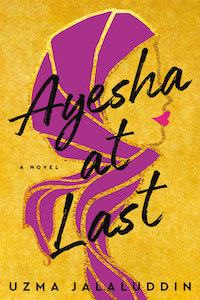
Ayesha at Last by Uzma Jalaluddin gives a modern Canadian Muslim twist to Pride and Prejudice.

In Ayesha at Last, Ayesha is a modern-day Elizabeth Bennet, while Khalid is her Mr. Darcy. Both are from Indian-background Muslim families in Canada, and both have experienced loss and tragedy. Their Muslim community faces challenges, and they try to help, though their ideas don’t always match.

Uzma told us that she wanted to show an “observant” Muslim as a character we could understand and relate to, so she introduced Khalid. (“Observant” here means that he strictly observes the practices of his faith.) Khalid finds his identity in wearing a long white robe, a white skullcap, and a bushy beard. He doesn’t shake women’s hands (sign of a strict Muslim), and tends to judge others, though he treats them with respect. He works hard and does well in his company. But a new boss arrives who is prejudiced against him for his religion and appearance. She looks for excuses to fire him.

Ayesha is a poet, working as a substitute teacher but unhappy with teaching. She wears a purple hijab—traditional, but not. She is also a committed Muslim, but not as strict as Khalid. Sparks fly when they meet. A villain, of course, tries to come between them.

The story is compelling and I found it hard to put down.  The characters are well-drawn and interesting. Uzma Jalaluddin gives us insight into a Muslim community in Toronto, Canada, their mosque and community center, and the challenges they face. The novel is a clean read (although there is some discussion of pornography).

In an illuminating online article, Uzma Jalaluddin says, 

“I write romance novels.

“That’s not what I set out to do when I first put fingers to keyboard. I wasn’t thinking about genre at all. All I knew was that I wanted to write funny, joyful books about characters I had rarely seen represented on the page; characters who looked like me, and who would bring a different perspective to the traditional love story.

“I write romantic comedies so that I can see my stories represented in the world.”

Hana Khan Carries On is another entertaining story set in the same community.

In Uzma Jaluluddin’s second excellent novel, Hana Khan Carries On, her heroine focuses on the need for “more entertaining stories that represent all of our experiences, not just our pain.” Hana Khan is a budding broadcaster who insists on stories that reflect many dimensions of her Toronto Muslim community, not just tragedies and stereotypes. She asks “The Big Questions: ‘What do you want out of life? What do we owe the people we love? How do our histories and stories influence who we become?” Uzma Jalaluddin says those questions “form the backbone” of all her stories.

Like Jane Austen and all good writers, Uzma Jalauddin gives us three-dimensional characters. We can relate to them on many levels, while also seeing their uniqueness. She entangles them in plots that are fun and compelling to read.

I recommend both Ayesha at Last and Hana Khan Carries On.

Note: Previously I reviewed another excellent Austen variation set in a Muslim community: Soniah Kamal’s Unmarriageable, a Pride and Prejudice retelling set in Pakistan. 

*The JEDI Committee: JASNA Equity, Diversity, and Inclusion Committee

Brenda S. Cox, author of Fashionable Goodness: Christianity in Jane Austen’s England, also writes at Faith, Science, Joy, and Jane Austen.

Read Full Post »

By Brenda S. Cox

“It is a truth universally acknowledged that a book can change a life.”—The Jane Austen Remedy, by Ruth Wilson

I’ve certainly found this true in my life; haven’t you? This statement opens Ruth Wilson’s memoir of how a “careful re-reading of Jane Austen’s six novels” enabled her to “re-examine [her] lived life in the context of [her] reading life.”

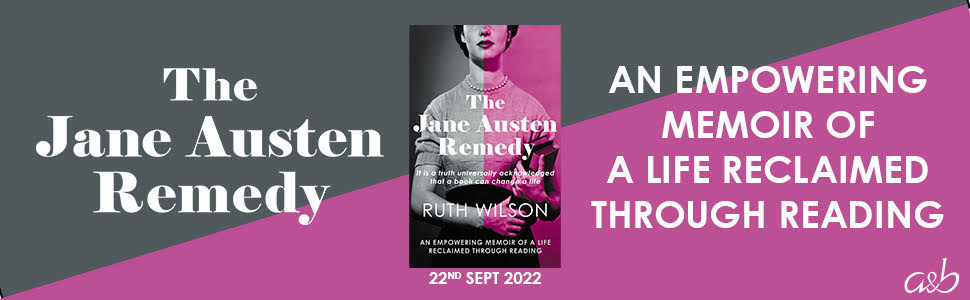
In The Jane Austen Remedy, by Ruth Wilson, the author explores her life through the lens of Jane Austen’s novels.

When Wilson turned sixty, she realized she was “out of love with the world and . . . not happy.” She says, “my body was telling me that my soul, however such an entity is conceptualised, was ailing.” She grieved for herself, for what she had not achieved, and for “the years that lay ahead.” She identified with Elizabeth Bennet who says, “The more I see of the world, the more I am dissatisfied with it.”

So, Wilson bought a small cottage two hours from her home in Sydney, Australia. Her goal was to have “a room of one’s own,” as Virginia Woolf puts it in her book with that title (which I highly recommend, by the way). Woolf is talking about women writers, but Wilson says, “All women need their own space to inhabit, their own air to breathe.” She hoped, in that place “to find a happier way of being.”

Wilson left her husband and family for a time and determined to re-read Austen’s novels. She says,

I was making Austen’s novels a starting point for exploring the satisfactions and dissatisfactions of my own life, framed and illuminated by her fictional universe.

The Jane Austen Remedy takes readers along with Ruth Wilson on this journey through her life. She discusses many books that impacted her, some of which were familiar to me and some not. But the Austen novels were at the heart of her journey.

Wilson begins with her own discovery of literature and how it impacted her life. Her “reading life truly began with Pride and Prejudice,” which made reading into “a source of nourishment and imaginative expansion” for her. She says from that point on, Austen’s novels

shaped the course of my future: because of them, I became a lover of language, a teacher of literature, a parent-reader, and, in a broader sense, an educator. My inner life has been nourished, illuminated and comforted by the empathetic voices, the complex characters and the challenging ideas in Austen’s novels – and they have changed, as I have done, over a lifetime.

As Ruth Wilson was growing up, Austen filled personal needs that her family and the people around her could not fill. She says, “I think of Jane Austen as a writer whose novels never stop helping readers to grow up.”


Northanger Abbey covers, like this one from Barnes and Noble Classics, tend to emphasize the Gothic connection. But Wilson suggests a different emphasis for teenage readers.

Northanger Abbey

When she set out to re-read Austen, she began with Northanger Abbey, since it was the one she remembered the least. She discussed it with an English teacher, who taught it with a focus on the Gothic novel. (I have taught it that way myself, I confess.)

However, Wilson says we should teach literature by helping students look for ways the story relates to their own lives. I love this idea! She says, “The nature and authenticity of friendship and romantic intimacy are central ideas that shape the events of Catherine’s holiday in Bath.” Friendship and romantic relationships are likely to be the most relevant issues for young people reading the novel.

Re-reading Northanger Abbey led Wilson to consider her own friendships throughout her life. She identifies herself as being, like her father, “both Jewish and Australian.” She meditates on how those parts of her identity affected her relationships.

Pride and Prejudice

In Pride and Prejudice, Wilson found “an exploration of what it means to be human, of the consequences of daring to make bold choices about how to live.” She repeatedly finds new insights and new connections to her own life as she re-reads it. Elizabeth became her heroine as soon as Elizabeth laughed when telling Charlotte about Darcy refusing to dance with her. When you think about that, what an amazing and joyful response it was!

Sense and Sensibility

The Dashwood family’s displacement in Sense and Sensibility led Ruth Wilson to consider her own family’s displacement when they moved to Israel for some years. This move had repercussions for her children, her marriage, and her extended family. She considered her expectations, losses, and gains as she read about Elinor and Marianne’s experiences. This chapter also delves into the implications of Austen’s grammar and use of free indirect discourse to share the Dashwoods’ experiences.

Fanny Price shows her “strength of character” in refusing Henry Crawford.

Mansfield Park

Wilson looks at the moral dilemmas raised in Mansfield Park. She points out that many readers are drawn to the Crawfords, “despite continuing evidence that pursuit of their own happiness inflicts pain on those they call their friends.” Fanny’s “strength of character” shows up in strong contrast. Wilson appreciates Fanny’s “bold” claim that:

“it ought not to be set down as certain, that a man must be acceptable to every woman he might happen to like himself”!

Wilson also considers times of displacement in her own childhood as she sees young Fanny’s homesickness and adjustments.  

Emma

Wilson’s reading of Emma is subtitled “A Critique of Love.” She found that each time she re-read one of Austen’s novels, she connected with “a different stage of [her] life” and found “a different significance in each novel.” She thought about Emma’s early loss of her mother, and how her indulgent governess might have encouraged Emma toward self-love and slowed her emotional progress toward loving others. Emma investigates “filial love, neighbourly love, romantic love, love of others, self-love, and love of self.” Since Emma treats her self-centered father with love and respect, her story led Wilson to examine her relationship with her own father.

In thinking about film adaptations of Emma, Wilson makes a telling comment:

The point of making a film about a novel, surely [is] to illuminate or enrich or comment intelligently on the novel that is being glossed.

I suppose this is why we react strongly to some Austen adaptations; they may not fit our own understanding or interpretation of the novel, or they may give us new ideas about it which we love or don’t.

Persuasion

Wilson reads Persuasion with an old friend. They examine choices they have made and what second chances might look like. A theme of feminism runs through this book, and her friend Tamar has chosen a more independent course than Wilson has, but both have struggles and regrets. Wilson concludes that the people who love us can help us change. They can teach us how to love ourselves.

Conclusions

Wilson rebuilt her life in new ways. She began her PhD at age 84 and completed it at age 88. She researched “how and why Jane Austen’s novels were read and studied at school.” She says,

Fiction shows us possibilities; in real life we make our own choices and learn to live with them, one way or another.

She ends with a series of “Jane Austen remedies” for various maladies. For example, she prescribes Pride and Prejudice for “heartache” and Mansfield Park for “anxiety.” You’ll need to read the book to find the relevant symptoms, treatments, dosage, side effects, and benefits!

I found this book enjoyable and interesting. It does ramble, as the author takes us with her on her personal journey. Occasionally, she went off on tangents related to books and ideas I didn’t connect with, and I was lost for a bit. However, she soon returned to Austen, her own life, and how those intersected. The idea that Jane Austen can help us grow personally, at different stages in our lives, appeals to me and will probably appeal to most of our “gentle readers.” So, I recommend The Jane Austen Remedy to you all. 

Please tell us in the comments:

What is something new you’ve learned this year from Jane Austen?

Or, for what situations or feelings would you recommend a particular Jane Austen novel as a remedy?


From the press release:

An uplifting memoir of love, self-acceptance and the curative power of reading, The Jane Austen Remedy raises big questions about truth and memory, personal loyalty and betrayal, prudence and risk, reason and passion. It is an inspirational account of recovery and self-discovery. Ruth travels through nine decades of living, loving and learning, unravelling memories of relationships and lived experiences, looking for small truths that help explain the arc of a life that has been both ordinary and extraordinary.


Ruth Wilson, author of The Jane Austen Remedy

Ruth Wilson read her first Jane Austen novel in 1947 and in 2021 completed her PhD on reading and teaching Austen fiction. In between, she taught English and worked on oral history projects including one with Holocaust survivors. She encourages her four children, five grandchildren and eight great-grandchildren to read widely, wisely and well. She and her husband are a married couple who live apart together.


Brenda S. Cox writes for Jane Austen’s World and for her own blog, Faith, Science, Joy, and Jane Austen. Her book, Fashionable Goodness: Christianity in Jane Austen’s England is now available.

Read Full Post »

Rachel Dodge’s Book Debut November 1st

Our very own author and contributor to this blog, Rachel Dodge, debuts yet another devotional on November 1st. Entitled The Secret Garden Devotional, the book offers inspiration that explores the themes of faith, family, contentment, wisdom, and joy based on the classic Frances Hodgson Burnett novel, cherished by generations. Purchase this book at stores near you or online in a variety of formats. Read the outstanding reviews on Goodreads. Average stars: Five!

Learn more about Rachel’s books in this link.

Student Contribution To Our Blog

Several weeks ago Mr Philip Turner, who volunteers with a children’s history club, described independently researched projects and presentations on topics of the children’s choosing. One group chose 19th century England. Their presentation was so successful and interesting that Mr Turner reports he learned a great deal of new information!

Screen Shot 2022-10-30 at 6.37.05 PMThe students used our links page (https://janeaustensworld.com/links/) for their research. One of the kids, Alice, suggested that our blog add a link to an article they found about the History of Big Ben

They thought that our readers would find this site interesting. I love that they wanted to share  their find!

Mr Turner, and a number of other teachers and students over the years, have regularly sent their appreciation of our links. We are more than happy to include Alice’s suggestion! Thank you for contacting us, Mr. Turner, and please let your class know we’ve included the link in our list!

Pride & Prejudice 1995 China Pattern

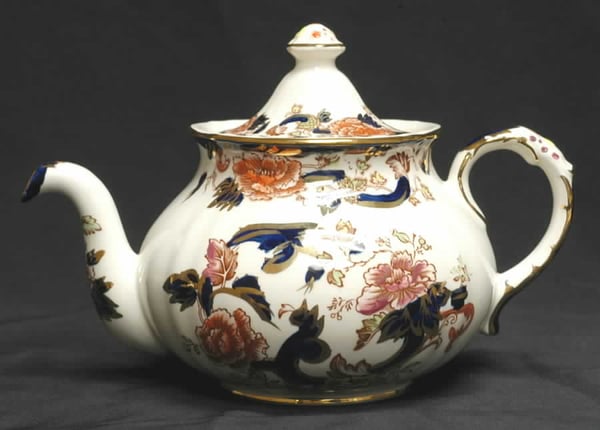
Inquiring readers, Krissy, who enjoys our blog’s posts, alerted us to yet another china pattern used in the 1995 film that featured Jennifer Ehle as Elizabeth and Colin Firth as Mr Darcy. She writes: “I‘ve especially enjoyed reading the articles about the china patterns in the 1995 adaptation of Pride and Prejudice, so when I came across the breakfast set used by the newly minted Mrs. Charlotte Collins at Hunsford Parsonage I thought I’d send it in!

image0

This Mandalay Blue Multicolor set by Mason’s was, no doubt, suggested by Lady Catherine herself as we all know that nothing is too small to be beneath her notice. (The photo is from Replacements.com.)

Where’s Jane? Find Jane Austen Hidden in Her Novels

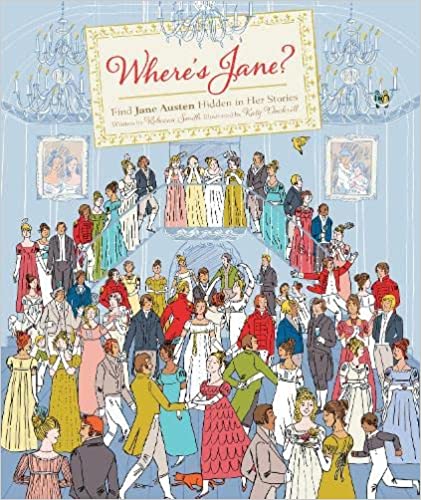
Where's Jane bookThis book, published in 2018, and written by Rebecca Smith and illustrated by Katy Dockrill, is still available. I purchased mine at the Walters Art Museum gift shop recently. Amazon still sells it (although with postage added, it is the same cost as the museum’s). The reading age is for 6-9 year olds. What a perfect time to introduce Austen to children!

Images below show how the main plot of Pride and Prejudice (one of six novel examples) is introduced in comic book form, as are the characters in oval vignettes. Part One introduces the first half of the book, then provides two pages of wonderful images. Readers are asked to find the characters, as well as Jane Austen, whose image sits on the ‘About this Book’ page. 

The solutions sit at the very end.

This slideshow requires JavaScript.

Images from Amazon.com from a preview of the book.

Part Two introduces the last half of the novel and more characters. As a tutor of adults, adult literacy, and children, I found this book not only a delightful introduction to Austen’s novels, but also a perfect way for a child to interact with texts and images, and provide them to answer question and ask questions of customs 200 years ago.

Read Full Post »

« Newer Posts - Older Posts »