Feeds:
Posts
Comments

Archive for the ‘Chawton Cottage’ Category

One of the releases I’ve most anticipated this year is the new book A Jane Austen Year: Celebrating 250 years of Jane Austen by Jane Austen’s House and the brilliant new A Jane Austen Year Podcast of the same name.

After spending so much time researching and writing my seasonal, month-by-month “A Year in Jane Austen’s World” blog series last year, I knew it was right down my alley. I am happy to report that the information included in this book covers a variety of intriguing topics, recipes, illustrations, and specially commissioned photos. It feels like taking a tour of Jane Austen’s House Museum each month of the year. It is well worth the read!

“Arranged chronologically across the calendar year, this uniquely intimate insight into Jane Austen’s world offers reproductions of her letters, the objects she held dear, the story of how her first novel Pride and Prejudice came to be published and the routines of her everyday life at this idyllic Hampshire cottage. Experience life as Austen did herself, as both the notable writer she was, and also the daughter, sister and friend she remained to those closest to her.”

Published by Pitkin, A Jane Austen Year releases March 11, 2025. I was grateful to receive a digital copy in order to review it before its release.

ORDER YOUR COPY HERE

My Review

First of all, this book makes a beautiful addition to your shelves or coffee table if you’re a book collector or if you like to display your Jane Austen books as part of your home, office, or library decor. I also appreciate that it was put together by the people who work at Jane Austen’s House Museum. Many of the photos and insights come directly from Chawton Cottage, where Jane Austen spent the latter years of her life and writing career, and its collections.

As I read through each month’s offerings in A Jane Austen Year, I enjoyed seeing photographs of Jane Austen’s House Museum during every season and reading through the excerpts from Jane Austen’s letters and novels that pertained to that particular month. Of special note are the recipes for meals, vinegars, and salves, sheet music Jane might have played or heard, costume designs for theater productions of the time, gardening notes and illustrations, photos from the collections held at JAHM, as well as snippets from the film adaptations.

Overall, this is a wonderful book to peruse. I look forward to spending a lot more time with it this year. The photographs are stunning and I can’t wait to delve in deeper with the information provided. Now that I’ve read through the entire book, I plan to go through it month by month for the remainder of the year.

Book Excerpt

“This book is written from Jane Austen’s House in Chawton – one of the most important places in the history of English literature and the development of the novel.

“Here, in this inspiring Hampshire cottage, Jane Austen lived for the last eight years of her life. Here, her genius flourished and she wrote, revised and had published all six of her globally beloved novels: Sense and Sensibility, Pride and Prejudice, Mansfield Park, Emma, Northanger Abbey and Persuasion.

“Today, Jane Austen’s House is a cherished museum with an unparalleled collection of Austen treasures, including items of furniture, paintings and household objects. Visitors can discover Jane’s personal letters and first editions of her novels, items of jewellery, portraits of her friends and family, and the tiny writing table at which she wrote.

“This book brings together some of the precious fragments of Jane Austen’s life story, along with world events that shaped her life and understanding, extracts from her novels and letters, and a range of extraordinary objects held here in the museum’s collection. Dip into it as you will, or go through month by month and enjoy a full year of Jane Austen: her life and writings, people and objects she knew and, of course, her beautiful, inspiring home.”

Book Description

This beautifully illustrated book charts the life of one of the world’s most beloved authors through the letters, objects, and manuscripts that shaped her life.

Published in partnership with the curators of Jane Austen’s House, the enchanting Hampshire cottage where Jane Austen’s genius flourished that now attracts thousands of visitors every year.

Arranged over the course of a calendar year, from snowy scenes in January to festive recipes in December, specially commissioned photography of Austen’s home and possessions are brought together with extracts from her books, reproductions of her letters, and stories of her life throughout the seasons. Highlights include the first time Austen read a published copy of Pride and Prejudice to an enraptured audience in her drawing room, affectionate letters to her sister Cassandra reproduced in full and an exquisite miniature portrait of Tom Lefroy, the man she nearly married.

Read this book for a unique and intimate insight into Austen’s world. Dip into it as you will, or visit each month, and enjoy a full year of Austen—her life, works and letters, people and objects she knew, and of course her idyllic, inspiring home.

A Jane Austen Year Podcast

Jane Austen’s House has also released a delightful new podcast to accompany the book. There is a new installment each month! You can listen in HERE.

The A Jane Austen Year podcast is a seasonal journey through Jane Austen’s novels, the story of her life and the world she lived in. It is created and recorded at Jane Austen’s House in Chawton, Hampshire – “the most treasured Austen site in the world.”

For those who haven’t listened yet, I must say that I find this podcast absolutely delightful! It is chock-full of wonderful information about Jane Austen, her writing, her family, her world, and Chawton Cottage. The music, narration, and production make this podcast one of the most soothing and gentle podcasts I’ve heard in a long time. I can’t wait for the next installment!

Podcast Details

A Jane Austen Year transports you to Jane Austen’s House in Chawton, the idyllic Hampshire cottage where Jane Austen lived and wrote her globally beloved novels – now a beloved museum.

Each month, join us on a seasonal journey through Jane Austen’s novels, the story of her life and the world she lived in. Discover scenes, letters, recipes, and objects from the museum collection, bound together with readings and sounds recorded in the House itself.

Each episode is recorded by the people who work at Jane Austen’s House, caring for this special place and protecting it for future generations. January, for example, is voiced by: Lizzie Dunford, Jenny Durrant, Jessica Halmshaw, Amelia Harvell,Sophie Reynolds, Rebecca Wood – with a guest appearance by Dominic Gerrard.

I highly recommend both the book and the podcast. If I could travel to Chawton again this summer, that would be the pinnacle of my Jane Austen year, but these new productions are an absolute gift from Jane Austen’s House Museum. I’m sure it’s been a massive undertaking, and I am grateful!


RACHEL DODGE teaches college English classes, speaks at libraries, teas, and conferences, and writes for Jane Austen’s World blog. She is the bestselling and award-winning author of The Anne of Green Gables DevotionalThe Little Women Devotional, The Secret Garden Devotional, and Praying with Jane: 31 Days Through the Prayers of Jane Austen. A true kindred spirit at heart, Rachel loves books, bonnets, and ballgowns. Visit her online at www.RachelDodge.com.
Read Full Post »

Our month-by-month exploration of Jane Austen’s life, letters, and novels continues now as we take a look at August in Jane Austen’s world. If you’re new to the “A Year in Jane Austen’s World” series, you can find previous articles here: JanuaryFebruaryMarchAprilMay, June, and July.

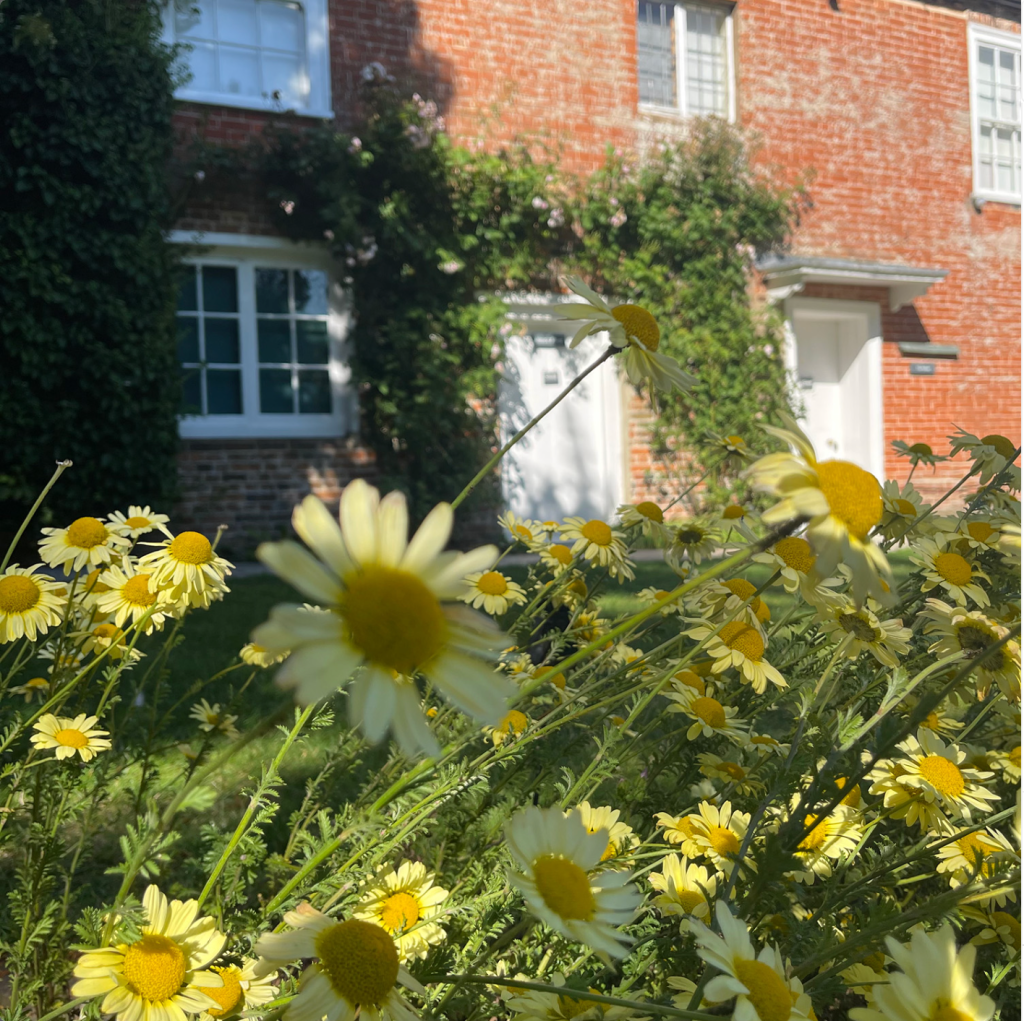
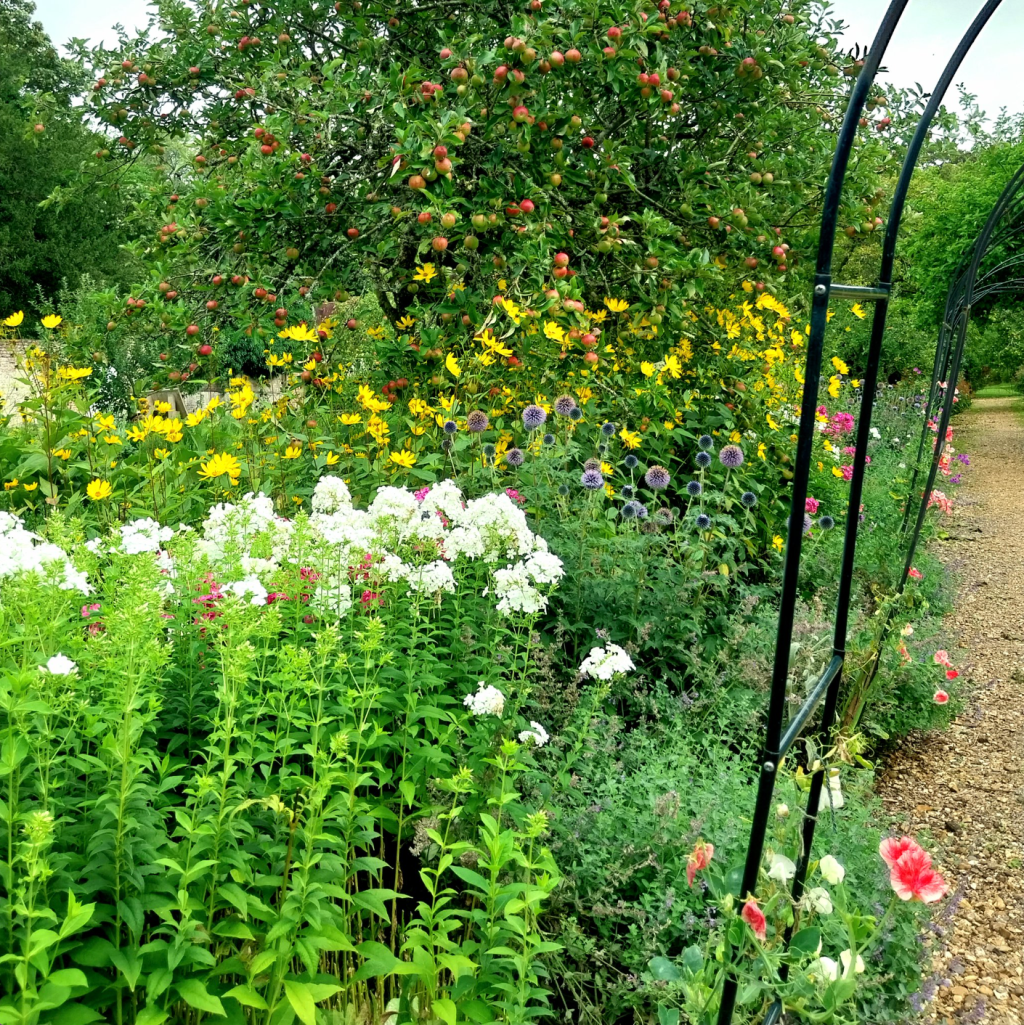
During the lovely summer months in the Hampshire countryside, we know Jane loved to walk and write and visit with friends and family. Sometimes the days are hot, but most of the time, it’s sunny and warm–usually with a chance of showers, which is what helps keep things so pretty and green. If you visit Chawton House Gardens or Jane Austen’s House this time of year, there is plenty to see!

Chawton House in August: Photo @ChawtonHouse.
Jane Austen’s House in August, Photo: @JaneAustensHouse.

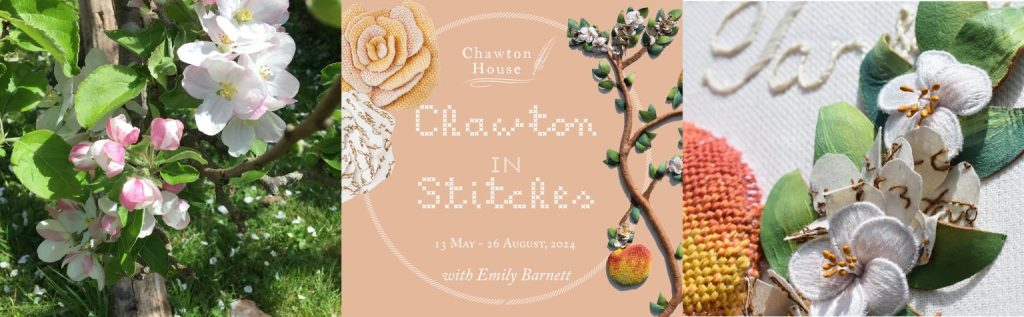
Austen in Stitches

This summer, Chawton House Museum is hosting the “Chawton in Stitches” exhibit, which showcases “the work of award-winning graduate of the Royal School of Needlework Emily Barnett, whose degree project took inspiration from the gardens and collection at Chawton House. Her final showstopping piece comprises three beautifully embroidered panels, focusing on the Orchard and the Knight family cookbook, the Rose Garden and Elizabeth Blackwell’s Curious Herbal, and the Library Terrace and the women’s writing collection.”

You can read more about it HERE.

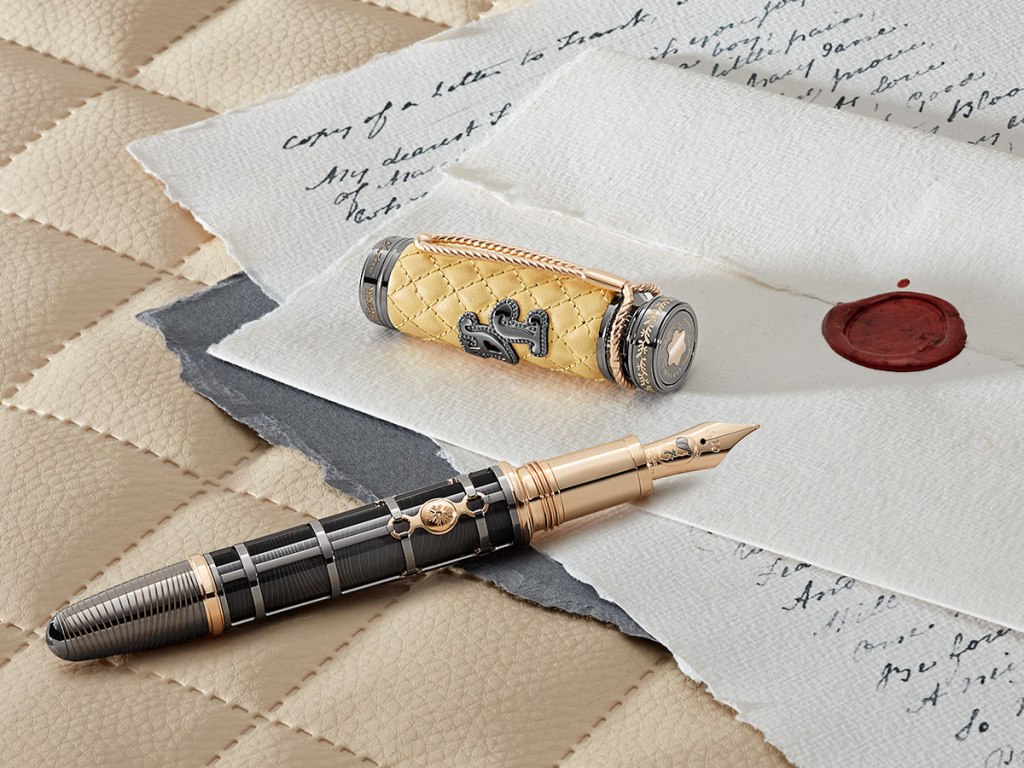
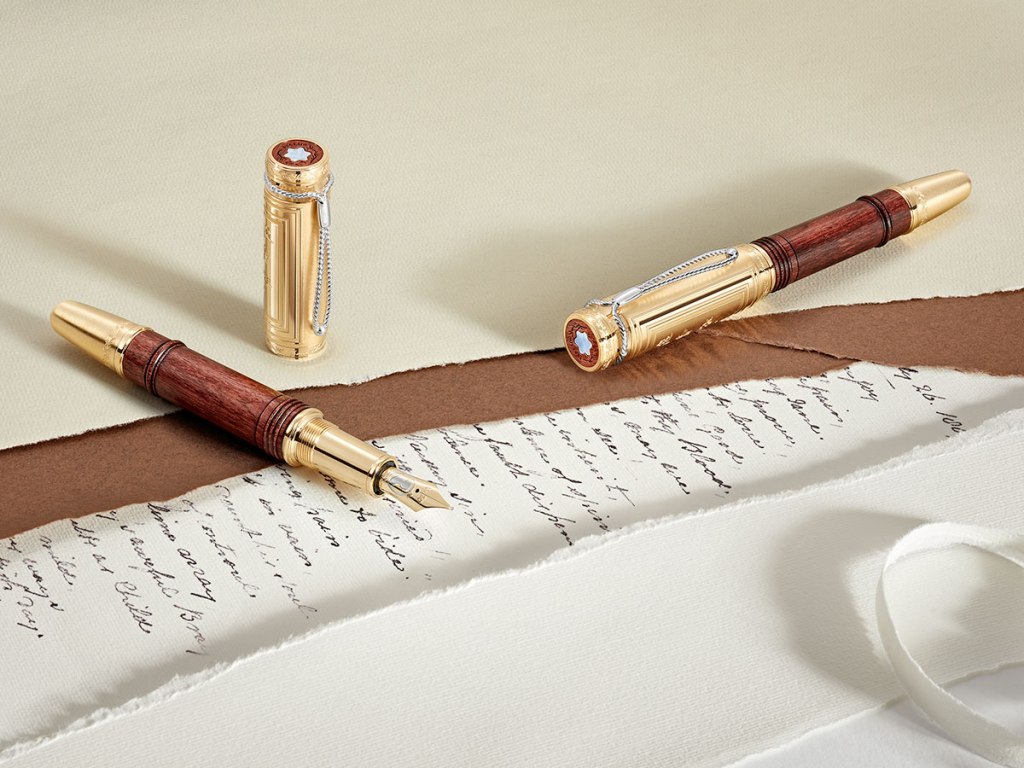
Austen Fountain Pens

The Jane Austen House Museum is proud to announce a beautiful new set of pens from Montblanc: “Historic luxury pen manufacturer Montblanc releases four exquisite limited edition writing instruments, celebrating Jane Austen and inspired by Jane Austen’s House.”

“The Montblanc Writers Edition Homage to Jane Austen pays tribute to Jane Austen as one of Britain’s most celebrated novelists with four limited edition pens. Each writing instrument in the collection represents a passion in Jane Austen’s life, including the countryside, this very House, travel and the ball, illustrating the many facets of her life and works. Details in the craftsmanship of each pen seamlessly reflect aspects of Jane Austen’s life and writing.”

August in Jane Austen’s Letters

Jane tends to write about the weather at some point in her letters, and her August letters are no different:

Cork Street, August 1796
“We reached Staines yesterday, I do not (know) when, without suffering so much from the heat as I had hoped to do. We set off again this morning at seven o’clock, and had a very pleasant drive, as the morning was cloudy and perfectly cool. I came all the way in the chaise from Hertford Bridge.”

She also writes about Henry’s lovely new home in Hans Place, about her own room, the gardens, and the downstairs room that seems to be where she writes in the morning.

23 Hans Place, August 1814
It is a delightful place,—more than answers my expectation. Having got rid of my unreasonable ideas, I find more space and comfort in the rooms than I had supposed, and the garden is quite a love. I am in the front attic, which is the bedchamber to be preferred.”

“I live in [Henry’s] room downstairs; it is particularly pleasant from opening upon the garden. I go and refresh myself every now and then, and then come back to solitary coolness.”

Now I have breakfasted and have the room to myself again. It is likely to be a fine day. How do you all do?”

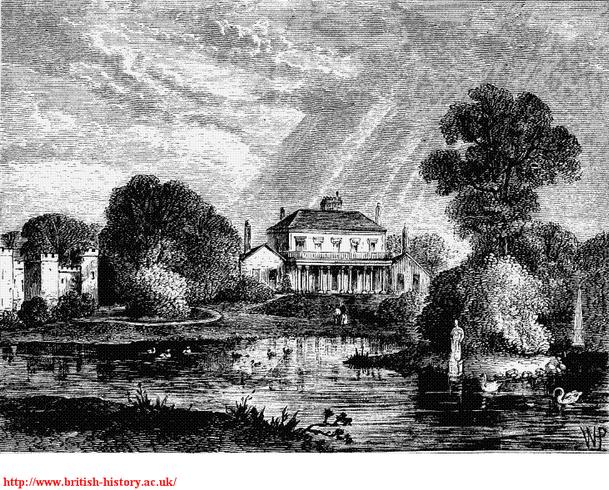
From Vic: “In 1814, Henry moved from his rooms above his bank to a house he purchased in Hans Place in Knightsbridge. The area was situated near his old quarters on Sloane Street.” You can read more about Hans Place in Vic’s detailed article, “Jane Austen’s Visits to London.”

Hans Place, The Pavillion, 1812. Image @British History Online

August in Jane Austen’s Novels

Pride and Prejudice

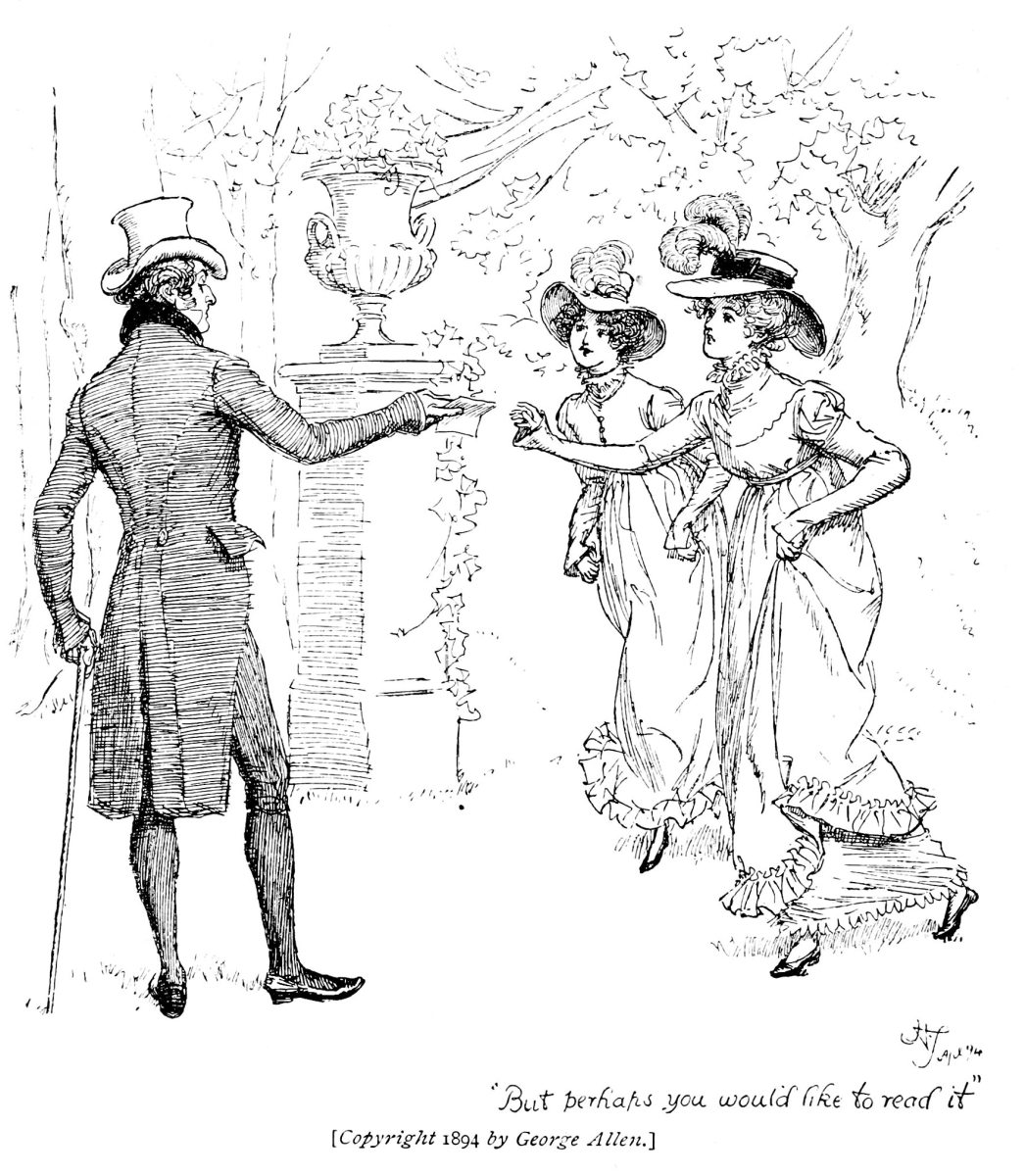
  • Mr. Gardiner writes to Mr. Bennet in August (Gracechurch Street, Monday, August 2). Elizabeth reads the letter:

    “My dear Brother, At last I am able to send you some tidings of my niece, and such as, upon the whole, I hope will give you satisfaction. Soon after you left me on Saturday, I was fortunate enough to find out in what part of London they were. The particulars I reserve till we meet. It is enough to know they are discovered: I have seen them both——”

    “Then it is as I always hoped,” cried Jane: “they are married!”

    Elizabeth reads on: “I have seen them both. They are not married, nor can I find there was any intention of being so; but if you are willing to perform the engagements which I have ventured to make on your side, I hope it will not be long before they are. All that is required of you is, to assure to your daughter, by settlement, her equal share of the five thousand pounds, secured among your children after the decease of yourself and my sister; and, moreover, to enter into an engagement of allowing her, during your life, one hundred pounds per annum…”

Mansfield Park

  • Tom Bertram arrives home: “Sir Thomas was to return in November, and his eldest son had duties to call him earlier home. The approach of September brought tidings of Mr. Bertram, first in a letter to the gamekeeper and then in a letter to Edmund; and by the end of August he arrived himself, to be gay, agreeable, and gallant again as occasion served, or Miss Crawford demanded; to tell of races and Weymouth, and parties and friends, to which she might have listened six weeks before with some interest, and altogether to give her the fullest conviction, by the power of actual comparison, of her preferring his younger brother.”
  • Sir Thomas arrives home earlier than expected: “Julia, appearing at it, with a face all aghast, exclaimed, ‘My father is come! He is in the hall at this moment.’ How is the consternation of the party to be described? To the greater number it was a moment of absolute horror. Sir Thomas in the house! All felt the instantaneous conviction. Not a hope of imposition or mistake was harboured anywhere. Julia’s looks were an evidence of the fact that made it indisputable; and after the first starts and exclamations, not a word was spoken for half a minute: each with an altered countenance was looking at some other, and almost each was feeling it a stroke the most unwelcome, most ill-timed, most appalling! Mr. Yates might consider it only as a vexatious interruption for the evening, and Mr. Rushworth might imagine it a blessing; but every other heart was sinking under some degree of self-condemnation or undefined alarm, every other heart was suggesting, ‘What will become of us? what is to be done now?’ It was a terrible pause; and terrible to every ear were the corroborating sounds of opening doors and passing footsteps.”

Emma

  • August is when Jane Fairfax will leave Highbury: “Jane Fairfax was still at her grandmother’s; and as the return of the Campbells from Ireland was again delayed, and August, instead of Midsummer, fixed for it, she was likely to remain there full two months longer, provided at least she were able to defeat Mrs. Elton’s activity in her service, and save herself from being hurried into a delightful situation against her will.”
  • Emma’s sisters Isabella plans to visit in August (and will keep Harriet with them until then): “Mr. and Mrs. John Knightley were to come down in August, and she was invited to remain till they could bring her back.”
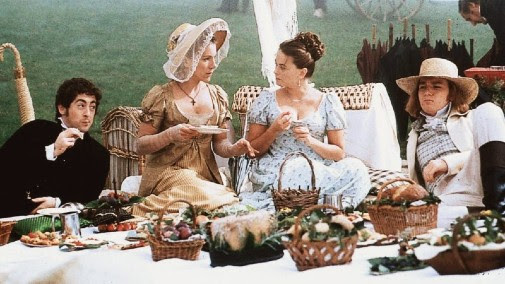
Box Hill Picnic

Persuasion

  • Anne Elliot’s birthday: Anne, born August 9, 1787.
  • Captain Wentworth goes to stay with Captain Benwick in August in order to break the news of Fanny Harville’s (his fiancée’s) death: “Not till the first week of August, when he came home from the Cape, just made into the Grappler. I was at Plymouth dreading to hear of him; he sent in letters, but the Grappler was under orders for Portsmouth. There the news must follow him, but who was to tell it? not I. I would as soon have been run up to the yard-arm. Nobody could do it, but that good fellow (pointing to Captain Wentworth). The Laconia had come into Plymouth the week before; no danger of her being sent to sea again. He stood his chance for the rest; wrote up for leave of absence, but without waiting the return, travelled night and day till he got to Portsmouth, rowed off to the Grappler that instant, and never left the poor fellow for a week. That’s what he did, and nobody else could have saved poor James. You may think, Miss Elliot, whether he is dear to us!”
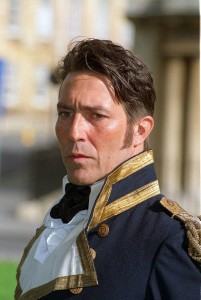
Ciarán Hinds as Captain Frederick Wentworth in Persuasion, 1995.

August Dates of Importance

This brings us now to several important August dates that relate to Jane and her family:

Family News:
26 August 1766: George Austen (Jane’s brother) born at Deane.
July-August 1768: Austen family moves to Steventon, Hampshire.

Historic Dates:
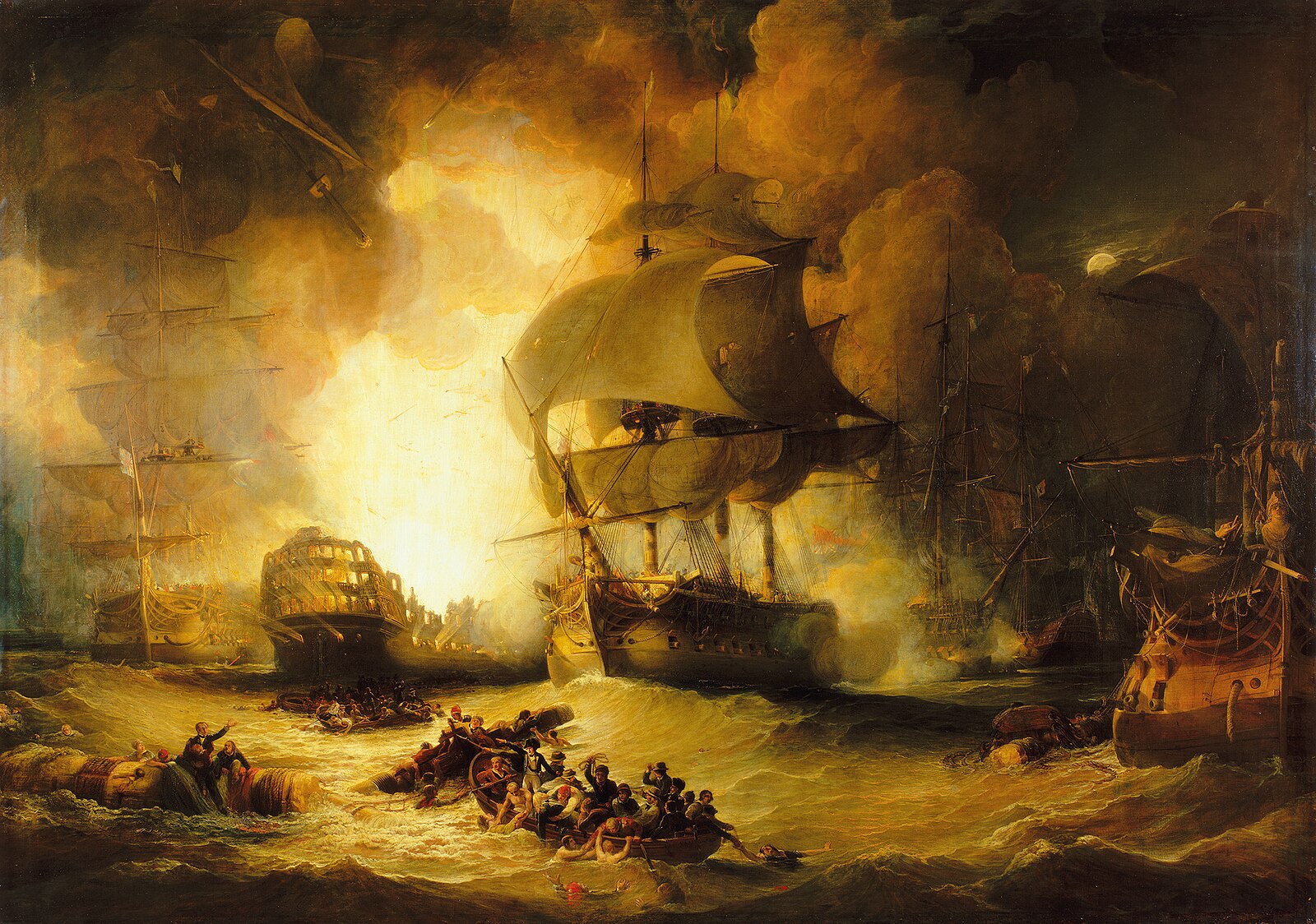
1 August 1798: Horatio Nelson’s victory over Napoleon’s fleet at the Battle of the Nile.

Writing:
August 1797: Austen finishes “First Impressions.”
8 August 1815: Austen begins Persuasion.
August 1816: Persuasion revised and finished.

Sorrows:
9 August 1798: Lady Williams (Jane Cooper, one of Austen’s lifelong friends), dies in a tragic carriage accident on the Isle of Wight at the age of 27.

The Destruction of ‘L’Orient’ at the Battle of the Nile, George Arnald.
1 August 1798. (Wikimedia Commons.)

Summer Wanes

As the summer heat slowly diminishes in Jane Austen’s England, we can look forward to the first breaths of autumn next month when we return to examine September in Jane Austen’s World. Until then, I hope you’ve enjoyed exploring August and all it has to offer!


RACHEL DODGE teaches college English classes, gives talks at libraries, teas, and book clubs, and writes for Jane Austen’s World blog. She is the bestselling author of The Little Women DevotionalThe Anne of Green Gables Devotional and Praying with Jane: 31 Days Through the Prayers of Jane Austen. Now Available: The Secret Garden Devotional! You can visit Rachel online at www.RachelDodge.com.
Read Full Post »

As the summer months continue in our month-by-month exploration of Jane Austen’s life, letters, and novels, we turn our attention to July in Jane Austen’s world. If you’re new to the “A Year in Jane Austen’s World” series, you can find previous articles here: JanuaryFebruaryMarchApril, May, and June.

Last month, we enjoyed the June roses at Chawton House Gardens. Let’s take a look at our monthly view for July! Can you imagine exploring the walled gardens on a warm summer day? I know two kids who did explore the gardens and the apple orchard (with permission) at Chawton House a few years ago!

Chawton House in July: Photo @ChawtonHouse.

July in Hampshire

July in Hampshire brings sporadic heat waves, overcast days, sunny days, and frequent rain showers. The Austen women moved to Chawton in July 1809:

“On this day (7 July) in 1809 Jane Austen moved to Chawton to live in this house. It was here, in this inspiring cottage, that Jane’s genius flourished and where she wrote, revised, and had published all six of her globally beloved novels.” (Jane Austen’s House Museum)

Jane Austen’s House in July, Photo: @JaneAustensHouse.

July in Jane Austen’s Letters

We don’t have as many of Jane’s letters from the month of July on record, though there is one funny aside that caught my attention as I searched through her letters. After complaining earlier to Cassandra about a few days of “cold disagreeable weather,” “fires every day,” and use of her “kerseymere spencer” for evening walks, Jane wrote the following on 1 July 1808: “The weather is mended, which I attribute to my writing about it…”

The fact is, however, that two of the most important letters we have from the month of July are not from Jane herself but from her sister Cassandra. And those, as many of you well know, are the letters Cassandra wrote to her niece Fanny Knight after Jane’s passing in July 1817.

Cassandra’s Letters

Cassandra’s letters, which many of you have read, are some of the most beautiful letters we have on record. Jane was Cassandra’s younger sister, but she was also her lifelong companion and best friend. Cassandra’s sorrow at losing one so dear is obvious in her writings.

In her first letter (18 July 1817), Cassandra tells Fanny about Jane’s last days and hours with delicacy, reverence, and love:

I have lost a treasure, such a sister, such a friend as never can have been surpassed. She was the sun of my life, the gilder of every pleasure, the soother of every sorrow; I had not a thought concealed from her, and it is as if I had lost a part of myself. I loved her only too well,—not better than she deserved, but I am conscious that my affection for her made me sometimes unjust to and negligent of others; and I can acknowledge, more than as a general principle, the justice of the Hand which has struck this blow.

You know me too well to be at all afraid that I should suffer materially from my feelings; I am perfectly conscious of the extent of my irreparable loss, but I am not at all overpowered and very little indisposed,—nothing but what a short time, with rest and change of air, will remove. I thank God that I was enabled to attend her to the last, and amongst my many causes of self-reproach I have not to add any wilful neglect of her comfort.

In her second letter (29 July 1817), Cassandra expresses to Fanny that she often thinks of Jane in Heaven and hopes she will one day be reunited with her there:

If I think of her less as on earth, God grant that I may never cease to reflect on her as inhabiting heaven, and never cease my humble endeavors (when it shall please God) to join her there.

As a lifelong lover of Jane Austen, I treasure Cassandra’s letters deeply, as I’m sure many of you do too. If you have not read her letters in a while, or if you wish to read them for the first time, you can find them HERE.

July in Jane Austen’s Novels

Pride and Prejudice

  • July is when Elizabeth travels with Mr. and Mrs. Gardiner: “The time fixed for the beginning of their northern tour was now fast approaching; and a fortnight only was wanting of it, when a letter arrived from Mrs. Gardiner, which at once delayed its commencement and curtailed its extent. Mr. Gardiner would be prevented by business from setting out till a fortnight later in July, and must be in London again within a month; and as that left too short a period for them to go so far, and see so much as they had proposed, or at least to see it with the leisure and comfort they had built on, they were obliged to give up the Lakes, and substitute a more contracted tour; and, according to the present plan, were to go no farther northward than Derbyshire. In that county there was enough to be seen to occupy the chief of their three weeks; and to Mrs. Gardiner it had a peculiarly strong attraction. The town where she had formerly passed some years of her life, and where they were now to spend a few days, was probably as great an object of her curiosity as all the celebrated beauties of Matlock, Chatsworth, Dovedale, or the Peak.”
Elizabeth and Mr. Darcy, Mr. and Mrs. Gardiner

Mansfield Park

  • Mr. and Miss Crawford come on the scene: “Such was the state of affairs in the month of July; and Fanny had just reached her eighteenth year, when the society of the village received an addition in the brother and sister of Mrs. Grant, a Mr. and Miss Crawford, the children of her mother by a second marriage. They were young people of fortune. The son had a good estate in Norfolk, the daughter twenty thousand pounds.”

Emma

  • The night before Mr. Knightley returns from London, Emma spends a miserable evening wondering what will come of Harriet’s feelings (and her own feelings) toward Mr. Knightley: “The evening of this day was very long, and melancholy, at Hartfield. The weather added what it could of gloom. A cold stormy rain set in, and nothing of July appeared but in the trees and shrubs, which the wind was despoiling, and the length of the day, which only made such cruel sights the longer visible.”
  • Emma’s thoughts that evening regarding the loss of Mr. Knightley, if he were to marry Harriet: “All that were good would be withdrawn; and if to these losses, the loss of Donwell were to be added, what would remain of cheerful or of rational society within their reach? Mr. Knightley to be no longer coming there for his evening comfort!—No longer walking in at all hours, as if ever willing to change his own home for theirs!—How was it to be endured?”
Gwyneth Paltrow in Emma, 1997.

Persuasion

  • Sir Walter Elliot’s wedding day: “Walter Elliot, born March 1, 1760, married, July 15, 1784, Elizabeth, daughter of James Stevenson, Esq. of South Park, in the county of Gloucester, by which lady (who died 1800) he has issue Elizabeth, born June 1, 1785; Anne, born August 9, 1787; a still-born son, November 5, 1789; Mary, born November 20, 1791.”
  • The letter Mrs. Smith produces from Mr. Elliot, written to “Charles Smith, Esq. Tunbridge Wells,” dated July 1803, reads as follows:

“Dear Smith,

“I have received yours. Your kindness almost overpowers me. I wish nature had made such hearts as yours more common, but I have lived three-and-twenty years in the world, and have seen none like it. At present, believe me, I have no need of your services, being in cash again. Give me joy: I have got rid of Sir Walter and Miss. They are gone back to Kellynch, and almost made me swear to visit them this summer; but my first visit to Kellynch will be with a surveyor, to tell me how to bring it with best advantage to the hammer. The baronet, nevertheless, is not unlikely to marry again; he is quite fool enough. If he does, however, they will leave me in peace, which may be a decent equivalent for the reversion. He is worse than last year.

“I wish I had any name but Elliot. I am sick of it. The name of Walter I can drop, thank God! and I desire you will never insult me with my second W. again, meaning, for the rest of my life, to be only yours truly,

“WM. ELLIOT.”

Samuel West at Mr. Elliot in Persuasion, 1995.

July Dates of Importance

This brings us now to several important July dates that relate to Jane and her family:

Family News:

July–August 1768: The Austen family moves to Steventon, Hampshire.

3 July 1779: James Austen matriculates at St. John’s College, Oxford (BA 1783, MA 1788).

1 July 1788: Henry Austen matriculates at St. John’s College, Oxford (BA 1792, MA 1796).

2 July 1806: Mrs. Austen and her daughters leave Bath.

24 July 1806: Francis Austen marries Mary Gibson.

7 July 1809: Austen women and Martha Lloyd move to Chawton Cottage.

Historic Dates:

14 July 1789: Storming of the Bastille in Paris.

July 1793: Beginning of the Reign of Terror in France.

Writing:

July 1813: Austen (most likely) finishes Mansfield Park.

18 July 1816: Austen completes first draft of Persuasion.

Sorrows:

18 July 1817: Jane Austen dies, early in the morning, attended by her sister Cassandra.

24 July 1817: Jane Austen is buried in Winchester Cathedral.

Helen LeFroy at a private JASNA ceremony at Jane Austen’s grave, Winchester Cathedral, 2007. Image @ Rachel Dodge.
Jane Austen’s Grave.

July Beginnings and Endings

It’s interesting to note that Jane Austen moved to Chawton in July 1809 and passed away (in Winchester) in July 1817. Her years at Chawton Cottage are some of the most fruitful of all her writing career. From Jane Austen’s House Museum:

1811: Sense and Sensibility published.
1813: Pride and Prejudice published.
1814: Mansfield Park published.
1816: Emma published (December 1815).
1815 – 1816: Jane writes The Elliots (later published as Persuasion).
January 1817: Jane begins The Brothers (later published as Sanditon), but she only completes the first twelve chapters.

Though we wish Austen could have lived much longer, enjoyed her wonderful family, and written many more novels, it’s incredible to think that she was able to accomplish so much in just a few short years. I’m thankful that Austen enjoyed a season of joy and creativity at Chawton Cottage. She wrote happily there in the beloved Hampshire countryside of her youth.

See you next month for August in Jane Austen’s World!


RACHEL DODGE teaches college English classes, gives talks at libraries, teas, and book clubs, and writes for Jane Austen’s World blog. She is the bestselling author of The Little Women DevotionalThe Anne of Green Gables Devotional and Praying with Jane: 31 Days Through the Prayers of Jane Austen. Now Available: The Secret Garden Devotional! You can visit Rachel online at www.RachelDodge.com.
Read Full Post »

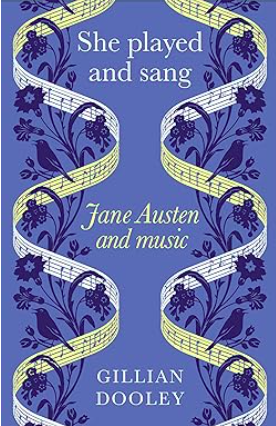
Book CoverIn the introduction, author Gillian Dooley reveals her primary reason for writing a book about music in Austen’s life – that of exploring the “rhetorical link between writing and making music, especially given the musicality of her prose” (P 3). This statement reveals the book’s direction. She quotes Robert K. Wallace in Jane Austen and Mozart:

“the classical and neoclassical value of balance, equilibrium, proportion, symmetry, clarity, restraint, wit, and elegance that are typical of Austen’s novels and of Mozart’s piano concertos are typical as well of the music that Austen played on her square piano” – P 3

In pages 4-8, Dooley describes the connection between music and Austen’s writing with examples in her novels, such as Sense and Sensibility and Mansfield Park. Mind you, we are still in the introduction, which is rich with information.   

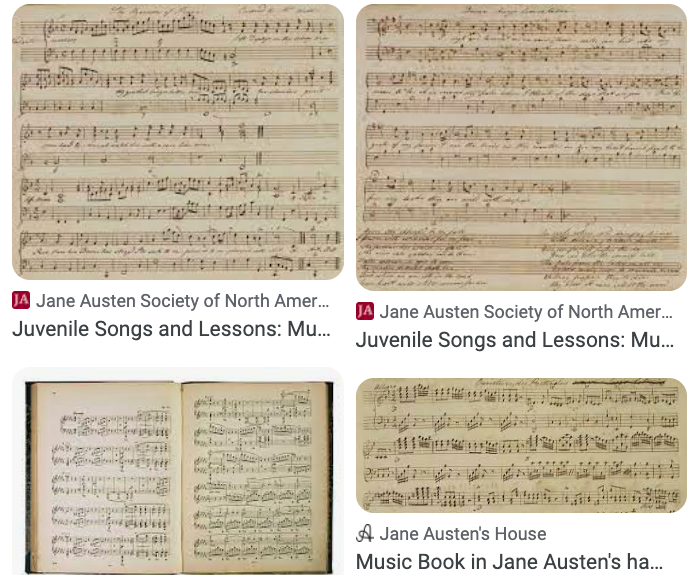
The Jane Austen  music manuscripts

Jane Austen's Music Books

Screen shot of an online search

These manuscripts consist of more than 500 separate playable pieces of eighteen albums, which can be found on the Internet Archive. Four of the surviving music books contain manuscripts in Austen’s hand (P 24). Dooley discusses the “160 or so” pieces of music that she meticulously copied by hand (listed in Appendix 2). These most likely represented the memorable music that meant more to her than the other pieces she played and sung as well.

The section that describes the Austen family music collection includes a wider range of musical tastes. When the Austens moved from Steventon to Bath in 1801, they brought along with them a large music collection, although there is no record of its details. Of the eighteen albums that we now know of, it was determined that seven belonged to Austen, and that the remaining 11 albums belonged to the extended family (P 87). Dooley mentions their names, including Eliza née Hancock, who married Henry Austen; Elizabeth Bridges, who married Edward Austen Knight; Louisa and Cassandra Austen Knight, Edward’s youngest daughters, and more.

Movie music vs. Austen’s preferences

I’ve tried over the years to find if the music played in the films based on Austen’s novels represent her actual taste in music, or the music popular in her time. Much to my chagrin, my feeble attempts took time, and I suspect that I still got much of the information wrong. So I embarked on a quick search in Dooley’s book.

I’ve long favored the earthy music and folksy ballads included in Emma 2020, which spoke to my heart. Was my instinct correct about these folk pieces’ connection to Austen’s musical tastes? Dooley provides some important insights. 

One question I had was about Haydn’s and Mozart’s influence in her repertoire. Dooley mentions Haydn:

“In the later decades of the eighteenth century Franz Joseph Haydn (1732–1809) was far better known in London than Mozart. Adjacent to the Mozart duet in Austen’s album are three of Haydn’s English canzonets, in a hand which has been attributed to Elizabeth Austen, née Bridges, Edward’s wife. It is very similar indeed to Austen’s own handwriting … the presence of these songs, even if copied in Elizabeth’s handwriting, in Austen’s manuscript book indicates that she knew them and perhaps sang them.” 

While Austen knew of Haydn, she was fond of the composer Ignaz Pleyel, who was his student, and she had a number of Pleyel’s pieces. As an aside, Dooley mentioned that Mozart’s music played a minor role (P 43) in her collection of music, which surprised me. 

Over the years, Austen’s letters indicated that she shared musical information with friends and family, and that she planned to play country dances for her young relatives, some of whom recalled her singing for the family years later. She did not perform  for company or in public, (PP 70-71). It was said that she had a fine singing voice.

“Most of the English nursery rhymes among the manuscripts are unattributed and the only one which uses the tune familiar today is ‘Dickory, dickory dock’. They appear towards the middle of the book and were probably copied by Austen to sing for the amusement of her young nieces and nephews” (P 64). 

On a personal note, I favor songs, old or modern, that tell a story. Austen, it appears, recorded many such songs, such as Irish and Scottish folk songs. One song mentioned by Dooley was familiar to Austen, but was not recorded in her manuscript. Still, ‘Anna’ is representative of her tastes:

“ ‘Anna: A favorite Scotch song with variations for the piano forte composed by J. L. Dussek’.  The Dussek variations are not to be found in any of her surviving music books. This Scottish folk song, which is more usually titled ‘Shepherds I have lost my love’, was well known at the time, appearing in musical arrangements by several other composers including Joseph Haydn and Ignaz Pleyel. Austen would have been familiar with the tune – she had a copy of an arrangement for [a] piano duet by Thomas Billington in one of her composite volumes of printed music. The song lyrics are not included in the Dussek and Billington versions, but Austen might still have known them.

Shepherds, I have lost my love;

Have you seen my Anna?

Pride of ev’ry shady grove,

Upon the banks of Banna!

I for her my home forsook,

Near yon misty mountain;

Left my flock, my pipe, my crook,

Greenwood shade, and fountain.

Never shall I see them more

Until her returning;

All the joys of life are o’er,

From gladness chang’d to mourning.

Whither is my charmer flown?

Shepherds, tell me whither?

Ah! Woe for me, perhaps she’s gone

For ever and for ever. – P 74

This story melts my heart. I grew up loving folk songs and this one is right up my alley. You can listen to it in the YouTube video below. The fact that the song has some connection to Austen makes it even sweeter for me. 

But what of the waltz? Was it not introduced during Austen’s time? Did she not mention it? Indeed she did, but here’s the rub – Dooley explains that the waltz was controversial, even considered scandalous in some quarters:

“Those whose opposing opinions were recorded were either the jealous lovers of the female partners in a waltz who felt that the dance allowed other men to take liberties, or the authors of advice manuals for young women. The very fact that these opinions were voiced suggests that the waltz was already common and the opposition was therefore not universal at all … it is implied that the ‘irresistible waltz’ played by Mrs Weston in Emma (Volume II, Chapter 8) accompanied a ‘longways country dance set in waltz time, not waltzing in pairs’, which would have been more controversial. There are several waltz tunes from the 1790s in the ‘Juvenile songs and lessons’ album, but it seems likely that they were played to accompany country dances rather than the ‘turning waltz’ that was not widely danced in England until late in Austen’s lifetime.” – P 51

Poignantly, Dooley includes Caroline Austen’s memory of her Aunt Jane’s last four songs when “she had nearly left off singing” (P 229).

The book’s final pages (starting at P 235) includes a bibliography, two appendices, notes, and an index. Appendix Two covers an annotated list of manuscripts in Austen’s hand (PP 238 – 292). Information contained at the end is quite extensive and provides a wealth of information. 

In my estimation, this book is a keeper and will be kept on my shelf of reference materials. It’s an interesting read, but, more importantly, it fills a gap in our knowledge of the music Austen loved, copied,  and sang. Dooley brought to mind how important reading out loud was to Austen and the people of her time, and how important music was in an era when family and local musicians provided wonderful entertainments for their families and communities.

More on the topic

Publisher ‏: ‎ Manchester University Press (March 5, 2024)

Language ‏ : ‎ English

Hardcover ‏ : ‎ 344 pages

ISBN-10 ‏ : ‎ 1526170108

ISBN-13 ‏ : ‎ 978-1526170101

Read Full Post »

On January 9, 1773, Jane Austen’s older sister Cassandra Austen was born – 250 years ago – and we Austen fans are celebrating her life worldwide!

The two Austen sisters were nearly inseparable, from the time Jane was born until she passed away. She was the yin to Austen’s yang . . . or to put it in Regency terms, she was the darning needle to Jane’s stockings, the saucer to her tea cup. If you love Jane, then you would have undoubtedly loved Cassandra!

A Friend and Companion

When Jane was born, her father famously wrote: “We have now another girl, a present plaything for her sister Cassy, and a future companion.”

Reverend Austen was right on both counts. When the girls were young, Jane was extremely attached to Cassandra. So much so that when Cassandra went away to school, Jane was allowed to go as well. Not because she was necessarily ready for school, but because, as their mother said, “if Cassandra’s head had been going to be cut off, Jane would have hers cut off too.”

As they grew up, the sisters became the closest of companions and the dearest of friends. Of particular note, Cassandra is known for her sketches and watercolor paintings, particularly those believed to be of Jane and those that accompany Jane’s History of England.

Excerpt from the History of England by Jane Austen, illustrated by Cassandra Austen, the British Library.

Cassandra and Jane

Much of what we know about Austen’s personal life is largely due to the letters Jane wrote to her sister. Though Cassandra destroyed many of Jane’s letters after her death, there is still much we can find out about the two sisters through reading Jane Austen’s letters. Cassandra’s own letters about Jane’s illness and death provide a tender glimpse into the love and closeness of the Austen sisters.

I have lost a treasure, such a sister, such a friend as never can have been surpassed. She was the sun of my life, the gilder of every pleasure, the soother of every sorrow; I had not a thought concealed from her, and it is as if I had lost a part of myself… I thank God that I was enabled to attend her to the last…

Cassandra Austen to Fanny Knight, July 18, 1817
Jane Austen by Cassandra

A Year of Cassandra

To honor Cassandra’s life and legacy, Jane Austen’s House Museum launched its “Year of Cassandra,” during which the museum will feature special events and exhibitions to celebrate her life.

If you’re like me and you want to be part of this special celebration but don’t live close enough to participate in person, the Museum is planning a “Cassandra-themed” Virtual Tour of the museum in March. The tour description is as follows: “Find out about Cassandra’s life at Chawton Cottage and discover objects related to her on a lively, fact-filled tour that you can enjoy from the comfort of your own home.” You can find the details HERE.

Cassandra’s Orchard

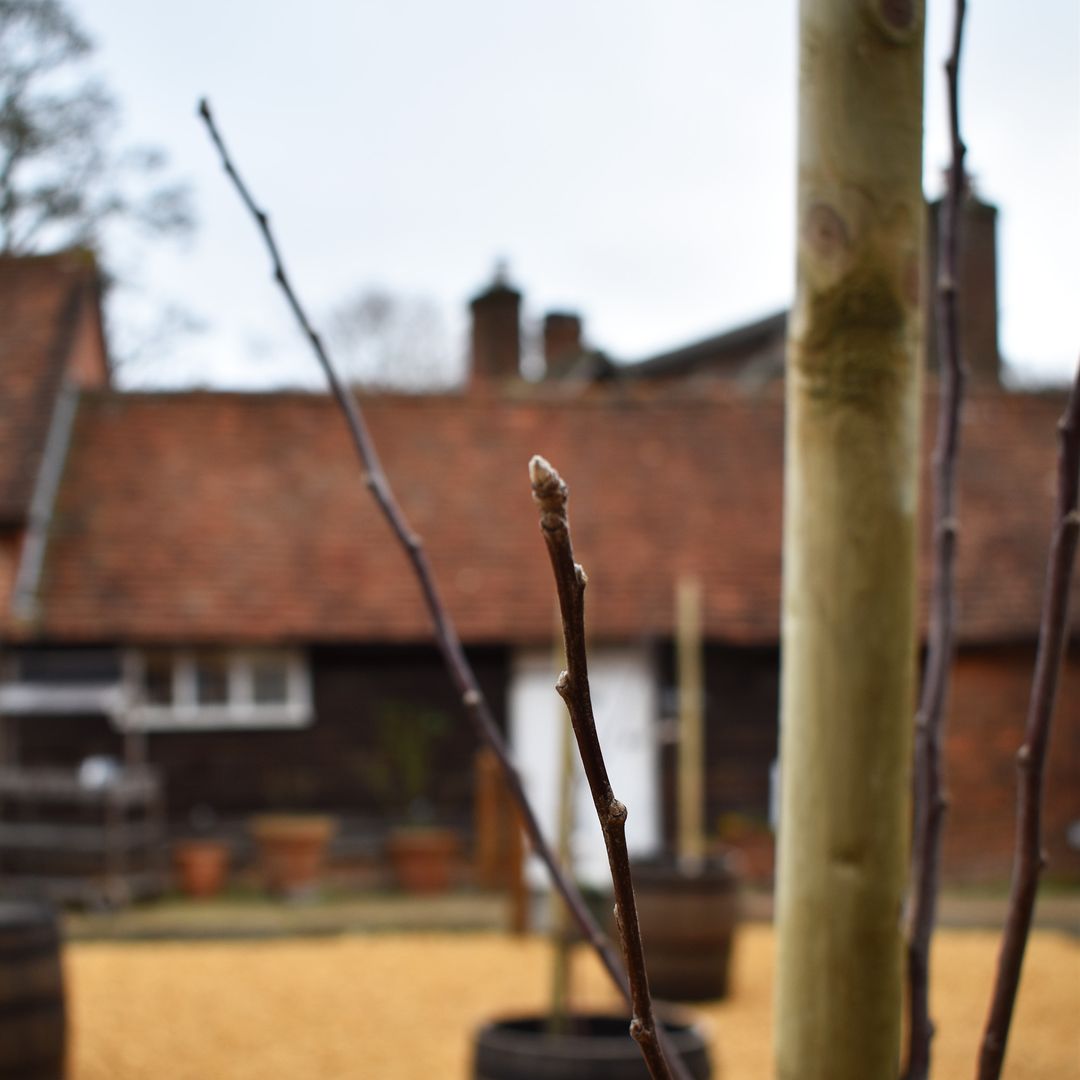
Of special note is the commemorative orchard being planted in Cassandra Austen’s honor, which has been named “Cassandra’s Orchard.” The name itself certainly makes me want to visit Chawton Cottage again one day soon, but the descriptions are even more intriguing:

Jane’s letters to her are filled with references to plants, flowers and fruits from the orchard, now sadly lost from the grounds of the House.

We will recreate this lost orchard, using dwarf varieties suitable for growing in containers. There will be a tree for every novel, and donors’ names will be recorded on plaques for each tree. The orchard will provide blossom in the spring, delicious shade in the summer, and fruits in the autumn. We will underplant the trees with plants for pollinators, turning this empty space into a haven for people and wildlife alike.

Jane Austen’s House Museum
Cassandra’s Orchard, Photo courtesy of Jane Austen’s House Museum.

More About Cassandra

I’ve been following along with the progress of the Cassandra’s Orchard project, and I was delighted when the museum announced in December (on Jane’s birthday) that it had reached its fundraising goal. I can just imagine what a wonderful addition this little orchard will make to Jane Austen’s house.

I’m thankful for Cassandra Austen because I know that having someone who believes in you, supports you, and challenges you intellectually is important in every person’s life – but especially in the lives of writers, artists, and creatives. The very fact that she was so loved by Jane means that Cassandra must have been quite a remarkable person.

If you’d like to know more about Cassandra Austen’s life, Vic here at Jane Austen’s World has built quite the catalog of articles over the years. You can access those articles HERE. Of particular note is the article entitled, “Cassandra Austen: Jane’s confidante, supporter and helpmate” that is well worth your time.

More links about this topic:


RACHEL DODGE teaches college English classes, gives talks at libraries, teas, and book clubs, and writes for Jane Austen’s World blog. She is the bestselling author of The Little Women DevotionalThe Anne of Green Gables Devotional and Praying with Jane: 31 Days Through the Prayers of Jane Austen. Her newest release is The Secret Garden Devotional! You can visit Rachel online at www.RachelDodge.com.
Read Full Post »

Older Posts »