Feeds:
Posts
Comments

Archive for the ‘Christmas’ Category

Jane Austen’s Christmas Day at Godmersham Park, her brother’s estate in the English countryside of Kent, was a merry one. As described by Claire Tomalin in Jane Austen: A Life , “Christmas was celebrated with carols, card games, blindman’s bluff, battledore, bullet pudding and dancing.”

Austen herself described the gaiety and revelry of Christmas in Persuasion, Chapter 14:

On one side was a table occupied by some chattering girls, cutting up silk and gold paper; and on the other were trestles and trays, bending under the weight of brawn and cold pies, where riotous boys were holding high revel; the whole completed by a roaring Christmas fire, which seemed determined to be heard in spite of the noise of the others.”

The games mentioned by Tomalin in her excellent biography of Austen included Hunt the Slipper, which, when played by children, would be fun and boisterous, and when played by adults at a country house gathering could have a naughty connotation, as in the 1802 image in the Hunt the Slipper: A Story, (Peabody Essex Museum).

Game directions for Hunt the Slipper

Hunt the Slipper game directions. (Hunt the Slipper, The American Folk Song Collection,  Kodaly Center, Holy Names University.

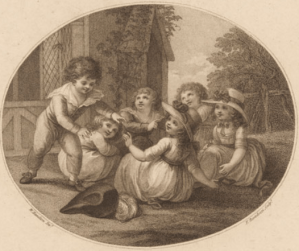
Image of Hunt the Slipper by Francesco Bartolozzi, 1787, Pushkin Museum of Fine Arts (GMII): Image in the public domain. Wikimedia

Francesco Bartolozzi, 1787, Pushkin Museum of Fine Arts (GMII): Image in the public domain. Wikimedia

Hunt the Slipper reminds me of musical chairs, only the slipper is passed secretly to the players until the song ends. This simple but fun song/game is still played today. You can view the “Hunt the Slipper” image by Kate Greenaway,  who lived in the last half of the 19th century, then read the 2008 description of the game in The Guardian at this link: click here. The rules over the centuries are remarkably similar.

In her book, Claire Tomalin mentioned a second song and game that the Austen family (and other families of the era) played called “Oranges and Lemons.” References to this traditional song and nursery rhyme appeared as early as the 17th century.

The first published record of Oranges and Lemons dates back to 1744 in Tommy Thumb’s Pretty Song Book, although it’s fair to assume it had been in circulation for some time before then. There is a reference to a square dance with the same name in a 1665 publication…– What is London’s Oranges and Lemons rhyme all about? by Benjamin Till, People Features, London, BBC Home, 13 November, 2014

Till discusses the many meanings of this song. In short, London’s churches, which are located in distinct districts within the city, are identified with certain trades.

References to “pancakes and fritters”, “kettles and pans” and “brick bats and tiles” tell us of bakers, coppersmiths and builders in areas around St Peter Upon Cornhill, St Anne’s and St Giles, Cripplegate respectively.” — Till, BBC Home

A version of the song can be heard on YouTube.

Many versions of this song exist, which makes one wonder which lyrics Jane Austen and her family sang. This is one version:

“Oranges and Lemons”

Two Sticks and Apple,
Ring ye Bells at Whitechapple,
Old Father Bald Pate,
Ring ye Bells Aldgate,
Maids in White Aprons,
Ring ye Bells a St. Catherines,
Oranges and Lemmons,
Ring ye bells at St. Clemens,
When will you pay me,
Ring ye Bells at ye Old Bailey,
When I am Rich,
Ring ye Bells at Fleetditch,
When will that be,
Ring ye Bells at Stepney,
When I am Old,
Ring ye Bells at Pauls

Here is another version, date unknown by me:

Gay go up and gay go down,
To ring the bells of London town.

Oranges and lemons,
Say the bells of St. Clements.

Bull’s eyes and targets,
Say the bells of St. Margret’s.

Brickbats and tiles,
Say the bells of St. Giles’.

Halfpence and farthings,
Say the bells of St. Martin’s.

Pancakes and fritters,
Say the bells of St. Peter’s.

Two sticks and an apple,
Say the bells of Whitechapel.

Pokers and tongs,
Say the bells of St. John’s.

Kettles and pans,
Say the bells of St. Ann’s.

Old Father Baldpate,
Say the slow bells of Aldgate.

You owe me ten shillings,
Say the bells of St. Helen’s.

When will you pay me?
Say the bells of Old Bailey.

When I grow rich,
Say the bells of Shoreditch.

Pray when will that be?
Say the bells of Stepney.

I do not know,
Says the great bell of Bow.

Here comes a candle to light you to bed,
Here comes a chopper to chop off your head.

Chop chop chop chop
The last man’s dead!

This YouTube video of Oranges and Lemons from Gresham College performs the earliest known version of the song by Catherine King. The illustration of the dance for “Oranges and Lemons,” which is copyright free, is by Agnes Rose Bouvier (1842 – 1892).

One can imagine how much fun Aunts Jane and Cassandra must have had singing these popular songs while dancing and playing the games during the Christmas season with their nieces and nephews and the family in general.

As I end this post, Christmas day has nearly come to an end. I wish you all a happy holiday season and New Year’s celebration. May you all find joy, dear readers, in the gifts and love of your family, faith, and friends.

Sources:

Tomalin, Claire, 1999. Jane Austen: A Life. New York, Random House, First Vintage Books Edition.

What is London’s Oranges and Lemons rhyme all about? by Benjamin Till, People Features, London, BBC Home, 13 November, 2014

Other Christmas Posts on this Blog:

Click on this link for posts related to the topic

Games Regency People Play: Blind Man’s Bluff

Read Full Post »

Detail of sprigs of ivy in window, Bowles and Carver print, London. Circa 1775

Sprigs of ivy in window panes and a bough of mistletoe overhead. Detail of a Bowles and Carver print, London. Circa 1775

On Christmas Eve the children laid out the traditional holly branches on the window ledges…” Jane Austen: A Life, Claire Tomalin, p. 4.

Christmas decorations during the Regency era were relatively simple compared to today’s standards, or even Victorian standards, when Christmas trees and wrapped packages made major appearances in common households.

Evergreen plants that bore fruit in the winter season, such as holly, mistletoe, rosemary, bay, laurel, box, yew, and fir have been popular British holiday decorations for centuries. Their meaning as symbols of everlasting life is derived from pagan days (Sciencing). It is uncertain when these evergreens began to be used as Christmas decorations, but carols mentioning the holly and ivy appeared before the 15th century. In addition to the holly and ivy, this early 17th century carol describes Christmas customs that are still popular.

[A Christmas Carol, by George Wither. From his “Juvenilia,” first printed in 1622.]

So, now is come our joyfulst feast;
Let every man be jolly;
Each room with ivy leaves is drest,
And every post with holly.
Though some churls at our mirth repine,
Round your foreheads garlands twine;
‘Drown sorrow in a cup of wine,
And let us all be merry.
Now, all our neighbours’ chimnies smoke,
And Christmas blocks are burning;
Their ovens they with bak’d meats choke,
And all their spits are turning.
Without the door let sorrow lye;
And if for cold it hap to die,
We’ll bury’t in a Christmas pie,
And ever more be merry.


In Susan Drury’s 1985 study of  “Customs and Beliefs Associated with Christmas Evergreens: A Preliminary Survey,” the tradition of putting up and taking down evergreen Christmas decorations varied across England. Observing the superstitions of a particular region (and the strict rules for their length of stay), decorations were put up on either Christmas Eve or on Christmas day.  Some regions dictated that decorations be taken down on Twelfth Night, or the 12th day of Christmas, while others recorded that they should remain up until Candlemas Eve on February 2, or the 40th day of Christmas. To make matters more complicated, the manner of disposing the evergreens differed according to local superstitions. “In Cornwall, as probably in Devon, evergreens would appear to have been hung on Christmas Eve… On Twelfth Day every piece of evergreen had to be removed, because it was believed that for every leaf left a ghost would be seen in the house in the ensuing year.”


We all know of Jane Austen’s years in Bath, Somerset. Drury mentions that in this region no holly or mistletoe “was to be hung up before Christmas eve,” which gives us an idea of when the Austen’s purchased evergreens (for they were now city dwellers) to festoon their house. Drury’s passage for Somerset is somewhat confusing in the disposal of evergreens, for she jumps from Somerset to South Somerset to the customs of local churches, which all differ. She writes that “The importance of Christmas evergreen decorations in England is shown by the strict rules regarding their length of stay and the care taken in disposing of them when they were removed from the walls, a process which varies between and often within each county.”

In closing, Robert Herrick describes the best time of the year for the disposal of a variety evergreens throughout the calendar year in this poem…

CEREMONIES FOR CANDLEMAS EVE

Down with the rosemary and bays,
Down with the misletoe;
Instead of holly, now up-raise
The greener box, for show.

The holly hitherto did sway;
Let box now domineer,
Until the dancing Easter-day,
Or Easter’s eve appear.

Then youthful box, which now hath grace
Your houses to renew,
Grown old, surrender must his place
Unto the crisped yew.

When yew is out, then birch comes in,
And many flowers beside,
Both of a fresh and fragrant kin,
To honour Whitsuntide.

Green rushes then, and sweetest bents,
With cooler oaken boughs,
Come in for comely ornaments,
To re-adorn the house.
Thus times do shift; each thing his turn does hold;
New things succeed, as former things grow old.

Sources:

Tomalin, Claire, 1999. Jane Austen: A Life. New York, Random House, First Vintage Books Edition.

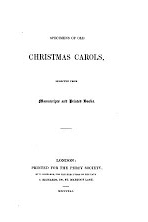
Specimens of Old Christmas Carols: Selected from Manuscripts and Printed Books, Volume 4, London: Printed for the Percy Society. By T. Richards, for the Executors of the late C. Richards, 100, St. Martin’s Lane. 1841.
 

Customs and Beliefs Associated with Christmas Evergreens: A Preliminary Survey, Susan Dury. Folklore, Vol. 98, No.2 (1987), pp. 194-199. Published by Taylor & Francis, Ltd. on behalf of Folklore Enterprises, Ltd. Accessed 09-12-2018 at https://ww.jstor.org/stable/1259980

“Ceremony Upon Candlemas Eve,” Hesperides, or, The works both humane & divine of Robert Herrick, Esq.  London: Printed for John Williams and Francis Eglesfield, 1648.

Christmas in Prints, Michael Olmert, 2008, Colonial Williamsburg

Other Christmas Posts on this Blog:

Click on this link for posts related to the topic

Another Interesting Blog Post About Christmas

But Surely Christmas in England Didn’t Exist Until Dickens Invented It? Austenonly

Read Full Post »

Faithful readers,

Fronticepiece of Christmas Carols by Thomas Wright, 1841Once again December has caught me flat footed. It is almost 10 days into the month and I am still researching interesting historical information about Christmas holiday celebrations as Jane Austen would have known them. While many books, articles, bloggers and internet sites cover this topic in detail, I hope to add a few interesting items that might not be widely known. I urge you to read Austenonly’s excellent article, “But Surely Christmas in England Didn’t Exist Until Dickens Invented It? “, which explains how and why this season was suppressed for years by the Puritans in the mid-17th century, when Charles I had been deposed and beheaded, and how our customs managed to survive and flourish.
As many of you know, Christmas celebrations as we know it in modern times (the decorative tree, a German custom, the elaborately wrapped presents, and the many traditional carols we still sing today) are rooted in Victorian times. So how did Jane Austen and her contemporaries celebrate this important Christian holiday? I hope to link to many articles of interest and provide a few insights of my own.

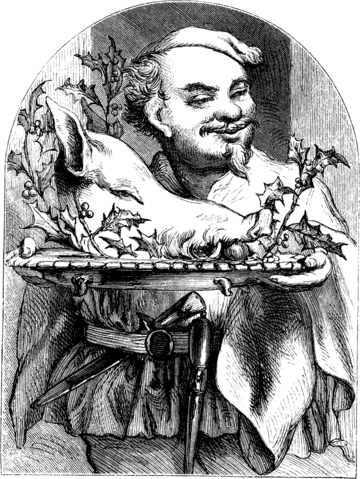
I learned with shock that many of my favorite carols, such as Silent Night and The First Noel, were written after Jane Austen’s death. I chose the following two 17th century carols (which Jane Austen might not have known, but which had been retrieved from obscurity in 1841 by Thomas Wright in Specimens of Old Christmas Carols ) because of the Boar’s Head motif, which has endured to this day. I love the old English spelling in these songs and yet their content speaks to the celebrations we still hold today.

A Carol bringyng in the bores heed.

Caput apm’ dgfero, Reddens laudes Domino.

[From a Collection of Christmas Carols, printed by Wynkyn de Worde, in 1521, from which book it is given by Hearne, in his notes to William of Newbery, iii. p. 17 5.]

The bores heed in hande bring I,

With garlands gay and rosemary;

I praye you all synge merely,

qui estis in convivio.

The bores heed, I understande,

Is the chefe servyce of this lande;

Loke where ever it be fande,

servite cum cantico.

Be gladde, lordes, bothe more and lasse,

For this hath ordeyned owr stewarde,

T o chere you all this Christmasse,

The bores heed with mustarde.

Bringing in the Boar's Head image, copyright free.

XIX. [The following modernised form of the foregoing carol, is given by Dr. Dibdin, as preserved and used up to a very recent period at Queen’s College, Oxford. Dibdin’s Ames, vol. ii. p. 252.]

THE boar’s head in hand bear I,

Bedeck’d with bays and rosemary;

And I pray you, my masters, be merry,

Quot estis in convivio.

Caput Apri defero,

Reddens laudes Domino.

The boar’s head, as I understand,

Is the rarest dish in all this land,

Which thus bedeck’d with a gay garland,

Let us servire cantico.

Caput Apri dlfero,

Reddens laudes Domino.

Our steward hath provided this

In honour of the king of bliss;

Which on this day to be served is

In Reginemn’ Atria.

Caput Apri defero,

Reddens laudcs Domino.

Read Full Post »

Christmas with Jane Austen

Many Austen fans enjoy thinking about how Jane and her family celebrated Christmas. They wonder, did she give gifts, “deck” the halls, or have a Christmas tree? As most Austen fans know, many of the Christmas traditions we might picture actually became popular during the Victorian Era. However, there are plenty of Regency Christmas traditions that are still familiar today and others that can add to our enjoyment of the holiday season.

Christmas Celebrations in Jane Austen’s Novels

In each of Austen’s novels, Christmas is mentioned. It was, as it is today, a time for festive dances, parties, and dinners. As Mr. Elton says in Emma, “This is quite the season indeed for friendly meetings. At Christmas every body invites their friends about them…” (E 115). In Pride and Prejudice, Caroline Bingley writes to Jane, saying, “I sincerely hope your Christmas in Hertfordshire may abound in the gaieties which that season generally brings” (PP 117).

Just as we do today, the people of Austen’s time enjoyed seasonal foods, drinks, and decorations. In Persuasion, Austen paints a festive Christmas scene:

“On one side was a table occupied by some chattering girls, cutting up silk and gold paper; and on the other were tressels and trays, bending under the weight of brawn and cold pies, where riotous boys were holding high revel; the whole completed by a roaring Christmas fire, which seemed determined to be heard, in spite of all the noise of the others. […] Charles and Mary also came in, of course, during their visit, and Mr Musgrove made a point of paying his respects to Lady Russell, and sat down close to her for ten minutes, talking with a very raised voice, but from the clamour of the children on his knees, generally in vain. It was a fine family-piece.” (P 134)

Most of us have witnessed a similar scene at a large Christmas party or family gathering, where children are playing and laughing, great quantities of food are set out, and people are talking so loudly it’s hard to keep up a conversation.
Christmas was also a time for families to gather together. Children away at school came home for the holidays. Extended family traveled to visit one another. Emma personally looks forward to Christmas because it means her sister Isabella’s family will visit for a week: “many a long October and November evening must be struggled through at Hartfield, before Christmas brought the next visit from Isabella and her husband, and their little children, to fill the house, and give her pleasant society again” (E 7).

In Pride and Prejudice, Mr. and Mrs. Gardiner come to Longbourn with their children to visit: “On the following Monday, Mrs. Bennet had the pleasure of receiving her brother and his wife, who came as usual to spend the Christmas at Longbourn” (PP 139). At the end of Pride and Prejudice, Elizabeth writes to her aunt Gardiner and says, “You are all to come to Pemberley at Christmas” (383). Thus, a new family tradition begins.

And for a young girl like Catherine Morland, Christmas increased the likelihood of getting cornered by an older relative. In Northanger Abbey, Catherine worries about what “gown and what head-dress she should wear” because “her great aunt had read her a lecture on the subject only the Christmas before” (NA 73). The main message of that lecture: “Dress is at all times a frivolous distinction, and excessive solicitude about it often destroys its own aim” (73).

Regency Christmas Traditions

Rachel Dodge Book Photo

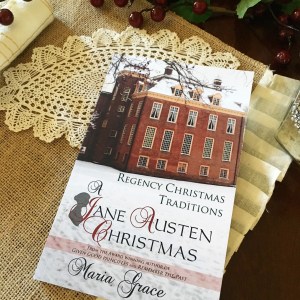
A Jane Austen Christmas by Maria Grace. Photo by Rachel Dodge  

In her book A Jane Austen Christmas: Regency Christmas Traditions, Maria Grace shares details about the Christmas traditions that Jane would have experienced. She explains that the Christmas season itself started “a week before Advent […] and extended all the way through Twelfth Night in January” (Grace 1). She covers the types of foods and sweets they ate—including a delightful history and explanation of plum pudding—and provides descriptions of holiday drinks, quaint parlor games, and seasonal dinner parties, card parties, and balls. She also talks about the charitable traditions of the time, like St. Thomas Day and Boxing Day, as well as the Christmas carols Jane might have known, such as The First Noel and God Rest Ye Merry, Gentlemen (31).

Gift giving, according to Grace, became more popular toward the end of the Regency period, when ads began to run “in periodicals suggesting novel ideas for gifts” (43). However, people did give gifts during Austen’s lifetime on St. Nicholas Day, Christmas Day, and Twelfth Night, typically from “those lower in status to those above them” (42) and between social equals “like friends and family” (43).

Church attendance was a focal point for most Regency families on Christmas Day. In Kirsten Olsen’s All Things Austen, she says, “At church, a special sermon was delivered, and communion was offered” (203). In Austen’s family, that meant that her father Reverend Austen would preach and her family would all go to church on Christmas Day.

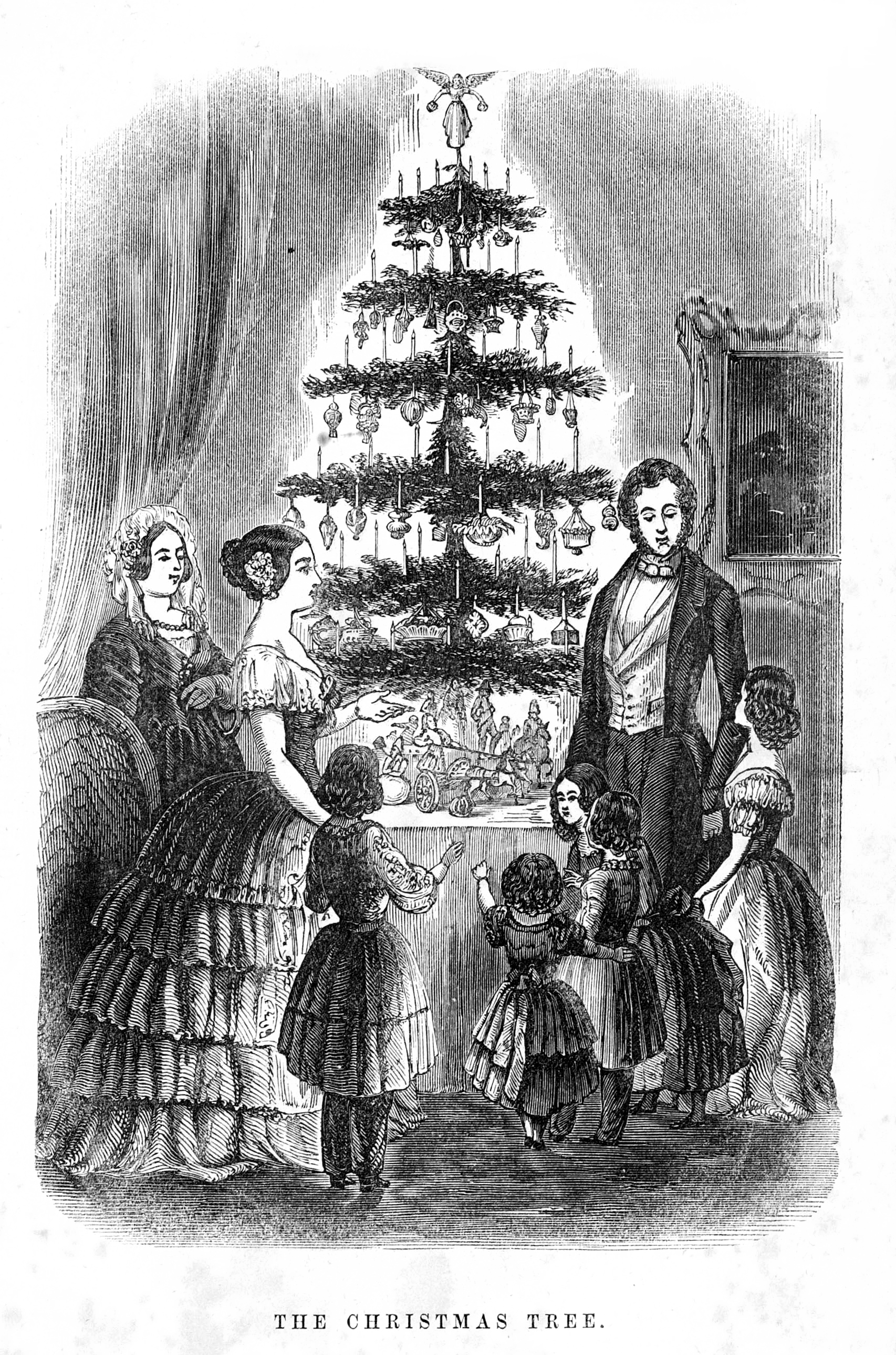
Though Regency families didn’t decorate their homes to the extent that we do today, Olsen notes that “[h]ouses were decorated with holly and other green foliage” (Olsen 203). As for Christmas trees, they didn’t become prevalent in England until later: “Christmas trees only became popular after The Illustrated London News published a picture of Victoria and Albert with a family Christmas tree in 1848” (Grace 33).

First_Christmas_Tree_in_Britain_1846_Illustrated_London_News

Illustration Caption: “Lithograph in The Illustrated London News in the winter of 1848,” Wikimedia Commons.

If you’d like to add a new Regency tradition to your holiday season or throw an Austen-inspired Christmas party, books such as A Jane Austen Christmas: Regency Christmas Traditions by Maria Grace are full of wonderful details. I picked up my copy at this year’s JASNA AGM, but it’s available on Amazon as well.

Christmas in Hampshire

In Chawton, Jane Austen’s House Museum has its own special tradition this time of year. The museum celebrates the Christmas season and Jane’s birthday at their “Annual Open day” on December 16. The museum offers free admission and mince pies for all visitors. This year, visitors can also create free Christmas crafts inspired by the Austen family coverlet currently on display at the museum.

Works Cited

  • Austen, Jane. The Oxford Illustrated Jane Austen. Edited by R. W. Chapman. Oxford: Oxford University Press, 1988.
  • Grace, Maria. A Jane Austen Christmas; Regency Christmas Traditions. White Soup Press, 2014.
  • Olsen, Kirstin. All Things Austen: A Concise Encyclopedia of Austen’s World. Oxford, Greenwood World, 2008.

Other blog posts on this site citing Regency Christmas traditions: Click on this link for a variety of traditions and foods during this era

Read Full Post »

Dear Readers, Happy Holidays! If you happen to stand under a sprig of mistletoe (these days it is most likely artificial), you will probably hug or kiss the person standing nearest you. This tradition did not appear in English literature until the 18th century. The practice of gathering mistletoe began in the second century BC with the Druids in ancient Britain. They gathered the parasitic plant at the start of winter from the sacred oak as a symbol of hope, peace, and harmony. Sprigs were hung in homes to herald good fortune. The plants were also used for medicinal purposes to promote female fertility and as an antidote for poison. Today we associate mistletoe boughs with Christmas. Gathered on this page are a few quotes from various sources.

Illustrated London News, Dec 20, 1851

The Mistletoe Season

Down South for the past month all the boys and girls who want to earn money have been gathering mistletoe.

Weeks before the Christmas-time, these young people begin to hunt the woods for mistletoe. Having found it, they watch it growing. If they find that some one else watching the same bunch, they announce it is their mistletoe.

The mistletoe grows on the tree, but is no more a part of the tree than the moss with which Northern children are familiar, or vines that climb up the outside of the tree. The mistletoe grows high up in the tree and, if out on a slender branch, must be reached after with a stick and pulled off gently. Even then it is not out of danger, for the beauty is marred if the little plant falls to the ground. –  New outlook, Volume 52, edited by Alfred Emanuel Smith, Francis Walton Outlook Publishing Company, Inc., U.S., 1895, p. 1146

Mistletoe sprigs decorated chandeliers, doorways, and ceilings.

A ball of mistletoe, ornamented with ribbons, would be hung around Christmastime, and no unmarried girl could refuse a kiss if she was underneath it. At every kiss, the boy would pluck one of the mistletoe berries, and when there were no more berries, the ball was taken down until the next year. If a girl didn’t receive a mistletoe kiss by the time the ball was taken down, she couldn’t expect to marry in the following year. So the kiss could be a promise of marriage or a symbol of admiration, but it was also a kind of mystical fortune-telling trick. – Apartment Therapy – History of the Mistletoe

Gathering mistletoe in Nomandy

The best time for gathering mistletoe is in November after a few frosts have fallen and before the sap freezes, though it may be gathered and used at any period of the year. When gathered it should at once be spread out to dry as it will mould in a very short time if kept in a box or sack. It is best to dry it in the shade. – United States medical investigator1878,  p 132.

Kiss under the mistletoe

Mistletoe grew in England and the United States. The common mistletoe of England grew on orchard trees and forest trees, and seldom on oak trees, which is why Druids revered it for its rarity. Mistletoe sapped the strength of apple trees in Brittany and Normandy. There it was gathered for the London market. The American mistletoe grows on deciduous trees, especially the tupelo poplar and red maple, from New Jersey, southern Indiana and east Kansas, to the Gulf. –  The Standard reference work: for the home, school and library, Volume 5, edited by Harold Melvin Stanford Standard Education Society, 1921

Mr Fezziwig's ball, John Leech, A Christmas Carol by Dickens

By the Victorian era, there was scarcely a house or cottage that did not have mistletoe at Christmas time.

Down with the rosemary, and so,

Down with the baies and Mistletoe;

Down with the holly, ivie, all,

Wherewith ye dressed the Christmas Hall.

19th c. mistletoe gatherer

The damsel donn’d her kirtle sheen;

The hall was dress’d with holly green,

Forth to the wood did merry men go

To gather in the Mistletoe.”

– English botany, or, coloured figures of British plants, Volume 4, By James Sowerby G. Bell, 1873

Kiss under the mistletoe

Happy Christmas Eve and Christmas Day to All!

Read Full Post »

« Newer Posts - Older Posts »