Feeds:
Posts
Comments

Archive for the ‘Fashions’ Category

During the 18th and early 19th century, social satire prints were engraved and sold separately in print shops. By 1750, the term ‘caricature’ was applied to almost any comic cartoon or satiric illustration.

The ‘golden age’ when James Gillray (1756-1815), Thomas Rowlandson (1756-1827) and George Cruikshank (1792-1878) were active, occurred between 1780 and 1830. Most satirical prints were produced in London and were sold singly by publishers and booksellers, such as S. W. Fores and William Holland, who also put together collections for clients and even hired them out. A wide range of prices reflected the very different sizes and degrees of sophistication of satirical prints. In 1807 the publisher Thomas Tegg started a business selling cheap, crudely coloured prints aimed at a wide market. – British Museum
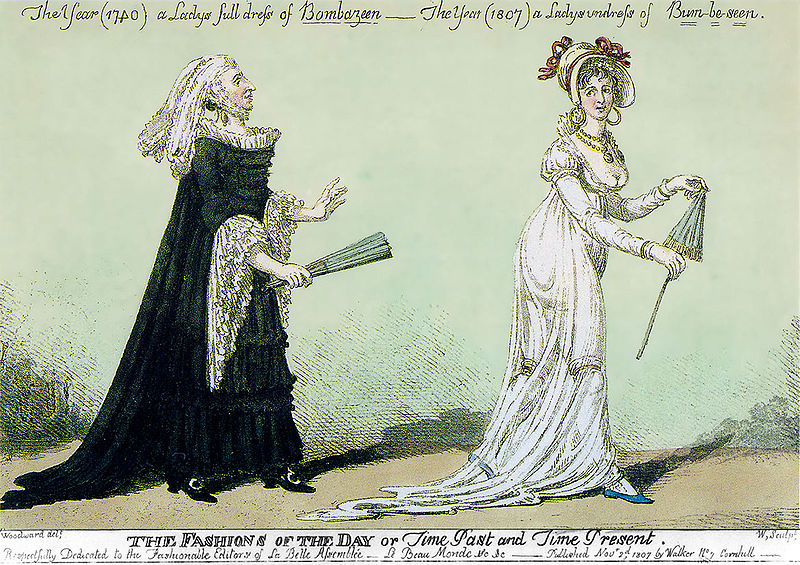
“The Fashions of the Day, or Time Past and Present”, an 1807 caricature engraved by Charles Williams after a drawing by Woodward. It presents a contrast between “The Year 1740: A Lady’s full dress of Bombazeen (i.e. bombazine or bombasine, a heavy corded fabric. Black bombazine was worn by widows during heavy mourning) and “The year 1807: A Lady’s undress of Bum-be-seen.”  There are some fascinating details to observe about the fashionable regency lady, whose decolletage is so low that her breasts are practically popping out of their restraints. One can see her drawers under her thin muslin dress, and her stockings come up over her knee. They were held up by garters. (Click on this link to read a fascinating article about stockings and to see a pair of 1820 stockings and garters.  This link also leads to an article about 18th & 19th century hose.) Regency ladies as a rule did not wear drawers for the first 20 years of the 19th century. Those who did wore a modified version of men’s drawers, which tied at the waist and split in the middle. Chances were that, if she did not wear a petticoat or a chemise, her bum would have shown through the thin fabric!


The following comment about Williams’ caricature is from Wikimedia Commons:

Note that “undress” didn’t mean anything naughty — there’s a definition of it here.[1] In pursuing his goal of satirizing certain features of contemporary 1807 fashions, the caricaturist did not really draw a fair comparison between the styles of 1740 and 1807, since a young Regency fashionable is juxtaposed here to a sedate middle-aged pre-Regency lady (perhaps in mourning), and such features of mid-18th century dress as tight stiff stays with extremely low necklines were not included (also, the “1740” costume actually seems to be somewhat of a pastiche with 17th century styles).
(Women’s fashions of the Empire/Regency weren’t always “sensible”, but their excesses do seem to be more in accord overall with the spirit of the 21st century than the fashion excesses of most other periods between the 16th century and World War I, which tended to go in for such things as huge hoopskirts and tight corsets…)

Read Full Post »

Hems (l - r) 1795, 1800, 1805-1810, 1816

Its all in the details Making a Regency Ballgown is a useful site for people who are interested in studying regency costumes or making a regency ballgown. The site is arranged in year order and makes the evolving styles clear. The evening or ballgowns are arranged by year and described in detail by bodices, sleeves, skirts, hair and hats. The information can also be downloaded as a PDF document. This is the clearest description of the changes in hemline that I have seen on a site. Trains, simple hems and long skirst gave way to fancy hems and skirts that revealed slippers and ankles.

Read Full Post »

Contest Closed: Using a random number generator, the winner is Leslie Ann McCleod. Her quote was:

“Tell me if, when I returned to England in the year eight, with a few thousand pounds, and was posted into the Laconia, if I had then written to you, would you have answered my letter? would you, in short, have renewed the engagement then?”

“Would I!” was all her answer; but the accent was decisive enough. – Persuasion

Thank you all for participating!

Good news! You have an opportunity to win a copy of Fashion in the Time of Jane Austen! All you need to do is leave a comment with your favorite line from a Jane Austen novel. The line can come from any character and be on any topic. The winner will be announced two weeks from today on April 19th. One lucky person will be chosen using a random number creator. Those who live in Canada and the U.S. are eligible to enter the contest.

Read my review of the book

Format: Trade Paperback, 64 pages
Author: Sarah Jane Downing
Price: $12.95
ISBN: 978-0-7478-0767-4 (0-7478-0767-1)

Read Full Post »

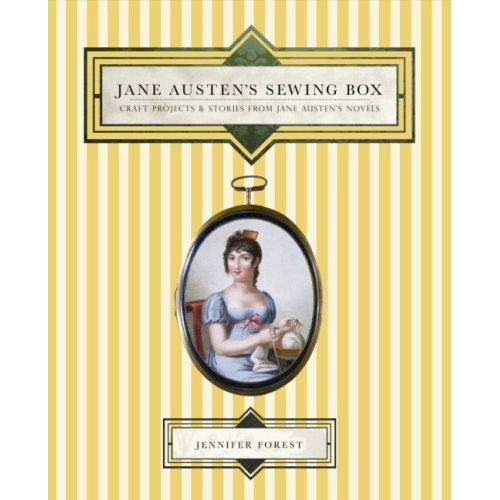
Gentle readers, Collette from the Serendipity franchise has graciously allowed me to reprint her review of Jane Austen’s Sewing box. I wrote “franchise” because her online presence includes: Serendipity Vintage, Serendipity Handmade, Vintage Life Network, Serendipity Vintage Facebook, and SerendipityVintage on Twitter.

I also now have a copy of the lovely Jane Austen’s Sewing Box: Craft Projects and Stories from Jane Austen’s Novels. You may have seen a review or two on other craft blogs. As I am a Austen aficionado I could not pass it up:

It is a beautiful book, filled with gorgeous color fashion plates of the time that are worth a look. I read it cover-to-cover and enjoyed every moment. However, I would recommend purchasing it only if you enjoy historical Regency costume and /or are a die-hard Regency or Jane Austen fan.

As for the crafts themselves, some are probably of more interest to the costume enthusiast (like the cravat, the bonnet, or the tippet). There is only one photo of each project and even one more photograph of each project would have enhanced this book. Yet one whole page might be devoted to one short quote from one of Austen’s novels, or to a lovely painting from the time period:

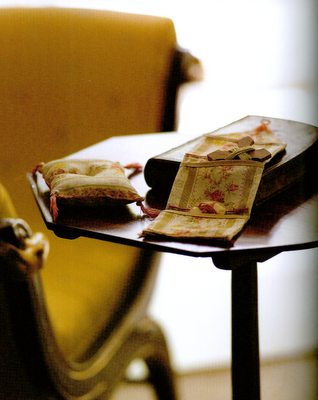
The actual instructions for each project were also quite succinct and limited to only one page. If you’ve ever read any of the antique craft books from the early-to-mid 19th century you know that project instructions were usually all text and that diagrams were sparse. The actual descriptions of the the projects were very reminiscent of the actual books of the time. Still, I would like to make this case for embroidery thread:


In the time of the Regency you would store your
embroidery thread on a bone or wood thread winder

Austen mentioned each craft project in one of her novels, and it is fascinating to read the excerpts from the novels and then read Forest’s commentary about the craft as it was practiced at the time. If you are interested in historical craft and want to know more about the role of crafts in the lives of Regency women you will love the historical detail in this book. It’s definitely an informative and charming read!

Photographs from Jane Austen’s Sewing Box, Murdoch Books, or in the public domain. Review reprinted with permission.

Read Full Post »

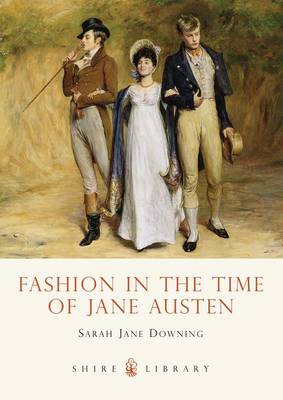
Ever since I learned that this book would be coming out in the spring, I couldn’t wait for its arrival. The title alone told me that it was tailor made to my interests. Slim and more a monograph than a book, Fashion in the Time of Jane Austen‘s 62 pages are jam-packed with information and images. Some of the material that author Sarah Jane Downing wrote about was familiar, but much of it was new. While I finished the book in two sittings, I know I will be using it frequently for future reference.

Until the Napoleonic Wars, France had influenced fashions in Britain and Europe. It was the custom of messengers known as les grandes couriers de la mode to deliver the latest French fashions to the great courts of Europe in person. Wearing designer creations, their costumes were analyzed from head to toe and then tried on and taken apart. Patterns were made from the resulting pieces. People who visited cities and returned home were plied with questions about the latest trends in fashions by those who stayed behind. Soon, fashion journals appeared showing images of fashions, home furnishings, and architectural plans, and new styles trickled down to even those who lived in the farthest reaches of England.

Walking gowns, 1796

The French Revolution marked a radical shift from the elegant, wide-skirted brocade gowns so prevalent for most of the 18th century to the streamlined, body-hugging, empire-waisted silhouettes of the Directoire Period that were inspired by classical antiquity. Wide hooped skirts were still worn for appearances at court, but gowns became simpler, narrower, and more vertical. In fact, the change in dress silhouettes was so dramatic that such a radical shift in style would not occur again until the flapper era and the jazz age over a century later.

Jane Austen’s books were written during the narrow time frame when empire dresses with their high waists, short sleeves and décolletté necklines reigned supreme in the fashion world. When long sleeves were introduced in evening dress, she wrote Cassandra:

I wear my gauze gown today long sleeves & all; I shall see how they succeed, but as yet I have no reason to suppose long sleeves are allowable. Mrs. Tilson has long sleeves too, & she assured me that they are worn in the evening by many. I was glad to hear this. – Jane Austen, 1814

1815 Long sleeved evening dress. Costume of the ladies of England 1810-1823.(NYPL Digital Collection)

Male attire also went through a dramatic change. Ruffles and ornate brocaded fabrics gave way to intricately folded neckcloths, simple shirts, stark jackets and leg-hugging breeches. The emphasis was on the neckcloths, but not the shirts, which were sewn by women, not tailors. Jane was known to be an excellent seamstress, and she wrote about completing a batch of shirts for her brother Charles: “[I] am to send his shirts by half dozens as they are finished; one set will go next week,” and “In Mansfield Park Fanny price works diligently to ensure that her brother’s linen is ready when he goes to sea.” – p 13.

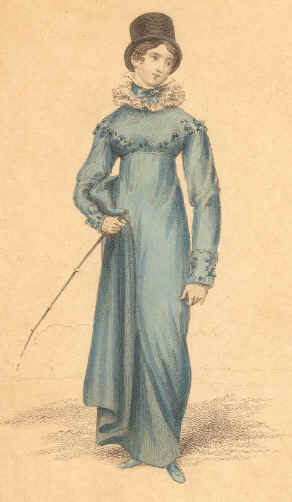
1816 Riding Habit

There are so many other interesting tidbits of information that I won’t share in this review lest I spoil the reader’s pleasure. Fashion in the Time of Jane Austen discusses accessories, underwear, half dress, full dress, court dress and more. I wish a timeline had been included of when hems were raised and when they became decorative; precisely how the Napoleonic Wars affected fashion in both England and France and who influenced who and when; and when waists when up, then down, then up and down again. Another quibble I had was with the book’s cover, which John Pettie painted in 1887. With all the lush images and paintings available of regency misses and their chaperones and suitors, why choose a Victorian painting? The woman in this painting belongs so obviously to another age that I find her face a little creepy.

Be that as it may, I give this book three out of three regency fans and recommend it highly to all readers who are interested in Regency fashion and historical romance writers who are interested in precise details of dress.

More on the topic

Another excellent book about fashion is Penelope Byrd’s A Frivolous Distinction: Fashion and Needlework in the works of Jane Austen.

Regency Fashion History is an excellent site.

And Cathy Decker’s comprehensive site cannot be topped.

Order the book here.

Add to DeliciousAdd to DiggAdd to FaceBookAdd to Google BookmarkAdd to RedditAdd to StumbleUponAdd to TechnoratiAdd to Twitter

Read Full Post »

« Newer Posts - Older Posts »