This Jane Austen blog brings Jane Austen, her novels, and the Regency Period alive through food, dress, social customs, and other 19th C. historical details related to this topic.
It’s “Heart Day,” and those of us here at JAW are dreaming of what it might be like to celebrate Valentine’s Day in the Regency Era with Jane and her best and silliest characters.
Valentine’s Day has a long history, and it dates back far beyond Jane Austen’s lifetime. For those interested in learning more about the history of Valentine’s Day or what Valentine’s Day looked like during the Regency era, here are several articles to peruse, most by our Vic:
History of Valentine’s Day: Initially, Valentines were usually handmade and given anonymously. During the 1800s much larger hand-painted copperplates molded in the shape of hearts replaced paper e-cards. You can read more HERE.
Ophelia’s Valentine’s Song: Jane Austen would certainly have known Ophelia’s Song, written by William Shakespeare in the 16th century. You can read it HERE.
Valentine’s Day in Jane Austen’s Day: By the middle of the eighteenth century, it was common for friends and lovers in all social classes to exchange small tokens of affection or handwritten notes. You can read about it HERE.
Valentine puzzle purse, February 14, 1816. Image by Nancy Rosin.
Be Mine, Austen Edition
And now for a reprise of a set of Austen-Themed Valentine’s created for your enjoyment! Perhaps you’ll send a few to a friend and have a good laugh together over Austen’s sense of humor:
True Romantics
And finally, a few beautiful quotes from Austen’s best literary moments for the true romantics among us. These are absolutely swoon-worthy and worth sending to a special someone:
A very Happy Valentine’s Day to you, from all of us here at Jane Austen’s World! May your day be filled with love, laughter, and good books!
Taking a vacation—whether it’s a staycation or a trip—is all about taking a break from your everyday activities to rest, relax, and get refreshed. As things continue to reopen, it’s fun to think about ways to make the summer season special. And of course, Jane always provides me with special inspiration!
Here are a few activities you might like to try this summer, whether you prefer to keep closer to home or you are ready to set out and have an adventure. These “Jane-cation” ideas are designed to fill your cup and put a pep in your step! Most of these activities can be done virtually, with your family, or in small groups.
#1 – Take a Book Lovers Day Off
Clear your calendar—just like a regular vacation day
Plan your meals ahead of time
Select your books
Read books you want to read (not something you have to read)
Set up a cozy spot indoors (or create an outdoor reading nook)
Read Like Jane: Read the books Jane Austen read in her lifetime. You can select some of your titles from this list from Jane Austen in Vermont: Jane Austen’s Reading List.
Jane Austen on Reading:
The person, be it gentleman or lady, who has not pleasure in a good novel, must be intolerably stupid.
―Mr. Tilney, Northanger Abbey
I declare after all there is no enjoyment like reading! How much sooner one tires of anything than of a book! When I have a house of my own, I shall be miserable if I have not an excellent library.
―Miss Bingley, Pride and Prejudice
If a book is well written, I always find it too short.
―Kitty Percival, “Catharine, or the Bower”
Anne Hathaway, Becoming Jane
#2 – Host a Small Garden Party
Plan summer fare that’s light and fresh
Invite guests to bring a favorite tea cup
Provide a selection of teas, lemonades, and sparkling waters
Decorate with fresh flowers, tea cups, and stacks of books tied with ribbon
Party like Jane: Ask your guests to bring fresh flowers and create your own bouquets or nosegays. You can read this JAW article about Regency bridal bouquets for inspiration. Learn how to make Georgian ices here!
Jane Austen on Parties:
Our party went off extremely well. There were many solicitudes, alarms, and vexations beforehand, of course, but at last everything was quite right. The rooms were dressed up with flowers, etc., and looked very pretty.
―Jane Austen’s Letter to Cassandra, 25 April, 1811.
You know how interesting the purchase of a sponge-cake is to me.
―Jane Austen’s Letter to Cassandra, 15 June, 1808.
The Orange Wine will want our Care soon. –But in the meantime for Elegance & Ease & Luxury . . . I shall eat Ice & drink French wine, & be above Vulgar Economy.
Bring a pretty basket, delicious food, drinks, and a blanket
Play games or provide riddles for guests
Try a new recipe
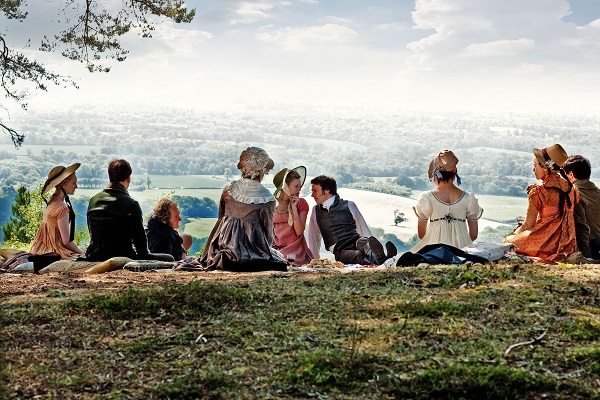
Picnic like Jane: Take cushions, flowers, and other items to make it comfortable and picturesque. You can read this JAW article on Box Hill and Regency picnics. Or plan a Regency picnic menu courtesy of the Jane Austen Centre.
Jane Austen on Excursions:
We are to walk about your gardens, and gather the strawberries ourselves, and sit under trees;—and whatever else you may like to provide, it is to be all out of doors—a table spread in the shade, you know. Every thing as natural and simple as possible.
―Mrs. Elton, Emma
To sit in the shade on a fine day, and look upon verdure, is the most perfect refreshment.
―Fanny Price, Mansfield Park
The pleasures of friendship, of unreserved conversation, of similarity of taste and opinions will make good amends for orange wine.
―Jane Austen’s Letter to Cassandra, 20 June, 1808.
Emma, 2009
#4 – Take a Home & Garden Tour:
Explore a local public garden
Tour a historic home
Volunteer in a community garden
Revamp a corner of your own garden or patio
Take a gardening class
Garden like Jane: Try planting flowers like Jane might have had in her garden. Read this JAW article on Jane Austen’s garden when she was living at Chawton Cottage. Or enjoy this Pictorial Visit to Chawton by Tony Grant.
Jane Austen on Homes & Gardens:
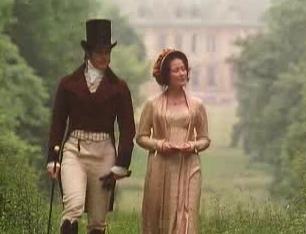
Pemberley House . . . was a large, handsome stone building, standing well on rising ground, and backed by a ridge of high woody hills; and in front, a stream of some natural importance was swelled into greater, but without any artificial appearance. Its banks were neither formal nor falsely adorned. Elizabeth was delighted.
―Jane Austen, Pride and Prejudice
Some of the flower seeds are coming up very well, but your mignonette makes a wretched appearance. …Our young piony [sic] at the foot of the fir-tree has just blown and looks very handsome, and the whole of the shrubbery border will soon be very gay with pinks and sweet-williams, in addition to the columbines already in bloom. The syringas, too, are coming out. We are likely to have a great crop of Orleans plums, but not many greengages—on the standard scarcely any, three or four dozen, perhaps, against the wall.
―Jane Austen’s Letter to Cassandra, 29 May, 1811.
Two . . . hedgerows radiated, as it were, from the parsonage garden. One, a continuation of the turf terrace, proceeded westward, forming the southern boundary of the home meadows; and was formed into a rustic shrubbery, with occasional seats, entitled “The Wood Walk.” The other ran straight up the hill, under the name of “The Church Walk,” because it led to the parish church.
―James Edward Austen-Leigh, A Memoir of Jane Austen (Description of Steventon)
Jane described the syringa in the garden. Image@Tony Grant
#5 – Take a trip to the seaside or mountains:
Go to the seaside
Drive to the mountains
Take a day trip
Rent a house or cabin
Camp out
Travel like Jane: Looking for something literary? Explore one of these Literary-themed Day Trips. Or check out some of the Best Literary Places to Read and Eat around the world. Want to stay closer to home? Visit your local independent bookstore, buy a book, and show your support.
Jane Austen on Travels:
A little sea-bathing would set me up forever.
―Mrs. Bennet, Pride and Prejudice
What delight! what felicity! You give me fresh life and vigour. Adieu to disappointment and spleen. What are young men to rocks and mountains? Oh! what hours of transport we shall spend!
―Elizabeth Bennet, Pride and Prejudice
The Cobb itself, its old wonders and new improvements, with the very beautiful line of cliffs stretching out to the east of the town, are what the stranger’s eye will seek; and a very strange stranger it must be, who does not see charms in the immediate environs of Lyme, to make him wish to know it better.
―Jane Austen, Persuasion
We had a little water-party yesterday; I and my two nephews went from the Itchen Ferry up to Northam, where we landed, looked into the 74, and walked home, and it was so much enjoyed that I had intended to take them to Netley to-day; the tide is just right for our going immediately after moonshine, but I am afraid there will be rain; if we cannot get so far, however, we may perhaps go round from the ferry to the quay.
―Jane Austen’s Letter to Cassandra, 24 October, 1808.
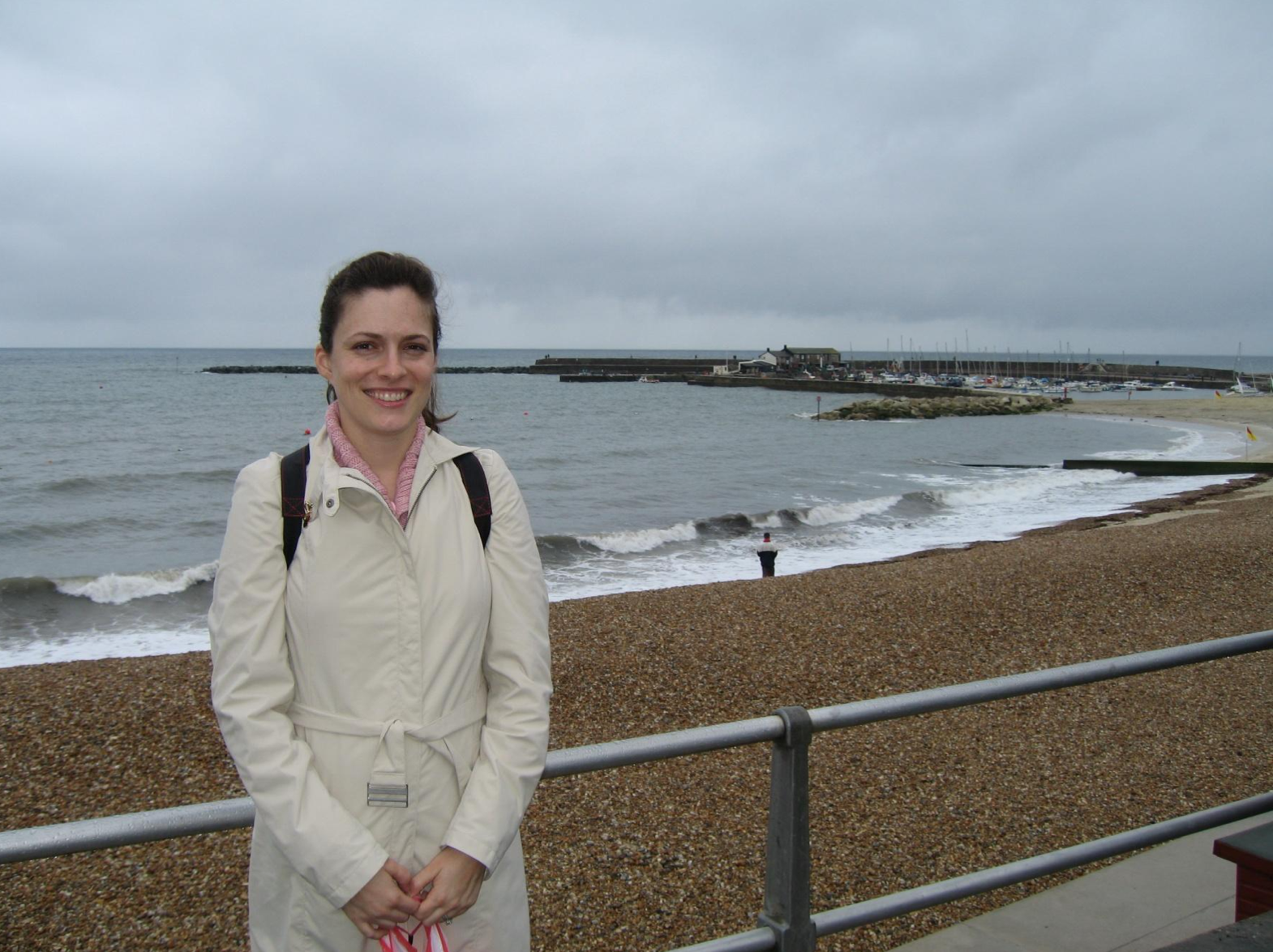
Lyme Regis and The Cobb (Rachel Dodge, 2007)
Wishing you all a summer filled with bookish plans, dear Jane Austen’s World readers! If you could choose any “Jane-cation” (if travel/health restrictions did not exist), where would you go?
This Easter weekend is a perfect time to reflect on Jane Austen and Easter. Hats and bonnets were prevalent, of course, and so were Easter Fairs and eating hot cross buns.
In her book, Jane Austen and the Clergy, Irene Collins writes: Clergymen in Jane Austen’s day were not expected to write original sermons every Sunday. “Henry Crawford, assessing Edmund Bertram’s commitments at Thornton Lacey, judged that ‘a sermon at Christmas and Easter ‘would be’ the sum total of the sacrifice.” Mr. Collins produced only two sermons between his ordination at Easter and his visit to Longbourn in November of the same year.- p. 96.
Jane Austen herself mentions Easter, most notably in Pride and Prejudice:
In this quiet way, the first fortnight of her visit soon passed away. Easter was approaching, and the week preceding it was to bring an addition to the family at Rosings, which in so small a circle must be important. Elizabeth had heard, soon after her arrival, that Mr. Darcy was expected there in the course of a few weeks, and though there were not many of her acquaintance whom she did not prefer, his coming would furnish one comparatively new to look at in their Rosings parties, and she might be amused in seeing how hopeless Miss Bingley’s designs on him were, by his behaviour to his cousin, for whom he was evidently destined by Lady Catherine; who talked of his coming with the greatest satisfaction, spoke of him in terms of the highest admiration, and seemed almost angry to find that he had already been frequently seen by Miss Lucas and herself.
At Rosings with Colonel Fitzwilliam
Colonel Fitzwilliam’s manners were very much admired at the parsonage, and the ladies all felt that he must add considerably to the pleasure of their engagements at Rosings. It was some days, however, before they received any invitation thither, for while there were visitors in the house they could not be necessary; and it was not till Easter-day, almost a week after the gentlemen’s arrival, that they were honoured by such an attention, and then they were merely asked on leaving church to come there in the evening. For the last week they had seen ver little of either Lady Catherine or her daughter. Colonel Fitzwilliam had called at the parsonage more than once during the time, but Mr. Darcy they had only seen at church.
The invitation was accepted of course, and at a proper hour they joined the party in Lady Catherine’s drawing room. Her ladyship received them civilly, but it was plain that their company was by no means so acceptable as when she could get nobody else; and she was, in fact, almost engrossed by her nephews, speaking to them, especially to Darcy, much more than to any other person in the room.
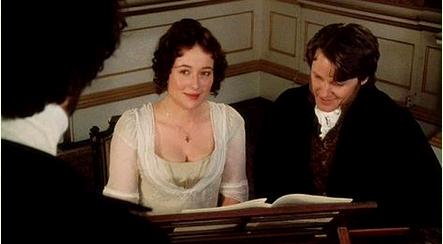
Elizabeth Bennet, Mr. Darcy and Colonel Fitzwilliam at the pianoforte
Ellen Moody noted that dating Sense and Sensibility presented a problem. It was revised several times and as a result the chronology remains inconsistent. Towards the book’s end, Easter is mentioned as occurring on March 31. This would have fallen in 1793, when the first draft of the novel was written. But, there is another reference to Easter in early April, which would have placed the novel in 1798 (the most likely), 1801, 1803, and 1809.
I’m a little late for the party, but a full day still remains until Laurel Ann at Austenprose finishes her in-depth tour of Sanditon, Jane Austen’s last, unfinished novel. Click on this page to catch up on all the links and comments and guest posts.
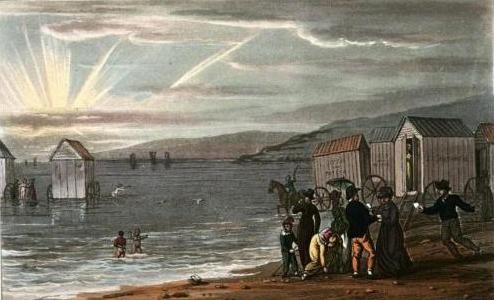
Sea Bathing in Scarborough, 1813
Read more about the seaside and seaside fashions on this blog to round out your knowledge of how the Regency folks enjoyed their seaside excursions:
Heap on more wood! — the wind is chill;
But let it whistle as it will,
We’ll keep our Christmas merry still.
Each age has deemed the new born year
The fittest time for festal cheer.
And well our Christian sires of old.
Loved when the year its course had rolled,
And brought blithe Christmas back again,
With all his hospitable train.
Domestic and religious rite
Gave honour to the holy night:
On Christmas eve the bells were rung;
On Christmas eve the mass was sung;
That only night, in all the year,
Saw the stoled priest the chalice rear.
The damsel donned her kirtle sheen;
The hail was dressed with holly green;
Forth to the wood did merry men go,
To gather in the mistletoe,
Then opened wide the baron’s hail
To vassal, tenant, serf, and all;
Power laid his rod of rule aside,
And ceremony doff’d his pride.
The heir, with roses in his shoes,
That night might village partner choose.
The lord, underogating, share
The vulgar game of “post and pair!”
All hailed with uncontroll’d delight
And general voice, the happy night
That to the cottage, as the crown,
Brought tidings of salvation down.
The fire with well dried logs supplied,
Went roaring up the chimney wide;
The huge hail table’s oaken face,
Scrubb’d till it shone, the day to grace,
Bore then upon: its massive board
No mark to part the squire and lord.
Then was brought in the lusty brawn,
By old, blue-coated serving-man;
Then the grim boar’s head frowned on high,
Crested with bays and rosemary.
Well can the green-garbed ranger tell,
How, when, and where, the monster fell;
What dogs before his death he tore,
And all the baiting of the boar.
The wassail round in good brown bowls,
Garnished with ribbon, blithely trowls.
There the huge sirloin reeked: hard by
Plum-porridge stood, and Christmas pie;
Nor failed old Scotland to produce
At such high tide her savoury goose.
Then came the merry masquers in,
And carols roar’d with blithesome din;
If unmelodious was the song,
It was a hearty note, and strong.
Who lists may in their mumming see
Traces of ancient mystery;
White shirts supplied the masquerade,
And smutted cheeks the visor made
But oh! what masquers, richly dight,
Can boast of bosoms half so light!
England was merry England when
Old Christmas brought his sports again.
’Twas Christmas broached the mightiest ale,
’Twas Christmas told the merriest tale;
A Christmas gambol oft would cheer
A poor man’s heart through half the year.
Fashionable Goodness: Christianity in Jane Austen's England is now available! By JAW contributor Brenda S. Cox. See Review. Available from Amazon and Jane Austen Books.
Available through December 31st, 2025. Click on image for details, and share this poster with other teachers and students!
The Obituary of Charlotte Collins by Andrew Capes
Click on image to read the story.
Comments
“My idea of good company…is the company of clever, well-informed people, who have a great deal of conversation.” – Jane Austen, Persuasion
Gentle readers: Please feel free to post your comments and continue the conversation! Due to SPAM, we will no longer accept comments on posts after 30 days of publication. In some instances, links will be removed from comments as well.
Administrators and Contributors
Vic Sanborn, founder of this blog, is supported by a team of talented and knowledgeable writers about Jane Austen and the Regency era. They are:
Tony Grant, who now contributes his photos from London and England
Click on their names to enter their own blogs.
In addition, we thank the many experts and authors who frequently contribute their posts and opinions, and who continue to do so freely or at our request.
Click here to enter the page. Topics include Regency fashion, historic foods, Jane Austen societies, British sites, related topics. Click on image.
May we suggest?
Hello, my name is Vic and I live in Maryland, USA. I have adored Jane Austen almost all of my life. I am a proud lifetime member of the Jane Austen Society of North America. This blog is a personal blog written and edited by me and my team. We do not accept any form of cash advertising, sponsorship, or paid topic insertions. However, we do accept and keep books and CDs to review.
If you would like to share a new site, or point out an error, please email us. (Yes, we are fallible. We'll own up to our mistakes and will make the corrections with a polite smile on our faces.) Write us at
Thank you for visiting this blog. Your comments and suggestions are most welcome.
Project Gutenberg: eBook of Stage-coach and Mail in Days of Yore, Volume 2 (of 2), by Charles G. Harper
STAGE-COACH AND MAIL IN DAYS OF YORE: A PICTURESQUE HISTORY
OF THE COACHING AGE, VOL. II, By CHARLES G. HARPER. 1903. Click on this link.






















 Jane Austen's World