Feeds:
Posts
Comments

Archive for the ‘Jane Austen Novels’ Category

Gentle Readers, This month I have joined the Sense and Sensibility Bicentenary Celebration on Maria Grazia’s My Jane Austen Book Club blog. Click on the banner on the sidebar to read the other articles posted each month in celebration of Jane Austen’s first published book. The first half of my post about Mr. Palmer’s observations of his fellow minor characters in the book sits here. The rest of the article sits on My Jane Austen Book Club.
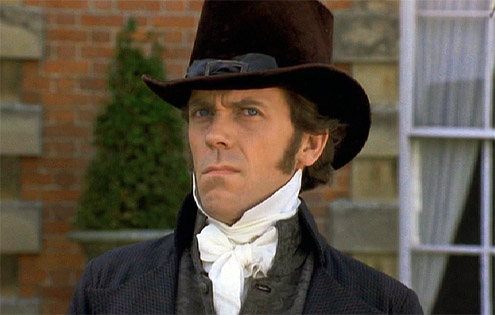
I, Thomas Palmer, Esq., have been charged to analyze and discuss the traits of my fellow minor characters in Sense and Sensibility, the first of six novels by Jane Austen. I shall endeavor to do JUSTICE to that estimable author’s first published effort, which made its way to the public some 200 years ago and has never failed to be in print since.

I must first cast my thoughts upon Fanny and John Dashwood, whose miserliness oblidged the Dashwood women to leave their comfortable home at Norland to establish themselves in Barton Cottage and live a FRUGAL life in Devonshire amongst strangers. Miss Austen was a mere 20 years of age when she first conceived of this novel in epistolary form, first naming it Elinor and Marianne. That such a young author, whose knowledge of the world was CONFINED largely to books and the experiences of others, could create two such memorable characters as Fanny and John Dashwood portended her genius.

Fanny in particular is a character like no other in literature. Her manipulation of her weak husband in persuading him to abandon his PLEDGE to his father on that man’s deathbed is breathtaking in its audacity and avarice. The sequence of her skewed logic and her husband’s reaction to her CONTRIVANCE to preserve every pence of her darling son’s inheritance is matchless. Even I could not have conceived of a more cynical, darkly humorous dialog than young Miss Austen presented through these two minor characters, thereby setting the novel’s direction and tone. “People always live for ever when there is an annuity to be paid them.” One simply cannot add or take away a word to improve this utterance by Mrs. Dashwood.

The John Dashwoods represent, like so many minor characters, a FOIL – brilliantly conceived foils, to be sure – that are meant to contrast with other characters. Take my rather vulgar brother-in-law, Sir John Middleton, who is renowned for his generous impulses. Whilst the Dashwood ladies were figuratively shoved out of Norland by the John Dashwoods, Sir John, a distant relation, emerges from nowhere to offer them a hearth and home. The CONTRAST twixt the two Johns – one so weak and tight-fisted that he willing to break his vow to his dying father, the other so generous that he is forever inviting the entire neighborhood to sample the contents of his larder – cannot be ignored.

I next turn my gaze upon the Steele sisters, Lucy and Anne. Anne is a flat minor character who is doomed to learn nothing from life’s experiences, but who interjects a running COMIC gag over her obsession with Dr. Davies (he will never offer his hand in marriage). Her main purpose in the novel is to REVEAL the engagement of Lucy to Edward at a most awkward moment.

Her sister Lucy, a smarter, prettier version of Anne, is as mean, cunning and scheming a creature as I have ever come across. I had her measure from the start, I assure you. Lucy’s sole ambition is to ingratiate herself with her betters in order to take her place in SOCIETY. Knowing of Edward Ferrars’ attraction to Miss Dashwood, she makes a preemptive strike by CONFIDING her secrets to Elinor, forcing our hapless heroine to LISTEN to matters that, while they pain her deeply, she must keep to herself. Many minor characters play the role of confidante to a novel’s protagonist, but Lucy Steele turned the table on Elinor, forcing her to listen to matters that were most distasteful and hurtful. Our scheming Lucy more than turned the table on Edward, eloping with his younger brother Robert when it becomes apparent that the latter will INHERIT the Ferrars fortune of £1,000 per year. One can only cheer knowing that this feckless couple will always be dissatisfied with each other, always wanting more possessions.

To read the rest of the article, click here to enter My Jane Austen Book Club
Click here to read the other articles in this year long series:

1. January          Jennifer Becton    

Men, Marriage and Money in Sense and Sensibility

2. February      Alexa Adams         

Sense and Sensibility on Film

3. March            C. Allyn Pierson

Property and Inheritance Law in S &S 

4. April               Beth Pattillo

Lost in Sense and Sensibility

5. May                Jane Odiwe

Willoughby: a rogue on trial

6. June               Deb @JASNA Vermont

Secrets in Sense and Sensibility

7. July                Laurie Viera Rigler

Interview with Lucy Steele

8. August           Regina Jeffers       

Settling for the Compromise Marriage

9. September    Lynn Shepherd

The origins of S&S: Richardson, Jane Austen, Elinore & Marianne                                        

10. October       Meredith @Austenesque Reviews

Sense and Sensibility Fan Fiction

11. November   Vic @Jane Austen’s World  

Mr. Palmer Discusses His Fellow Minor characters in Sense and Sensibility

12. December    Laurel Ann @Austenprose

Marianne Dashwood: A passion for dead Leaves and other Sensibilities                 
Read Full Post »

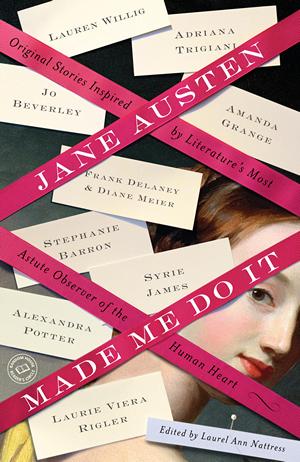
One regret I have in my busy life is the lack of leisure time I have for reading. Right now there are four stacks of books on the floor of my office, all waiting to be read. So many books! So little time. Given my schedule, I am glad I set aside the required hours to read Jane Austen Made Me Do It, an anthology of Jane Austen-inspired stories by published Jane Austen sequel authors and edited by Laurel Ann Nattress.

I rarely read anthologies front to back, but flit here and there, landing instead on a story with an intriguing title or by a favorite author. In this instance I began with Stephanie Barron’s tale of Jane And the Gentleman Rogue: Being a fragment of a Jane Austen mystery. I am so glad I did, for it prompted me to linger longer over dinner and read another short story. Beth Pattillo’s  When Only a Darcy Will Do was a delight, as was Margaret C. Sullivan’s Heard of You, which I read just before going to bed. The list of authors in this anthology is impressive: Pamela Aidan • Elizabeth Aston • Brenna Aubrey • Stephanie Barron • Carrie Bebris • Jo Beverley • Diana Birchall • Frank Delaney & Diane Meier • Monica Fairview • Amanda Grange • Syrie James • Janet Mullany • Jane Odiwe • Beth Pattillo • Alexandra Potter • Myretta Robens • Jane Rubino & Caitlen Rubino Bradway • Maya Slater • Margaret Sullivan • Adriana Trigiani • Laurie Viera Rigler • Lauren Willig.

I’ve always enjoyed reading anthologies. They allow one to pick and choose on a whim, and finish a story in a short space of time. Anthology stories serve as literary versions of amuse bouches, those tasty bites served at the start of dinner. Even the most the discerning reader is bound to find selections and authors they will love. (Or discover a new author!) Click here to read a short synopsis of each story.

I favored some stories over others, but won’t share them with you for the simple reason that some of the stories I disliked received rave reviews on other blogs. Anthologies appeal to a variety of tastes, and I found it remarkable how many in Jane Austen Made Me Do It captivated me.  If you decide to purchase this book, I can guarantee that you will discover new authors and stories that you will want to reread.

This is due, no doubt, to the hard work that editor Laurel Ann Nattress put into the project. As a blogger, I can’t imagine how much of her time was spent in contacting the authors and working with them, overseeing a contest for an  unpublished author (the honor went to Brenna Aubrey), working with her publishing house in editing the stories, and now publicizing the book. I tip my hat to Laurel Ann for overseeing this ambitious and very worthwhile project, for this is her first book.  I give Jane Austen Made Me Do It  five out of five Regency tea cups!

Ballantine Books
Trade paperback (464) pages
ISBN: 978-0345524966

Order the Book

• Barnes & Noble
• Amazon
• IndieBound
• Book Depository
• Random House

Read Full Post »

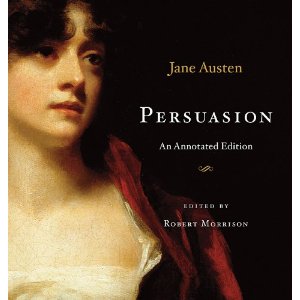
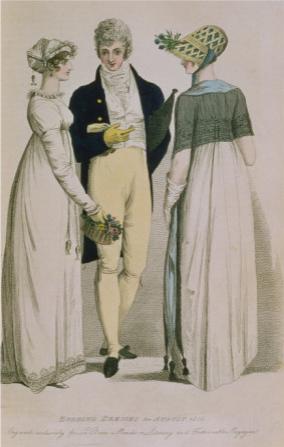
Harvard University Press has done it again and wowed us with a superb annotation of a Jane Austen novel! Persuasion: An Annotated Edition, edited by Robert Morrison is slated to be released in November. This large edition hardback is a mouthwateringly scrumptious book that contains 102 color illustrations (some of which are included in this review), notes on the original text, a 21-page introduction by Dr. Morrison, the text of Persuasion and annotations placed in the far margins, the original ending of Persuasion, (which Jane Austen abandoned), biographical notice of the author by her brother Henry Austen (written shortly after her death), and further recommended reading. Annotator, Dr. Morrison, describes the book as the most profound novel that Jane Austen has written, containing “her most compelling and adult love story.”

1808 evening dresses, August issue of Le Beau Monde.

I found every part of this book worthy of reading. In his foreword, Dr. Morrison sets up the novel in context of the Napoleonic Wars and Jane Austen’s experience with her sailor brothers and knowledge of how the wars changed the British class system, allowing self-made men like Admiral Croft and Captain Wentworth to rise in the world, while those who clung to traditional conventions, like Sir Walter Elliot and his daughters Elizabeth and Mary, to become increasingly anachronisistic. Dr Morrison explains in an interview for Harvard Press:

“Austen, on the other hand, is a novelist, and the emphasis when editing her is frequently on her immensely insightful views on social structures, sexual politics, economic pressures, and individual obligations and aspirations. Editing her means developing a very clear sense of the difference between riding in a barouche and riding in a curricle, of what it means to command a frigate as opposed to a sloop.“ – Interview with Robert Morrison, Harvard Press 

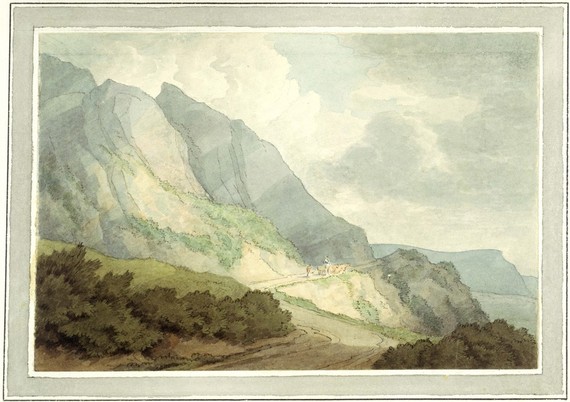
Between Lyme Regis and Charmouth, by John White Abbot

The star attractions of this book are the annotations, which are liberally sprinkled in the sidebars of each page. Dr. Morrison chose information that would appeal to seasoned readers of the novel as well as those who are reading it for the first time. He discusses naval rank, the various reasons why Anne’s family pressured her to not marry Wentworth, descriptions of the duties of apothecaries and surgeons, inheritance laws, the streets and buildings in Bath, descriptions of Lyme Regis, letter writing, and more. He explained in an interview for Harvard Press:

“Knowing my prose was going to appear right beside Austen’s really did change the way I approached writing my commentary. I have tried to use the commentary to illuminate the text as often as I can, and from as many different angles as I can, and to emphasize both what I believe to be central in Persuasion, and what the finest critics from Austen’s day to ours have written about it. I have attempted to produce a commentary that is in immediate and active dialogue with her text, rather than in a relationship that is more distant and intermittent.” – Interview, Harvard Press

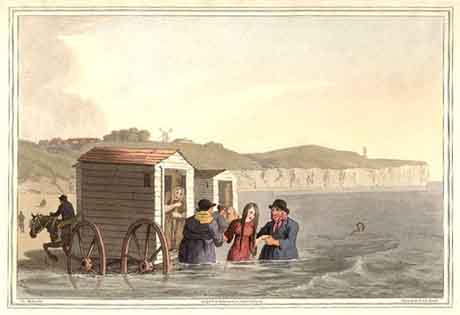
Sea bathing at Scarborough

I find it hard to read a novel smoothly while referring to the annotations, which I regard as interruptions, so I generally read the annotations alone. I then refer to the sections of the novel that are described. After going through the annotations, I will sit down and read the novel again. That second reading is much enriched because of the additional information. (I am curious to know how others tackle reading an annotated book!)

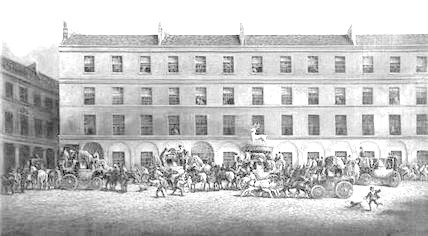
The White Hart Inn

Professor Morrison ends his interview with Harvard Press by comparing the radical change in Anne from a faded to a blooming woman to the transformation in Jane Austen’s novels: “[Persuasion] signals a radical change from what she has written in the past, and throws searching light on the world that is to come.”

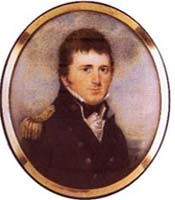
Francis Austen, Jane Austen's sailor brother.

Persuasion, an annotated edition will sit proudly on my bookshelf next to last year’s edition of Pride and Prejudice: An Annotated Edition by Patricia Meyer Spacks, also from Harvard University Press. I give this book five out of five Regency teacups.

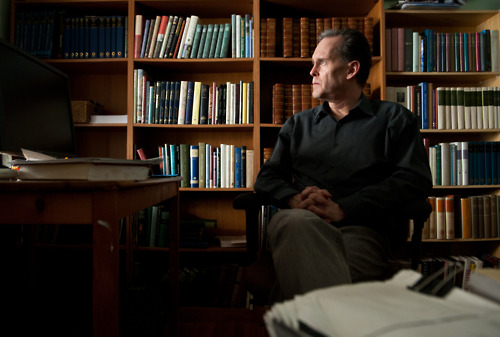
Dr. Robert Morrison. Image @Galit Rodan

About the author: Robert Morrison, is an English professor and world-class scholar of Romantic and Victorian literature at Queen’s University, Ontario, Cananda. He is the author of the acclaimed biography of Thomas de Quincey entitled The English Opium Eater.

Hardcover: 360 pages, 102 ills.
Publisher: Belknap Press of Harvard University Press; Annotated edition
Language: English
ISBN-13: 978-0674049741

Read Full Post »

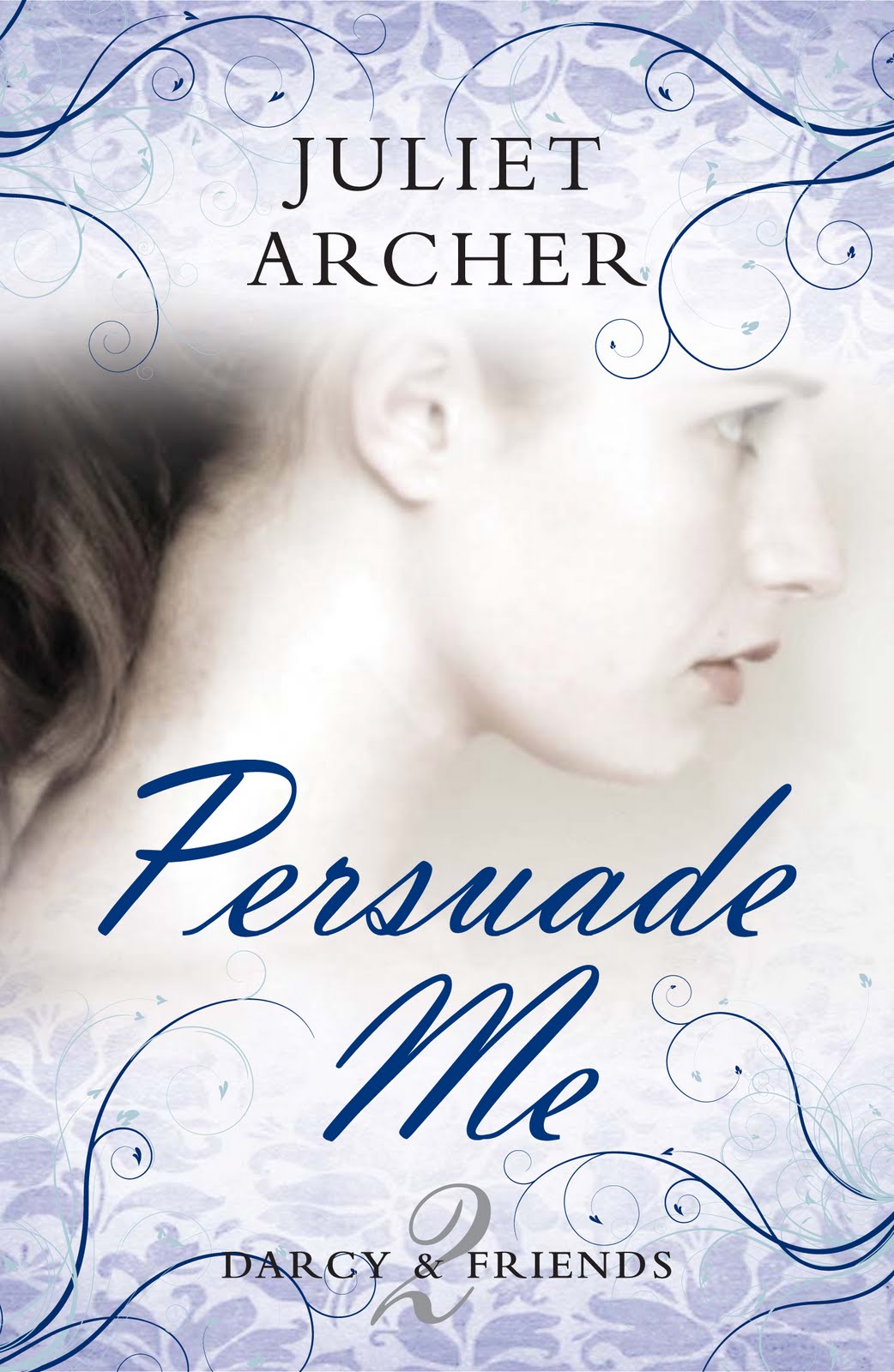
Persuade Me by Juliet Archer is a modernized treatment of Jane Austen’s Persuasion. When I first received the book I was reminded of the Three Weissmanns of Westport, a modern take of Sense and Sensibility by Cathleen Schine. Since I wasn’t as impressed with the Weissmanns as the New York Times bestselling book crowd seemed to be, I picked up Persuade Me with a sense of “Here we go again.”

Persuade Me is the story of Anna Elliot and Rick Wentworth, celebrity scientist and best selling author of Sex in the Sea, an entertaining yet informative non-fiction book about sea animal propagation. Rick’s movie star good looks propel him to instant stardom. And thus we meet him on a book tour in England, away from Australia, his adopted country. Rick’s return to England is bittersweet. While he’s found fame, he’s never found a woman to replace his lost love, Anna, and memories keep washing over him as he visits familiar haunts. Even though the memories are sweet, Rick remains bitter, for his failed romance with Anna has spoiled him for any other woman.

Enter Anna Elliot. Softly pretty, single, and with a serious job, that of a Russian literature scholar. Her life, too, has been scarred by a love once treasured, now lost. Memories of Rick’s kisses and arms are as fresh to Anna today as they were ten years ago, before she foolishly broke up with him.

Insofar as the plot goes, Jane Austen fans know the drill. Rick meets Anna on his book tour, and circumstances serve to throw the two together physically while emotionally keeping them apart. Anna’s sisters Lisa and Mona resemble their Jane Austen counterparts, except that shrewish Mona is also a lush, a touch I loved. Sir Walter Elliot is a vain popinjay who instantly re-invites his slimy, two-timing nephew William back to the bosom of his family because he is (and here I am paraphrasing Sir Walter) a “mimick-me”. Except for William’s chin having an unfortunate tendency towards receding, Sir Walter regards the man as the perfect consort for his lovely eldest daughter Lisa.

I won’t go into more details about the plot, since that will spoil the book for you, except to make a few observations. Juliet Archer takes the reader into both Anna’s and Rick’s minds. Now, I am one of those readers who thrills in reading books in which the author does this. I am always dying to know what other characters are thinking, and Juliet has given me that gift. This works both for and against the plot. Let me explain. When Rick and Anna get together, you can cut the sexual tension with a knife. Knowing what both were thinking and why they were unable to act upon their desires kept me turning the pages.

BUT! By providing us with Rick’s thoughts, the mystery of the book is gone. Jane Austen brilliantly kept her readers in suspense about Captain Wentworth’s thoughts and how they informed his actions. We knew what emotional torture poor Anne Elliot was going through and we had to wait (with bated breaths) for the last few chapters to learn how very much Captain Wentworth had wanted her back all along. For a variety of reasons, there is no such mystery in Persuade Me. Nevertheless, Juliet Archers has given us the thrill of following Rick’s mind as he encounters Anna in Lyme and Bath and sees her with William Elliot. It helps that the author is British, and therefore can capture the nuances of speech and customs of her country perfectly. One feels that this Anna and William could have been the great great grandchildren of Jane Austen’s counterparts.

The second reason that the suspense of this tale is missing is that it is based on a beloved book that 99% of Janeites have read. We already know the outcome. Yet I found the book a satisfying read. Even though I regard its original model as nearly perfect, I give Persuade Me four out of five Regency tea cups.

Persuade Me is the second book in Juliet Archer’s Darcy & Friends series, published by Choc Lit at http://www.choc-lit.com

Read Full Post »

Gentle readers, strap on your seat belts. Tony Grant from London Calling sent in his review of “A Jane Austen Education: How six novels taught me about love, friendship and the things that really matter“by William Deresiewicz. Let’s just say this is a review by a bloke about a bloke’s book. There will be no teacup or regency fan ratings this time. 

Just recently a dear friend sent me a copy of A Jane Austen Education by William Deresiewicz. I had read some of the reviews written on a few of the Jane blogs and my impression from those was that it must be a fresh, slightly different approach to engaging with Jane’s works. I sort of put the idea of reading it to one side, I must admit. I thought it would be just another quirky angle on Jane. Anything with Jane’s name attached to it sells, doesn’t it? However, now having a copy here in front of me I decided, at the very least, I should have a look, delve in, and see what I thought.

The front cover was at first a mystery and slightly off putting. A paper doll cut out suited gentleman, headless, to be placed over an inanimate cardboard cut out of a Regency, or did it look more early Victorian, gentleman, presumably wearing underwear, seemed an odd choice. One dimensional, stiff, inanimate, stuck in one pose, drinking tea, ah yes, there was the Jane connection. What did all this reveal about what I was about to discover between the sheets?

The contents page revealed a nice straightforward approach. Chapter 1 Emma, Every Day Matters, Chapter 2 Pride and Prejudice, Growing Up and so on through the six published novels, each providing William with a stepping stone along his journey of self discovery and growth. And to round it all off, a nice concluding chapter “The End of the story.” Yes, a well-ordered and neatly constructed narrative was bound to follow.

By the end of the first chapter I had our William sussed. Start with the personal stuff (my life was crap-type thing) – provide an overview of the novel, characters, and plot, and then follow through by laboriously comparing his life events with the characters and events in the book. And finally, relating how it had changed him for the best. I began to feel that I was about to hunker down for a tortuous time. But things were worse than that, William was depressed. Now I’m fine with depression and especially manic depression. All the great comedians profess to be depressives. We have had and have (some of them are dead by the way) Peter Sellers, Spike Milligan and John Clease. All of them are professed manic depressives who used this depth of pain to create some of the greatest humour ever. Winston Churchill suffered from what he termed his ”black dog.” Virginia Woolf and Sylvia Plath, both incredible writers who could bare their souls and take us to places in the human psyche we would never have dreamed of, both took their lives. Life was too unbearable.

However William writes,

Well it just sat there, that realisation, like a lump in my gut – sat there for weeks. I didn’t know what to do with it, how to get rid of it, how to dig myself out the hole I just discovered I was in. But I knew I couldn’t live like that anymore.”

This passage is a build up to telling his girlfriend at the time, that he thought they should part their ways. There was no depth to their relationship apparently. This level of depression is the equivalent of having a bad cold. In the hierarchy of depressive situations, William is not going to reach into our emotional depths and inspire us with what is a very common place situation. I was hoping things would get better, but no, he droned on in this flat slightly miserable way all through the first chapter. And what did he learn from Emma?

“Even I was beginning to realise what a real relationship looked like,” he droned.

Oh I see!!!!!!! Yes, I was really beginning to see.

I was getting the idea. I really do hope William gets his full share of the kudos that Jane’s name, applied to a title, provides. I was beginning to think, what else is there? What other value?

At one stage, I must say, I thought that the analysis part of each chapter had worth, William is an English literature lecturer at a university after all, but then I got bored with that too. He is far, far too contrived. Later in the book, here is William analysing Mansfield Park, my favourite Austen novel,

“What Austen recommended to us, she urged upon her nearest and dearest, too. Love means effort and self control – for the sake of others, and thus, ultimately, for your own.”

Oh God, this is beginning to sound so profound. Life’s hard lessons learned so emphatically, and by a writer so young too.

I squirmed a few times while reading this. Yes, I did persevere. The book was compelling in a ”how can it get worse?” sort of way.

But this is the real sneaky bit. Come on William, tell us the truth. What were you thinking when you wrote this stuff ?

We had jumped each other one night the previous summer, and though we had been together for over a year we had little in common and had never much progressed beyond the sex.”

Honesty, the baring of ones soul, telling it like it is — it’s all in this book. William repeats at discrete, well-paced intervals, lightly (and apparently carelessly), how bad he feels about superficial relationships and jumping into bed for hot steamy one night stands. Any bloke down my pub would laugh at him heartily and call him a …….!!! No I really can’t write what I know my mates would say. William might sue me. This book just ain’t for blokes, let’s put it that way.

It does beg the question who this little boy lost saga is for.

By the end of the book William tells us he has found true, deep, long-lasting love. He has found out at last what it means to be “intimate.” One of the most squirm-creating moments in this whole squirm-creating edifice was earlier in the book when William asks a girlfriend in a cafe what intimacy was and if they were being intimate at that time.

The book ends: (Warning: Spoiler alert.)

That first weekend she came to Brooklyn, the visit that sealed our fate, she brought along a book, just in case there was some downtime. [I’m trying to imagine what the downtime might entail and why and how there could be downtime.] She knew I was a graduate student by that point, but she had no idea what I studied or whom I was writing my dissertation about. It was just the thing she happened to be reading at the time.

The book was Pride and Prejudice.

Reader, I married her.”

So let me get this right. In the end, after all the soul searching, all those profound life lessons it boiled down to Pride and Prejudice?

We’ve been taken through the superficial relationships and I must admit, when I got to the end of the book, I discovered William’s photograph on the back of the fly sheet. It startled me. This bloke had superficial relationships!!!!! There has been the father who disapproved. There has been the depressive moments, mild depression by the way, boring and ordinary, that nothing but a good blow of the nose into a handkerchief wouldn’t have solved. There have been the life lessons learned. I’m sorry, I can’t get it out of my head: This young bloke has learned life’s lessons through Jane Austen already. Where does he go from there? My experience is nothing like that. Life creeps up on you imperceptibly. You adapt and grow slowly, often without noticing and sometimes you regress badly. Life and life’s lessons are nowhere near as easy to learn, as William makes out, by reading a set of novels. You can’t learn it in your head, you have to live life. Sometimes I think it’s impossibly to learn the so-called life lessons. Often we are just stuck, through no fault of our own, because we are who we are.

I am very reluctant to throw a book onto a fire, for echoes of the many evil political regimes that have done that sort of thing come to mind. What I’ll do, out of gratitude to my friend who sent me this copy, is put it on my bookshelf to gather dust. Then I’ll forget about it.

Read Full Post »

« Newer Posts - Older Posts »