Feeds:
Posts
Comments

Archive for the ‘Jane Austen Novels’ Category

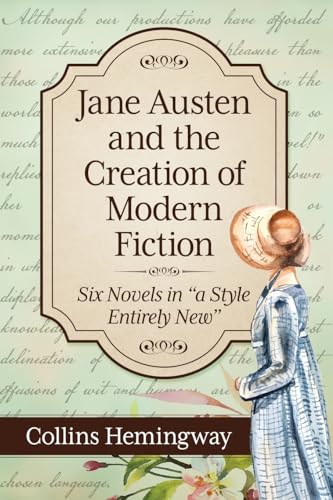
Jane Austen and the Creation of Modern Fiction: Six Novels in “a Style Entirely New,” explores Jane Austen’s development as a fiction writer.

by Brenda S. Cox

A few days ago I reviewed Collins Hemingway’s fascinating new book on the development of Austen’s writing techniques, Jane Austen and the Creation of Modern Fiction: Six Novels in “a Style Entirely New.”  Today we meet with the author to get his perspectives on the book.

Collins Hemingway began his analysis of Jane Austen’s writing techniques as he wrote a fiction trilogy speculating on the “lost years” of Austen’s life, The Marriage of Miss Jane Austen.

I asked Collins Hemingway to tell us more about Jane Austen and the Creation of Modern Fiction.

JAW: What led you to write this book, Collins?

Collins: I’ve read Austen all my life, but I did not read much commentary during my 25-year high-tech career. When I came back to Austen fulltime, I read a ton of Austen scholarship from the last 20 years. I noticed that there wasn’t much about her writing, as writing. Scholars would mention a technique and use it as a launch point for broader criticism. With rare exceptions, they would not analyze the technique itself or how it affected the reader. I saw this as an area in which I could add something new.

JAW: You have, of course, written a fiction series, The Marriage of Miss Jane Austen. How did your experiences writing fiction about Austen feed into your development of Jane Austen and the Creation of Modern Fiction?

Collins: Writing the novels led directly to this book, though it took several years of hard reading, notetaking, and writing to flesh out the meat over the bones. I have shared that story on my blog.

JAW: The book is full of great insights. For you, what was one of the most helpful, something that helped you see Austen’s novels in a new way?

Collins: After completing the fiction trilogy, I went a step further, going through each of Austen’s six novels line by line, noting everything of interest to a writer. I ended up with 20 to 30 pages of handwritten notes on each one. Then I began to consolidate various topics. For instance, I ended up with five pages of notes just on description, collated from all her books, including the juvenilia. Then I examined the patterns in different aspects of writing and tried to understand how the patterns fit within and between each book.

As the patterns began to organize themselves, I realized that there was a distinct trend from early to late. In each book, Austen learned something, then applied it in the succeeding books. Like Virginia Woolf examining the early works and the unfinished works, I began to see the internal structures of each book. (As my wife would caution—in my opinion.) I could see how Austen was feeling her way along in the early works, then painting like a master in the later ones.

JAW: You’ve pointed out the strengths and weaknesses of each of Austen’s novels. It appears that you see Emma as the most “perfect” novel, as other commentators do. But for you personally, which novel do you tend to enjoy re-reading the most, and why?

Collins: Depends on my mood. P&P for its sheer energy, and for Liz bowing to no one, ever. Emma for its magnificence, page by page. Persuasion for the depth of Anne’s feeling. MP, though it is in no way my favorite, when I just want to admire the structural purity and the work she put into it.

JAW: You talk about many techniques of modern fiction that Jane Austen helped to develop and show how they developed in her novels over time. Could you briefly list for us some of those techniques, so readers can see some of the treats they have in store?

Collins: She was a master of dialogue probably from the day she first picked up a quill pen. Description. Behavior. Character motivation and interaction. Complex plots (without castles, brigands, or shipwrecks.) Ever deeper and subtler ways to get into her characters’ minds.

JAW: What is one takeaway that you want readers to have when they finish reading your book?

Collins: What Austen accomplished would make any author proud. But the fact that she learned all that she did on her own, away from other writers, pulling the best from a small number of others (such as Richardson, in a very specific way), building on a few good things from tradition, figuring out the rest on her own—it’s astonishing. And she did it in her too short 41.5 years of life!

JAW: What was the most fun part of the book to write?

Collins: My breakthrough in really understanding the internals came through descriptions. They unlocked the issues in NA and S&S, showed how radically different P&P was from the earlier two, and became miraculously mature in MP. This was the most fun. Especially when I realized the difference in the way Austen treated Lady Russell and Anne as they entered Bath in Persuasion. It took my breath away to see what Austen had done.


You may want to read my review if you missed it earlier. This is a fascinating book if you want to better understand Jane Austen’s modern writing techniques and how she developed them herself. Jane Austen and the Creation of Modern Fiction is available from Amazon and from Jane Austen Books. Jane Austen Books is currently offering it at a substantial discount.


Brenda S. Cox is the author of Fashionable Goodness: Christianity in Jane Austen’s England. She also blogs at Faith, Science, Joy, and Jane Austen.

Read Full Post »

By Brenda S. Cox

I thoroughly enjoyed Jane Austen and the Creation of Modern Fiction: Six Novels in “a Style Entirely New,” by Collins Hemingway. As a fiction writer himself, Hemingway examines Austen’s novels, in the order she wrote them, to analyze the techniques she pioneered. He observes her abilities growing from novel to novel, as she experiments and succeeds in creating the worlds and characters we so love.

Collins Hemingway’s new book, Jane Austen and the Creation of Modern Fiction: Six Novels in “a Style Entirely New, gives fascinating insights into Austen’s development of modern techniques of fiction writing.

A New Style?

Did Jane Austen develop a new style of novel-writing? Her contemporary reviewers thought so. They felt compelled to give long contrasts between the previous style of novel-writing, full of intensity and improbability, with Jane Austen’s new realistic style. Sir Walter Scott in his 1815 review of Emma said Austen “draws the characters and incidents introduced more immediately from the current of everyday life.” Rev. Richard Whately wrote in his 1821 review of Northanger Abbey and Persuasion, “A new style of novel has arisen. . . . The substitute for these excitements [of unlikely adventures] . . . was the art of copying from nature as she really exists in the common walks of life.” Both these reviews are worth reading (follow the links above) to see how Austen’s contemporaries struggled to describe what she was, and wasn’t, doing in her novels.

The third volume of Austen’s Juvenilia includes a penciled note inside the front cover, “Effusions of Fancy by a very Young Lady consisting of Tales in a Style entirely new.” Peter Sabor says this inscription is written in Jane’s father’s handwriting, though others have speculated that it may have been written by Cassandra or even by Jane herself, tongue-in-cheek.

Author Collins Hemingway told me, “The epigram seems most likely to me to be from her father. . . . To me, the quotation is Mr. Austen enjoying and encouraging Jane’s raw power and comedy, her sheer audacity in sending up the pulp fiction of the day with her various teenage writings. I saw a strong parallel to her adult fiction. Her juvenilia showed that she understood that traditional fiction didn’t cut it. Her adult fiction shows that she learned how to write good novels—something new at the time.”

Jane Austen Learning (or Inventing) the Craft of Writing Fiction

Jane Austen and the Creation of Modern Fiction starts out with a preface for more academic readers (feel free to skip it if that’s not you), then an introduction for us all, which begins:

“I wrote this book so that people can read Jane Austen with fresh eyes. I wanted booklovers to view her not as a literary or cultural icon but as a writer, someone who puts words to paper to try to touch another person’s heart. I wanted people to see her as a human being who struggled to master her craft as anyone in any field, regardless of talent, must do. . . . As both a student of literature and a writer, I wanted to know how Austen affects readers. I wanted to know how she created remarkably  real people interacting in remarkably realistic situations. This is what writers care about, and what readers respond to.”

Yes.

Hemingway starts with an exploration of the context of Austen’s writing, how she “straddled the old and new literary order, ultimately pivoting the novel from improbable adventures to deep penetration of the minds of her heroines.” (These early chapters are necessarily a bit more difficult, as they compare Austen with her contemporaries, who most of us have not read—and here we can see why Austen is so much more accessible than other writers of her time!)

Then he brings us deep into our beloved Austen–following her development of description in her earliest novels, Northanger Abbey and Sense and Sensibility. In Pride and Prejudice, she continues to develop “pocket descriptions,” which are “pithy, telling details.” For example, Elizabeth Bennet’s jumping over stiles and puddles and arriving at Netherfield with “weary ancles” and “dirty stockings” is a pocket description that shows us a lot about Elizabeth.

Sense and Sensibility was originally written in the popular “epistolary” form, as a series of letters. Letters give a sense of distance, as the character is writing about events that have already happened, rather than the author drawing readers directly into events. A chapter analyzes how Austen made the transition from letters into narrative. For example, Edward Ferrars is a “blurry” presence in the early chapters, which are closer to the letter format. By the end of the novel, though, Austen has added vivid, immediate scenes. So, in the final proposal scene, we see Edward as “the very real and anguished presence of a human being.”

My favorite chapter is the one on “The Marvelous Complexity of Mansfield Park.” Hemingway’s discussion helps readers appreciate its elaborate scenes, complex characters, and interconnected plotlines. He particularly explores the depths of Fanny Price’s thoughts and feelings.

Fanny’s “responses, which for the most part only the reader observes, show her to be by far the most complex individual Austen ever creates. Outwardly, she is a saint. Inwardly, she is as confused and angry as any person who is regularly embarrassed or put down. Her raw feelings sometimes overpower her Christian charity and patience.” Austen even uses the furnishings of Fanny’s room to show her interior life. Fanny constantly examines her own motives, trying to find the right path.

Every chapter includes new insights into Austen’s novels, her writing techniques, and her development as an author.

Persuasion

One area of the book that Janeites might find a little uncomfortable is the section on Persuasion. Collins Hemingway discusses the revision process—authors generally rewrite their books multiple times. He points out several areas in Persuasion that could be considered imperfect. For example, Mrs. Smith is not quite consistent. Why does she encourage Anne to marry Mr. Elliot, then reveal how horrible he is? And why does Lady Russell mostly disappear from the second half of the book?

Austen might have fixed these issues with a major rewrite. (I suggest she also might have changed Charles Hayter’s name, so we wouldn’t have two adult characters named Charles, besides Charles Musgrove’s son Little Charles.) But Hemingway suggests that perhaps her health was failing already, and she did not have the time and energy for major revision. She had already replaced the original ending with the beautiful one we know and love. And, in “the quiet passion of Anne Elliot,” she had already given readers “a depth of character never seen before.”

If Austen had begun another revision to fix smaller structural issues, she might not have had a publishable version available when she died. So, Hemingway persuades us that Austen wrapped up the work, as it stood, to give the world another work of art and to help provide for her mother and sister after her death. As Hemingway states, “Like Emma, Jane is faultless despite her faults.”

Any lover of Austen will learn a lot from Jane Austen and the Creation of Modern Fiction. I particularly recommend it to writers (like myself), who will enjoy seeing Austen’s techniques and their development. Any of you who love digging deeper into Austen’s novels will find new delights here.

On Monday, we’ll interview the author to get his perspectives on the book.

Jane Austen and the Creation of Modern Fiction is available from Amazon and from Jane Austen Books. Jane Austen Books is currently offering it at a substantial discount.

Gentle readers, what aspect of Austen’s writing do you most admire? Her settings, characters, plots, style, humor, or something else?

Brenda S. Cox is the author of Fashionable Goodness: Christianity in Jane Austen’s England. She also blogs at Faith, Science, Joy, and Jane Austen.

Read Full Post »

As spring turns to summer on our month-by-month exploration of Jane Austen’s life, letters, and novels, we turn our attention to May in Jane Austen’s world. If you’re just jumping on the bus, you can find previous articles in this “A Year in Jane Austen’s World” series here: JanuaryFebruary, March, and April.

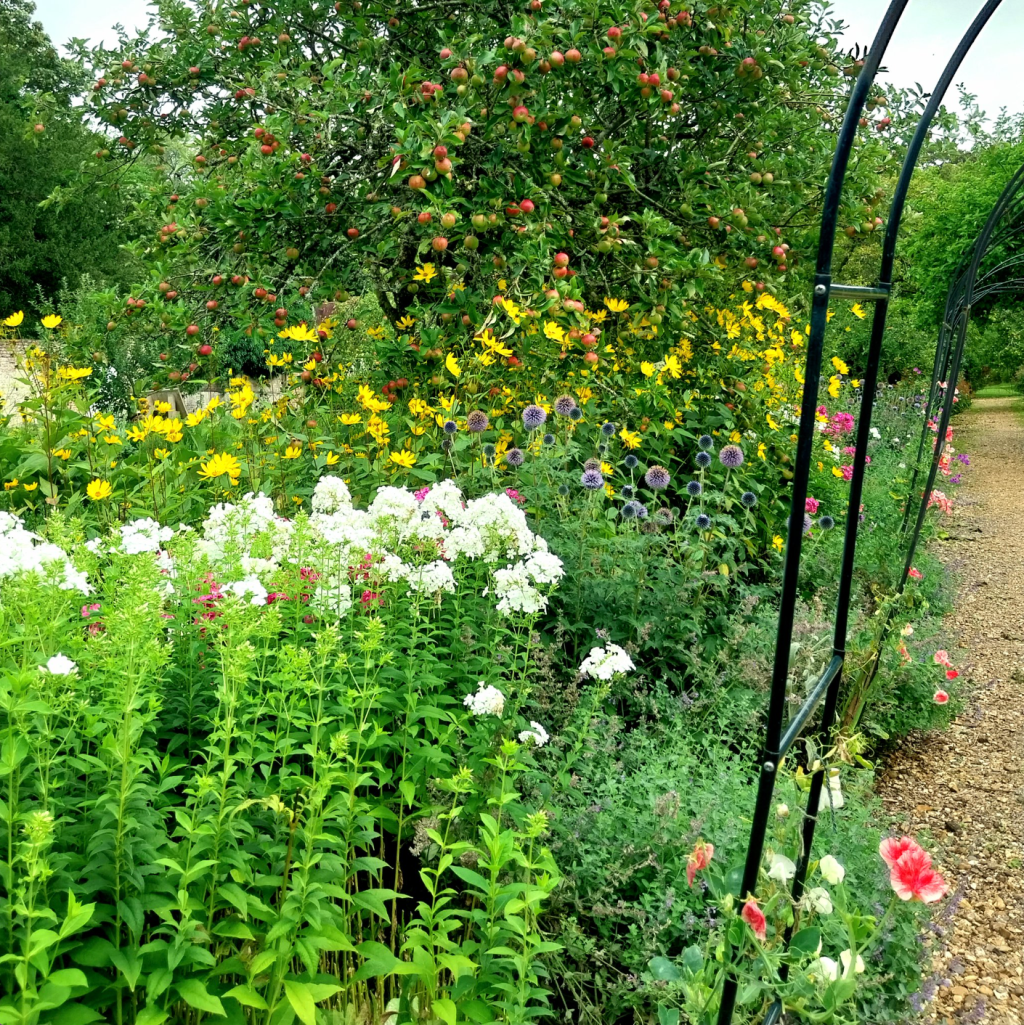
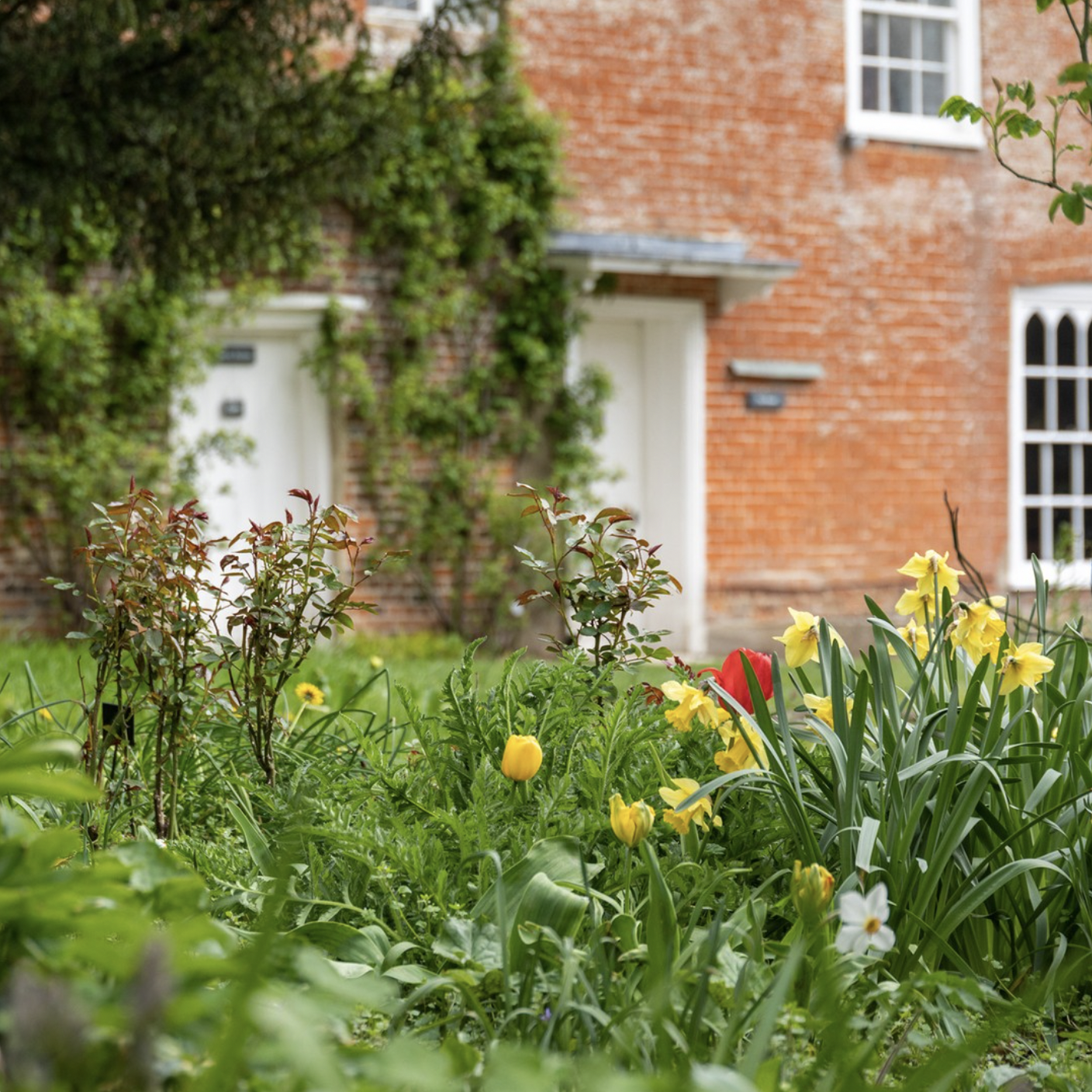
During last month’s April showers in England, we dreamed of May flowers…and the Hampshire countryside certainly is showing some May flower power. First up, our monthly view of Chawton House Gardens. It certainly is bursting with color!

Chawton House in May: Photo @ChawtonHouse.

May in Hampshire

May is the time of year when the sun shines more regularly and everything bursts into bloom. Summer is close at hand, which means the temperatures are starting to warm up a bit, but frequent rain helps keep the gardens cool and watered. Austen had this to say in May 1811 in a letter to Cassandra:

The chickens are all alive and fit for the table, but we save them for something grand. Some of the flower seeds are coming up very well, but your mignonette makes a wretched appearance. Miss Benn has been equally unlucky as to hers. She had seed from four different people, and none of it comes up. Our young piony (sic) at the foot of the fir-tree has just blown and looks very handsome, and the whole of the shrubbery border will soon be very gay with pinks and sweet-williams, in addition to the columbines already in bloom. The syringas, too, are coming out. We are likely to have a great crop of Orleans plums, but not many greengages—on the standard scarcely any, three or four dozen, perhaps, against the wall. (Chawton, Wednesday May 29, 1811)

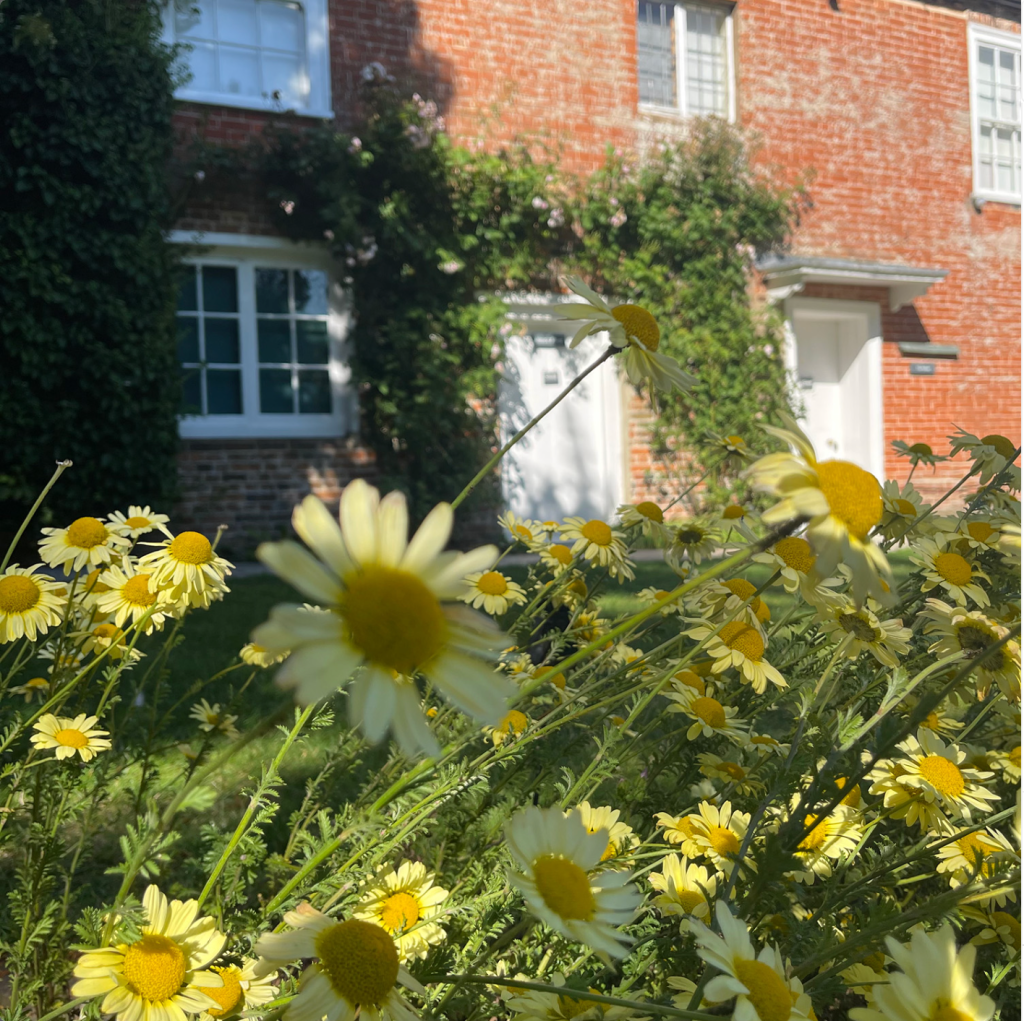
Here is a glimpse of Jane Austen’s House Museum and its blooms this month.

Jane Austen’s House in May, Photo: @JaneAustensHouse.

May in Jane Austen’s Letters

We have several letters from May to peruse. Interestingly, several are written from Bath. In an interesting article entitled “A Brief History of Jane Austen in Bath” on VisitBath.com, we read this about Jane Austen:

While many assume that Jane’s connection with Bath began when she moved to 4 Sydney Place in 1801 after her father’s retirement, the Austen family’s history with the City actually dates back further. Jane’s parents were married at St Swithin’s Church in 1764, and Jane herself visited in 1797 and 1799, lodging with her mother and sister-in-law at 13 Queen Square in 1799 while her brother took the waters for his health. Before moving into Sydney Place, she also stayed with her aunt and uncle, the Leigh-Perrots, at No.1 The Paragon. These short visits had a lasting impact on the young Jane Austen, inspiring her to write Northanger Abbey about Catherine Morland’s first visit to Bath and her “eager delight” at all it offered. (VisitBath.com)

May 17, 1799 (Queen’s Square):

  • Jane’s thoughts on the house: “We are exceedingly pleased with the house; the rooms are quite as large as we expected. Mrs. Bromley is a fat woman in mourning, and a little black kitten runs about the staircase. Elizabeth has the apartment within the drawing-room; she wanted my mother to have it, but as there was no bed in the inner one, and the stairs are so much easier of ascent, or my mother so much stronger than in Paragon as not to regard the double flight, it is settled for us to be above, where we have two very nice-sized rooms, with dirty quilts and everything comfortable. I have the outward and larger apartment, as I ought to have; which is quite as large as our bedroom at home, and my mother’s is not materially less. The beds are both as large as any at Steventon, and I have a very nice chest of drawers and a closet full of shelves — so full indeed that there is nothing else in it, and it should therefore be called a cupboard rather than a closet, I suppose.”
  • Happy and content, despite a delay with her trunk: “I find no difficulty in closing my eyes. I like our situation very much; it is far more cheerful than Paragon, and the prospect from the drawing-room window, at which I now write, is rather picturesque, as it commands a prospective view of the left side of Brock Street, broken by three Lombardy poplars in the garden of the last house in Queen’s Parade.”
The Royal Crescent in Spring (Photo Courtesy of VisitBath.com).

May 1801 (Paragon):

  • May 5 (their journey): “I have the pleasure of writing from my own room up two pair of stairs, with everything very comfortable about me. Our journey here was perfectly free from accident or event; we changed horses at the end of every stage, and paid at almost every turn-pike. We had charming weather, hardly any dust, and were exceedingly agreeable, as we did not speak above once in three miles. Between Luggershall and Everley we made our grand meal, and then with admiring astonishment perceived in what a magnificent manner our support had been provided for. We could not with the utmost exertion consume above the twentieth part of the beef. The cucumber will, I believe, be a very acceptable present, as my uncle talks of having inquired the price of one lately, when he was told a shilling.
  • Food prices: “I am not without hopes of tempting Mrs. Lloyd to settle in Bath; meat is only 8d. per pound, butter 12d., and cheese 9 1/2 d. You must carefully conceal from her, however, the exorbitant price of fish: a salmon has been sold at 2s. 9d. per pound the whole fish. The Duchess of York’s removal is expected to make that article more reasonable — and till it really appears so, say nothing about salmon.”
  • New bonnets: “My mother has ordered a new bonnet, and so have I; both white strip, trimmed with white ribbon. I find my straw bonnet looking very much like other people’s, and quite as smart. Bonnets of cambric muslin on the plan of Lady Bridges’ are a good deal worn, and some of them are very pretty; but I shall defer one of that sort till your arrival.”
The Paragon from Travelpod
  • May 12 (a ball): “In the evening, I hope you honoured my toilette and ball with a thought; I dressed myself as well as I could, and had all my finery much admired at home. By nine o’clock my uncle, aunt, and I entered the rooms, and linked Miss Winstone on to us. Before tea it was rather a dull affair; but then the before tea did not last long, for there was only one dance, danced by four couple. Think of four couple, surrounded by about an hundred people, dancing in the Upper Rooms at Bath. After tea we cheered up; the breaking up of private parties sent some scores more to the ball, and though it was shockingly and inhumanly thin for this place, there were people enough, I suppose, to have made five or six very pretty Basingstoke assemblies.”
  • The sale of their belongings: “I thank you for your Sunday’s letter, it is very long and very agreeable. I fancy you know many more particulars of our sale than we do; we have heard the price of nothing but the cows, bacon, hay, hops, tables, and my father’s chest of drawers and study table. Mary is more minute in her account of their own gains than in ours; probably being better informed in them. I will attend to Mrs. Lloyd’s commission and to her abhorrence of musk when I write again.”
Fancy Ball at the Upper Rooms, Bath, Thomas Rowlandson
  • May 21 – the search for apartments continues: “Our views on G. P. Buildings seem all at an end; the observation of the damps still remaining in the offices of an house which has been only vacated a week, with reports of discontented families and putrid fevers, has given the coup de grace. We have now nothing in view. When you arrive, we will at least have the pleasure of examining some of these putrefying houses again; they are so very desirable in size and situation, that there is some satisfaction in spending ten minutes within them.”
  • Walking with Mrs. Chamberlayne: “It would have amused you to see our progress. We went up by Sion Hill, and returned across the fields. In climbing a hill Mrs. Chamberlayne is very capital; I could with difficulty keep pace with her, yet would not flinch for the world. On plain ground I was quite her equal. And so we posted away under a fine hot sun, she without any parasol or any shade to her hat, stopping for nothing, and crossing the churchyard at Weston with as much expedition as if we were afraid of being buried alive. After seeing what she is equal to, I cannot help feeling a regard for her. As to agreeableness, she is much like other people.”
  • On a small party: “We are to have a tiny party here to-night. I hate tiny parties, they force one into constant exertion. Miss Edwards and her father, Mrs. Busby and her nephew, Mr. Maitland, and Mrs. Lillingstone are to be the whole; and I am prevented from setting my black cap at Mr. Maitland by his having a wife and ten children.”
Panorama of Bath from Beechen Cliff, 1824, Harvey Wood

Jane wrote several other “May letters” from Chawton (1811) and Sloane Street (1813):

May 29, 1811 (Chawton):

  • Springtime storms: “Mrs. Terry, Mary, and Robert, with my aunt Harding and her daughter, came from Dummer for a day and a night,—all very agreeable and very much delighted with the new house and with Chawton in general. We sat upstairs, and had thunder and lightning as usual. I never knew such a spring for thunderstorms as it has been. Thank God! we have had no bad ones here. I thought myself in luck to have my uncomfortable feelings shared by the mistress of the house, as that procured blinds and candles. It had been excessively hot the whole day.”
  • Improvements: “The chimneys at the Great House are done. Mr. Prowting has opened a gravel-pit, very conveniently for my mother, just at the mouth of the approach to his house; but it looks a little as if he meant to catch all his company. Tolerable gravel.”

May 20, 1813 (Sloane Street):

  • Travels: “We left Guildford at twenty minutes before twelve (I hope somebody cares for these minutiæ), and were at Esher in about two hours more. I was very much pleased with the country in general. Between Guildford and Ripley I thought it particularly pretty, also about Painshill; and from a Mr. Spicer’s grounds at Esher, which we walked into before dinner, the views were beautiful. I cannot say what we did not see, but I should think there could not be a wood, or a meadow, or palace, or remarkable spot in England that was not spread out before us on one side or other.”
  • Settling in: “I fancy it was about half-past six when we reached this house,—a twelve hours’ business, and the horses did not appear more than reasonably tired. I was very tired too, and glad to get to bed early, but am quite well to-day. I am very snug in the front drawing-room all to myself, and would not say “thank you” for any company but you. The quietness of it does me good.”

May 24, 1813 (Sloane Street):

  • On visiting an exhibition and finding the Mrs. Bingley’s (Jane Bennet’s) likeness and looking for Mrs. Darcy’s (Elizabeth Bennet’s) likeness: “…to my great amusement, Henry and I went to the exhibition in Spring Gardens. It is not thought a good collection, but I was very well pleased, particularly (pray tell Fanny) with a small portrait of Mrs. Bingley, excessively like her. I went in hopes of seeing one of her sister, but there was no Mrs. Darcy. Perhaps, however, I may find her in the great exhibition, which we shall go to if we have time. I have no chance of her in the collection of Sir Joshua Reynolds’s paintings, which is now showing in Pall Mall, and which we are also to visit. Mrs. Bingley’s is exactly herself,—size, shaped face, features, and sweetness; there never was a greater likeness. She is dressed in a white gown, with green ornaments, which convinces me of what I had always supposed, that green was a favorite color with her. I dare say Mrs. D. will be in yellow.”
  • Later that evening, on searching for Mrs. D (Elizabeth Bennet): “We have been both to the exhibition and Sir J. Reynolds’s, and I am disappointed, for there was nothing like Mrs. D. at either. I can only imagine that Mr. D. prizes any picture of her too much to like it should be exposed to the public eye. I can imagine he would have that sort of feeling,—that mixture of love, pride, and delicacy.”
Jane Bennet, Pride and Prejudice (1995).

May in Jane Austen’s Novels

May isn’t mentioned too terribly much in Austen’s novels, but it is a special point of interest and conversation in Emma because of the timing of Frank Churchill’s visit and the timing of the ball:

Emma

  • Frank’s visit: “Emma heard that Frank wrote in the highest spirits of this arrangement, and seemed most fully to appreciate the blessing of having two months before him of such near neighbourhood to many dear friends—for the house was taken for May and June. She was told that now he wrote with the greatest confidence of being often with them, almost as often as he could even wish.”
  • Mr. Weston’s joy: “Mr. Weston’s own happiness was indisputable. He was quite delighted. It was the very circumstance he could have wished for. Now, it would be really having Frank in their neighbourhood. What were nine miles to a young man?—An hour’s ride. He would be always coming over.
  • A ball: “Mr. Weston’s ball was to be a real thing. A very few to-morrows stood between the young people of Highbury and happiness.”
  • May is better for everything: “Mr. Woodhouse was resigned. The time of year lightened the evil to him. May was better for every thing than February.”
  • Evening fire in May: “The whole party walked about, and looked, and praised again; and then, having nothing else to do, formed a sort of half-circle round the fire, to observe in their various modes, till other subjects were started, that, though May, a fire in the evening was still very pleasant.
Anya Taylor-Joy (left) as “Emma Woodhouse” and Callum Turner (right) as “Frank Churchilll.” (2020). Credit : Focus Features.

May Dates of Importance

This brings us now to several important May dates that relate to Jane and her family:

Family News:

May 1801: Austen family leaves Steventon and settles in Bath. Mrs. Austen and Jane travel via Ibthorpe. James Austen and his family take resident at Steventon rectory.

May 1807: Captain Charles Austen marries Fanny Palmer in Bermuda.

Historic Dates:

18 May 1804: Napoleon crowns himself emperor of France.

Writing:

May 1814: Mansfield Park published anonymously, “By the Author of ‘Sense & Sensibility,’ and ‘Pride & Prejudice.’

Sorrows:

24 May 1817: Jane leaves Chawton and moves with Cassandra to Winchester, for medical treatment.

On this day in 1817, Jane Austen left this house for the final time. She went to stay in Winchester, closer to her doctor, where she died two months later, on 18 July. -Jane Austen’s House Museum

May 24, 2024 @JaneAustensHouse

Lovely May

I hope you’re enjoying our journey through each month of the year in Jane Austen’s world. It is a joy to look through this lens into Austen’s life and letters. We’ll continue our exploration and find out what happened in June in next month’s installment, June in Jane Austen’s World!


RACHEL DODGE teaches college English classes, gives talks at libraries, teas, and book clubs, and writes for Jane Austen’s World blog. She is the bestselling author of The Little Women DevotionalThe Anne of Green Gables Devotional and Praying with Jane: 31 Days Through the Prayers of Jane Austen. Now Available: The Secret Garden Devotional! You can visit Rachel online at www.RachelDodge.com.
Read Full Post »

As we continue our month-by-month journey through Jane Austen’s novels, letters, and lifetime, we find ourselves in the lovely month of April! If you’re just jumping on the bus, you can find previous articles in my “A Year in Jane Austen’s World” series here: JanuaryFebruary, and March.

Let’s see what we find as we explore April in Jane Austen’s World! First up, our monthly view of Chawton House and Gardens, where the tulips are beginning to bloom!

Chawton House in April, Photo: @ChawtonHouse.

April in Hampshire

April is when everything starts to come back to life and bloom in Hampshire. The trees boast new leaves, the roads and lanes are lined with green, and flowers and trees are in blossom. The weather ranges from cloudy to partly cloudy to partly sunny to rainy.

Why talk about the flowers and the weather? Because it’s fun to picture some of the details about Hampshire that Austen loved and that we can still enjoy today!

The badness of the weather disconcerted an excellent plan of mine,—that of calling on Miss Beckford again; but from the middle of the day it rained incessantly.

Letter to Cassandra, Sloane St., Thursday (April 18, 1811)

Your lilacs are in leaf, ours are in bloom. The horse-chestnuts are quite out, and the elms almost. I had a pleasant walk in Kensington Gardens on Sunday with Henry, Mr. Smith, and Mr. Tilson; everything was fresh and beautiful.

Letter to Cassandra, Sloane St., Thursday (April 25, 1811)

Here is a glimpse of Jane Austen’s House Museum this month. The garden is looking absolutely lovely already!

Jane Austen’s House in April, Photo: @JaneAustensHouse.

April in Jane Austen’s Letters

We have two letters from April 1811 when Jane was staying with her brother in Sloane Street in London. The following are a few excerpts of special interest:

April 18, 1811 Letter: Sloane Street

  • Her spring shopping purchases: “I am sorry to tell you that I am getting very extravagant, and spending all my money, and, what is worse for you, I have been spending yours too; for in a linendraper’s shop to which I went for checked muslin, and for which I was obliged to give seven shillings a yard, I was tempted by a pretty-coloured muslin, and bought ten yards of it on the chance of your liking it; but, at the same time, if it should not suit you, you must not think yourself at all obliged to take it; it is only 3s. 6d. per yard, and I should not in the least mind keeping the whole. In texture it is just what we prefer, but its resemblance to green crewels, I must own, is not great, for the pattern is a small red spot. And now I believe I have done all my commissions except Wedgwood.”
  • More walking and shopping: “I liked my walk very much; it was shorter than I had expected, and the weather was delightful. We set off immediately after breakfast, and must have reached Grafton House by half-past 11; but when we entered the shop the whole counter was thronged, and we waited full half an hour before we could be attended to. When we were served, however, I was very well satisfied with my purchases — my bugle trimming at 2s. 4d. and three pair silk stockings for a little less than 12s. a pair.”
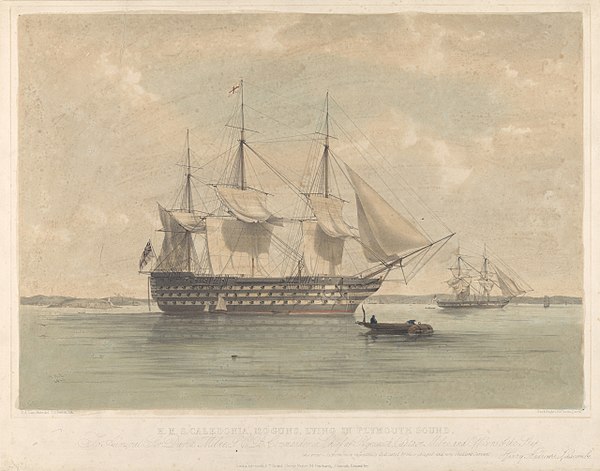
  • News about their brothers and their careers in the Navy: “Frank is superseded in the ‘Caledonia.’ Henry brought us this news yesterday from Mr. Daysh, and he heard at the same time that Charles may be in England in the course of a month. Sir Edward Pollen succeeds Lord Gambier in his command, and some captain of his succeeds Frank; and I believe the order is already gone out. Henry means to inquire farther to-day. He wrote to Mary on the occasion. This is something to think of. Henry is convinced that he will have the offer of something else, but does not think it will be at all incumbent on him to accept it; and then follows, what will he do? and where will he live?”
The HMS Caledonia was a 120-gun first-rate ship of the line of the Royal Navy, launched on 25 June 1808 at Plymouth. Wikipedia.

April 25, 1811 Letter: Sloane Street

  • Austen’s progress with and thoughts about Sense and Sensibility: “No, indeed, I am never too busy to think of S. and S. I can no more forget it than a mother can forget her sucking child; and I am much obliged to you for your inquiries. I have had two sheets to correct, but the last only brings us to Willoughby’s first appearance. Mrs. K. regrets in the most flattering manner that she must wait till May, but I have scarcely a hope of its being out in June. Henry does not neglect it; he has hurried the printer, and says he will see him again to-day. It will not stand still during his absence, it will be sent to Eliza.”
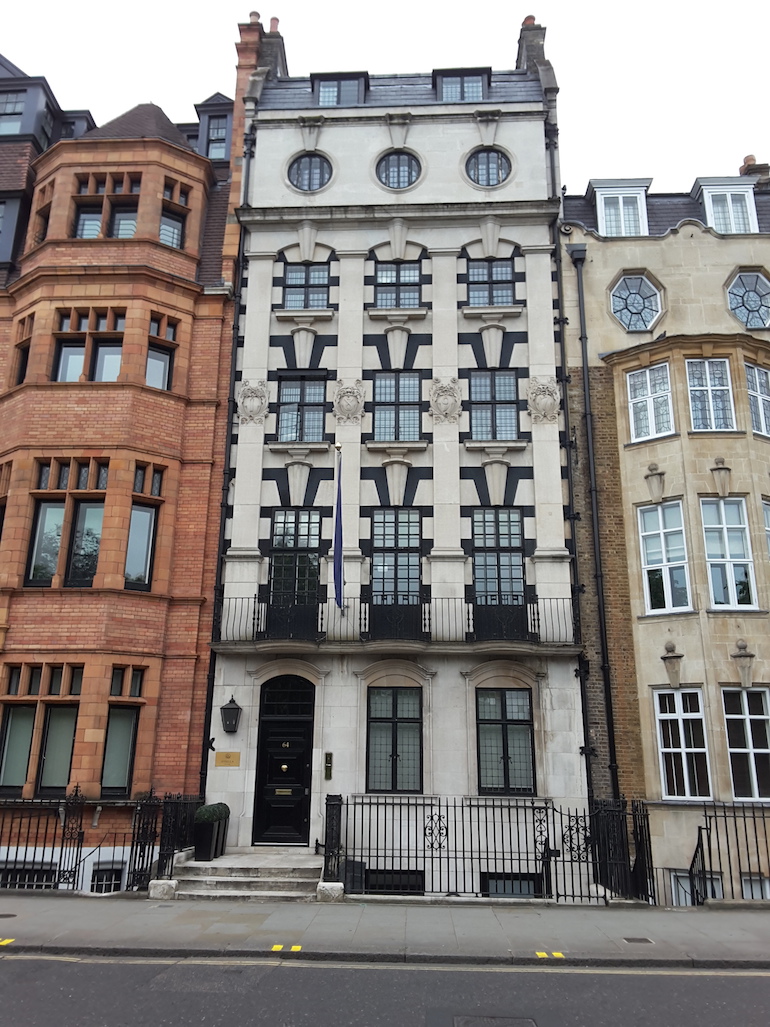
  • Plenty of wonderful details about a party hosted by Henry and Eliza: “Including everybody we were sixty-six — which was considerably more than Eliza had expected, and quite enough to fill the back drawing-room and leave a few to be scattered about in the other and in the passage.”
  • “The music was extremely good. It opened (tell Fanny) with ‘Poike de Parp pirs praise pof Prapela’; and of the other glees I remember, ‘In peace love tunes,’ ‘Rosabelle,’ ‘The Red Cross Knight,’ and ‘Poor Insect.’ Between the songs were lessons on the harp, or harp and pianoforte together; and the harp-player was Wiepart, whose name seems famous, though new to me. There was one female singer, a short Miss Davis, all in blue, bringing up for the public line, whose voice was said to be very fine indeed; and all the performers gave great satisfaction by doing what they were paid for, and giving themselves no airs. No amateur could be persuaded to do anything.”
  • “The house was not clear till after twelve. If you wish to hear more of it, you must put your questions, but I seem rather to have exhausted than spared the subject.”
64 Sloane Street in London. Photo Credit: © Ingrid M Wallenborg, GuideLondon.org.

April in Jane Austen’s Novels

The following are a collection of interesting details and scenes that occur in (or refer to) the month of April in Austen’s novels. Springtime appears to be a good time for travel, walking, and riding as the weather slowly improves:

Sense and Sensibility

  • The Palmers, Mrs. Jennings, and the Dashwood sisters leave London for Cleveland in April (for the Easter holidays): “Very early in April, and tolerably early in the day, the two parties from Hanover Square and Berkeley Street set out from their respective homes, to meet, by appointment, on the road. For the convenience of Charlotte and her child, they were to be more than two days on their journey, and Mr. Palmer, travelling more expeditiously with Colonel Brandon, was to join them at Cleveland soon after their arrival.”

Pride and Prejudice

  • Darcy proposes again and refers to his first April proposal to Elizabeth Bennet (he surely remembers that date VERY well): “You are too generous to trifle with me. If your feelings are still what they were last April, tell me so at once. My affections and wishes are unchanged; but one word from you will silence me on this subject for ever.”

Mansfield Park

  • Fanny is left without fitting exercise: “[The Miss Bertrams] took their cheerful rides in the fine mornings of April and May; and Fanny either sat at home the whole day with one aunt, or walked beyond her strength at the instigation of the other: Lady Bertram holding exercise to be as unnecessary for everybody as it was unpleasant to herself; and Mrs. Norris, who was walking all day, thinking everybody ought to walk as much.”
  • Sir Thomas’s letter home: “[Sir Thomas] wrote in April, and had strong hopes of settling everything to his entire satisfaction, and leaving Antigua before the end of the summer.”
  • Fanny Price in Portsmouth: “The end of April was coming on; it would soon be almost three months, instead of two, that she had been absent from them all, and that her days had been passing in a state of penance, which she loved them too well to hope they would thoroughly understand; and who could yet say when there might be leisure to think of or fetch her?”
  • Fanny’s thoughts on springtime in the countryside versus the congested town: “It was sad to Fanny to lose all the pleasures of spring. She had not known before what pleasures she had to lose in passing March and April in a town. She had not known before how much the beginnings and progress of vegetation had delighted her. What animation, both of body and mind, she had derived from watching the advance of that season which cannot, in spite of its capriciousness, be unlovely, and seeing its increasing beauties from the earliest flowers in the warmest divisions of her aunt’s garden, to the opening of leaves of her uncle’s plantations, and the glory of his woods. To be losing such pleasures was no trifle; to be losing them, because she was in the midst of closeness and noise, to have confinement, bad air, bad smells, substituted for liberty, freshness, fragrance, and verdure, was infinitely worse: but even these incitements to regret were feeble, compared with what arose from the conviction of being missed by her best friends, and the longing to be useful to those who were wanting her!

Northanger Abbey

  • Isabella writes a “very unexpected letter” to Catherine.

Emma

  • Mrs. Elton pressures Jane to find a position as a governess very soon so that she doesn’t miss her chance: “But, my dear child, the time is drawing near; here is April, and June, or say even July, is very near, with such business to accomplish before us. Your inexperience really amuses me! A situation such as you deserve, and your friends would require for you, is no everyday occurrence, is not obtained at a moment’s notice; indeed, indeed, we must begin inquiring directly.”
  • For the introverts among us: “John Knightley only was in mute astonishment.—That a man (Mr. Weston) who might have spent his evening quietly at home after a day of business in London, should set off again, and walk half a mile to another man’s house, for the sake of being in mixed company till bed-time, of finishing his day in the efforts of civility and the noise of numbers, was a circumstance to strike him deeply. A man who had been in motion since eight o’clock in the morning, and might now have been still, who had been long talking, and might have been silent, who had been in more than one crowd, and might have been alone!—Such a man, to quit the tranquillity and independence of his own fireside, and on the evening of a cold sleety April day rush out again into the world!
Mrs. Elton and Jane Fairfax in Emma (1996).

April Dates of Importance

This brings us now to several dates that would have been important to Austen personally and to the Austen family as a whole:

Family News:

26 April 1764: Rev. George Austen marries Cassandra Leigh.

23 April 1774: Francis (Frank) Austen (Jane’s brother) born at Steventon.

April 1786: Francis Austen enters the Royal Naval Academy at Portsmouth

15 April 1793: James Austen’s first child, Anna, is born.

Historic Dates:

19 April 1775: The Battle of Lexington marks the start of America’s Revolutionary War.

Writing:

April 1811: Austen continues to correct proofs of Sense and Sensibility. She anticipates its publication date.

Sorrows:

22 April 1813: Eliza de Feuillide (Austen’s cousin and, later, sister-in-law) ill. Jane Austen goes to her bedside in London to help attend to her.

25 April 1813: Eliza de Feuillide dies.

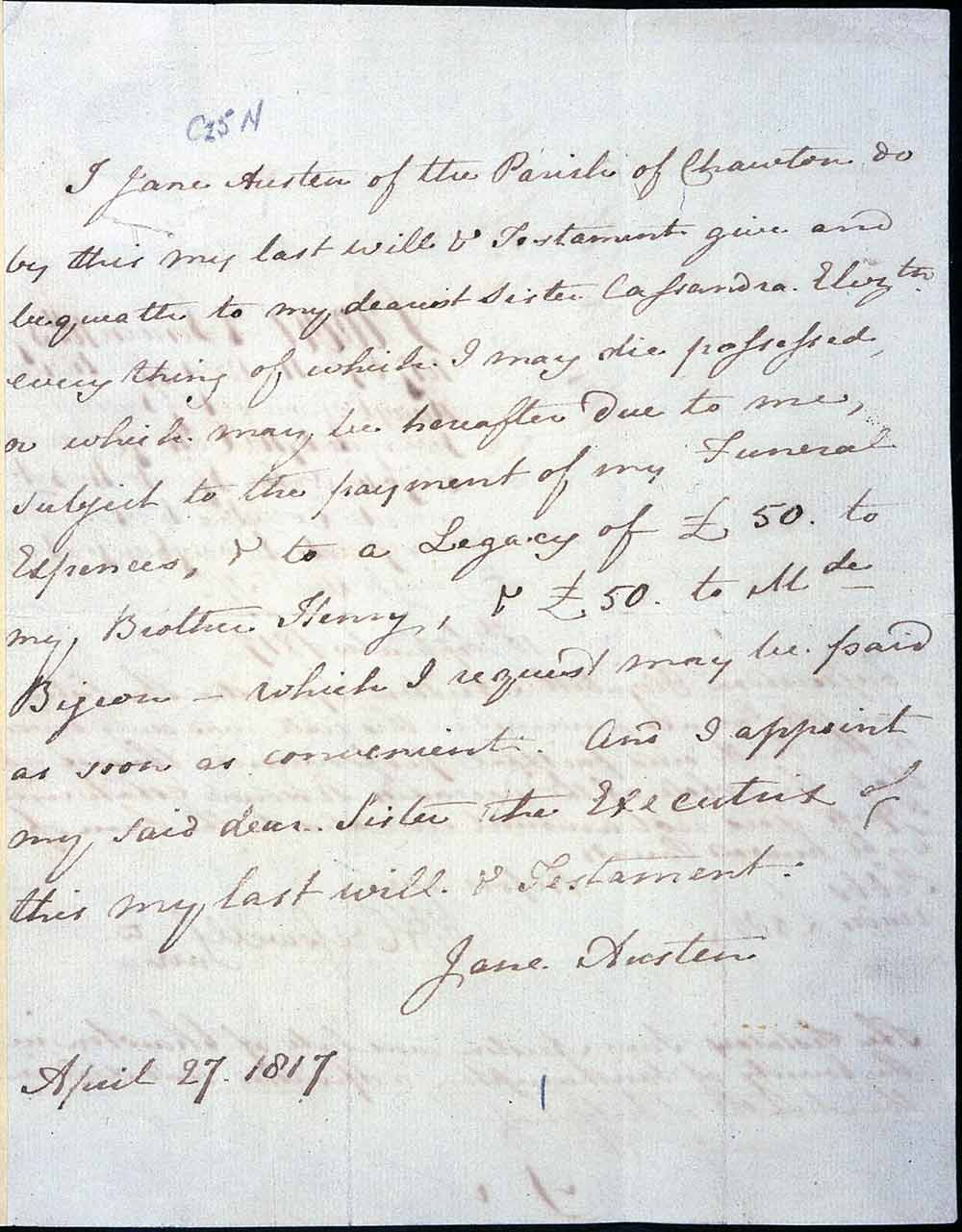
27 April 1817: Austen drafts her will:

“I Jane Austen of the Parish of Chawton do by this my last Will & Testament give and bequeath to my dearest Sister Cassandra Elizth everything of which I may die possessed, or which may be hereafter due to me, subject to the payment of my Funeral Expences, & to a Legacy of £50. to my Brother Henry, & £50. to Mde Bigeon–which I request may be paid as soon as convenient. And I appoint my said dear Sister the Executrix of this my last Will & Testament.”

April Showers

As we continue through the year, one of the highlights for me has been surveying the photos of the gardens at Chawton House and Jane Austen’s House each month and seeing the changes therein. I hope these April showers will bring many beautiful May flowers next month as we continue our tour of Hampshire in the spring with May in Jane Austen’s World!


RACHEL DODGE teaches college English classes, gives talks at libraries, teas, and book clubs, and writes for Jane Austen’s World blog. She is the bestselling author of The Little Women DevotionalThe Anne of Green Gables Devotional and Praying with Jane: 31 Days Through the Prayers of Jane Austen. Now Available: The Secret Garden Devotional! You can visit Rachel online at www.RachelDodge.com.

Read Full Post »

For years, I’ve loved the Penguin Random House “Puffin in Bloom” editions of Anne of Green GablesHeidiLittle Women, and A Little Princess. I typically purchase these gorgeous books as gifts for my bookish friends and their daughters.

Now, the Puffin in Bloom line has expanded to include three of Jane Austen’s novels as well!

Delectable Classic Covers

The Puffin in Bloom line started with four classic, coming-of-age novels: Anne of Green GablesHeidiLittle Women, and A Little Princess. These hardcover classics feature floral cover illustrations by Anna Bond, the creative director and artistic inspiration behind the global stationery phenomenon Rifle Paper Co. Puffin in Bloom became an instant success and the original foursome continues to fly off the shelves. Classics novels with such beautiful covers do not disappoint!

Each book can be purchased individually or as a boxed set in a beautiful keepsake box. These hardcover books don’t just boast a pretty cover; they look and feel great in your hands. They are just the right size and they read well. I am very particular about the feel of a book in my hands, and these are a joy to hold and read. You can easily slip them into a purse or tote to take with you, too!

Alice’s Adventures in Wonderland

To commemorate the 150th anniversary of Alice’s Adventures in Wonderful by Lewis Carroll, Puffin Books added to the Puffin in Bloom line and released a deluxe, hardcover gift edition of the famous novel. Once again, the talented Anna Bond created the cover illustration, and she also provided full-color illustrations inside. The result is exquisite!

“In this beautiful edition, Alice’s story comes to life for a whole new generation of readers through the colorful, whimsical artwork of Anna Bond, best known as the creative director and artistic inspiration behind the worldwide stationery and gift brand Rifle Paper Co.”

Jane Austen in Bloom

After years of waiting and wondering (and wishing), I was overjoyed when Penguin announced last year that they were planning to expand the Puffin in Bloom line to include other classics as well. Again, they chose Anna Bond to create new cover art with her signature style. But best of all, they chose our Jane’s cherished novels for this new endeavor!!

This first installment (I truly hope there will be more) includes Austen’s Pride and Prejudice, Sense and Sensibility, and Emma. Let’s take a closer look:

Pride and Prejudice

Though her sisters are keen on finding men to marry, Elizabeth Bennet would rather wait for someone she loves – certainly not someone like Mr. Fitzwilliam Darcy, whom she finds to be smug and judgmental, in contrast to the charming George Wickham. But soon Elizabeth learns that her first impressions may not have been correct, and the quiet, genteel Mr. Darcy might be her true love after all. You can view and purchase HERE.

Sense and Sensibility

Book Description: “Marianne Dashwood wears her heart on her sleeve, and when she falls in love with the dashing but unsuitable John Willoughby, she ignores her sister Elinor‘s warning that her impulsive behavior leaves her open to gossip and innuendo. Meanwhile Elinor, always sensitive to social convention, is struggling to conceal her own romantic disappointment, even from those closest to her. Through their parallel experience of love– and its threatened loss–the sisters learn that sense must mix with sensibility if they are to find personal happiness in a society where status and money govern the rules of love.” You can view and purchase HERE.

Emma

Book Description: “Emma Woodhouse believes herself to be an excellent matchmaker, though she herself does not plan on marrying. But as she meddles in the relationships of others, she causes confusion and misunderstandings throughout the village, and she just may be overlooking a true love of her own.” You can view and purchase HERE.

Anna Bond

Anna Bond is co-founder and CCO of Rifle Paper Co., an international stationery and lifestyle brand with offices in Winter Park, Florida and New York City. Originally from Summit, New Jersey, Anna trained as a graphic designer and made her way to Florida to work as a senior art director at a media company at age 21. After a year of working in print design she left to pursue her passion in illustration. A number of gig posters and freelance work later, she re-discovered her lifelong love of stationery through wedding invitation design and the idea for a stationery collection was born.

Together with her husband Nathan, Anna launched Rifle Paper Co. based out of their apartment in November 2009 and the brand has quickly grown to become of the most notable brands in the industry. Every one of Rifle’s over 900 products are designed by Anna and feature her signature hand-painted illustrations, vibrant color palette, and whimsical tone which has helped propel the brand’s success. Rifle Paper Co. now employs over 200 people and is carried in over 5,000 stores around the world including Anthropologie, MoMA and Barnes & Noble. You can see more of Anna’s work HERE.

Collecting Austen Covers

With covers like these, who can resist “just one more” edition of Austen’s beloved novels? I know many of us have shelves with several pretty editions, plus a favorite, worn-in version that we keep close by for regular reading. Do you have several editions of Austen’s novels? Which books do you collect and how many do you have so far?


RACHEL DODGE teaches college English classes, gives talks at libraries, teas, and book clubs, and writes for Jane Austen’s World blog. She is the bestselling author of The Little Women DevotionalThe Anne of Green Gables Devotional and Praying with Jane: 31 Days Through the Prayers of Jane Austen. Now Available: The Secret Garden Devotional! You can visit Rachel online at www.RachelDodge.com.

Read Full Post »

« Newer Posts - Older Posts »