Feeds:
Posts
Comments

Archive for the ‘jane austen’ Category

Update! The paperback edition of this novel is available at this link.

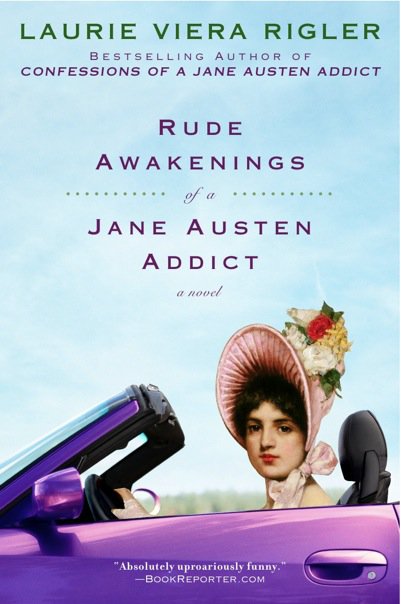
I became hooked on time travel stories watching Somewhere in Time with Christopher Reeve and Jane Seymour. Then I read Jude Devereux’s Knight in Shining Armor and fell so in love with the characters and improbable plot that I began to actively seek out time travel novels. I discovered from reading Diana Gabaldon’s Outlander and watching the recent television presentation of Lost in Austen that I prefer stories that take a character back in history over those in which a person is transported to our time. This is simply a matter of taste. So I beg of you, gentle reader, to keep my little bias in mind as you read this review of Laurie Viera Rigler’s latest book, whose cover of Rude Awakenings of a Jane Austen Addict appropriately depicts a Regency woman wearing an ipod.
Rude Awakening of a Jane Austen Addict Having traveled back to the Regency era in Confessions of a Jane Austen Addict, Courtney Stone is now living Jane Mansfield’s life. It happened like this: One evening, the very American, extremely modern Courtney is grieving over the end of her engagement to a cad and the betrayal of her best male friend, Wes. The next morning she wakes up in Regency England in the body of a tall, elegant woman whose relationship with her mother can best be described as rotten. Confessions ended with Courtney falling in love with Jane’s beau, Mr. Edgeworth, and overcoming the inconvenience of living without indoor plumbing or electricity. But if Courtney has taken over Jane Mansfield’s body and life, what became of her regency counterpart?

In Rude Awakenings of a Jane Austen Addict the reader discovers that poor Jane Mansfield has been transported into Courtney’s shorter, curvier body after a fall from a horse and has landed smack dab in a modern apartment in Los Angeles. Horror of horrors, nothing that Jane has ever known is recognizable in this strange environment, nothing except for Pride and Prejudice. The 1995 A&E version is playing on television as Jane examines her strange surroundings. Mr. Darcy and Elizabeth are mere illusions but Jane confuses their ethereal transmissions for the real thing. She is rapturous when she comes across Jane Austen’s novels on Courtney’s bookshelves, happily discovering that more were published than the two she’d known about. The books provide her with her first emotional security blanket, for up to that moment everything Jane has seen, heard, and touched in this new world has been surreal and mind-boggling. As Jane says to a fortune teller who helps her sort out her confusion, “If I am not asleep, how can I be anything but awake?”

One imagines that Courtney had a much easier time adjusting to the past, for she’d been a Jane Austen addict, and had had the opportunity to study the regency era in history books and novels. Poor Jane Mansfield had no such knowledge about 2009, for who in 1813 could have forecast the invention of microwave ovens, cars, cell phones, planes, elevators, high rise buildings, computers, refrigerators, and – wonder of wonders – efficient showers and toilets? And then there were the clothes. How was a self-respecting Regency Miss supposed to wear those indecently skimpy outfits and hoydenish makeup that her new friends put on without blushing?

modern la

Thankfully, Courtney’s body has retained a visceral 21st-century memory of dressing, driving and using appliances, giving Jane some time to recover her equilibrium and sort out her bewildering surroundings. When life becomes too crushing for her, she happily hunkers down to read Emma or Mansfield Park, or watch the marvelous movie adaptations of Jane’s novels. Despite those few moments of bliss, there are still many modern customs that Jane must learn. She is both intrigued and appalled that women must work for a living, for isn’t this an activity reserved for working class women? And yet the working women she meets enjoy riches and freedoms that she could only dream about in her constricted regency world. Then there is the situation with her rotten ex-fiance and ex-best friend, Wes, whose gentle presence is at odds with the antipathy Jane’s new friends feel toward him. Wes is just the sort of Mark II hero that this reviewer loves – sweet, warm, cuddly, and handsome – and I rooted for him to win Jane’s hand despite the evidence of his betrayal.

Rude Awakenings ties up the plot threads left dangling in Confessions, and I was pleasantly surprised to have my many questions answered in a sensible way, especially about Jane’s terrible mother. Of the two books, I did prefer Confessions, but please do recall my bias towards those who travel backwards, not forwards. Having spent a satisfying couple of evenings reading this latest installment of Laurie’s series, I would like to see her write a third one in which the descendants of the Jane Austen Addict characters are united. In my imagined plot I see Courtney writing an extensive journal about her Regency experiences which languishes on the dusty shelves of an antique book seller for over 150 years. This document is discovered by Jane’s daughter, a confirmed Jane Austen addict and romance novelist. She visits England in 2034 in search of archived information about the Mansfield and Wentworth families after her mother confesses a few pertinent bits of information about her Regency past. During her quest, Jane’s daughter meets a haughty male descendant of Courtney’s, a handsome but priggish Jane Austen scholar, who discounts Courtney’s journal as the rantings of an insane relative. The two young descendants disagree, sparks fly, she suggests a DNA test, and they then …. well, use your imagination.
3 regency fansMeanwhile, I can think of no better way of spending a Sunday afternoon than to curl up in a hammock and read Rude Awakenings of a Jane Austen Addict. Just make sure to have enough ice tea and sun screen at hand, for you won’t be able to put this gently humorous book down until you are finished. Three out of three Regency fans.

More links:

Read Full Post »

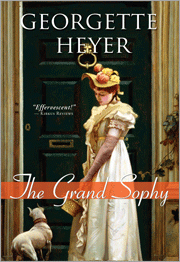
Gentle Readers, Georgette Heyer’s The Grand Sophy has been reissued by Source Books. This 1950 novel features a feisty Mark I heroine who flies against social conventions at almost every turn. Georgette Heyer, who was known for her research and historical accuracy, wrote a novel about a single young woman who frequently bent the rules. Given the strictures of the age, this post explores why Sophy’s actions were tolerated.

Lady Sarah Jersey, Almack's patroness, from a drawing by Richard Cosway

Lady Sarah Jersey, Almack's patroness, from a drawing by Richard Cosway

By 1820, a strict code of conduct had evolved for polite society that protected the upper crust from vulgar and improper behavior. The code was particularly stringent for young ladies of good breeding, for one false step could permanently injure their chances of making an excellent match. As the century progressed, the rules of precedence became so complicated that inexperienced Victorian hostesses would often consult Burke’s Book of Precedence or their relatives and friends in order to avoid critical mistakes in leading guests to the dining room in the right order and seating them properly at the table. Rules of conduct covered visitations, invitations, introductions, balls and assemblies, morning and afternoon walks, rides in the park, relations between men and women, and modes of dress. A budding young hostess would spend countless hours learning the code in order not to offend family, friends, strangers, and guests.

While a young lady of high rank would enjoy some protection from Society’s censure when she made a mistake, those who were rising up the social ladder or whose families were placed on the lower rungs or moved along the fringes of the Ton, were given no such license. It was particularly important for them to develop a certain elegance of manners and deportment, and to adhere strictly to the rules. One snub from a major patron could end one’s social standing, as Beau Brummel fatally discovered when he offended the Prince Regent. In Georgette Heyer’s The Grand Sophy, Miss Eugenia Wraxton never quite understood how highly placed Miss Sophy Stanton-Lacy was in the eyes of the world. While it was true that Sophy had largely lived abroad with her father and had been allowed a great deal of freedom in her actions, her father’s exalted rank protected her to a certain degree and allowed her some leeway when she broke the rules outright* (as in the case of visiting the money lender unescorted in a bad part of Town) or disregarded its strictures (as when she drives Charles’s carriage without his permission through The City.)

The snobbish Miss Wraxton, mistakenly thinking that Sophy has no social standing to speak of, tells her fiance, Charles Rivenhall: “I am afraid her visit has brought extra cares upon you, my dear Charles. Much must be forgiven as a girl who has never known a mother’s care, but I confess I had hoped that under your Mama’s guidance she would have tried to conform to English standards of propriety.” Charles, who at first sides with Miss Wraxton in his opinion of his cousin, exclaims,  “It’s my belief she delights in keeping us all upon tenterhooks!”

How true. Miss Sophy Stanton-Lacy is a larger than life heroine who oozes self-confidence. Combining  brains, connections, and ability, she is an unstoppable force. Although she is the object of Miss Wraxton’s jealousy, Sophy commands the respect of her influential family and father’s friends, as well as that of Lady Jersey, Lady Castlereah, Countess de Lieven and Princess Esterhazy, who were the gatekeepers of Almack’s. Just after Miss Wraxton cautions Sophy about the difficulty in obtaining vouchers at Almack’s, she discovers, much to her chagrin, that Sophy is already well acquainted with these ladies and that her entry into that select club is assured.

Pall Mall

Pall Mall

Miss Wraxton is the sort of person who outwardly follows the rules of propriety, but whose sense of self-importance and mean-spirited intentions prompt her to overstep the boundaries time and again. Sophy will brook none of her interference and her hackles are raised when Miss Wraxton lectures her, “I wonder if I might venture to put you a little on your guard! In Paris and Vienna I am sure you would be able to tell me how I should go on, but in London I must be more at home than you.” Miss Wraxton continues in this vein, saying, “I do not think you can be aware of what is expected of a woman of quality! Or – forgive me! – how fatal it is to set up the backs of people, and to give rise to such gossip as must be painful to the Rivenhalls…” Unaware that she has put Sophy’s aristocratic nose out of joint, Miss Wraxton goes on with her harangue, prompting Sophy to say, “I am only afraid that you may suffer for being seen in such a vehicle as this [high perch phaeton], and with so fast a female!” Miss Wraxton reassures her, saying that her own character was sufficiently well established to withstand a faux pas or two.

“Now, let me understand you!” begged Sophy. “If I were to do something outrageous while in your company, would your credit be good enough to carry me off?”

“Let us say my family’s credit, Miss Stanton-Lacy. I may venture to reply, without hesitation, yes.”

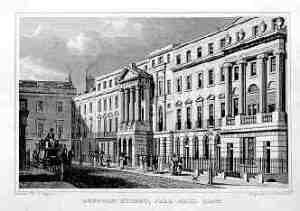
This is all the boasting Sophy needs to spur into action, and she swings her phaeton out of Hyde Park and into the streets of Mayfair. When Miss Wraxton orders her to stop, Sophy tells her she can always walk. “What, and walk along Piccadilly unattended?” Miss Wraxton retorts. Heedless of her pleas and saying that Miss Wraxton’s spotless reputation will protect them, Sophy drives her phaeton down the exclusive male haunts of Pall Mall and past the famed bow window of White’s Club. “No lady would be seen driving there! Amongst all the clubs – the object of every town saunterer! You cannot know what would be said of you!” Miss Wraxton screeches. But Sophy, intent on teaching her a lesson, continues to drive along a section of London that is strictly forbidden to single young ladies. By the time Sophy drops her rival off in Berkeley Square, Miss Wraxton is white with rage.

Berkeley Square, 1813

Berkeley Square, 1813

In this masterful scene, Georgette Heyer captured the essence of Sophy’s and Miss Wraxton’s characters, and taught us in her delightful style about the 19th century’s narrow expectations of women and how their every move was controlled. Except for her spitefulness, Miss Wraxton represents the traditional Regency society woman, whose life was strictly proscribed by a seemingly endless list of rules. The most important decisions in her life were made by her male relatives and, because she was not allowed to work  or manage her own money, she had almost no opportunity to break out of her gilded prison. When she had no choice but to work, only a few poorly paid positions were open to her. A rich widow seemed to have the most liberty in leading a self-fulfilled life, but even she needed to arrange for an acceptable companion when traveling or attending public gatherings.

By disregarding society’s rules, Sophy demonstrates her independence of spirit, as well as the absurdity of those strictures. In reality, many smart, capable, and resourceful women of that era, like Mary Wollstonecraft or the Duchess of Devonshire, must have chafed against these constant restraints. Thankfully, Sophy’s father was rather progressive and he provided her with sufficient funds to allow her a degree of freedom in making her own choices, such as purchasing her own carriage and arranging for a stable. Sophy’s independence and control over her own finances rubs her cousin Charles the wrong way, for this goes counter to everything he knows about dealing with women.

Grand SophyWith the exception of her visit to the money lender, Sophy ignores the more banal rules that define her world, but she does adhere to a strict code of honor, which sets her apart from Miss Wraxton. It is this code, her unerring sense of what is right and wrong, her loyalty, generosity of spirit, and her unassailable rank in Society that save her time and again. Towards the end of the book, Charles eyes are opened to Sophy’s warmth and humanity, but he is still stuck with his pragmatic and unromantic fiancee, for, in another one of Society’s arcane rules, a man cannot cry off an engagement. Only the woman has that power. Half the fun of the plot is in discovering how Sophy manipulates Miss Wraxton into seeing Charles’s “true character” and releasing him from his bond.

The Grand Sophy is so much more than a mere love story. In this outrageous and funny tale set in London two hundred years ago, Georgette Heyer manages to inform the reader in the most charming way about the customs and mores of a bygone era, and how dramatically women’s lives have changed since then.

*Plot spoiler: Some comments about Sophy’s visit to Mr. Goldhanger in a seemy part of London – because she told no one where she was going and because no one caught her in the act of visiting such a disreputable man unescorted, Sophy’s reputation escaped being ruined. Had she been caught in the act, her Social standing would not have provided her with enough protection to save her. By the time Charles learned of Sophy’s actions, he had become inured to her willfulness. Because her intentions were pure and because she was successful in saving his brother, he cut her some slack and chose to remain silent about her deed. He even found humor in her use of the pistol. Had Miss Wraxton learned of the visit, she could have used the information to harm Sophy, and then the novel would have taken another turn.

More links:

Read Full Post »

Anna, 7th Duchess of Bedford possessed the beauty and hauteur of Lady Susan

Anna, 7th Duchess of Bedford possessed the beauty and hauteur of Lady Susan

If six Jane Austen novels have left you craving for more of her fine writing, and you have not yet read Lady Susan, perhaps now is the right time to read this unusual novel. Epistolary in form, the letters between Mrs. Vernon and her mother, and Lady Susan and her friend, Mrs. Johnson, reveal a calculating woman who will use her daughter and fool around with her friend’s husband in order to get what she wants. Early on the reader learns what an unnatural and unloving a mother Lady Susan is to her daughter, Frederica. Not once does the reader feel sympathy for this anti heroine. Read my review of the novel in this link, Lady Susan, A Vicious Jewel.

Read Full Post »

Grand SophyThe Grand Sophy, the latest Georgette Heyer release by SourceBooks, is a page turner that will keep the reader guessing and wondering when and how the heroine will top her previous outrageous acts. Sir Horace Stanton-Lacy, a rich widower who has recently returned from the Continent, convinces his sister, Lady Ombersley, that his sweet, motherless daughter ought to stay with her while he returns abroad. Several weeks after their discussion, Miss Sophy Stanton-Lacy makes a grand entrance:

Lady Ombersley, meanwhile, standing as though rooted to her own doorstep, was realizing with strong indignation, that the light in which a gentleman of great height and large proportions regarded his daughter had been misleading. Sir Horace’s little Sophy stood five feet nine inches in her stockinged feet, and was built on generous lines, a long-legged, deep-bosomed creature, with a merry face, and a quantity of glossy brown ringlets under one of the most dashing hats her cousins had ever seen.

Sophy could not exactly be called a beauty, but no one who had met her could ever quite forget her. Not ten minutes after her dramatic arrival, Lady Ombersley wonders: “What kind of niece was this, who set up her stable, made her own arrangements, and called her father Sir Horace?” The entire family, nay all of London, would soon find out.

Georgette Heyer wrote about two types of heroines. The Mark II heroine, who was a biddable and quiet young girl, and the Mark I heroine whose independent habits and dominant character invariably clashed with the hero’s personality. Sophy is the quintessential Mark I Heyer heroine: a tall, bossy, outrageously rich and independent, problem-solving, smart and capable young lady who will let nothing, not even Mr. Charles Rivenhall’s censure and outrage stand in her way. Arriving at the Ombersley’s house wearing a sable stole and carrying a sable muff, she alights from a coach and four with an entourage that includes several liveried footmen, a doyenne, an Italian greyhound, a monkey named Jacko, and a parrot in a birdcage. Even as Lady Ombersley struggles to hide her dismay, Sophy’s cousins are delighted, except for Charles. Everything about Sophy sets him on edge, especially when she won’t give way to even his slightest wishes.

High Perch Phaeton

As heroes go, Charles is a bit of a prig. He cannot help himself, for his father, Lord Ombersley is an inveterate gambler. Charles unexpectedly came into an inheritance from a rich relative who had made his fortune in India and he uses his wealth to pay off his father’s debts. In doing so, Charles becomes the de facto head of the family. A sensible man, he proposes to a patronizing young lady of impeccable character, Miss Eugenia Wraxton, and leads a bland existence … until Sophy turns his well-ordered life upside down. The reader learns one thing about Charles that others don’t seem to appreciate – children, dogs, monkeys, and parrots turn instinctively to him, and although he might seem harsh on the surface, he has a soft heart and is an easy touch. However, his dictatorial ways intimidate two of his siblings, Cecilia and Hubert, to the point where Sophy feels she needs to help out. This causes Charles to gnash his teeth at her presumption. At the core of this book are the crackling scenes between Sophy and Charles, and thankfully they are numerous.

The Grand Sophy is one of Georgette Heyer’s “larger than life” books. Everything – from the characters to Sophy’s antics to the settings – is bigger and grander than in most of her other novels, and the side characters are unforgettable. Augustus Fawnhope is a beautiful but a gloriously silly poet whom Cecilia loves. Cecilia, Charles’s lovestruck sister, is a sweet Mark II heroine with backbone and pluck, who sees the error of her ways, but can do little to rectify the situation. Enter Sophy to the rescue. Sancia, Sir Horace’s Spanish fiancee, is singularly lazy and unforgettable in her ability to drop off to sleep in front of guests, but Sophy knows she can solicit her support whenever it is needed. Lord Bromford, a terminally boring hypochondriac and Mamma’s boy, woos Sophy with the tenacity of a bulldog, much to the glee of her younger cousins, who watch with awe as their older cousin deftly skirts his advances.

Charles’s fiancee, the horse-faced and prudish Eugenia Wraxton, is Sophy’s perfect foil. On the outside, Miss Wraxton is all that is proper, but on the inside she is small and mean of spirit. Sophy sees right through her and is determined to open Charles’s eyes before he is leg-shackled to her through marriage. Where Miss Wraxton merely pays lip service to being a lady, Sophy is warmhearted and generous to a fault. Her rarified social status allows her to behave outrageously with impunity, a fact that the jealous Miss Wraxton never quite realizes. Miss Wraxton constantly lectures Sophy or, worse, tattles on her, as the following scene between Sophy and Charles suggests. In it they are discussing her purchase of her high perch phaeton, to which Charles has strenuously objected:

“I have no control over your actions, cousin,” he said coldly. No doubt if it seems good to you to make a spectacle of yourself in the Park, you will do so. But you will not, if you please, take any of my sisters up beside you!”

“But it does please me,” she said. “I have already taken Cecilia for a turn round the Drive. You have very antiquated notions, have you not? I saw several excessively smart sporting carriages being driven by ladies of the highest ton!”

“I have no particular objection to a phaeton and pair,” he said, still more coldly, “though a perch model is quite unsuited to a lady. You will forgive me if I tell you that there is something more than a little fast in such a style of carriage.”

“Now, who in the world can have been spiteful enough to have put that idea into your head?” wondered Sophy.

He flushed, but did not answer.

Although this book provides us with a fun romp through Regency London, it does possess one flawed scene. The scene is pivotal and demonstrates Sophy’s fearlessness in helping Charles’s brother Hubert out of an impossible situation, but Georgette Heyer is a product of her snobbish upbringing and time. Her description of a stereotypical Jewish lender, the villainous Mr. Goldhanger, is old-fashioned and ruffles our modern sensibilities. For many readers, this scene is a deal-breaker (see comments in link). Some stop reading the book at this point, others feel that the book loses some of its lustre, and others like myself manage to move on, realizing that authors cannot help but be influenced by the age in which they live. A friend of mine observed that Huckleberry Finn is full of racial slurs, but these statements did not prevent it from becoming a classic. Having said that, Georgette’s description of the Jewish lender did give me pause, but after a few pages, I was once again absorbed by Sophy’s antics and rooting for the characters I had come to love. When I turned the last page, I could only wish them all the happiest of ever afters.

3 regency fansI give The Grand Sophy three out of three regency fans. Order the book at this link.
Read this blog’s other Georgette Heyer reviews here.

Gentle readers: The Grand Sophy will be released today. A reissue from SourceBooks, this 1950 novel was one of Georgette Heyer’s best. Look for a month-long kick off of this highly entertaining book on Jane Austen Today, Austenprose and this blog.

Also:

Regency Manners and The Grand Sophy

Read the review on Austenprose at this link.

Read Full Post »

“Invite him to dinner, Emma, and help him to the best of the fish and the chicken, but leave him to choose his own wife.” – Jane Austen, Emma

By the time breakfast was served in a regency household, the family had been up for a while. After rising, people would engage in tasks such as letter writing, practicing the piano, taking a walk or riding. In larger households, the cook and maids would busy themselves heating the stove and boiling water. In more modest establishments, such as the Austen household at Chawton, Jane would help with preparing breakfast. A simple repast of toast, rolls, cheese, tea, coffee, chocolate, or ale would be served between nine and ten. The more elaborate breakfast would not be featured until Victorian times.*

chinoiserieIndividuals would rise early, at around 6:00 in the morning. Within the next half-hour or so, people would start work. Breakfast would be taken later, at around 9:00 and afterwards. The morning’s work would finish with ‘dinner’–probably taken between 12:30 and 14:00. Work continued until late. For some, there was tea in the late afternoon, between 17:00 and 18:00. It would be common not to leave one’s work before 19:00. After the evening meal, people would go to bed at around 22:00 – Time and Work in England 1750- 1830, Hans-Joachim Voth
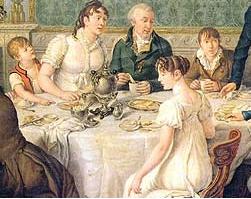
Nuncheon or luncheon was a midday meal served at an inn. For several centuries this meal was simply a snack. Dr. Johnson’s 1755 Dictionary defined luncheon as “as much food as one’s hand can hold.” In the Regency home, such meals had no official name and often consisted of only a cold snack and drink to provide sustenance until the evening meal.*

Morning

food

After breakfast with the children, the first job of the lady of the house would be to talk to the housekeeper. It would be important for them to communicate about the other servants, making sure they were doing their jobs properly and behaving correctly above and below stairs.

They would also discuss the evening meal. If visitors were expected, the lady would choose meals that were lavish and unusual. (They loved showing off) When these matters were dealt with the wife would then check through the household accounts. Bills for meat, candles and flour would usually be paid weekly. When the early morning activities were finished, the social whirl would begin! High society ladies would either receive calls or visit others. Tea would be drunk and snacks eaten.- The Regency Townhouse

During the medieval period dinner was eaten at midday, but this meal was slowly moved up to 3 in the afternoon, then pushed up to five. These meals became elaborate affairs of at least two or three courses, which Louis Simond, a French/American traveler to London, described in wondrous detail in his travel diary. During Jane Austen’s time tea would be served an hour or so after the meal, or from 3-6 o’clock, depending on when dinner was served. Suppers became light snacks, except in the case of a grand ball, where elaborate buffets might be served.

In 1798 Jane Austen writes of half past three being the customary dinner hour at Steventon, but by 1808 they are dining at five o’clock in Southampton. There are many mentions of the timing of dinner in the novels, but none is so explicit as in the fragment The Watsons. Tom Musgrave knows perfectly well that the unpretentious Watson family dine at three, and times his visit to embarrass them, arriving just as their servant is bringing in the tray of cutlery. Tom compounds his rudeness by boasting that he dines at eight: the latest dinner hour of any character. At Mansfield Parsonage they dine at half past four and at Northanger Abbey at five. The effect of London fashion can be seen in the difference between the half past four dinner at Longbourn and that at half past six at Netherfield. – Jane Austen in Context, Janet Todd, p. 264

  • *Jane Austen’s World, Maggie Lane

Read Full Post »

« Newer Posts - Older Posts »