Feeds:
Posts
Comments

Archive for the ‘jane austen’ Category

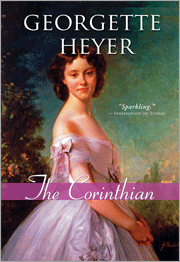
corinthianGentle Reader,

As you may have guessed from our reviews, SourceBooks has been reissuing a series of Georgette Heyer novels for summer reading, The Corinthian among them. I ‘ve spent many pleasant hours  journeying through Regency England from London to Bath to Sussex with Georgette’s scintillating characters, wishing I were as bright and witty in my repartee as her heroines, and that the men in my life were as dashingly romantic. If you’ve never tried a Georgette Heyer regency novel before, now is a good time to read one.

Pen Creed, the 17-year-old heroine of The Corinthian might be a tad young and naïve, but she is fearless in her dealings with the world and a most decidedly determined young lady. Rather than wait for her aunt to force her into an engagement with her fish-faced cousin, she has cropped her hair, put on boy’s clothes, and embarked on a journey to find Piers, her child hood friend. Having vowed to marry each other five year before, Pen is convinced that Piers will greet her with a great deal of pleasure and live up to his boyish promise.

Enter the Corinthian. At 29, Sir Richard Wyndham is a little drunk, bored beyond calculation, and feeling that he is the unluckiest dog alive. He is about to become betrothed to a woman so cold-blooded in nature that she could freeze the Arctic Ocean solid for two miles down. The night before he is to formally ask for her hand, Sir Richard encounters Pen dangling from knotted bed sheets several feet short of the pavement. Hearing her cries for help, he comes to her rescue and listens to her with aristocratic aplomb as she explains her convoluted reasons for running away in the middle of the night. Wanting to leave London to buy himself some time, he escorts Pen on a public coach to her destination.

Georgette’s heroine is much, much younger than the hero, which initially gave me a few misgivings, but both characters are so likeable that one can’t help cheering them on as they embark on their splendid adventure. While Pen resembles a fresh-faced urchin, Sir Richard is a resplendent example of the Regency dandy and sporting man. Georgette’s description of him could fit Beau Brummell to a tee:

He was a very notable Corinthian. From his Wind-swept hair (most difficult of all styles to achieve), to the toes of his gleaming Hessians, he might have posed as an advertisement for the Man of Fashion. His fine shoulders set off a coat of of superfine cloth to perfection; his cravat, which had excited George’s admiration, had been arranged by the hands of a master; his waistcoat was chosen with a nice eye; his biscuit-coloured pantaloons showed not one crease; and his Hessians with their jaunty gold tassels, had not only been made for him by Hoby, but were polished, George suspected with a blacking mixed with champagne. A quizzing-glass on a black ribbon hung round his neck; a fob at his waist; and in one hand he carried a Sevres snuff-box. His air proclaimed his unutterable boredom, but no tailoring, no amount of studied nonchalance, could conceal the muscle in his thighs, or the strength of his shoulders. Above the starched points of shirt-collar, a weary, handsome face showed its owner’s disillusionment.

Sir Richard is thrown into situations in which all of his ingenuity and influence are required. He must deal with a mystery regarding a stolen diamond necklace, a murder, things that go bump in the night, and Pen’s discovery that Piers has all but forgotten their childhood pledge. The young man has fallen madly in love with Lydia, a prettily plumb and silly female who, as she ages, will be prone to fits and vapors, and to whom he is secretly engaged. Unlike Pen, Sir Richard realizes at this point that he has compromised her and that they must marry. Not that he quails at the thought. Pen, who has fallen for her dashing and dependable escort, does not want to be his “obligation.” Instead, she concentrates her efforts on uniting Piers and Lydia, whose union is forbidden by their families. By the final pages, the plot and plottings have become so twisted that Sir Richard can only exclaim:

I am recalling my comfortable home, my ordered life, my hitherto stainless reputation, and wondering what I can ever have done to deserve being pitchforked into this shameless imbroglio!

3 regency fansRest assured that Sir Richard has never had so much fun in his life. At the end of the novel, his adventures with Pen lead to a romantic conclusion. To say that I enjoyed myself while reading this fast-paced romp is to state the obvious, and I give this delightful book 3 out of 3 regency fans.

Order The Corinthian here. Coming up next: My review of The Grand Sophy!

Other Heyer book reviews:
Read Full Post »


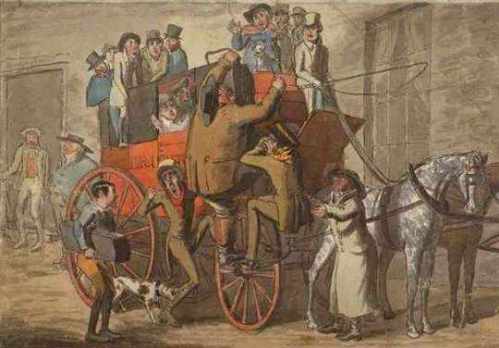
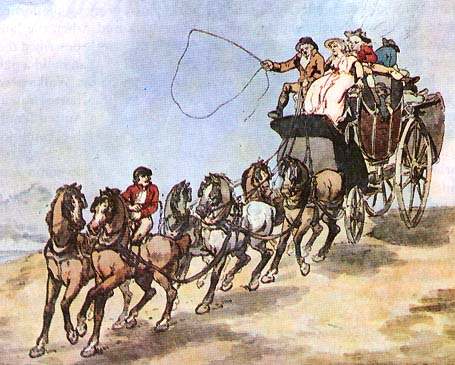
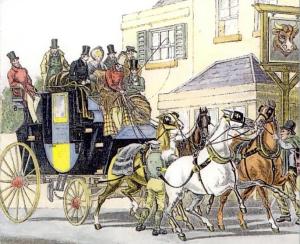
Stage coach travel. Notice the number of passengers laden on the coach and the number of horses.

Stage coach travel. Notice the number of passengers laden on the coach and the number of horses.

At the height of 19th century coaching days Northallerton in North Yorkshire had four inns that catered to travellers – the Black Bull, the King’s Head, the Old Golden Lion and, the largest, the Golden Lion. Horses that pulled the public coaches suffered mightily for the sake of speed. In a previous post I had already discussed that if forced to run at breakneck speed, coach horses did not last longer than three years. Recently I ran across this description:

The Highflyer changed horses at the King’s Head but the horses belonged to Mr Frank Hirst. This coach was driven by a coachman called Scott, a very big fellow of the Old Weller type who had to be hauled into his seat and nearly broke the coach down. The Express also stopped at the King’s Head but the horses that worked this coach stood at the Waggon and Horses and belonged to Mr Hall of Northallerton. The Wellington London and Newcastle coach changed horses at the Golden Lion and was horsed by Mr Frank Hirst. At one time it was driven by Ralph Soulsby, who was a terror to drive, and it is on record that once during a period when the Wellington was running in opposition he succeeded in killing three out of his four horses on the short stage seven miles from Great Smeaton to Northallerton. Opposition coaches were terribly hard on horseflesh; they used to gallop every inch of the road up hill and down dale, and Soulsby’s third horse dropped dead just opposite the church, and he finished his journey to the Golden Lion with but a single horse. When the railway began to supersede the road and coach after coach began to fall away, the Wellington still held on until it at last stood alone. One of the oldest and first coaches on the road, it had withstood the tide of opposition through all time until it remained the absolute last regular coach running on this section of the Great North Road. The old coaching days in Yorkshire By Tom Bradley

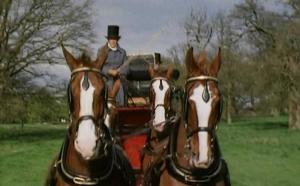
Coach and four

Coach and four

Horses were chattel and the general attitude towards beasts of burden during the Regency Era was one of exploitation. Fresh teams of horses were kept ready to replace an exhausted team that had just run the previous stage of a journey. These teams were contracted to stage lines or the Royal Mail. Other horses were available to be leased by individuals. Crack teams of hostlers prided themselves in changing mail coach teams in as little as three minutes. The combined refinements in coach design, and in road construction and maintenance allowed the heavy coach horses to be replaced by teams of faster half-bred or pure Thoroughbred horses. The luxurious coaches of the wealthy pulled by warmblooded horses or Thoroughbreds seemed to fly down the better roads at the unheard of speed of ten miles per hour. *

Coach leaving Brighton, 1840

Coach leaving Brighton, 1840

It wasn’t until 1821, that Colonel Richard Martin, MP for Galway in Ireland, introduced the Treatment of Horses bill. This piece of legislature was greeted by laughter in the House of Commons. The first known prosecution for cruelty to animals was brought in 1822 against two men found beating horses in London’s Smithfield Market, where livestock had been sold since the 10th century. They were fined 20 shillings each. Colonel Martin’s “Ill Treatment of Horses and Cattle Bill,” or “Martin’s Act”, as it became known, was finally passed in 1822 and became the world’s first major piece of animal protection legislation. Not much changed for working horses, however.  After a coaching horse’s usefulness ended, they were sold to labor for others**:

Mrs Mountain of the Saracen’s Head kept some 2,000 horses in her stables for the routes she served. Lord William Lennox sometime later estimated that it took some 2 pounds per week to keep coach horses. It is also estimated that the life of a coach horse was some three years. After that they were sold for they still had significant working life left. It was the nature of coaching with the strain of pulling a coach weighing more than 2 tons for an average of 10 miles at a speed of some 12 miles per hour 2 days out of 3.  Farm work seemed easy by comparison. – Coaching Inns

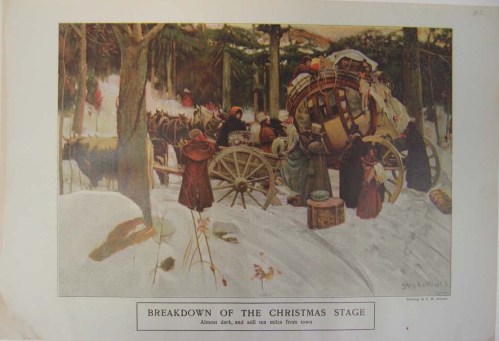
The Breakdown of the Christmas Stage shows how heavily laden the coaches were

The Breakdown of the Christmas Stage shows how heavily laden the coaches were

A society that lacked adequate social service systems to take care of the poor did not place a high priority on the ethical treatment of animals. Cockfighting, bear baiting, and dog fights were common”betting” sports prevalent during the Regency Period. A retired coach horse would have an easier life plowing a farmer’s field than pulling a coach. Accidents were frequent, but horses were seldom given a break, forced to struggle through blizzards and quagmire after passengers alighted and luggage was taken off to lighten the load. Not every horse led a harsh life. The following excerpt describes a private, more benevolent owner, the Rev. George Bennet, Jane Austen’s father, whose horses pulled heavy carriages over poor roads:

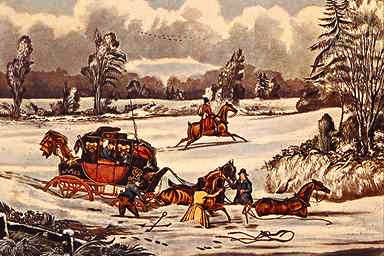
Coach stuck in snow

Coach stuck in snow

A carriage and a pair of horses were kept. This might imply a higher style of living in our days than it did in theirs. There were then no assessed taxes. The carriage, once bought, entailed little further expense; and the horses probably, like Mr. Bennet’s, were often employed on farm work. Moreover, it should be remembered that a pair of horses in those days were almost necessary, if ladies were to move about at all; for neither the condition of the roads nor the style of carriage-building admitted of any comfortable vehicle being drawn by a single horse. When one looks at the few specimens still remaining of coach-building in the last century, it strikes one that the chief object of the builders must have been to combine the greatest possible weight with the least possible amount of accommodation. – Memoir of Jane Austen by James Edward Austen-Leigh, Description of life at Steventon

Rowlandson, Coach Travel

Rowlandson, Coach Travel

Read Full Post »

glengarry habit miss mcdonaldThis description in The Grand Sophy by Georgette Heyer makes me wonder if Georgette Heyer was looking at this 1817 Ackermann fashion plate of The Glengary Habit when she wrote the passage:

When Miss Wraxton’s invitation was conveyed to Sophy she professed herself happy to accept it and at once desired Miss Jane Storridge to press out her riding dress. This garment, when she appeared in it on the following afternoon, filled Cecilia with envy but slightly staggered her brother, who could not feel that a habit made of pale blue cloth, with epaulettes and frogs, a la Hussar, and sleeves braided halfway up the arm, would win approval from Miss Wraxton. Blue kid gloves and half-boots, a high-standing collar trimmed with lace, a muslin cravat, narrow lace ruffles at the wrists, and a tall-crowned hat, like a shako, with a peak over the eyes, and a plume of curled ostrich feathers completed this dashing toilette. The tightly fitting habit set off Sophy’s magnificent figure to admiration; and from under the brim of her hat her brown locks curled quite charmingly; but Mr. Rivenhall, appealed to by his sister to subscribe to her conviction that Sophy looked beautiful, merely bowed, and said that he was no judge of such matters.

riding habit 1816
The mannish riding attire in the above image from 1816 is simpler than the first image, lacking the epaulettes, military-style piping and frogs, but it does emulate the masculine style and echoes a military overtone with the Shako hat.  It is interesting to note that until the mid-19th century tailors, not dress-makers, designed female riding habits.

Sean Bean as Richard Sharpe

Sean Bean as Richard Sharpe

The riding hat, or Shako Hat, was adapted from military headdress worn by the Infantry. By 1800, the cocked hat had been replaced by Shakos ornamented with a brass plate bearing the King’s crest. They sported  a tuft fixed in front rising from a black cockade. After each war it had been the habit of the British Army to adopt a head-cover belonging to its allies or the enemy.The cylindrical, flat-topped Shako adopted for the Infantry after the Napoleonic Wars was  in vogue among Britain’s Continental Allies.  Feminine versions of the Shako were often tied with sheer scarves which trailed behind and had feather plumes in front.

Learn more about the topic in these links:

Read Full Post »

I would like to suggest British History Online for your perusal. This rich resource includes information about London throughout the ages, including the Regency Period,  geographical places, genealogy charts, and census records. The factual descriptions, even with their lack of detail, make the era come alive again. The following quotes provide a small sampling of the information that sits on this endlessly useful site:

Dictionary of Traded Goods and Commodities: 1550-1820

Borage, or Forget-Me-Not

Borage, or Forget-Me-Not

This dictionary includes descriptions and definitions of items that have historic signifance. Helpful to the historian, student, and author, each term is listed alphabetically and, like the OED, includes its history.

Borage water [burrage water]

Water made from BORAGE, and probably the same as AQUA LANGUE DE BOEUF. It was a pleasantly flavoured drink with limited medicinal uses. For example, the earliest reference in the OED online claimed it was ‘good agaynst madnes or vnwytyng [German ‘unsvnnigkeit’ (spelling as OED)] and melancolye’. Both John Gerard and Nicholas Culpeper confirmed the excellence of borage generally against these conditions, and Culpeper added that the water ‘helpeth the redness and inflammation of the eyes’ [Culpeper (1792)].

See also DISTILLED WATERS.
Sources: Inventories (early), Inventories (mid-period).
References: Culpeper (1792).

Survey of London

I refer to this section most often when researching London. This section describes St. James’s and Westminster in astonishing detail.

In 1720 St. James’s Market was described as ‘a large Place, with a commodious Market-house in the Midst, filled with Butchers Shambles; besides the Stalls in the Market-Place, for Country Butchers, Higglers, and the like; being a Market new grown to great Account, and much resorted unto, as being well served with good Provisions. On the South-west Corner is the Paved Alley, a good Through-fare into Charles-Street and so into St. James’s Square, and those Parts; but is of no great Account for Buildings for Inhabitants.’  Provisions were ‘usually a fourth Part dearer than in the Markets about the City of London, most of the Provisions being brought from thence, and bought up here by the Stewards of People of Quality, who spare no Price to furnish their Lords Houses with what is nice and delicate’.

St. James's Market, Haymarket, 1850

St. James's Market, Haymarket, 1850

By the early nineteenth century St. James’s Market was no longer of such good repute. Writing in 1856 the Reverend J. Richardson remembered it and the adjoining streets as being ‘very properly avoided by all persons who respected their characters or their garments, and were consequently only known to a “select few”, whose avocations obliged, or whose peculiar tastes induced them to penetrate the labyrinth of burrows which extended to Jermyn Street, and westward to St. James-square’.

Sackville Street

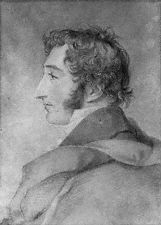
General John Fane, 11th Earl of Westmorland, born in Sackville St, 1784. Image by Sir Thomas Lawrence, 1815

General John Fane, 11th Earl of Westmorland, born in Sackville St, 1784. Image by Sir Thomas Lawrence, 1815

Though perhaps not in the first rank of fashion, the larger houses in Sackville Street, particularly those on the west side, attracted throughout the eighteenth century the minor nobility, the dowager, the member of Parliament, the senior army officer and the prosperous medical man. But the present commercial character of the street is not of recent origin. Even at the time of building there were three shops (two apothecaries’ and a cheesemonger’s), one tavern and a coffee house. By the beginning of the nineteenth century the tailoring trade, which is so prominent in the street today, had already established itself. Out of thirty-two tradesmen and professional men listed in Sackville Street in the Post Office directory for 1830 about 40 per cent (thirteen) were tailors; the next largest group consisted of four solicitors. This proportion has not changed considerably to-day (1962), for although many of the houses have been divided and there are fewer private occupants, about 34 per cent of the one hundred and fifteen listed tradesmen and professional men are tailors.

Other topics found on this site:

Read Full Post »

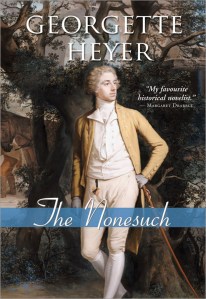
Layout 1Gentle Readers, This Georgette Heyer book is reviewed by Lady Anne, a paragon of friendship and nonpareil of GH reviewers. She is someone who, to my way of thinking, is “without an equal.”  In celebration of all things Georgette Heyer and Jane Austen, my regency-loving friends and I will partake of pâté, whole wheat triscuits, grapes, and French wine tonight. Here then, for your summer reading pleasure, is Lady Anne’s review of The Nonesuch, another incomparable offering by Sourcebooks.

A ‘nonesuch’ is something unrivalled, a paragon, or something like nothing else. The hero in Georgette Heyer’s romance entitled The Nonesuch is indeed all of the above. Sir Waldo Hawkridge has been nicknamed Nonesuch by those of the Corinthian set, because he could do it all: drive, ride, shoot, fish, box, dress elegantly in an unobtrusive fashion suiting his splendid physique. The book begins as Sir Waldo has been named the heir to an elderly and eccentric cousin; others in the Family had attended the reading of the Will in vain hope, where we meet also the two younger cousins who have looked up to and been assisted by Waldo – one well, and one poorly –as they have grown from grubby schoolboys to young men about Town. And we discover another attribute of Sir Waldo’s that truly makes him a paragon.

Many of the heroes in Heyer’s frothy Regency romances are jaded with society and its predictable lifestyles. Over-burdened with family members wanting something from them, or chased by match-making mamas more interested in the money and pedigree attached to their names, knowing that they must marry for the sake of the family, they are bored with life as only idle rich can afford to be. Sir Waldo, however, has followed his parents’ examples and precepts: “My father and my grandfather before him,” he tells a character in the book, “were considerable philanthropists, and my mother was used to be very friendly with Lady Spencer – the one that died a couple of years ago, and was mad after educating the poor. So you may say that I grew up amongst charities! This was the one that seemed to me more worth the doing than any other: collecting as many of the homeless waifs you may find in any city as I could, and rearing them to become respectable citizens….”

Here for once is a wealthy man who is interested not only in his own amusements, but also actively considers his responsibilities and pursues good works: the epitome of noblesse oblige.
Waldo plans to house some 50 orphans in his new legacy, but before he has made the renovations to the house and made the contacts with the people in Leeds, he doesn’t want it widely known.

The Nonesuch takes place in Jane Austen’s England, with the village society, country house parties, and gossip. There is a broader range of society here than in London where they would stay stratified within the ton; some of the families here are definitely below the salt. It is another example of the changing times. But like any Austen neighborhood when a new bachelor finds his way there, parties abound. And romance flourishes.

The Nonesuch also tends to his philanthropic business, first by seeking out the vicar to get his assistance in getting his business done in Leeds. The town appears in the book as a nearby shopping mecca for the young ladies, but its interest to our hero is that it was one of the fast-growing factory towns that thrust England into the forefront of the world as the Industrial Revolution changed the way all the classes interacted. The Enclosure Acts of the late 18th and early 19th Century took away the wherewithal of many of the poorest classes to earn their living from the land by assigning the use of previous open land to the local lord. The poor flocked to the cities and the factories to sustain themselves, not always to the best effect for their health. Illness, malnutrition, and drunkenness took their toll, and the Nonesuch found plenty of the ‘brats’ under the auspices of the parish, for whom he could do a great deal.

Which is not to say that we actually see Sir Waldo meeting with the good people of Leeds; his work is alluded to obliquely in several different situations throughout the book, moving the plot along.

More to our immediate interest, Sir Waldo also finds in the neighborhood one Ancilla Trent, a young lady of impeccable breeding, currently working as a companion to a beautiful and amazingly spoiled young minx. Like Sir Waldo, Ancilla is serious-minded person. Not one to become a financial drain on her family, she gives up her chance in the Marriage Mart to work first as a teacher and then to keep the lovely and headstrong Tiffany Weld from destroying her own chances at a good marriage; Tiffany is wealthy, but she is mercantile rather than gentry, barely seeing the point of basic courtesy, and much too sure of her position as most beautiful heiress in the area. With all the young men of the neighborhood, Sir Waldo’s two young cousins, the young ladies of the neighborhood, as well as Tiffany, we have all the ingredients for plenty of delightful parties and outings, an abundance of amusing chatter, and one of the very best last scenes any book could ask for.

The Nonesuch looks like a typical Regency romance, but as Georgette Heyer always provides, there is much more between the covers.

Read Full Post »

« Newer Posts - Older Posts »