Feeds:
Posts
Comments

Archive for the ‘jane austen’ Category

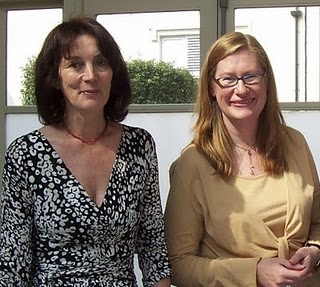
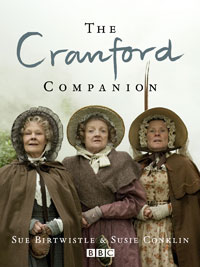
Copyright (c) Jane Austen’s World. The Cranford Companion, a book by Sue Birtwistle and Susie Conklin, the co-creators of the wildly popular series based on the Cranford books by Elizabeth Gaskell, is now available for purchase. The miniseries, produced by the BBC, aired last year in the United States on PBS.

Lushly illustrated in full color photographs, this companion book will provide fans of the two mini-series, Cranford and Return to Cranford, with all the behind the scenes stories about the production, film locations, map of Cranford, and the characters and actors who portray them. Included are points of historic interest, such as the building of the railroads, as well as information on etiquette, the fairer sex, Victorian society and more.

It is hard to describe the book when I think a short video can demonstrate all its fabulous features so much better!

I recommend The Cranford Companion highly to all Cranford and Elizabeth Gaskell fans. Purchase the book in England at this Bloomsbury site and in the U.S. at Amazon.com

Sue Birtwistle and Susie Conklin. Image @Manchester Literature Festival Blog*

My reviews of the series:

My post about Elizabeth Gaskell: A Short description of Her Life

*Manchester Literature Festival Blog

Read Full Post »

Copyright (a) Jane Austen’s World. Gentle Readers, The previous post elicited a question about Regency underdrawers or a lady’s unmentionables. My answer was so long that I decided to create a new post from it.

1742 and 1794 fashion silhouette contrast

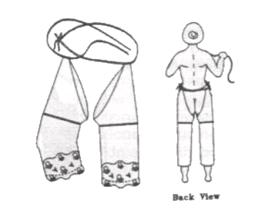
Drawers, which made their first serious appearance in 1806, and were fashioned after men’s underdrawers, were still optional during 1810. They would be worn more frequently as the century progressed. Underdrawers were considered risque, for the garments resembled men’s pant legs.  Even if the garments were worn, they did not resemble the pretty underdrawers that we associate with the Victorian era.

Image of early under drawers

As you can see in this image, early ladies underdrawers consisted of two tubes of cloth that were tied to the waist, allowing a woman to, uhm, attend to her business without having to remove too many clothes. In an era without indoor plumbing, this must have been an important consideration.

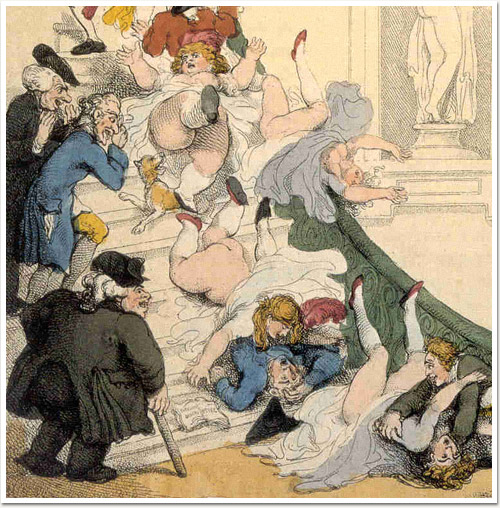
I recently viewed a shameless cartoon by Thomas Rowlandson of a group of travelers (3 ladies and a gent, all family members), who were attending to their calls of nature on the side of the road. Because the image is quite vulgar, which many of Rowlandson’s images tend to be, I will only link to it. From the headdresses that the ladies are wearing, this cartoon was drawn much earlier than 1806. As you can see, no underdrawers obstructed the group from relieving their most pressing needs.

Detail of the Exhibition Staircase, Rowlandson, 1800

Detail of Rowlandson's Exhibition Staircase, 1800

Rowlandson’s Exhibition Staircase cartoon has a given date of 1800. The ladies’ tumble down a steep, crowded staircase forcibly reminds us that underdrawers were still a fashion consideration for the future.

Underdrawers belonging to the Duchess of Kent, 1810-1820. *Image@Regency Society of America Pro Boards

By 1820, wearing drawers was still optional, but by the 1850’s, the caged hooped skirts made them a necessity, for a hoop could be wildly unpredictable. One wrong swinging move or errant gust of wind, and a lady’s most delicate (or indelicate) parts would appear in full view. The 1956 version of The King and I contains one of my favorite scenes in which the King’s wives wear Western dresses for the first time. When the King enters, they immediately drop down to bow to him. Their hooped skirts swung straight up in the air, revealing their bare bottoms and shocking Anna, who had not anticipated such an END (ahem) to her well-meant scheme.

Caged crinoline

Needless to say, by the mid-19th century, ladies wore drawers as a matter of course.

*Regency Society of America Pro Boards

Read Full Post »

Copyright (c) Jane Austen’s World. A fine mist and cool air will  greet my dog and me on our morning walk. I intend to put on a thick short coat and scarf, and faux fur lined boots. How would my Regency counterpart have dressed in November, 1810, precisely 200 years ago?

More elegantly, I decided. While I putter on my computer in my jammies and robe, and sip coffee upon first rising, my Regency counterpart would have sipped hot chocolate from a delicate china cup and written letters, read from a book, or practiced on the pianoforte, as Jane Austen was wont to do in the early morning.

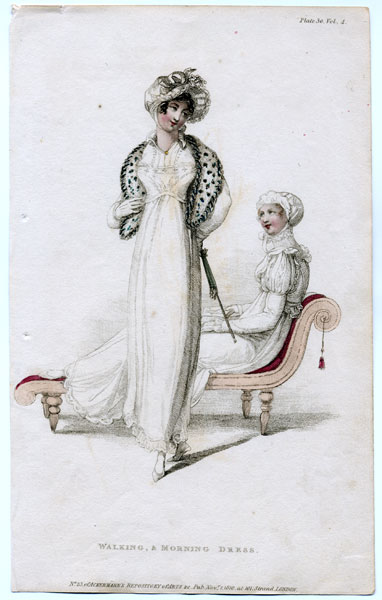
The maid would have started a fire in the morning room, but the house overall would have felt much cooler than it did even a month ago. A Rumford stove, which was becoming quite popular, would have retained  more heat, but as you can see, our Regency miss is swathed in a cap, long sleeved dress, and a high-necked chemisette. She wears gloves, stockings, and thin slippers. Layered as she is (for she probably wore a corseted petticoat underneath her ensemble and perhaps even a chemise), she would have felt comfortably warm. Had she still felt cold, she could opt to throw a thick shawl around her shoulders and a small throw over her lap.

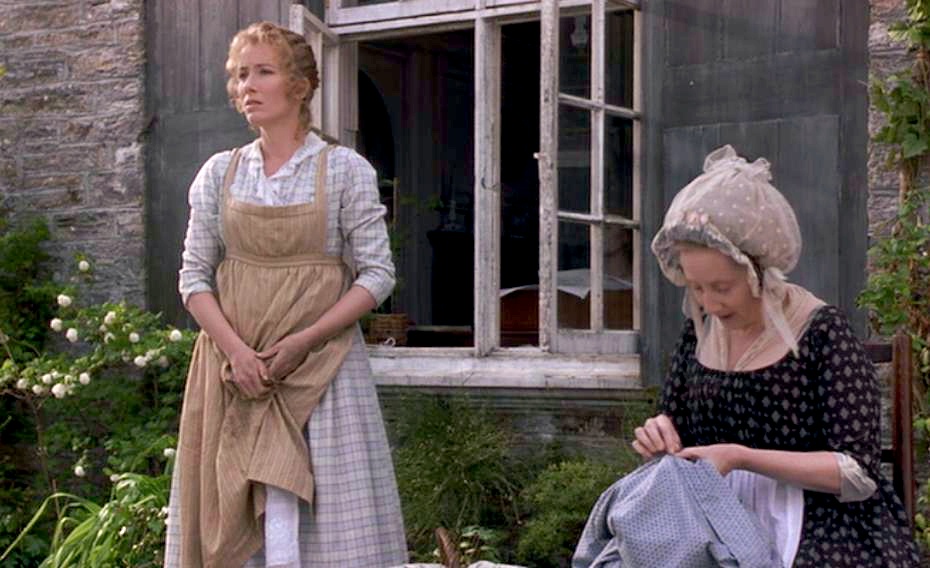
Morning dress, or undress, were dresses worn by ladies who expected to be seen only by close members of the family or guests in the home. They were never meant to be seen by visitors. Undress outfits, especially in more modest households where women worked alongside their servants, preparing vegetables or overseeing household duties, gardening and the like, were covered by aprons and pinafores.

In this image from Sense and Sensibility 1996, Elinor and Mrs. Dashwood are shown wearing undress. As soon as Edward Ferrars nears the house, the women tidy themselves, taking off their aprons, and making sure they look neat and presentable. They would not have had time to change into nicer outfits, nor would they have likely had many choices of dress to choose from.

Some Regency ladies who stayed at home all day would remain in a state of undress until dinner, when they changed into a gown suitable for the dinner table. Others would change their outfit much sooner, when they were ready to leave the house or if they had arranged to receive visitors. After I finish writing this post, I shall put on my half-dress, replacing my morning robe with a walking outfit consisting of a hooded sweatshirt, long-sleeved t-shirt, jeans a short coat and a scarf. I’ll exchange these outdoor exercise clothes with a more formal office look for work, which means that I will have worn three outfits by nine a.m.

My Regency counterpart would also change her outfit. A lady of fashion would look vastly more elegant  in her walking outfit with its little fur tippet artfully arranged over a long-sleeved spencer jacket than me in my walking suit. If she was married or a spinster, she would place her  jaunty hat with its  soft capote crown over a cap, whose lace trim would peep out from beneath the hat’s brim. Sturdier leather slippers, leather gloves, a reticule and umbrella or parasol would complete the ensemble.

A middle class lady would look less modish than the idealized women depicted in Ackermann’s Repository, which was the Vogue magazine of its day. She would have fewer clothes to choose from, and most likely possessed only one walking outfit instead of a variety, and certainly not in the first stare of fashion.

Whatever her social background, our Regency lady was now ready to meet the world and visit friends, go shopping, or generally run errands outside of the house. The walking outfit in the Ackermann plate provided sufficient layers for a lady to stay warm during her walks and errands. Should the November day turn particularly windy and wet, she would most likely trade the tiny fur tippet for a more substantial shawl or cloak. The middle class Regency lady might trade her shawl for her only cloak, which she would keep for years until its usefulness was outworn.

More on the topic:

Read Full Post »

Copyright (c) Jane Austen’s World. Inquiring Reader, When I visited Bath years ago, I kept a journal, which I completely forgot about until yesterday, when I found it among a pile of papers. It is the custom in my family to arrange for lodging on the day of our arrival and the night before our departure in any foreign land, and to trust in the suggestions from the people at the local visitor’s bureau for the rest of the vacation. We visit such establishments after 3 or 4 PM, when many hotels begin to deeply discount their rooms. This habit is a bit like gambling, but for us it has paid off spectacularly.

My budget-minded family has followed this practice successfully, sometimes even at the height of tourist season, in England, the Netherlands, France, New Zealand, and the great American west. The pay-off is in finding lodging in charming hotels or B&Bs at a fraction of their normal price. (Our best bargain ever was in the French Quarter in New Orleans at the Place d’Arms, where we spent 4 glorious days in a luxury suite for $78/night. It was April, perfect weather for N.O.)
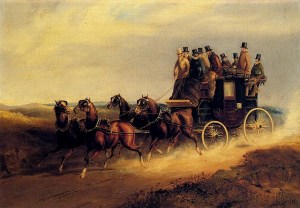
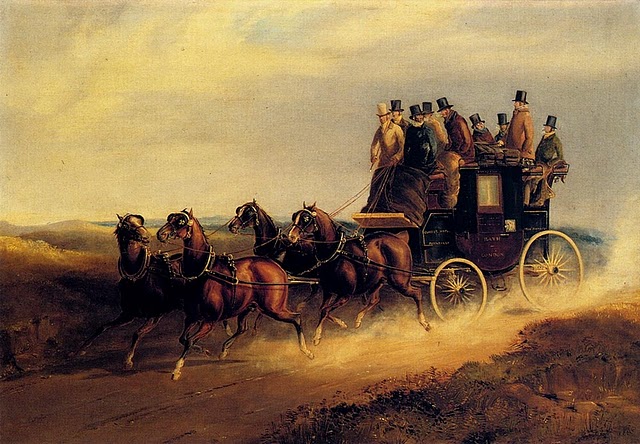
Bath to London coach on the open road

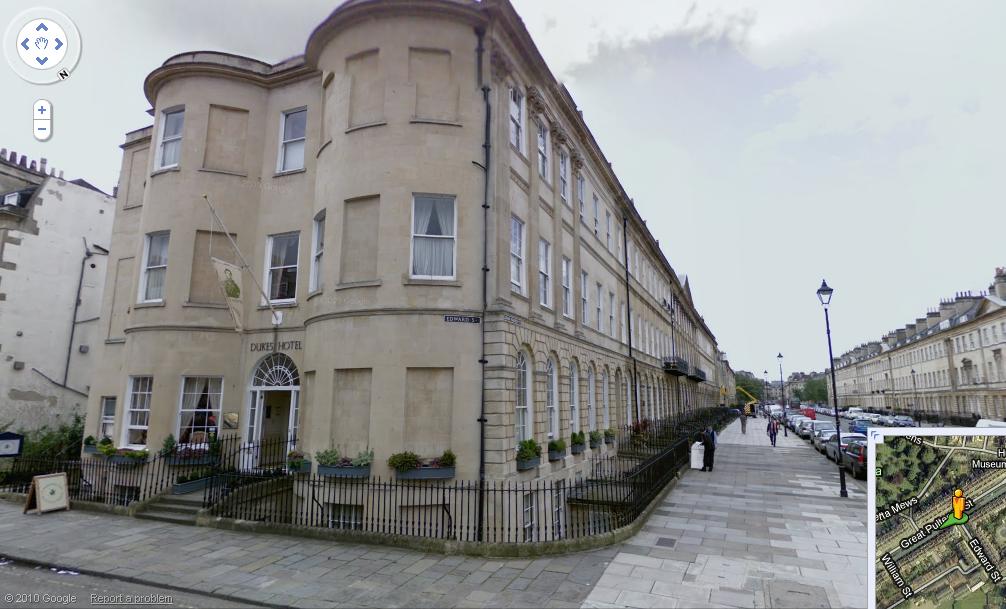
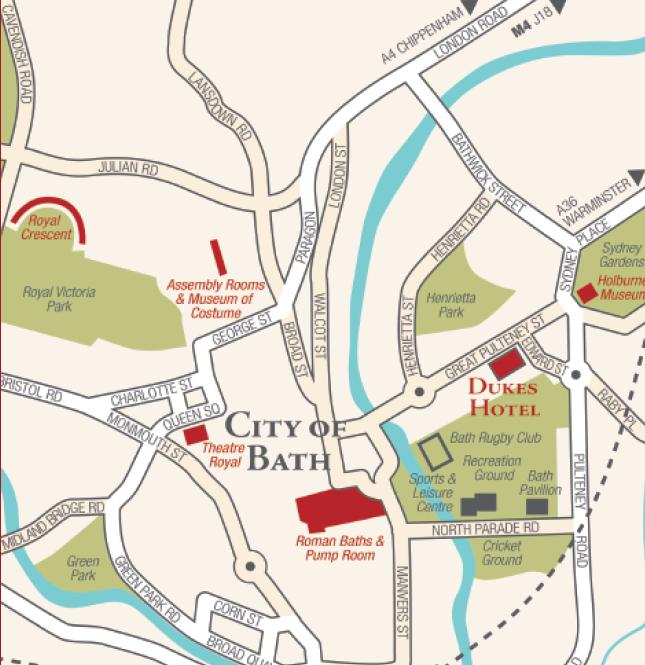
Back to England. My ex and I traveled from London to Bath (yes, we rented a car, and yes, he successfully negotiated his way out of London with me reading the map and helping him to enter and exit the round-abouts. Talk about a hair raising journey, for he had never driven on the British side of the road before and I am at best a terrible map reader). We entered Bath along the London Road, looking for the distinctive blue and white V sign, and discussed the price we were willing to pay. Those good people steered us to the Dukes Hotel on Edward Street, just off Great Pulteney Street,  across the Pulteney Bridge in Bathwick and near Sydney Gardens.
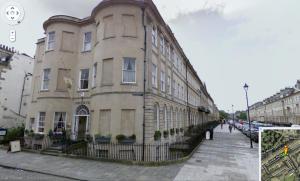
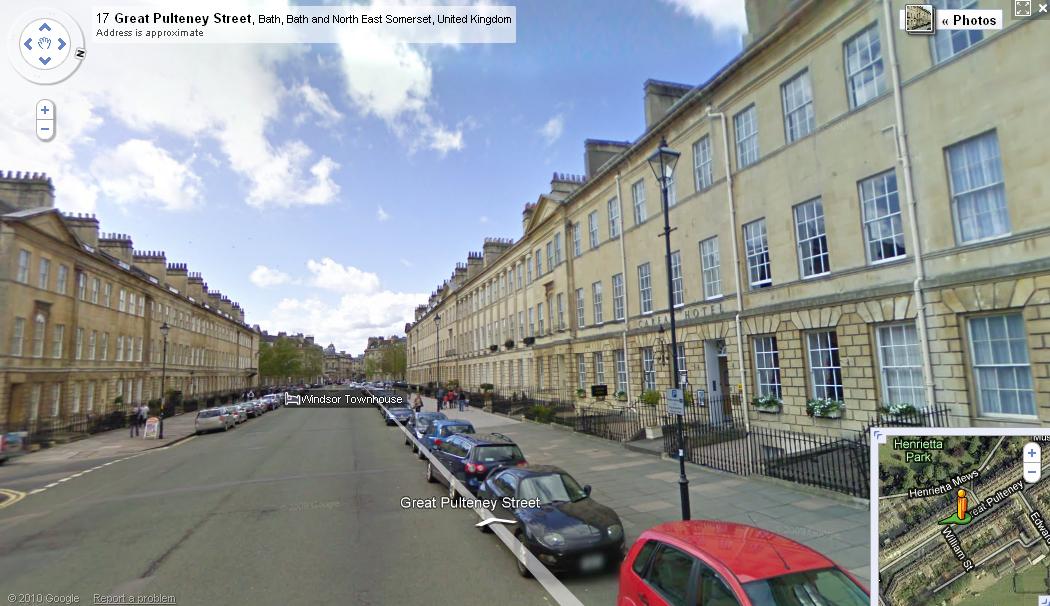
The Dukes Hotel on the corner of Edward Street and Great Pulteney Street

As a Georgette Heyer and Jane Austen fan, I felt that I had simply died and gone to heaven.

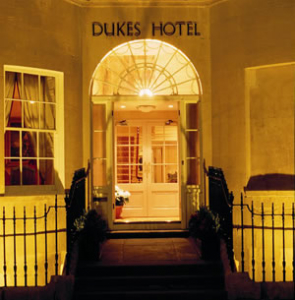
Entrance to the Dukes Hotel

Compared to Bath’s ancient Roman buildings and medieval streets, Great Pulteney Street is rather modern.  In the 3rd quarter of the 18th century, the city council voted to expand Bath’s boundaries across the River Avon. This era marked an expansion and growth for the city that resulted in the addition of thousands of new houses inside Bath proper and outside of it. Sir William Pulteney, who resided on an estate called Bathwick and fortuitously located across the river, commissioned architect Thomas Baldwin to design and build Great Pulteney Street. The task was completed in 1789.
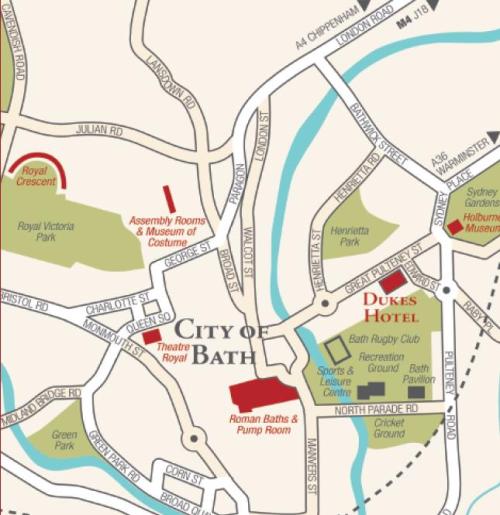
Location of the Dukes Hotel

Situated at one end of this long broad thoroughfare is Sydney Gardens, the pleasure gardens mentioned so often by Jane Austen and Georgette Heyer and others who have journeyed to Bath.
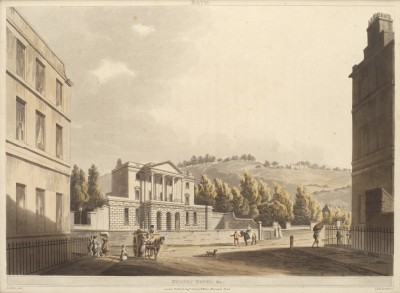
Bath Hotel at the entrance of Sydney Gardens 1825

Seen prominently at the entrance of Sydney Gardens was the Bath Hotel (see a 360 panoramic view), now the Holburne Museum.
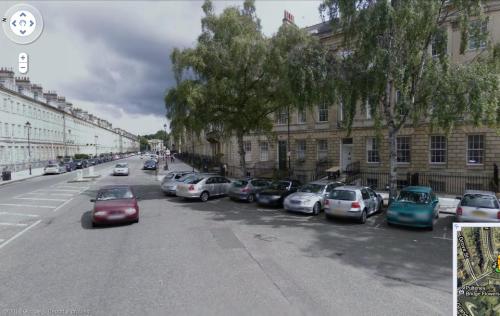
View from Laura Place towards Sydney Gardens with the Holburne Museum barely visible at the end of the street.

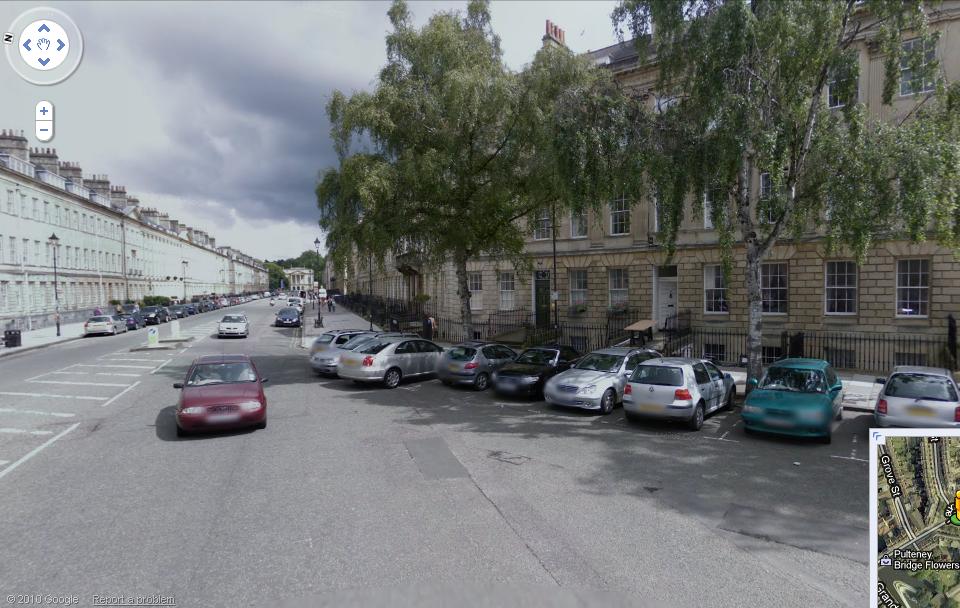
To return to our first evening in Bath, our room at the Dukes Hotel was charming but offered no view (which often happens when you wait for a bargain). We  immediately set off to explore Bath on foot, for it was mid-July when the days were long. Great Pulteney Street did not disappoint me with its wide sidewalks and row upon row of graceful houses made of Bath stone.  I would take this walk several times per day, and it is this street in particular that I still recall most vividly. I imagined myself wearing a Regency outfit and hearing the clopping of horses’ hooves and the rattling of carriages as I made my way towards Bath proper.
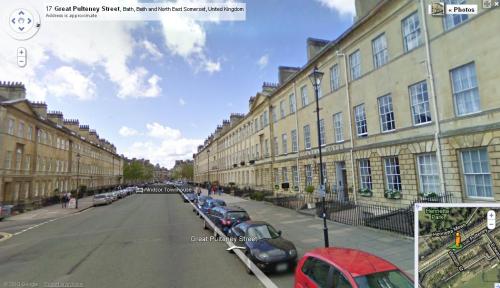
The wides expanse of Great Pulteney Street, walking from Edward St. towards Pulteney Bridge

At this point I must share with you why I am using Google earth images. My own photos are still missing. You can imagine how delighted I was to be able to reconstruct my journey from my newly found journal and the images I pulled from Google maps.
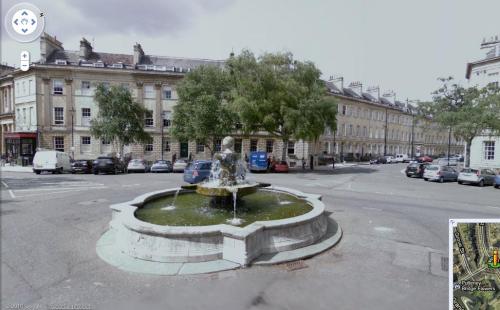
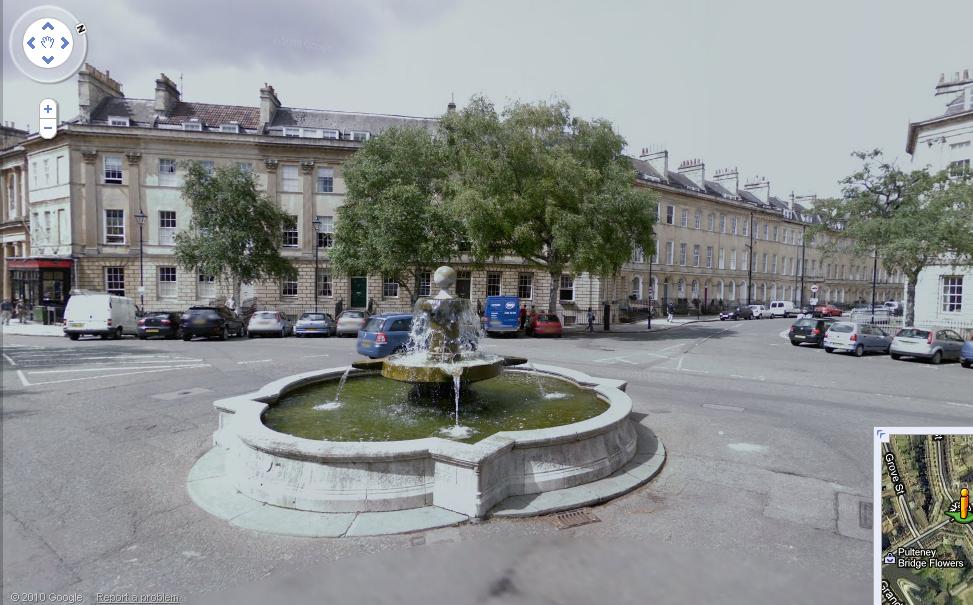
Laura Place. The fountain was built in the third quarter of the 19th century.

We walked past Laura Place, where Lady Dalrymple from Persuasion had taken a house for three months, until Great Pulteney Street ended at the fountain. It is then named Argyle Street.
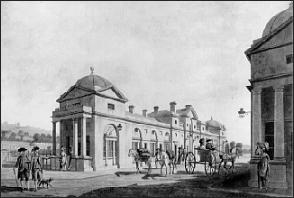
Pulteney Bridge, 1779 by Thomas Malton Image @Victoria Gallery

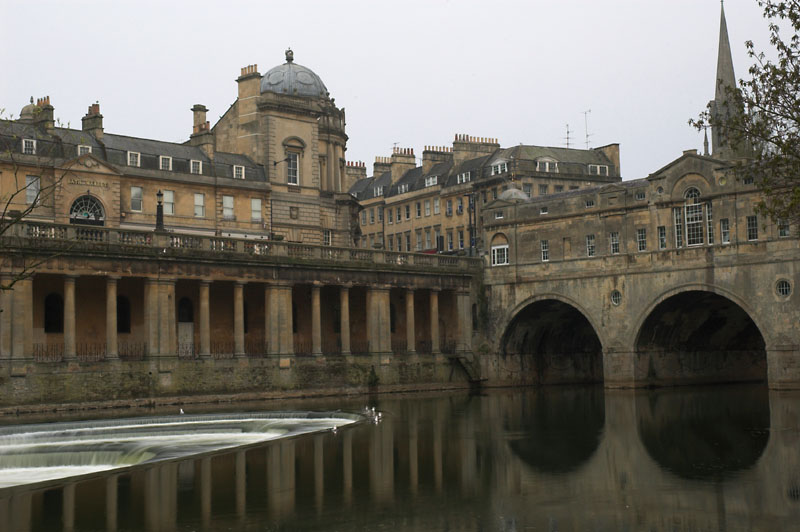
We ambled along slowly, taking in all the sights and brazenly looking into windows when we could, and continued on to  Pulteney Bridge, a Palladian bridge designed by the Adam brothers and finished in 1773. The bridge has seen several renovations since, especially in the design of the shops that line it.
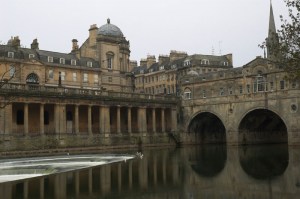
The Weir as seen below the bridge

We walked down the steps to the bank of the river and listened to the rush of water on the Weir  until the sun set. Click here for an arial view of the walk I have just described.
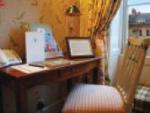
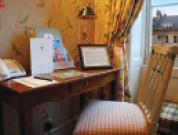
And so I conclude our first evening in Bath, which, due to the stress of driving in a foreign land from a major city along by-ways that eschewed busy thoroughfares, ended quite early for us. I did have time to write down my thoughts at a tiny desk in our third floor room.

This video brings back memories of driving around Bath’s environs. Driving up and down green hills near Bath, England

Read Full Post »
“Now, Edward,” said [Marianne], calling his attention to the prospect, “here is Barton valley. Look up it, and be tranquil if you can. Look at those hills! Did you ever see their equals? To the left is Barton park, amongst those woods and plantations. You may see one end of the house. And there, beneath that farthest hill, which rises with such grandeur, is our cottage.”

“It is a beautiful country,” he replied; “but these bottoms must be dirty in winter.”

“How can you think of dirt, with such objects before you?”

“Because,” replied he, smiling, “among the rest of the objects before me, I see a very dirty lane.”

“How strange!” said Marianne to herself as she walked on.

“Have you an agreeable neighbourhood here? Are the Middletons pleasant people?”

“No, not at all,” answered Marianne, “we could not be more unfortunately situated.”

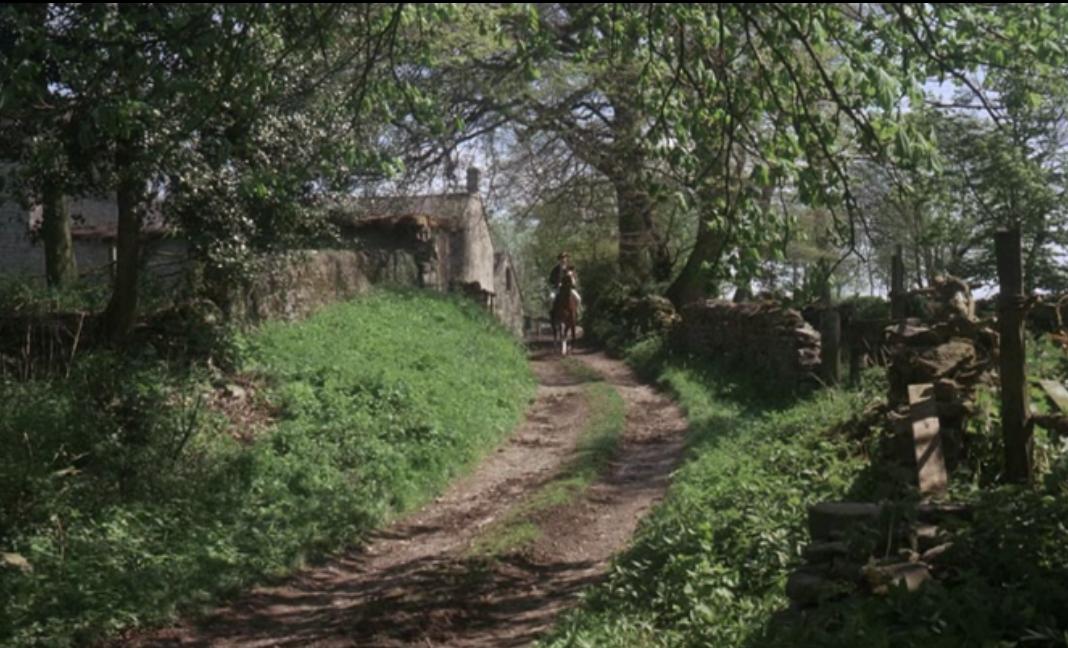
Country lane, Barry Lyndon

I had the leisure of viewing Stanley Kubrick’s Barry Lyndon the other day, I say leisure, for the film is over three hours long and I took the opportunity to pull images. These two stills of country roads reminded me forcibly of the difference between Marianne’s histrionic behavior in Sense and Sensibility and Edward’s reactions during a time when both characters are experiencing extreme disappointment in their love lives.

Marianne has completely given over to her emotions after Willoughby departs, and Edward struggles to hold up his chin, knowing he is in love with Elinor but is bound by his engagement to Lucy Steele. His view of the landscape is utilitarian. He sees none of the sweep of grandeur and only the practical aspects of the scene below and can only imagine it in the winter, when roads are rutted and muddy. Throughout Sense and Sensibility, Marianne expresses picturesque point of views. In this scene in particular, she also demonstrates her youth and immaturity, giving Edward a churlish answer about their new neighbors, which, while perhaps  true, the sensible Elinor would never admit.

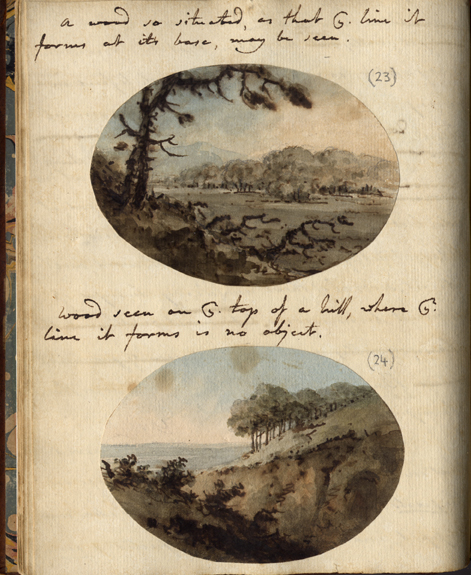
William Gilpin was instrumental in promoting the Romantic picturesque movement, which defines an aesthetic sensibility of a charming or quaint scene. Marianne Dashwood, whose personality tends towards the melodramatic, embraces the fashion for the picturesque ideal, whereas both Elinor Dashwood and Edward Ferrars represent a more practical viewpoint which depends less on the sublime and relies more on what their experiences and restrained personalities tell them to feel.

Gilpin's watercolor shows how best to achieve a picturesque effect through the clumping of trees.*

The following quote about William Gilpin’s influence on this new aesthetic movement is from the aptly titled, Penny cyclopaedia of the Society for the Diffusion of Useful Knowledge, Volumes 11-12, Charles Knight, London, 1838, p. 222:

But Mr Gilpin was a person of a remarkably refined taste, as is evinced by writings of his, of a class entirely distinct from those we have enumerated. These are his volumes in which he has illustrated, both by his pencil and his pen, the picturesque beauty of some parts of England, and generally the principles of beauty in landscape. The first of these works was published in 1790 in two volumes 8 vo; it was entitled Observations relative chiefly to Picturesque Beauty, made in the year 76 in several parts of Great Britain, particularly the Highlands of Scotland. This was followed by two other volumes of the same character, the greater part of them relating to the lake country of Cumberland and Westmoreland. Two volumes more on Forest Scenery succeeded. Besides these there are his Essays on Picturesque Beauty, Picturesque Travels, and the Art of Sketching Landscapes; Observations on the River Wye; and Picturesque Remarks on the Western parts of England. These form a body of works which were well received by the public at the times of their appearance, and which are now gathered into the libraries of the tasteful and the curious, so that copies rarely present themselves for public sale.”

The picturesque ideal expressed itself in literature, poetry, and paintings, and its influence could still be felt in the romantic paintings that depicted the natural beauty of America’s vast landscapes, such as the Hudson River School of painting.

Excellent posts about the topic are found in the following blogs:

*William Gilpin, How to Clump Trees, Bodlein Library

Read Full Post »

« Newer Posts - Older Posts »