Feeds:
Posts
Comments

Archive for the ‘jane austen’ Category

1833 Bentley edition of Jane Austen's novels

If you are thinking about getting out of the stock market and placing your money on a sure thing, consider bidding for this edition of six Jane Austen novels in 5 volumes at Bonhams. Set to be sold on June 8, with an estimate of £2,000 – 3,000, the value of this rare set is sure to  go up during the auction and for many years thereafter. The description of the Standard Novels on Bonhams’ web site states:

[Works, Bentley’s Standard Novel edition], 6 vol. in 5, 5 engraved frontispieces and additional titles, some light spotting to first and final few leaves, small corner tear to printed title “Pride and Prejudice”, without half-titles, ownership inscription of Eularia E. Burnaby (1856) on printed titles, bookplate of Henry Vincent, bookseller’s label of H.M. Gilbert, Southampton, uniform contemporary half calf, red and dark green morocco labels, extremities lightly rubbed [Gilson D1-D5], 8vo, R. Bentley, 1833 – Bonhams Website

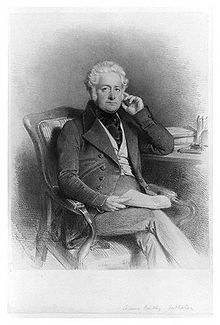
Richard Bentley (Wikimedia Commons)

The Bentley editions are notable in that no English reissue of JA’s novels is known after 1818. In 1832, Richard Bentley, publisher, purchased the remaining copyrights to Jane’s novels. (An excellent description of how Henry and Cassandra Austen sold the copyright to Richard Bentley and how little money they received for relinquishing their rights to their sister’s novels can be found in Claire Harman’s Jane’s Fame.) Bentley published all of Austen’s completed novels in 1833 in five volume sets known as the Standard Novels.  They came with illustrations that were significant for depicting scenes in early Victorian settings, not Regency settings. (One wonders how much the costume designers of the 1940 Pride and Prejudice film adaptations were influenced by these illustrations.) Bentley’s purchase marked a milestone, for from this time forward Jane Austen’s novels would always remain in print.

Illustration, Pride and Prejudice, Bentley edition (Image: Wikimedia Commons)

At the time of the Bentley reissues, Jane Austen was still regarded as a niche writer. Only a few hundred copies of her books were published and reprinted over the years. When Bentley’s copyrights expired, other printers began to publish her works, but book sales remained modest. Then came 1870. The publication of A Memoir of Jane Austen by J.E. Austen-Leigh, Jane’s nephew, sparked renewed interest in her novels. Bentley reprinted the novels as 21-5 in his Favorite Novels series (Sutherland, page 3),keeping Jane’s name in front of the public. Public demand for Jane’s novels continued to rise with the arrival of Bentley’s deluxe Steventon edition in six volumes in 1882. In 1884, Jane’s great nephew Lord Brabourne published the 2-volume set of Letters of Jane Austen. Combined with the previous publications and a largely favorable assessment of scholars and critics, Jane’s star was born.  A second wave of popularity, whose crest we are still riding, surged after the Jane Austen film adaptations of the 1990’s. It is conjectured that interest in her novels, adaptations, and sequels has peaked, but the number of readers that continue to visit this blog (and other Jane Austen blogs) and to clamor for films based on her life and novels belie that belief .

Bonhams, New Bond Street

About Bonhams LTD:

Bonhams is the world’s oldest and largest auction house still in British ownership. Thomas Dodd, an antique print dealer, and Walter Bonham, a book specialist, founded Bonhams in London in 1793.  When the auction house was launched, it was one of several similar concerns in Georgian London. The firm handled antique objects as well as fine wines. Today Bonhams is considered on of the four major auction houses in England, along with Christie’s, Sotheby’s, and Phillips, and sales take place almost daily at the firm’s New Bond Street location in Mayfair, London. (Image at right: University of Notthingham.)

For a more detailed description of Eularia E. Burnaby, whose name is inscribed inside the printed titles of this Standard Novel Edition, read Laurel Ann’s post entitled, Hey Bonhams! That Bentley Edition of Jane Austen Novels is Worth More Than You Thought!

Read Full Post »

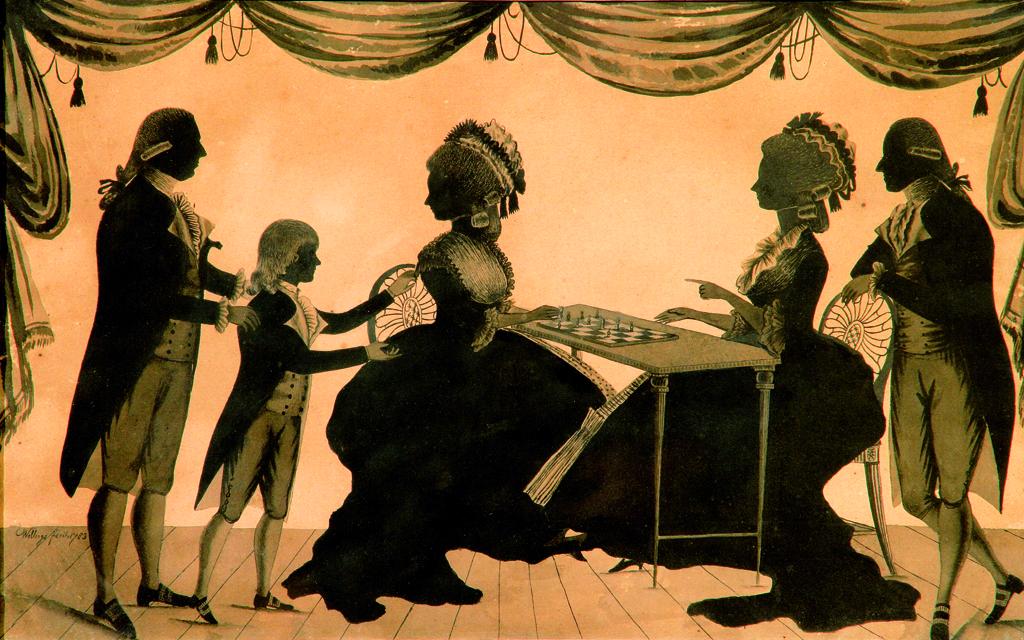
Chawton House Library has in its collection a rare green suit worn by Jane Austen’s brother, Edward. The suit – a child’s frock coat with matching breeches – looks very similar to the clothes young Edward is seen wearing in the Wellings Silhouette, which depicts his presentation to his adoptive parents. The suit is made of green silk, while the coat is fully lined with gold taffeta. Edward apparently liked oversized buttons, which can be seen in this frock coat and in the Grand Tour painting he had commissioned during his travels through Europe as a young man.

As you can see from the images of the suit (below), extensive and expensive conservation work is needed to stabilize the suit’s condition to prevent its further deterioration. Work on long term preservation is required before the suit (which was made in 1789 ) can be displayed, and donations are needed for its long term preservation.

Edward Austen Knight on the Grand Tour

The suit’s provenance is impeccable. While experts can’t categorically say that this is the actual jacket worn in the Wellings silhouette, it certainly belonged to Edward. The suit was passed down through generations of the Knight and Bradford family, and finally ended up in a dressing up box belonging to the Bradford family. The Bradfords are relations of the Knight Family and also descendents of Edward Austen Knight. Richard Knight, current owner of Chawton House, was given the suit some years ago by the Bradford Family.

Edward a fortunate child, had two families who considered him their son: the Austens and the Knights. The following history (which is reproduced by permission), chronicles how Edward Austen was adopted by the Knight family, a practice commonly followed by childless couples of the time:

Rev. George Austen presents his son Edward to the Knight family

The freehold of Chawton House has remained in the Knight family ever since the sixteenth century, though on many occasions the ownership passed laterally and sometimes by female descent, requiring several heirs to change their surnames to Knight. Sir Richard Knight, who inherited at the age of two in 1641, had no children and he left the estate to a grandson of his aunt, Richard (Martin) Knight. His brother, and then his sister, Elizabeth, inherited in their turn. During the first part of the eighteenth century, Elizabeth undertook the further development of the house and gardens. She married twice, but again no children were born, and when she died the estate passed to her cousin Thomas Brodnax May Knight, who united it with his own large fashionable property in Kent, Godmersham Park.

In 1781, Thomas Knight II inherited, but when he and his wife Catherine showed no sign of having children of their own, they adopted a son of the Reverend George Austen, who was a cousin of Thomas Knight’s. The Austen’s had six sons and two daughters, and the Knights adopted the third eldest son, Edward. Edward Austen Knight eventually took over management of the estates at Godmersham and Chawton in 1797, living mostly at Godmersham and letting the Great House at Chawton to gentlemen tenants.

In 1809 he offered a house in the village to his mother and two sisters Cassandra and Jane, and it was there that Jane Austen began the most prolific period of her writing life. Her career as a novelist took off with the publication of Sense and Sensibility in 1811, and she went on to publish a further three of her novels while at Chawton (two more followed shortly after her death). She lived in Chawton almost until her death in 1817, only moving to Winchester near the end of her life to be nearer medical care.

This meeting and subsequent adoption is a pivotal moment in English literary history because, had not Edward been adopted by Thomas and Catherine Knight, and then inherited Chawton House, his sister, Jane Austen may not have been able to complete her novels and as a consequence, probably the most famous women writers of the age, would never have been discovered.

The Library intends to eventually display the suit in the Oak room at Chawton House, a room well known by Jane Austen and where the original of the ‘Wellings’ silhouette is located. Supporters are asked to donate funds for the project, which will cost £12,000 ($ 17, 318). A stockman and environmentally controlled cabinet need to be custom-made for a secure display. A child’s mannequin, which must be constructed of conservation quality materials, will also be made for the display.

Green silk Breeches, dated to approximately 1789.

Frock coat with lining

Additional plans include making a replica suit to show to school children. Students and visitors will learn about the social history and background of the suit, including its style and construction, and from what materials the suit was made (silk and taffeta), who made it, and where the silk came from.

To make a donation, click on the link to the Virgin Giving website.

About Chawton House:

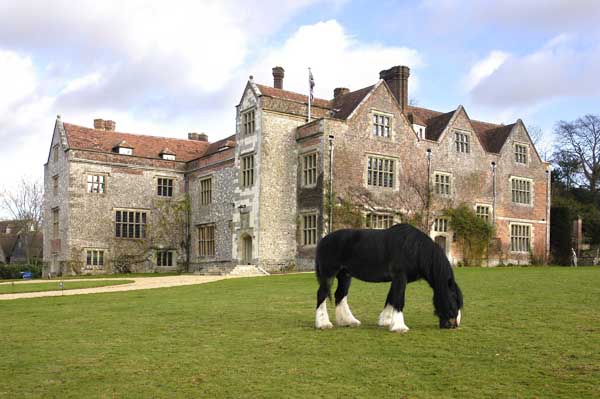
The house is open to the public for ‘Open’ tours in the afternoon of Tuesdays and Thursday each week, and pre booked tours most days of the week. Conferences  based on studies of the ‘Long’ 18th Century and women writers are scheduled regularly. Last year an important three day international conference was held to celebrate the bicentennial anniversary of Jane Austen’s arrival in Chawton. The event was attended by Austen scholars from all over the world. In excess of 8,000 visitors visited the house, gardens and library last year.

Chawton House (Image from website)

Chawton House Library works in partnership with Jane Austen’s House Museum to provide high quality visits to both sites for primary, secondary and A level schools and colleges. These include presentations of Jane Austen Life and works, tours of both houses, workshops relating to dress, manners and the use of herbs, dancing in replica clothing and an opportunity to handle real objects from the period of Austen’s life. For this work both Houses were awarded a Heritage Education Trust award.  Restoration of Edward’s suit is integral to the history of Chawton House and also has an important place in the interpretation of the life and legacy of Jane Austen.

Thomas Draddyll in 1789 wears a typical boy's suit of the era. Painted by Sir Joshua Reynolds.

Breakdown of Project Costs

  • Conservation of the Suit: £6629.35
  • Display Case: £4788.13
  • Mount or Stockman: £587.50
  • Replica Suit: £646.25
  • Total Project Costs £12,651.23

More on the topic:

Read Full Post »

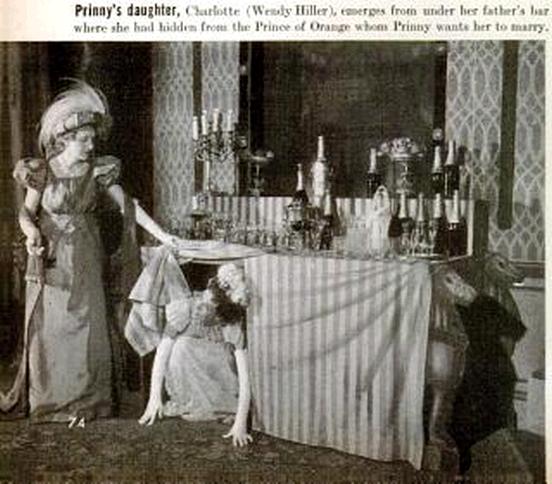
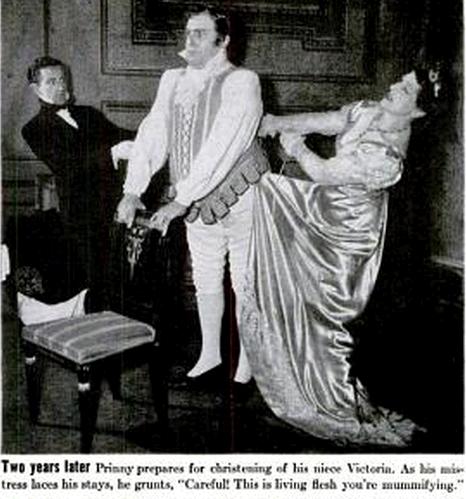
Robert Morley and Wendy Hiller, The First Gentleman, 1945 (Image, LIFE magazine)

While researching information for my post about the Prince Regent and his strange marriage to Princess Caroline of Brunswick, I ran across this obscure item – a play in two acts about Prinny named The First Gentleman, written by Norman Ginsbury and performed in London in 1945. Robert Morley played Prinny and Wendy Hiller portrayed the doomed Princes Charlotte (who died in childbirth in 1817, the same year that Jane Austen died). I surmise that Frances Waring acted the role of Caroline of Brunswick, but could not confirm this detail. About Wendy Hiller’s performance, Roberth Morley said:

Wendy Hiller as Princes Charlotte hides under the table

She was never afraid of over-acting when she felt instinctively that the role required her to do so and, as Princess Charlotte, she was in turn so fierce and so gentle that, on some evenings, after she had died in the second act it seemed a waste of time continuing with the play.- Dame Wendy Hiller

The play ran in London’s New Theatre for a run of 654 performances. In 1948, a film of the same name was made. This movie, released in 1949, also remains obscure.

Set Design for The First Gentleman, Columbia, 1948

A theatre programme from the pre-West End touring production in Liverpool’s The Royal Court Theatre was recently for sale online. The play’s cast also included Brown Derby, Wilfred Walter, Guy Le Feuvre, Sigrid Landstad, Una Venning, Christina Horniman, Helen Stirling, Catharina Ferraz, Christine Lindsay, Robert Beaumont, Geoffrey Toone, Amy Frank, Mary Masters, Ian Sadler, Beryl Harrison, Pamela Carme, Martin Beckwith, John Baker, Grenville Eves, Robin Christie, Mary Marshall, Sebastian Minton and Valentine Richmond.

The Prince Regent after Charlotte's death

More on the topic:

Read Full Post »

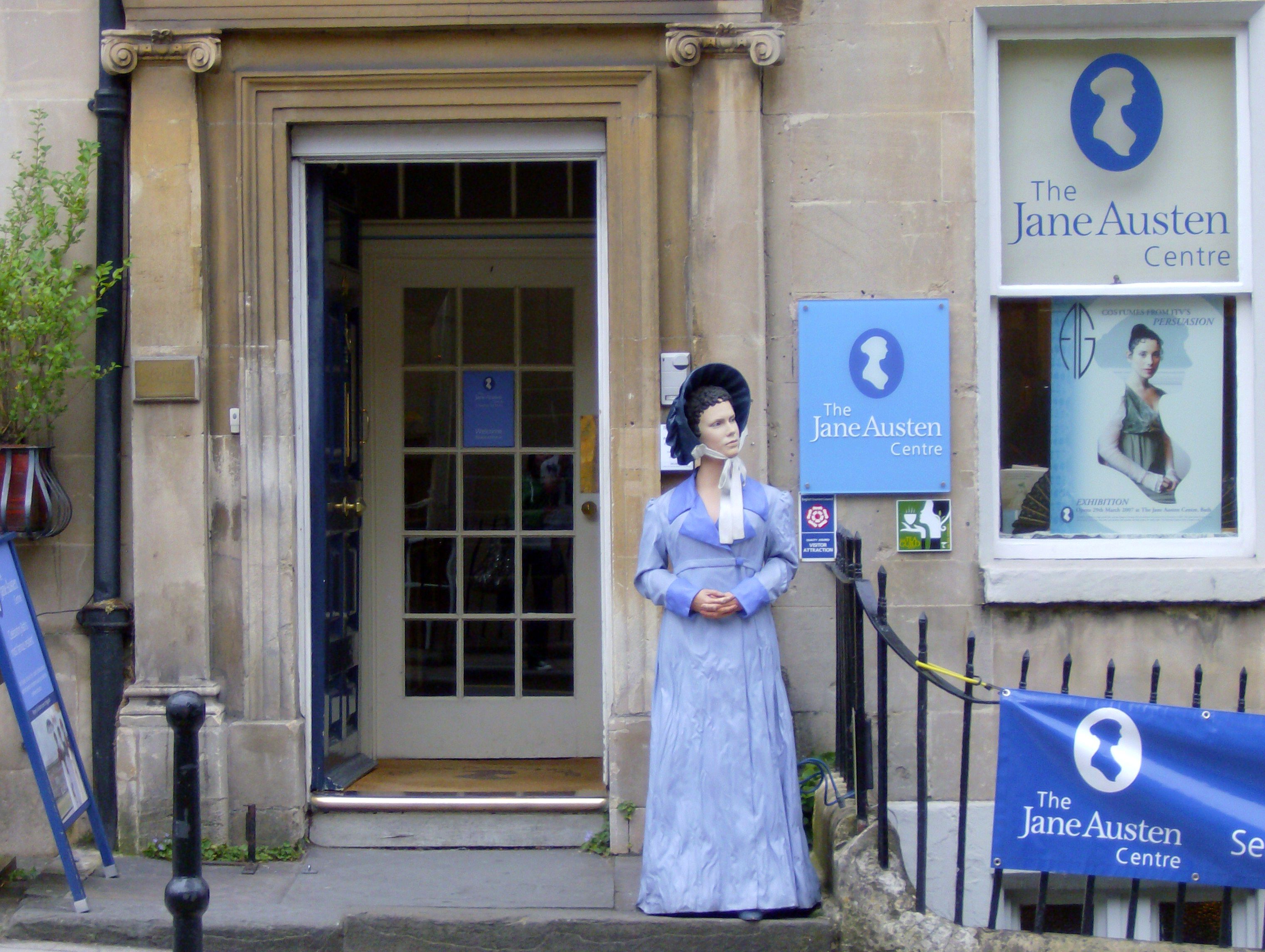
Great news! Jane Austen’s World has been nominated for best Jane Austen blog by the good people at The Jane Austen Centre. Click on this link to VOTE for *hint* this blog as well as these categories: Which actress is your favorite Emma Woodhouse? Which actor is your favorite Mr. Knightley? Best Austen inspired book published in 2009? What is your favorite Jane Austen Minor Work? Who is your favorite Jane Austen rogue?

You are allowed one vote! While you are there, poke around this great site, which features an online magazine, a shoppe, forum, videos, and other Jane Austen inspired topics and interests. You can also sign up for their email newsletter, which Becca drops in my inbox with welcome regularity.

The Jane Austen Centre, Image, Wikimedia Commons

Read Full Post »

The Prince Regent – “Prinny” – made no secret of his reluctance to marry Princess Caroline of Brunswick. Some years before he had secretly married Mrs. Maria Fitzherbert, a Catholic widow and the woman he loved. But according to the Royal Marriage Act their union was illegal. Princess Caroline, the daughter of Prinny’s eldest aunt AND a Protestant, was considered a more suitable consort by King George III. This proposed union with his cousin went much against the Prince’s  wishes, and when he met the 27-year-old German Princess in 1795, he turned to Lord Malmesbury and said, “Harris, I am not well. Pray, get me a glass of brandy.”

The Prince of Wales had acquiesced to his father’s wishes only to clear his debts, which totaled £630,000 pounds, a staggering sum for that era, and for an increase in his yearly allowance. Although Prinny’s first impression of Caroline was unfavorable, she was thought to be quite pretty in her youth. The Prince, who was soft and fat,  made an equally distasteful first impression on the Princess, and thus the couple, both spoiled and eccentric (to put it mildly) were off to a bad start. During the ceremony Prinny continually looked at his mistress, Lady Jersey, instead of his wife, and at one point the King had to persuade the Prince to finish the ceremony.

The marriage ceremony proceeded as arranged, attended by his well pleased father, on the evening of 8th April, 1795 at the Chapel Royal at St. James’ Palace. The bride wore a elaborate dress of silver tissue and lace and a velvet robe lined with ermine. The distraught bridegroom spent his wedding night lying on the bedroom floor by the fireplace in a drunken stupor.

Prinny and his German bride (Image from the Georgian Index)

Although he was repelled by his wife, George eventually did his duty and brought himself to consummate the marriage and the Princess of Wales gave birth to a daughter and heir to the throne, Princess Charlotte, on 7th January, 1796.”  – English monarchs

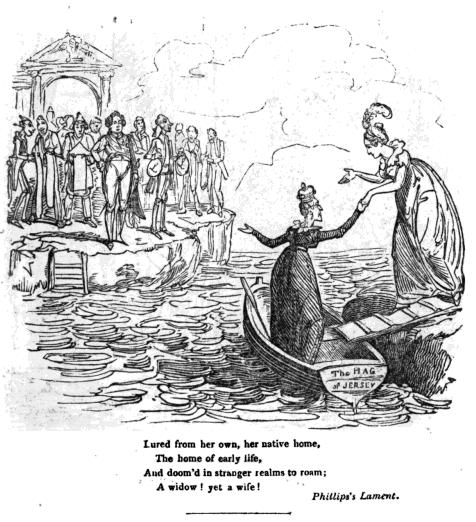
Although not entirely unattractive, Princess Caroline was neither graceful nor elegant, nor did she behave in a regal fashion. Her “clumsy deportment and jerky movements made one MP liken her to a “Fanny Royds” (a weighted Dutch doll with red cheeks that jumps up to standing position)” – Historicizing Romantic Sexuality. Her German manners and demeanor never quite came up to English royal expectations or their level of “sophistication.” Lady Jersey, the Prince’s mistress at the time, was cruel enough to wear a pair of pearl bracelets in front of Caroline that the Prince had originally presented to his bride as a wedding gift. He then took the jewelry back and gave the bracelets to Lady Jersey. The cartoon in the first image, which is sympathetic towards Caroline’s marital situation, shows Lady Jersey as an old hag welcoming a virginal Caroline to England.

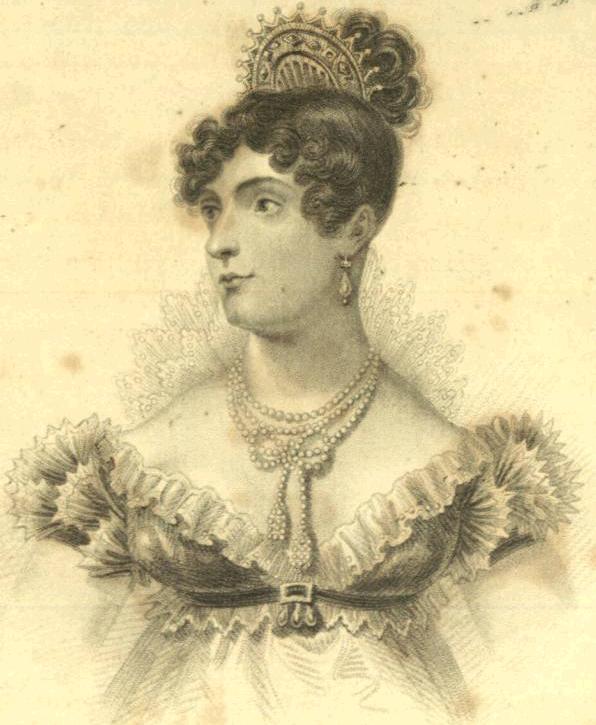
Caroline, Princess of Wales (Image from LIFE)

In her youth Caroline could look quite presentable. A contemporary described her as being

… above the middle height, extremely spread for her age, her bosom full but finely shaped, her shoulders large, and her whole person voluptuous, but of a nature to become soon spoiled; and without much care and exercise she will shortly lose all beauty in fat and clumsiness. Her skin is white but not a transparent white. There is little or no shade in her face, but her features are very fine. Their expression like that of her general demeanour is noble. Her feet are rather small, and her hands and arms are finely moulded She has a hesitation in her speech amounting almost to a stammer … – Memoirs of the Court of England During the Regency (1811-1820)

Observers did agree on several aspects about Caroline: her manners could be coarse and gruff, and her taste in dress was atrocious. Mary Berry described the princess in her journal: “Such an over-dressed, bare-bosomed, painted eye-browed figure one never saw”.  She flouted convention,  “even if this meant exposing her decidedly lustful nature”; this rebellious streak, accompanied by her “outlandish ways and bizarre dress sense” combined to give Caroline an eccentricity not becoming in a female member of the British court, let alone its royal family.” – Elizabeth Fay, Historicizing Romantic Sexuality. As Caroline aged, her penchant for wearing virginal gowns made her look ridiculous and she became a target for satirists, as in the image below.
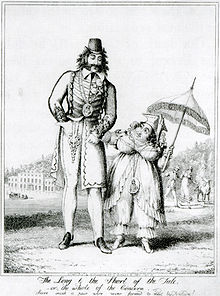
Caroline tended to dress too youthfully for her age and often cut a ridiculous figure in public.

Caroline, who flaunted her unconventional and ribald tastes, surrounded herself with people of questionable morality.

The Princess evidently preferred gay company, a certain sprinkling of intelligence with a good flow of animal spirits being the ordinary passports to her society. No questions appear to have been asked of either sex; it is therefore not surprising that several of the favoured circle were celebrated more or less for their independence of moral obligations.” – Memoirs of the Court of England During the Regency (1811-1820)

The Duke of Buckingham and Chandos observed of her childhood: “Her faults have evidently never been checked nor her virtues fostered.” The Princess remained capricious and lewd all her life, and her risque conversations kept her attendants  in daily dread of her impetuous pronouncements.
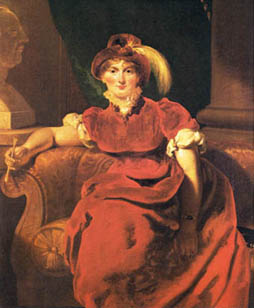
Portrait of Caroline by Thomas Lawrence

Caroline was  –  in her husband’s eyes – expendable. He thought her an unfit wife and mother and permitted her to see her daughter Princess Charlotte only once a week. Prinny’s reluctance to live with his wife and daughter, his politics, and his profligate ways made him unpopular with the public. Princess Caroline made the most of this situation, publicly playing the role of victim, even though by contemporary accounts she did not demonstrate much affection for her daughter. The Queen’s Matrimonial Ladder, published in 1820, demonstrates how sympathetic many were to her plight as the Prince Regent’s ostracized wife. Jane Austen famously wrote:  “Poor woman, I shall support her as long as I can, because she is a Woman and because I hate her Husband.”
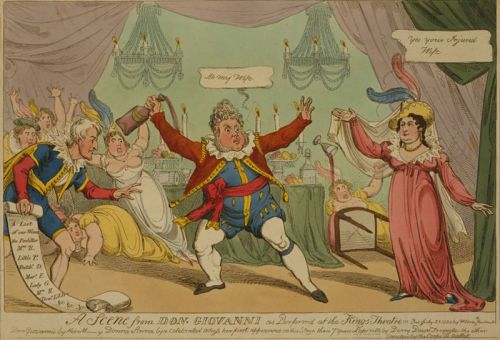
Sartiric Cartoon: Princess Caroline shows up at the King's Theatre during the performance of Don Giovanni, reminding the Prince that he is married

Banned from the social gatherings at the Prince’s lodgings and at Carlton House, Caroline established a rival court at Kensington Palace and Blackheath. The strange marriage between this eccentric couple provided an endless source for gossip, for Caroline’s indiscretions (as well as Prinny’s)  were public knowledge:
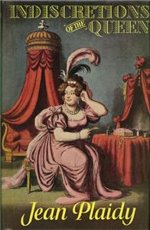
… her Royal Highness had associates of an infinitely lower grade to whom she often devoted herself with an abandonment of self respect that equally perplexed and disgusted the ladies of her suite.  With such a Court, as may be imagined, the pursuits of the Princess were not remarkable for dignity were often remarkable for its violation.” – Memoirs of the Court of England During the Regency (1811-1820)

In 1814, Caroline moved to Europe, traveling to Germany and Switzerland, and living for some time in Italy.  The Prince sent agents to spy on her in order to prove not only her unfitness as mother and wife, but the burden she placed on the privy purse as well. Her every movement was reported back to England. And there was much to report, for her randy behavior was shocking, so much so that the members of her English entourage left her one by one. She dyed her blond hair black, favored short, diaphanous dresses that were designed for women half her age (she was in her forties), bared her bosom and arms, and danced and partied until the wee hours of the morning. Caroline loved spectacles and grand entrances:

At Genoa, [she] drove through the streets in a phaeton with a child dressed as a cupid leading two tiny horses who pulled the shell-shaped carriage. Caroline was dressed in a body-revealing pink gauze bodice, short white skirt and pink-feathered headdress.” – Historicizing Romantic Sexuality

Lady Bessborough wrote a description of Caroline at a ball during this period:

The first thing I saw in the room was a short, very fat, elderly woman, with an extremely red face (owing, I suppose, to the heat) in a girl’s white frock looking dress, but with shoulder, back, and neck, quite low (disgustingly so) down to the middle of her stomach; very black hair and eyebrows, which gave her a fierce look, and a wreath of light pink roses on her head…I could not bear the sort of whispering and talking all round about…” – The Prince of Pleasure, J.B. Priestley
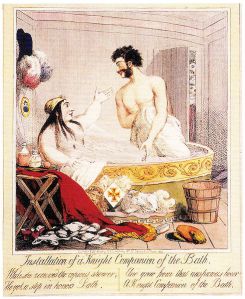
Caroline and Pergami in the Bath

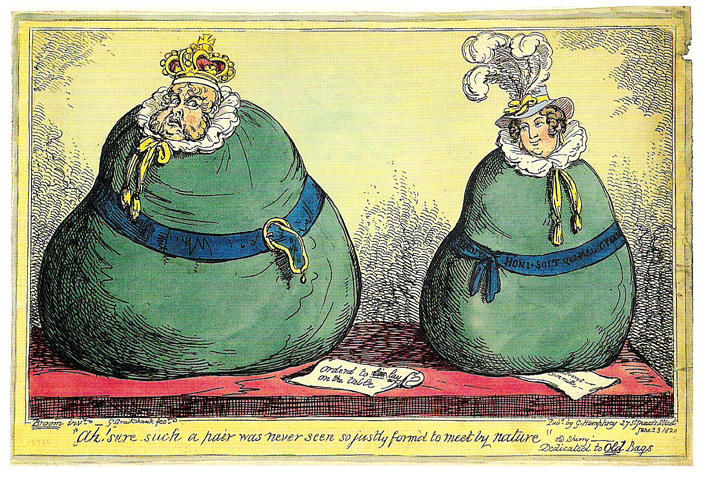
When she arrived in Milan, the peripatetic Caroline met Bartolomeo Pergami, a tall and handsome ex-soldier who became her chamberlain. She began an affair with him, treating him more like her consort than lover. Their brazen relationship opened an investigation into her behavior. Thirty-one Italian witnesses were called, resulting in the conclusion that Caroline had engaged in continued adulterous intercourse. The Two Green Bags illustration (below) comes with the following interpretation: “In this iconic caricature, George and Caroline are depicted as a pair of fat green bags, a clear reference to the green bags that contained the evidence collected against Caroline by the Milan commission. George is much fatter than Caroline, and his bag is girded by a garter belt, part of which hangs down in the manner of a limp penis.” Wikimedia Commons. The truth was that the Princess was happy with Pergami and would have been content to remain in Italy had she been provided with a handsome enough income. (At that time she received 35,000 pounds per year.)

Two green bags

Prinny, who did not bother to hide his many scandalous affairs from the public, was excessively cruel to Caroline when their daughter, Princess Charlotte, died in childbirth. Instead of contacting Caroline directly, she heard about her daughter’s death through secondary sources. When King George III finally died, Caroline returned to England to claim her rights as Queen. Arriving in Dover in June 1820, she was cheered by crowds as she traveled in triumph to London.  The irony was that despite her outlandish behavior abroad, the public so hated George IV that they supported her with wild (almost blind) loyalty, burning bonfires in her honor and setting off illuminations. Caroline took full advantage of her popularity, showing up at public events as often as possible. Her celebrity did not deter George from seeking a formal separation and a divorce from his much loathed wife.

Caroline returns to England against much winded opposition (image from The Queen's Matrimonial Ladder)

He persuaded Lord Liverpool and his government to bring in an Act of parliament to deprive her of the title Queen and to declare the marriage “for ever wholly dissolved, annulled and made void”. The Whigs opposed the measure and their were public demonstrations against the new king.” – Historicizing Romantic Sexuality
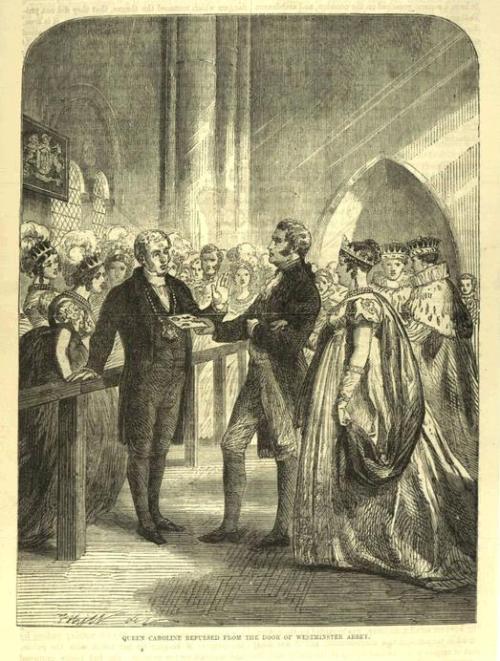
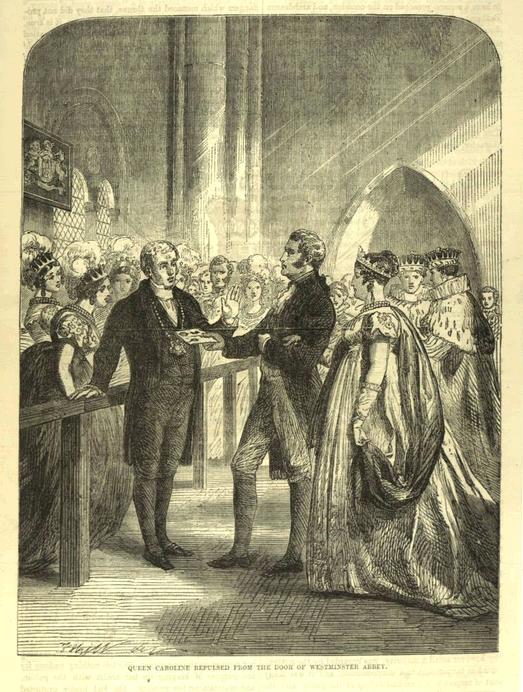
Queen Caroline repulsed from Westminster Abbey (LIFE magazine image)

The bill to deprive Caroline from her right, privileges, and pretension to Queen Consort was thrown out after weeks and weeks of political wrangling. Caroline, who was no fool, said: “No one cares for me in this business.” She appeared fully and royally dressed at King George’s coronation but was turned away from the doors of Westminster Abbey a number of times, as she tried repeatedly to enter several entrances with no success. This outrageous action resulted in further public demonstrations that ended when Caroline died suddenly on August 7th in 1821 of an unknown gastric disorder. She was 53.
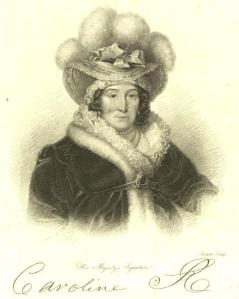
Queen Caroline in 1820, (LIFE Magazine image)

More on the Topic

Read Full Post »
« Newer Posts - Older Posts »