This Jane Austen blog brings Jane Austen, her novels, and the Regency Period alive through food, dress, social customs, and other 19th C. historical details related to this topic.
Your visits and loyalty will soon drive this blog’s bean counter over the million mark. My, oh, my! When I began blogging about Jane Austen in 2006, I only meant to provide information for my Jane Austen book group. Over three years later I have had the pleasure of meeting Jane lovers from around the world, and getting to know a few of you closely.
To celebrate, I will be giving away a box of Jane Austen sequels or Regency books (some of which I have reviewed, so they are technically considered “used”.) All you need to do is leave a comment on why you visit this blog and what your favorite topics are. I can only send the box of book to someone who lives in the Continental U.S. I will, however, send one book to anywhere in the world, so ALL are eligible to leave a comment.
Let the celebrations begin! And thank you for visiting. Contest ends the moment this blog’s counter hits a million, which I estimate will be two or three weeks. UPDATE: The Comment section is closed for the contest. The winner is Heather Carrol! Thank you ALL for participating and visiting this blog.
The incident at Box Hill loomed large in this episode. What did you think of the series as a whole? How did it stack up against other Emma film adaptations? Vote here.
More polls sit below asking you how well the actors fit in their roles. To save you from fatigue, not all the show’s actors are listed.
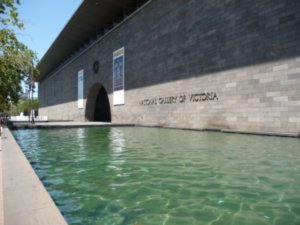
Inquiring Reader: Emma, the author of this post, lives in Melbourne, Australia. After she interviewed me for a class assignment, I asked her if she would give us her impressions of the the fabulous fashion show at the National Gallery of Victoria. Happily, she said yes. Click here to read an article on Jane Austen Today and for more images from the exhibit. I first featured this post on Jane Austen Today and decided to embellish it a little, adding more images of the museum and items in the exhibit. New links have been added, as well as additional comments about the dresses. About 50 costumes were shown in the exhibit. If you click on all the links to view images on other sites, you will see about 20% of the outfits and a few of the Regency items that accompanied them.
Entrance arch to the National Gallery of Victoria
Entrance to exhibit
The National Gallery of Victoria has a permanent space for textile exhibits that is often overlooked by visitors. So, you can imagine my surprise when I entered the Persuasion space and found it far from empty. There were young children, middle aged couples, elderly couples and a selection of tourists, all gathered in the rooms openly admiring the clothing and documents behind their glass cases.
Exhibits with dresses, drawings and artifacts
The collection was set up beautifully in their cases, decorated to become rooms – painted blue, with pianofortes, writing desks and sitting chairs.
It was interesting listening to the thoughts of those around me, with many observing the “heaviness of the walking dress” and the “gorgeous detailing on that white muslin.” Of course every woman in the room stopped to admire the outfit worn by Colin Firth in the BBC adaptation of Pride and Prejudice, no doubt reliving the lake scene.
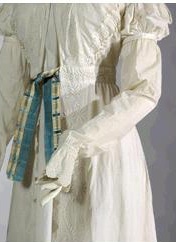
Detail, cotton muslin dress, 1815
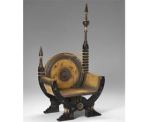
Regency chair "throne"
With so many pieces to choose from I had no idea how I was going to pick one or two to write about, but finally I have settled on the ball and the walking dress.
Having read many ball scenes in Austen’s works it what inevitable that I would love the ball dress. The dress was an empire line, with a skirt that went outwards into a cone shape, and the sleeves were puffed with lace detailing. It was interesting to read the plaque which revealed just how complicated the ball dress actually was – with there being gauze, embroidery with silk floss, lace, satin, piping and some sort of plants vine used in its construction.
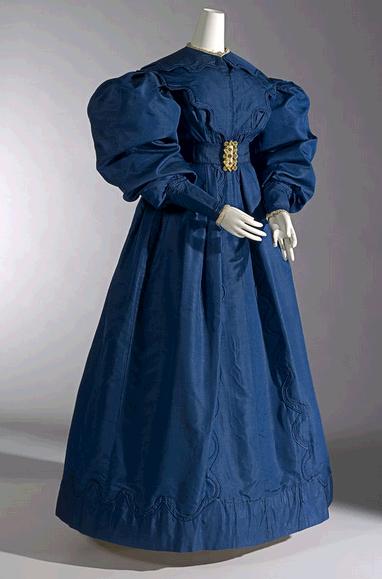
And then there was the walking dress, a dress that I’m not sure I’d like to go for a walk in myself. I’d expected something lighter so I was very surprised by the heavy bronze satin dress in the case. It appeared very restrictive – fitted, long tight sleeves – but was incredibly beautiful and well made.
The bronze walking dress is at right
The exhibit closes at the gallery on November 8, 2009. I encourage anyone that can make it to go. It’s free of charge and definitely a collection not be to missed.
This 1802 round gown is similar to one that Jane Austen would have worn
Click here for an audio tour of the exhibit.In it you will learn that this exhibit shows the more provincial, country dresses that were designed for walking and outdoor activities. Empire dresses allowed for a greater freedom of movement than in previous eras. The thin cotton, often low-cut gowns also revealed more of a woman’s figure than before, prompting Jane Austen to write about a vicar’s wife that she was “nakedly and expensively dressed.”
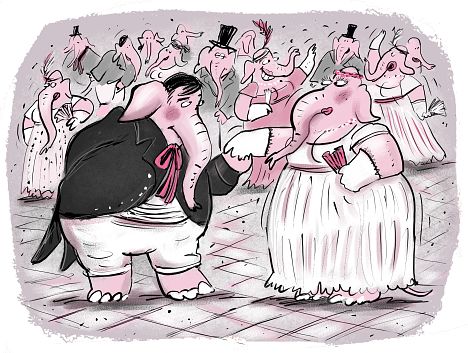
During the 2007-2008 holidays, artist and cartoonist Paula J. Becker watched Pride and Prejudice movies nonstop, from the 1940’s version, to the 1980’s and the mammoth 1995 Colin Firth adaptation. When she finished viewing P&P 2005, she was inspired to draw Mr. Darcy and Lizzy at a ball. What fun she must have had! You will recognize Ms Becker’s style, for you have most likely seen her cartoons in greeting cards and her artwork in children’s books.
The tension of the series comes not from the characters being marooned in stuffy Regency England, but from the bizarre twenty-first-century dating psychobabble. At some point, whoever created this very pretty 9 pm drama seems to have thrown the actual novel aside and adapted the work with exclusive reference to other Jane Austen adaptations and what they think middle-aged women want to down with their end-of-Sabbath Chardonnay. Even the actors seem to be stuck in synthetic Austen-land.
Having watched 3/4 of the film, tell us what you thought of Emma, Episode Three
My rambling discourse about hair echoes my thinking about this production of Emma, for I can’t decide whether I like it or not. Count me as one of the viewers who is still sitting on the fence. I understand that the producers wanted to modernize and jazz Emma up, so that a new audience can appreciate her story. But many liberties were taken in the process, such as with Jane Austen’s dialogue and wit, which are practically nonexistent. Let’s examine the hair styles in this film. Ringlets were in vogue at the time Jane Austen wrote the novel. They peeped out of bonnets and mobcaps. Even when hair was pulled back into a chignon, ringlets would be fashioned around the face and in front of the ears.
In this image, Harriet Smith’s hair style has ringlets aplenty, but is more reminiscent of the updos worn in 1826-1832, when the ringlets resembled poodle ears. Of course, this hairdo did have a certain cinematic effect, for Harriet is a bit silly and naive and the hairdo suits her personality to a tee. If you recall, Mrs. Bennet (Alison Steadman) in 1995’s Pride and Prejudice was given a similar hair do, and every time she spoke, her ringlets shook, making her seem even sillier.
Ballgown 1826
Fashion plate 1832
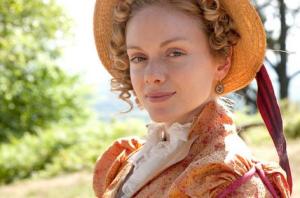
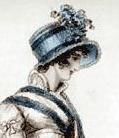
In the next image, Christina Cole (Augusta Elton), below, demonstrates the sort of hair/bonnet combination I have come to associate with the era. Her loose ringlets peep out from under her straw hat most becomingly. Emma was published in 1815. Let’s compare Augusta’s hair and cap to fashion plate images of the same year. Close enough, don’t you think? Her bonnet is different, but there were many modish styles to choose from and one can’t quibble with a becoming straw cap.
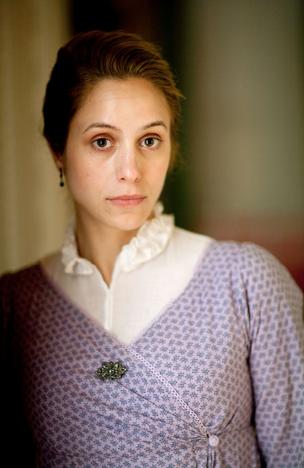
Jodhi May as Mrs. Weston
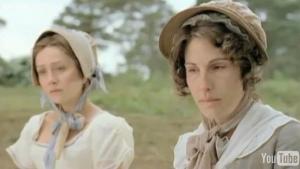
Why was such a plain and unflattering hairstyle chosen for beautiful Jodhi May? Was her hair Quakerish on purpose so that she would not compete in beauty with Emma? At this point she is no longer a governess, but the mistress of her own house and can dress herself accordingly. Even poor Miss Bates (sitting at right below) shows more attempt at “styling”.
Miss Fairfax and Miss Bates at Box Hill
This plain upswept chignon was adorned with simple curls in front of the ears, which would have helped Jodhi’s hairstyle immensely, making it seem more “authentic.”
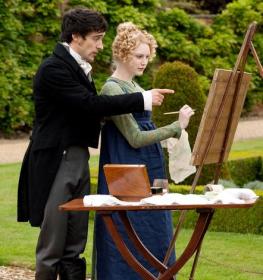
In this image, Blake Ritson wears his hair a la Brutus, a style commonly worn by men in the Regency era. Poor Harriet (Louise Dylan) is stuck with the poodle style for the duration of the film.
In the image below, Blake looks like he’s about to enter Bedlam, which I suppose was his hair stylist’s intention, for Mr. Elton IS a ridiculous character. Still, Blake’s facial ticks should have been enough to clue the viewer in. We didn’t need crazy hair as well.
Did the stylists use 21st century hair gel to accomplish this style?
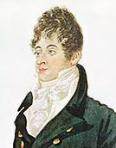
To be fair, men pomaded their hair and created fantastic styles. Witness Beau Brummel in 1805.
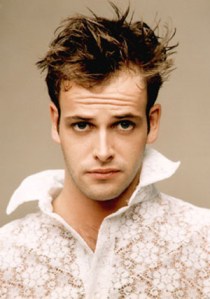
Which begs the question: Why did Jonny Lee Miller fashion his hair a la the 21st century?
Oops, wrong image
I meant to insert this one
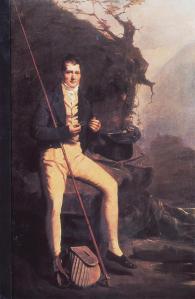
Men wore their hair in many styles, some elaborate, and some quite sleek and modern to our eyes. Jonny’s hairstyle is remarkably close to McMurdo’s below, who, from the neck up would not look too out of place in today’s world.
Lieut Colonel Bryce McMurdo, 1800-1810 by Henry Raeburn
Women often wore caps in bed, which they drew over their paper curlers. Hair was washed only occasionally in those days, and caps prevented pillow cases from being soiled from accumulated oil and dirt.
Ok, we get it. Harriet is SICK. Where is her night cap?
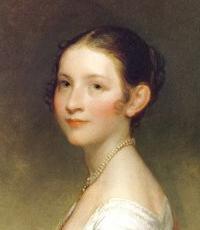
I just had to include the image below. Yes, very young girls at that time wore their hair loose, and, yes, they had to be taught their manners. (For aren’t we all little savages until our governesses teach us better?) For my finnicky taste, this image shows a woman who is much too modern in hairstyle and facial expression. At the very least, Emma would have been taught to place her hand in front of her mouth when yawning.
Goodness. What would the servants have thought?
I’m still on the fence, waiting to like this film adaptation. It seems that the numbers are tanking and people are not staying with the show (a bad omen for the future of bonnet movies on BBC). Kali at StrangeGirl.com and blog author of Emma Adaptations is still liking this adaptation, although elements are starting to get on her nerves. Please feel free to agree or disagree with anything said in this post. :)
Fashionable Goodness: Christianity in Jane Austen's England is now available! By JAW contributor Brenda S. Cox. See Review. Available from Amazon and Jane Austen Books.
Available through December 31st, 2025. Click on image for details, and share this poster with other teachers and students!
The Obituary of Charlotte Collins by Andrew Capes
Click on image to read the story.
Comments
“My idea of good company…is the company of clever, well-informed people, who have a great deal of conversation.” – Jane Austen, Persuasion
Gentle readers: Please feel free to post your comments and continue the conversation! Due to SPAM, we will no longer accept comments on posts after 30 days of publication. In some instances, links will be removed from comments as well.
Administrators and Contributors
Vic Sanborn, founder of this blog, is supported by a team of talented and knowledgeable writers about Jane Austen and the Regency era. They are:
Tony Grant, who now contributes his photos from London and England
Click on their names to enter their own blogs.
In addition, we thank the many experts and authors who frequently contribute their posts and opinions, and who continue to do so freely or at our request.
Click here to enter the page. Topics include Regency fashion, historic foods, Jane Austen societies, British sites, related topics. Click on image.
May we suggest?
Hello, my name is Vic and I live in Maryland, USA. I have adored Jane Austen almost all of my life. I am a proud lifetime member of the Jane Austen Society of North America. This blog is a personal blog written and edited by me and my team. We do not accept any form of cash advertising, sponsorship, or paid topic insertions. However, we do accept and keep books and CDs to review.
If you would like to share a new site, or point out an error, please email us. (Yes, we are fallible. We'll own up to our mistakes and will make the corrections with a polite smile on our faces.) Write us at
Thank you for visiting this blog. Your comments and suggestions are most welcome.
Project Gutenberg: eBook of Stage-coach and Mail in Days of Yore, Volume 2 (of 2), by Charles G. Harper
STAGE-COACH AND MAIL IN DAYS OF YORE: A PICTURESQUE HISTORY
OF THE COACHING AGE, VOL. II, By CHARLES G. HARPER. 1903. Click on this link.
 Inquiring readers,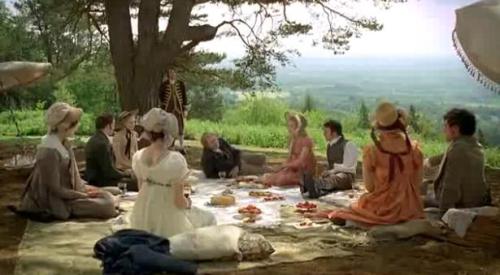





.jpg)


 Emily Hill of the Evening Standard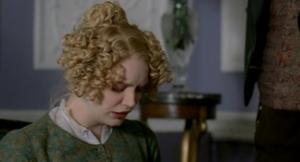







 Goodness. What would the servants have thought?






 Jane Austen's World