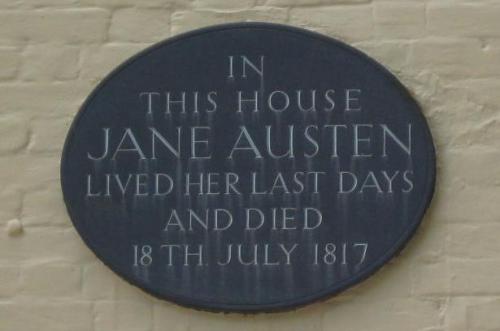
July 18th (today) marks the anniversary day of Jane Austen’s death in a rented house in College Street, Winchester. Her life was all too short (December 16, 1775 – July 18, 1817), and her output all too meager for those who wish she had written more novels. This post consists of a series of recollections of Jane’s last days from her, her family, and her biographers:

During her illness, Jane wrote:
“I live chiefly on the sofa, but am allowed to walk from one room to the other. I have been out once in a sedan-chair, and am to repeat it and be promoted to a wheeled chair as the weather serves.”
“On this subject I will only say further that my dearest sister, my tender watchful, indefatigable nurse has not been made ill by her exertions. As to what I owe to her, and to the anxious affection of all my beloved family on this occasion, I can only cry over it, and pray to God to bless them more and more.”
Her brother Henry wrote that “she supported, during two months, all the varying pain, irksomeness, and tedium,” attendant on her decline “with more than resignation, with a truly elastic cheerfulness.” “She retained,” he says, “her faculties, her memory, her fancy, her temper, and her affections, warm, clear, and unimpaired, to the last . . . . She expired on Friday, July 18 (1817), in the arms of her sister.”
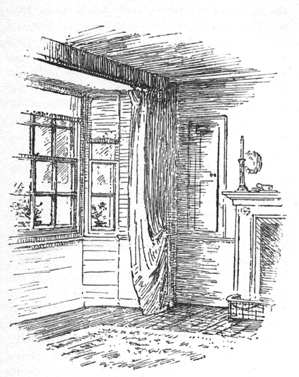
We have followed Miss Austen to Winchester, and have visited the house in College Street where she passed the last weeks of her life. College Street is a narrow picturesque lane, with small old-fashioned houses on one side, terminating in the ancient stone buildings of the College. The garden ground on the opposite side of the street belonged, and still belongs, to the head master. We have entered the “neat little drawing-room with a bow window” which remains unchanged. It is a pretty quaint parlour, with a low ceiling and a narrow doorway. Its white muslin curtains and pots of gay flowers on the window sill lent a cheerful air to the room. We almost fancied we could see Miss Austen seated in the window writing to her nephew, glancing from time to time across the high-walled garden, with its waving trees, to the old red roofs of the Close, with the great grey Cathedral towering above them.- Constance Hill, Jane Austen, Her Homes and Friends

The parlour in College Street
Of her last days, her brother Henry wrote in the introduction of Persuasion and Northanger Abbey, published posthumously:
But the symptoms of a decay, deep and incurable, began to shew themselves in the commencement of 1816. Her decline was at first deceitfully slow; and until the spring of this present year, those who knew their happiness to be involved in her existence could not endure to despair. But in the month of May, 1817, it was found advisable that she should be removed to Winchester for the benefit of constant medical aid, which none even then dared to hope would be permanently beneficial. She supported, during two months, all the varying pain, irksomeness, and tedium, attendant on decaying nature, with more than resignation, with a truly elastic cheerfulness. She retained her faculties, her memory, her fancy, her temper, and her affections, warm, clear, and unimpaired, to the last. Neither her love of God, nor of her fellow creatures flagged for a moment. She made a point of receiving the sacrament before excessive bodily weakness might have rendered her perception unequal to her wishes. She wrote whilst she could hold a pen, and with a pencil when a pen was become too laborious. The day preceding her death she composed some stanzas replete with fancy and vigour. Her last voluntary speech conveyed thanks to her medical attendant; and to the final question asked of her, purporting to know her wants, she replied, “I want nothing but death.”
Jane’s last poem written July 15th:
When Winchester Races
When Winchester races first took their beginning
It is said the good people forgot their old Saint
Not applying at all for the leave of Saint Swithin
And that William of Wykeham’s approval was faint.
The races however were fixed and determined
The company came and the Weather was charming
The Lords and the Ladies were satine’d and ermined
And nobody saw any future alarming.–
But when the old Saint was informed of these doings
He made but one Spring from his Shrine to the Roof
Of the Palace which now lies so sadly in ruins
And then he addressed them all standing aloof.
‘Oh! subjects rebellious! Oh Venta depraved
When once we are buried you think we are gone
But behold me immortal! By vice you’re enslaved
You have sinned and must suffer, ten farther he said
These races and revels and dissolute measures
With which you’re debasing a neighboring Plain
Let them stand–You shall meet with your curse in your pleasures
Set off for your course, I’ll pursue with my rain.
Ye cannot but know my command o’er July
Henceforward I’ll triumph in shewing my powers
Shift your race as you will it shall never be dry
The curse upon Venta is July in showers–‘.
About Jane’s funeral, David Nokes writes in Jane Austen: A Life:
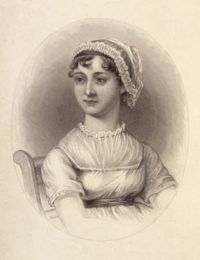 The funeral took place on the morning of Thursday 24 July at Winchester Cathedral. “It is a satisfaction to me,’ Cassandra wrote to Fanny, that her sister’s dear remains were ‘to lie in a building she admired so much – her precious soul I presume to hope reposes in a far superior mansion.’ Only three of the brothers – Edward, Henry and Frank – were present at this ‘last sad ceremony’. Charles, at Easbourne, was too far away to attend; James, too, stayed away. ‘In the sad state of his own health and nerves,’ he said, ‘the trial would be too much for him.’ Women were not expected to attend such melancholy ceremonies; their grief, it was thought, might overcome them. The funeral was held in the early morning; it ‘must be over before ten o’clock,’ Cassandra told Fanny, ‘as the Cathedral service begins at that hour’. Before the coffin was closed, she cut off several lock of Jane’s hair as family mementoes. ‘Everything was conducted with the greatest tranquility,’ she wrote. She and Martha Lloyd ‘watched the little mournful procession the length of the street & when it turned from my sight I had lost her for ever.’ (p. 521)
More about Jane’s last days:
Read Full Post »










 Jane Austen's World