Feeds:
Posts
Comments

Archive for the ‘Jane Austen’s letters’ Category

As we explore September in Jane Austen’s World, we’re nearing the end of summer and the start of fall. Let’s take a look at Jane Austen’s life, letters, and novels and all they can tell us about Regency life in the month of September!

If you’re just jumping on the bus, you can find previous articles in this “A Year in Jane Austen’s World” series here: JanuaryFebruaryMarchAprilMayJune, July, and August.

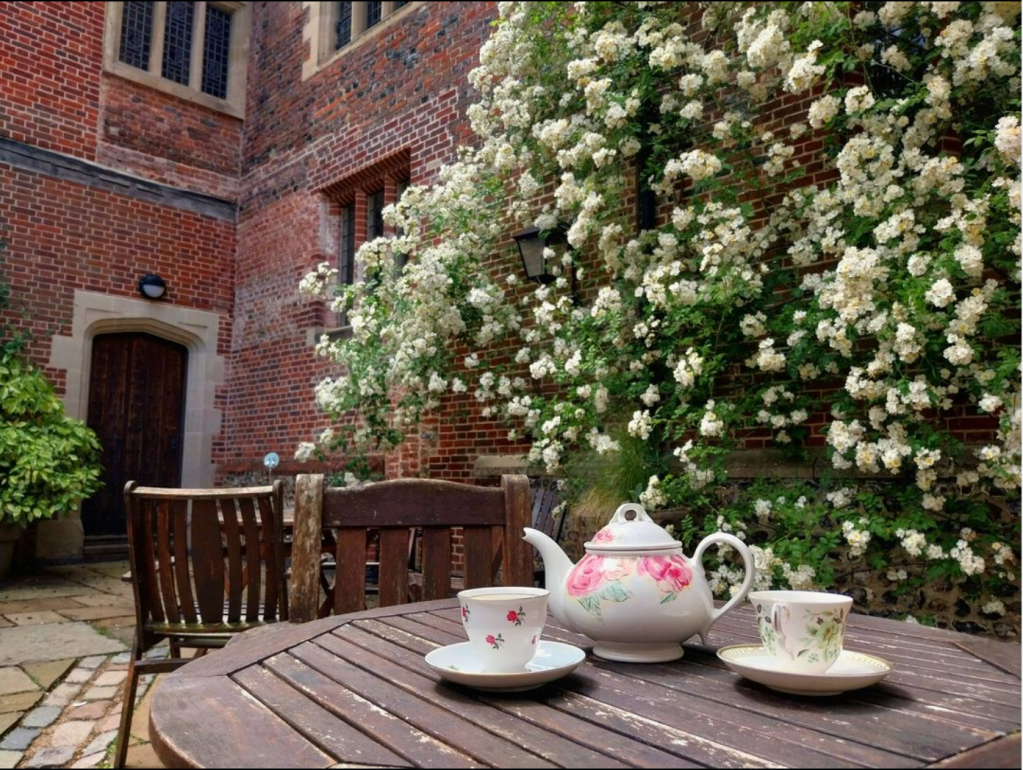
First off, we always love to see what each month brings to the English countryside in Jane Austen’s Hampshire. You can already see a hint of fall colors here and there, but the gardens are still lush and green. Here is a look at Chawton House this time of year:
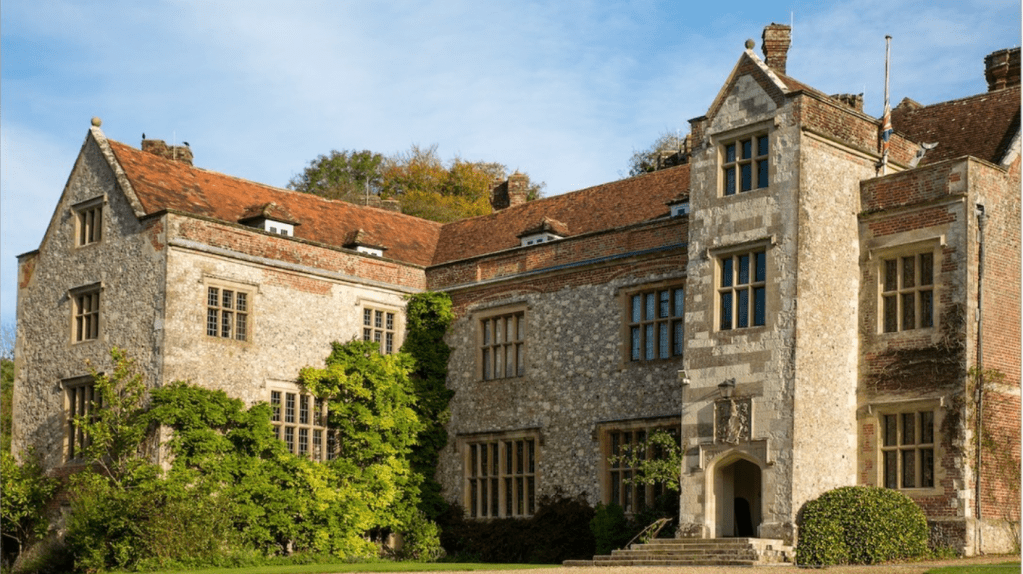
Chawton House in September: Photo @ChawtonHouse.

September in Hampshire

In September, Jane Austen’s Hampshire still feels like summer, but there is a hint of autumn in the air that deepens as the month draws on. Of the weather, we have two comments from Austen in September 1796:

1 September (Rowling): “Our men had but indifferent weather for their visit to Godmersham, for it rained great part of the way there and all the way back.”

18 September (Rowling): “What dreadful hot weather we have! It keeps one in a continual state of inelegance.”

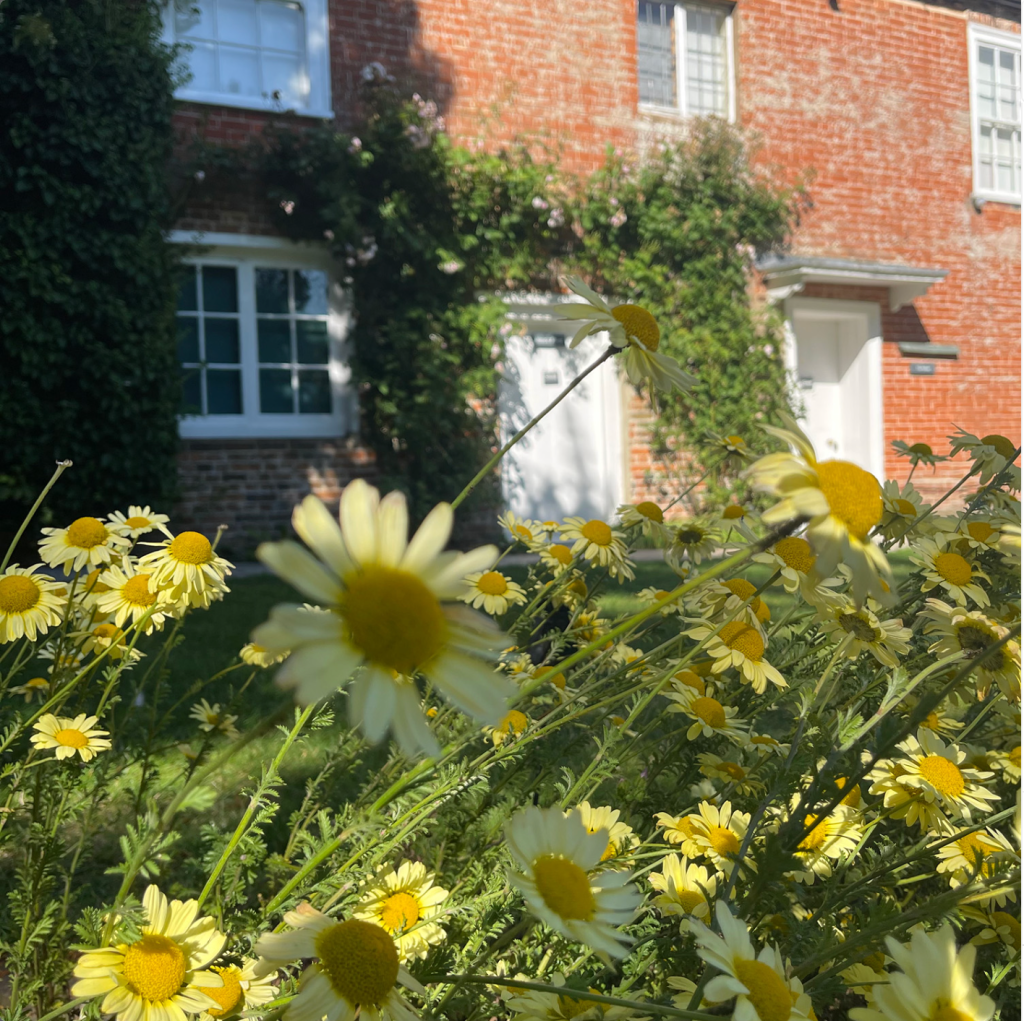
Here is a glimpse of Jane Austen’s House Museum and its gardens in September:
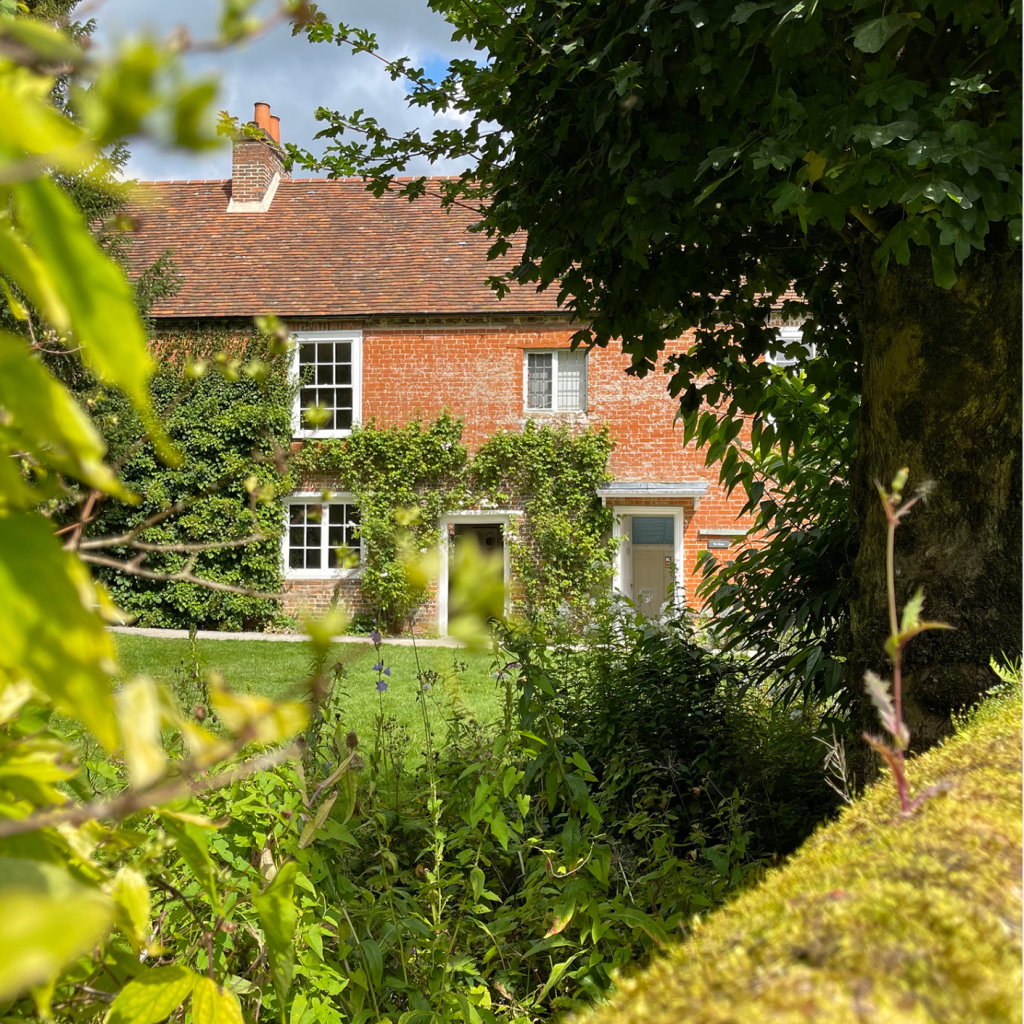
Jane Austen’s House in September, Photo: @JaneAustensHouse.

September in Jane Austen’s Letters

Of Austen’s surviving letters, there are four from the month of September. All are dated from September 1796, at Rowling House. Austen spent several weeks there visiting her brother Edward and his wife, Elizabeth, at their first home, Rowling, a large farmhouse in Kent. Here are a few interesting highlights from her letters during her time there:

1 September:

  • Jane and Cassandra’s friendship: “The letter which I have this moment received from you has diverted me beyond moderation. I could die of laughter at it, as they used to say at school. You are indeed the finest comic writer of the present age.”
  • New gowns: “I have had my new gown made up, and it really makes a very superb surplice. I am sorry to say that my new coloured gown is very much washed out, though I charged everybody to take great care of it. I hope yours is so too.”
  • Jane’s skill with a needle and thread: “We are very busy making Edward’s shirts, and I am proud to say that I am the neatest worker of the party.”

Jane Austen quite prided herself on her needlework. In her article “I Am the Neatest Worker of the Party”: Making and Mending the Family’s Wardrobe,” Ann Buermann Wass (Persuasions On-Line) shares this:

“Before the invention of the sewing machine, all sewing had to be done by hand. While some tasks were left to professionals, the sewing of mothers, sisters, and daughters was a significant contribution to the household. Both letters and diaries suggest that women’s hands were seldom idle as they “sat at work,” that is, sewed garments for themselves and their families and mended them as they showed signs of wear. This work, stowed in work (or sewing) bags, was portable and could be carried around the house or even taken out visiting, allowing women to be productive while they chatted.” (Bauermann Wass)
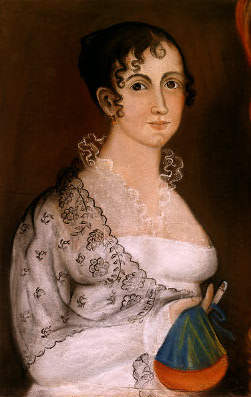
Lady with a Red and Blue Sewing Bag (1815). National Gallery of Art.

5 September:

  • Cassandra attends a ball: “I shall be extremely anxious to hear the event of your ball, and shall hope to receive so long and minute an account of every particular that I shall be tired of reading it. Let me know how many, besides their fourteen selves and Mr. and Mrs. Wright, Michael will contrive to place about their coach, and how many of the gentlemen, musicians, and waiters, he will have persuaded to come in their shooting-jackets. I hope John Lovett’s accident will not prevent his attending the ball, as you will otherwise be obliged to dance with Mr. Tincton the whole evening. Let me know how J. Harwood deports himself without the Miss Biggs, and which of the Marys will carry the day with my brother James.”
  • Jane attends a ball: “We were at a ball on Saturday, I assure you. We dined at Goodnestone, and in the evening danced two country-dances and the Boulangeries. I opened the ball with Edward Bridges; the other couples were Lewis Cage and Harriet, Frank and Louisa, Fanny and George. Elizabeth played one country-dance, Lady Bridges the other, which she made Henry dance with her, and Miss Finch played the Boulangeries. (In reading over the last three or four lines, I am aware of my having expressed myself in so doubtful a manner that, if I did not tell you to the contrary, you might imagine it was Lady Bridges who made Henry dance with her at the same time that she was playing, which, if not impossible, must appear a very improbable event to you. But it was Elizabeth who danced.) We supped there, and walked home at night under the shade of two umbrellas.”
15 September:

  • Living in style: “We have been very gay since I wrote last; dining at Nackington, returning by moonlight, and everything quite in style, not to mention Mr. Claringbould’s funeral which we saw go by on Sunday.”
  • Jane’s commentary: “Miss Fletcher and I were very thick, but I am the thinnest of the two. She wore her purple muslin, which is pretty enough, though it does not become her complexion. There are two traits in her character which are pleasing — namely, she admires Camilla, and drinks no cream in her tea.”
  • A gentleman Jane admired: “We went by Bifrons, and I contemplated with a melancholy pleasure the abode of him on whom I once fondly doated.”
  • Jane’s travel plans: “As to the mode of our travelling to town, I want to go in a stage-coach, but Frank will not let me. As you are likely to have the Williams and Lloyds with you next week, you would hardly find room for us then. If anyone wants anything in town, they must send their commissions to Frank, as I shall merely pass through it. The tallow-chandler is Penlington, at the Crown and Beehive, Charles Street, Covent Garden.

What an intriguing line: “the abode of him on whome I once fondly doated.” Like me, you’re probably thinking, Who was this man? While some might wonder if she was referencing Tom Lefroy, it seems that Austen was actually writing about a different man.

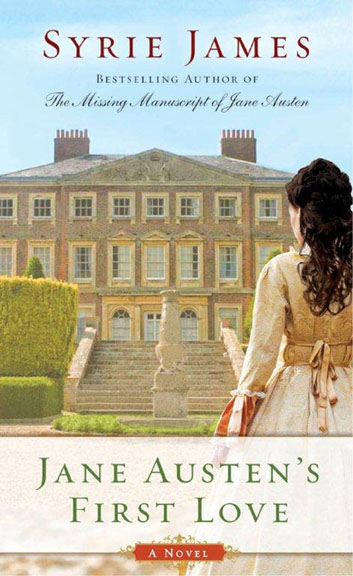
Syrie James explains this reference in the following excerpt from her article, “Edward Taylor of Bifrons: Jane Austen’s First Love,” English Historical Fiction Authors (December 3, 2014):

When Jane wrote that letter in 1796, her flirtation with Lefroy had ended some seven months prior. She was reminiscing with wistful longing about a young man she’d met many years earlier. Scholars have long since identified the “Him” as Edward Taylor, and the “abode,” Bifrons Park, as the estate in Kent which he would one day inherit. Little else, however, was known about him. Biographer Deirdre Le Faye, in Jane Austen: A Family Record (1989) simply states, “Jane met and briefly cherished a girlish passion for young Mr. Edward Taylor of Bifrons.” John Halperin, in The Life of Jane Austen (1984), refers to Edward Taylor as “her old beau” and “the most shadowy of her possible early ‘suitors.’

You can read more of James’s fascinating article about Edward Taylor of Bifrons HERE. Her book Jane Austen’s First Love is based on her research about the young man Jane Austen apparently “doated” on in her youth. I have not read it, but I like the concept!
18 September:

  • News of Frank’s new appointment: “Frank has received his appointment on board the “Captain John Gore,” commanded by the “Triton,” and will therefore be obliged to be in town on Wednesday.” (The “Triton” is a new 32 frigate just launch at Deptford. Frank is much pleased with the prospect of having Captain Gore under his command.)

Having brothers in the Navy meant that the two Austen sisters were well-versed on topics surrounding ships, men in leadership, and appointments. Here is a fascinating bit of information I discovered about the very unique HMS Triton:

Triton was an experimental ship and the only one built to that design; she was constructed out of fir due to wartime supply shortages of more traditional materials and had some unusual features such as no tumblehome. Her namesake was the Greek god Triton, a god of the sea. She was commissioned in June 1796 under Captain John Gore, with whom she would spend the majority of her active service, to serve in the Channel in the squadron of Sir John Warren.” (Wikipedia)
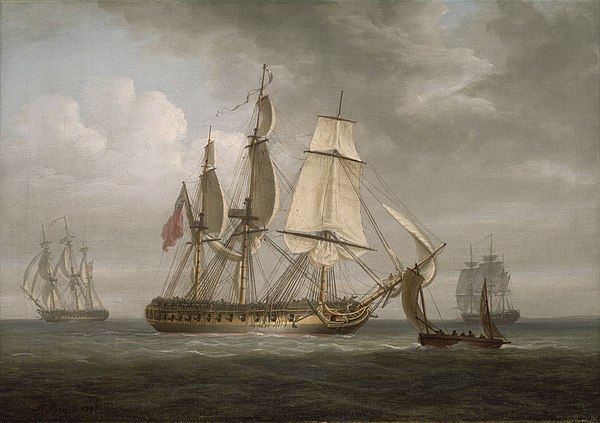
HMS Triton, artist Nicholas Pocock (1797).

September in Jane Austen’s Novels

Sense and Sensibility

  • The Dashwood women arrive at Barton Cottage in September: “As a house, Barton Cottage, though small, was comfortable and compact; but as a cottage it was defective, for the building was regular, the roof was tiled, the window shutters were not painted green, nor were the walls covered with honeysuckles. A narrow passage led directly through the house into the garden behind. On each side of the entrance was a sitting room, about sixteen feet square; and beyond them were the offices and the stairs. Four bed-rooms and two garrets formed the rest of the house. It had not been built many years and was in good repair. In comparison of Norland, it was poor and small indeed!—but the tears which recollection called forth as they entered the house were soon dried away. They were cheered by the joy of the servants on their arrival, and each for the sake of the others resolved to appear happy. It was very early in September; the season was fine, and from first seeing the place under the advantage of good weather, they received an impression in its favour which was of material service in recommending it to their lasting approbation.”
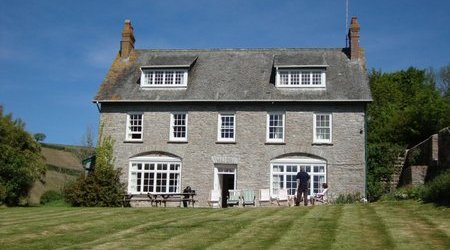
Barton Cottage, Sense and Sensibility (1995), an 18th century stone cottage on Flete Estate in South Devon.

Pride and Prejudice

  • Lydia’s new husband goes hunting in September: “Lydia was exceedingly fond of him. He was her dear Wickham on every occasion; no one was to be put in competition with him. He did everything best in the world; and she was sure he would kill more birds on the first of September than anybody else in the country.”

September 1st is when hunting season opens for partridge, duck, and goose in the UK, as it did in Jane Austen’s day. Apparently, Lydia thinks her new husband will kill more birds than any other man in England on opening day!

Mansfield Park

  • Mr. Crawford goes to Norfolk in September: “The season and duties which brought Mr. Bertram back to Mansfield took Mr. Crawford into Norfolk. Everingham could not do without him in the beginning of September. He went for a fortnight—a fortnight of such dullness to the Miss Bertrams as ought to have put them both on their guard, and made even Julia admit, in her jealousy of her sister, the absolute necessity of distrusting his attentions, and wishing him not to return; and a fortnight of sufficient leisure, in the intervals of shooting and sleeping, to have convinced the gentleman that he ought to keep longer away, had he been more in the habit of examining his own motives, and of reflecting to what the indulgence of his idle vanity was tending; but, thoughtless and selfish from prosperity and bad example, he would not look beyond the present moment. The sisters, handsome, clever, and encouraging, were an amusement to his sated mind; and finding nothing in Norfolk to equal the social pleasures of Mansfield, he gladly returned to it at the time appointed, and was welcomed thither quite as gladly by those whom he came to trifle with further.”

Emma

  • Mr. Weston proclaimed a hero by Emma’s sister for his help one September night: “Me, my love,” cried his wife, hearing and understanding only in part.— “Are you talking about me?—I am sure nobody ought to be, or can be, a greater advocate for matrimony than I am; and if it had not been for the misery of her leaving Hartfield, I should never have thought of Miss Taylor but as the most fortunate woman in the world; and as to slighting Mr. Weston, that excellent Mr. Weston, I think there is nothing he does not deserve. I believe he is one of the very best-tempered men that ever existed. Excepting yourself and your brother, I do not know his equal for temper. I shall never forget his flying Henry’s kite for him that very windy day last Easter—and ever since his particular kindness last September twelvemonth in writing that note, at twelve o’clock at night, on purpose to assure me that there was no scarlet fever at Cobham, I have been convinced there could not be a more feeling heart nor a better man in existence.—If any body can deserve him, it must be Miss Taylor.”
  • Harriet’s visit to the Martin family and a fond September memory: “She had seen only Mrs. Martin and the two girls. They had received her doubtingly, if not coolly; and nothing beyond the merest commonplace had been talked almost all the time—till just at last, when Mrs. Martin’s saying, all of a sudden, that she thought Miss Smith was grown, had brought on a more interesting subject, and a warmer manner. In that very room she had been measured last September, with her two friends. There were the pencilled marks and memorandums on the wainscot by the window. He had done it. They all seemed to remember the day, the hour, the party, the occasion—to feel the same consciousness, the same regrets—to be ready to return to the same good understanding; and they were just growing again like themselves, (Harriet, as Emma must suspect, as ready as the best of them to be cordial and happy,) when the carriage reappeared, and all was over. The style of the visit, and the shortness of it, were then felt to be decisive. Fourteen minutes to be given to those with whom she had thankfully passed six weeks not six months ago!”
  • Harriet marries Mr. Martin in September:Before the end of September, Emma attended Harriet to church, and saw her hand bestowed on Robert Martin with so complete a satisfaction, as no remembrances, even connected with Mr. Elton as he stood before them, could impair.—Perhaps, indeed, at that time she scarcely saw Mr. Elton, but as the clergyman whose blessing at the altar might next fall on herself.—Robert Martin and Harriet Smith, the latest couple engaged of the three, were the first to be married.”
  • Anne grieves living away from Kellynch Hall for Michaelmas (29th of September): “Michaelmas came; and now Anne’s heart must be in Kellynch again. A beloved home made over to others; all the precious rooms and furniture, groves, and prospects, beginning to own other eyes and other limbs! She could not think of much else on the 29th of September; and she had this sympathetic touch in the evening from Mary, who, on having occasion to note down the day of the month, exclaimed, “Dear me, is not this the day the Crofts were to come to Kellynch? I am glad I did not think of it before. How low it makes me!”
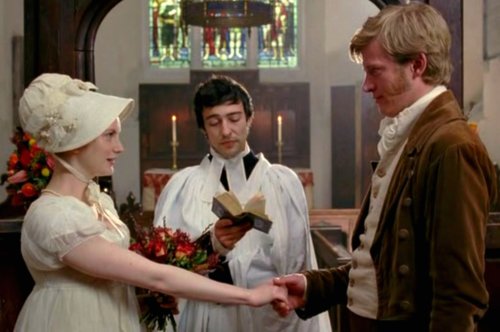
Harriet marries Mr. Martin (Emma 2009).

September Dates of Importance

This brings us now to several important September dates that relate to Jane and her family:

Family News:

15 September 1791: James Austen becomes vicar of Sherborne St John, Hampshire.

September 1794: Charles Austen graduates from the Royal Naval Academy and becomes a midshipman aboard HMS Daedalus.

Historic Dates:

3 September 1783: The Treaty of Paris is signed, ending the American War of Independence.

29 September (yearly): Michaelmas celebrations, a day of feasting, which traditionally included a roast goose and blackberry pie.

Writing:

August/September 1815: Jane Austen possibly travels to London, regarding the publication of Emma, returning early in September.

Sorrows:

6 September 1814: Charles Austen’s wife Fanny dies after childbirth.
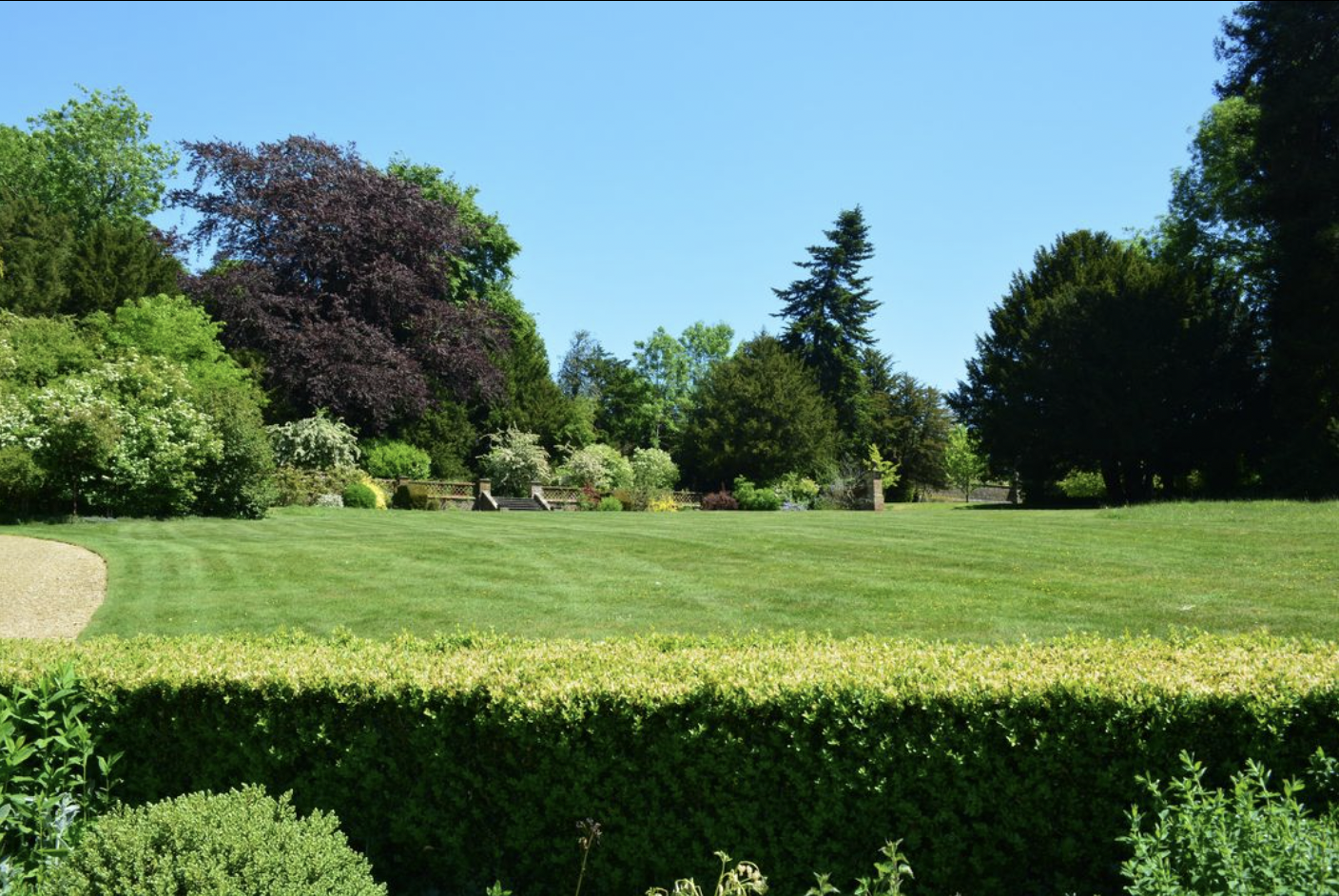
Chawton House Gardens in September: Photo @ChawtonHouse.

September

As you can see, September is a month when Jane Austen and her friends, family, and characters enjoyed travel, balls, and other outings. Next month, we’ll step into autumn in Hampshire and learn about October in Jane Austen’s World!


RACHEL DODGE teaches college English classes, gives talks at libraries, teas, and book clubs, and writes for Jane Austen’s World blog. She is the bestselling author of The Little Women DevotionalThe Anne of Green Gables Devotional and Praying with Jane: 31 Days Through the Prayers of Jane Austen. Now Available: The Secret Garden Devotional! You can visit Rachel online at www.RachelDodge.com.
Read Full Post »

Our month-by-month exploration of Jane Austen’s life, letters, and novels continues now as we take a look at August in Jane Austen’s world. If you’re new to the “A Year in Jane Austen’s World” series, you can find previous articles here: JanuaryFebruaryMarchAprilMay, June, and July.

During the lovely summer months in the Hampshire countryside, we know Jane loved to walk and write and visit with friends and family. Sometimes the days are hot, but most of the time, it’s sunny and warm–usually with a chance of showers, which is what helps keep things so pretty and green. If you visit Chawton House Gardens or Jane Austen’s House this time of year, there is plenty to see!

Chawton House in August: Photo @ChawtonHouse.
Jane Austen’s House in August, Photo: @JaneAustensHouse.

Austen in Stitches

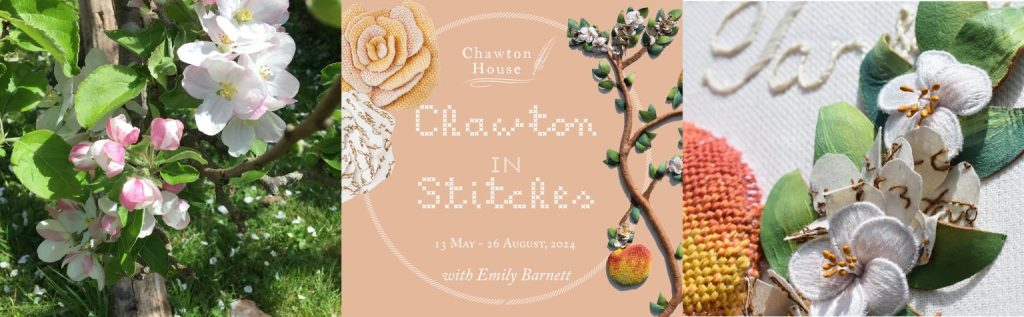
This summer, Chawton House Museum is hosting the “Chawton in Stitches” exhibit, which showcases “the work of award-winning graduate of the Royal School of Needlework Emily Barnett, whose degree project took inspiration from the gardens and collection at Chawton House. Her final showstopping piece comprises three beautifully embroidered panels, focusing on the Orchard and the Knight family cookbook, the Rose Garden and Elizabeth Blackwell’s Curious Herbal, and the Library Terrace and the women’s writing collection.”

You can read more about it HERE.

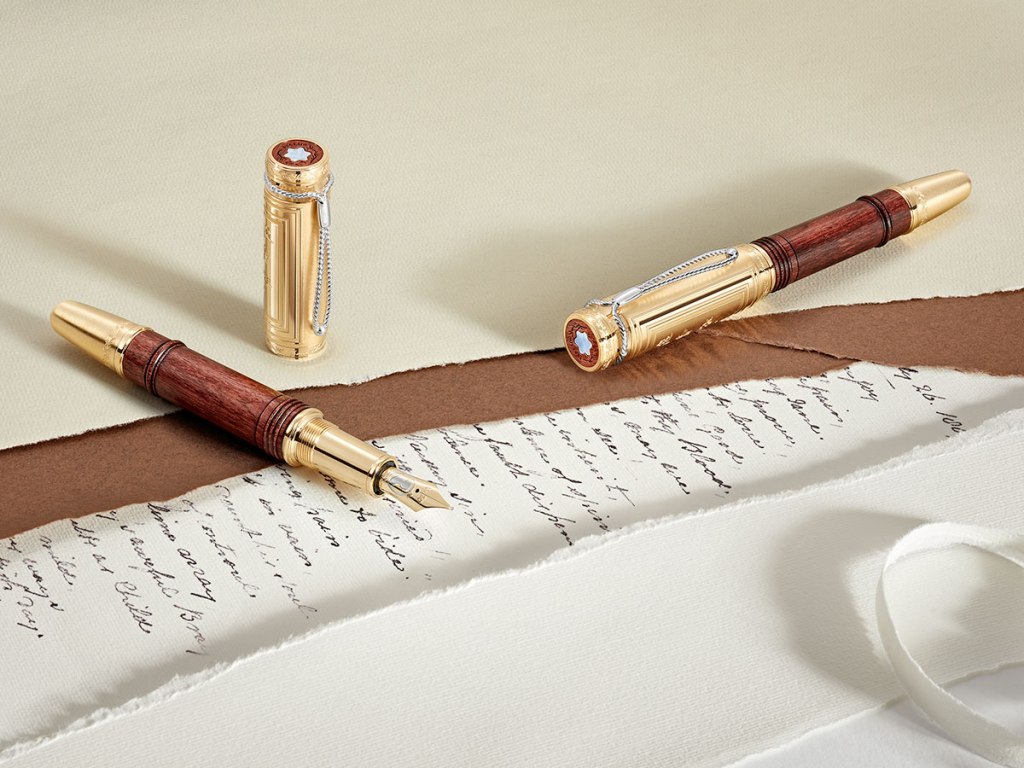
Austen Fountain Pens

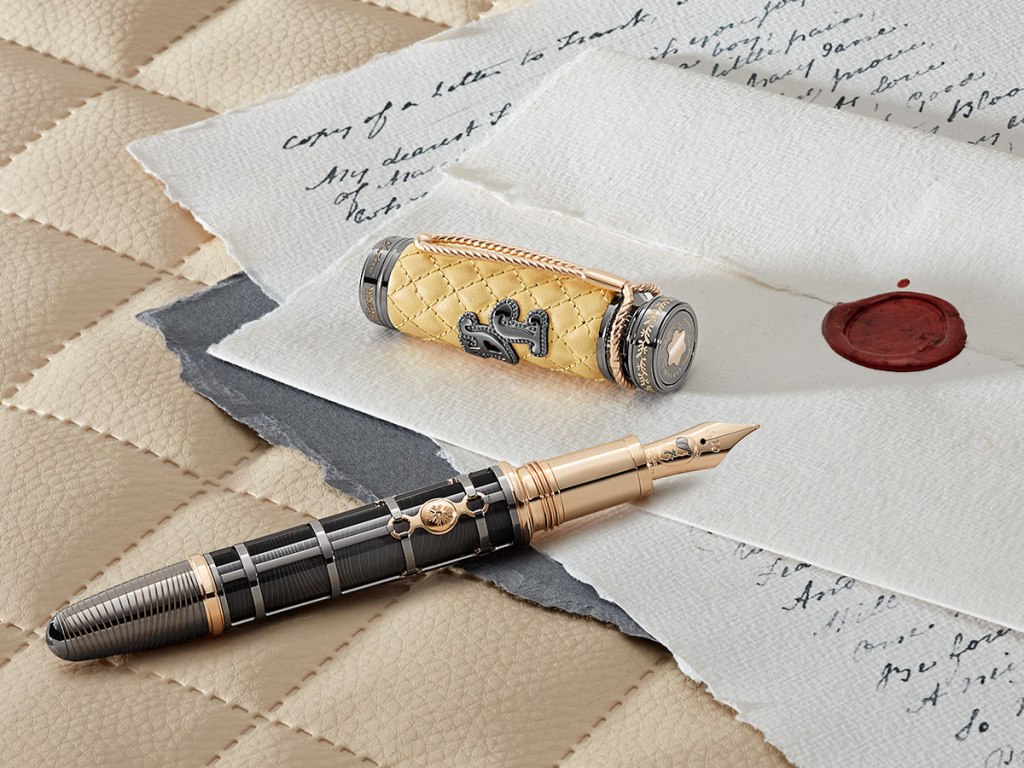
The Jane Austen House Museum is proud to announce a beautiful new set of pens from Montblanc: “Historic luxury pen manufacturer Montblanc releases four exquisite limited edition writing instruments, celebrating Jane Austen and inspired by Jane Austen’s House.”

“The Montblanc Writers Edition Homage to Jane Austen pays tribute to Jane Austen as one of Britain’s most celebrated novelists with four limited edition pens. Each writing instrument in the collection represents a passion in Jane Austen’s life, including the countryside, this very House, travel and the ball, illustrating the many facets of her life and works. Details in the craftsmanship of each pen seamlessly reflect aspects of Jane Austen’s life and writing.”

August in Jane Austen’s Letters

Jane tends to write about the weather at some point in her letters, and her August letters are no different:

Cork Street, August 1796
“We reached Staines yesterday, I do not (know) when, without suffering so much from the heat as I had hoped to do. We set off again this morning at seven o’clock, and had a very pleasant drive, as the morning was cloudy and perfectly cool. I came all the way in the chaise from Hertford Bridge.”

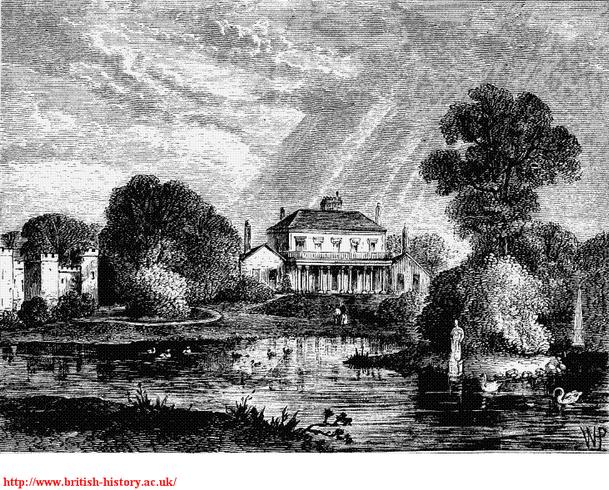
She also writes about Henry’s lovely new home in Hans Place, about her own room, the gardens, and the downstairs room that seems to be where she writes in the morning.

23 Hans Place, August 1814
It is a delightful place,—more than answers my expectation. Having got rid of my unreasonable ideas, I find more space and comfort in the rooms than I had supposed, and the garden is quite a love. I am in the front attic, which is the bedchamber to be preferred.”

“I live in [Henry’s] room downstairs; it is particularly pleasant from opening upon the garden. I go and refresh myself every now and then, and then come back to solitary coolness.”

Now I have breakfasted and have the room to myself again. It is likely to be a fine day. How do you all do?”

From Vic: “In 1814, Henry moved from his rooms above his bank to a house he purchased in Hans Place in Knightsbridge. The area was situated near his old quarters on Sloane Street.” You can read more about Hans Place in Vic’s detailed article, “Jane Austen’s Visits to London.”

Hans Place, The Pavillion, 1812. Image @British History Online

August in Jane Austen’s Novels

Pride and Prejudice

  • Mr. Gardiner writes to Mr. Bennet in August (Gracechurch Street, Monday, August 2). Elizabeth reads the letter:

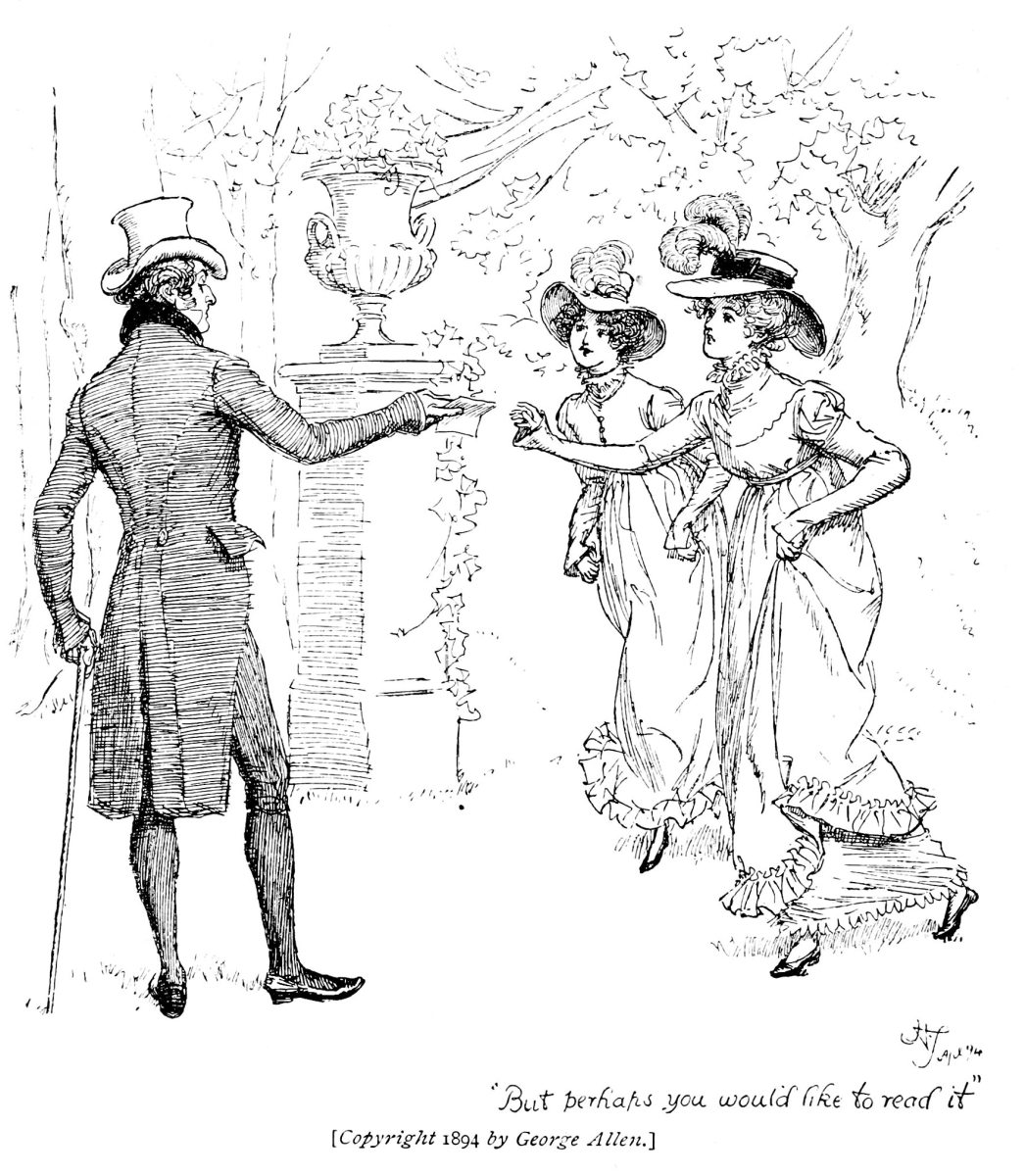
    “My dear Brother, At last I am able to send you some tidings of my niece, and such as, upon the whole, I hope will give you satisfaction. Soon after you left me on Saturday, I was fortunate enough to find out in what part of London they were. The particulars I reserve till we meet. It is enough to know they are discovered: I have seen them both——”

    “Then it is as I always hoped,” cried Jane: “they are married!”

    Elizabeth reads on: “I have seen them both. They are not married, nor can I find there was any intention of being so; but if you are willing to perform the engagements which I have ventured to make on your side, I hope it will not be long before they are. All that is required of you is, to assure to your daughter, by settlement, her equal share of the five thousand pounds, secured among your children after the decease of yourself and my sister; and, moreover, to enter into an engagement of allowing her, during your life, one hundred pounds per annum…”

Mansfield Park

  • Tom Bertram arrives home: “Sir Thomas was to return in November, and his eldest son had duties to call him earlier home. The approach of September brought tidings of Mr. Bertram, first in a letter to the gamekeeper and then in a letter to Edmund; and by the end of August he arrived himself, to be gay, agreeable, and gallant again as occasion served, or Miss Crawford demanded; to tell of races and Weymouth, and parties and friends, to which she might have listened six weeks before with some interest, and altogether to give her the fullest conviction, by the power of actual comparison, of her preferring his younger brother.”
  • Sir Thomas arrives home earlier than expected: “Julia, appearing at it, with a face all aghast, exclaimed, ‘My father is come! He is in the hall at this moment.’ How is the consternation of the party to be described? To the greater number it was a moment of absolute horror. Sir Thomas in the house! All felt the instantaneous conviction. Not a hope of imposition or mistake was harboured anywhere. Julia’s looks were an evidence of the fact that made it indisputable; and after the first starts and exclamations, not a word was spoken for half a minute: each with an altered countenance was looking at some other, and almost each was feeling it a stroke the most unwelcome, most ill-timed, most appalling! Mr. Yates might consider it only as a vexatious interruption for the evening, and Mr. Rushworth might imagine it a blessing; but every other heart was sinking under some degree of self-condemnation or undefined alarm, every other heart was suggesting, ‘What will become of us? what is to be done now?’ It was a terrible pause; and terrible to every ear were the corroborating sounds of opening doors and passing footsteps.”

Emma

  • August is when Jane Fairfax will leave Highbury: “Jane Fairfax was still at her grandmother’s; and as the return of the Campbells from Ireland was again delayed, and August, instead of Midsummer, fixed for it, she was likely to remain there full two months longer, provided at least she were able to defeat Mrs. Elton’s activity in her service, and save herself from being hurried into a delightful situation against her will.”
  • Emma’s sisters Isabella plans to visit in August (and will keep Harriet with them until then): “Mr. and Mrs. John Knightley were to come down in August, and she was invited to remain till they could bring her back.”
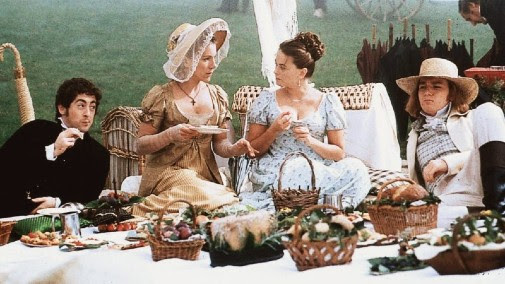
Box Hill Picnic

Persuasion

  • Anne Elliot’s birthday: Anne, born August 9, 1787.
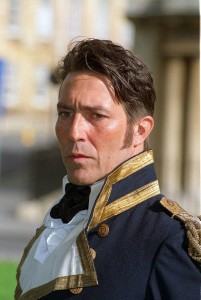
  • Captain Wentworth goes to stay with Captain Benwick in August in order to break the news of Fanny Harville’s (his fiancée’s) death: “Not till the first week of August, when he came home from the Cape, just made into the Grappler. I was at Plymouth dreading to hear of him; he sent in letters, but the Grappler was under orders for Portsmouth. There the news must follow him, but who was to tell it? not I. I would as soon have been run up to the yard-arm. Nobody could do it, but that good fellow (pointing to Captain Wentworth). The Laconia had come into Plymouth the week before; no danger of her being sent to sea again. He stood his chance for the rest; wrote up for leave of absence, but without waiting the return, travelled night and day till he got to Portsmouth, rowed off to the Grappler that instant, and never left the poor fellow for a week. That’s what he did, and nobody else could have saved poor James. You may think, Miss Elliot, whether he is dear to us!”
Ciarán Hinds as Captain Frederick Wentworth in Persuasion, 1995.

August Dates of Importance

This brings us now to several important August dates that relate to Jane and her family:

Family News:
26 August 1766: George Austen (Jane’s brother) born at Deane.
July-August 1768: Austen family moves to Steventon, Hampshire.

Historic Dates:
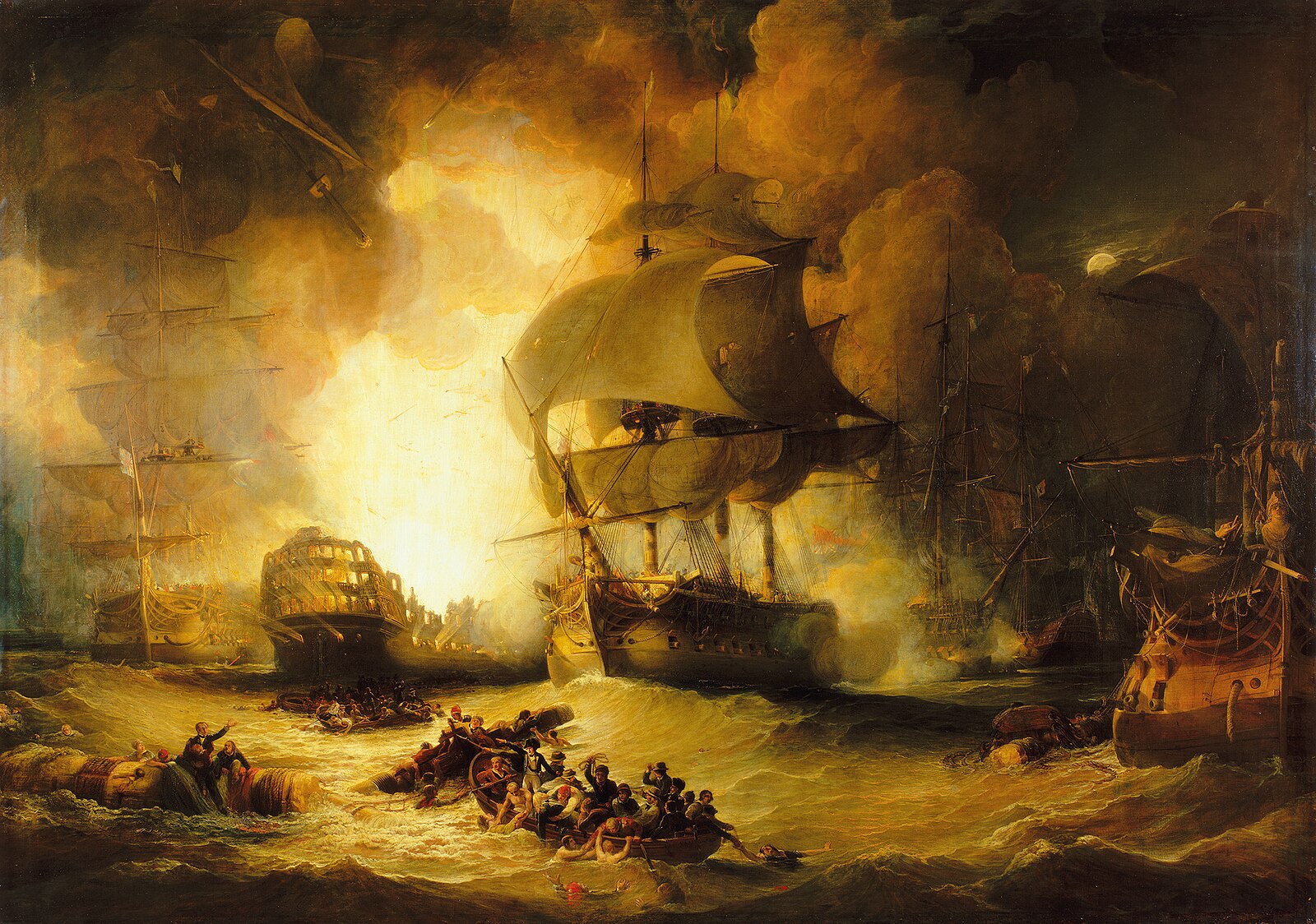
1 August 1798: Horatio Nelson’s victory over Napoleon’s fleet at the Battle of the Nile.

Writing:
August 1797: Austen finishes “First Impressions.”
8 August 1815: Austen begins Persuasion.
August 1816: Persuasion revised and finished.

Sorrows:
9 August 1798: Lady Williams (Jane Cooper, one of Austen’s lifelong friends), dies in a tragic carriage accident on the Isle of Wight at the age of 27.

The Destruction of ‘L’Orient’ at the Battle of the Nile, George Arnald.
1 August 1798. (Wikimedia Commons.)

Summer Wanes

As the summer heat slowly diminishes in Jane Austen’s England, we can look forward to the first breaths of autumn next month when we return to examine September in Jane Austen’s World. Until then, I hope you’ve enjoyed exploring August and all it has to offer!


RACHEL DODGE teaches college English classes, gives talks at libraries, teas, and book clubs, and writes for Jane Austen’s World blog. She is the bestselling author of The Little Women DevotionalThe Anne of Green Gables Devotional and Praying with Jane: 31 Days Through the Prayers of Jane Austen. Now Available: The Secret Garden Devotional! You can visit Rachel online at www.RachelDodge.com.
Read Full Post »

As the summer months continue in our month-by-month exploration of Jane Austen’s life, letters, and novels, we turn our attention to July in Jane Austen’s world. If you’re new to the “A Year in Jane Austen’s World” series, you can find previous articles here: JanuaryFebruaryMarchApril, May, and June.

Last month, we enjoyed the June roses at Chawton House Gardens. Let’s take a look at our monthly view for July! Can you imagine exploring the walled gardens on a warm summer day? I know two kids who did explore the gardens and the apple orchard (with permission) at Chawton House a few years ago!

Chawton House in July: Photo @ChawtonHouse.

July in Hampshire

July in Hampshire brings sporadic heat waves, overcast days, sunny days, and frequent rain showers. The Austen women moved to Chawton in July 1809:

“On this day (7 July) in 1809 Jane Austen moved to Chawton to live in this house. It was here, in this inspiring cottage, that Jane’s genius flourished and where she wrote, revised, and had published all six of her globally beloved novels.” (Jane Austen’s House Museum)

Jane Austen’s House in July, Photo: @JaneAustensHouse.

July in Jane Austen’s Letters

We don’t have as many of Jane’s letters from the month of July on record, though there is one funny aside that caught my attention as I searched through her letters. After complaining earlier to Cassandra about a few days of “cold disagreeable weather,” “fires every day,” and use of her “kerseymere spencer” for evening walks, Jane wrote the following on 1 July 1808: “The weather is mended, which I attribute to my writing about it…”

The fact is, however, that two of the most important letters we have from the month of July are not from Jane herself but from her sister Cassandra. And those, as many of you well know, are the letters Cassandra wrote to her niece Fanny Knight after Jane’s passing in July 1817.

Cassandra’s Letters

Cassandra’s letters, which many of you have read, are some of the most beautiful letters we have on record. Jane was Cassandra’s younger sister, but she was also her lifelong companion and best friend. Cassandra’s sorrow at losing one so dear is obvious in her writings.

In her first letter (18 July 1817), Cassandra tells Fanny about Jane’s last days and hours with delicacy, reverence, and love:

I have lost a treasure, such a sister, such a friend as never can have been surpassed. She was the sun of my life, the gilder of every pleasure, the soother of every sorrow; I had not a thought concealed from her, and it is as if I had lost a part of myself. I loved her only too well,—not better than she deserved, but I am conscious that my affection for her made me sometimes unjust to and negligent of others; and I can acknowledge, more than as a general principle, the justice of the Hand which has struck this blow.

You know me too well to be at all afraid that I should suffer materially from my feelings; I am perfectly conscious of the extent of my irreparable loss, but I am not at all overpowered and very little indisposed,—nothing but what a short time, with rest and change of air, will remove. I thank God that I was enabled to attend her to the last, and amongst my many causes of self-reproach I have not to add any wilful neglect of her comfort.

In her second letter (29 July 1817), Cassandra expresses to Fanny that she often thinks of Jane in Heaven and hopes she will one day be reunited with her there:

If I think of her less as on earth, God grant that I may never cease to reflect on her as inhabiting heaven, and never cease my humble endeavors (when it shall please God) to join her there.

As a lifelong lover of Jane Austen, I treasure Cassandra’s letters deeply, as I’m sure many of you do too. If you have not read her letters in a while, or if you wish to read them for the first time, you can find them HERE.

July in Jane Austen’s Novels

Pride and Prejudice

  • July is when Elizabeth travels with Mr. and Mrs. Gardiner: “The time fixed for the beginning of their northern tour was now fast approaching; and a fortnight only was wanting of it, when a letter arrived from Mrs. Gardiner, which at once delayed its commencement and curtailed its extent. Mr. Gardiner would be prevented by business from setting out till a fortnight later in July, and must be in London again within a month; and as that left too short a period for them to go so far, and see so much as they had proposed, or at least to see it with the leisure and comfort they had built on, they were obliged to give up the Lakes, and substitute a more contracted tour; and, according to the present plan, were to go no farther northward than Derbyshire. In that county there was enough to be seen to occupy the chief of their three weeks; and to Mrs. Gardiner it had a peculiarly strong attraction. The town where she had formerly passed some years of her life, and where they were now to spend a few days, was probably as great an object of her curiosity as all the celebrated beauties of Matlock, Chatsworth, Dovedale, or the Peak.”
Elizabeth and Mr. Darcy, Mr. and Mrs. Gardiner

Mansfield Park

  • Mr. and Miss Crawford come on the scene: “Such was the state of affairs in the month of July; and Fanny had just reached her eighteenth year, when the society of the village received an addition in the brother and sister of Mrs. Grant, a Mr. and Miss Crawford, the children of her mother by a second marriage. They were young people of fortune. The son had a good estate in Norfolk, the daughter twenty thousand pounds.”

Emma

  • The night before Mr. Knightley returns from London, Emma spends a miserable evening wondering what will come of Harriet’s feelings (and her own feelings) toward Mr. Knightley: “The evening of this day was very long, and melancholy, at Hartfield. The weather added what it could of gloom. A cold stormy rain set in, and nothing of July appeared but in the trees and shrubs, which the wind was despoiling, and the length of the day, which only made such cruel sights the longer visible.”
  • Emma’s thoughts that evening regarding the loss of Mr. Knightley, if he were to marry Harriet: “All that were good would be withdrawn; and if to these losses, the loss of Donwell were to be added, what would remain of cheerful or of rational society within their reach? Mr. Knightley to be no longer coming there for his evening comfort!—No longer walking in at all hours, as if ever willing to change his own home for theirs!—How was it to be endured?”
Gwyneth Paltrow in Emma, 1997.

Persuasion

  • Sir Walter Elliot’s wedding day: “Walter Elliot, born March 1, 1760, married, July 15, 1784, Elizabeth, daughter of James Stevenson, Esq. of South Park, in the county of Gloucester, by which lady (who died 1800) he has issue Elizabeth, born June 1, 1785; Anne, born August 9, 1787; a still-born son, November 5, 1789; Mary, born November 20, 1791.”
  • The letter Mrs. Smith produces from Mr. Elliot, written to “Charles Smith, Esq. Tunbridge Wells,” dated July 1803, reads as follows:

“Dear Smith,

“I have received yours. Your kindness almost overpowers me. I wish nature had made such hearts as yours more common, but I have lived three-and-twenty years in the world, and have seen none like it. At present, believe me, I have no need of your services, being in cash again. Give me joy: I have got rid of Sir Walter and Miss. They are gone back to Kellynch, and almost made me swear to visit them this summer; but my first visit to Kellynch will be with a surveyor, to tell me how to bring it with best advantage to the hammer. The baronet, nevertheless, is not unlikely to marry again; he is quite fool enough. If he does, however, they will leave me in peace, which may be a decent equivalent for the reversion. He is worse than last year.

“I wish I had any name but Elliot. I am sick of it. The name of Walter I can drop, thank God! and I desire you will never insult me with my second W. again, meaning, for the rest of my life, to be only yours truly,

“WM. ELLIOT.”

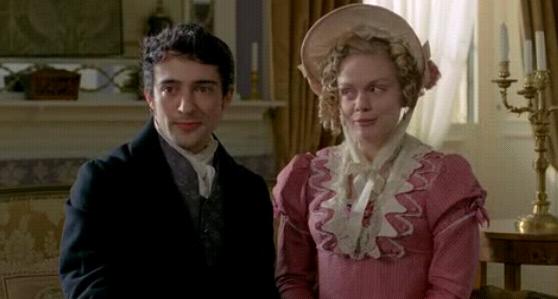
Samuel West at Mr. Elliot in Persuasion, 1995.

July Dates of Importance

This brings us now to several important July dates that relate to Jane and her family:

Family News:

July–August 1768: The Austen family moves to Steventon, Hampshire.

3 July 1779: James Austen matriculates at St. John’s College, Oxford (BA 1783, MA 1788).

1 July 1788: Henry Austen matriculates at St. John’s College, Oxford (BA 1792, MA 1796).

2 July 1806: Mrs. Austen and her daughters leave Bath.

24 July 1806: Francis Austen marries Mary Gibson.

7 July 1809: Austen women and Martha Lloyd move to Chawton Cottage.

Historic Dates:

14 July 1789: Storming of the Bastille in Paris.

July 1793: Beginning of the Reign of Terror in France.

Writing:

July 1813: Austen (most likely) finishes Mansfield Park.

18 July 1816: Austen completes first draft of Persuasion.

Sorrows:

18 July 1817: Jane Austen dies, early in the morning, attended by her sister Cassandra.

24 July 1817: Jane Austen is buried in Winchester Cathedral.

Helen LeFroy at a private JASNA ceremony at Jane Austen’s grave, Winchester Cathedral, 2007. Image @ Rachel Dodge.
Jane Austen’s Grave.

July Beginnings and Endings

It’s interesting to note that Jane Austen moved to Chawton in July 1809 and passed away (in Winchester) in July 1817. Her years at Chawton Cottage are some of the most fruitful of all her writing career. From Jane Austen’s House Museum:

1811: Sense and Sensibility published.
1813: Pride and Prejudice published.
1814: Mansfield Park published.
1816: Emma published (December 1815).
1815 – 1816: Jane writes The Elliots (later published as Persuasion).
January 1817: Jane begins The Brothers (later published as Sanditon), but she only completes the first twelve chapters.

Though we wish Austen could have lived much longer, enjoyed her wonderful family, and written many more novels, it’s incredible to think that she was able to accomplish so much in just a few short years. I’m thankful that Austen enjoyed a season of joy and creativity at Chawton Cottage. She wrote happily there in the beloved Hampshire countryside of her youth.

See you next month for August in Jane Austen’s World!


RACHEL DODGE teaches college English classes, gives talks at libraries, teas, and book clubs, and writes for Jane Austen’s World blog. She is the bestselling author of The Little Women DevotionalThe Anne of Green Gables Devotional and Praying with Jane: 31 Days Through the Prayers of Jane Austen. Now Available: The Secret Garden Devotional! You can visit Rachel online at www.RachelDodge.com.
Read Full Post »

As spring turns to summer on our month-by-month exploration of Jane Austen’s life, letters, and novels, we turn our attention to June in Jane Austen’s world. If you’re new to the series, you can find previous articles in this “A Year in Jane Austen’s World” series here: JanuaryFebruaryMarch, April, and May.

Last month, we enjoyed the beauty of springtime coming to Chawton, along with the beautiful blooms of May. Let’s take a look at our monthly view of Chawton House Gardens. Many visitors will come tour the gardens over the next few months to enjoy the garden walks, see the house, and perhaps stay for tea.

Chawton House in June: Photo @ChawtonHouse.

June in Hampshire

June is the time of year when England turns into a beautiful garden of scenic greenery, lush fields, and lovely flowers. Hampshire is one of the prettiest places you can visit. I’ve been to Hampshire in the spring and early summer several times, and I highly recommend a summer trip if the opportunity ever presents itself. It’s also time for berries!

“Yesterday I had the agreable (sic) surprise of finding several scarlet strawberries quite ripe;- had you been at home, this would have been a pleasure lost. There are more Gooseberries & fewer Currants than I thought at first.- We must buy currants for our Wine.-” (Jane Austen writing to Cassandra from Chawton Cottage in June 1811)

Here is Jane Austen’s House Museum and the roses that frame the front door this time of year:

Jane Austen’s House in June, Photo: @JaneAustensHouse.

June in Jane Austen’s Letters

We have several letters from June to explore. After the “season” ended, many rich families left London and went to the countryside or Bath. Jane and her family frequently traveled to visit family members or friends for longer visits during the summer months.

2 June 1799 (Queen’s Square, Bath):

  • Edward’s health: “What must I tell you of Edward? Truth or falsehood? I will try the former, and you may choose for yourself another time. He was better yesterday than he had been for two or three days before,—about as well as while he was at Steventon. He drinks at the Hetling Pump, is to bathe to-morrow, and try electricity on Tuesday. He proposed the latter himself to Dr. Fellowes, who made no objection to it, but I fancy we are all unanimous in expecting no advantage from it. At present I have no great notion of our staying here beyond the month.”
  • Visits with friends: “I spent Friday evening with the Mapletons, and was obliged to submit to being pleased in spite of my inclination. We took a very charming walk from six to eight up Beacon Hill, and across some fields, to the village of Charlecombe, which is sweetly situated in a little green valley, as a village with such a name ought to be. Marianne is sensible and intelligent; and even Jane, considering how fair she is, is not unpleasant. We had a Miss North and a Mr. Gould of our party; the latter walked home with me after tea. He is a very young man, just entered Oxford, wears spectacles, and has heard that ‘Evelina’ was written by Dr. Johnson.”
  • Outings: “There is to be a grand gala on Tuesday evening in Sydney Gardens, a concert, with illuminations and fireworks. To the latter Elizabeth and I look forward with pleasure, and even the concert will have more than its usual charm for me, as the gardens are large enough for me to get pretty well beyond the reach of its sound. In the morning Lady Willoughby is to present the colors to some corps, or Yeomanry, or other, in the Crescent, and that such festivities may have a proper commencement, we think of going to….”

11 June 1799 (Queen Square, Bath):

  • Taking the waters: “Edward has been pretty well for this last week, and as the waters have never disagreed with him in any respect, we are inclined to hope that he will derive advantage from them in the end. Everybody encourages us in this expectation, for they all say that the effect of the waters cannot be negative, and many are the instances in which their benefit is felt afterwards more than on the spot.”
  • Thoughts on “First Impressions”: “I would not let Martha read ‘First Impressions’ again upon any account, and am very glad that I did not leave it in your power. She is very cunning, but I saw through her design; she means to publish it from memory, and one more perusal must enable her to do it.”
Public Domain Image.

15 June 1808 (Godmersham)

  • Details of their journey: “Which of all my important nothings shall I tell you first? At half after seven yesterday morning Henry saw us into our own carriage, and we drove away from the Bath Hotel; which, by the by, had been found most uncomfortable quarters,—very dirty, very noisy, and very ill-provided. James began his journey by the coach at five. Our first eight miles were hot; Deptford Hill brought to my mind our hot journey into Kent fourteen years ago; but after Blackheath we suffered nothing, and as the day advanced it grew quite cool.
  • A rest for breakfast: “At Dartford, which we reached within the two hours and three-quarters, we went to the Bull, the same inn at which we breakfasted in that said journey, and on the present occasion had about the same bad butter. At half-past ten we were again off, and, travelling on without any adventure reached Sittingbourne by three. Daniel was watching for us at the door of the George, and I was acknowledged very kindly by Mr. and Mrs. Marshall, to the latter of whom I devoted my conversation, while Mary went out to buy some gloves. A few minutes, of course, did for Sittingbourne; and so off we drove, drove, drove, and by six o’clock were at Godmersham.”
Godmersham Park

25 April 1811 (Sloane St.)

  • Possible publishing date for Sense and Sensibility: “No, indeed, I am never too busy to think of S. and S. I can no more forget it than a mother can forget her sucking child; and I am much obliged to you for your inquiries. I have had two sheets to correct, but the last only brings us to Willoughby’s first appearance. Mrs. K. regrets in the most flattering manner that she must wait till May, but I have scarcely a hope of its being out in June. Henry does not neglect it; he has hurried the printer, and says he will see him again to-day. It will not stand still during his absence, it will be sent to Eliza.”

6 June 1811 (Chawton)

  • New set of dishes: “On Monday I had the pleasure of receiving, unpacking, and approving our Wedgwood ware. It all came very safely, and upon the whole is a good match, though I think they might have allowed us rather larger leaves, especially in such a year of fine foliage as this. One is apt to suppose that the woods about Birmingham must be blighted. There was no bill with the goods, but that shall not screen them from being paid. I mean to ask Martha to settle the account. It will be quite in her way, for she is just now sending my mother a breakfast-set from the same place. I hope it will come by the wagon to-morrow; it is certainly what we want, and I long to know what it is like, and as I am sure Martha has great pleasure in making the present, I will not have any regret. We have considerable dealings with the wagons at present: a hamper of port and brandy from Southampton is now in the kitchen.”
Wedgwood Queensware, c. 1790. Image @Christies

13 June 1814 (Chawton)

  • Thoughts on Mansfield Park from Mr. and Mrs. Cooke: “In addition to their standing claims on me they admire “Mansfield Park” exceedingly. Mr. Cooke says “it is the most sensible novel he ever read,” and the manner in which I treat the clergy delights them very much. Altogether, I must go, and I want you to join me there when your visit in Henrietta St. is over. Put this into your capacious head.”

23 June 1814 (Chawton):

  • Travels and plans: “I certainly do not wish that Henry should think again of getting me to town. I would rather return straight from Bookham; but if he really does propose it, I cannot say No to what will be so kindly intended. It could be but for a few days, however, as my mother would be quite disappointed by my exceeding the fortnight which I now talk of as the outside—at least, we could not both remain longer away comfortably.”
  • Friends go to Clifton: “Instead of Bath the Deans Dundases have taken a house at Clifton—Richmond Terrace—and she is as glad of the change as even you and I should be, or almost. She will now be able to go on from Berks and visit them without any fears from heat.”

23 June 1816 (Chawton)

  • Bits of news: “My dear Anna,—Cassy desires her best thanks for the book. She was quite delighted to see it. I do not know when I have seen her so much struck by anybody’s kindness as on this occasion. Her sensibility seems to be opening to the perception of great actions. These gloves having appeared on the pianoforte ever since you were here on Friday, we imagine they must be yours. Mrs. Digweed returned yesterday through all the afternoon’s rain, and was of course wet through; but in speaking of it she never once said “it was beyond everything,” which I am sure it must have been. Your mamma means to ride to Speen Hill to-morrow to see the Mrs. Hulberts, who are both very indifferent. By all accounts they really are breaking now,—not so stout as the old jackass.”
Rolinda Sharples’ Clifton Assembly Room (1817).

June in Jane Austen’s Novels

Pride and Prejudice

  • Lady Catherine to Elizabeth: “Oh, your father, of course, may spare you, if your mother can. Daughters are never of so much consequence to a father. And if you will stay another month complete, it will be in my power to take one of you as far as London, for I am going there early in June, for a week; and as Dawson does not object to the barouche-box, there will be very good room for one of you—and, indeed, if the weather should happen to be cool, I should not object to taking you both, as you are neither of you large.”
  • June at Longbourn after Lydia’s departure: After the first fortnight or three weeks of [Lydia’s] absence, health, good-humour, and cheerfulness began to reappear at Longbourn. Everything wore a happier aspect. The families who had been in town for the winter came back again, and summer finery and summer engagements arose. Mrs. Bennet was restored to her usual querulous serenity; and by the middle of June Kitty was so much recovered as to be able to enter Meryton without tears…
  • Lydia born in June: “Well,” cried her mother, “it is all very right; who should do it but her own uncle? If he had not had a family of his own, I and my children must have had all his money, you know; and it is the first time we have ever had anything from him except a few presents. Well! I am so happy. In a short time, I shall have a daughter married. Mrs. Wickham! How well it sounds! And she was only sixteen last June. My dear Jane, I am in such a flutter, that I am sure I can’t write; so I will dictate, and you write for me. We will settle with your father about the money afterwards; but the things should be ordered immediately.”
Happy Lydia and Unhappy Mr. Wickham

Mansfield Park

  • Edmund’s letter to Fanny: “I have sometimes thought of going to London again after Easter, and sometimes resolved on doing nothing till she returns to Mansfield. Even now, she speaks with pleasure of being in Mansfield in June; but June is at a great distance, and I believe I shall write to her. I have nearly determined on explaining myself by letter. To be at an early certainty is a material object. My present state is miserably irksome.”

Emma

  • Happenings in Highbury: “In this state of schemes, and hopes, and connivance, June opened upon Hartfield. To Highbury in general it brought no material change. The Eltons were still talking of a visit from the Sucklings, and of the use to be made of their barouche-landau; and Jane Fairfax was still at her grandmother’s; and as the return of the Campbells from Ireland was again delayed, and August, instead of Midsummer, fixed for it, she was likely to remain there full two months longer, provided at least she were able to defeat Mrs. Elton’s activity in her service, and save herself from being hurried into a delightful situation against her will.”
  • An outing delayed: “It was now the middle of June, and the weather fine; and Mrs. Elton was growing impatient to name the day, and settle with Mr. Weston as to pigeon-pies and cold lamb, when a lame carriage-horse threw every thing into sad uncertainty. It might be weeks, it might be only a few days, before the horse were useable; but no preparations could be ventured on, and it was all melancholy stagnation. Mrs. Elton’s resources were inadequate to such an attack.”
  • Mr. Knightley offers his strawberry fields: “You had better explore to Donwell,” replied Mr. Knightley. “That may be done without horses. Come, and eat my strawberries. They are ripening fast.”
Mr. and Mrs. Elton involved in everyone’s lives.

Persuasion

  • Elizabeth Elliot born: “Walter Elliot, born March 1, 1760, married, July 15, 1784, Elizabeth, daughter of James Stevenson, Esq. of South Park, in the county of Gloucester, by which lady (who died 1800) he has issue Elizabeth, born June 1, 1785; Anne, born August 9, 1787; a still-born son, November 5, 1789; Mary, born November 20, 1791.”
  • A June sorrow: “And I am sure,” cried Mary, warmly, “it was a very little to his credit, if he did. Miss Harville only died last June. Such a heart is very little worth having; is it, Lady Russell? I am sure you will agree with me.”

June Dates of Importance

This brings us now to several important June dates that relate to Jane and her family:

Family News:

8 June 1771: Henry Thomas Austen (Jane’s brother) born at Steventon.

23 June 1779: Charles Austen (Jane’s brother) born at Steventon.

18 June 1805: James Austen’s daughter, Caroline, born.

Historic Dates:

18 June 1812: The United States declares war on Great Britain (War of 1812).

18 June 1815: The Duke of Wellington defeats Napoleon at the Battle of Waterloo.

Writing:

3 June 1793: Jane Austen most likely writes the last item of her juvenilia.

June 1799: Austen most likely finishes Susan (Northanger Abbey).

Sorrows:

I’m happy to report that I found no major sorrows for the Austen family in the month of June throughout Austen’s lifetime.

June 2024 @JaneAustensHouse.

Joyful June

This concludes our June ramble through Jane Austen’s life, letters, and works. There is always something fascinating to explore! Next month, we’ll discover all the important dates and events from July in Jane Austen’s World. Until then, you might join the Jane Austen’s House Museum virtual book club! You can click here for more: https://janeaustens.house/visit/whats-on/.


RACHEL DODGE teaches college English classes, gives talks at libraries, teas, and book clubs, and writes for Jane Austen’s World blog. She is the bestselling author of The Little Women DevotionalThe Anne of Green Gables Devotional and Praying with Jane: 31 Days Through the Prayers of Jane Austen. Now Available: The Secret Garden Devotional! You can visit Rachel online at www.RachelDodge.com.
Read Full Post »

From her birth in 1775 until her family moved to Bath in 1801, Jane Austen spent most of her time in a small triangle of villages: Steventon, Ashe, and Deane. Her father was rector of both Steventon and Deane, leading services and preaching at both parish churches, and serving the people of both communities.

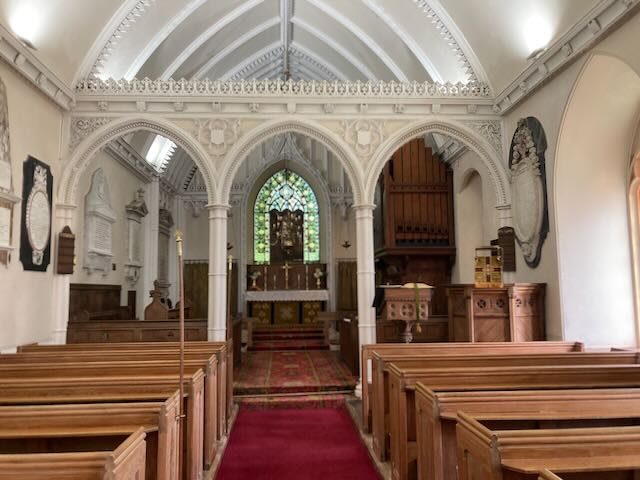
Nave and chancel of Holy Trinity Church at Deane.
The damp Deane parsonage where the Austens lived is long gone; it was replaced by a new building in 1855. One of the churchwardens says, “There was a rectory in the paddock opposite the path leading to the church, which burnt down. I believe the wall [old section in this photo] protected this rectory.”

Deane Parsonage and Living

George and Cassandra Austen lived in the Deane parsonage until 1768 when the Steventon parsonage was ready. Their first three children, James, George, and Edward, were born there. Mrs. Austen’s widowed mother, Jane Leigh, also lived with them at Deane, though she died shortly after the move to Steventon.

The Steventon living was worth only about £100 a year, including about three acres of glebe farmland. So Mr. Knight also let George Austen farm the 200-acre Cheesedown Farm for more income. Still, the Austens found the income too low to support their rapidly growing family. George’s great-uncle Francis of Sevenoaks in Kent bought the options on two nearby livings, Ashe and Deane, for George’s benefit.

The rector of Deane died before the rector of Ashe, so George Austen took the living for the parish of Deane, and Francis sold the other option to another relative, who later installed the Lefroys at Ashe. In 1773, Mr. Austen became rector of Deane, another small parish of “about two dozen families of farm labourers . . . worth £110” per year (Le Faye, 25). He also began taking in boys as students, to further supplement his income.

The Deane parsonage now belonged to George Austen, as part of the living. From 1786-1788, Madam Lefroy’s younger brother, Egerton Brydges, rented it from him and lived there. In 1789, George advertised the parsonage for rent, as “a neat brick dwelling-house with four living-rooms and four bedrooms, as well as all the necessary store rooms and servants’ quarter, plus a large garden, coach-house and stabling for six horses” (Le Faye, 68), making it sound more desirable than it had been. The next tenants were a clergyman’s widow, Mrs. Lloyd, and her daughters Martha and Mary. (Good Bible names for sisters; see John 11.) Martha and Mary soon became close friends of Jane and her sister Cassandra. Eventually both Lloyd sisters married into the Austen family.

In 1792, Jane’s eldest brother James and his wife Anne took over Deane parsonage, spending £200 to refurnish it, more than they could actually afford. James became his father’s curate at Deane, also serving two other small parishes. Their daughter Anna (Jane Anna Elizabeth Austen) was born in the Deane parsonage in 1793, with the help of her grandmother. “Mrs. Austen rose from her bed in the middle of the night, and walked by the light of a lantern a mile and a half of muddy country lane to attend her [daughter-in-law], and to usher into the world a new grandchild” (Le Faye, 84).

James’s wife Anne died in 1795, and Mary Lloyd returned to Deane parsonage as James’s second wife in 1797. In 1801, James and his family moved to the Steventon parsonage when George Austen retired to Bath. James served as curate of Steventon until his father died in 1805, when James became rector of Steventon.

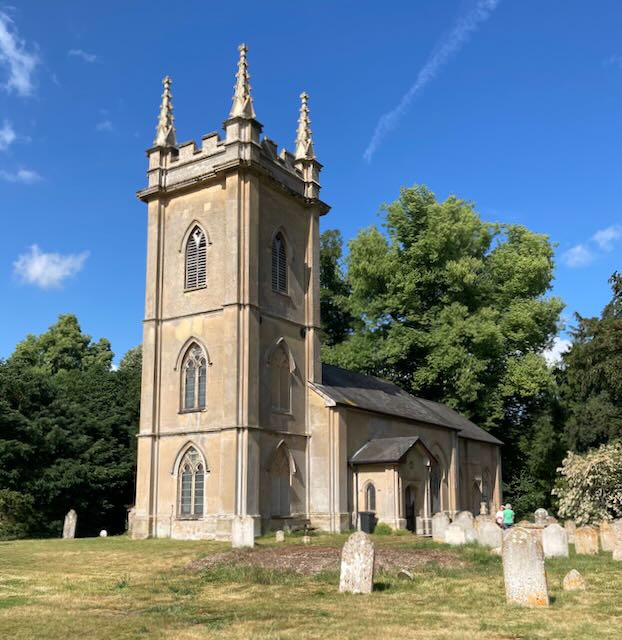
Holy Trinity Church at Deane was completely rebuilt, 1818-1820, in the pointed Gothic style. Much of the church was built of Coade stone, an artificial stone invented and produced by a woman, Eleanor Coade (1733-1821). She developed an amazing material that could be made to look like either wood or marble, resisted weathering, and could be molded into mass-produced items ranging from tiny ornaments to the pinnacles of this church. Thousands of intact examples of Coade stone can still be seen across England and abroad today.

Jane Austen’s Connections with Deane

Jane Austen mentions Deane in 27 of her existing letters. She also includes it in one of her juvenile pieces, “Memoirs of Mr. Clifford.” Mr. Clifford’s “first Day’s Journey carried him only to Dean Gate where he remained a few Days and found himself much benefited by the change of Air.” She is referring to the Deane Gate Inn, where men of the Austen family would catch the stagecoach. It is now a restaurant, the Palm Brasserie.

Jane often visited the parsonage at Deane, first when the Lloyds were living there, then when her brother and his family were there. Dampness and flooding were still an issue. On Oct. 27, 1798, she wrote:

“There has been a great deal of rain here for this last fortnight, much more than in Kent, and indeed we found the roads all the way from Staines most disgracefully dirty. Steventon lane has its full share of it, and I don’t know when I shall be able to get to Deane.”

In November and December she again talks about visits to her sister-in-law Mary at Deane, who gave birth to James Edward (who became Jane Austen’s first biographer) on Nov. 17:

I went to Deane with my father two days ago to see Mary, who is still plagued with the rheumatism, which she would be very glad to get rid of, and still more glad to get rid of her child, of whom she is heartily tired. Her nurse is come and has no particular charm either of person or manner; but as all the Hurstbourne world pronounce her to be the best nurse that ever was, Mary expects her attachment to increase. . . . Sunday. — I have just received a note from James to say that Mary was brought to bed last night, at eleven o’clock, of a fine little boy, and that everything is going on very well. My mother had desired to know nothing of it before it should be all over, and we were clever enough to prevent her having any suspicion of it”—Nov. 17-18, 1798

Jane continued to visit Mary every few days, reporting on her health. She even visited when ice covered the ground: 

“I enjoyed the hard black Frosts of last week very much, & one day while they lasted walked to Deane by myself.–I do not know that I ever did such a thing in my life before. . . . Mary went to Church on Sunday, & had the weather been smiling, we would have seen her here before this time”—Dec. 18, 1798.  This may have been when Mary was “churched,” a ceremony celebrating the safety of a mother after childbirth.

The main families of Deane, Steventon, and Ashe all visited each other and went to balls together. Jane danced at the Harwoods’ ball, in Deane, on Jan. 8, 1796. She often mentions John Harwood in her letters; for example:

“This morning has been made very gay to us, by visits from our two lively Neighbours, Mr. Holder and Mr. John Harwood.”—Dec. 18, 1798

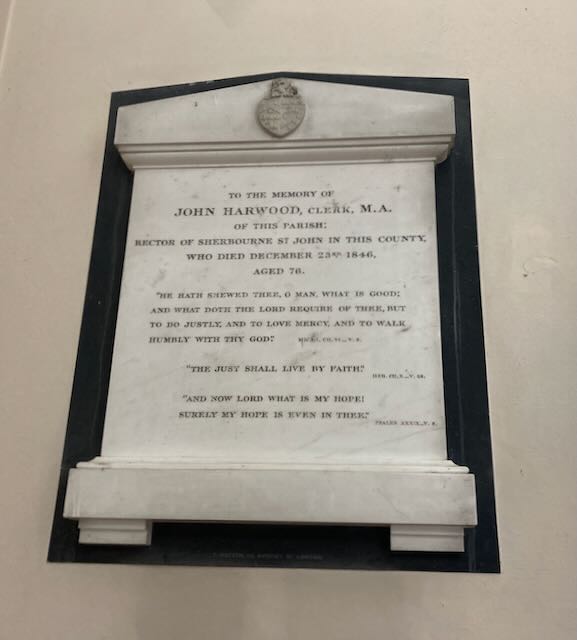
Deane church memorial to John Harwood (1770-1846), a member of the Harwood family of Deane, friends of the Austens. Harwood was rector of nearby Sherbourne St. John, where James Austen was vicar from 1791 to 1819. (The parish had both a vicar and a rector until 1844; the rector got more of the tithes.) Jane Austen mentions John Harwood in her letters in the context of visits, balls, and other events.
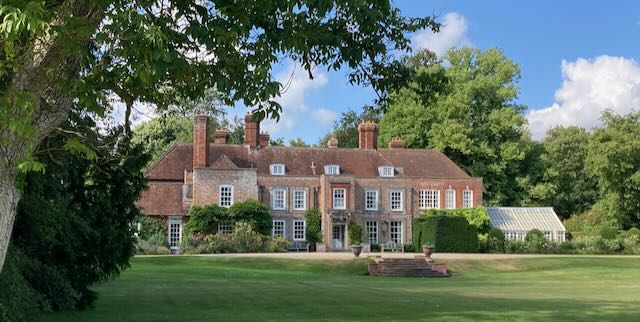
The Harwoods owned Deane House, now The Old Manor House. It can still be seen from the Deane church. Jane Austen danced there.

All Saints Church at Deane, Then and Now

In July, 1818, the Norman-era church at Deane was “in so Dangerous a state of Ruin as to be unsafe for the congregation.” So the patron, Wither Bramston of Oakley Hall, got approval from the Bishop of Winchester to rebuild it at his own cost, about £8000. It was consecrated two years later.

All Saints at Deane is considered “one of the most complete and successful” 19th century Gothic churches (Tanner). It is also renowned for its eight bells, which are rung regularly, and an 1820 Gothic chancel screen. The church today is a grade II listed building, but is not the same as the medieval church building where George and James Austen ministered. Some monuments from their time are on the walls of the current church, however.

An entrance to the Deane church marks its rebuilding in 1818.
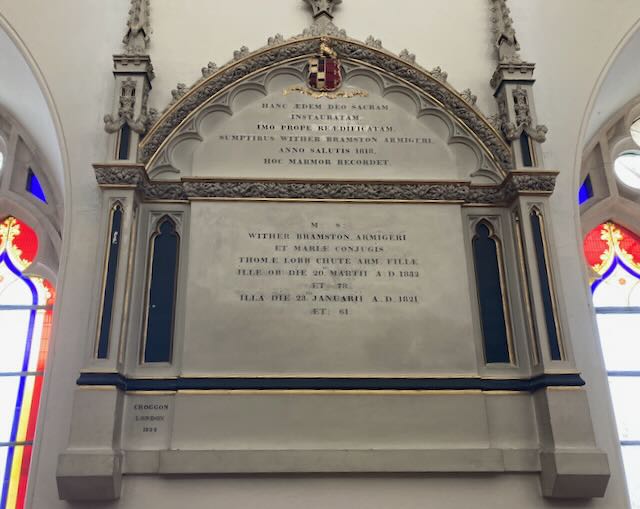
Memorial in Latin to Wither Bramston, died 1832, and his wife. As patron of the Deane living, he rebuilt the Deane church in 1818-1820 (as recorded in the top section of the memorial), at his own expense.

The church could seat 146 people in 1851. On Census Sunday, 94 parishioners attended in the morning and 124 in the evening. Leading up to World War I, the rector offered daily Communion in the church, and in 1917, he reported twenty people in the choir for Evensong. However, the population dropped, and in 2011, Deane included only an estimated 55 inhabitants, with an average age of over 60.

Now there are about 25 houses in the village, and about 8-10 people attend Sunday morning services twice a month. For a larger service, like the Christmas carol service, they may have about 40 attendees. Weddings are held there occasionally, and special services like pet blessings. All Saints is part of the United Benefice of North Waltham, Steventon, Ashe, and Deane.

Our guide to the church, Sue Hebeler, said she loves this church since it is her local church and her husband is buried there. She appreciates the traditional, old-fashioned services. If you’re in the vicinity, you may also enjoy a visit to this lovely, peaceful church.

This embroidered tapestry blesses the church, which was called St. Mary’s before it was rebuilt over 200 years ago. The picture may be more like the church’s earlier form. It reads, “Peace be within this sacred place; And joy a constant guest; With holy gifts and heavenly grace; Be her attendants blest.”

All images in this post ©Brenda S. Cox, 2024.

Brenda S. Cox is the author of Fashionable Goodness: Christianity in Jane Austen’s England. She also blogs at Faith, Science, Joy, and Jane Austen.


Posts on Other Austen Family Churches

Steventon

Chawton

Hamstall Ridware and Austen’s First Cousin, Edward Cooper

Adlestrop and the Leigh Family

Stoneleigh Abbey Chapel and Mansfield Park

Great Bookham and Austen’s Godfather, Rev. Samuel Cooke

Ashe and the Lefroy Family


Sources and Further Reference

Deirdre Le Faye, Jane Austen : A Family Record. Much of Le Faye’s information about Deane is also online at Deane

Terry Townsend, Jane Austen’s Hampshire, has a helpful chapter on Deane.

Richard Tanner, Ashe & Deane, explores the area.

Trailblazing Women of the Georgian Era by Mike Rendell includes a fascinating chapter on Eleanor Coade—manufacturer of artificial stone.

Read Full Post »

« Newer Posts - Older Posts »