Feeds:
Posts
Comments

Archive for the ‘Jane Austen’s World’ Category

Punctuation Personified, 1760 version of A Pretty Little Pocket Book. Image from the British Library

This post about Jane Austen’s experiences in boarding school at a young age was written by Tony Grant, who is a frequent contributor. Tony also writes for his own blog, London Calling.

In 1782 at the age of 7 Jane Austen went to school for the first time. Theories go that she wanted to go to school because her elder sister Cassandra was being sent to Mrs Cawley’s school in Oxford to accompany their cousin Jane Cooper who was being sent there. Cassandra was to go as a companion for Jane Cooper. Jane did not like to be separated from Cassandra and Mrs Austen in later years suggested that Jane was insistent that she accompany Cassandra. However this may have been defensive reasoning by Mrs Autsen because of the near disaster that befell the girls whilst in the care of Mrs Cawley. So the real reasoning for sending Jane to this school at the age of seven is obscure.
Behavior at the School, from A Pretty Little Pocketbook, 1744

Mrs Cawley moved the school to Southampton because a measles outbreak had occurred in Oxford. However in 1783 troops, returning to the port of Southampton brought an infectious disease with them and Jane, Cassandra and their cousin Jane Cooper caught it. The three of them became very ill. It was only a letter from Jane Cooper to her mother and father in Bath that alerted the Austens to the predicament. Mrs Austen and Mrs Cooper both went to Southampton to collect their daughters. Mrs Austen had to nurse Jane back to health. Mrs Cooper caught the disease and later that year,died from it.

Reading Abbey, 1783, public domain image

One wonders what sort of education the girls actually got under the direction of Mrs Cawley. Sewing and French were taught, they read a lot and I presume they were able to write letters.

The adult Jane Austen wrote scathingly of girls schools. She found it hard to see schools as anything more than places of torment.

In1784 Jane was still at home after this first experience of school. She had free run of her fathers extensive library. After a year at home with the now motherless Jane Cooper the girls were sent off to school again. This time to A Mrs La Tournelles in Reading. Madame La Tournelle, she was not French by the way and spoke no French , was really called Sarah Hackit. She used the French name to impress prospective parents. She enjoyed telling stories about actors and actresses. She involved children in drama productions. They learned spelling, needlework and did get some French from one of the other teachers. Jane might have also learned to play the piano there.
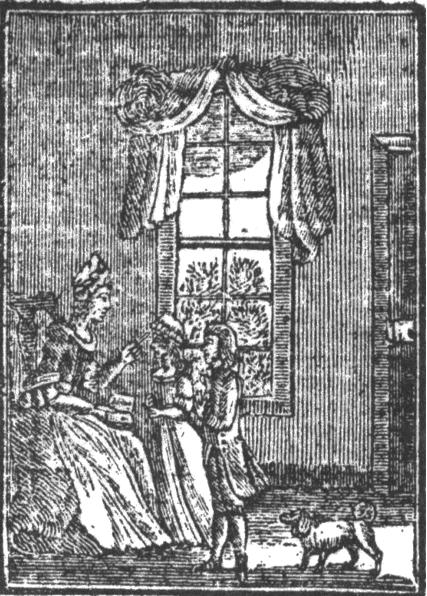
Instruction with delight, from A Pretty Little Pocketbook, 1744

In 1786 a Gloucestershire cousin of Mr Austen, the reverend Thomas Lea of Adlestrop, visited the girls while passing through Reading. Later that year The Reverend Austen removed Jane and Cassandra from the school. Maybe Thomas Lea gave a poor report of the school and Jane’s father thought he was wasting his money. Jane never had any formal education again.

From their experience of school we can gather that Jane and Cassandra had perhaps learned some social skills, had had the opportunity to read, take part in plays, learn some French and learn the piano. These were things that were all available at home anyway.

B is for Bull, from an old alphabet book

So what makes for a fantastic, brilliant, inspiring, life changing, learning experience and how did Jane Austen actually learn?

With all those intelligent older brothers Jane had some great roll models. The vitally active and mentally agile and alert Jane must have passionately absorbed and lapped up what her brothers were doing, saying and experiencing. She must have had this inner drive and force to want what they had mentally and imaginatively. Inspiration is a great motivator. An inner need and hunger for something can’t be beaten when we want to learn. Jane must have had this in spades.

Cruikshank, Alphabet book

James Austen passionately loved the theatre and plays. He organised and directed dramas in their barn at Steventon. So Jane had acting and playwriting modelled for her to copy and use as her own skill. She began to write some juvenile works.

The there was her fathers library. She had a whole range of books covering many subjests to read and peruse. Somebody with Jane’s brain and need to know and explore would have been asking questions and finding answers that created more questions and so more reading and more asking. You can imagine an explosion of questions, ideas and exploration going on in that mind of hers.
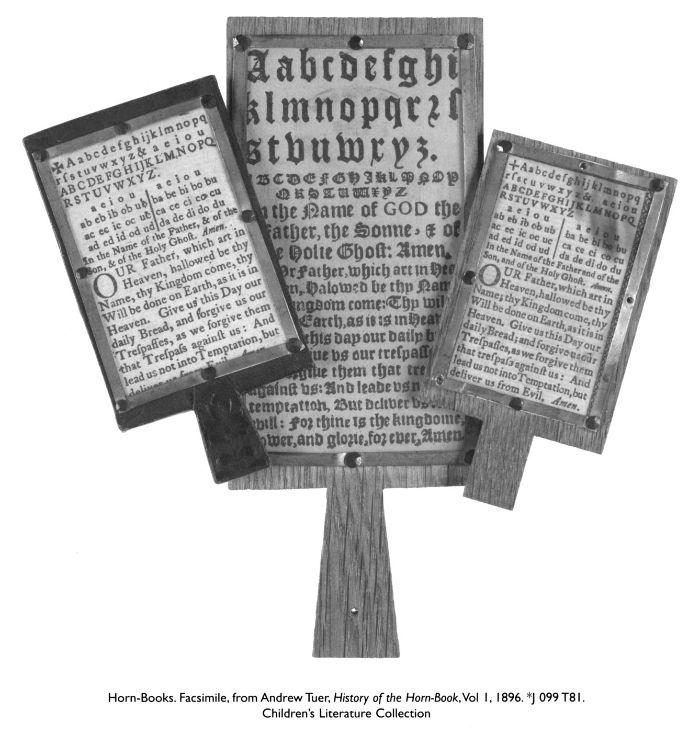
Children's horn books

From the point of view of a teacher what I aspire to do for my pupils is to make them independent, passionate learners, for life. But what gets them started? What gets that spark going? What ignites it all? I, as a teacher, have to try and provide experiences, I have to be a roll model, I have to demonstrate and model all sorts of different skills , I have to break things down into manageable learning experiences that have a progression. As an example of what I mean, here is how a might get a class to write a poem. On a fine sunny day I could take a group of children outside of the classroom to lie on the grass and look at the sky. We could talk about the clouds, the blue sky in-between, we could talk about the shapes they see, their feelings and all the while I would be coaxing them along by introducing new vocabulary, asking them, What? Why? How? What if? When? to get them to think in new ways and see and feel and think about things differently. Talking together is so important for the children. Teachers should talk less by the way.

Most of the lessons were given in a building next to the Gateway. Image from Austenized.

Then we could go back into the classroom. I would gather some vocabulary and ideas from the children and I would model the structure of a poem and maybe write a couple of lines of my own for them to see. The children now ready with words, a structure, ideas, concepts, similes and metaphors, some support materials for those who need it and with all this churning around in their heads, can write their poem.

The next time I wanted to write poem I would give them a little more independence. I would get them to tell me the process we did last time and they could use this. Those who needed my help would get more focussed support.

A little boy and girl reading, A Pretty Little Pocket Book, 1744

I can see this learning process in the story of our Jane. The way humans learn hasn’t changed, ever; it’s just that teachers through the centuries have gone against the natural process of learning. Nowadays we are far more enlightened and are actually trying to find out how our pupils can learn in the classroom and out of it. All those great learning experiences were there for Jane. Her mind was open to learning. She craved it. Children who tell me they hate school I always think is because nobody has tuned into their learning style, found out what inspires them, found out what WOWS!!! them. It’s all about close relationships really. A teacher should be able to get into the minds and feelings of their children, get under their skin.

Thank God Jane’s experiences, relationships and the world around her became her , “school,” and using the experiences and world around her, ignited her genius mind.

The idea of education in the 18th century was all about enforcing ideas and behaviours. Jane set free from that, was released into her real learning environment.

Read Full Post »

Inquiring readers, Adriana Zardini from the Jane Austen Society of Brazil, wrote this post for her blog and sent it on to me! Do visit Adriana’s lovely site, which comes with a translator!

A new version of Sense and Sensibility? Take a look on IDMB page.
I discovered today a new movie being filmed there in the United States with the title: Scents and Sensibility. Because there is a summary and not even a line about Jane Austen, the only thing that links this production to Austen’s Sense and Sensibility is the fact that some of characters in the film have the same names as characters in the book.

Director: Brian Brough

Actors: Marla Sokoloff and Ashley Williams (already appeared in various TV series). Slated to do  Elinor and Marianne.

Nick Zano (Brandon) – is currently in the series Cougar Town

Brad Johnson (Edward Farris) probably a typo, right?

Danielle Chuchran (Margarett Dashwood)

Jason Celaya (John Willoughby)

Adriana’s other contributions to this blog:

Read Full Post »

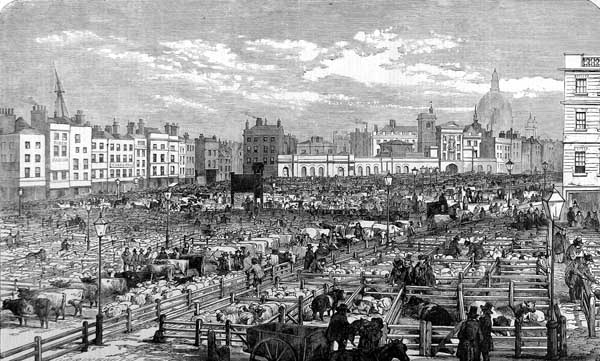
Last day of Old Smithfield, 1855

By the turn of the 19th century, over one million people lived and worked in London and its environs. The challenge in feeding so many people was no mean feat. Surrounding  farms sent produce to London’s markets, and drovers brought sheep and cattle over deeply rutted and ancient roads  from as far north as Scotland. Every September and October, enormous numbers of animals converged in Smithfield market, where they were sold and slaughtered for consumption. In Oliver Twist (1838), Charles Dickens described the filth of Smithfield Market, and the bellowing of frightened animals who had been forced to trudge from their peaceful pastures to what must have been a frightful, bewildering and nightmarish place.

It was market morning. The ground was covered nearly ankle deep with filth and mire; and a thick steam perpetually rising from the reeking bodies of the cattle, and mingling with the fog, which seemed to rest upon the chimney tops, hung heavily above … Countrymen, butchers, drovers, hawkers, boys , thieves, idlers, and vagabonds of every low grade, were mingled together in a dense mass: the whistling of drovers, the barking of dogs, the bellowing and plunging of beasts, the bleating of sheep, and the grunting and squealing of pigs; the cries of hawkers, the shouts, oaths, amd quarrelling on all sides, the ringing of bells, and the roar of voices that issued from every public house; the crowding, pushing, driving, beating, whooping and yelling; the hideous and discordant din that resounded from every corner of the market; and the unwashed, unshaven, squalid, and dirty figures constantly running to and fro, and bursting in and out of the throng, rendered it a stunning and bewildering scene which quite confused the senses.’

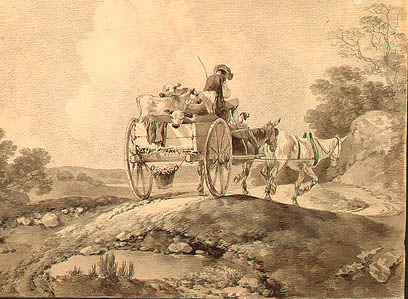
Drover with calves in a country cart, Gainsborough, 1755

Smithfield Market Days.-Monday for fat cattle and sheep. Tuesday, Thursday, and Saturday, for hay and straw; Friday, cattle and sheep and much cows, and at 2 o’clock for scrub-horse and asses. All sales take place by commission. The customary commission for the sale of an ox of any value is 4s., and of a sheep 8d. The City receives a toll upon every beast exposed to sale of 1d. per head, and of sheep at 2d. per score, and for every pen 1s. The total produce to the Corporation is from 5000l. to 6000l. a-year. Smithfield salesmen estimate the weight of cattle by the eye, and from constant practice, approach so near exactness, that they are seldom out more than a few pounds. The sales are always for cash. No paper is passed, but when the bargain is struck, the buyer and seller shake hands and close the sale. Several millions, it is said, are annually paid away in this manner in the narrow area of Smithfield Market.

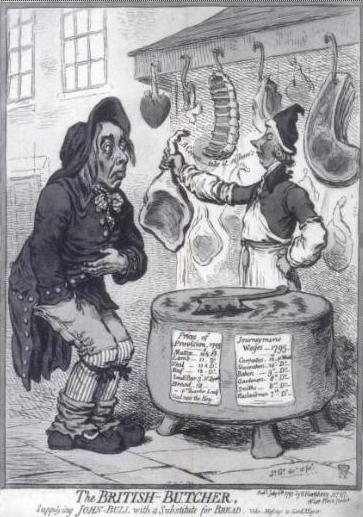
The British butcher

Quantities sold -The average weekly sale of beasts is said to be about 5000 ; and of sheep about 30,000 ; increased in the Christmas week to about 4000 beasts, and 47,000 sheep. As a sheep market, Smithfield has been constantly on the decrease within the last ten years. The following return shows the number of cattle and sheep annually sold in Smithfield during the following periods – Peter Cunningham, Hand-Book of London, 1850 – Victorian London Markets

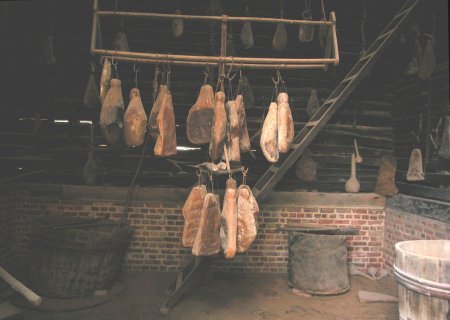
Smoke house, Mt. Vernon, Virginia. Image @Donald Mark

Without refrigeration and cookstoves, food storage and preparation presented challenges to the housewife and innkeeper alike. Fortunately, salt needed for preservation was plentiful in England. Cattle were brought into the market towns in September and October. The beef was salted and then hung up in smoke to preserve it. Pork was likewise both salted and smoked to make bacon and ham. For poorer families, these were practically the only meats eaten during the winter months. – Merrye Olde England: Food

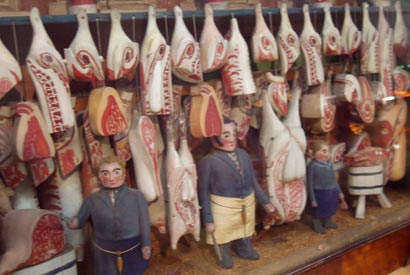
Toy 19th century butchers. Image @The Royal County Arbiter

The preservation of meat turned out to be a relatively simple technique. The meat was salt cured, which meant preserving it with a mixture of salt and saltpetre. Flavorings could be added, such as honey, sugar, pepper, and juniper berries. The salt in the meat drew out moisture, reducing the weight of the meat by as much as 18%-25%, and preventing the meat from decomposing.  The salted meat was hung to dry cure from a few months to a year. This process deepened the color of the meat and produced an intense flavor. Dried and cured, the meat was cut into thin slices and could be served at any time. – Historical Recipes: Dry Cured Ham


Read Full Post »

Inquiring Readers, Tony Grant has been contributing articles to Jane Austen Today for several months. Recently, Tony and his family traveled to Bath and the West Country. This is one of many posts he has written about his journey. Tony also has published several posts about his trip on this blog: Going to Bath With Jane Austen and The Servant’s Entrance to Regency Townhouses, for which he supplied the photographs. He has already contributed a post about Milsom Street for Jane Austen Today. This post about his tour through Bath was first published on Jane Austen Today, but the images caused the sidebar to be pushed out of sight, so I placed it here.

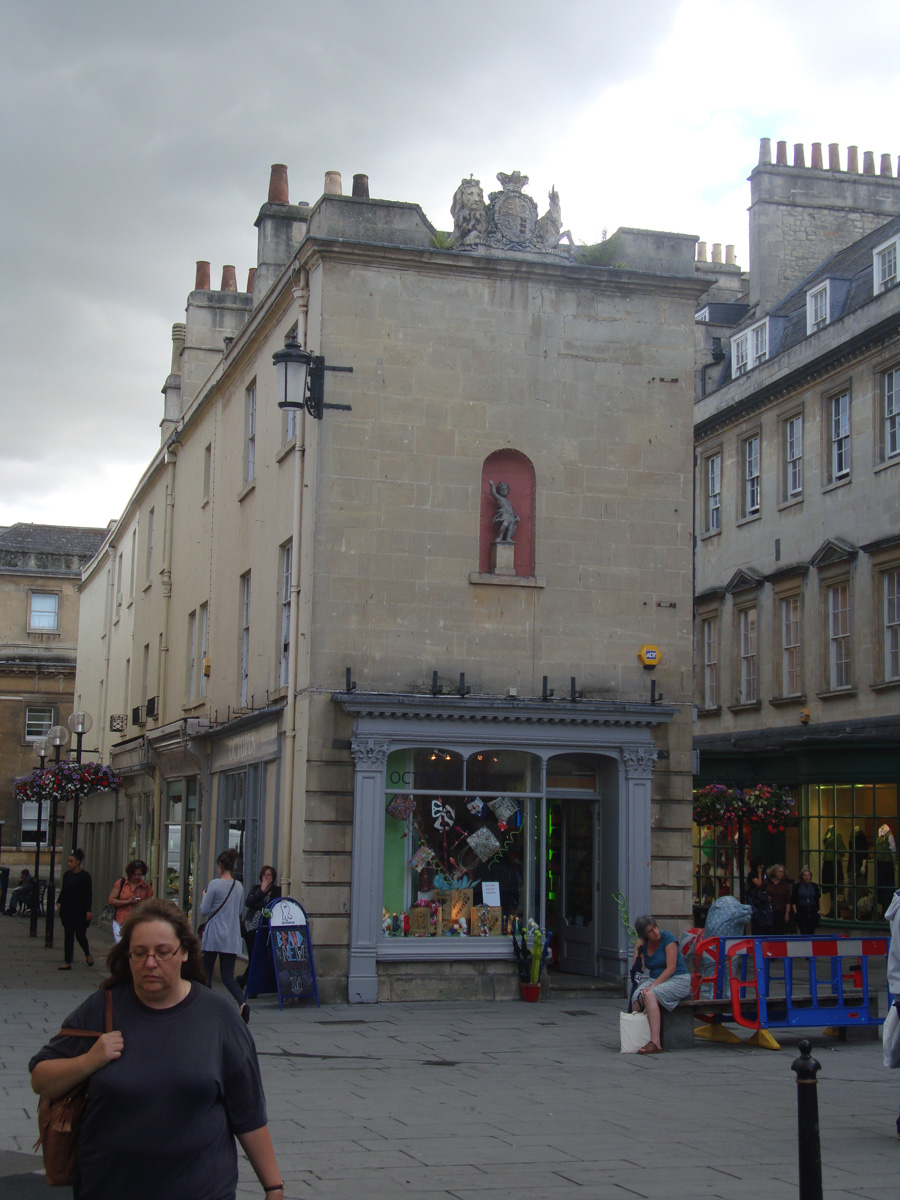
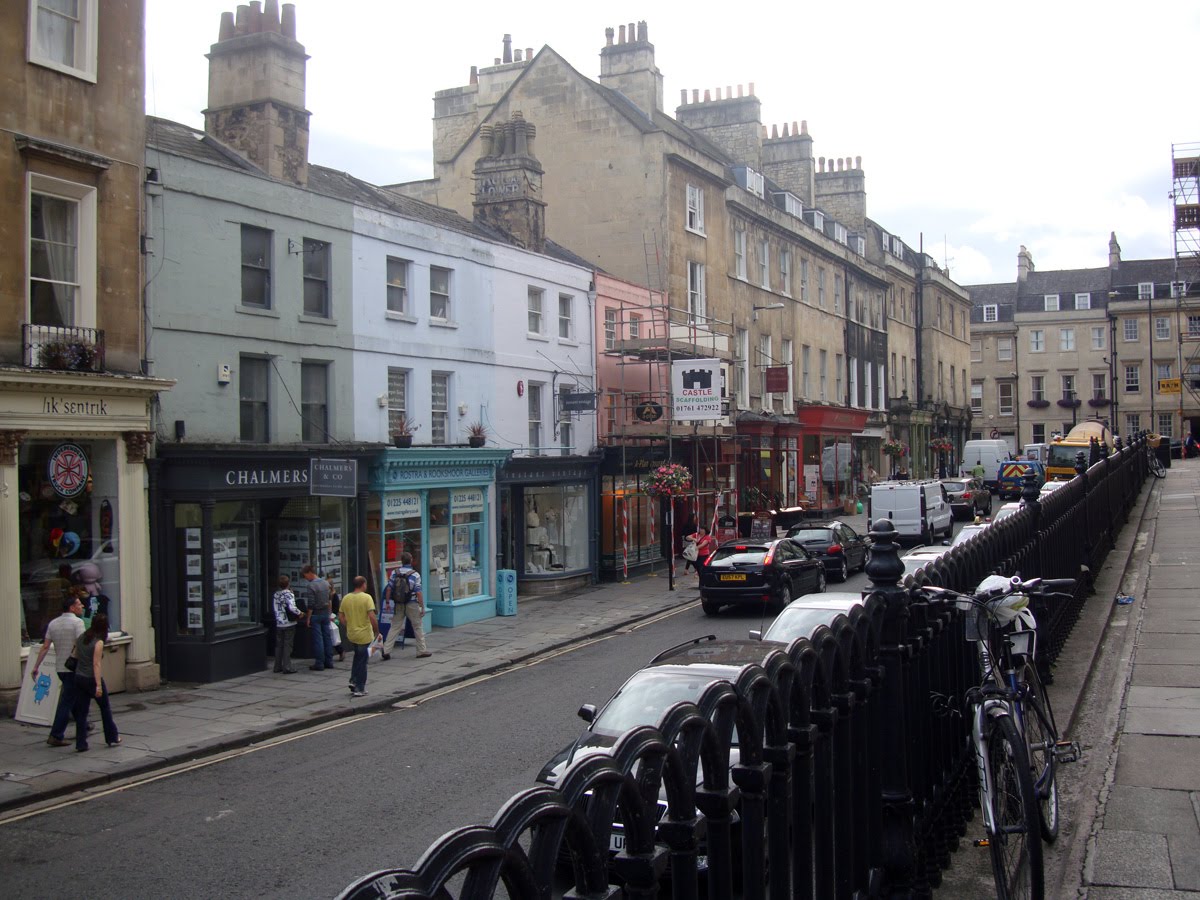
Bath Thoroughfare
Jane Austen knew Bath extremely well. Throughout Persuasion and Northanger Abbey she houses her characters in real streets and in real buildings, although she does avoid giving us the number of the house in such and such a street. The real owners and occupants might not have liked the notoriety. And today they might not like the notoriety as well. Was there such a thing as litigation in the 18th century? I’m sure there was.

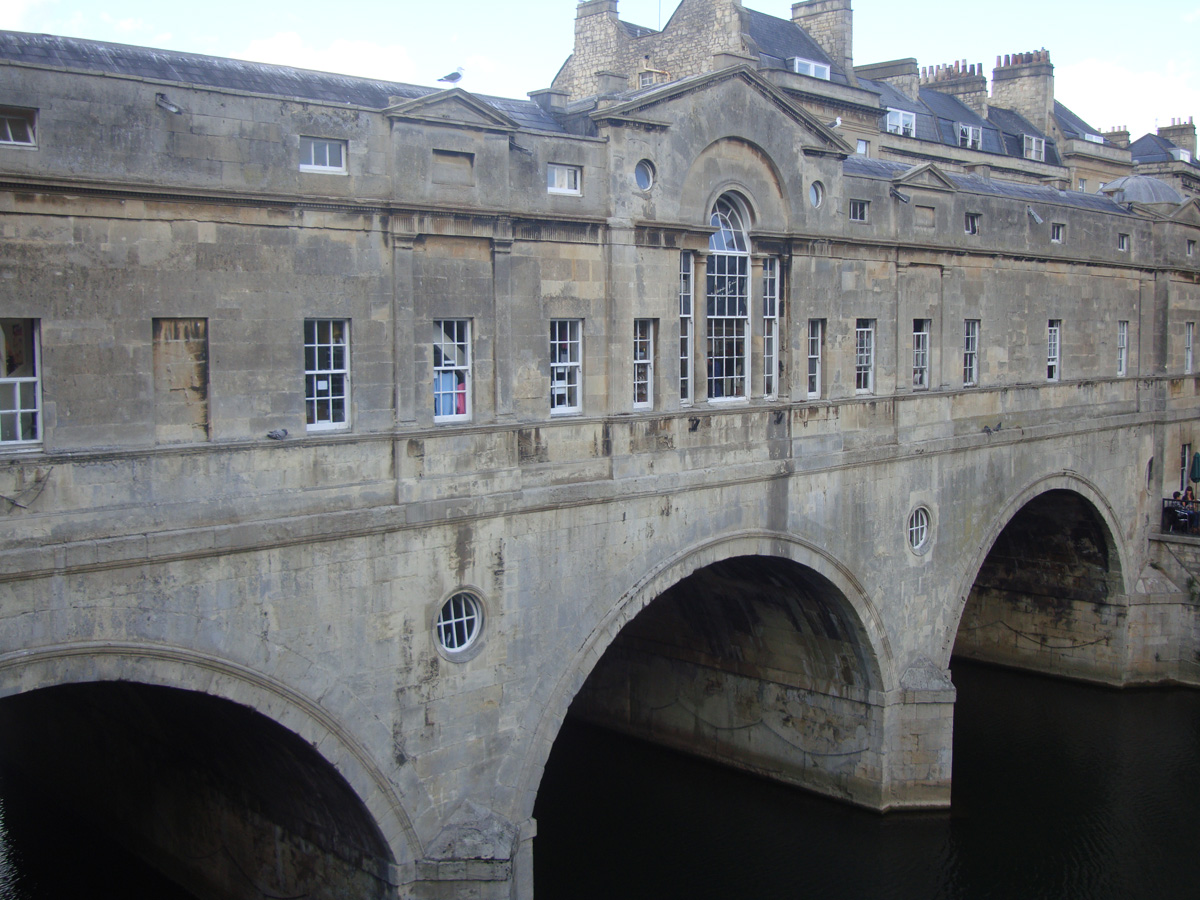
Pultney Bridge

Here are some of the places that Janes characters lived in and when you go to Bath you can see them for yourself.

  • Anne Elliot and her father lived in Camden Place up the hill at the top of the town.
  • Lady Russel lived in Rivers Street just north of The Circus.
  • Rich, Mrs Wallis lived in Marlborough Gardens on the hill leading down from the north end of The Royal Crescent.
  • Catherine Moreland lived in Pultney Street, which is now called Great Pultney Street, very close to Sydney Street. I wonder if Jane saw somebody in Pultney Street that she thought, “ah, that’s Catherine Moreland.”
  • The Dowager Viscountess Dalrymple lived in Laura Place at the end of Great Pultney Street and at the start of Pultney Bridge.

The meeting places and places central to both novels are Milsom Street where everybody shops. Shopping, the bain of my life. My wife and three daughters love shopping. Shopping could be their lives. In Jane’s time tooapparently. It makes me come out in a cold sweat thinking about it. The amount of standing in shops and outside of shops I’ve done.

God, I’ve suffered for shopping over the years.

Ah, that’s better. I needed that rant.

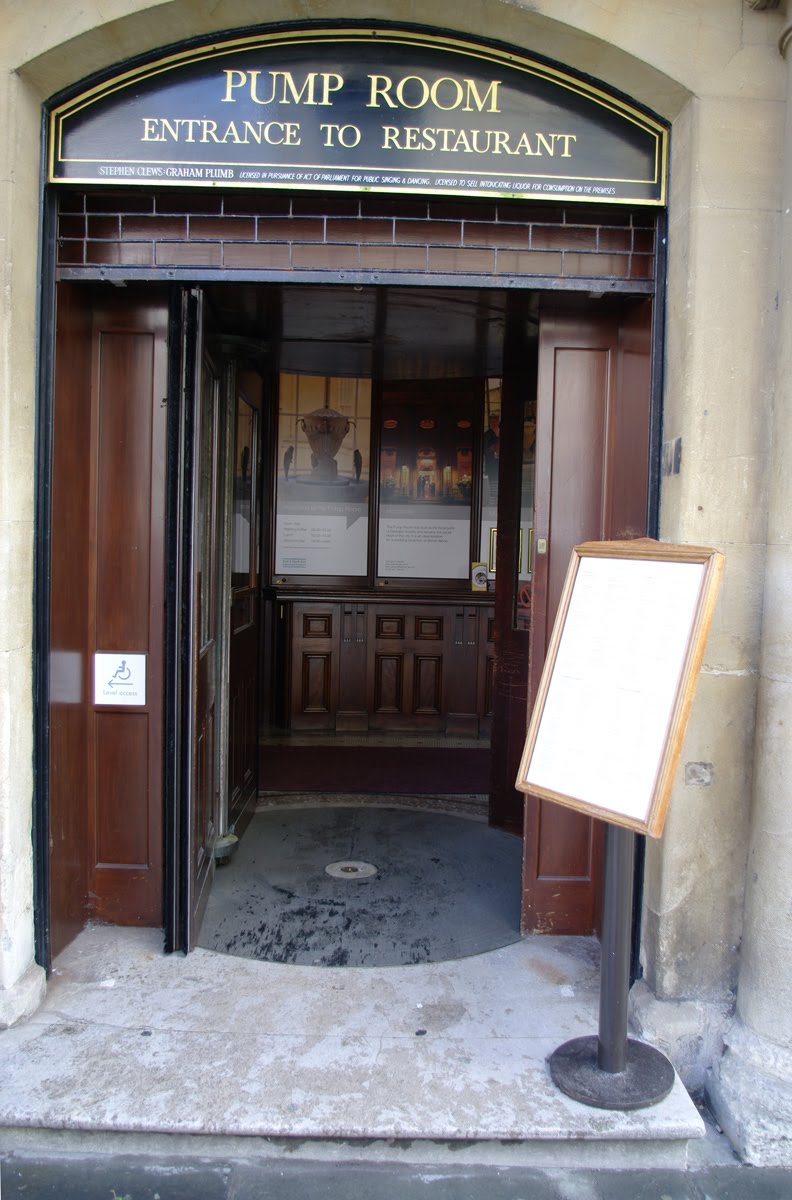
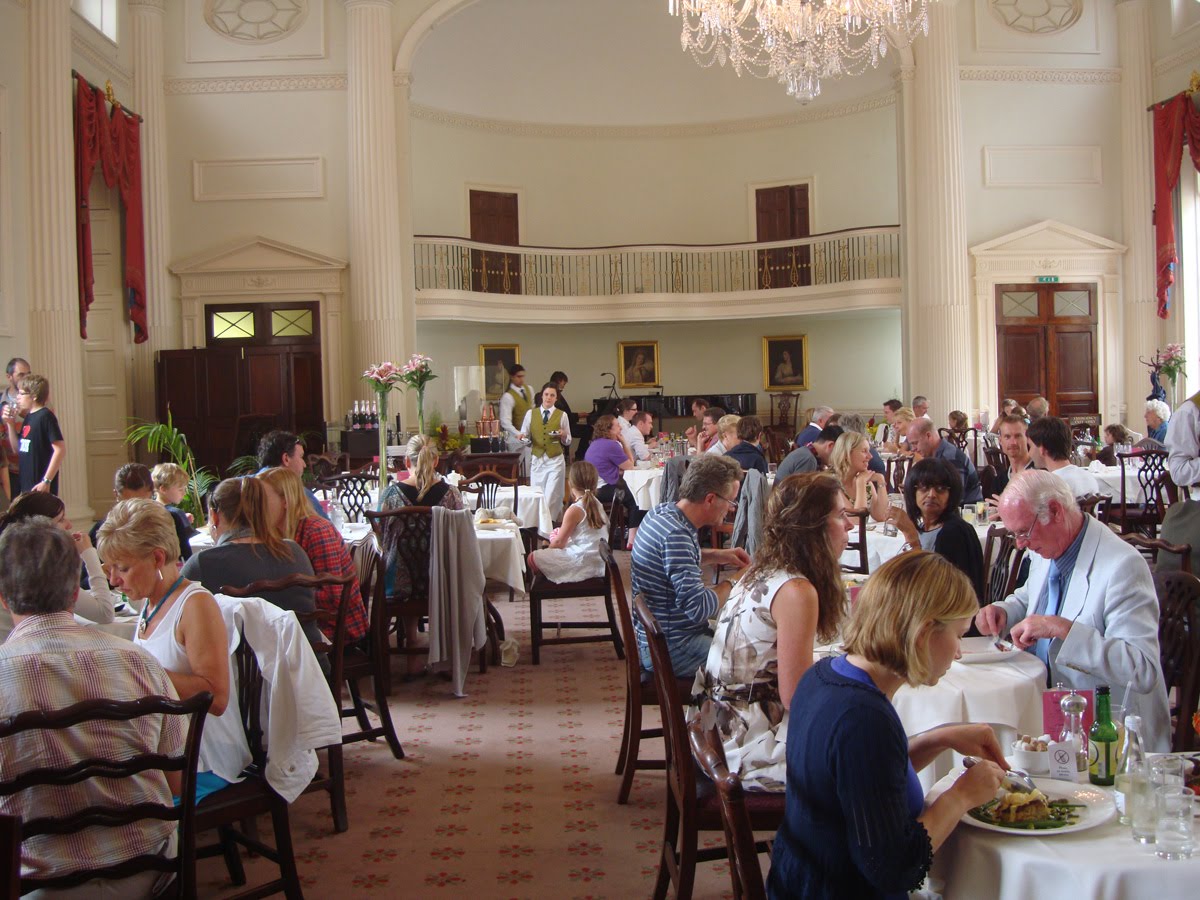
Also the Pump room. What a glorious place it is. I felt a tingle down my spine as I my wife, Abigail and myself were shown to our seats by the headwaiter and we were graciously handed the menus. A trio of musicians, cello, pianist and violinist, played sedately at one end of the room. People lined up at the water pump to imbibe Baths greatest commodity, water from the spring and we ordered tea and cakes.

Pump room window
The “pump room blend” of tea is as close as you can get to the blend of tea that Jane Austen, Catherine Morland and Anne Elliot would have drunk. The scones with clotted cream and fresh strawberry jam were exquisite. The tea was delicious and there I was with my family, in THE PUMP ROOM!!!!!!

The Pump Room

I could almost see Catherine Morland pop in to see if she could find Henry Tilney and of course take a few turns of the room to see and be seen. I knew nobody in The Pump Room just as Catherine knew nobody.

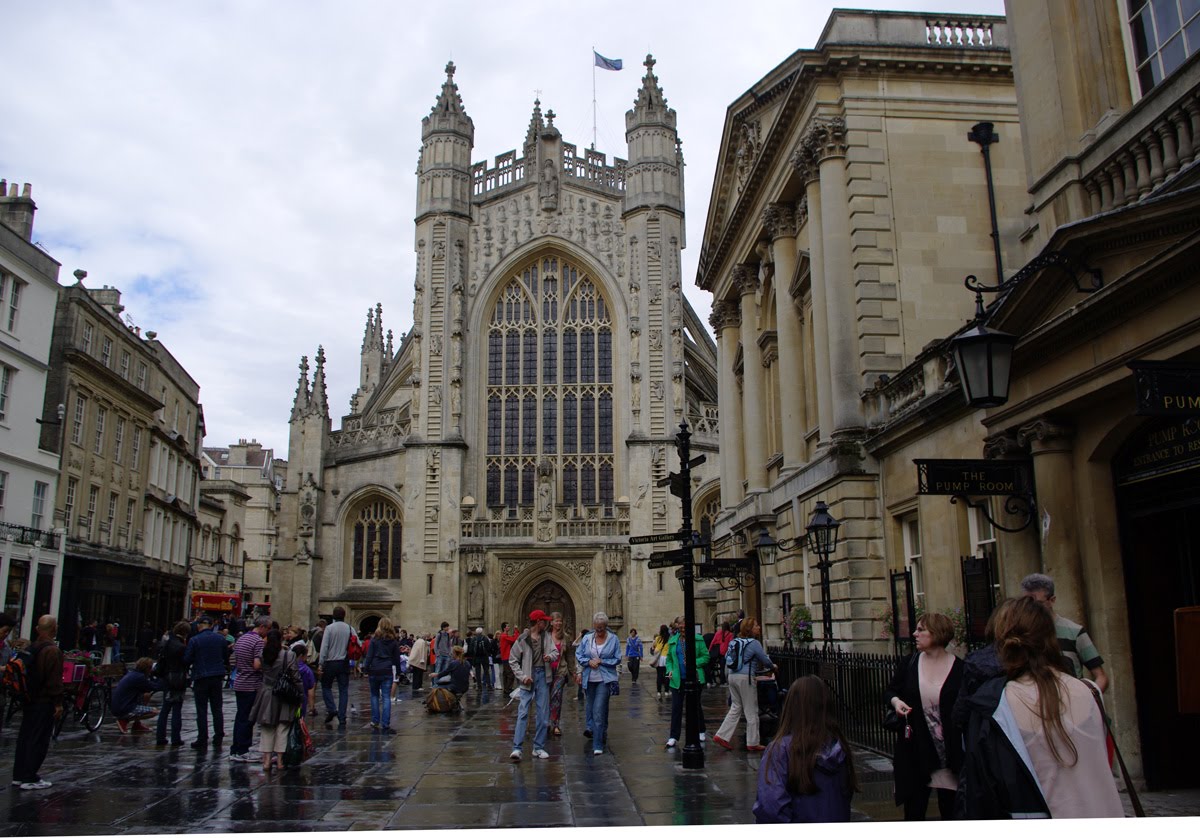
Bath Abbey


Then we had a look inside Bath Abbey. Jane seems to have not attended services at the abbey. She preferred The Octagon. This was a newly built chapel in Jane’s day. She seems to have preferred churches where the incumbent vicar had new and fresh ideas to deliver in his sermons.

Cheap Street
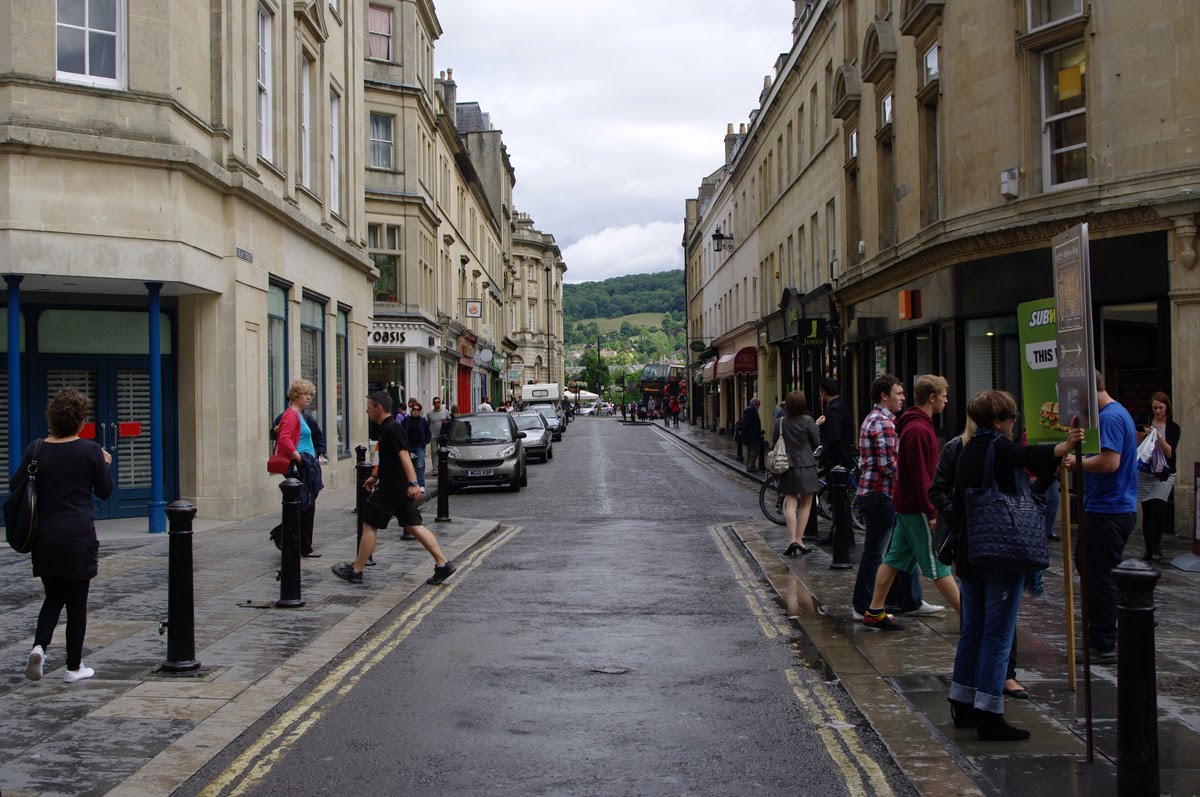
After Bath Abbey we walked through the passageway that leads from the churchyard opposite The Pump Rooms, called Union Passage and into Cheap Street. It is the very passage that Catherine Moreland walked through with Miss Thorpe and suddenly sees a carriage with her brother and coincidently Miss Thorpe’s brother too, the awful John Thorpe. It is their first fateful meeting.

George Street outside Edgar Buildings

We walked on up Milson Street to George Street where Edgar Buildings are situated. Edgar Buildings are where the Thorpes stayed.

25 Gay Street

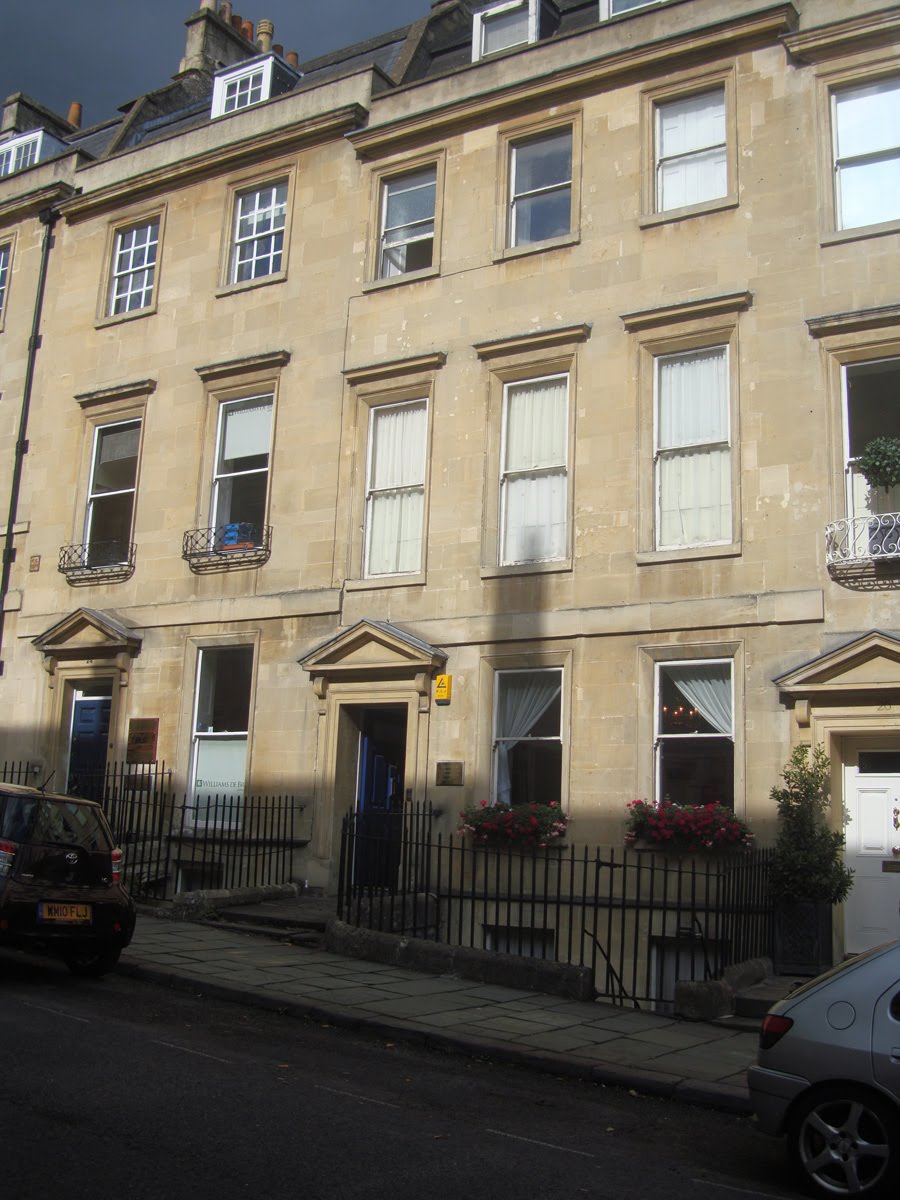
From George Street we went into Gay Street and walked past number 25 where the Austens stayed for a while.

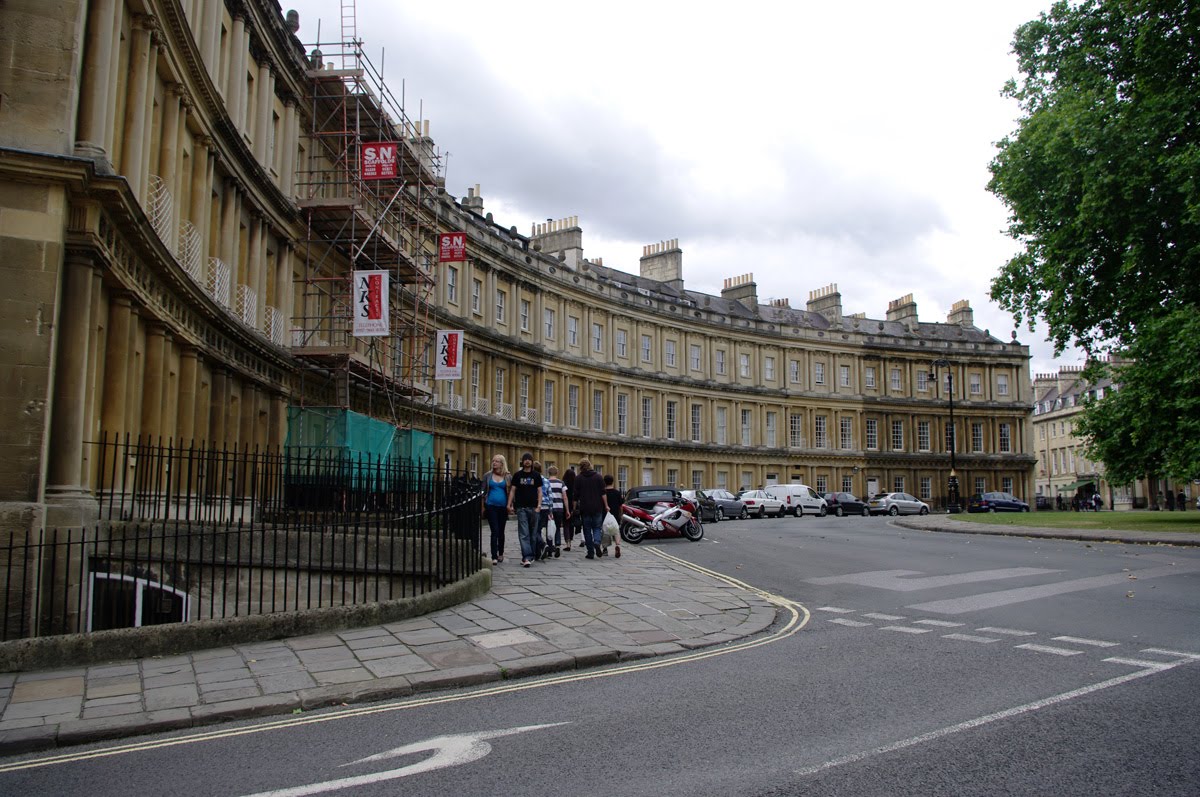
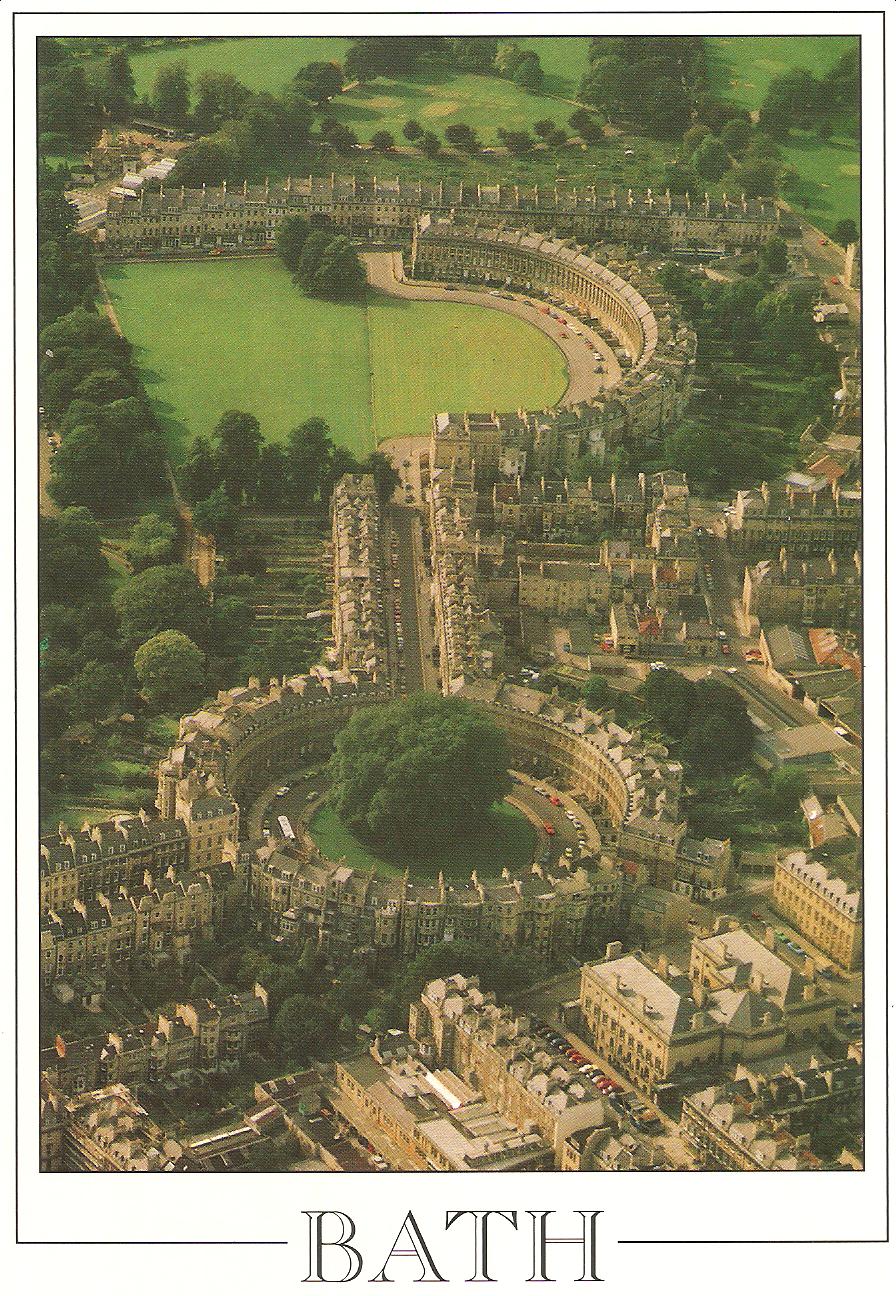
At the top of Gay Street is the magnificent, The Circus. This is a circle of the most magnificent Georgian Houses. There is a small green park in the centre of the circle in which grow four gigantic London Plains trees. They must be four or five hundred years old. Jane knew them. The portrait artist Gainsborough lived in one of these houses in The Circus for a while. Bath would have provided many opportunities to gain commissions and make money.

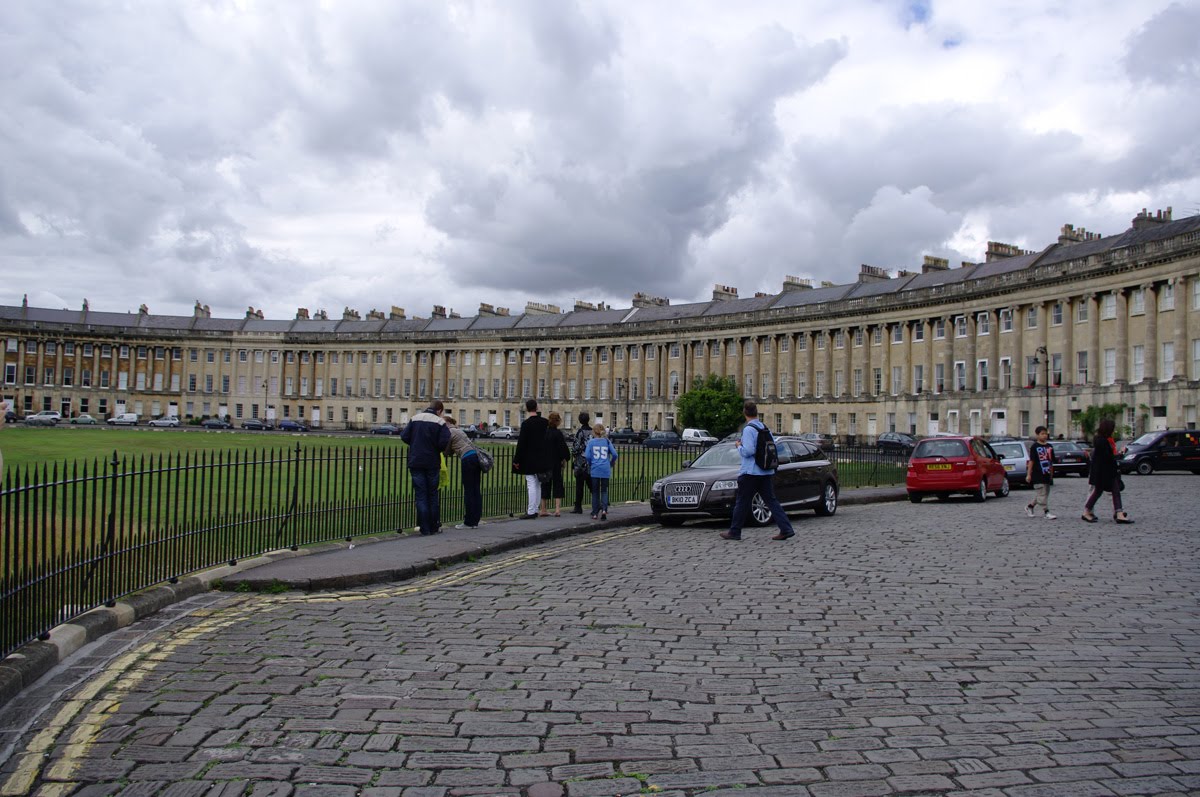
The Royal Crescent

From The Circus we turned down Brock Street and arrived at The Crescent at the top of the hill.

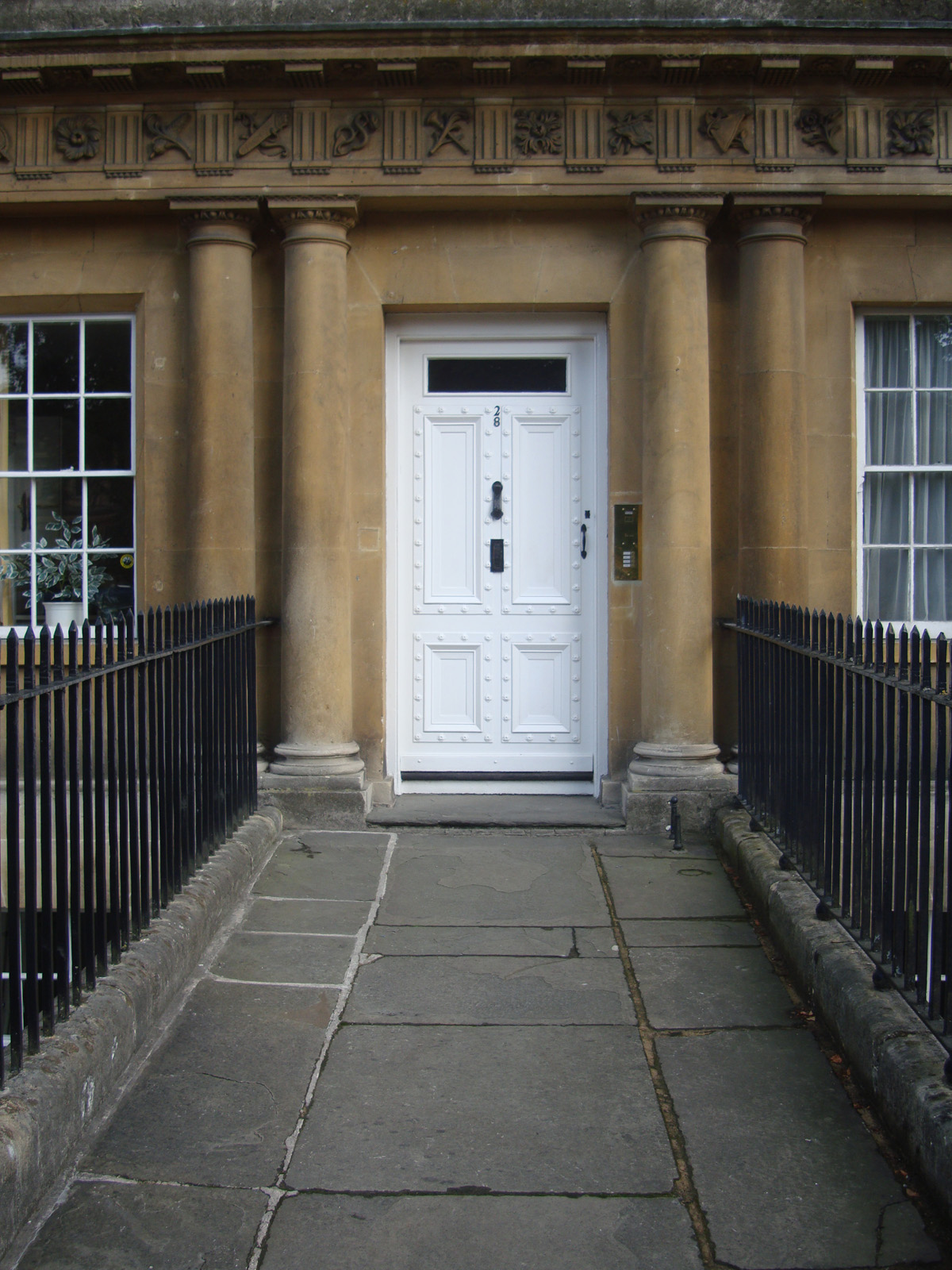
A front door at the Royal Crescent


This was the place where the elite lived. These were the largest and most expensive houses. Lords, Dukes and the very wealthy lived up here. It was also a good place to walk to get fresh air.

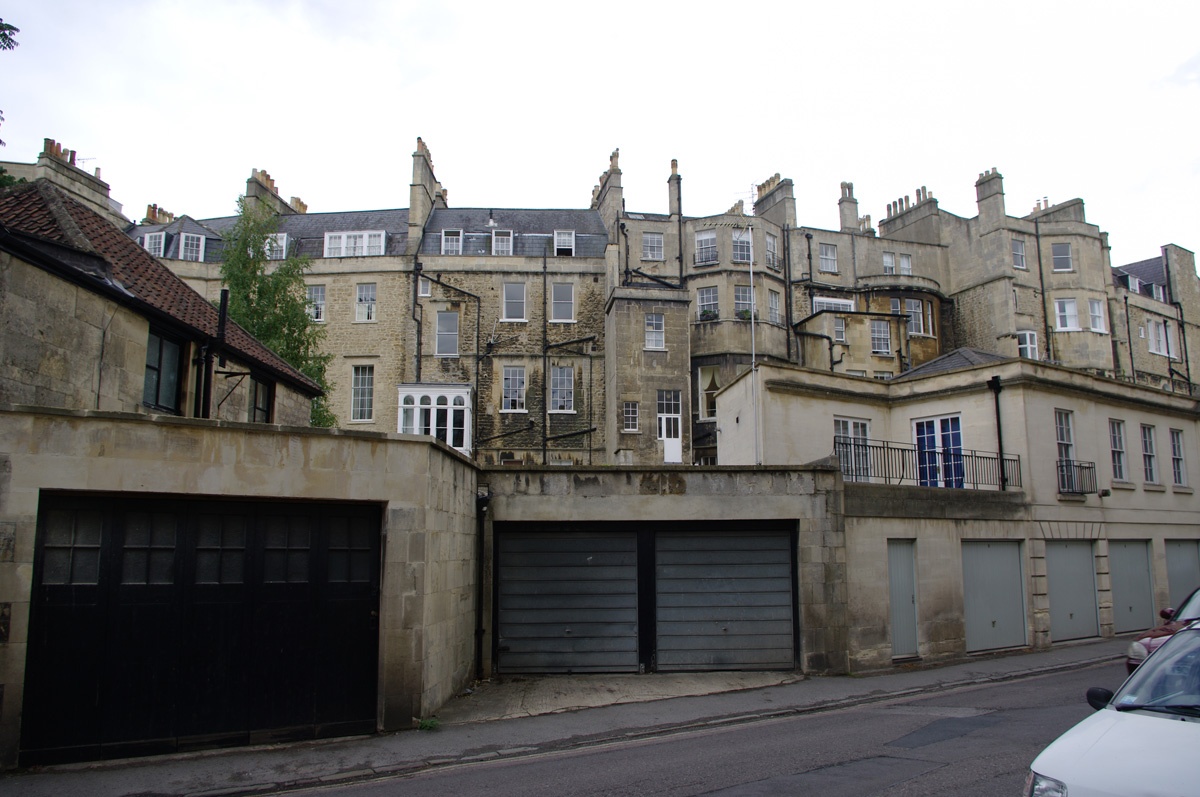
The back of the Crescent, each house is different
Jane mentions in her letters taking walks up to The Crescent and walking in the park and enjoying the views. Catherine Morland and Anne Elliot also walked there. There is a very good reason why Jane and her characters might want to walk here, the fresh air. If you look back over Bath you can see the beautiful city with its creamy yellow stonework In Jane’s time it would have been black. You will also notice the myriads of chimneys, which no longer spout black sooty smoke from thousands of coal fires. Coal is no longer burnt. We have clean air towns and cities nowadays. In Jane’s time the air was far from clean and the beautiful Cotswold stone became black. You can see today a building or two that have not had their surface cleaned since the clean air act was passed through parliament.

The Assembly Rooms

The Assembly Rooms, just north of The Circus, are what Jane and her characters knew as The Upper Assembly Rooms and also included the Octagon tearoom. This is where Catherine Morland met with the Thorpes.

The Lower Assembly Rooms, the original assembly rooms in Bath, where Beau Nash officiated , were situated near the abbey. They no longer exist. It was in the Lower Assembly Rooms that Catherine met Henry Tilney for the first time and fell in love.
Just to conclude, a couple of stories about Bath.

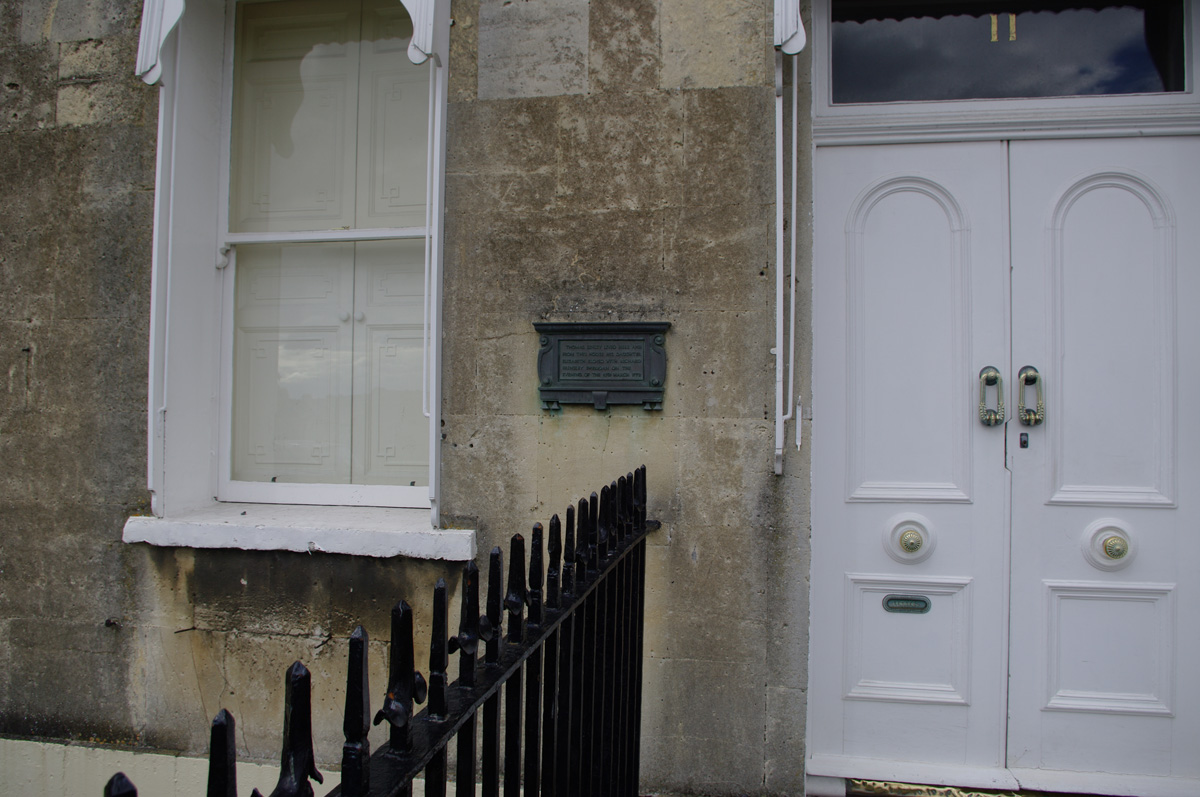
Sheridan eloped with Elizabeth from this house

In the Crescent , about half way round, is a house with plaque that relates a very dramatic story. In 1755 Richard Brinsley Sheridan, who was a great playwright in the 18th century and wrote The Rivals and School for Scandal and who was also the owner of the Covent Garden Theatre, absconded with a young lady from the house. Her father chased them all over Europe. When they were found the father made Sheridan marry his daughter. However soon after Richard Brinsley left her in the lurch. The chase was the thing. The excitement of the chase had gone. What a cad and bounder!!!!!

Tony at Pultney Bridge

Now, a story about myself. As we walked up Gay Street towards The Circus we obviously stopped outside number 25 to look at it and photograph ourselves outside. An irate and very upset looking lady marched out of the front door next to number 25 with a bowl full of water and threw it all over my legs. I must add this does not normally happen to me. The circumstances were, that some juvenile idiot had drawn rude graffiti over the side of her white van parked outside. She was trying to clean the words off. She was obviously upset and came out to wash the side of her vehicle. Unfortunately for me, she missed. She was SO sorry. Luckily it was a warm day and my trousers dried quickly in the walk up the hill.

The Royal Crescent (top) and the Circus (Bottom with trees at center.)

One fact before I finish. Did you know that the houses in The Crescent and in The Circus are all different? They all look the same because they are the same on the outside. The builder built the fronts and sold just the fronts. The new owners had to build their own backs to their houses. Hence, if you go round behind the houses in The Crescent they all look different.

Posted by Tony Grant, London Calling

Read Full Post »

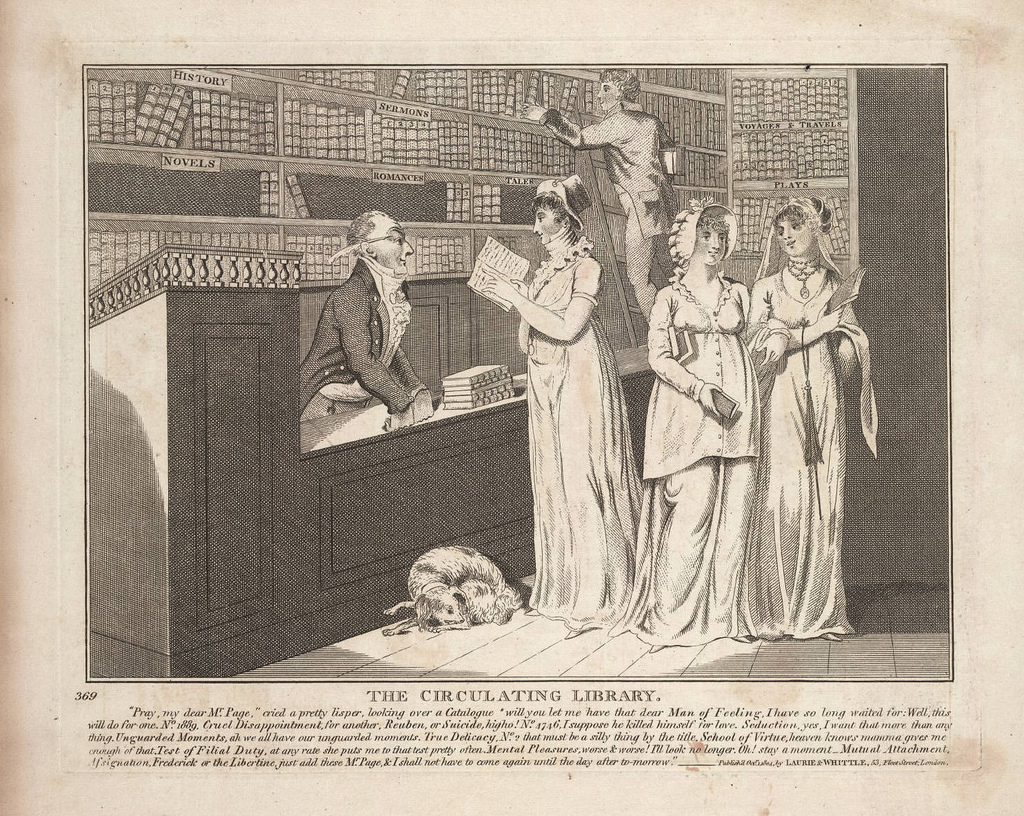
Circulating libraries in the 18th and 19th century were associated with leisure, and were found  in cities and towns with a population of 2,000 and upward. They were as much of an attraction in wealthy resorts, where people came to relax and look after their health, as in cities and small towns, like Basingstoke, where Jane Austen subscribed to Mrs. Martin’s circulating library.

In 1801, it was said that there were 1,000 circulating libraries in Britain. Book shops abounded as well, but in 1815 a 3-volume novel cost the equivalent of $100 today. Such a price placed a novel beyond the reach of most people. Worried about a second edition for Mansfield Park, Jane Austen wrote in 1814:

“People are more ready to borrow and praise, than to buy –which I cannot wonder at.”

Circulating libraries made books accessible to many more people at an affordable price.  For two guineas a year, a patron could check out two volumes. Which meant that for the price of one book, a patron could read up to 26 volumes per year.

By 1800, most copies of a novel’s edition were sold to the libraries, which were flourishing businesses to be found in every major English city and town, and which promoted the sale of books during a period when their price rose relative to the cost of living. The libraries created a market for the publishers’ product and encouraged readers to read more by charging them an annual subscription fee that would entitle them to check out a specified number of volumes at one time. – Lee Ericson, The Economy of Novel Reading

The leisurely classes had plenty of time for reading, late 18th c.

The practice of borrowing books was not a new concept in the Regency era. Records from the 17th century show that people were borrowing books from booksellers. As early as 1735, Samuel Fancourt advertised a circulating library in Salisbury for his religious books and pamphlets.

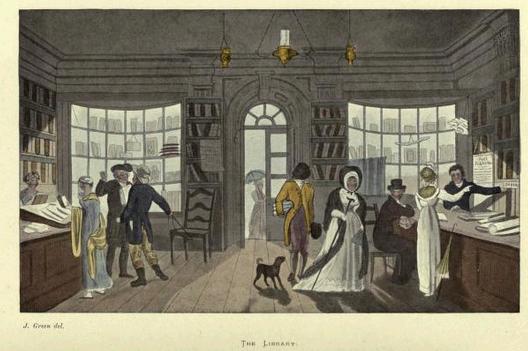
Circulating libraries attracted many patrons, even those who did not necessarily come to borrow or book or read, for they were also places for fashionable people to “hang out” and meet others.

In the resorts the circulating libraries became fashionable daytime lounges where ladies could see others and be seen, where raffles were held and games were played, and where expensive merchandise could be purchased.  – Lee Ericson, The Economy of Novel Reading

Jane Austen well knew the attractions of libraries at sea side resorts. Mrs. Whitby’s Circulating Library operated in Sanditon, and Lydia visited one in Brighton.  In her letters to Cassandra, Jane frequently mentioned circulating libraries, in particular visiting one in Southampton.

Circulating Library and Reading Room, Milsom Street, Bath. Image, Tony Grant

Circulating libraries tended to be located in a convenient location in the center of a resort. Newcomers would find out about them from guide books, such as the one in Brighton. The Royal Colonade Library advertised itself as thus:

MESSRS. WRIGHT AND SON’S ROYAL COLONADE LIBRARY, MUSIC SALOON, AND READING ROOMS.

This establishment is situated in North-street, at the corner of the New Road, and contains between seven and eight thousand volumes of History, Biography, Novels, French and Italian, and all the best Modern Publications. The Reading Room is frequented both by Ladies and Gentlemen, and is daily supplied with a profusion of London morning and evening papers, besides the French and weekly English journals, magazines, reviews, and general popular periodicals. – Brighton As It Is, 1836

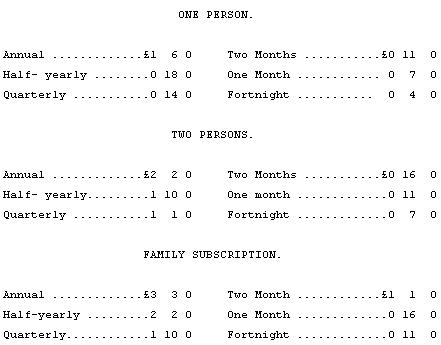
In 1836, Cassandra Austen would have been familiar with the costs associated with the Royal Colonade Library’s terms of subscriptions:

Terms of subscription

By the end of the 18th century, Scarborough, a resortt located in the county of North Yorkshire, boasted several circulating libraries. The town’s population had risen to 7,067 by 1811, and one can imagine that, with the many leisurely hours available to tourists and visitors, these libraries managed a booming business.


A circulating library in Scarborough around 1818, from Poetical Sketches of Scarborough

The Poetical Sketches of Scarborough, first published in 1813, features twenty-one illustrations of humorous subjects about the many features available in the resort, including a satiric poem about the Circulating Library:

As in life’s tide by careful fate
The mind is made to circulate
Just so each watering place supplies
It’s CIRCULATING LIBRARIES:

Where charming volumes may be had
Of good indifferent and bad
And some small towns on Britain’s shore
Can boast of book shops half a score
Scarbro and with much truth may boast
Her’s good as any on our coast
AINSWORTH’S or SCAUM’S no matter which
Or WHITING’S all in learning rich
Afford a more than common measure
Of pleasant intellectual treasure

One wonders if the following publication could be checked out a Scarborough circulating library at the turn of the 19th century, for the book was written by a local schoolmaster:

A Short Grammar of The English Language. In Two Parts By John Hornsey. Schoolmaster, Scarborough.

THE publick are much indebted to Mr Hornsey for this able and excellent compendium of English grammar. We acknowledge that we perused it with singular satisfaction; and are well persuaded that a more useful introduction to the English language cannot be placed in the hands of our youth. That this work should reach a second edition, did not excite our wonder; may it pass through many succeeding ones!- The Nichols, John.Gentleman’s Magazine, Vol 86, 1799, p 1144.

Read Full Post »

« Newer Posts - Older Posts »