Feeds:
Posts
Comments

Archive for the ‘Jane Austen’s World’ Category

Inquiring reader, in honor of this week’s tepid heat wave in Richmond, I continue my coverage of all things seaside during the Regency era. To our moderns eyes, Regency fashions by the seashore covered as much of the body as ordinary clothes, and were as complicated as regular fashions. Let’s take a closer look.
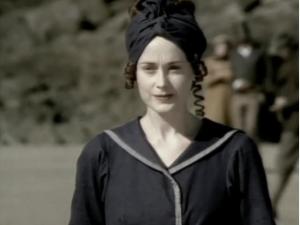
Becky Sharpe (Natasha Little) in bathing costume, Vanity Fair 1998

Becky Sharpe (Natasha Little) in bathing costume, Vanity Fair 1998

I question this image from 1998’s Vanity Fair, in which Natasha Little as Becky Sharpe looks more like a Victorian seaside gamboller than a proper Regency lady. In addition, she would have changed into this bathing costume inside the bathing machine and gone into the water largely unnoticed. She is shown in full view of both men and women on the beach wearing this outfit, which was clearly meant for swimming.

This Belle Assemblee fashion plate depicts a more demure approach to seaside fashion. The muslin gowns are rather plain, meant for the day, but it is only 1810 after all, when dress silhouettes were still classically severe. These dresses could be worn in full view of other vacationers on the beach. One sees the “wrapping” in the style of the turbans and pelisse and cape. A seaside outing was meant to be bracing and restorative, and therefore people would venture to the beach regardless of the weather.
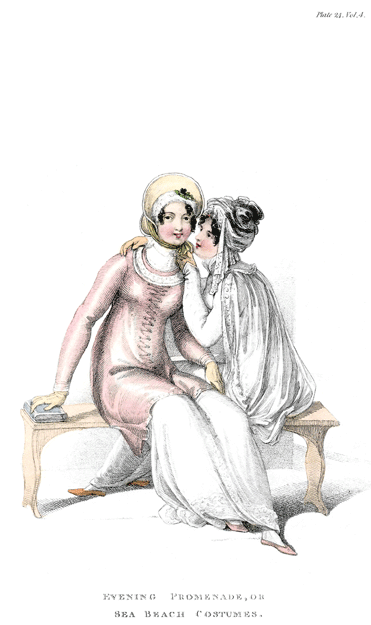
1810_October sea beach costume

The women are sitting, or else the length of the dress would become obvious. The length of dresses meant to be worn when walking along the shore were cut a little higher, one supposes to accommodate a walk along the beach when sand and waves would wreak havoc with delicate hems. The lady in the illustration is dressed for the evening, perhaps for a fete on a public pier, who knows? Either way, she is dressed to be seen in high style, even if the tiered lacy hems of her bloomers are showing.
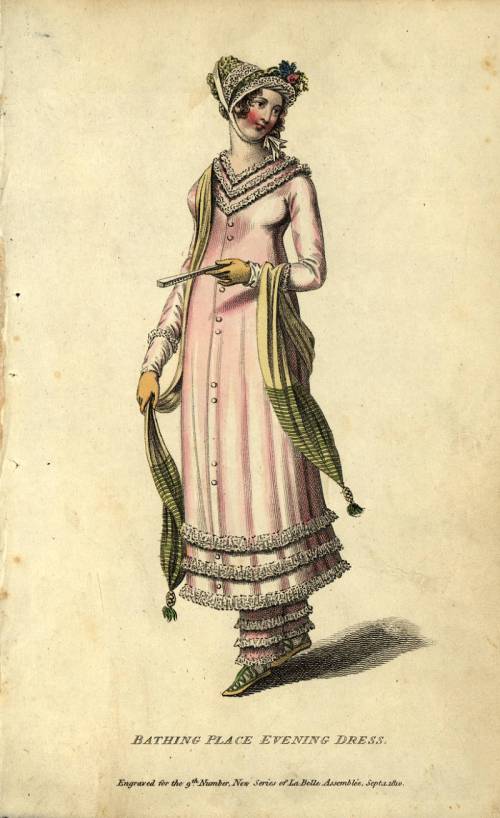
Bathing place evening dress, 1810

Bathing place evening dress, 1810

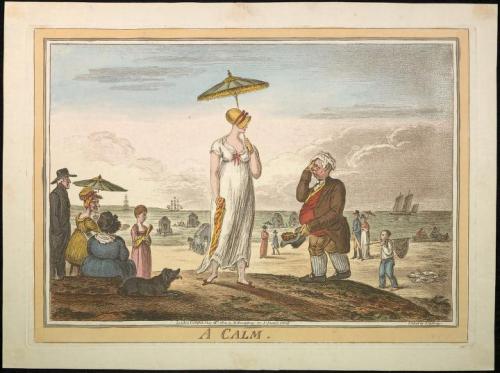
Famed illustrator James Gillray showed seaside fashion in all its glory. From the high tide hem of the lady in the center, to the completely covered up garb of the women sitting on the beach. This lovely illustration from 1810, “The Calm,” shows the seashore on a calm day, with our fashionable miss as exposed as she can decently be – her arms and neck bare, her head covered by a small straw bonnet, and her tiny parasol barely protecting her delicate skin from Sol’s harmful rays.a calm 1810 gilray
This illustration shows the sea shore on a raw day that many Britons will recognize, with the winds whipping up waves, woolen capes, and muslin skirts. Even covered up, this lady exposes more to prying eyes than was appropriate!
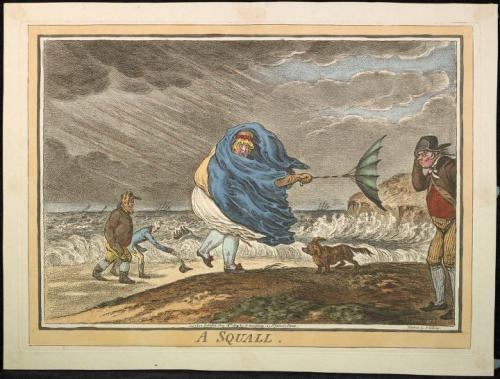
A squall, Gilray 1810

A squall, Gilray 1810

Taking cold dips in the ocean and drinking foul-tasting spa water were two of the health benefits derived from visiting a seaside resort. Inhaling the fresh sea air was another. These fashions again show how thoroughly one covered up before venturing out of doors.

Poetical Sketches of Scarborough, 1813

Poetical Sketches of Scarborough, 1813

Regardless of their location in or out of the water, non-swimmers remained covered up. It is ironic that once in the water, so many men and women would swim completely naked, but there you have it: Seaside, Regency style.
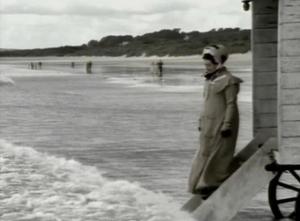
Steps to the sea, Vanity Fair, 1998

Steps to the sea, Vanity Fair, 1998

On a side note, a dog lover like myself will find the Gilray prints and the Scarborough print quite interesting, for dogs are prominently displayed as realistic touches.

Read Full Post »

Martha Gunn, dipper

Martha Gunn, dipper

In a scene in 1998’s Vanity Fair with Natasha Little as Becky Sharp, she visits Brighton with her husband and friends. The film, set during the Regency era, depicted a scene in which one of the party is taken from a bathing machine and dipped into the cold waters by a large woman. The bather floats on her back with her bathing costume billowing from the trapped air. This comical scene was based on fact. Brighton during the late 1790’s early 1800’s  employed some twenty male and female “dippers”” whose jobs were to vigorously dip their clients into the sea and push them through the waves, keeping them afloat, then help them back into the bathing machine.

floating with billowing skirt vanity fair 1998Brighton’s most famous dipper was Martha Gunn, a large, sturdy woman whose fame exists to this day. Bathers were separated by sex, a restriction that remained until 1930 in Brighton, and were drawn  into the waters by horses hitched to bathing machines. The bathers would be inside the vehicles changing into their bathing costumes, or not, for, screened from the world and the opposite sex, they would enter the waters au naturel. The terminology for immersion differed for the sexes. When men immersed men into the waters, it was called bathing. When women immersed women into the waters, they were dipping.
Sea Bathing machine

Sea Bathing machine

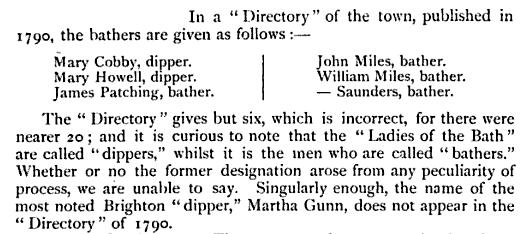
On page 233 in a Directory of Brighton published in 1790 the bathers are listed as follows:

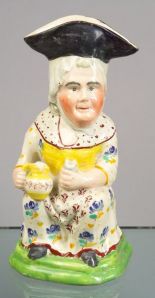
Martha Gunn Toby Jug

Martha Gunn Toby Jug

Born in 1726, Martha Gunn dipped seaside visitors from around 1750 until she was forced to retire through ill health around 1814. She was such a popular figure that the Prince of Wales granted her free access to his kitchens.  The dipper was known as ‘The Venerable Priestess of the Bath’ by the locals. Large and  strong, well known and respected by the townsfolk as well as the visitors, Marth appeared in comic caricatures of the times. “Life for Dippers and Bathers was not easy – standing all day in the sea even in August calls for a tough constitution and Martha Gunn’s ample size was no doubt one of the reasons for her success in the cold waters.” ( Martha Gunn) Mrs. Gunn died in 1815 and is buried in the yard at St Nicholas Church. Her portrait hangs in the tea-room of the Royal Pavilion, and her house still stands on 36 East Street. Her fellow dippers and bathers continued to perform their duties in Brighton until the mid 19th century.

[Dippers] were also technicians of the ritual process: on-site masters of the requirements of the sea-bathing treatment. They judged the waves, the state of their clients, and their daily requirements: bathing at such and such a time or for so long. Many of the bathers could not swim: Dippers, often women, were essential figures of dependable strength and assurance. This might explain the inordinate affection of them. The ritual purging and bathing, the ministrations of the Dipper, and the natural influence of the seashore itself with its salt water, sea air, and ‘ozone’ were vital ingredients in both the reality and perception of a Cure. – Ritual Pleasures of a Seaside Resort, Chris Jenks, p169.

Martha's grave

Martha’s grave

Read Full Post »

Bathing machine

Some historians attibute the invention of the bathing machine to Benjamin Beale, a Quaker and a glove and breeches maker who lived in Margate, a coastal seaside resort in England, during the 18th century. This was not so. Beale’s actual contribution in 1750 was the invention of an awning attached to the rear of the bathing machine. The cloth hood became popularly known as a modesty hood. It could be lowered in front of the machine down to the water and provide a private bathing area for the modest swimmer. There were variations to the hood, such as a  canvas awning called a lift, which could be extended over the back of the cart like a tent and completely hide the bather from view. An additional benefit of the hood was that it also protected delicate skin from the sun.

During the 18th and 19th centuries, people did not bathe in the sea for pleasure but for their health. After the publication of the Use of Seawater in the Diseases of the Glands by Dr Richard Russell in 1752, sea bathing became more fashionable.

Ramsgate bathing machines off the High Street

Ramsgate bathing machines off the High Street

The engraving above is an early version of the of the lower High Street in Margate in Benjamin Beale’s time before the Bathing rooms were constructed. The view from the bay shows how the Bathing Machines were accessed from the lower High Street.

Woman swimming in the sea; the need for privacy in such a situation is acute

Woman swimming in the sea; the need for privacy in such a situation is acute

It was considered inappropriate for the upper and middle classes to swim in the waves together, thus bathing machines became popular. Modesty and decorum dictated that the opposite sex should bathe in isolation from each other, for nude bathing for both sexes was common until the Victorian age.  “It is believed that naked bathing continued until 1862, when a law was passed stating that male and female bathers were to be segregated by not less than 60 feet, and that all owners of bathing machines would provide gowns or dresses to female bathers and drawers or similar to male bathers.”  After swimming, bathers would re-enter the bathing machine, dry off, and change back to their street clothing. The bathing machine would be wheeled back to the beach and the bather would emerge fully dressed. “The hiring charge for a bathing machine in 1770 varied from 9d for two or more gentlemen bathing themselves to 1/6d for a gentleman taking a machine with a guide.”*

Bathing machine and attendants

Bathing machine and attendants

Imagine to yourself a small, snug, wooden chamber, fixed upon a wheel-carriage, having a door at each end, and on each side a little window above, a bench below – The bather, ascending into this apartment by wooden steps, shuts himself in, and begins to undress, while the attendant yokes a horse to the end next the sea, and draws the carriage forwards, til the surface of the water is on a level with the floor of the dressingroom, then he moves and fixes the horse to the other end – The person within being stripped, opens the door to the sea-ward, where he finds the guide ready, and plunges headlong into the water – After having bathed, he re-ascends into the apartment, by the steps which had been shifted for that purpose, and puts on his clothes at his leisure, while the carriage is drawn back again upon the dry land; so that he has nothing further to do, but to open the door, and come down as he went up – Should he be so weak or ill as to require a servant to put off and on his clothes, there is room enough in the apartment for half a dozen people. – The Expedition of Humphrey Clinker, Tobias Smollett, 1771

Beale bathing machine

Beale bathing machine

Beale did not get rich off his invention, and he was reduced to poverty after his machines were destroyed in storms.

“The public are obliged to Benjamin Beale, one of the people called Quakers, for the invention,” writes the author of A Short Description of the Isle of Thanet, published in 1796. But it was the old story; the public became grateful after the inventor had been ruined by his enterprise. His successors had reaped the harvest. Old Benjamin Beale’s widow could remember in her last days the first family that ever resorted to Margate for the purpose of bathing being carried into the sea in a covered cart. In 1803 Beale’s machines were one of the institutions of Margate. It was alarmingly claimed for them that “they may be driven to any depth into the sea by careful guides.” – New York Times, August 11, 1906

southsea_common from a lithograph from A. Pernell 1865

The design of the bathing machine changed little in 150 years, and most, except those built for the rich, remained nothing more than damp wooden boxes on wheels. In the 1865 lithograph of the Southsea above, Beale bathing machines can be seen with their awnings fully unfurled to the water.

Read Full Post »

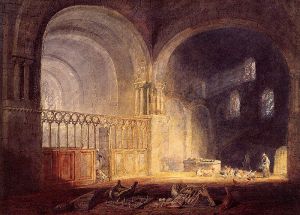
Interior of Lindisfarne Priory, 1797, Thomas Girtin

Interior of Lindisfarne Priory, 1797, Thomas Girtin

Young Thomas Girtin’s painter friend was the famous artist J.M.W. Turner. As teenagers both men had been employed to color prints with watercolor paints. While Turner lived to be over seventy-five years of age, Girtin died of consumption at 27. Turner would recall in his later years: “Had Tom Girtin lived I should have starved.” No small praise.  During his short life, Girtin gained a major reputation as a watercolor artist and played an important role in establishing English Romantic watercolor paintings as an art form. As one biographer noted, “While Girtin lived, Turner followed.”  One can only imagine how fascinated young and romantically minded Catherine Morland would have been had she seen Girtin’s painting of the priory ruins.

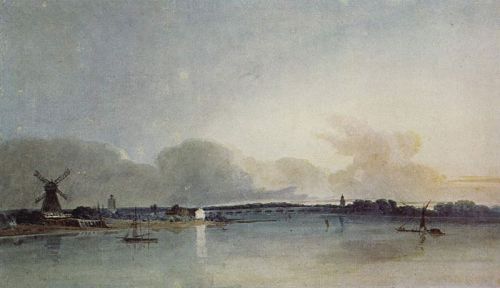
Watercolor landscape, Thomas Girtin, 1800

Watercolor landscape, Thomas Girtin, 1800

Three years before his death, Girtin had acquired important patrons who collected his works. Thankfully the young artist had been prolific and his influence was not soon forgotten. In 1842, while sketching high in the Swiss Alps, a mature Turner, reminded of a unique effect of light in darkness, penciled a brief note in the margin of his drawing: “Girtin’s White House.”

Transept of Ewenny Priory, Glamorganshire, JMW Turner, 1797

Transept of Ewenny Priory, Glamorganshire, JMW Turner, 1797

Read about Thomas Girtin in these links:

Read Full Post »

Wednesday, June 27, 1711, Mr. Addison writes a letter to The Spectator:

Mr. Spectator – Women are armed with fans as men with swords, and sometime do more excution with them. To the end therefore that ladies may be entire mistresses of the weapon which they bear, I have erected an academy for the training up of young women in the exercise of the fan, according to the most fashionable airs and motions that are now practiced at court. The ladies who carry fans under me are drawn up twice a-day in my great hall, where they are instructed in the use of their arms, and exercised by the following words of command: – Handle your fans, Unfurl your fans, Discharge your fans, Flutter your fans – By the right observation of these few plain words of commands, a woman of a tolerable genius, who will apply herself diligently to her exercise for the space of but one half-year, shall be able to give her fan all the graces that can possibly enter into that little modish machine… For the rest of Addison’s letter to The Spectator, please click here.

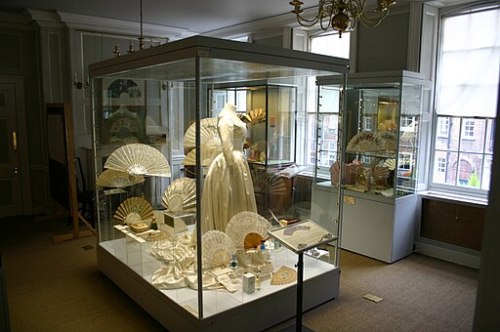
Wikimedia Commons, Image of the Fan Museum, Greenwich, UK

A lady’s fan carried far more symbolism than the mere act of cooling by agitating the air. At first considered a novelty, the fan gained popularity in Europe in the mid-sixteenth century and could be seen in the paintings of fine Elizabethan ladies. The folding fan, which was introduced from the Far East, gradually replaced the fixed fan. Made from vellum or paper, these fashionable and expensive accessories lent themselves well to elaborate painting and decoration. By 1709, fans began to be manufactured in London and a Fan Makers’ Company was established. Commemorative fans that celebrated an historic event were quite popular among the well to do, and their styles echoed the fashion of the day. Neoclassical fans, like the commemorative fan depicted above, lacked color and were generally bare of decoration, reflecting the simple white muslin dresses so popular during the Regency era. When dresses became more ornate and colorful again, fans followed the trend. They were highly prized for their aesthetics, for “in the ordinary fan of the present day Art has not strayed far from Nature.”

Over the centuries, a language of the fan evolved. Legend has it that by the time the Victorian era began fan gestures had been rigidly codified, wherein each movement and snap of the wrist carried a message fraught with meaning, although some experts dispute this. (See comment below made by Pierre Henri Biger, a fan expert.)  Once popular both during the day and evening, fans gradually became restricted only for the evening, increasing in size in the last two decades of the nineteenth century.  Their popularity waned and waxed as the quote below suggests, but until they could be cheaply manufactered in large quantities, they remained the province of only those who could afford them. In the late 19th century to early 1920’s, fans were made in profusion to carry advertisements, and were given away as souvenirs by hotels, restaurants, and businesses.*

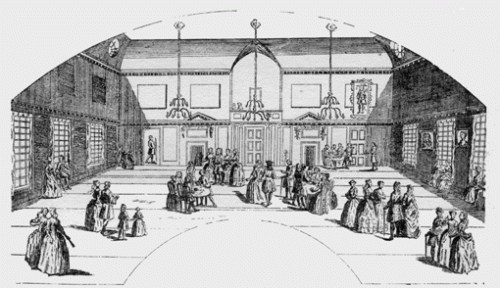
Fan Design, The Lower Rooms, Bath

Fan Design, The Lower Rooms, Bath

For just a century after Addison wrote, the fan figured prominently in polite society, matched, when the sword went out of fashion, against the snuff-box and the clouded cane, and often victorious. The satirists and dramatists wore in turn bitter and pleasant in their references to it. Painters and their sitters paraded it ostentatiously. It is said to have done wonders in diplomacy, and who could wonder at the success of flying sap and masked battery against garrisons defended by an eye-glass, a pinch of snuff, and a malacca. The fan’s apogee was in the days of the minuet de la cour. But since athletic waltzes, polkas, and mazurkas have elbowed out their courtly predecessors, the once ” modish little machine” has retired into obscurity with the “wall-flowers,” or, if at all, is used by the dancers as inartistically as though it were the archetypal ” vanne” or wind engine. Brighter days may, however, dawn, and society which, in its way back to costumes of the Watteau and Pastoral periods, has already reached the stage of short waists and long trains, may over in our time reclaim the little exile from its temporary partial shade. – Nature and Art, by Day & Sons, 1866, p62

More about this fascinating fashion accessory

Read Full Post »

« Newer Posts - Older Posts »