Feeds:
Posts
Comments

Archive for the ‘Jane Austen’s World’ Category

When Fanny Price first arrived at Mansfield Park, her cousins  found her ignorant on many things. “Dear mama, only think, my cousin cannot put the map of Europe together.”  The girls  were referring to dissected geography puzzles, now known as jigsaw puzzles, that had first made their appearance in Europe in the 18th century and were popularized and widely used in England and America in the 19th and 20th centuries. Mansfield Park makes one of the earliest references to this educational way of teaching of geography. While Fanny Price’s cousins teased her for not being familiar with these expensive new schoolroom toys, the truth was that her Portsmouth parents could not afford them.

At the turn of the 18th century,  British companies began to make toys that are still favorites today: toy soldiers, farmyards, wooden building blocks, steam engines, and kaleidoscopes. The toymaking industry began to boom, making mass-produced toys cheap enough to afford. By the start of the Regency Period,  people had become accustomed to purchasing them and they became educational in nature as well, such as puzzles. Many sources claim that John Spilsbury, a teacher in England, created the first jigsaw puzzle in  1767.  He glued a map of England and Wales  to a  flat thin piece of mahogany board and used a fine saw (fretsaw) to cut along the borders of the counties, which made up the separate pieces.  The “dissected map” became instantly successful.
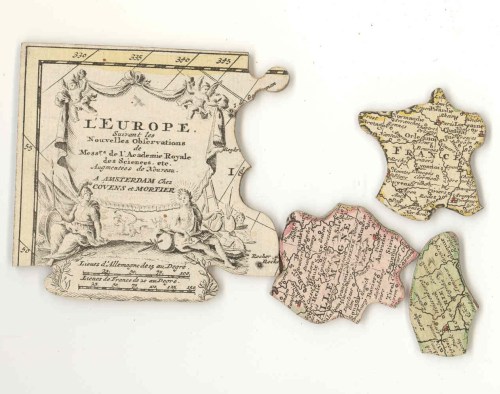
18th century Dutch dissected puzzle

18th century Dutch dissected puzzle

While it is popularly thought that Spilsbury created the first dissected puzzle, the Dutch dissected puzzle in this image was made ca. 1750 (Cartographic dept. Univ. Library of Amsterdam), predating Spilsbury’s invention by seventeen years. If you will notice, only the borders of this early map of Europe interlock but not the central parts. ( Theo de Boer.) The Dutch puzzle might well be one of the earliest jigsaw puzzles made in the world, but there is evidence that several countries in Europe, including France, were teaching geography in this “entertaining manner.” As an interesting aside, so many new geographical features were discovered during this period of scientific discovery and exploration, that maps quickly became outmoded as new ones were drawn.

Before long, pictorial puzzles became popular, teaching such subjects as history, alphabets, botany, biblical scenes, and zoology. Soon the puzzles began to be made for their entertainment value as well. Click here to view two fine examples of early puzzles, including an alphabet puzzle.

Colorful_british_pub_picturEarly puzzles did not come with an image that helped people to solve them, and a careless movement could ruin hours of painstaking work.The treadly saw, first used in 1880, could cut out more intricate shapes, and thus the jigsaw puzzle was born. The interlocking pieces held firmly together and the game took off in popularity. Paperboard began to replace wood and the pieces became more varied and intricate. The game was portable, became more affordable with the passing years, and could entertain families for hours at a time. By the early 19th century, America in particular experienced a puzzle craze that lasted for decades and still exists today.

Read Full Post »

Lady Maria Hamilton, 1802, by Thomas Lawrence.

Lady Maria Hamilton, 1802, by Thomas Lawrence.

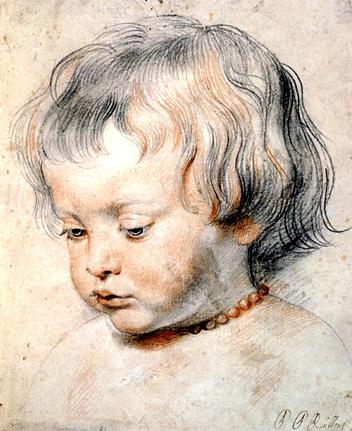
Inquiring Reader: You’ve probably seen the necklaces dozens of times without noticing them. I have. These beautiful single string coral necklaces worn by Regency ladies escaped my attention until my friend and blogging partner on Jane Austen Today, Laurel Ann of Austenprose, sent me some spectacular images, such as the one of Lady Maria Hamilton, who died in 1814 unmarried. Coral has enjoyed a long and ancient tradition, first worn as a talisman and later for its color and beauty. One of my favorite drawings by Peter Paul Rubens depicts his son with a coral necklace. At the time coral was thought to protect the wearer.

Nicolaas Rubens Wearing a Coral Necklace, Peter Paul Rubens, Red and black chalk heightened with white and some black ink on paper, c. 1619

Nicolaas Rubens Wearing a Coral Necklace, Peter Paul Rubens, Red and black chalk heightened with white and some black ink on paper, c. 1619

The tradition of giving children coral necklaces continued through the 19th century, as shown in this detail of a late 18th century John Hoppner painting of one of the Sackville girls. The gemstone was considered a guardian of sorts, protecting children from illnesses like stomachaches, fever, typhus, smallpox, and rickets. The mala beads were polished to a smooth sheen and matched in color. Bead sizes could be similar or gradated from small to larger stones that were strung in the center.

The Sackville Children, detail, John Hoppner, 1796

The Sackville Children, detail, John Hoppner, 1796

Handmade jewellery created during the late Georgian Era (1760-1837) is extremely hard to find today.  As styles changed, the pieces were remade rather than tossed out or sold. Until the latter part of the 18th century, coral was harvested from the sea largely by dredging. Fine quality red coral came from the Mediterranean – Algeria, France, Italy, Morocco, Spain, Tunisia and the islands of Corsica, Sardinia and Sicily, with some saying that the best corals came off the coasts of Algeria and Tunisia. Eighteenth century coral was a rich warm red and is unavailable today. In fact, original antique jewellery made with dark red coral is so difficult to find that it has become a highly prized collectible.

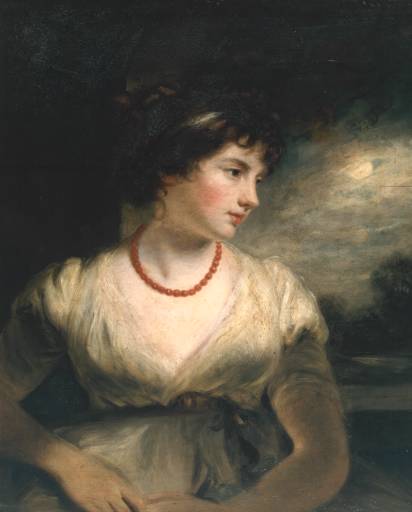
Jane Elizabeth, Countess of Oxford, John Hoppner, 1797

Jane Elizabeth, Countess of Oxford, John Hoppner, 1797

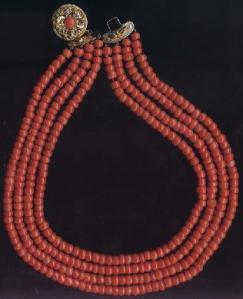
Early 19th century red coral necklace

Early 19th century red coral necklace

Simple round necklaces, like the one worn by the Countess of Oxford, were popular and complimented low necklines, but chokers were also fashionable, like the Georgian Cannetille Sardinian red coral four strand necklace on the left. Coral is made up of the skeletal material built up by small animals that live in slow growing colonies in the sea. Colors range from vivid orange, red, and white, to salmon and pale pink (called angelskin coral). In jewelry making coral is either carved into beads, cameos, and other forms, or is left in its natural branch-like form and simply polished. (My mother had such a necklace, which I played with as a child.) The most sought after color (and the rarest) is a deep red, as in the necklace at left.  Coral manufacturing during the Regency Period consisted primarily of filing beads of smoothed coral and stringing necklaces. Because coral consists of calcium carbonate, it is extremely sensitive to chemicals,  perfumes, and body acids. Like pearls, the necklaces must be washed with a damp cloth (no detergents) and restrung periodically.

Little boy placing a coral necklace on a dog's neck, Martin Drolling

Little boy placing a coral necklace on a dog's neck, Martin Drolling

detail of Jacopo Vignali's Head of a Young Woman, 17th c

Many mystical and medicinal properties were attributed to coral, among them vitality, physical strength, stronger marital relationships, wealth, increased sensuality, and protection while out to sea. Coral was also used as a medicinal powder. Primitive physics believed that coral oxides mixed with honey made a person strong. Mix it with betel leaf and it made a potent cure for cough and heart disease. Coral powder is still a popular aphrodisiac in India today, which prompts avaricious collectors to dynamite coral reefs, putting fragile reefs in acute danger. In the detail of a 17th century drawing by Jacopo Vignali at right, one can easily see why this semi-precious stone was considered to have sensual qualities. The combination of the coral necklace and her full lips make the young woman look both fragile and seductive. Thank you, Laurel Ann, for introducing me to this fascinating topic! As you can see, I got a little carried away.

More information about corals can be found in these links:

Read Full Post »

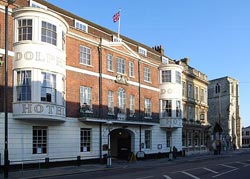
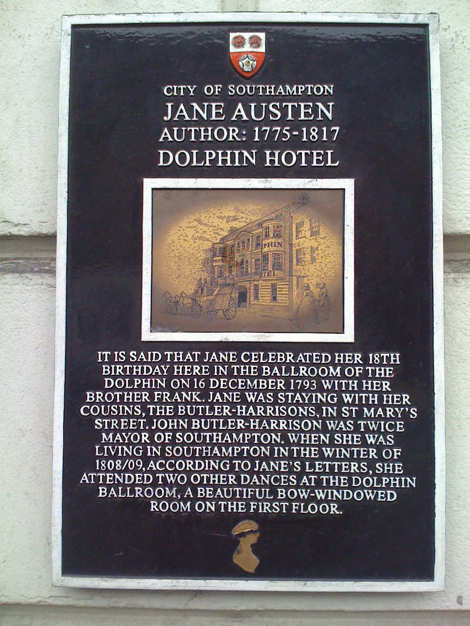
Dolphin Hotel in Southampton

Dolphin Hotel in Southampton

According to a recent newspaper report, The Dolphin, a 3-star hotel in Southampton, will close at the end of this month. Jane Austen danced in its ballroom between 1806 and 1809 after her father’s death and after she and her mother and sister moved from Bath. The building that houses the Dolphin was erected in 1250 and the hotel dates from 1550, a venerable history. Southampton is a medieval city. Its western walls were built in 1338 and remain one of the finest medieval town defenses in the UK.

The medieval town that Jane knew was, according to the diarist Mrs Powys, “one of the most neat and pleasant towns I ever saw … once walled round, many large stones of which are now remaining. There were four gates, only three now … one long fine street of a quarter mile in length … At the extremity a capital building was erected with two detached wings, and colonnades. The centre was an elegant tavern, with assembly, card room, etc., and at each wing hotels to accommodate the nobility and gentry. The tavern is taken down, but the wings converted into genteel houses” (Mitton 1917). – Hantsweb

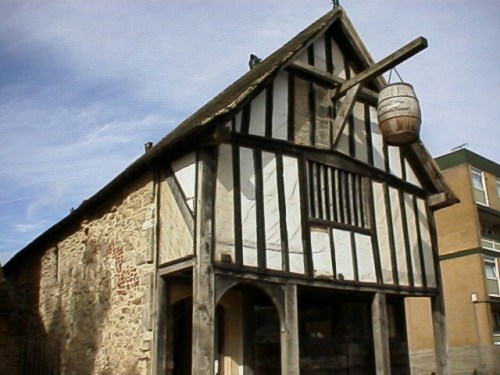
Medieval Merchant's House, Southampton

Medieval Merchant's House, Southampton

In one of her letters Jane mentioned a ball at the Assembly Rooms. These rooms, said a contemporary writer, were situated near the West Quay, and were very elegantly fitted up. “The Long Room, he says, was built in 1761, the Ball Room soon afterwards.”

Quadrille Plate from Le Bon Genre, 1805

Quadrille Plate from Le Bon Genre, 1805

“Our ball was rather more amusing than I expected,” Jane writes . . . . “The room was tolerably full, and there were, perhaps, thirty couple of dancers . . . . It was the same room in which we danced fifteen years ago. I thought it all over, and in spite of the shame of being so much older felt, with thankfulness, that I was quite as happy now as then . . . . you will not expect to hear that I was asked to dance, but I was – by the gentleman whom we met that Sunday with Captain D’Auvergne. We have always kept up a bowing acquaintance since, and being pleased with his black eyes, I spoke to him at the ball, which brought on me this civility; but I do not know his name, and he seems so little at home in the English language, that I believe his black eyes may be the best of him.”[1] Constance Hill, Jane Austen Southampton. – Constance Hill

Southampton Sea Walls

Southampton Sea Walls

During the 18th century Southampton was a popular Spa town, but this development did not last long. Although assembly rooms and baths were constructed, there were not enough features in the town to maintain it as a tourist attraction. Jane and her family could visit the theatre and there was a circulating library, but Southampton was more a working seaport than a resort. Unfortunately the building that Jane Austen lived in and its surrounding area have been demolished, but one can still see the medieval walls and ancient portions of the city.*  The Dolphin’s website describes the Assembly Rooms today:

Jane Austen Assembly Rooms – Jane Austen was a regular visitor to Southampton and famously attended a ball in the Assembly rooms here at the Dolphin on her 18th birthday. The main room divides into three creating: Jane Austen Assembly Room – One A large room, decorated in the Georgian style, featuring a quite stunning stone carved fireplace and one of two enormous bay windows, which are reputed to be the largest in the world, providing ample natural daylight. Jane Austen Assembly Room Two – The smallest of our meeting rooms is still a good size, with three sash windows, opening onto the royal balcony, which hangs over the high street. Jane Austen Assembly Room Three – A large room, decorated in the Georgian style, featuring a quite stunning stone carved fireplace on which one of our resident ghosts (Beau) is reputed to lean, whilst looking out of the bay window, which are reputed to be the largest in the world, providing ample natural daylight. Jane Austen Assembly Rooms Full Room – When the whole room is opened up, the symmetry of the architecture can be seen in its full glory, much as it would have been when Jane danced here. The two stone carved fireplaces, facing one another across the length of the room and the two bay windows together with the high ceilings reflect a style of architecture which has sadly passed. Jane Austen Music Room – The music room is also situated on the first floor, adjacent to Jane Austen Assembly Room One, was built slightly later than the main room in around 1780 and features a marble fireplace and five sash windows, overlooking the high street.

To mark the 200th anniversary of the year Jane took up residence in Southampton, a Jane Austen Trail was launched in July 2006. There are eight plaques each at a location associated with Jane and, available at Southampton Tourist Information Centre.

dolphin-hotel-jane-austen-trail

Find more on the topic in these links:

Read Full Post »

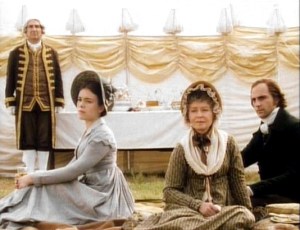
picnic-at-box-hill-frank-saw-emma-first-in-march-2

The wretchedness of a scheme to Box Hill was in Emma’s thoughts all the evening. How it might be considered by the rest of the party, she could not tell. They, in their different homes, and their different ways, might be looking back on it with pleasure; but in her view it was a morning more completely misspent, more totally bare of rational satisfaction at the time, and more to be abhorred in recollection, than any she had ever passed. – Emma, Jane Austen, Chapter 44

  • Re-reading Box Hill: Reading the Practice of Reading Everyday Life offers five articles on the topic of Box Hill. How astounding. Click here to enter the site.

Read Full Post »

Inquiring Readers,

Joan Hassall's portrait of Jane Austen

Joan Hassall's portrait of Jane Austen

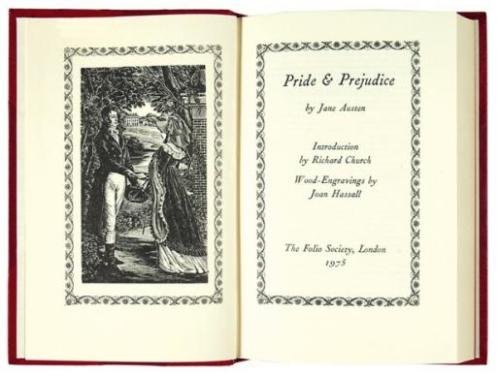
Every once in a while I contribute a small amount of information to Wikipedia, and only when I think I can add to the general pool of knowledge. When I consulted Wikipedia’s entry on Joan Hassall, the exquisitely talented wood engraver, I found it woefully lacking and added what little I knew. The best online information about her life (1906-1988) sits at this site: Joan Hassall Wood Engraver: Textualities. Between 1957 and 1962, Joan was commissioned to create wood engravings for the Folio Society editions of Jane Austen’s novels, which is her main association with the author. These editions have been frequently reprinted, but the  first folio editions of Austen’s works are now quite scarce.

Joan was known for carving detailed illustrations using an exacting medium that allowed for few mistakes. One wrong move with an engraving tool and a wood block could be ruined. She also had to plan backwards, for dark areas on the wood block printed light and light areas filled up with ink and came out as lines or shadows. Printed on paper, the image came out in reverse. The wood had to have just the right firmness and even texture. The grain could not present resistance to cutting, yet it had to be hard enough to withstand wear and permit a sharp edge to the line. Fruitwoods, such as pear or cherry were ideal candidates for this medium, whereas American oak or walnut were considered much too hard. – Technique for the Color Woodcut: Cutting

pride-and-prejudice

Joan Hassall

Joan Hassall

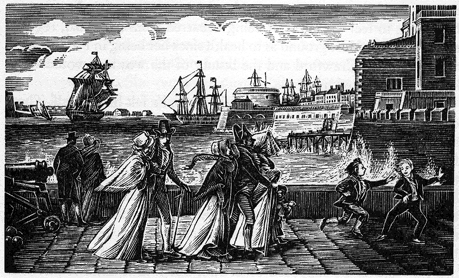
C. E. Brock and Hugh Thomson are better known illustrators of Jane Austen’s novels, however I find it interesting that Joan Hassell, who resembled a matronly British lady, created more forceful images than these two famous men. Brock’s and Thomson’s works are delicate and airy, while Hassall’s are stark and masculine. Her style was defined by her medium – the wood block. Hassall generally worked in black and white, scraping out thin  and thick lines with engraving tools, and adding stippled variations in between, yet she attained an astonishing amount of detail with an unerring hand. One of the reasons why I like her image of Fanny Price in Portsmouth is not only because of the robustness of the scene, but because I can practically smell the sea air. She managed to evoke waves dashing against the shore, children playing, clouds scudding by, and a stiff breeze blowing against the ribbons and short capes of the strollers. In less capable hands, this scene would have been nearly impossible to attempt in such a small area. She also moves from light to shadow effortlessly. Witness how the ships’ masts are outlined against the white cloud bank and how the legs of the little boy on the right, who stands in dark shadows, are limned by a single light line. Masterful.

Fanny Price in Portsmouth, Mansfield Park, Folio Society, illustrated by Joan Hassall

Fanny Price in Portsmouth, Mansfield Park, Folio Society, illustrated by Joan Hassall

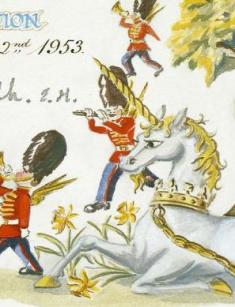
Hassall’s talents as a wood engraver did not mean that she did not possess a delicate hand, as this exquisite watercolor invitation for the Queen’s coronation in 1953 demonstrates. The queen commissioned Joan to create an invitation especially for Prince Charles, who was only five years old at the time. It is still proudly displayed in the royal collection.

royal-invitation-1953

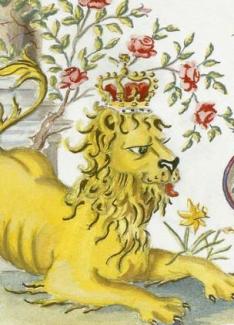
Imagine the young Prince Charles’s delight when he saw these whimsical details:

Lion detail, Prince Charles's Invitation

Lion detail, Prince Charles's Invitation

Unicorn detail, Invitation to the royal coronation

Unicorn detail, Invitation to the royal coronation

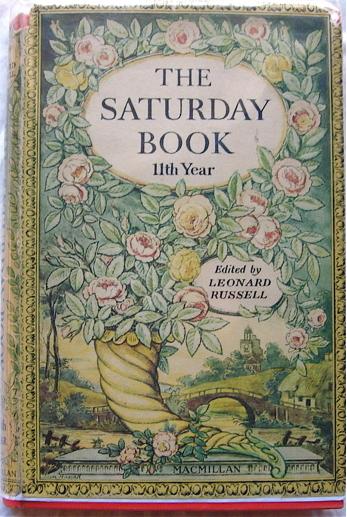
The Saturday Book, Joan Hassall dust jacket, 1951

The Saturday Book, Joan Hassall dust jacket, 1951

This 1951 dust jacket for The Saturday Book shows how expertly Joan can handle a brush as well as an engraver’s tool.

flow-gently-sweet-afton

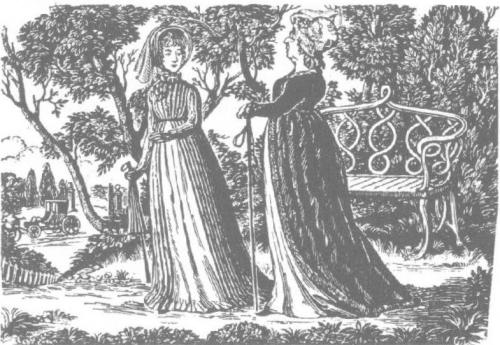
Joan’s themes also ran to nature, and she was so well known for her natural studies that people like Flora Thompson, the author of Lark Rise to Candleford, collected her individual prints. In a 1989 JASNA article (Illustrating Jane Austen), Keiko Parker discusses Hassall’s ability to add interesting details in this wood engraving of Lady Catherine de Bourgh and Elizabeth Bennet as they take a turn in the “prettyish kind of a little wilderness on one side of your lawn.” The print demonstrates Joan’s ability to add exquisite details. You can even see the leaves between the scrollwork of the bench. One errant slip, and the back of the bench would have been ruined. Her handling of the leaves, grass, and dirt path are reminiscent of her nature studies; and she even manages to create a vista, leading one’s eye to the waiting carriage and the road that will take Lady Catherine back to her home.

Lady Catherine de Bourgh and Elizabeth Bennet

Lady Catherine de Bourgh and Elizabeth Bennet

Hassall’s talents as a carver were recognized by her peers and she was the first woman to be elected as a master member to the Art Workers Guild (1964). In 1950 she designed an edition of Robert Burns poems and created a series of illustration that are among her most delightful small prints, especially the one of a tiny mouse rolling in the grass.
hassall-pix_460

The Old Tree, 1950

The Old Tree, 1950

Joan’s family members led lives that were as interesting and creative as hers. Her father was John Hassall, an illustrator of posters and childrens books, whose most famous work of art, a 1908 poster of The Jolly Fisherman, still promotes Skegness as a seaside resort today. Joan’s brother, Christopher Hassall, was a poet, actor, and librettist famous for his collaborations with composer Ivor Novello. Modern audiences have heard  I Can Give You the Starlight, sung by Jeremy Northam in Gosford Park. The words by Christopher and Ivor’s melody evoke “Britishness” in the 1930’s to a tee.

Learn more about Joan Hassall at these links:

Read Full Post »

« Newer Posts - Older Posts »