Feeds:
Posts
Comments

Archive for the ‘Jane Austen’s World’ Category

The 18th Century Sedan Chair

The 18th Century Sedan Chair; Image from Georgian Index

After the fire of London, in 1666, the streets were impassable, and so people of quality went on their business or pleasure in sedan chairs.They became in time such a nuisance as to obstruct the highways. – The History of Dress, The New York Times, 1884,
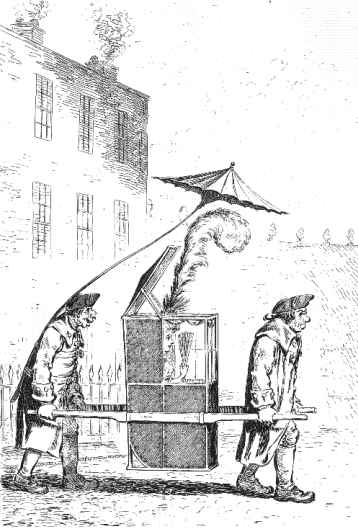
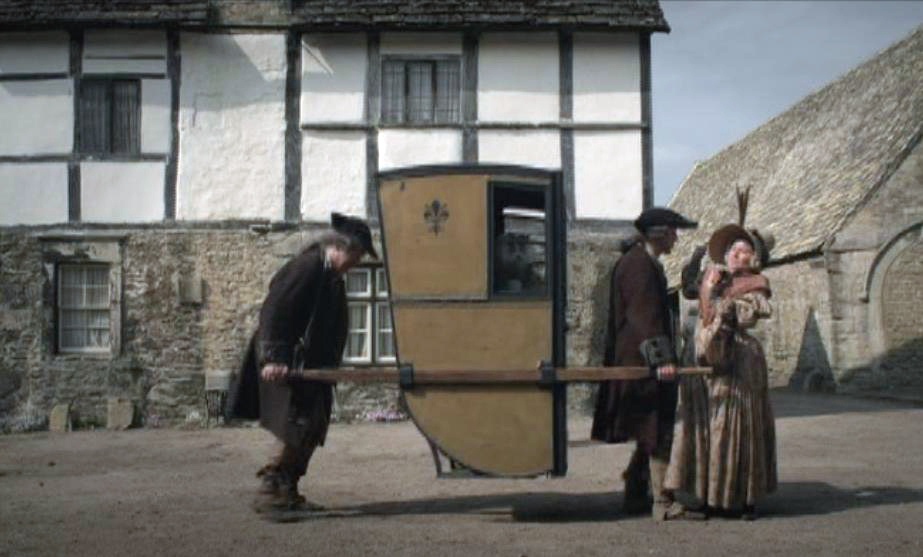
Modern young miss transported with her feather headress intact

Young Georgian miss transported across town with her headdress feathers intact. Click on image for larger view.

Sedan chairs were a major mode of transportation through London’s narrow streets and along Bath’s steep lanes throughout the 17th and 18th centuries and early part of the 19th century. Strong chair carriers could transport passengers down winding passageways much faster than a carriage, which had to make frequent stops in congested traffic. The chair was named after the town of Sedan in France where it was first used. By 1634, they had been introduced to London as vehicles for hire, and their popularity quickly spread to France and Scotland, as well as the rest of Europe.

These portable covered chairs, used in one form or another in other cultures since ancient times, sported side windows and a hinged door at the front. Sedan carriers inserted long wood poles into metal brackets on either side of the chair. The poles were long and springy and provided a slightly bouncy ride. They were arranged in such a manner that the chair would remain in a horizontal position as the carriers climbed up steps or steep slopes. Passenger entered and exited between the poles if they remained in place.
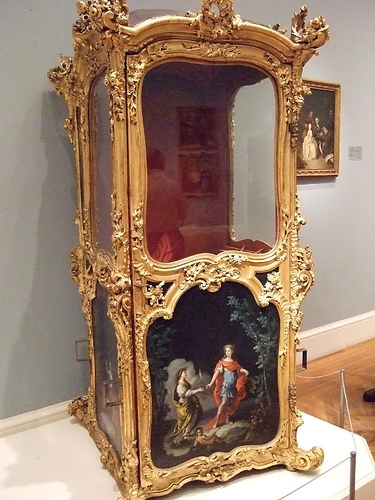
Early 18th c. gilt and wood Sedan chair; painted panels attributed to Charles Antoine Coypel
Early 18th c. gilt and wood Sedan chair; painted panels attributed to Charles Antoine Coypel

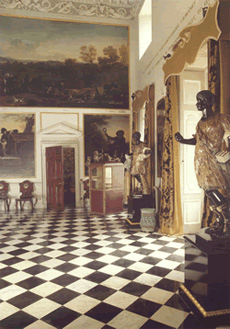
Sedan chair, 1760, made for the Countess of Spencer

Sedan chair in entrance hall of Althorpe House, made for the Countess of Spencer in 1760.

Chairs for the wealthy were richly carved and decorated, and stood inside the entrance hall to be used at the owner’s convenience. Footmen would summon hired carriers, who would take patrons to their destination. For the more ornate Sedan chairs, painters would create beautiful scenes on panels mounted on the sides, and many were extravagantly upholstered in silk on the inside. The less affluent hired plainer, leather covered chairs. (See 1700 image.)
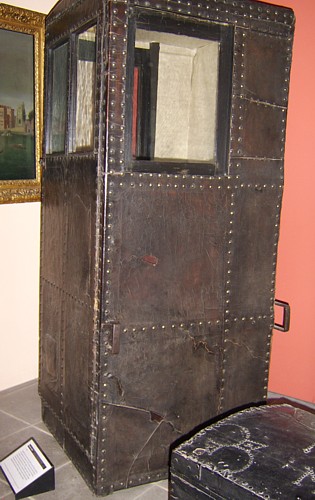
Plain leather covered sedan chair, 1700. Notice the metal brackets.
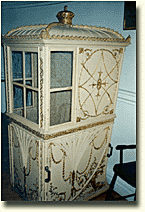
Plain leather covered sedan chair, 1700. Notice the metal brackets.

Sedan chair in the Pump Room

Sedan chair in the Pump Room

Sedan chair houses were available throughout the city of Bath, as shown in the image lower down in this post, although they were also kept in hallways by those who owned them. A rather plain Sedan chair was on display underneath the stairs in the hall of No. 1 Royal Crescent when I visited Bath. One feature that made the chair so popular in Bath – a city in which invalids were transported for healing sessions to the hot mineral baths – is that the vehicle was narrow enough to be carried up the stairs and taken into the bedchamber. Once an invalid entered the chair, he or she would stay inside, unexposed to outside air. The chairs could be carried inside to the baths or to the Pump Room, as you can see in this illustration by Rowlandson, who shows a man on crutches emerging from a Sedan chair.

Rowlandson, Comforts of Bath, Pump Room

Rowlandson, Comforts of Bath, Pump Room

Because these portable chairs could be carried inside buildings, people could be transported around the city without being identified. This made it easier for people who were evading the law to go about their business, or for public personages to carry on trysts. Links-boys would light the road at night, and they waited until they were needed again to light the way back. As the painting below shows, accidents did happen!

Rowlandson, Sedan chair breaking down

Rowlandson, Sedan chair breaking down

“At Bath, Tunbridge Wells, and other fashionable places, chairmen plied in the streets as cabs and hansoms now do. Occasionally they were used by spendthrifts, who were anxious to avoid the tipstaves, as they could enter them in their own houses and be deposited in that of a friend. However, it does not appear that the Sedan chair was always a safe refuge against arrest for debt, as in one of Hogarth’s prints the tipstaves are seen to be laying hold of one they were in search of, just as he was about to descend from his supposed place of security. One of the best caricatures of the day represented an Irishman being carried through the streets in a Sedan chair by two burly men, with his feet touching the ground, some wag having taken out the bottom of the Sedan, and the chairmen, aware of the practical joke, selecting the dirtiest part of the road.” NY Times, 1875, Old Coaches and Sedan Chairs
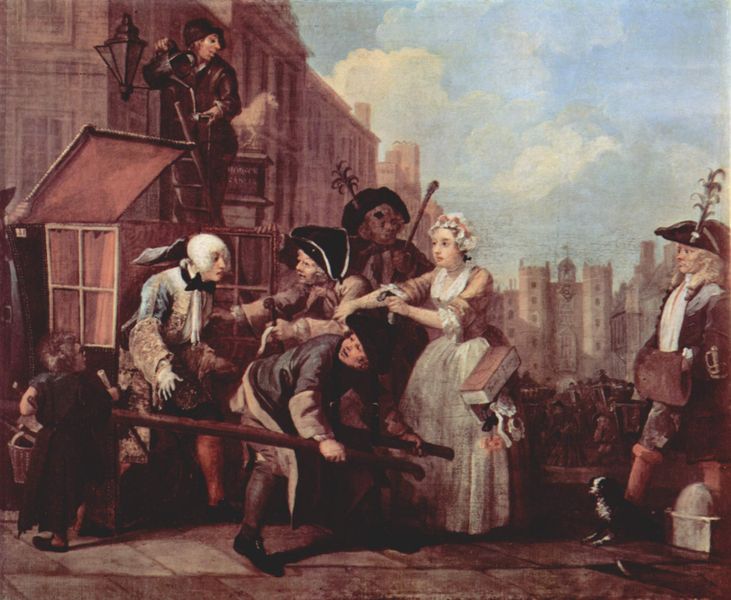
A Rake's Progress, Hogarth, Sedan Chair

A Rake’s Progress, Hogarth, Sedan Chair

As previously stated, Sedan chairs for hire were common in London. Chairmen wore a uniform, were licensed to carry passengers, and had to display a number, like today’s taxi drivers. Three hundred chair permits were issued in London and Westminster in the early 1700’s. A similar system was later used in Scotland, where a fare system was established in 1738. A trip within a city cost six pence and a day’s rental was four shillings. It cost £1 1 shilling to hire a sedan chair for a week. The chairs were available around the clock, but after midnight the chairmen would be paid double the fare.
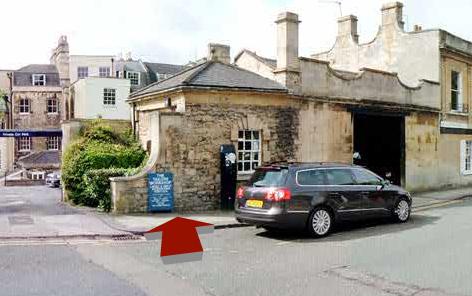
Sedan chair house in Barh, Queen's Parade Place

Sedan chair house in Bath, Queen’s Parade Place

Sedan chair houses, or stations, were common in cities were they were used. Only two examples of these houses remain today in Bath:

“Continue along Gay Street and turn first left into Queen’s Parade Place. On either side of an opening are the only examples of sedan chair houses in Britain. Here chairmen would rest before carrying passengers to their destinations. They were notoriously rude and unscrupulous often locking their passengers in the chair until they had paid the exorbitant fare! Beau Nash licensed them and set reasonable fares. Their demise came when a local man invented the “Bath chair,” a 3 wheeled vehicle.”  From eu-journal, 011

1840, wheeled Bath chairs outside of the Pump Room

1840, Wheeled Bath chairs outside of the Pump Room

The Sedan chair fell gradually into disuse. Horace Walpole bemoaned their waning popularity as early as 1774, and by the mid-19th century three-wheeled Bath chairs had taken their place.

“The chairmen were fine, robust men; they had little regard for foot passengers, and considered the pavement their own exclusive property. It was rather an amusing sight to witness how the men trotted off, when a chair was required, racing to be first for hire. After a time Sedan chairs got out of fashion, except at Bath, Cheltenham, and Leamington, where they wer in favor for many years after they ceased to exist in the metropolis. – Old Coaches and Sedan Chairs, NY Times, october 17, 1875

Chairmen huffing and puffing in Cranford

Chairmen huffing and puffing in Cranford

While the Sedan chair had gone out of fashion by the mid-19th Century, it played a crucial part in the recent mini-series, Cranford. One of the funniest and most memorable scenes in the movie showed two chairmen trying to keep apace with Miss Pole, a spinster, and Mrs. Forrester, whose cat had ingested lace, as they ran into the village seeking help. The men huffed and puffed as they carried their heavy load with Mrs. Jamieson inside, and staggered into Cranford.

More information on Sedan chairs:

UPDATE: Marie Antoinette’s Gossip Guide has published a sedan chair post that links to mine!

Robert Adam's Design for a Sedan Chair for Queen Charlotte, 1775. Click for a larger image.

Robert Adam Neoclassical Design for a Sedan Chair for Queen Charlotte, 1775. Click on image for a larger view.
Read Full Post »

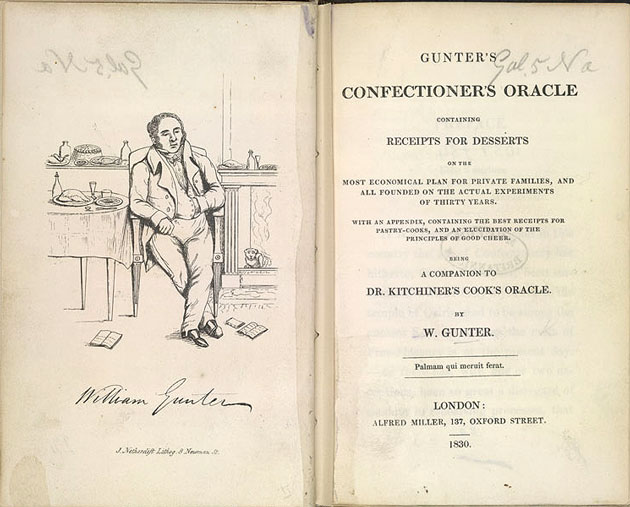
Gunter's Confectioner's Oracle, 1830

Gunter

The very interesting blog, Regency Reader, which features historical romance novels, authors, and series, also publishes interesting posts about the Regency World. Titled Hot Spots, the site includes information about:

  • Jackson’s: Famous pugilist and title champion, 1795
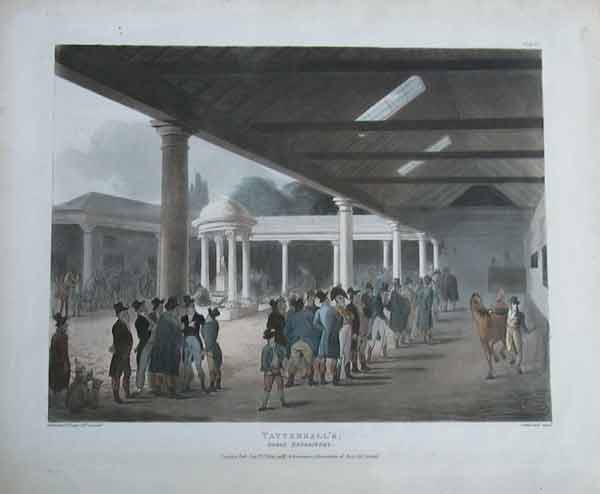
Tattersall's

Tattersall

Additional Links:

Read Full Post »

Interested readers, my association with Austenprose’s month-long and comprehensive coverage of Northanger Abbey continues as I visit Beechen Cliff this week. The setting of this site includes some of Catherine Morland’s and Henry Tilney’s most interesting conversations. Here is where Catherine exhibits her wide-eyed naivete towards travel, and her lack of knowledge about art and the picturesque, and where Mr. Tilney’s wit shines:

Henry Tilney, however, is a genuinely witty character. But Jane Austen allows him to flirt with being defined by convention too. When he takes his sister and Catherine for a walk to Beechen Cliff above Bath, he expresses, if he does not actually hold, conventional attitudes toward women, suggesting that they have so much brain power that they seldom use half of it and showing why the narrator cautions a woman in a man’s society, “especially if she have the misfortune of knowing any thing,” to “conceal it as well as she can. – The Invention of Civility in Northanger Abbey, Joseph Wiesenfarth

To illustrate Jane Austen’s words, I will quote only a partial scene from Northanger Abbey, but you can find the entire conversation on The Republic of Pemberley.

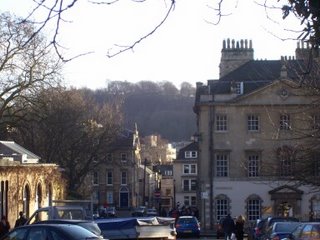
Beechen Cliff Above Queen Square, photo by Rob Hardy

Beechen Cliff Above Queen Square, photo by Rob Hardy

They determined on walking round Beechen Cliff, that noble hill whose beautiful verdure and hanging coppice render it so striking an object from almost every opening in Bath.

“I never look at it,” said Catherine, as they walked along the side of the river, “without thinking of the south of France.”

“You have been abroad then?” said Henry, a little surprised.

“Oh! No, I only mean what I have read about. It always puts me in mind of the country that Emily and her father travelled through, in The Mysteries of Udolpho. – Jane Austen, Northanger Abbey

Jane Austen, a hardy walker, would have had no hesitation in writing a scene that had her heroine and hero walk from Bath’s center, follow a path along the eastern bank of the Avon River, and take a steep sloped path and a flight of steps (known as Jacob’s Ladder) up to Beechen Cliff, which sits 127 meters above sea level. As Ellen Moody writes on her blog: “Northanger Abbey had not conveyed how steep this hill really was. I had attributed Catherine Morland’s satisfaction on Beechen Cliff almost wholly to the lingering memory of a hard-won battle: to go on this country walk with her real friends she had had to fend off the pressure and deceits practised upon her by a brother and two false friends”

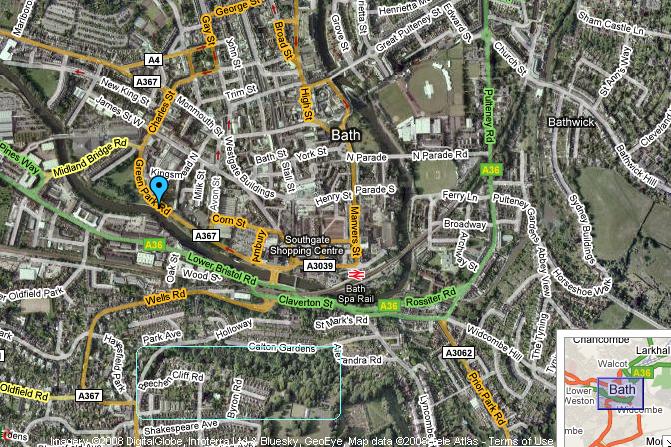
Beechen Cliff in relation to the old center of Bath

Beechen Cliff in relation to the old center of Bath

Click on the images for a clearer view. The area is still mostly an open public space and almost without development. The flat top of the hill is now known as Alexandra Park, a formal park opened in 1902, and the only extant building on the site is Beechen Cliff School.

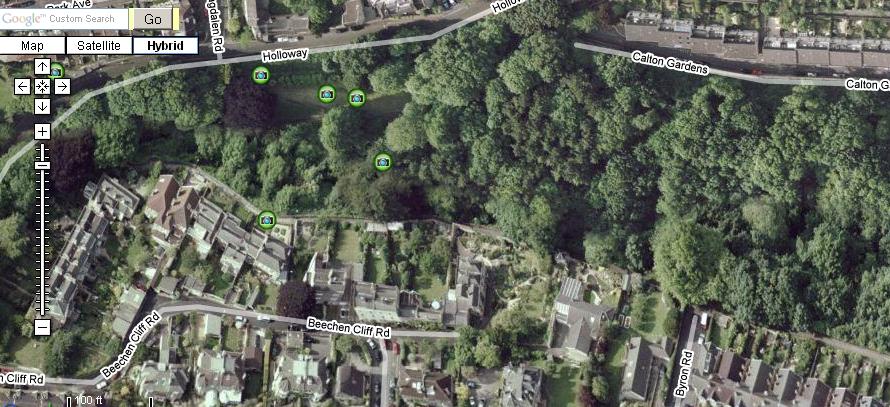
Beechen Cliff is still wild today

Beechen Cliff is still wild today

Once Henry, Eleanor, and Catherine had attained the Cliff’s heights, they would have been rewarded with a breathtaking view.

It was on Beechen Cliff that Catherine Morland was walking with the Tilneys when Henry discoursed upon the picturesque in Nature – talking of “foregrounds, distances, second distances, side-screens and perspective, lights and shades, and Catherine was so hopeful a scholar, that when they gained the top of Beechen Cliff, she voluntarily rejected the whole city of Bath as unworthy to make part of a landscape.”- Constance Hill, Jane Austen: Her Homes and Her Friends, page 120

The slopes to the south and west are much shallower than the north face. One aspect that makes the view from Beechen Cliff so distinctive is the large expanse of uninterrupted sky. This is due to the hill being so high and quite separate from its neighbors.

(Click here to see a spectacular interactive panoramic view of Bath from Beechen Cliff.)

Panoramic view from Beechen Cliff

Panoramic view from Beechen Cliff

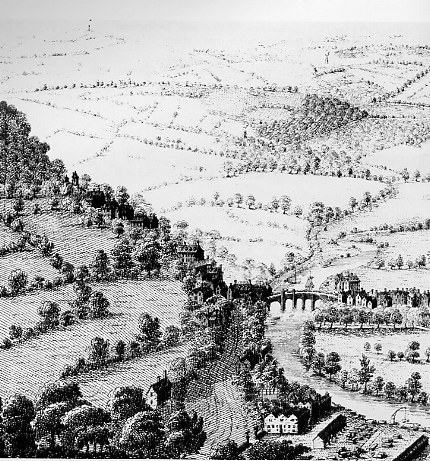
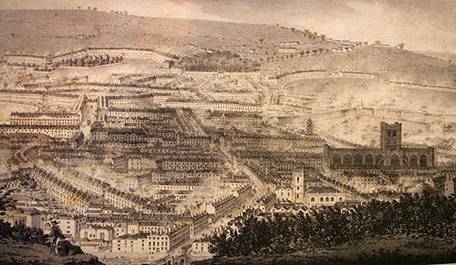
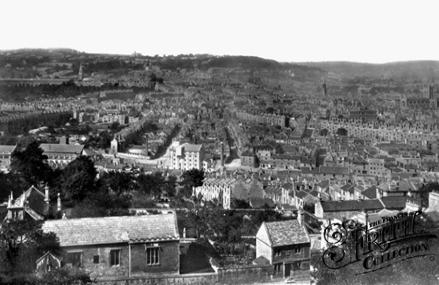
“The steep wooded slope of Beechen Cliff includes a number of well used walkways which are one of the main ways of experiencing the area and accessing the viewpoints.” (Land Use and Buildings, Beechen Cliff and Alexandra Park.) A series of wooden steps leads hikers up the wooded, wild garlic scented hill to the breathtaking views on top. One can see from this series of prints how rapidly Bath grew from 1735 (image below) to the early 19th century (2nd image). There are concerns about modern architectural projects that may mar the view in the future, and about the wild, unclipped bushes and trees that are obscuring the panorama today.

Beechen Cliff, 1734

Beechen Cliff, Harvey Wood, 1824

Beechen Cliff, Harvey Wood, 1824

View from Beechen Cliff, 1876

View from Beechen Cliff, 1876

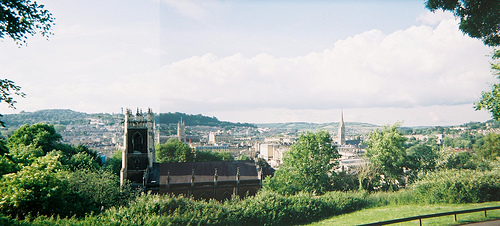
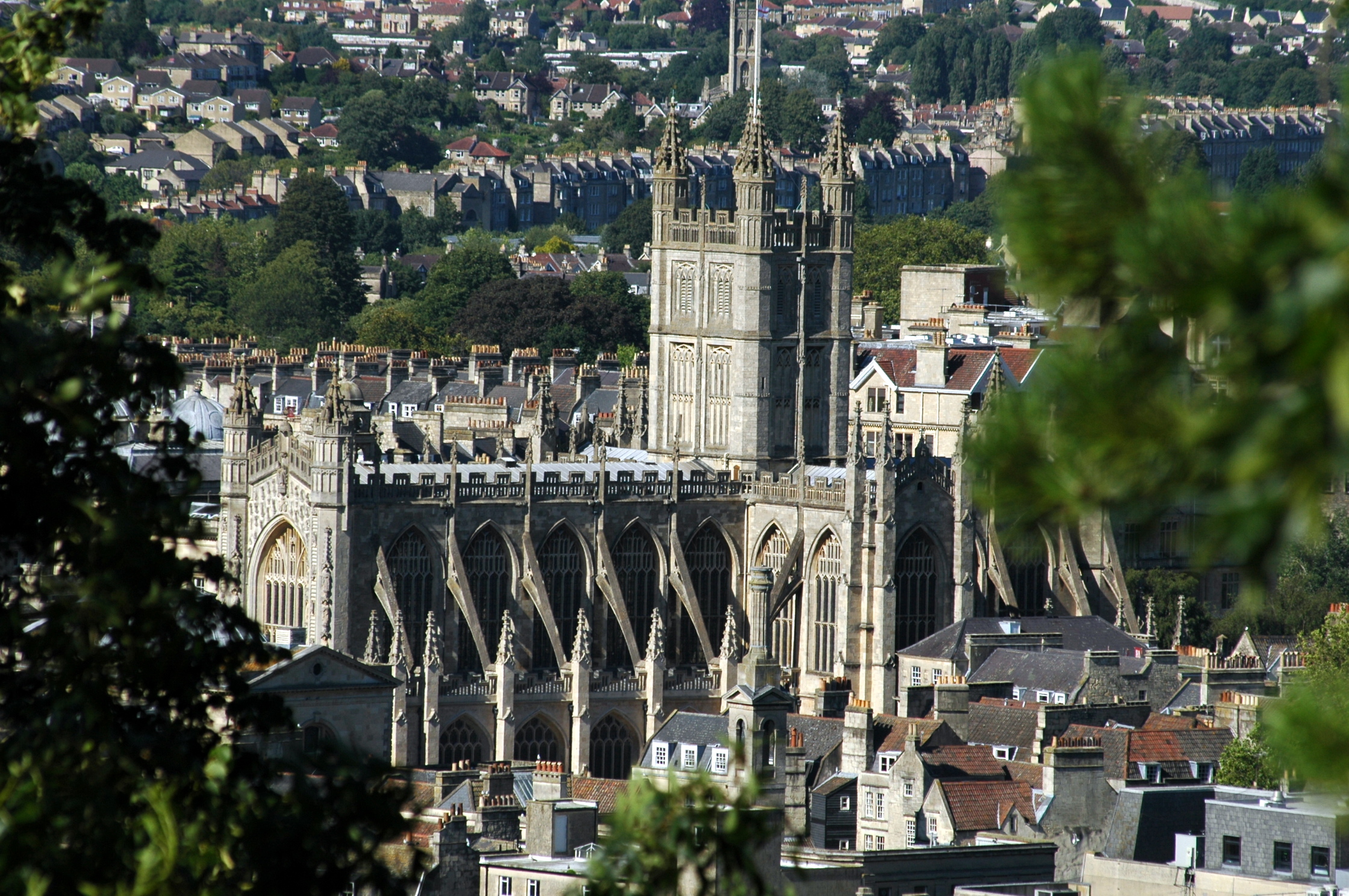
Bath Abbey from Beechen Cliff today

Bath Abbey from Beechen Cliff today

More Links:

Read Full Post »

Mansfield Park Revisited: A Jane Austen Entertainment is a re-release of a Joan Aiken novel that was originally published in 1984. The book begins four years after Fanny and Edmund marry. Sir Thomas Bertram has died unexpectedly and his interests in Antigua need tending. Fanny and Edmund, now parents, are chosen to go, since Lady Bertram is hesitant to part with Tom, the heir. They take their son with them but leave their young daughter behind. As readers, we re-meet Fanny briefly, but the major protagonist is Susan Price, her young sister, who has turned into a sensible young woman – more forceful in her opinions and actions than Fanny – but equally devoted to Lady Bertram’s comfort.

Mrs. Norris has also died. Julia Yates, sister to the pariah Maria (did Jane Austen intend for those two words to rhyme?) takes over the Mrs. Norris role as a petty, peevish, mean, and spiteful woman.

Miss Julia Bertram, having been so ill-judged as to marry the younger son of a peer, had soon, on becoming more closely acquainted with the limited extent of her huband’s fortune, decided to quit the doubtful pleasures of life in London on a straitened income, and console herself by becoming queen of a smaller society. She had persuaded her husband, the Honourable John Yates, to purchase a respectable property in Northamptonshire, not too far distant from Mansfield Park, therefore able to be illumined by some of its lustre. Since the, by almost daily visits to Mansfield, and by longer visits amounting to several months during the course of the year, Mrs. Yates was able to reduce materially her own domestic expenditure …

While Julia tries to make Susan’s life miserable, she does not succeed, for Susan can see right through her. Thus she ultimately fails to put Susan in her place, despite her repeated attempts to lord it over her younger cousin. Tom and Susan are like oil and water for no discernable reason, except that Tom feels that Susan often oversteps her bounds and Susan thinks him lacking in substance and character. He spends his time learning the ropes as the heir to the Bertram fortune and pursuing his love of horses and racing. More sober and grown up than the man limned by Jane Austen, Tom still has much to learn about life and women.

Joan Aiken’s talent lies in developing Jane Austen’s characters further, and she captures Lady Bertram with exquisite perfection in passages such as this, when Edmund suggests leaving his daughter, Mary, behind:

The little dear. Of course we shall be happy to have her,” sighed Lady Bertram, anticipating no inconvenience to herself in this arrangement, as indeed there would not be, for she could be quite certain that three-year-old Mary would be devotedly cared for by her aunt Susan.

Mary and Henry Crawford re-appear in the district shortly after Fanny and Edmund depart, which is when the plot truly becomes interesting. Without giving too much away let me just say that I was surprised by the turns this book takes. Mary Crawford has changed greatly, which is all I will reveal, except to mention that Tom becomes intrigued with her and that their association changes his life in a significant way. We also re-meet William, Fanny’s and Susan’s brother, who has now become the captain of his own ship. Several other new and interesting characters are also introduced, which keeps the story fresh.

Joan’s tale moves quickly and at times I could not put the book down. What I found missing from this very short but good novel was Jane’s sure sense of irony and wit. Ms. Aiken has writing talent (how could she not, being Conrad Aiken’s daughter and Jane Aiken Hodge’s sister?) but she fails to convey the tender emotions and human insights that distinguish a great author from a good writer. One key scene in the novel fell decidedly flat, and where I should have cried I could not. Ms. Aiken’s description of the event was so matter-of-fact she might have been describing a simple farewell instead of a wrenching death scene. I kept contrasting this scene with the way Jane Austen wrote about Marianne’s illness in Sense and Sensibility, and it was like comparing night to day.

As I said, the book is short (201 pages) and perhaps this is why I felt a bereft at the end. I wanted more time spent on how Tom and Susan finally change their minds about each other and begin to think of the other in a romantic way. As usual I am finding fault where others may not, for all in all I enjoyed the book thoroughly. Joan Aiken (1924-2004) might not have the stature of a Jane Austen, but she was a darned good writer and could spin an interesting yarn.

You can purchase the book from SourceBooks at this link.

  • Joan Aiken, (1924-2004) the author, is the daughter of the distinguished author Conrad Aiken and sister to Jane Aiken-Hodge, an author who has written about Jane Austen and Georgette Heyer.

Read Full Post »

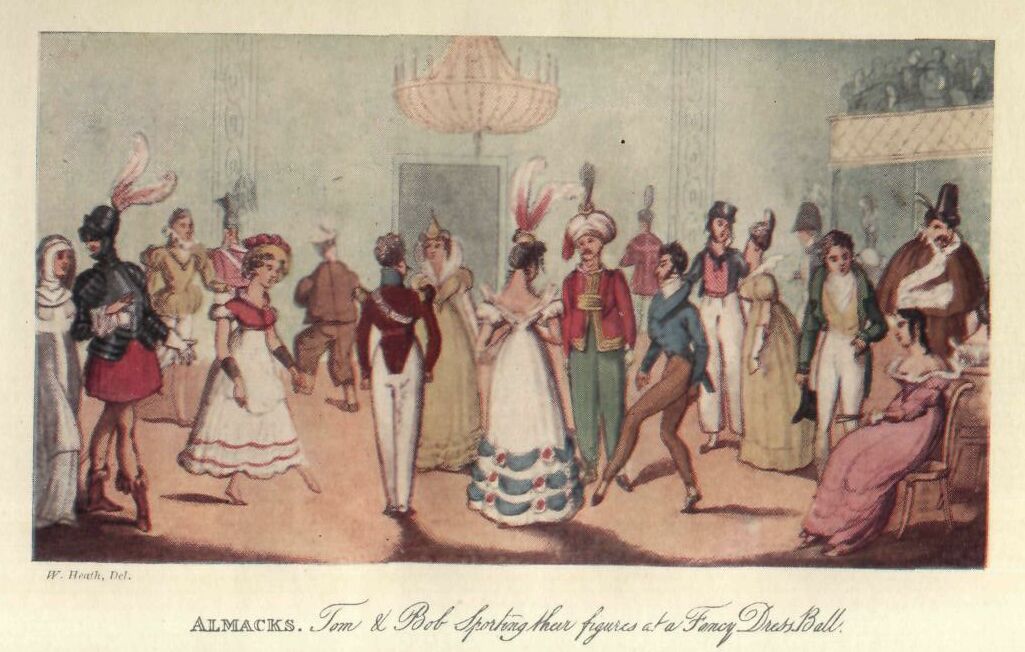
Oh, how delicious! Look what I found online: Almack’s: A Novel, by Marianne Spencer Stanhope Hudson and published by Saunders and Otley in 1826. Almack’s, as all followers of the regency era know, was the exclusive establishment where ladies and gentlemen of the Ton could dance every Wednesday night during the London Season. The powerful patronesses of Almack’s were Lady Sarah Jersey (whose lover was the Prince Regent), Lady Castlereigh, Lady Cowper, Lady Sefton, Princess Esterhazy, and the Countess of Leiven. They decreed who could gain admittance to the assembly rooms and who could not, thereby exercising enormous social influence, as described in the novel:

That grand tribunal at Almack’s makes and unmakes fashionables, I understand. The six grand inquisitors decide upon the degree of ton of each of their followers, just as a committee of tailors would sit in judgment upon a cape or a collar.

The following two quotes provide more details from this vivid, digitized 413-page novel. The first is regarding a lady’s appearance:

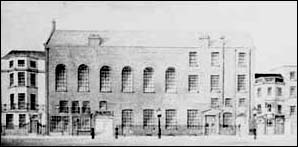
Almack's Assembly Rooms

Almack

… after dinner a man’s heart naturally opens, sur tout au coin du feu: I have often observed, that a comfortable seat will hasten a declaration; men are such lovers of ease, so naturally sensual. I shall persuade the Baron not to order the carriage till eleven o clock, to give time. Pray put on your new white gown, my love, and those turquoise ornaments, with that pretty blue garland, it becomes your light hair so particularly; and a soupcon of rouge, just to give a glow – nothing more! what even Julia herself could not disapprove.”

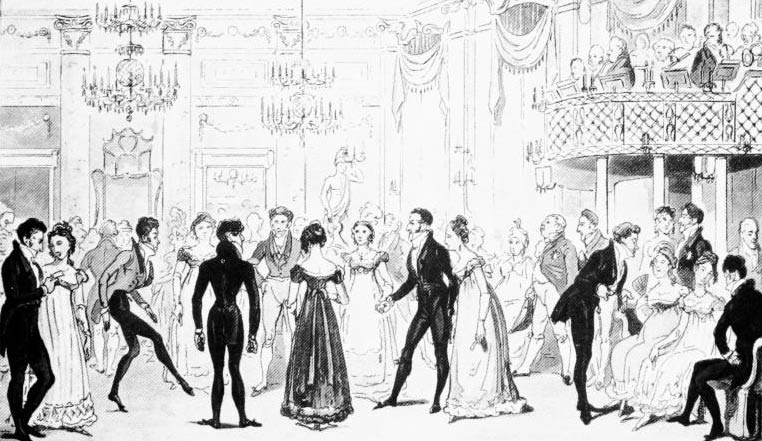
Real Life in London, p. 148, Almack's

Real Life in London, p. 148, Almack

and this quote is about waiting for one’s carriage when it rains …

At this moment Lionel re-appeared. “Lady Birmingham”, said he, “it pours.  We must not lose a moment for there is sad confusion at the door, and I had great difficulty in getting your carriage up.” The bustle and agitation, the noise of the link boys, the oaths of the footmen, the violence of the coachmen, the kicking of the horses, and the blazing of the flambeaux effectually drove the Author of Waverley out of poor Lady Birmingham’s head; it was busied with other things. Had she ever read our friend Luttrell, she would have remembered that splendid description :

How in a rainy blustering night

The London coach maker’s delight …

Almack’s A Novel … By Marianne Spencer Stanhope Hudson, Charles White, 1826.

Almack's ExteriorMore Links:

Read Full Post »

« Newer Posts - Older Posts »