Feeds:
Posts
Comments

Archive for the ‘Jane Austen’s World’ Category

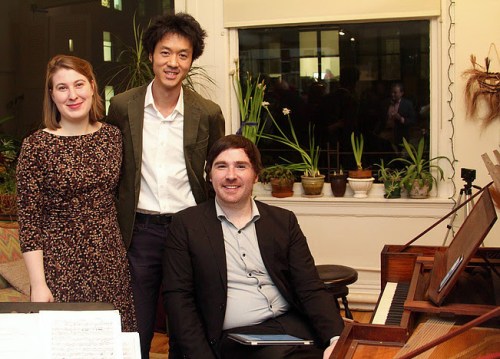
Jane Austen’s Music Library – Broadwood Junction in concert at the Bruno Walter Auditorium, New York City, October 28, 2017, with musicians Francis Liu; violin, Patrick T. Jones; fortepiano; Sarah Stone; cello and Lucy Dhegrae; mezzo soprano, by Patricia N. Saffran.

Broadwood junction2 copy

Photo courtesy of Broadwood Junction – at the square piano

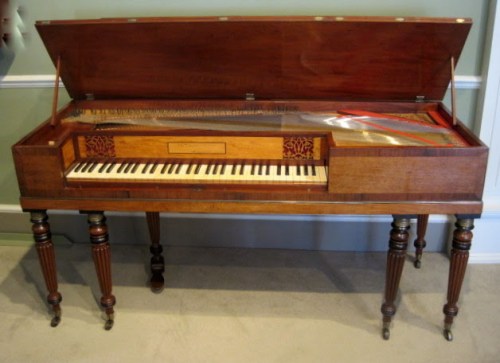
The concert opened with a passage read from Jane Austen’s Emma which included the mysterious arrival of an expensive square piano, a gift from an unknown donor, to the Fairfax household that could not afford such a piano, “a very elegant looking instrument-not a grand, but a large-sized square piano-forte.” In the early 1800s, the instrument described would have been a tastefully decorated Broadwood square piano with a damper pedal and would have cost £35, or £2,408 today.

broadwood square piano

Broadwood square piano.

The musicians proceeded to explain that their own Broadwood square piano was out of commission and Patrick T. Jones would be playing on a borrowed German fortepiano. The group, which consists of alumni from Juilliard’s Historical Performance program, was formed when a Broadwood square piano from 1809 was spotted at an estate auction in Virginia, and they quickly snapped it up. Broadwood square pianos, with their quiet sound, had been mass produced for the home. Violinist Francis Liu then explained that the program would consist of Jane Austen’s own music books, some of which she copied herself in a refined readable hand from borrowed sheet music. Her music library is now on-line for the public to read at the University of Southampton, UK, website.

The first piece was George Kiallmark’s Robin Adair, Theme and Variations for Piano of the Scottish song, and with Lucy Dhegrae then singing Robin Adair.

Ignaz Pleyel’s Trio was next from 1793, originally scored for harpsichord. This was followed by Thomas Arne’s beautiful Cymon and Iphigenia, cantata for tenor originally, and instruments. In between pieces, the musicians read more passages from Jane Austen about music, from novels and letters.

Except for the popular and noisy “The Battle of Prague” by Frantisek Kotzwara, the remaining pieces by Joseph Wölfl, James Hook and several Anonymous vocal selections revealed a lack of musical development. This phenomenon was explained by Francis Liu, “This music is kitsch and entertaining. It was the music that people from good families could easily perform at home. Usually, there would be a girl with good posture at the piano singing. Rarely, a man would accompany her, perhaps on a flute, but not a violin which would have required more skill.”

It is curious that Jane Austen, one of the most sophisticated novelists of all time, would have been enamored of such simple music. When asked after the concert, Mr. Liu explained further, “In a good family, a girl couldn’t play like a professional musician. She wouldn’t have played music performed in the theaters.” That would have put her in the category of demi-monde. It was an aristocratic dictate in society that those from better families could not appear too professional. For gentlemen the exception was to be a  clergyman or an officer, such as a skilled soldier or cavalryman. Women would have been at risk of making a good marriage, a main theme in Jane Austen novels, if they revealed they had genuine musical talent.

Two lovely Jane Austen youtube selections are on YouTube-


More on the topic:


Read Full Post »

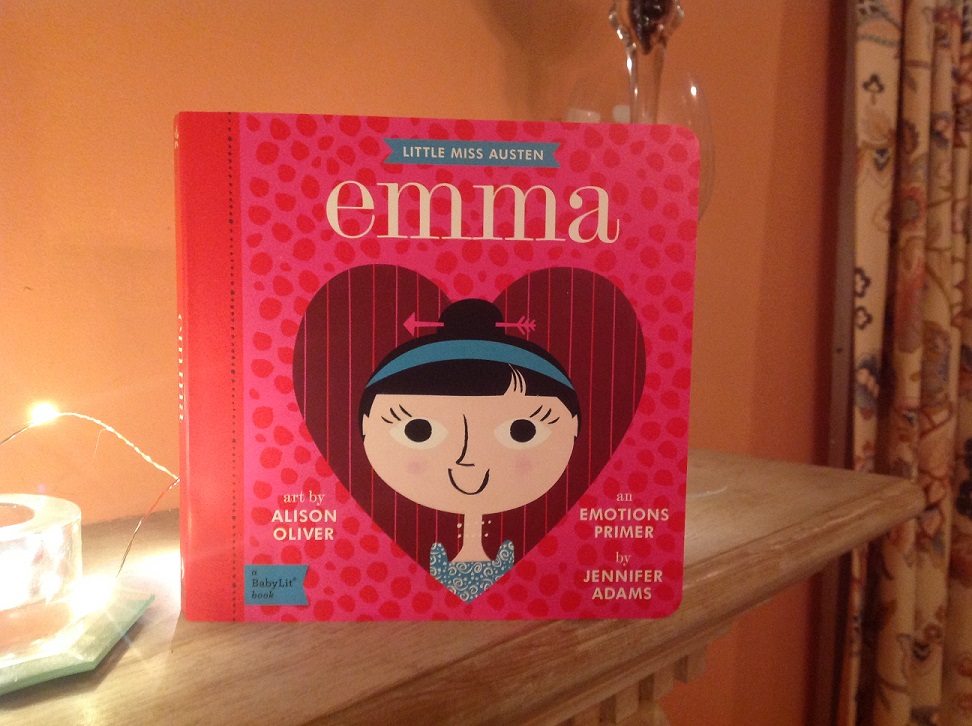
My dear friend Kate is a member of our select and very small Janeite group, Janeites on the James. We’ve not met often recently due to busy schedules and life’s vicissitudes. When Kate’s wee one was born almost two years ago I gave her the board book Emma by Jennifer Adams to read to her daughter.

Emma by Jennifer Adams

Our sweet peanut, as she is affectionately known, loves to hear her mama read Emma. Jennifer Adams has written another series of books for toddlers.

Peanut’s Papa may soon be sent to Paris for several months on a business venture. Coincidentally, Jennifer Adams has written another series of books for toddlers, this time taking them on a tour to famous cities – like Paris, New York, San Francisco, and London.

IMG_0120

My Little Cities by Jennifer Adams and pictures by Greg Pizzou: Paris, New York, San Francisco, and London

You can imagine our wee one’s delight in reading these books designed just for her age group.

IMG_1073

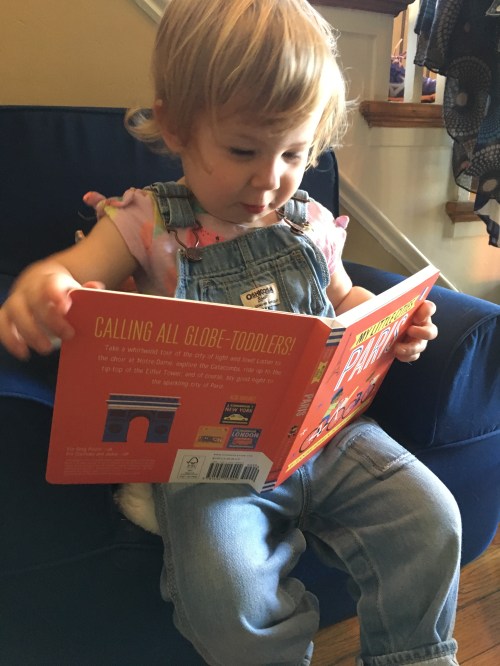
Evie, or Peanut, reading Paris, where Daddy might be stationed.

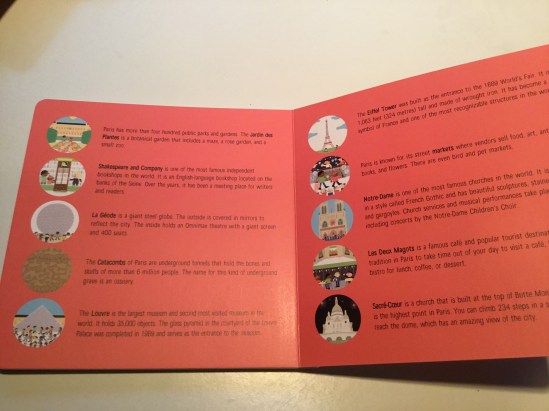
This beautifully illustrated series also includes more detailed information for parents at the end of each book that they can explain to their budding globe-toddling child.

IMG_0117

Notes for parents

For example, at the end of San Francisco the notes state that:

The Golden Gate Bridge is San Francisco’s most famous landmark and one of the wonders of the modern world. The bridge opened in 1937 and is 4,200 feet (1,280 meters) long. It is a suspension bridge…

Kate tells me that Evie reads her book independently now. Her reaction? Priceless!!!!!

IMG_1072

As a sidenote, Jane Austen was a doting and affectionate aunt and an impressive and witty story teller. Her nephew James Edward Austen Leigh recalls:

Though in the course of fifty years I have forgotten much, I have not forgotten that Aunt Jane was the delight of all her nephews and nieces. We did not think of her as being clever, still less as being famous: but we valued her as one always kind, sympathising and amusing.

Jane Austen’s connection to us and our children remains strong to this day.

Read Full Post »

Fashion Plate (Afternoon Dress for Decr. 1800) LACMA M.86.266.37Just as fire was the centerpiece of most evening gatherings in Jane Austen’s time, candles also played a vital role in Regency life and culture. Today, family members work or read in separate rooms in the evening and go to bed at different times (due to the advent of electricity), but people in Austen’s day lived differently: They sat together to read books, write letters, and socialize in the evening—all by candlelight.

As readers, we should consider Austen’s evening scenes with a careful eye to the lighting. Dinners, dances, card games, and music were all undertaken by candlelight. Many of our favorite scenes—in which Austen brings her heroines and heroes, villains and vicars to life—take place in the evening. Candlelit rooms provide the perfect spot for Emma and Frank Churchill to gossip, for Fanny to sink into the shadows unnoticed, for Lydia and Kitty to romp with the officers, and for Anne Elliot to hide her tears at the piano while the others dance. Indeed, when Darcy watches Elizabeth and Caroline Bingley walking around the drawing-room and quips that their “figures appear to the greatest advantage in walking,” (PP 56) he watches them walk by candlelight after dinner and tea (served later in the evening). Austen uses candle-power (or the lack thereof) to communicate the rank and financial status of her characters as well as set the stage for some of her best scenes.

Candles in Regency Life

In Austen’s lifetime, virtually every task after dusk required candles. Fall and winter months in England are cold and dark with only 8-9 hours of sunlight during some months. It was a mark of wealth to have enough candles to burn in the evening for work and pleasure. In working class homes, people might burn a rushlight (which burned for 20-30 minutes) or simply retire early. In genteel homes, where candles were plentiful, people stayed up later. In her JAW article “Lighting the Dark,” Vic Sanbourn tells us, “Only the more affluent members of society could afford to burn a large number of candles at a time, and their homes were characterized by spacious windows and well placed reflectors and mirrors.” This was common in most of the grand homes in Austen’s novels, which we see when Elinor and Marianne accompany Lady Middleton to a party in London and “enter a room splendidly lit up, quite full of company, and insufferably hot” (SS 175).

During quiet evenings at home, families and small groups shared the firelight or a few candles together. As Austen states in one of her letters to Cassandra: “We have got the second volume of “Espriella’s Letters,” and I read it aloud by candle-light. (Letters 147). As one might imagine, working by candlelight was not easy on the eyes. Austen alludes to this when Lady Middleton remarks that it might “hurt [Lucy’s] eyes to work filigree by candlelight” and suggests that she “ring the bell for some working candles” (144). And in Northanger Abbey, when General Tilney stays up to read at night, he says his “eyes will be blinding” from reading so late by candlelight (NA 187).

Candles Speak Volumes

Everything in Austen’s novels means something—including the kind and number of candles used in different households. Beeswax candles burned brighter and more efficiently but were more expensive. Tallow candles were cheaper but gave off less light, smoked, and smelled of mutton. In her article “Let there be light! Candles in the time of Jane Austen,” Sue Dell of the Jane Austen’s House Museum says that “[t]allow candles would have been the most common candles in such a home as the Austens’.” She explains: “Even the very wealthy used wax candles sparingly; Jane’s brother, Edward, would have used them for entertaining, but tallow candles would have been used for everyday life” (Dell). In Emma, Mrs. Elton boasts that a certain Mrs. Bragge even has wax candles in her school room (300); however, Dell says this “would have been instantly recognised by contemporary readers as untrue” because “no-one would do such a thing” (Dell). Mrs. Elton also decides she will educate Highbury society and give “one very superior party—in which her card-tables should be set out with their separate candles and unbroken packs in the true style” (290). In affluent and pretentious homes like General Tilney’s in Northanger Abbey, candles are plentiful. When it is time to retire, Miss Tilney rings the bell for candles, which the butler comes to light (187). They each take their candles to bed, but the General stays up to work. In Emma, when they have supper at the ball, Mrs. Bates says, “I never saw any thing equal to the comfort and style—Candles everywhere” (329).

Conversely, at the Price home in Mansfield Park, even one candle is hard to come by. When Mr. Price arrives, Austen paints the scene vividly: “with something of the oath kind he kicked away his son’s port-manteau and his daughter’s bandbox in the passage, and called out for a candle; no candle was brought, however, and he walked into the room” (MP 379). Fanny rises to greet him but sits down again “on finding herself undistinguished in the dusk, and unthought of” (379). When a candle is finally brought, Fanny is still forgotten as her father reads the newspaper, “without seeming to recollect her existence. The solitary candle was held between himself and the paper, without any reference to her possible convenience” (382).

Candles Set the Stage

As anyone who has ever camped, had their electricity shut off, or eaten dinner at a romantic restaurant knows, everything looks different by candlelight. Shadows grow and dark corners emerge. The mood changes. Austen uses candles to set the tone in many scenes in her novels, and she capitalizes on the mere lack of a candle to throw rooms into confusion, provide cover for secret goodbyes, send people to bed early, and propel one imaginative young girl into hysterics.

In Austen’s novels, candlelight provides cover for all sorts of things. In a practical sense, candles hide visible flaws as when Mrs. Weston comments on the wallpaper at the Crown Inn in Emma: “[T]his paper is worse than I expected. Look! in places you see it is dreadfully dirty; and the wainscot is more yellow and forlorn than any thing I could have imagined” (253). Her husband responds that she will “see nothing of it by candlelight. It will be as clean as Randalls by candlelight.”

In a more romantic sense, Austen uses semi-darkness to cover a goodbye between Frank Churchill and Jane Fairfax. We read the following scene in Emma:

[Jane Fairfax] was afterwards looking for her shawl—Frank Churchill was looking also—it was growing dusk, and the room was in confusion; and how they parted, Mr. Knightley could not tell.  He remained at Hartfield after all the rest, his thoughts full of what he had seen; so full, that when the candles came to assist his observations, he must—yes, he certainly must, as a friend—an anxious friend—give Emma some hint, ask her some question. He could not see her in a situation of such danger, without trying to preserve her. (349)

We have no proof that anything more than “certain expressive looks” pass between Frank and Jane as they part under the covering of the dusky room; however, Austen uses this moment to give Mr. Knightley a hint as to the true nature of their relationship while everyone else is busy, before the candles are lit.

In Northanger Abbey, Austen uses a “single lamp” and the light it emits to set the stage for a nervous Catherine Morland in the gothic-style scene she paints on Catherine’s first night at the Abbey. The light from her candle and the fire are, quite humorously, the only thing standing between Catherine and emotional stability. Catherine enters “her room with a tolerably stout heart” at the end of the evening (167). However, once the fire dies down, she is left with only her candle to light the room. When Catherine “snuffs” the candle, meaning to “cut or pinch off the burned part of a candle wick” (Dictionary.com), she accidentally extinguishes it as well. Her response is hilarious:

Alas! It was snuffed and extinguished in one. A lamp could not have expired with more awful effect. Catherine, for a few moments, was motionless with horror. It was done completely; not a remnant of light in the wick could give hope to the rekindling breath. Darkness impenetrable and immovable filled the room. A violent gust of wind, rising with sudden fury, added fresh horror to the moment. (170)

Catherine’s bravery dissolves once the candle is out. Austen says, “A cold sweat stood on her forehead, the manuscript fell from her hand, and groping her way to the bed, she jumped hastily in, and sought some suspension of agony by creeping far underneath the clothes” (170). She is unable to sleep until 3 a.m. The reader chuckles, but Austen is well aware that we understand Catherine’s plight. Though some of us may not like to admit it, we all—at some point in our lives—have jumped under the covers when the wind blew, the curtains moved, and the lights suddenly went out.

Works Cited

Austen, Jane. The Oxford Illustrated Jane Austen. Edited by R. W. Chapman, Oxford UP, 1988.

—. Jane Austen’s Letters. Edited by Deirdre Le Faye, 4th ed., Oxford UP, 2011.

Dell, Sue. “Let there be light! Candles in the time of Jane Austen.” Jane Austen’s House Museum, 12 Jan 2016. https://www.jane-austens-house-museum.org.uk/single-post/2016/1/12/Let-there-be-light-Candles-in-the-time-of-Jane-Austen. Date accessed: 1 October 2017.

Sanborn, Vic. “Lighting the darkness.” Jane Austen’s World, 29 April 2007. https://janeaustensworld.wordpress.com/2007/04/29/lighting-the-darkness-in-the-regency-era/. Date accessed: 1 October 2017.

Read Full Post »

At the heart of every household in Jane Austen’s time, a fire burned. Fires provided a fixed source of heat and light, around which people gathered and moved, cooked and cleaned, lived and socialized. And while it’s lovely to imagine that families in Austen’s day gathered together in the evening simply because they enjoyed one another’s company, drawing near the fire on cold, damp days and evenings was a necessity. In a letter to Cassandra in October, Austen says, “It is cold enough now for us to prefer dining upstairs to dining below without a fire” (Letters 151). A warm fire provided heat, comfort, and community; at it, cold feet were thawed, conversations were held, prayers were said, books were read, and tea was made.

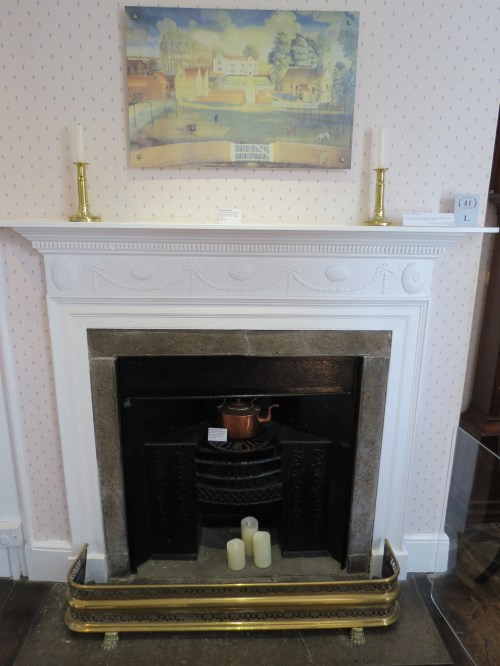
Chawton Cottage Fireplace

Chawton Cottage fireplace. Image Rachel Dodge

In her novels, Austen uses fires—and the heat and light that emanate from them—as a centerpiece for household and social activity, and she spins her characters and plots into motion around them in unique and surprising ways. Austen’s ingenious use of fires is fascinating to consider. In many scenes, she uses fires as clever props. However, fires also signify something deeper about the physical, mental, and emotional state of several key characters.

Fires as Clever Props

Let’s first consider the creative way Austen uses fires and fireplaces to move her characters in and out of rooms, group them together, and provide insight into their personalities. Many of these examples are quite humorous:

  • Edmund Bertram goes to the fire on numerous occasions when he is upset and sits down to “stir the fire in thoughtful vexation” (MP 128),
  • Meddlesome Mrs. Norris is, of course, found “fresh arranging and injuring the noble fire which the butler had prepared” (MP 273),
  • Reserved Edward Ferrars finds a safe place to talk and read in the small family circle “drawn round the fire” after dinner with the Dashwood women (SS 90),
  • Just the “slight remains” of a fire on a warm day are enough to push an over-heated, hot-and-bothered Frank Churchill over the edge (E 364),
  • In Emma, they have “nothing else to do” and form “a sort of half-circle round the fire,” discussing the fire itself “till other subjects [are] started” (E 320),
  • Fickle Collins changes his mind from Jane to Elizabeth in the matter of a few moments—in the time it takes Mrs. Bennet to stir the fire (PP 71), and
  • When Captain Wentworth wants to cross the room to sit by Anne, he goes first to the fire-place, “probably for the sake of walking away from it soon afterwards” before he goes to sit “with less bare-faced design, by Anne” (P 255).

Fires as Subtle Clues: Marianne Dashwood, Mr. Woodhouse, and Fanny Price

Austen also uses fire to provide significant clues as to the physical, mental, and emotional well-being of her characters. During Austen’s lifetime, the spot nearest the fire was reserved for the elderly or infirm, as is seen throughout her novels. Furthermore, giving someone the chair closest to the fire indicated care and concern for their well-being. In the case of Marianne Dashwood, the distracted way she walks to and from the fire signals to Elinor that her mind and heart are in turmoil over Willoughby: “Marianne, too restless for employment, too anxious for conversation, walked from one window to the other, or sat down by the fire in melancholy meditation” (SS 172). In response to Marianne’s visible unhappiness, Mrs. Jennings treats her “with all the indulgent fondness of a parent,” tempting her with delicate foods and giving her the “best place by the fire” (193). However, when the usually healthy and active Marianne later spends a whole day “sitting shivering over the fire with a book in her hand…or in lying, weary and languid, on a sofa,” it’s clear she is suffering from more than emotional distress (307). Elinor hopes that a good night’s sleep will revive Marianne, but Colonel Brandon suspects the danger of something more serious. After a “very restless and feverish night,” the apothecary is sent for and Marianne sinks lower (307).

For Mr. Woodhouse, the very presence or lack of a fire has the power to give him comfort or cause him alarm. In “Mr. Woodhouse is not a Hypochondriac!,” Ted Bader argues that Mr. Woodhouse is aging, frail, and perhaps even suffering from “hypothyroidism” based on his diet, physical state, and behavior (Bader). In this case, Mr. Woodhouse’s concern for a fire is actually another clue toward the state of his health. Austen tells us that “Mr. Woodhouse’s tender habits required” a fire “almost every evening throughout the year” (E 351). He talks of fires repeatedly and can only be coaxed to leave his fireside when he is assured of a good fire elsewhere. On the day of the Donwell Abbey outing (on a sunny June day), the concern given to assure Mr. Woodhouse’s comfort and happiness is most touching: “Mr. Woodhouse was safely conveyed in his carriage, with one window down, to partake of this al-fresco party” (357). Emma and their friends wish to include him in the day’s activities, and so, “in one of the most comfortable rooms in the Abbey, especially prepared for him by a fire all the morning, he was happily placed, quite at his ease, ready to talk with pleasure of what had been achieved” (357). This kind of special care is given to someone in delicate health.

In Mansfield Park, a fire for Fanny denotes admittance into the family circle. Fanny finds great comfort in her “little white attic” at Mansfield; however, Mrs. Norris has cruelly “stipulated for there never being a fire” in Fanny’s room (MP 151). This signals to the reader both Mrs. Norris’s true character and Fanny’s station in the Bertram family circle. As Fanny lives there, not quite a family member, not quite a servant, she has no sense of belonging and feels keenly the lack of warmth from the Bertrams. Similarly, when she visits her family in Portsmouth, she again finds herself outside the family circle. In the very place she hopes to find solace, she is again (literally) left in the cold. She finds refuge “sitting together upstairs…quietly employed” with Susan, away from the family and “without a fire” (398). In both homes, she is an outsider. When she is given the luxury of a fire in her room at Mansfield, it reveals the change occurring at Mansfield: “She was struck, quite struck, when, on returning from her walk and going into the East room again, the first thing which caught her eye was a fire lighted and burning. A fire!” (322). This new “indulgence” coincides with her gradual movement into the heart of the family there. As the Bertram sisters continually disappoint Sir Thomas, and Fanny steadily wins his favor, Fanny takes her rightful place as a true member of the family and is treated as such.

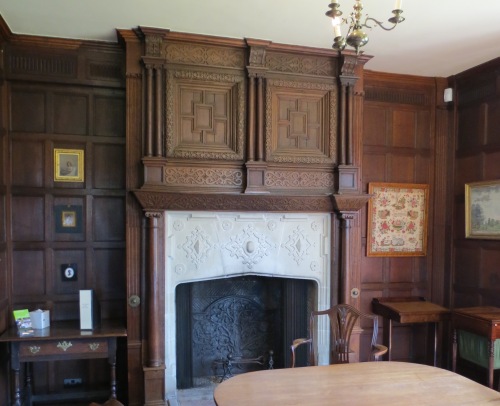
Chawton Great House Fireplace

Chawton House fireplace. Image Rachel Dodge.

Fuel Sources in Austen’s England

So what kind of fire did Edmund “stir…in thoughtful vexation” at Mansfield (MP 128)? Many of the examples in Austen’s novels appear to be wood fires, but the “coal fog” of London that lasted well into Queen Elizabeth II’s reign was already present during the Regency period. In All Things Austen, Kirsten Olsen says coal was quickly replacing wood during Austen’s lifetime, due to the “rate at which the English were consuming their natural resources” (Olsen 135). However, Deirdre Le Faye notes in Jane Austen: The World of Her Novels that in country houses, the open fireplaces were very large and burnt mostly wood because coal was transported by water, making it “a scared and very expensive fuel” (Le Faye 145).

The question of coal versus wood fires in Austen’s novels can most likely be answered by looking at the size and location of the houses featured, as well as the easiest and most economic fuel available to each. When Mr. Bingley spends a half hour “piling up the fire, lest [Jane] should suffer from the change of room” and suggests that she move “further from the door,” it’s clear he’s piling up wood (PP 54). Catherine Morland’s “spirits” are “immediately assisted by the cheerful blaze of a wood fire” in her room on her first night at the Abbey (NA 167), and the “roaring Christmas fire” in Persuasion must be wood (135). In Mansfield Park, however, the Price family has a coal fire (MP 379). At the Price home, coal was most likely burned because they lived in Portsmouth, a port city, but on the larger estates, away in the quiet countryside, wood was more commonly burned. Matthew White explains that the “growing demand for coal after 1750 revealed serious problems with Britain’s transport system.” A network of canals was build to cut down on the price of coal and by 1815 “over 2,000 miles of canals were in use in Britain” (White). By the time of Austen’s death, coal had become increasingly available even to the country homes of England.

You can follow Rachel Dodge at www.racheldodge.com or on Twitter (twitter.com/RachelEDodge), Instagram (@kindredspiritbooks), and Facebook (facebook.com/racheldodgebooks).

Works Cited

Austen, Jane, and R. W. Chapman. The Oxford Illustrated Jane Austen. Oxford UP, 1988.

Austen, Jane. Jane Austen’s Letters. Edited by Deirdre Le Faye, 4th ed., Oxford UP, 2011.

Bader, Ted. “Mr. Woodhouse is not a Hypochondriac!” Persuasions On-Line, vol. 21, no. 2, 2000 http://www.jasna.org/persuasions/on-line/vol21no2/bader.html. Accessed 1 September 2017.

Le Faye, Deirdre. Jane Austen: The World of Her Novels. London: Frances Lincoln, 2002.

Olsen, Kirstin. All Things Austen: A Concise Encyclopedia of Austen’s World. Oxford, Greenwood World, 2008.

White, Matthew. “The Industrial Revolution.” British Library, bl.uk, 14 October 2009, https://www.bl.uk/georgian-britain/articles/the-industrial-revolution. Accessed 1 September 2017.


For additional articles related to this topic:

Read more about keeping warm in Regency England here: https://janeaustensworld.wordpress.com/2009/01/21/keeping-warm-in-the-regency-era-part-one/

Learn more about coal in Regency England here:
Kane, Kathryn. “Coal: Heat Source or Gemstone?” The Regency Redingote, 3 June 2011, https://regencyredingote.wordpress.com/2011/06/03/coal-heat-source-or-gemstone/.

Enjoy these entertaining directions to servants on the proper care and lighting of a coal fire:
Boyle, Laura. “Directions how to make a fire with Lehigh coal.” JaneAusten.co.uk, 20 June 2011, https://www.janeausten.co.uk/directions-how-to-make-a-fire-with-lehigh-coal/.

Find out more about London’s air quality during Jane Austen’s time here:
Sanna, Antonio. “Jane Austen’s London.” Journal of Medical Humanities, 16 April 2017, pp. 1-10. Research Gate, https://www.researchgate.net/publication/316156566_Jane_Austen%27s_London.

Read Full Post »
Dear Readers,

Once again I found myself traveling between Richmond and Baltimore to visit family. In theory, the route over I-95 should take only 2 hours and 45 minutes. Hah! This time the trip took 5 hours due to heavy traffic and a thunderstorm or two. While driving, I love to listen to my favorite news, comedy, and satire shows. I had forgotten to load my iPod with new podcasts and had nothing of interest on the radio, but I did have a back-up plan.

Jane Austen to the rescue!

I am never far away from listening to my favorite author, whether walking, driving, reading, or working and have listened to all of the following:

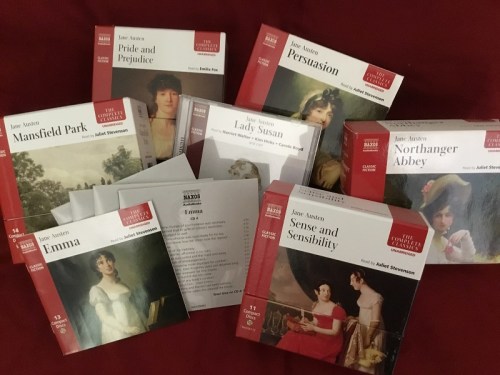
Naxos Audio Books:

Naxos CDs are beautifully packaged and produced. Mine came as a gift from the company over 10 years ago, and I am proud to advertise these great products.

IMG_0072

Image @ Vic Sanborn

Most of Jane Austen’s books for Naxos are read by the incomparable Juliet Stevenson, whose voice acting is as good as her characterizations on film. I listened to the first half of the unabridged version of Persuasion and was transported by Juliet’s voice as Anne Elliot, Captain Wentworth, Sir Walter Elliot, and all the other beloved characters in this book. Each time I listen to Jane’s prose, I learn something new. Her descriptions of Lyme were so vivid that I just knew she wrote them from memory. I could “see” the street leading straight down to the water, and the waves breaking up over the lower cobb.

Jane’s love for the navy and Mrs. Croft’s characterizations of life at sea must have come from the many tales her two sailor brothers told her or wrote to her in their letters. Her characters are so familiar by now that I felt that I was visiting family as I traveled to see my family.

Juliet Stevenson, if you recall, played Mrs. Elton in 1996’s Emma with Gwynneth Paltrow. Watch her introductory scene in these two YouTube clips:

Emma, The New Bride, Mrs. Elton (Juliet Stevenson

You can listen to an audio sample of Juliet reading Persuasion in this link: https://www.naxosaudiobooks.com/persuasion-unabridged/

Juliet did not read Pride and Prejudice, however. Emilia Fox, who played Georgiana Darcy in 1995’s Pride and Prejudice, was given this honor. Her voice is somewhat lighter than Julia’s, but her voice acting is equally as impressive. Listen to an audio sample by her in this link: https://www.naxosaudiobooks.com/pride-and-prejudice-unabridged/

Another exception includes Lady Susan, a 2 CD, 2 ½ hour unabridged novel read by Nigel Anthony, Carole Boyd, Kim Hicks, Jonathan Keeble, Ruth Sillers, Patience Tomlinson, and Harriet Walter (who played Fanny Dashwood in 1995’s Sense and Sensibility and reflected on Jane Austen in a Morgan Library film in 2009. https://www.naxos.com/catalogue/item.asp?item_code=NA222812

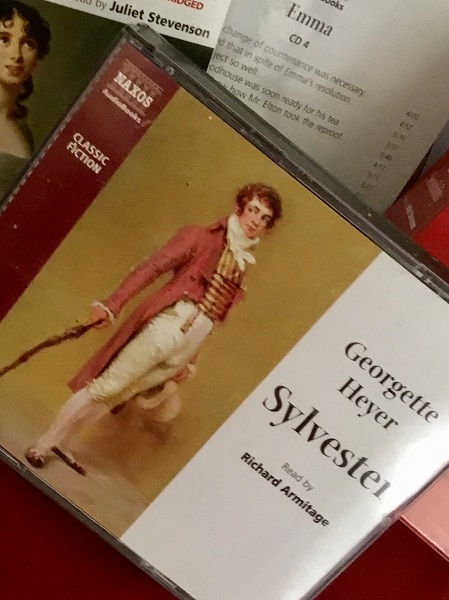
As an aside, fans of Richard Armitage will be delighted with his Naxos reading of Sylvester by Georgette Heyer (Listen to a sample in this 9 minute clip: http://richardarmitageonline.com/sylvester/Sylvester-Sample.mp3).

sylvester

Richard Armitage reads Sylvester. Image @ Vic Sanborn

If you’ve ever heard his voice overs for the Winter Olympics on BBC (listen to ski jumping: http://richardarmitageonline.com/olympics/BBCWinterOlympics2010-trailer-SkiJumping.mp3) you know that Richard is as delightful to listen to as look at! (Listen to all trailers here: http://richardarmitageonline.com/olympics/olympics-introduction.html.

But I digress.

Naxos is not the only audible way to listen to Jane Austen.

Amazon:

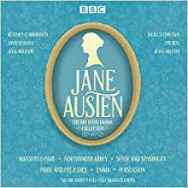
indexThe Jane Austen BBC Radio Drama Collection: Six BBC Radio Full-Cast Dramatisations – Abridged, Audiobook, CD by Jane Austen (Author), Benedict Cumberbatch, David Tennant, & Julia Stevenson, Jenny Agutter, Julia McKenzie, and Eve Best (Readers) has received 4 ½ stars out of 5 from reviewers. These dramatizations cost around $35.00. You can listen to an excerpt of Mansfield Park in an audio clip on this page, then click on listen.

The reviewers love this collection, except in the way it is boxed. All the CDs are boxed together and it is hard to find individual novels. As one listener puts it: “each disk is on top of the next; to use the last one all the other disks need to be handled.”

In addition, Amazon prime offers customers free movies (many Jane Austen related) and Kindle ebooks specials.

overdriveThe local library – online:

From my armchair, hotel room, or any place with an internet connection, I am able to borrow eBooks, audiobooks and streaming videos using the OverDrive app. The website states: “Available 24/7, now the library comes to you.” After some practice, I am able to check out any e-item that is available.

librivoxLibrivox:

This nonprofit project for providing free audio books of the classics has been one of my favorites for a long time. Back in 2008, I wrote a post about some of my favorite readers, such as Karen Savage, whose recordings have a professional quality. One has to be aware with librivox, since many recordings are performed by amateurs (think of authors who read their own novels – most are squirmingly awful). But librivox offers ALL the classics for free. I demonstrate this site to teachers who work with ESL students or adults who are improving their literacy skills. It is so much easier for them to improve their reading, comprehension, and fluency skills when listening to the words while reading them.

playawayPlayaway:

These stand-alone pre-loaded devices (one audio book each) are ready to use after inserting one battery. One does not need the internet or other devices to listen to the tapes. I own Mansfield Park. My only complaint is the earbuds, which are hard and distort the sound..

Favorite Podcasts on Player.fm

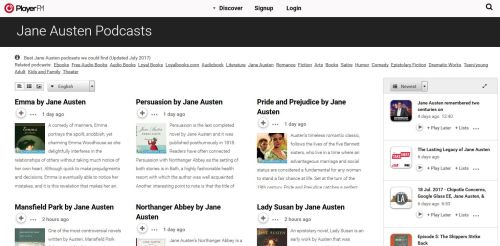
This is such an interesting site! It aggregates all the podcasts on a particular topic and allows you to listen either on your computer or laptop, and device by downloading an app. The player.fm topic I chose was Jane-Austen. Click on the link to view all the offerings. Many are from librivox, but others come from a variety of sources.

favorite podcast

Ah, 21st century technology! Thank you for making Jane Austen available in any format any way that I want to be with her. I feel blessed for spending so many worthwhile hours listening to her novels, reading her books, viewing videos based on her books, and looking for images of her life and family.


Read Full Post »

« Newer Posts - Older Posts »