This Jane Austen blog brings Jane Austen, her novels, and the Regency Period alive through food, dress, social customs, and other 19th C. historical details related to this topic.
Ah, the internet. I am happy to spend hours searching, researching, and sharing ideas as I crawl through thousands of fascinating sites each week.
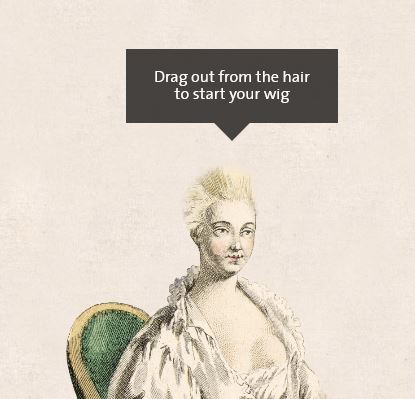
The Victoria & Albert Museum website seldom fails to please. Enter this interactive V&A site on Georgian wigs designed which teaches as well as encourages you and your child to create a fashion of the past. We all know about the over-the-top wigs worn by Marie Antoinette and her court. Does hyour child? The V&A gives us an opportunity to design a wig virtually and to share the results with the world.
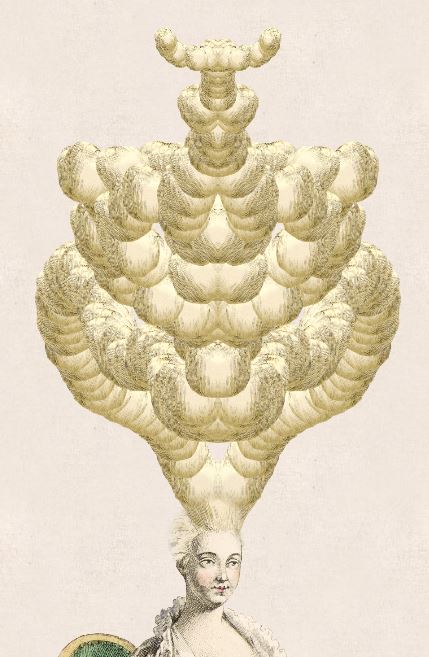
Before each step, the V&A provides some information about the zaniness of wig creations in the late 18th century. The instructions then ask you to drag out the hair to start your wig.
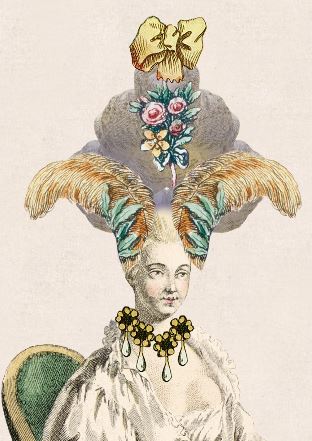
I came up with this. Hah! I tried a number of variations. Such fun. This would be a great teaching activity with your children. Let them go NUTS, I say.
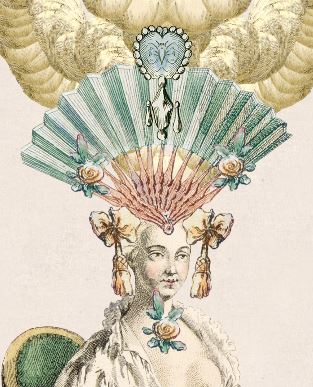
You are then asked to decorate with the usual ornaments – a ship, a fan, feathers, jewels, flowers, bows and tassels. Go crazy! I did.
Add powder in the final step, which I did not find quite as intuitive, and, voila! Your own bewigged work of art.
Could this interactive site have been more sophisticated? Oh, yes, but it’s free. Within the limitations of the site, the activity is quite informative and fun. Bring in a few paintings, caricatures, and illustrations of the day, and you’ve brought a fun history lesson into your child’s life. One can even show some modern influences.
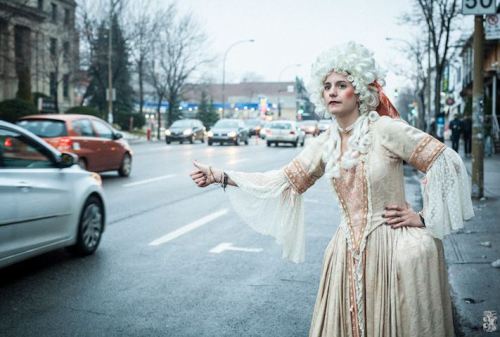
Photographer Thibault Carron imagines what modern life would be like if our fashion was from the 18th century in this playful series And if Fashion Was…, the Montreal-based creative juxtaposes scenes from contemporary culture with a woman whose outfit and hairstyle recall a time from centuries past.
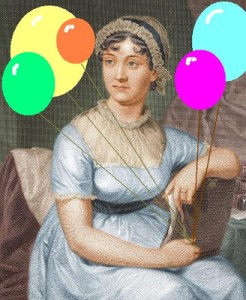
Jane Austen was born on a bitterly cold night on December 16, 1775.
Little is known about birthday celebrations on one’s natal day during the Regency era. Jane makes no mention of them, as far as I know, in her letters and novels. Please correct me if I am wrong. Common sense tells us that family members recognized this important day, but how? Perhaps a special meal was made and a handsome present or two were given. In Persuasion, Jane described a Christmas celebration in Uppercross, which gives us a sense of how a boisterous family celebrated an important event:
On one side was a table, occupied by some chattering girls cutting up silk and gold paper; and on the other were tressels and trays, bending under the weight of brawn and cold pies where riotous boys were holding high revel; the whole completed by a roaring Christmas fire, which seemed determined to be heard in spite of all the noise of the others.
The rich might have made more of a fuss for a loved one’s birthday – gifting a girl with a diamond brooch or a pearl pendant or the young heir with a sporty phaeton.
In celebration of Jane Austen’s 240th birthday, I’ve made a list of the gifts that people exchanged in Jane’s day, and came up with a variety of items that her family and friends might have given her:
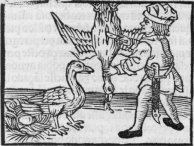
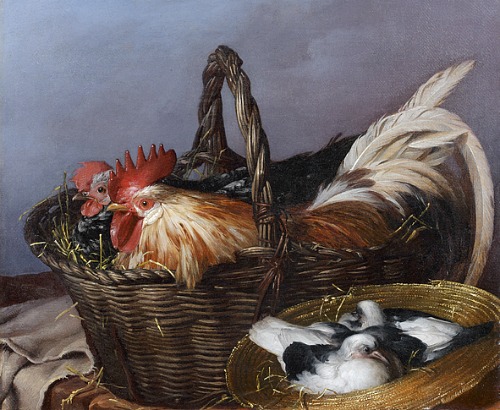
Brother Edward, a plump goose and a brace of pheasants from his lands
Brother Charles, a gift of exotic spices and tea from the West Indies.
Sister Cassandra, an exquisite embroidered shawl made from fine cloth given by brother Frank.
Her friend, Madame Lefroy, a year’s subscription to a circulating library.
Brother Henry, several music sheets of songs that were the current rage in London.
Her mother, a clever poem in her honor, and her father, ink, goose quills, and paper for her literary pursuits.
Her good friend Martha, special recipes to prepare Edward’s gifts of food.
An other article about Jane’s birthday on this blog:
I’d like to share my thoughts on two Jane Austen movies before the end of the year: Pride and Prejudice, 2005 and Clueless, 1995.
Pride and Prejudice 2005 premiered in November ten years ago in the U.S.. I recall watching the film with two members of our Jane Austen book club. The three of us felt less than “whelmed.” We usually eat dinner after a movie and discuss the film in detail. I recall very little discussion other than sharing our sense of disappointment. Keira Knightley seemed too thin and modern as Lizzie. Matthew MacFadyen was no Colin Firth, not his fault, I suppose, but damning in our eyes.
Ten years later, my opinion of the film has changed somewhat. I have come to appreciate that Joe Wright was trying to reach an audience much younger than the members in my book club. That he targeted his audience correctly is proven by the numerous fan clubs that sprang up around the film, the tens of thousands of creative and interesting icons that were created to represent P&P 2005 characters, the many discussion forums and blogs that dedicated reams of information about the film and its actors, and the many nominations the film received at award shows (although I find Keira Knightley’s Academy Award nomination for best actress perplexing). One cannot fault the film’s cinematography and music, which were lush and gorgeous. Has England ever looked more romantic? – its ancient, gnarled oaks, sweeping vistas, misty fields lit by rising suns, and grand houses never looked lovelier on film.
Let’s not forget that PROPOSAL scene in the rain. One cannot deny the chemistry between Keira and Matthew. Pure unrequited lust sprang off the screen.
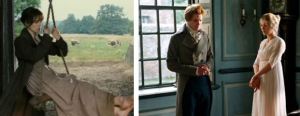
There was also a lovely scene in which Lizzie rotates on a swing in an archway as the seasons of the year swirled past. While this scene was short, it provided a unique visual of the passing seasons.
Finally, finally, this film delivered an actress as beautiful and sweet as the Jane Bennet of my imagination! I will be forever grateful to Joe Wright for hiring Rosamund Pike for the part and pairing her with the first true puppy-like Mr. Bingley.
Film directors are not expected to follow an author’s vision religiously. After all, film is a visual medium, whereas the author relies on words to stimulate our imaginations. BUT. Please. Did Jane Austen really mean for the Bennets to live in a moated manor house, with pigs, geese, and cattle meandering through a muddy courtyard?
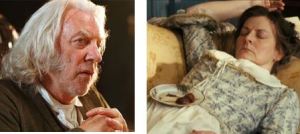
While I adore Donald Sutherland as an actor, at 70 he was more suited to playing Mr. Bennet’s elderly uncle than Mrs. Bennet’s husband. He also interpreted Mr. Bennet as still having the hots for Mrs. Bennet, despite her irritating personality, a modern POV, to be sure, but surely not in keeping with what we know about Mr. Bennet’s huge disappointment with his wife’s foolishness (and with himself for choosing such a ninny)?
While Lizzie was definitely a tomboy compared to her sisters, did she HAVE to be shown walking barefoot or slogging through the fields and dragging her hems through mud and dew so often? Austen, in demonstrating Lizzie’s loyalty to Jane, devised a scene where Lizzie walked through 3 miles of wet fields to be with her sister. This caused Miss Bingley to note with disdain that her petticoat was six inches deep in mud. The Bennets, while upper class, were not super rich. Cloth was not easily obtained or cheap. Clothes were made, remade, reused, and worked over, until the cloth became so threadbare that it was used for cleaning. So, for Lizzie to be shown muddying her hems in so many scenes makes no sense. Her gowns would need repeated washings, which, with the strong lye soaps of the day, would have degraded the cloth too quickly for practicality. She would surely have pinned her dress and train up, exposing only the petticoat, or worn a shorter day gown, as so many commoners and country folk did. Perhaps I am being too much of a stickler, but these lapses in logic affected my experience of the film the first time around and they still do.
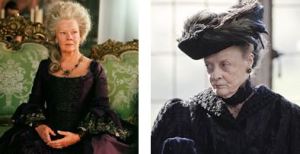
One more rant. It’s become de rigueur in historical films to dress dowagers in the richly made, old-fashioned clothes of their younger years (think of Violet, the dowager countess in Downton Abbey and Judith Dench as Lady Catherine de Bourgh in this film). We get that. My mom still wears serviceable but outdated clothes from the 1980s, but can there be any excuse for dressing Miss Bingley in a nightgown for the Netherfield Ball and arranging her hair in a 1960’s updo?
In my opinion, this 2-hour adaptation of a 200+ page novel falls short when compared to the 1995 six-hour P&P. In 2005, Wickham was given very short shrift, as were the younger Bennet sisters. The scenes moved too fast, though I suppose this suited director Joe Wright’s intent, since he was targeting an audience that can barely remember life before fast-paced electronic games, instant messages, and music videos.
My final beef is with the alternative American ending. Mr. Wright insulted many serious fans of classic literature across the Pond with the final dialogue between Lizzie and Darcy, which lowered their romance to the level of a Barbara Cartland novel.
I still don’t like P&P 2005 half as much as P&P 1995. Yet, despite my misgivings, P&P 2005 has held up relatively well and I think younger viewers still prefer this adaptation to P&P 95. The second film on my mind is Clueless, which premiered several months ahead of Pride and Prejudice 1995 in the U.S., and which also targeted the young theater goer.
Amy Heckerling’s 90’s take on Jane’s meddlesome Emma is as fresh and funny today as it was then. It’s hard to choose which is more ridiculous: the slang of the 90’s valley girl airheads, the over-the-top fashions, the conspicuous consumption of LA teen culture, the banality of Cher’s high school education, the immature boyfriends, or the neutered adults.
Who can forget Cher’s mugging, where she resists lying down on the ground in her designer outfit, even with a gun to her head? Or how Heckerling turned Frank Churchill into Christian, a disco-dancing, Oscar-Wilde-reading, Streisand-ticket-holding-friend-of-Dorothy cake boy?
As Dion reminds Cher, “He does like to shop and the boy can dress.” Cher’s classic reply to Christian’s being gay? “Oh, my God, I’m totally buggin’!” Then there’s the girls’ inability to drive in LA, where driving is as essential as breathing. Those scenes are still classic and not to be missed.
Amy Heckerling did a smart thing in reinterpreting Emma. She brought Jane’s heroine over to California and gave her a different name, and moved her from a dull, country town and dropped her in the center of Beverley Hills, the Mecca for consumption-driven materialists.
Like Emma, Cher is motherless. Whereas Emma’s mama died a natural death, Cher’s mom died from the complications of liposuction on a plastic surgeon’s table. Both Cher and Emma are rich, bored, and meddlesome. Cher babies her father, much as Emma caters to Mr. Woodhouse. In Clueless, Cher’s father, a lawyer, is more dynamic than Mr. Woodhouse. One senses that he tolerates Cher’s mothering more than needs it. The love between them is palpable, and Cher’s kindness to one and all is genuine and sweet. These traits save her shallow character.
There are many similarities between the Emma characters and Clueless characters, and it’s fun to guess in the film who is who. You can tell from my excited tone how much I like this cinematic take of Emma. Clueless is a broad satire that seldom delves below the surface. The film is a feel good movie designed to give the viewer a rollicking good time.
Clueless has the same energy, sense of fun, and satiric take on human foibles as Jane Austen’s Juvenilia. I wonder if Amy Heckerling, having lumbered through all 400+ pages of Emma, turned to Jane’s juvenile stories for inspiration? They are filled with zany plots and joie de vivre. I wonder if she decided to meld the boisterous tone of Jane’s youthful stories with the more layered and complex plot of Emma. Meld? I think not. I think Amy gleefully tossed Emma’s subtext aside in favor of a bit of fun.
I am curious, gentle readers, about your take on both films. Do you agree or disagree with my assessments? Please let me know.
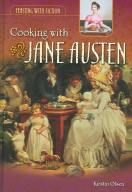
What can be a better way to celebrate fall and the Thanksgiving holiday than to examine a recipe or two from Kirstin Olsen’s 2005 book,Cooking with Jane Austen? – spending time with family and friends and sharing the food!
I’ll just get my two major complaints about the book out of the way. The font is difficult to read – too fancy for my taste – and the book’s cost: $55.00. I found my copy (in excellent shape) via second hand means, which I recommend.
Now, for the good news. While we know that Jane Austen was spare in her descriptions of food, interiors, and clothing in her novels, she provided enough hints for Ms. Olsen to peruse cookery books of that era. Using a variety of sources, Ms. Olsen found recipes similar and close to those she thought Jane might have known. Elizabeth Raffald’s and Hannah Glasse’s recipes are consulted, as well as those from John Farley, Martha Bradley, and more. Ms. Olsen provides historical context at the start of her book and with each recipe category. Even if you never try out one of the recipes, you can glean much information for your personal interest or to add authenticity to a novel you are writing.
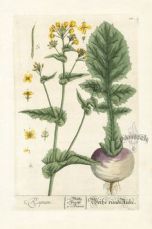
Illustration by Elizabeth Blackwell
Boiled Turnips
This recipe for boiled turnips begins with a quote from Mr Woodhouse in Emma (172)
An historic explanation of the popularization of the turnip follows, with a typical description of a recipe from an 18th century cookery book:
Turnips may be boiled in the pot with the meat, and indeed eat best when so done. When they be enough, take them out, put them in a pan, mash them with butter and a little salt, and in that state send them to the table…
Ms. Olsen then provides the modern recipe for today’ cook, which is extremely useful for those of us who wish to recreate a regency meal for our Jane Austen book clubs.
Modern Recipe for Boiled Turnips
1 lb turnips, 3 T. butter, 1 tsp. salt.
Wash and peel the turnips and trim off the tops an bottom. Cut them into 1″ dice. Bring a pot of salted water to a boil and add the turnips, boiling them until fork-tender, about 15 minutes. Mash the turnips with the butter and salt and serve immediately. (Olsen, p 216)
For my taste, I would prefer boiling the turnips with the meat, as suggested in the 18th century description, much as I prefer making stuffing inside the turkey over making the stuffing separately in the oven. The bird’s natural fat and juices add much more flavor, don’t you think?
Here’s another recipe to celebrate this season and holiday – Roast Stubble Goose. It starts off with a quotation from Emma, a novel filled with references to food. (Thank you, Jane.)
Mrs. Martin was so very kind as to send Mrs. Goddard a beautiful goose: the finest goose Mrs. Goddard had ever seen. Mrs. Goddard had dressed it on a Sunday, and asked all the three teachers, Miss Nash, and Miss Prince, and Miss Richardson, to sup with her. (Emma 28-29.)
Ms. Olsen tells us that a stubble goose is an older bird that fattened on harvest gleanings. In Jane Austen’s time, it was traditionally served with applesauce.
Elizabeth Raffald’s recipe for Roasted Stubble Goose starts with:
Chop a few sage leaves and two onions very fine; mix them with a good lump of butter, a teaspoonful of pepper and two of salt. Put it in your goose, then spit it and lay it down, singe it well, dust it with flour; when it is thoroughly hot baste it with fresh butter…
In this section of Cooking With Jane Austen (p 121-126), Ms. Olsen offers old and modern recipes for roast stubble goose, roast green goose, goose with mustard, and roast turkey. The book consists of 414 pages, so there are numerous recipes to try.
To all my U.S. readers, have a splendid Thanksgiving holiday. While we are thankful for our lives, family, and friends, please give a special thank you to the animals who were sacrificed to nourish us. They “gave” up their most precious gift – their lives.
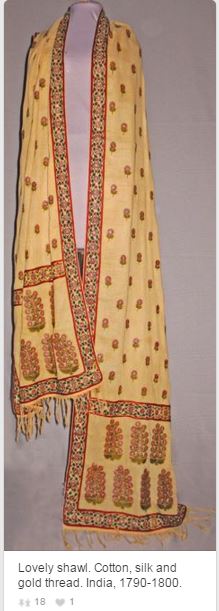
India shawl made of cotton, silk, and gold thread. 1790-1800, Napoleon-fashion.com
Indian influence on Regency dress included fine Indian muslin, used for dresses and cravats, and beautiful, expensive hand-loomed shawls. During the late 18th-early 19th century, an unprecedented number of Indian cloths, made of quality fabrics, were exported to Britain. These cloths were expressly made for the British market, with colors and chintz patterns toned down to appeal to the more restrained British taste.
While cheaper and inferior imitation paisley shawls were increasingly made in Great Britain (by 1821, shawls made in British locations like Spitalfields and Scottland would overtake the Indian exports in numbers sold), the authentic Indian shawl was highly prized for its quality, cost, and prestige. These shawls were so popular with those who could afford them that they were presented to friends and family members by merchants, soldiers, and visitors returning from the East Indies. Made of durable cloth, they were carefully handled and handed down from mother to daughter and aunt to niece over the years.
Shawls not only added prestige and style to a lady’s wardrobe, they served other functions, such as color and pattern. They definitely added warmth to the thin, gauzy, almost transparent muslin gowns that became so popular at the turn of the 19th century. The shawls lent themselves to other uses as well.
Lady Hamilton, Lord Horatio Nelson mistress, used the shawls to great effect for her “Attitudes,” as described by Mrs. St. George, who had the occasion to witness several of her performances.
From their book Drawings Faithfully Copied from Nature at Naples by Friedrich Rehberg, Engraver and Tommaso Piroli, Illustrator, 1794 4
She assumes their attitude expression, and drapery with great facility, swiftness, and accuracy. Several Indian shawls, a chair, some antique vases, a wreath of roses, a tambourine, and a few children are her whole apparatus. She stands at one end of the room, with a strong light to her left, and every other window closed. Her hair (which by-the-bye) is never clean is short, dressed like an antique, and her gown a simple calico chemise, very easy, with loose sleeves to the wrist. She disposes the shawls so as to form Grecian, Turkish, and other drapery, as well as a variety of turbans. Her arrangement of the turbans is absolute sleight of hand, she does it so quickly, so easily, and so well. It is a beautiful performance, amusing to the most ignorant, and highly interesting to lovers of art. The chief of her imitations are from the antique. Each representation lasts about ten minutes. It is remarkable that, though coarse and ungraceful in common life, she becomes highly graceful, and even beautiful, during this performance. It is also singular that, in spite of the accuracy of her imitation of the finest ancient draperies, her usual dress is tasteless, vulgar, loaded, and unbecoming. – Account by Mrs. St. George, Wit, Beaux, and Beauties of the Georgian Era, John Fyvie, 1909, pp 335-336.
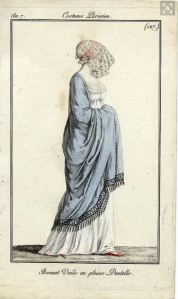
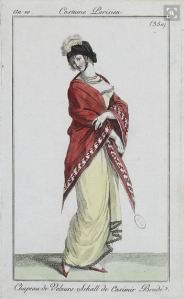
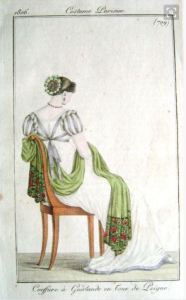
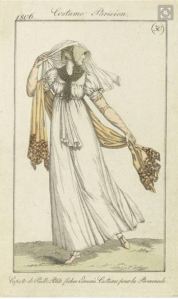
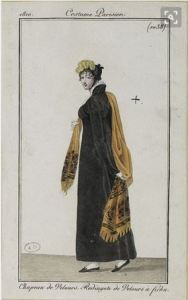
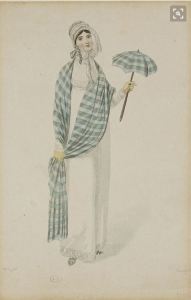
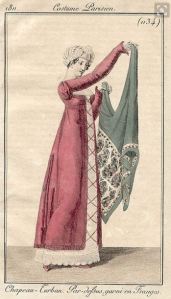
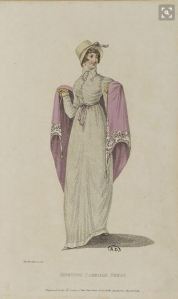
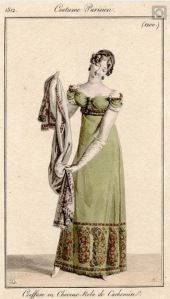
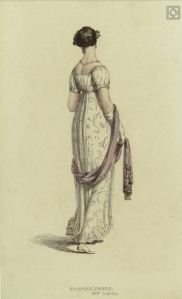
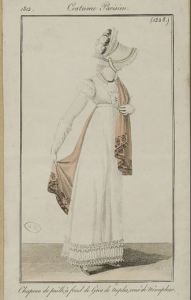
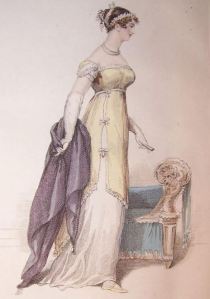
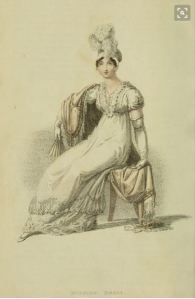
As I collected Pinterest images of fashion plates of elegant ladies and their shawls, I saw how much elegance and beauty these accessories added to a woman’s arm and hand gestures. The artists who drew the fashion plates were certainly aware of these effects. I have created a short gallery of an example of the beauty that shawls added to a woman’s figure and fashion statement. Enjoy.
Fashionable Goodness: Christianity in Jane Austen's England is now available! By JAW contributor Brenda S. Cox. See Review. Available from Amazon and Jane Austen Books.
Available through December 31st, 2025. Click on image for details, and share this poster with other teachers and students!
The Obituary of Charlotte Collins by Andrew Capes
Click on image to read the story.
Comments
“My idea of good company…is the company of clever, well-informed people, who have a great deal of conversation.” – Jane Austen, Persuasion
Gentle readers: Please feel free to post your comments and continue the conversation! Due to SPAM, we will no longer accept comments on posts after 30 days of publication. In some instances, links will be removed from comments as well.
Administrators and Contributors
Vic Sanborn, founder of this blog, is supported by a team of talented and knowledgeable writers about Jane Austen and the Regency era. They are:
Tony Grant, who now contributes his photos from London and England
Click on their names to enter their own blogs.
In addition, we thank the many experts and authors who frequently contribute their posts and opinions, and who continue to do so freely or at our request.
Click here to enter the page. Topics include Regency fashion, historic foods, Jane Austen societies, British sites, related topics. Click on image.
May we suggest?
Hello, my name is Vic and I live in Maryland, USA. I have adored Jane Austen almost all of my life. I am a proud lifetime member of the Jane Austen Society of North America. This blog is a personal blog written and edited by me and my team. We do not accept any form of cash advertising, sponsorship, or paid topic insertions. However, we do accept and keep books and CDs to review.
If you would like to share a new site, or point out an error, please email us. (Yes, we are fallible. We'll own up to our mistakes and will make the corrections with a polite smile on our faces.) Write us at
Thank you for visiting this blog. Your comments and suggestions are most welcome.
Project Gutenberg: eBook of Stage-coach and Mail in Days of Yore, Volume 2 (of 2), by Charles G. Harper
STAGE-COACH AND MAIL IN DAYS OF YORE: A PICTURESQUE HISTORY
OF THE COACHING AGE, VOL. II, By CHARLES G. HARPER. 1903. Click on this link.
 Jane Austen was born on a bitterly cold night on December 16, 1775.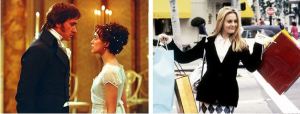






















 Jane Austen's World