Feeds:
Posts
Comments

Archive for the ‘Jane Austen’s World’ Category

Dr. Syntax Visits a Boarding School for Young Ladies

One of the most unexpected (and wonderful) finds in the Emporium at the 2012 JASNA meeting in NYC were the four Rowlandson prints that I purchased. One, entitled “Dr. Syntax Visits a Boarding School for Young Ladies” is charming. I included a number of images I found online to accompany this post. Except for the composition, t is remarkable how strikingly different each looks. My print resembles none of the ones displayed here – it is slightly yellowed and delicately colored, but the colors are neither bright nor faded. I can’t wait to frame it.

Dr syntax visits a boarding school for young ladies,1821. This image from the Yale Center of British Art is much paler than mine, in which the headmistress’s skirt is colored red and the young ladies in the foreground wear colored dresses.

This 190+ year old hand-colored aquatint came from The Tour of Doctor Syntax, published by Ackermann’s Repository in London from 1812-1821. Dr. Syntax, a British clergyman, sits under a tree next to a stern looking Lady Governess, who addresses the young pupils arrayed around them. The scene accompanies text in The Second Tour of Dr. Syntax, In Search of Consolation. The illustration reveals how Rowlandson works, outlining the figures with a reed pen and then delicately washing certain areas of the print with color. His pen and inks were then etched by a professional engraver, an artist in his own right. The impressions were then hand colored.

Rowlandson’s Prints

Rowlandson was prolific. Art historians deem his earlier works to be more artistic and carefully observed. As his reputation spread, he began to produce his designs in haste and the quality of his art began to suffer. His caricatures became predictable and in some instances overly exaggerated, but he never lost the facility with which he handled his pen.

In this series, Rowlandson created the illustrations first. Writer James Combe then wrote the narrative that accompanies the images. “This series is one of the best parodies of the more traditional narratives on journeys to different parts of England featuring more “serious” landscape illustrations and prose.” ( Prints from The Tours of Dr. Syntax, Prints With a Past.)

This print is similar to the one I purchased, but slightly more colorful. Image from Dr. Syntax’s Three Tours at Internet Archive, Cornell University Library

Doctor Syntax talks to the Young Ladies at Boarding School

Below sits the text (in verse) that accompanied this image, in which Dr. Syntax expounds on his listeners’ youth and character, and how they can learn from good example:

In the following page, Dr. Syntax exhorts his young charges to never swerve from virtue’s path and to take care of their good looks, for “flowing looks display’d to view, of black or brown or auburn hue, and well combin’d in various ways, a certain admiration raise…”:
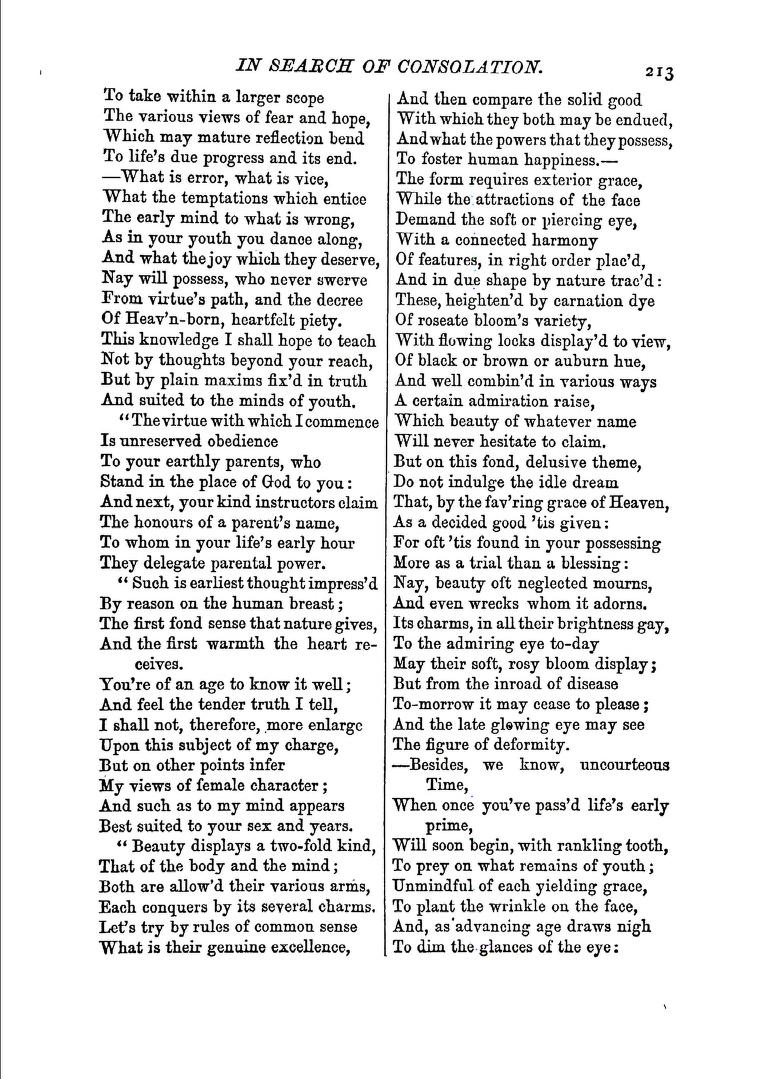
Dr. Syntax does not want for words. In fact, he is a bit of a windbag. How those girls could sit enraptured during this speech is a marvel to me. In this section the rich graces of the mind hold the beauty of the whole, the mortal form, th’ immortal soul.

I wonder if Dr. Syntax even drew breath! In this section the good doctor reinforces the concept that a woman’s place is in the home, overseeing the family and household.

The Doctor says his goodbye, admonishing the listeners to pay attention the kind preceptress, who “will explain what of this subject doth remain, and bring the whole before your view, to prove my solemn doctrine true.”

Sources: 

Books:

  • Dr. Syntax’s Three Tours Doctor Syntax’s three tours in search of the picturesque, consolation, and a wife. By William Combe. The original ed., complete and unabridged, with the life and adventures of the author, now first written, by John Camden Hotten. Eighty full page illustrations drawn and coloured after the originals by T. Rowlandson. Published 1868 by J. C. Hotten in London . Library of Congress, PR3359.C5 D6 1868

Other posts about the JASNA NYC 2012

Read Full Post »

Shades from Jane Austen by Honoria Marsh was published in 1975-1976 in a series of limited editions. I saw this rare work at the silent auction table at the 2012 JASNA AGM meeting in NYC. There were many beautiful items, but this one was a standout with its colored illustrations, mostly silhouettes, and a few reproductions of Jane Austen’s writings. Bidding began at $50.00, but at the time I approached the table the price had gone up to $150.00, a bit beyond my price range but still less than the book attracts in online bookstores. The price reflects the book’s rarity, for only a few copies are available. I had seen a few illustrations before, but not the originals … until now.

The video shows a number of illustrations from the book not seen in this post. The portrayals of Jane Austen’s characters were painted by the author from life. Her sitters were either friends and acquaintances, or Jane Austen’s descendants or people associated with her! You can read their names below the title of the characters.

Part one of the book includes ‘Jane Austen’s Family in Silhouette’, a table showing Jane Austen’s Family and Chronology of Events During her Lifetime’ (written by Peggy Hickman), and Jane Austen’s family tree.

Part two includes an introduction and a discussion of Sense and Sensibility, Pride and Prejudice, Mansfield Park, Emma, Northanger Abbey and Persuasion.

Silhouette of Mrs. Gardiner

Alas, I do not know who successfully bid for the book in the silent auction or what it went for. Does anyone know?

Read Full Post »

I can’t believe it’s been a day since the excitement of my first JASNA (Jane Austen Society of America) Annual Meeting. This one was held in Brooklyn, which turned out to be a fabulous place for this Janeite, for I walked over half of the Brooklyn Bridge between sessions and loitered in Brooklyn Heights, a truly wonderful neighborhood in which to while away one’s time. Then there were the plenary sessions, break out sessions and the EMPORIUM, where money flowed from my pocket into the vendors’. (I had to ship my loot back!)

Feather fan. Only some discoloration and one blemish flaw this otherwise remarkably preserved fan.

One of the loveliest displays was the antique fan exhibition presented by Dr. Abbey Block Cash. The variety of fans was astounding. One, made entirely of feathers, was in almost pristine condition (see image). The fans were so delicate that I would be afraid to handle them and many were hand painted. One in particular caught my eye … a puzzle fan from 1820:

The fan is made of French brise with blond horn sticks. The four images that open in four directions are:

  • Bouquet of flowers
  • Marriage proposal
  • Farm house
  • Planting scene

I went to the website suggested in the brochure, the Fan Association of North America at this link. Information on this site was varied and practical. What I liked in particular were the links to other fan sites. FANA is well worth a visit and exploration if you are interested in these beautiful yet practical accessories.

Not all the fans belonged to the Regency Era. As you can see, most are hand painted with exquisite scenes. The last fan in this video was made ca. 1910 (I hope my memory serves me right) and depicts scenes painted by Kate Greenaway. It is obvious from the quality of the fans that all were destined for the upper crust. I did not see a fan of the sort that the lower classes could afford, such as those with advertisements. (Because I did not see such fans, does not mean that they were absent.)

I wish I had the presence of mind to ask about the language of the fan, for there are so many myths swirling around that topic, but those of you who have been to an AGM know how much there is to see and do, and how many people one MUST meet NOW.

The red fan was exquisite and dramatic. The fan in back of it sports Kate Greenaway images of children.

There were some notable absences at this year’s AGM: I so wanted to meet my frequent blog partner Laurel Ann Nattres (editor of Jane Austen Made Me Do It and Austenprose) and Margaret Sullivant (editrix of Austenblog), but alas they did not come this year. You will see over the coming weeks the people I DID meet, such as Joan Klingel Ray, Susannah Fullerton, Deb Barnum (my lovely roommate), Lori Smith, Syrie James, and Dianah Baycich. Some of us fell all over each other like twins separated at birth. Every Janeite should make at least one JASNA Meeting. You simply will not be disappointed. I must add that the folks from JASNA NY did a splendid job of putting this complex (and largest) JASNA conference together. Kudos to all.

Read my other post from the AGM:

Read Full Post »

When Upstairs Downstairs was not included in last spring’s Masterpiece Classic line up I worried that we would not have an opportunity to see the series this year. Not to worry. The first installment of six of Season Two will air this Sunday ,October 7 and end November 11, 2012.

Will sandbags protect Eaton Place?

In 2010, Upstairs Downstairs aired just after the wildly popular Downton Abbey, suffering in comparison. To begin with, Downton’s budget was astronomical compared to UpDown’s.  And UpDown’s script needed to find a way to tie in to the classic and unforgettable 70’s series with Jean Marsh as Rose and Gordon Jackson as Mr. Hudson.  That series was a hard act to follow.

Mr. Pritchard is in charge of bomb siren warnings and other dangers. What is his secret?

This year UpDown suffered unanticipated setbacks: Jean Marsh suffered a stroke and could not continue to play Rose full time (she appears in two episodes) and Eileen Atkins (Maud, Lady Holland) decided not to return. Frankly, Eileen was the only comedic respite in Series One and the closest that UpDown came to challenging Maggie Smith’s unforgettable Violet.

The new baby hardly plays a role in the plot, except to point out Lady Holland’s depression and long road back to health.

Season Two’s UpDown is a somber series compared to Downton, even with that show’s foray into  WW1.  At the beginning of Season 2 in UpDown, World War II is about to break wide open. Air raid drills are a fact of life. Houses are sandbagged and Londoners are preparing for war, even practicing wearing gas masks indoors.

The cook and new maid, Eunice

Nothing isquite  the same at 165 Eaton Place.

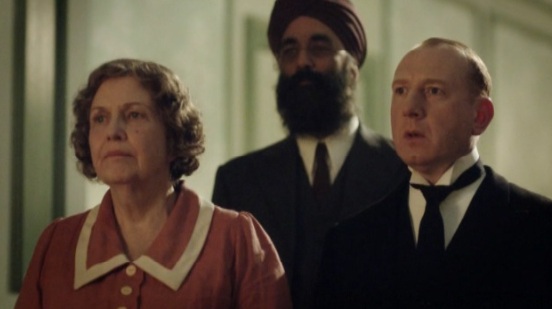
Mrs. Thackeray, Mr. Amanjit, and Mr. Pritchard. After Maude’s absence, Mr. Amanjit’s role is severely curtailed.

Elie Kendrick as Ivy is gone, replaced by two new maids: Eunice and Beryl.

Laurel Haddock as Beryl

Alex Kingston has come on board as Maude’s sister,  Dr. Blanceh Mottershead, an unwanted addition as far as Hallam Holland is concerend. Hallam is conerned 24/7 with diplomacy and making sure that the Brits aren’t totally bowled over by oily German diplomacy.

Hallam beset at all fronts

Then there’s Lady Holland’s story arc. Episode One starts with the birth of the Holland’s second child and Lady Holland’s struggle to regain her health after a difficult birth, which has resulted in post partum depression (or has it?)

Agnes, Blanche, and baby: A happy family?

A family tableau: Agnes, Blance, and baby. A happy famoly?

A handsome Hollywood producer appreciates her charms, even as Hallam is consumed by averting the war. Agnes’s sister Persey is ankle deep in Nazis, living abroad and living the high life until Kristalnacht, when she realizes that Nazi German politics is uber false and dirty and bent on annihilating innocent Jews.

Alex Kingston as Dr Blanche Mottershead

Fans of the original series know that UpDown was never ever a precursor of Downton Abbey. It always had a rather serious bent, with comedic elements toned down or nonexistent.

Sarah Gordy as Pamela Holland, Hallam’s long lost sister.

Downton Abby, which I adore, is in my opinion a phenomenon of our times – history mixed with rather outrageous elements that reflect our 21st century sensibilities. We cannot fault UpDown for staying true to its origins.

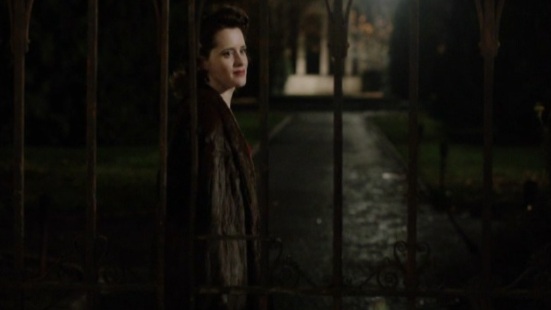
Claire Foy’s role as Lady Persey is dark this season. Who can love a mistress of the Nazis?

I watched all six episodes back to back, wanting to know how the story ends. It is sad to know that this intelligently written series was not renewed for a third season. Knowing this, I backpedaled, not allowing myself to get too invested in the story line, so that I would not be disappointed that the cliff hanger would not be resolved.

Blake Ritson as the Duke of Kent. His portrayal is highly stylized. I’m not sure I like this direction in his acting. Let me know what you think!

True to form, UpDown reverted to 1970s ways, not making a brouhaha at the end of the season, and almost tying up the story lines in a neat bow . Is Season 2 worth watching knowing that the series is at an edn? Absolutely. Click here to go to PBSs site.

Read Full Post »

Inquiring readers: While I am at JASNA’s meeting in NYC this weekend, I leave you with this delightful description of Catherine Morland as a very young girl. I have often wondered how much Jane Austen described her own character. After all, she lived with a house full of boys and must have played cricket with them and slid down the slope behind Steventon Rectory during the snow! Interestingly, Jane Austen wrote the description in one long paragraph, which my images break up. I love the tongue-in-cheek quality of her depiction of Catherine, yet she manages to describe exactly what a young lady’s accomplishments OUGHT to be.

**A family of ten children will be always called a fine family, where there are heads and arms and legs enough for the number. (Portait of Sir William Young and family, Johann Zoffany.) Walker Art Gallery

Description of Catherine Morland

A family of ten children will be always called a fine family, where there are heads and arms and legs enough for the number; but the Morlands had little other right to the word, for they were in general very plain, and Catherine, for many years of her life, as plain as any. She had a thin, awkward figure, a sallow skin without color, dark, lank hair, and strong features,— so much for her person. And not less unpropitious for heroism seemed her mind.

Embroidered 18th century handkerchief. “The ball once struck off, Away flies the boy, To the next destind post, And then home with joy.” *Image @CNN

She was fond of all boys’ plays, and greatly preferred cricket, not merely to dolls, but to the more heroic enjoyments of infancy, — nursing a dormouse, feeding a canary-bird, or watering a rose-bush. Indeed, she had no taste for a garden; and if she gathered flowers at all, it was chiefly for the pleasure of mischief, — at least so it was conjectured, from her always preferring those which she was forbidden to take. Such were her propensities. Her abilities were quite as extraordinary.

Girl sketching, by Henry Raeburn. c. 1811 Image @Sudley House

Catherine Morland’s Accomplishments

She never could learn or understand anything before she was taught; and sometimes not even then, for she was often inattentive and occasionally stupid. Her mother was three months in teaching her only to repeat the “Beggar’s Petition;” and after all, her next sister, Sally, could say it better than she did. Not that Catherine was always stupid,— by no means: she learnt the fable of “The Hare and many Friends” as quickly as any girl in England. Her mother wished her to learn music; and Catherine was sure she should like it, for she was very fond of tinkling the keys of the old forlorn spinnet; so, at eight years old, she began. She learnt a year, and could not bear it; and Mrs. Morland, who did not insist on her daughters being accomplished in spite of incapacity or distaste, allowed her to leave off. The day which dismissed the music-master was one of the happiest of Catherine’s life. Her taste for drawing was not superior; though whenever she could obtain the outside of a letter from her mother, or seize upon any other odd piece of paper, she did what she could in that way, by drawing houses and trees, hens and chickens, all very much like one another.

Dancing Masters Ball, 1794, Isaac Cruikshank. Childrens balls were arranged so that children could practice their dancing lessons. Image: Courtesy of Yale University, Lewis Walpole Digital Image Library Call Number 794.8.27.1

Writing and accounts she was taught by her father; French by her mother: her proficiency in either was not remarkable, and she shirked her lessons in both whenever she could. What a strange, unaccountable character!— for with all these symptoms of profligacy at ten years old, she had neither a bad heart nor a bad temper; was seldom stubborn, scarcely ever quarrelsome, and very kind to the little ones, with few interruptions of tyranny; she was moreover noisy and wild, hated confinement and cleanliness, and loved nothing so well in the world as rolling down the green slope at the back of the house.

Below: Catherine as I envision her when she meets Henry Tilney


Head of a girl
Louise Elisabeth Vigée Le Brun

Citations:
*Did baseball begin in 18th-century England?, By Simon Hooper, CNN, June 9, 2010 8:29 a.m. EDT

**A portrait of Sir William Young and his large family shows a picture of 18th century wealth in a fashionably bucolic setting. A “conversation piece”, this depiction was meant to tell a story. The artist, Johann Zoffany, helped develop this type of piece, positioning the sitters as if they are actors. The family is wearing a type of fancy dress, 17th century costumes inspired by century-old portraits by Sir Anthony Van Dyck . This type of nostalgia was extremely popular in Britain around 1770.  Michael Henry Adams, A Queen for Today! Huffington Post, April 22, 2009.

Read Full Post »

« Newer Posts - Older Posts »