Feeds:
Posts
Comments

Archive for the ‘Mansfield Park’ Category

“Hot Cross Buns, Hot Cross Buns,
One a penny, two a penny,
Hot Cross Buns.”

– Street Cry on Good Friday in England

easter_road

  • Easter Fun at Chawton House this year will depend on good weather. Then again, there’s nothing like a sturdy pair of Wellies and an umbrella to deal with spring showers.
  • Here is a fun project on Belly Timber to make decorative boxes that will hold your Easter eggs or candy.

Jane Austen mentions Easter in a peripheral way. Fanny Price pines for Mansfield Park hoping to return soon to the Bertrams after her ‘exile’ to Portsmouth. However, by Easter she still has not received a summons to come ‘home.’:

Easter came particularly late this year, as Fanny had most sorrowfully considered, on first learning that she had no chance of leaving Portsmouth till after it. It came, and she had yet heard nothing of her return–nothing even of the going to London, which was to precede her return. Her aunt often expressed a wish for her, but there was no notice, no message from the uncle on whom all depended. She supposed he could not yet leave his son, but it was a cruel, a terrible delay to her. The end of April was coming on; it would soon be almost three months, instead of two, that she had been absent from them all, and that her days had been passing in a state of penance, which she loved them too well to hope they would thoroughly understand; and who could yet say when there might be leisure to think of or fetch her? – Mansfield Park, Chapter 45

Happy Easter One and All.

Read Full Post »

Wentworth Before, Humphry Repton

Wentworth Before, Humphry Repton

One of the biggest names in landscaping during the late 18th and early 19th centuries was Humpry Repton (1752-1818), a self-made man who transformed the formal landscapes around England’s great houses along more natural, fluid, and graceful lines. Repton, who saw the relationship between house and landscape as a picturesque whole, wrote:

Wentworth After, Humphry Repton

Wentworth After, Humphry Repton

“In landscape gardening everything may be called a deception by which we endeavour to make our works appear to be the product of nature only. We plant a hill to make it appear higher than it really is, we open the banks of a natural river to make it appear wider, but whatever we do we must ensure that our finished work will look natural or it would fail to be agreeable.” Agreeable meant adding cattle or deer as focal points, and architectural structures that drew the eye. At times, entire villages were transported away from the great house and mature trees were transplanted so that the bucolic vision of manse and land could remain unspoiled and natural.

Transplanting trees, 1794, Hayes

Transplanting trees, 1794, Hayes

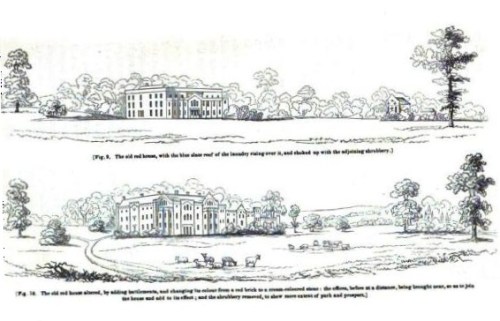
In following his vision, Repton moved roads,  created ponds, planted copses,  and built architectural structures. An artist, he painted his vision of how the property would look in 50 years in a series of red books, many of which still survive. Stoneleigh Abbey,  the ancestral home of Jane Austen’s mother’s family, was one of Repton’s most important commissions. Those who are planning to visit Stoneleigh Abbey will have an opportunity to view Repton’s red book for the Leighs, which took him a year to create and which will be on exhibit through 2009. Repton’s famous red books  showed painted scenes of the landscape before and after his transformations. In Observations on the Theory and Practice of Landscape Gardening, he wrote:

“The perfection of landscape gardening consists in the four following requisites. First, it must display the natural beauties and hide the defects of every situation. Secondly, it should give the appearance of extent and freedom by carefully disguising or hiding the boundary. Thirdly, it must studiously conceal every interference of art. However expensive by which the natural scenery is improved; making the whole appear the production of nature only; and fourthly, all objects of mere convenience or comfort, if incapable of being made ornamental, or of becoming proper parts of the general scenery, must be removed or concealed”.

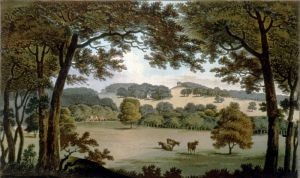
In 1796, following his own advice, Repton painted two watercolours for Whiton, the seat of Samuel Prime, esq., as seen below – (Images from Plants and Gardens Portrayed.)

Whiton, View from the Saloon Before, Humphry Repton, 1796

Whiton, View from the Saloon Before, Humphry Repton, 1796

Whiton, View from the Saloon After, Humphry Repton, 1796

Whiton, View from the Saloon After, Humphry Repton, 1796

Jane Austen famously mentioned Repton and the vogue for landscape transformations in Mansfield Park:

“Mr. Rushworth,” said Lady Bertram, “If I were you, I would have a very pretty shrubbery. One likes to get out into a shrubbery in fine weather.”

Mr. Rushworth was eager to assure her ladyship of his acquiescence, and tried to make out something complimentary; but, between his submission to her taste, and his having always intended the same himself, with the superadded objects of professing attention to the comfort of ladies in general, and of insinuating that there was one only whom he was anxious to please, he grew puzzled, and Edmund was glad to put an end to his speech by a proposal of wine. Mr. Rushworth, however, though not usually a great talker, had still more to say on the subject next his heart. “Smith has not much above a hundred acres altogether in his grounds, which is little enough, and makes it more surprising that the place can have been so improved. Now, at Sotherton we have a good seven hundred, without reckoning the water meadows; so that I think, if so much could be done at Compton, we need not despair. There have been two or three fine old trees cut down, that grew too near the house, and it opens the prospect amazingly, which makes me think that Repton, or anybody of that sort, would certainly have the avenue at Sotherton down: the avenue that leads from the west front to the top of the hill, you know,” turning to Miss Bertram particularly as he spoke. But Miss Bertram thought it most becoming to reply—

“The avenue! Oh! I do not recollect it. I really know very little of Sotherton.”

Fanny, who was sitting on the other side of Edmund, exactly opposite Miss Crawford, and who had been attentively listening, now looked at him, and said in a low voice—

“Cut down an avenue! What a pity! Does it not make you think of Cowper? ‘Ye fallen avenues, once more I mourn your fate unmerited.’”

He smiled as he answered, “I am afraid the avenue stands a bad chance, Fanny.”

“I should like to see Sotherton before it is cut down, to see the place as it is now, in its old state; but I do not suppose I shall.”

“Have you never been there? No, you never can; and, unluckily, it is out of distance for a ride. I wish we could contrive it.”

“Oh! it does not signify. Whenever I do see it, you will tell me how it has been altered.”

“I collect,” said Miss Crawford, “that Sotherton is an old place, and a place of some grandeur. In any particular style of building?”

“The house was built in Elizabeth’s time, and is a large, regular, brick building; heavy, but respectable looking, and has many good rooms. It is ill placed. It stands in one of the lowest spots of the park; in that respect, unfavourable for improvement. But the woods are fine, and there is a stream, which, I dare say, might be made a good deal of. Mr. Rushworth is quite right, I think, in meaning to give it a modern dress, and I have no doubt that it will be all done extremely well.”

Miss Crawford listened with submission, and said to herself, “He is a well–bred man; he makes the best of it.”

“I do not wish to influence Mr. Rushworth,” he continued; “but, had I a place to new fashion, I should not put myself into the hands of an improver. I would rather have an inferior degree of beauty, of my own choice, and acquired progressively. I would rather abide by my own blunders than by his.”

“You would know what you were about, of course; but that would not suit me. I have no eye or ingenuity for such matters, but as they are before me; and had I a place of my own in the country, I should be most thankful to any Mr. Repton who would undertake it, and give me as much beauty as he could for my money; and I should never look at it till it was complete.”

“It would be delightful to me to see the progress of it all,” said Fanny.

“Ay, you have been brought up to it. It was no part of my education; and the only dose I ever had, being administered by not the first favourite in the world, has made me consider improvements in hand as the greatest of nuisances. Three years ago the Admiral, my honoured uncle, bought a cottage at Twickenham for us all to spend our summers in; and my aunt and I went down to it quite in raptures; but it being excessively pretty, it was soon found necessary to be improved, and for three months we were all dirt and confusion, without a gravel walk to step on, or a bench fit for use. I would have everything as complete as possible in the country, shrubberies and flower–gardens, and rustic seats innumerable: but it must all be done without my care. Henry is different; he loves to be doing.” – Mansfield Park, Chapter 6

Repton's suggested improvements for house and landscape, p. 48, The Landscape Gardening and the Landscape Garden of the Late Humprhey Repton

Repton's suggested improvements for house and landscape, p. 48, The Landscape Gardening and the Landscape Garden of the Late Humprhey Repton

Repton, who was prolific in his thirty year career, taking on over 400 commissions, believed in providing picturesque vistas that included focal points from certain stops along a circuitous path wending its way through the landscape. He wrote how he accomplished this:

First, by collecting the wood into larger masses and distinguishing the lawns in a broad masterly manner without the confused frittering of too many single trees;

Secondly, by the interesting line of road winding through the lawn;

Thirdly, by the introduction of cattle to enliven the scene; and

Lastly, by the appearance of a seat on the knoll and a part of the house with its proposed alterations displaying its turrets and pinnacles amongst the trees. –  The Landscape Gardening and Landscape Architecture of the Late Humphrey Repton, Esq Being His Entire Works on These Subjects By Humphry Repton, John Claudius Loudon

Learn More About Humphry Repton by clicking on these links:

Hayes Image: Lasdun, Susan. The English Park, Royal, Private and Public. London. 1991, p 103. Print.

Read Full Post »

Gentle readers, One of my most popular posts is The Dummification of Mansfield Park, which I wrote in response to the 2007 ITV adaptation of Jane Austen’s novel. In addition, Austenprose has been showcasing Mansfield Park during the last two weeks of this month, discussing the novel at length and giving away prizes. A few days ago, Professor Ellen Moody posted her thoughts on Eighteenth Century Worlds about script writer Maggie Wadey’s recent adaptation of Mansfield Park. Once again Ellen has graciously allowed me to post her thoughts, which add another dimension to the latest Jane Austen film adaptation.

Script Writer Maggie Wadey

Script Writer Maggie Wadey

I know everyone so inveighs against this 2007 Mansfield Park written by Maggie Wadey (in TV the writer is central) and it’s true the film can be seen as a crude outline of a book through hitched-together scenes. The people in charge of this production had not the time, money, nor inclination to begin to present a proper translation of the book. Against the 1983 Mansfield Park this latest adaptation is a laugh. It also (like the 2008 Sense and Sensibility vis-a-vis the 1995 film by Emma Thomspon) imitates the 1999 Mansfield Park: The presentation of Henry and Mary Crawford is simply modeled on the earlier film version – they suddenly appear as a couple, like a pair of witty dolls.

Because of our immediate (and negative) reaction we ignore what is interesting — at least to me. There is a continual atmosphere of menace. One person who commented several times on this film argued that this reaction responded to something going on in Britain right now: a dislike of hierarchy, of artifice, of the older culture of deference. He saw it as deliberately opting for the “natural” in the preference say for a picnic, the eschewing of formality. I can see this but think it’s counteracted by the intense anger that is on the edge of exploding all the time — from the father and the oldest son. The notion of a sensitive temperament unable and unwilling, too gifted and at the same time self-possessed – which partly is in Austen’s characterization of Fanny – is transferred to Edmund (played very well by Blake Ritson). Fanny is presented as subdued because it’s in her interest, not because it’s her nature, and not really because she has been so crushed by the poisonous Mrs Norris. We see her as a tomboy in the opening in a scene taken from Austen’s Northanger Abbey, one which Davies also makes much of in his 2007 Northanger Abbey (anything that can make a woman into a boy is just great; Fanny’s now a horsewoman too, instinctively, not something learned which is what happens in the book and in the 1983 film).
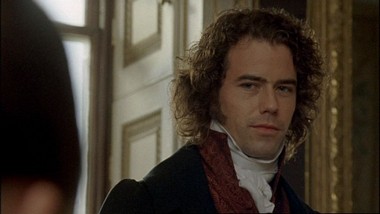
Our first sight of Henry Crawford, he looks out slightly menacing
Our first sight of Henry Crawford, he looks out slightly menacing

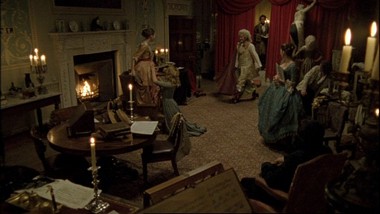
The scenes of the rehearsal are all dark lit, with a queasy masquerade feel
The scenes of the rehearsal are all dark lit, with a queasy masquerade feel

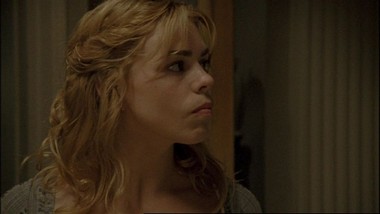
wary, and rightly so (for she is humiliated and marginalized, at the same time as at the center of what goes on)

A typical shot of Fanny during the time of the play: wary, and rightly so (for she is humiliated and marginalized, at the same time as at the center of what goes on)

An implied bullying is at the core of social life in this movie, which uses parties and little physical tussle games (Fanny with children) to provide momentary relief. Lady Bertram opts out but we are made to feel she could hold her own physically and mentally if she wanted to; that’s what I take is the point of making her say she knew all along that Fanny loved Edmund, bringing the happy ending about. (In the 1999 Mansfield Park the taboo is also slurred over, and Mary Crawford at least knows and repeats that Fanny loves Edmund.) I do think both enactments — a natural world against the formality and artifice of hierarchies and the continual bullying, menaces as central to experience — are in reaction to our time.
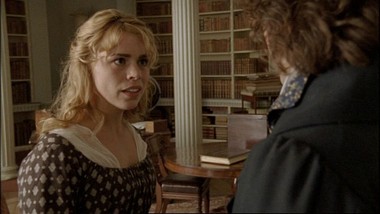
The proposal scene again has Henry aggressing on Fanny, and her backing away

The proposal scene again has Henry aggressing on Fanny, and her backing away

You must.

Sir Thomas's offer of a birthday celebration lacks his usual snarl, but he is saying with implied ability to punish: You must.

Similarly and this is a point brought out in many of the essays of the 1970s: this is a novel which distrusts social life, finds it hollow, treacherous, and seeks the retreat of long-known bonds, truthful affection, and yes quiet, stillness, companionship of hearts and minds.

In the original scene of star-gazing in the novel and in the 1983 MP, Fanny and Edmund are to the side of a social group who draw Edmund away:
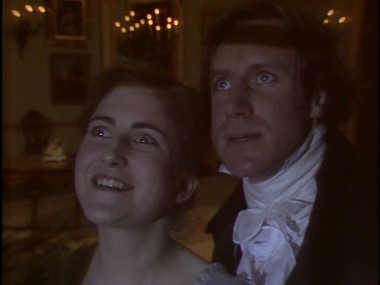
In the 2007 MP Fanny and Edmund star-gaze to get away from the birthday celebration (which like quite a number of the social occasions in the 2005 P&P are events to escape from):

We have no trip to Portsmouth. Instead Fanny eats, dreams, walks in nature, writes (or tries to write, to communicate is difficult, something to be careful about); and Henry finds her at Mansfield. Here is a typical dialogue when Henry comes upon Fanny alone, looking depressed, but holding still and firm, struggling and enduring as the novel says:

Fanny: “You are tired Mr Crawford.”

Henry: “Oh, I have been too much in society …”

Any news from London she says. He replies “none, no excitement [no war, he likes excitement whatever it be and the list is not attractive), but then he condescends to talk of small matters like Maria and Julia “who are tireless followers of fashion,” “even Edmund is at times at Maria’s where you may know my sister is living at present. Mary’s appetite for society remains undimmed.” The implied outlook on this is scathing. But “Tom, on the other hand, is away from all.” Too away but understandably avoiding what Mary’s appetite seeks. He goes on: “Perhaps living there she is no longer alive to its beauty but to me on a day like this it is an uncommon sight.” She replies: “Oh I think so too I can imagine no where lovelier than Mansfield Park.” There is a feeling of menace when Henry asks her to save him from returning to London.

And then after Tom is brought home very ill, and Edmund and Fanny walk and talk,

Fanny to Henry: “You saw Miss Crawford.”

Henry: “Yes, but not once alone. She was in a pack all the time. She danced a great deal. She spoke a great deal but said nothing sensible or even kind. She was I suppose her London self. Like a stranger with whom I had to argue every little point.”

A still from afar:

The key phrase in the film is given to Edmund (Blake Ritson) when Mary reveals to him her mercenary hopes after Tom’s death and her comment society will “forgive” Maria if they accept her and give enough dinners. He is bitter response: “Society will forgive us. What do I care about society? … I’d have lost you a thousand times rather than see you for what you really are.” That too iss an Austen sentiment; it’s Marianne’s reaction over Willoughby

Edmund listening to Mary.

Edmund listening to Mary.

There is nothing more natural about the kind of personality Bille Piper projects (or Frances O’Connor in the 1999 MP) than there is in the kind of personality Sylvestra Le Touzel portrays (1983); that is, the person who is maimed and made nervous and in need of support and cannot endure to assert herself publicly, especially when she is asked to pretend to be someone or something she’s not is NOT UNNATURAL. It’s just as natural to be quiet, a reader, thoughtful, and perceptive and able to see the other side (which Fanny does) as it is to be noisy, active, not thoughtful, stubborn, and aggressive.

By contrast, The 2001 Aristocrats by Stella Tillyard based on Harriet O’Caroll’s screenplay buys into the sweetness of aristocratic life at the time; it celebrates the artifice and luxury as pleasurable (if overdone in the case of Charles James Fox’s childhood — he takes a bath in cream).

Caroline reading.

Aristocrats: Caroline reading.

We might say the animating force of The Aristocrats is the opposite to the animating force of the 2007 Mansfield Park: in the first we are led to value artifice, and much of the aesthetics of the upper class in the eighteenth century; and want to have the sweetness of their life (as by the way we are in the 1983 Mansfield Park, which has Chekhovian scenes):

We see the sweetness of life during this long lingering nuanced conversation.

In the second we are not permitted to see these as enjoyable, but only the bullying stance of those in charge. The 1999 Mansfield Park reveals to us the political outlook of these people (Sir Thomas is a conservative; Mrs Norris a sycophant) and how they prey on the powerless (on the slaves). The key character in the 1999 MP is Mrs Price who cannot escape Mr Price as she tells Fanny when they hear his harsh voice requiring her to join him in bed. She married for love.

She married for love.

She married for love.

Ellen

Additional links to other reviews of Mansfield Park 2007:

Read Full Post »
“But there certainly are not so many men of large fortune in the world as there are pretty women to deserve them.”

Mansfield Park by Jane Austen has always had its admirers. I must admit, I am liking the novel more and more. Seen across the ether, are some interesting sites and posts:

  • Mansfield Park by Chris Dornan is a brand new blog. You might also check out his other blog, Peace and Wisdom, in which he writes about Jane’s novels, politics, and Buddhism. Recently his thoughts have turned mostly to Jane.
  • A Reading of Mansfield Park is a compilation of Ellen Moody’s comments about the novel on two listservs and certainly worth a visit.
  • Pemberley Image Gallery offers two graphics of Mansfield Park for its discussion board. One is rather sedate; the other, which sits on page two, is rather out there. Both images represent how people feel about this novel – either you love it or hate it.
  • I’m a little late reading this review of Mansfield Park 2007 on Flick Filosopher. In it the critic likens Fanny Price to a Mary Sue, and she seems to assume that the the film’s portrayal of Fanny is accurate.

Read Full Post »

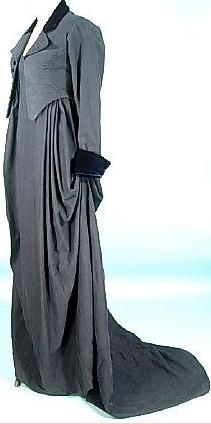
Antiques and Vintage Dress Gallery features beautiful close up photographs of a riding costume designed for Mansfield Park, 1999. “The jumper gown can be worn buttoned up at the sides as you see, or just unbutton to wear straight. The jacket has violet-blue velvet collar, cuffs and buttons”. Francis O’Connor, who played Fanny Price, did not wear this costume. Click on the link to see 15 images of the gown.

Read Full Post »

« Newer Posts - Older Posts »