Feeds:
Posts
Comments

Archive for the ‘Movie review’ Category

In my private library I own many versions of Jane Austen film adaptations, starting with the BBC Jane Austen Collection. Two of the films, Emma and Persuasion, were made in the early seventies, the other four films were produced in the 1980’s. In the space of one decade the changes in sets, costumes, and acting were remarkable. During the 1970’s the actors would rehearse their roles for several weeks before the movie was filmed on video tape, which was grainy. These 70’s costume dramas had an old-fashioned, static and staged feel to them, and from our modern perspective the 70’s hair styles and make-up were glaringly wrong. It was hard to look past the 70’s teased ringlets and see a Regency lady. By the 1980’s, staged sets were beginning to be replaced by outdoor shots and actual interiors. (Persuasion, 1971 showed Anne Elliot in Bath and Lyme Regis, but these were transition shots.)

My (relative) aversion for these earlier staged films explains why I have not seen the 1971 adaptation of Sense and Sensibility. I checked Netflix to see if the film was available for rent, but one has to purchase the film in order to view it, unless a VHS copy is available at a local library. So, when Professor Ellen Moody wrote about Sense and Sensibility 1971, I asked her if I could showcase her thoughts on my blog. Ellen is an authority on Jane Austen and, just as importantly, on the films based on Jane’s novels. Reading her reviews, I am always struck by how Ellen can view these older BBC films dispassionately and compare and contrast the plots against newer, more sophisticated film adaptations and Jane’s novels. She is not put off by dated staging or costumes, and stilted camera shots; instead she hones in on the characters and how faithful they are to a Jane Austen novel. When she read my previous observations, she responded with these words:

The earlier films are worthy — the way earlier famous painting or illustrations or books are. You have to get into the aesthetics of the era, sort of “see through” them to the core experience. We are doing this for Austen when we read her. I’ve even (by dint of rewatching) learnt to accept the extravagant hairdos of these later 60s early 70s films. The 72 Emma does not have them and I’ve noticed the faultline or divider is around 1972. Before that these hairdoes; after that either historically accurate ones or natural (meaning some mildly historized version of contemporary modern) ones.

Marianne and Willoughby (Ciaran Madden and Clive Francis )

Here, then, are Ellen’s thoughts about S&S 71:

I’m now closely watching the 1971 Sense and Sensibility, written by Denis Constanduros, and it has many merits. If faithfulness and originality were really prized, it’d be prized. It’s the most original of the S&S adaptations as it had nothing to build on. One can see that Alexander Baron in his 1981 S&S script used the 1971 outline to some extent, such as having Brandon at the ball/assembly where Marianne is snubbed, a scene also used by Andrew Davies for S&S 2008; and it’s faithful to the original proportions. The climax of Jane Austen’s Sense and Sensibility, Volume I is Lucy telling Elinor her secret and triumphing over her (not the snubbing at the ball, not Willoughby’s departure, and certainly no duel); the climax of Austen’s Volume II is Lucy’s invitation to go live with Fanny Dashwood, which is the result of her encounter with the Dashwoods and Mrs Ferrars at the dinner party where Mrs Ferrars snubs Elinor over her fire screen.

In the book, Willoughby’s desertion of Marianne occurs about half-way through Volume I. Therefore, Volume I climaxes not on Willoughby’s leaving but on Lucy’s revelation she’s engaged to Edward. That’s the deeply painful ending. In the book, Willoughby’s snubbing of Marianne occurs midway in Volume II; the climax of II occurs when Lucy is invited to stay with the Dashwoods in London, after the party where Mrs Ferrars humiliates Elinor. The 71 S&S keeps an equal emphasis on Lucy torturing Elinor and Elinor humiliated at Mrs Ferrars (with Marianne defending her) as it has on Willoughby’s snubbing Marianne. The 95 S&S and 08 S&S lengthen out the stay in Barton cottage and make the London sequence much much shorter; they make the relationships with the women much less emphatic, give it much less time than the relationships of the men and women; the 95 in particular loses the social satire. (I still think it the masterpiece of film art above the others, but it is very different from Austen’s proportions and emphasis.) The 81 keeps the proportions better but downplays the poisonous relationships among the women and social satire.

Of all the S&S film adaptations I’ve watched thus far, the 1971 version does this scene of Mrs Ferrars’s cruelty (even Fanny Dashwood in the book thinks it a bit much) most thoroughly (as it builds Lucy far more thoroughly and keeps Nancy and Lucy’s cruelties to Nancy), and what I want to say is how remarkable it seems to me that it still pains me to go through it. After all these years, I find myself averting my head not to look when Marianne cracks. Elinor has to watch her crack and this is where the gut of the scene lies. The 81 film has this too – to be fair, but the 1981 has not given us the full portrait of Lucy as this one has; the latter film has begun to build up Brandon more and the men.

In the 1971 film adaptation of Sense and Sensibility one can watch a close reenactment of the text in Volume I, Chapter 1. What happens there is Mrs Jennings (a comic character) comes in to tell Marianne and Elinor Dashwood what she has heard from someone about what happened with another group of characters. Those who know the novel will know that Mrs Jennings is told her story by a doctor who was called in to treat Fanny Dashwood after Fanny gets hysterical when she learns from Nancy Steele that her sister Lucy is engaged to Edward Ferrars. Mrs Jennings’ speech is inordinately long and in a paper I published I argued this was once originally a long letter written by Mrs Jennings, a comic one to someone else telling this story. The effect of this is to intersperse what happened dramatically with lots of explicit explanation from Mrs Jennings, some of it comic and incongruous and some of it philistine, but much spot on.
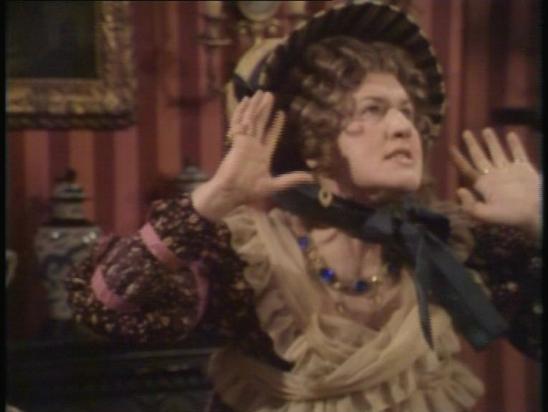
In the book we get another long (unusually long) speech by John Dashwood who comes in to tell the rest. Again I argued this was an epistolary narrative, a letter by Mr Dashwood telling another part of the story — about how Edward was disinherited. The scriptwriter, Constanduros, departs by having Mrs Jennings tell the whole. Mrs Jennings is played by an inimitable comic actress named Patricia Routledge who eventually became a Dame and she is just marvelous in this retelling (which is interrupted by the actress who plays Marianne who interperses with “Madame, how can you …” and “Don’t believe her … Don’t listen to her,” which Mrs Jennings interrupts her flow to object to, “It is true. It is, it is! ……)

In the two other S&S (1981 and 1995) the long monologue is scantier, just a bit given to the actress playing Mrs Jennings (Elizabeth Spriggs in the 1981 adaptation, another marvelous actress, who died in early July (click on link), but short so we can get onto the real business that interests scriptwriter Emma Thomson, which is Elinor’s misery and revelation of deep emotion (same goes for the ’81 film if not acted with the same effectiveness). In a way the recent adaptation by Andrew Davies (S&S 2008 ) is closer to Jane’s script in that he dramatizes the matter in what I think were originally two letters. But by doing this he loses not only the comedy but the explicit statement, the penumbra of nuances and inferences to be drawn and we get a strained melodramatic theatrical scene.

While it may seem crude to a modern audience to have this kind of material presented as comic, it is what is in the original book and I think a chapter which shows just this drive towards explicit
explanation, for in Austen we then get the two sisters talking and Elinor does make explicit how she has suffered for four months and tells all and the drama of withholding makes that long explanation believable.

I submit that the popularity of epistolary narrative in the 18th century is testimony to the drive to make explicit what is implicit, to bring what Carol Shields taught us in _Unless_ is the back story (or explanation into the public gaze where normally all one gets is the front (conventional and often untrue) explanation.

It has been said by some literary scholars of the 18th century (long ago by Irvin Ehrenpries and recently in one of John Richetti’s edited volumes on 18th century history and the 18th century novels) that there is a strong drive to give readers an explicit and full explanation of what’s happening in the novel and the procedures used to present them. It’s my view that the drive to the explicit statement may be part of the impetus which creates the epistolary narrative and makes it so popular in the era.

As a postscript, I’d like to add that in the literary criticism of Sense and Sensibility Marianne is nowadays occasionally called the Cassandra figure of the novel. The use of the term would seem to suggest Christa Wolf’s novel [ Cassandra, a masterpiece in German, later 20th century, 1988] and Wolf’s reading of the meaning of the figure have entered the general conversation of feminism and also literary criticism.

Despite the comedy of the ’71 S&S, the actress who plays Marianne (Ciaran Madden) does enact a Cassandra role. When Elinor is humiliated (as I’ve just described), Marianne comes forward to vigorously protest, point out Mrs Ferrars’s lies and support Elinor’s drawing. Alas, human beings being what they are instead of being grateful, she is seen as a pariah to have shouted out these truths. When in the ’71 film Willoughby tries to brush Marianne off in a famous scene at a ball, he cannot as she will not play the social games he expects her to. In this film he does not exactly snub her but tries to hint at ways she can save face for him and her, and she just won’t.

Click here to read Ellen’s post about the film on her blog, Ellen and Jim Have a Blog Too

Read Full Post »

No, this anime is not Jane Austen’s Emma. This Emma, or a series of Japanese cartoons, depicts the story of a Victorian maid who falls in love with a member of the gentry. These cartoons are subtitled in English, and it is best to view them with the sound turned low. (Unless you understand Japanese!)
As you can see, the drawings are remarkable. Click on the link above to see a YouTube version of the series.

Click here for a review of these animes.

Read Full Post »

It is ironic that a novel filled with clues similar to those found in a good mystery tale can spin off a film whose clues stand out like a red cape in front of a bull. Jane Austen deftly sprinkled hints about Jane Fairfax’s relationship with Frank Churchill throughout Emma. One has to read the novel twice to find her subtle inferences, and even then one might miss a few. The 1996 film version of Emma, written by Andrew Davies, leaves no stone unturned and drops its clues with such a heavy hand that midway through the film you want to shout – “enough!” Jane and Frank exchange frequent glances, are seen at the piano together in Mrs. and Miss Bates’ apartment, and argue on the terrace at Donwell Abbey. We even see Jane crying after their tiff as she walks through a field hatless. Tsk. Tsk. At least Mr. Davies did not sex up this particular film adaptation.

While I like this film overall, and gave it a favorable review when it was shown during PBS’s presentation of The Complete Jane Austen earlier this year, it did have a cringe worthy moment. Mr. Knightley, forcefully played by Mark Strong, proposes to Emma and says afterwards: “I held you in my arms when you were three weeks old”. Kate Beckinsale as Emma replies before they kiss: “Do you like me now as well as you did then?” Eww! The unfortunate image these words evoke are not at all what Jane intended. Here is how her Mr. Knightley proposes, which is just as it ought to be:

“My dearest Emma,” said he, “for dearest you will always be, whatever the event of this hour’s conversation, my dearest, most beloved Emma—tell me at once. Say ‘No,’ if it is to be said.”—She could really say nothing.—”You are silent,” he cried, with great animation; “absolutely silent! at present I ask no more.”

Emma was almost ready to sink under the agitation of this moment. The dread of being awakened from the happiest dream, was perhaps the most prominent feeling.

“I cannot make speeches, Emma:”—he soon resumed; and in a tone of such sincere, decided, intelligible tenderness as was tolerably convincing.—”If I loved you less, I might be able to talk about it more. But you know what I am.—You hear nothing but truth from me.—I have blamed you, and lectured you, and you have borne it as no other woman in England would have borne it.—Bear with the truths I would tell you now, dearest Emma, as well as you have borne with them. The manner, perhaps, may have as little to recommend them. God knows, I have been a very indifferent lover.—But you understand me.—Yes, you see, you understand my feelings—and will return them if you can. At present, I ask only to hear, once to hear your voice.”

Jane DID bring up the differences in ages, but earlier in her novel, when 21-year-old Emma and 37-year-old Mr. Knightley attended a family gathering soon after Mr. & Mrs. John Knightley arrive for a visit. The conversation occurs some time after Mr. Knightley had chastised Emma for influencing Harriet in declining Mr. Martin’s marriage proposal. In this scene, Emma and Mr. Knightley speak as long-standing friends and as relations through marriage:

Emma: “What a comfort it is, that we think alike about our nephews and nieces. As to men and women, our opinions are sometimes very different; but with regard to these children, I observe we never disagree.”

Mr. Knightley: “If you were as much guided by nature in your estimate of men and women, and as little under the power of fancy and whim in your dealings with them, as you are where these children are concerned, we might always think alike.”

Emma: “To be sure—our discordancies must always arise from my being in the wrong.”

Mr. Knightley: “Yes,” said he, smiling—”and reason good. I was sixteen years old when you were born.”

Emma: “A material difference then,” she replied—”and no doubt you were much my superior in judgment at that period of our lives; but does not the lapse of one-and-twenty years bring our understandings a good deal nearer?”

Mr. Knightley: “Yes—a good deal nearer.”

Emma: “But still, not near enough to give me a chance of being right, if we think differently.”

Mr. Knightley: “I have still the advantage of you by sixteen years’ experience, and by not being a pretty young woman and a spoiled child. Come, my dear Emma, let us be friends and say no more about it. Tell your aunt, little Emma, that she ought to set you a better example than to be renewing old grievances, and that if she were not wrong before, she is now.” – Emma, Chapter 7, Volume One

Since watching this film adaptation, I have often wondered why Mr. Davies inserted those words about Emma as a baby into the script at what should have been a supremely romantic moment. Thankfully the Harvest Ball almost made up for his faux pas, almost, but not quite. Although the scene ends the movie on a perfect note, Jane never wrote it for her novel.
Score: Jane Austen, 100; Andrew Davies, Good try.

For more posts about Emma, 1996, click on the links below:

Read Full Post »

Inquiring Readers,

When I read Professor Ellen Moody’s comments regarding Jane Austen Regrets 2007, I realized we were in complete agreement about the movie. She includes historical and literary details that set her essays apart from most movie reviews. Ellen has graciously allowed me to publish her thoughts on this blog.

Dear all,

It’s been asked how accurate is this film as a biography. That’s a hard question to answer because it depends on how you read Austen’s letters; and the letters themselves represent a minority of the letters she wrote and they are censored (clipped, abridged, cut — and we all know how one word left out can make a very great change in tone, not to omit literal meaning).

I rewatched it last night (thanks to my good friend, Judy, who sent me a video of the movie as it played on British TV). Alas, it too seems to be 84 minutes. It’s reported on IMDb that the movie is 90 minutes altogether; since scenes are so short (sometimes lasting 11seconds nowadays) and the camera cuts to and fro from scene to scene, 6 minutes is not nothing to lose (if 6 are indeed lost — bringing up the question which 6 and why were these cut?)

I think the real question is how unhappy was Austen’s life. The film presented her as very unhappy basically, even though she had freedom to write. Olivia Williams did the part with great tact and intuition and irony and made the state much more believable than the shallow imbecility (and glamorized victimhood complete with the crew adoring our heroine at the end) of ‘Becoming Jane’. We should recall first that (as Mary Lefkowitz among others in her lives of the classic poets says), it’s common for popular biography to present the life of a genius in any area as miserable; she suggests this comes out of envy, a desire for compensation (that is, most or many people’s lives are thwarted and unhappy and it makes them feel better to see the genius suffer too, a sense of alienation from someone different) and her classic case is the myths surrounding Euripides and she has a number of modern ones too.

A perceptive article on the recent spate of biopic movies shows that to a movie they all attribute the genius’s insight to loss of love. It must be a love affair that motivates the writing; nothing else will do, and in the case of a woman, she must be helped, inspired by the man she loved. Shakespeare in Love. Moliere. Dear Jane led to write by Tom Lefroy.

This one did show these paradigms in spades. Jane is different and thus alone so must be unhappy. Jane must have been in love and lost and thus we see where she got her stories.

Still I think it better than that; smarter. It seemed to suggest she was unhappy beyond this simply because she was dissatisfied with the choices offered her, whatever these were. She urges Fanny to marry, but she herself won’t take what’s on offer because she doesn’t want it.

It would have been more believable as a real depiction of a real life if there had been less physical beauty all around her, but that’s too much to ask in a heritage film I suppose. And we did get the new poverty: Austen used to be presented as richer than she was; the recent spate of films about her characters show them as much poorer than Austen imagined, and now she has come down to live in a farm-like cottage (below) with Cassandra in barely clean clothes too.

But we do see that her relations with her relatives are less than comforting — too bad they had only the mother; what about the aunt? What about the uncle? And we got only two brothers. Was there some salary limit so the pathology of family life had only minimal representation? (The 07 films have all been very minimalist in budget.) It is true there is strain in the letters from the mother, and from the mother’s leftover writing we see that she was very materialistic.

I’ve thought Austen was not happy in the way that’s common in lives. She had to live on a small allowance; she couldn’t travel about without a man or post (beneath her); the little evidence we have about her family, the manuscript of her leftover chapters of Persuasion and her letters show she was under some pressure to write conventionally (she had thought she was safe over the moral about the mother’s advice in Persuasion but not so, her mother resented the book somehow or other). She had to write for 3 decades before she could get anything in print, and then she wasn’t exactly getting huge sums (but then that was rare). The man who wrote back about Northanger Abbey was very nasty over it: she must give him the 10 pounds before he returns the NA manuscript and if she publishes, he’ll sue. I guess he wasn’t impressed by her connections, wasn’t afraid at all of offending her. Her close woman friend may have betrayed her (by sending the young man she was attracted to away) and then she died early (from a carriage accident); another was a governess in her brother’s house; her sister-in-law and cousin, Eliza, died before her. Her father died leaving her mother and sisters and her without an adequate income. Most of all she died young and in great pain and the sickness was a while coming on.

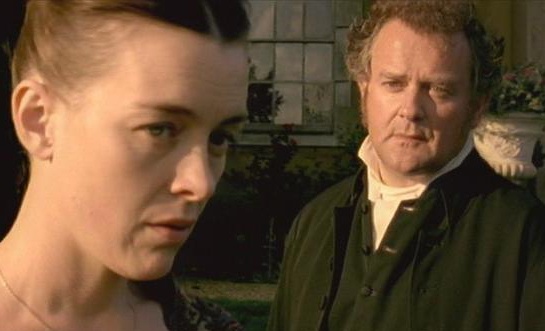
As to the specifics the film made it’s claim for — as I read the letters with common sense — there is no iota of evidence that Austen ever had a deep feeling love affair with any specific man, none whatsoever, and certainly not with Bridges (Hugh Bonneville, left) nor he for her; he did marry and had a passel of children and as far as we know did not go after Austen with his grief from the loss of her. Family members, such as Cassandra, told of a romance around 1802-4 in the west country where the man said he would meet Austen again next year but died. He is strangely omitted from the film — too vague? It does seem Austen had a crush or liking for Tom LeFroy and he for her, but this was easily quashed: he was sent away to make sure he didn’t get any further involved with a girl with no dowry, a fringe person who needed better connections, couldn’t offer them.

James Macavoy as Tom LeFroy and Anne Hathaway as Jane Austen in Becoming Jane

The story of Harris Bigg-Wither was told by someone else, and it does have the ring of truth. None of these three is a deep romance; the two last are anything but. Reading supercarefully I have noticed that in a couple of instances when older Austen was attracted to an amusing or congenial man, like the apothecary. She jokes about the clergyman. But if there was anything serious in it, Cassandra destroyed the evidence, and the tone of the letters is such that lots of people haven’t seen anything in the couple of instances I’ve noticed. One was an apothecary, and to be sure, this writer picked that up.

But to say Austen was deeply regretful at the end of her life that she hadn’t married. Nonsense. Her letters are filled to to the brim with dislike of endless pregnancies. Absolutely typical:

Anna has not a chance of escape; her husband called here the other day, & said she was pretty well but not equal to “so long a walk; she must come in her “Donkey Carriage.”–Poor Animal, she will be worn out before she is thirty.—I am very sorry for her.–Mrs Clement too is in that way again. I am quite tired of so many Children.–Mrs Benn has a 13th… (Jane Austen’s Letters, ed. Le Faye 336, Letter dated Sunday 23- Tuesday 25 March 1817

She preferred to write and to read and had she married it would have been all over for her. She had 3 sisters-in-laws constantly pregnant all of whom died young in childbirth. She writhed under the control of her brothers because she couldn’t travel. The story to be told is of a woman who decided not to marry because in her circumstances, it would have been a slavery forever she couldn’t stand. She regretted not being able to make more money.
She writhed at dying young. She grieved over not being able to finish Persuasion properly.

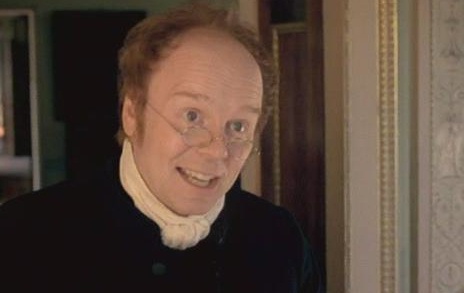
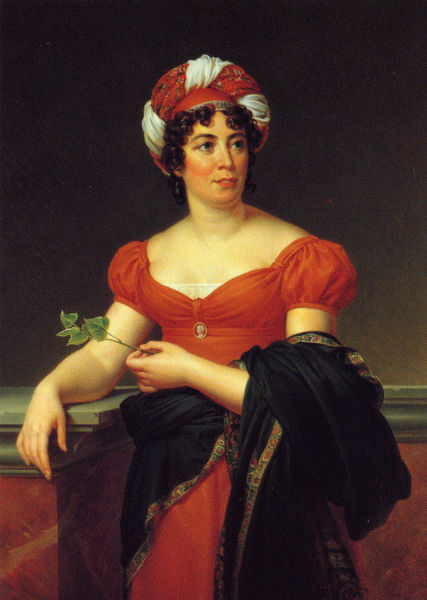
The movie does include the incident with the Regents’ librarian (Jason Watkins as Rev. Clarke at left). We see from her letters she was “taken” up by the Regents’ librarian and show the library. He was a rare literary person she met (if third rate) and he treated her seriously and it was to him she wrote a letter where she expressed some worry that Emma showed she was running out of material in a more sophisticated way than she usually discusses her work. She also makes a striking comment on how court life is a form of slavery she wouldn’t be able to stand. She did make fun of him, but she makes fun of lots of people and sometimes (frequently if we are candid) maliciously. She hardly ever has a good word for a fellow novelist. She was afraid to meet famous novelists in public arenas; she wasn’t used to it and knew she had little to make them respect her in the ordinary wordly way. So she refused an invitation to a party where she would have met Madame de Stael (Wikipedia image at right) even though (a rare instance) she praised Corinne highly (better than Milton she said).

I did like how her friendship for Madame Bigeon was presented, and there was an allusion to Isabelle de Montolieu — the woman who is said to have written Raison et Sentiments. Since I have Montolieu’s text of Caroline de Lichtfield on my site, a biography and her preface to Persuasion the translation, I liked that. But why not Miss Sharpe? Where was Martha who lived with them and married Frank? Where Frank? Who I think Austen did love very much (if only as a sister probably) — at least deeply enough to make the name Frank a repeating one and have Janes fall in love with Frank clandestinely, and have sailors central to her books. Why did we not get Anna? who wrote too. Nor her nephew?

Again why were so many people left out? Maybe to make the interpretation of love as central stick.

I thought as a movie it held together movingly though and was intelligently done. If you know little about Austen’s life, it at least is not complacent like the old 3 part BBC “life and works” type thing, and may just lead the viewer to go back to her letters or find a decent biography.

Ellen

Click here for Ellen’s other posts on this blog:

Click here for Ellen’s blog, Ellen and Jim Have a Blog Too and her main website.

Click here for my review of Miss Austen Regrets

Read Full Post »

Update: Watch Return to Cranford online at this link through February 16, 2010.

The folks at PBS Masterpiece are giving away 20 Cranford novels by Elizabeth Gaskell. For an opportunity to win one of these books, all you need to do is click here and sign up for a free Masterpiece e-newsletter.

Update: In addition, the site is offering a behind the scenes video, as well as streaming videos of Parts One and Two. After Sunday you can view all of Cranford online until May 23rd.

After May 23 you will have to make do with YouTube clips of the movie with foreign subtitles.

Part 3 of Cranford will be shown this Sunday on your local PBS station at 9 pm.

Read Full Post »

« Newer Posts - Older Posts »