Feeds:
Posts
Comments

Archive for the ‘Music popular in Jane Austen’s lifetime’ Category

Interview by Brenda S. Cox

“no one can be really esteemed accomplished [without] a thorough knowledge of music, singing, drawing, dancing, and the modern languages”–Pride and Prejudice

Jane Austen and Company, who have given us many fascinating series of talks, have been focusing on Austen and music this year. We asked Inger Brodey, Eric Bontempo, and Susan Ellen Ford to tell us more about that.

JAW: Thanks for joining us, Inger, Eric, and Susan. I understand that the three of you are directing the Jane Austen & Company program. Jane Austen & Co has been doing a series on Music and the Regency this year. Readers can watch and listen to the recordings here. Can you tell us about that?

Jane Austen & Co. did a series on Music in the Regency during 2025, and you can still enjoy the recordings online for free.

Eric:

Sure! Music making and music appreciation could be complicated—even contested—activities during the late eighteenth and early nineteenth centuries. In 2025, Jane Austen & Co. wanted to look at aspects of public and domestic music in the Regency period, and zero in on Jane Austen’s own musical experience. Back in February, we kicked things off with Jeff Nigro’s talk on “Georgian Fangirls” and the influence that Italian castrati had on Regency Music in England. Then, Gillian Dooley discussed music in Austen’s life and work, including some of what Austen would have played and sang. Kathryn Libin moved our series outward to women and musical education during this period. In April, Laura Klein discussed the evolution of keyboard music during this period and considered the music Austen was practicing when she was writing.

This fall, we’ve added three more events to the series. Lidia Chang from Colorado College gave an insightful talk on “Frivolity, Foppery, and the English Gentleman at Music.” And just two weeks ago, Jeanice Brooks from the University of Southampton delighted us with her talk exploring how music making shaped perceptions of people and lands far beyond the British home. The grand finale of the series came in late November when Penelope Appleyard and Jonathan Delbridge revealed the new song they have commissioned, recorded, and released to celebrate Jane Austen’s 250th Anniversary.

JAW: Tell us a little about one of those recorded events that our readers might enjoy listening to.

Grand finale of Music and the Regency, “A Song for Jane”

Eric: I think our grand finale to “Music and the Regency” is definitely worth watching. The 90-minute episode has a little bit of everything: Penelope Appleyard and Jonathan Delbridge performed live, and you can watch their stunning renditions of songs that Jane Austen loved and copied down in her family’s music books. They performed “Robin Adair” and a “Song for Burns” before delighting us with their recently commissioned setting of Austen’s teenage poem “Ode to Pity.”

In between performances, they walked us through the historical context of these songs, the musical instrument being played by Jonathan, and their connection to Jane Austen and her novels. It was fascinating, and if you watch until the end, you’ll notice that the audience Q&A kept the momentum going!

JAW: What are a few interesting things that you personally have learned from that series?
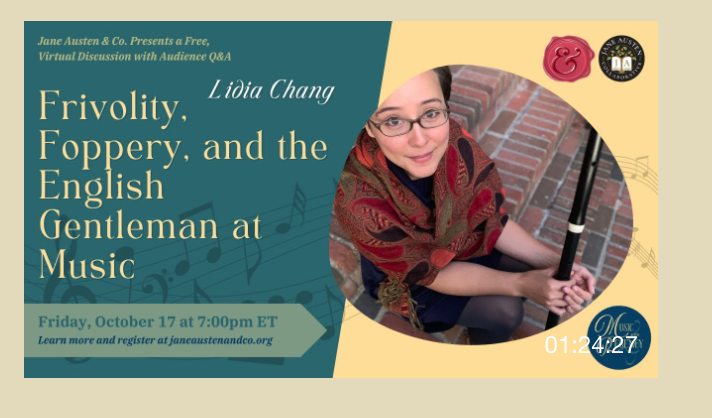
Lidia Chang’s episode on music and gender

Susan: One of my favorite episodes was the interview with Lidia Chang. She taught me a great deal about music and gender. I was interested to hear about how seldom amateur men would perform music, compared to women. She also drew connections to the few examples from the novels where men perform for private audiences.

JAW: What will the next series be?

Susan: Jane Austen & Company is launching a brand new series focusing on Jane Austen’s “Unsung Characters.” We are envisioning a series of presentations that explores Austen’s minor characters and the un-thought-of connections that may tie them together. We will be announcing the list of speakers and presentations soon!

JAW: A few months ago I reviewed your lovely new site, Jane Austen’s Desk. How is that going?
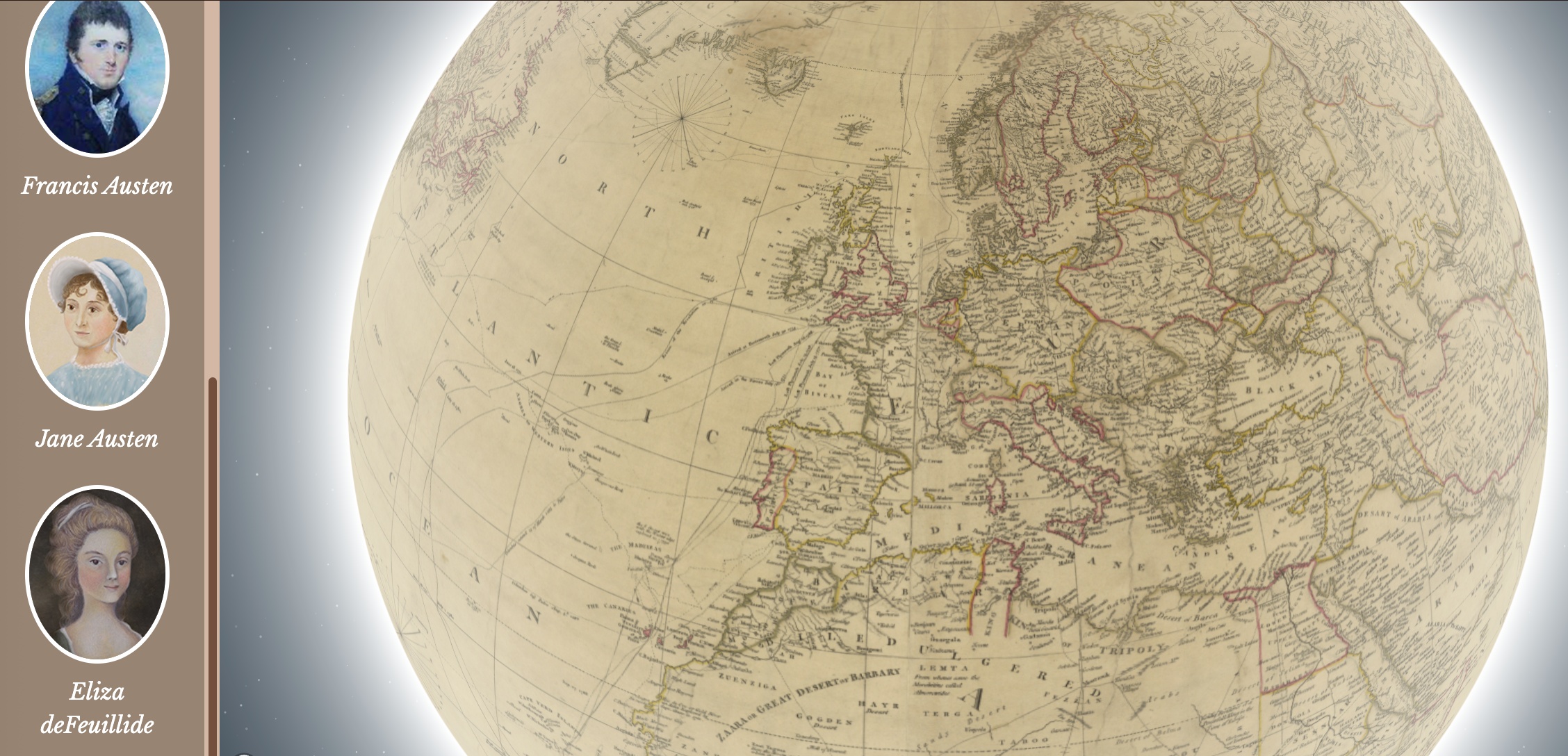
Eliza de Feuillide is now in the travel section of Jane Austen’s Desk.

Inger: Yes, we were very grateful for your review! Since then, we have added a few things to Jane Austen’s Desk. Most importantly, we’ve added a new traveller: Eliza De Feuillide, Austen’s first cousin and sister-in-law. We included a new hand-drawn portrait of her and programmed in most of her travels during Austen’s lifetime. We really wanted another female traveller, along with Fanny Palmer Austen, to indicate what we are calling Austen’s “vicarious travels.”  We are countering the image of Austen living a sheltered existence by showing visual, interactive representations of how much her correspondents travelled, giving her vivid, second-hand experience of diverse regions of the world. 

Susan: In honor of our new holiday campaign to raise funds, we also added some professionally recorded Christmas music, performed by Laura Klein on a period harpsicord, and some holiday greenery.  Have you seen them yet? (You have to ignore, momentarily, the unseasonable weather for March 30.)

Under the painting for travel sits a thus-far mostly silent pianoforte on the website Jane Austen’s Desk. We can participate in bringing it to life!

JAW: I understand you are raising money for adding music to that site. What are you hoping to add? How will that enrich the site?

Inger: Music was key to Jane Austen’s creative process. As you know, in her years at Chawton Cottage, she got up early in the mornings to play her pianoforte and compose her thoughts. This Kickstarter will raise the funds necessary to give tribute to the specific music Austen knew, loved, and transcribed by hand. We will add interactive tools with access to this music to our free website, making it come alive for all kinds of Janeites. The music will be performed by professional performers on historical instruments. We will provide historic illustrations, information about composers and specific pieces, and crisp images of Austen’s own sheet music.

An exciting part of the plan is to link the mentions of music in the novels to recordings by Laura Klein, and vice versa. So when you read about Mary Crawford playing a glee, for example, you can play an example and learn about what glees are. It’s an important dimension of our plan to show how the many different parts of Austen’s lived experience come together in her masterful novels.

JAW: That sounds fantastic, Inger. Why do you need to raise the money with a Kickstarter?

Inger: The design and building of our site has been primarily funded by two “Digital Projects for the Public” grants from the National Endowment for the Humanities. We were hoping for the largest, phase 3 grant in this line, but the whole program has been cancelled at the NEH, so we are forced to look elsewhere for our funding.  What we really need is a patroness! 

JAW: Lady Catherine de Bourgh, take note. Or perhaps someone who has “more true enjoyment of music” than she does, or “better natural taste”! How can our readers contribute, if they wish?

Inger: Our Kickstarter campaign is at: https://www.kickstarter.com/projects/janeaustencoll/adding-music-to-jane-austens-desk. On that site there are also two videos: one about our team that is making Jane Austen’s Desk and the other about the goals of our project. Kickstarter campaigns are all or nothing, so if we don’t meet our target by December 28th, then we don’t receive any of the promised funding! It’s a little nerve-wracking!

JAW: We very much hope you get all your need! Readers and music lovers, here’s an opportunity to contribute. Inger, Eric, and Susan, thanks for all your hard work to make so much great material available to us in such a fun way. (I vote that you do embroidery next 😊, but the music, “a very innocent diversion,” will be delightful!)


Brenda S. Cox is the author of Fashionable Goodness: Christianity in Jane Austen’s England. She also blogs at Faith, Science, Joy, and Jane Austen.
Read Full Post »

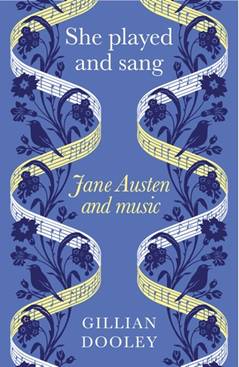
She Played and Sang: Jane Austen and musicThis is the time when new books are published ahead of the spring and summer seasons. One offering from Manchester University Press particularly intrigued me. I also included in this post  my responses to two books I recently purchased in preparation for a post about the Grand Tour.
She Played and Sang: Jane Austen and Music by Gillian Dooley

In March, Manchester University Press will offer a book that features an in depth look at Jane Austen’s lifelong connection to music. I have the honor of reading an advance proof and will review the book this March. The press sheet states:

“Until recently, our knowledge of Austen’s musical inclinations was  limited to the recollections of relatives who were still in their youth when she passed away. But with the digitisation of music books from her immediate family circle, a treasure trove of evidence has  emerged. Delving into these books, alongside letters and other  familial records, She played and sang unveils a previously unknown facet of Austen’s world. 

[Dooley] not only uncovers the music closely associated with Austen, but also unravels  her musical connections with family and friends, revealing the intricate ties between her fiction and  the melodies she performed. With these revelations, Austen’s musical legacy comes to life, granting  us a deeper understanding of her artistic prowess and the influences that shaped her literary  masterpieces.

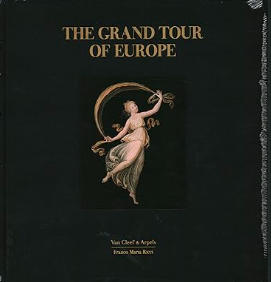
Screen Shot 2024-01-28 at 9.52.53 AMThe Grand Tour of Europe

I recently purchased this lavish book, The Grand Tour of Europe, which sits prominently on my coffee table. 

“The Grand Tour, a journey through Europe aimed at culture and leisure, was a common practice between the 17th century and the first quarter of the 19th century. This book revisits the stages in an itinerary that left profound traces in European culture.”

Published by Van Cleef & Arpels and edited by Franco Maria Ricci, the information is divided into the following lushly illustrated sections:

Chapter I: Three essays 

Fops on Holiday, Nicholas Foulkes

Theatres of Antiquity: Art and Artists During the Grand Tour, Fernando Mazzocca

The Grand Tour of Europe, Attilio Brilli

Chapter II: Myths and Views of Italy

Chapter III: Imagination and the Grand Tour – Sculpture

Chapter IV: Imagination and the Grand Tour – Painting

Chapter V: Travellers and Artists

Note: Chapters II – V include anthologies with reactions from 17th – 19th C. travellers to their experiences. 

For a peek inside the book, click on this link: https://www.francomariaricci.com/en/books/grandtour Publisher ‏ : ‎ Franco Maria Ricci Editore (October 29, 2023), 168 pages, ISBN-13 ‏ : ‎ 979-1280294180

I wanted to connect this beautiful book to Jane Austen’s life, and found the bridge in the following reproduction of Edward Austen Knight’s memories of his own Grand Tour.

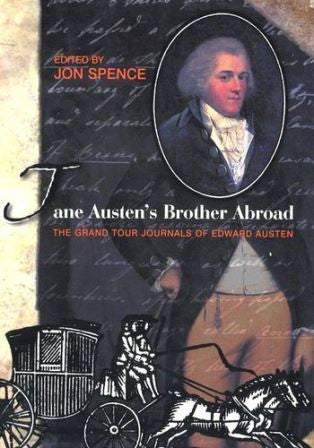
Edward Grand TourJane Austen’s Brother Abroad: The Grand Tour Journals of Edward Austen 
I ordered this book, edited by Jon Spence and first published in 2005, from Jane Austen’s Books. Austen herself, while she mentioned Edward Austen Knight in her surviving letters, provided few personal details about this brother and none about his Grand Tour. Before this book’s publication, we knew very little about his personality or his likes and dislikes, except for a letter from his mother, who compared and contrasted his talents with those of his brother James:

“[He] has a most active mind, a clear head, and a sound judgement, he is quite a man of business. That my dear James was not – Classical Knowledge, Literary Taste and the Power of Elegant Composition possessed in the highest degree; to these Mr Knight makes no pretensions. Both equally good, amiable and sweet-tempered.” – From an introduction in the book by Jon Spence.

In his foreword, Richard Knight, a descendant of Edward Austen Knight and a trustee today of the Chawton House Library writes:

“The publication of Edward’s Grand Tour journals provides another, more personal and intimate memorial to Edward himself. In the journals he speaks to us as he was as a young man: wry, amusing, playful, eager, and interested.”

The latter two books help Austen aficionados understand the scope of these “rites of passage” and educational journeys for the males* of the upper classes and those of the bourgeoisie who had the time and means to leave their home countries for lengthy periods, in some instances for years. Edward’s journal was written from the notes he kept during his travels and the result was meant to be read out loud to his family. 

*Females also embarked on Grand Tours, but not near the numbers of their male counterparts.

Read Full Post »

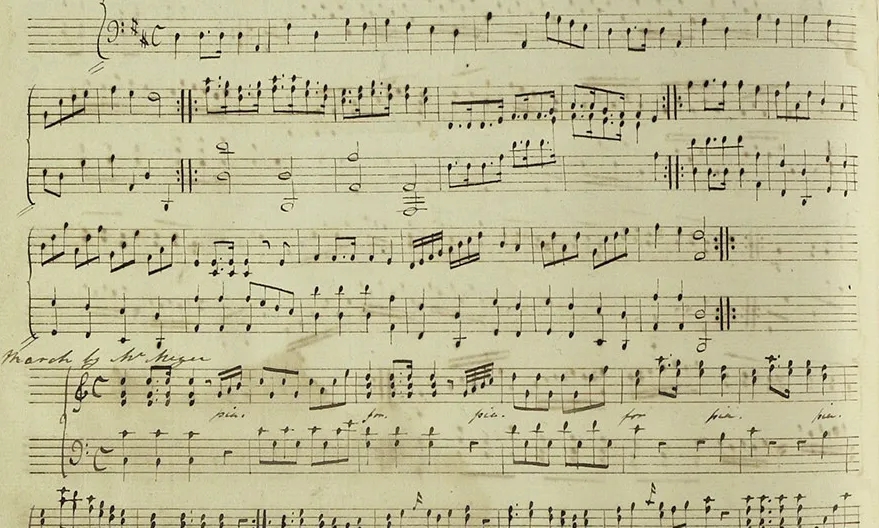
Jane Austen’s relationship with music, especially her private morning sessions on the piano forte before her family arose, was as creatively important to her as her writing. Digitized versions of the Jane Austen Music Books are stored on the Southampton UK website, where scholars, musicians, and Austen fans can peruse the music that the family liked and deemed important.

“The Austen Family Music Books is a collection of 18 albums of music containing around 600 pieces that belonged to the 19th century writer and her relations.”

Yet even with these troves of treasures, modern audiences are left to wonder:

screen_shot_2016-07-15_at_110010_am

This musical score, in Jane Austen’s handwriting, is one of nearly 600 Austen family musical treasures available in an online archive. Jane Austen Museum/Public Domain

“So what kind of music did Jane Austen like to play?

“The line between classical and popular music was very soft in that period,” [Austen scholar Professor Joan] Ray noted. “She lived 1775 to 1817. So she has a lot of popular music but, for example, she had a popular song called ‘William.’ But when music scholars really looked at the 20th and 21st centuries, they discovered it was actually based on Haydn’s Piano Concerto No. 1.”

For as much as Austen loved and collected music, and created characters in her novels who also loved music, she was light on specifics in her novels.” – Discover The Music Jane Austen Loved | Colorado Public Radio

The Colorado Public Radio site provides sample music from movie soundtracks based on Austen’s novels. Interestingly, today’s film composers have only a vague idea of the music Austen specifically liked because of the very few references she made in writing: they had to imagine which music best represented the stories in the time they were written. The 1995 film of Pride and Prejudice used music from Mozart, Haydn, and Schubert: it is still celebrated as one of the best musical scores in an Austen film.

Three Emma film musical scores

The music scorers of following three Emma film adaptations use different approaches to music to tell Austen’s tales of the young, self-important heroine. If you have access to the streaming videos or own the DVDs, you may want to listen to the music and compare how their composers move these plots forward. The scores of each film are suited to the settings and vision of the film director.

  • Emma 1996 with Gwynneth Paltrow: Rachel Portman, the female composer for the musical score, won an academy award.

“One of Rachel’s [Portman’s} most well-known film scores was for Emma (1996). Starring Gwyneth Paltrow, this film is an adaptation of the Jane Austen novel of the same name. A light and playful romantic comedy, the film needed the right music to go with it. As FF2 Contributor Sophia Jin says of Rachel’s score for Emma, “Portman’s music feels joyful and lighthearted. It is warming and brings a sense of calm and peace to the picture.” Rachel won an Academy Award for Best Musical or Comedy Score for Emma, making her the first female composer to win an Academy Award in that category.” – Composer Rachel Portman is a Mastermind of Movie Music, International Swans

YouTube video of 3 musical themes from Emma 1996

  • Emma 2009, with Romola Garai took an earthier musical approach. In this film adaptation, Highbury was depicted as a relatively unsophisticated country town outside of London. Emma danced to rustic music that could easily be played by local musicians. The costumes also had a more earthy, homemade feel.  

Emma 2009: 4 musical themes from the film – YouTube video

  • Emma 2020 mixes folksongs that were popular during Austen’s era, with classical, and modern compositions.

The score fits the beautiful, elegant vision of director Autumn de Wilde, who had only directed music videos before tackling a full length feature film.

As with today’s musical tastes, in Austen’s day the line between classical and popular music was ever shifting. She copied the music of “La Marseillaise”, the French National Anthem, and contemporary tunes and folk music that were popular in her day. The Family Music Books show the family’s preferences, but few references were made in Austen’s letters to the music she practiced daily. In her writings, she mentioned only one classical composer – Johann Baptise Cramer.  The following YouTube video features his Piano Concerto No 5 in C Minor, Opus 48.

Cramer was credited with renaming Beethoven’s final piano concerto the “Emperor”. Beethoven began composing this Concerto in 1809, while Vienna was under invasion from Napoleon’s forces for the second time.

No documentation exists that Austen heard this concerto in person. After moving to Chawton, Austen visited her brother Henry frequently in London to work on the publication of her novels. Before this period she lived in Bath after her father retired from his living in Steventon. In both cities she regularly attended recitals and concerts, and likely had a more sophisticated exposure to contemporary music, especially to the works that arrived in major cities from the European composers. 

Screen Shot 2023-09-30 at 1.47.14 PM

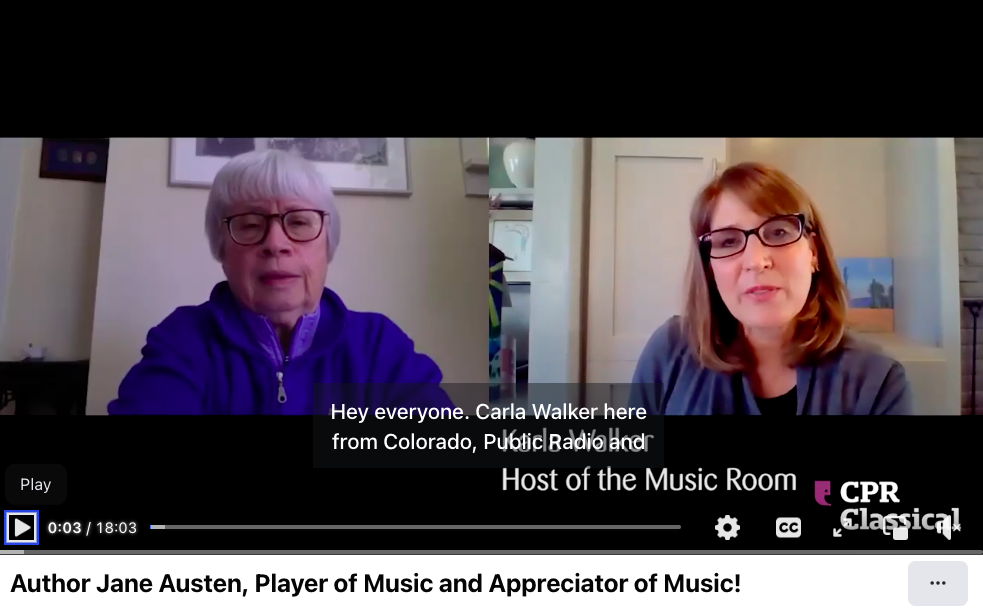
Screen shot of Joan Ray’s talk with Carla Walker, host of the Music Room, CPR Classical, Public Radio

Listen to the full discussion at this CPR https://fb.watch/no42mQ7gfS/  Video

The clue to Austen’s love for music was in her daily practice at the piano forte. Her novels also provided clues. Any young lady in her novels who lived in the upper strata of society learned to play the piano forte and/or harp and could give concerts at home events. As for Austen, her morning practices were private. She did not provide entertainment for others in a public situation as some films have suggested. Instead, Austen took quiet comfort and inspiration from her morning musicals. They added as much to her creativity as her writings.

More background information and suggested readings:

Read Full Post »