Feeds:
Posts
Comments

Archive for the ‘Popular culture’ Category

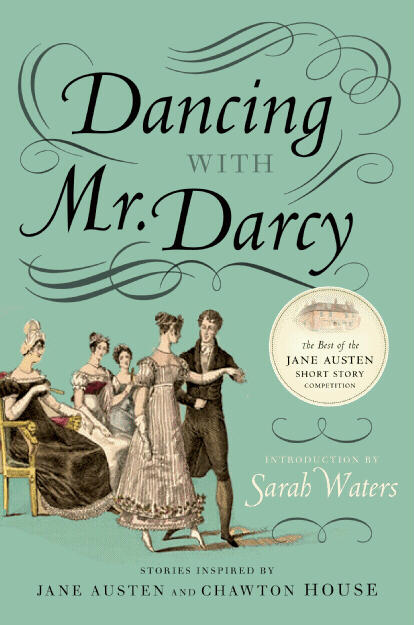
Elated readers: You have a chance of winning one of three copies of Dancing With Mr. Darcy: Stories Inspired by Jane Austen and Chawton House Library, and compiled by Sarah Waters. The book will be available in your local bookstore on October 19th!

For a chance to win, just leave your comment. Please address this topic: What kind of story about Jane Austen or her characters would you be interested in reading?

Contest ends October 20th. Names will be drawn through a random number generator.

So sorry: Only those who live in the U.S. or Canada are eligible to win. THANK YOU for participating. Contest is closed.

Read Full Post »

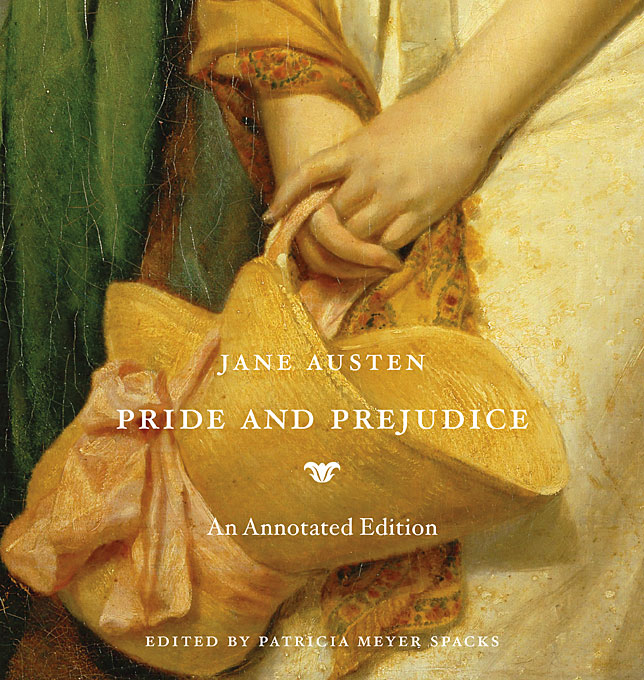
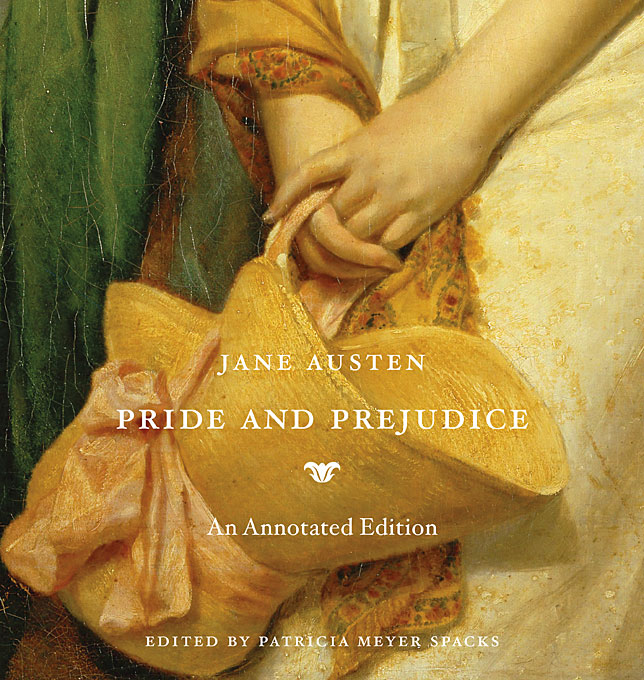
Jane Austen scholar Patricia Meyer Spacks has written many books, but none so lush and lovely as Pride and Prejudice: An Annotated Edition. Not only will this beautiful annotated edition of Jane Austen’s beloved novel look fabulous on your coffee table, but after reading it you will feel that you’ve come to understand Pride and Prejudice as you never have before.

Dr. Spacks’s definitions, descriptions, and clarifications of arcane words, Regency customs, and obscure passages add dimension to a novel that I have read over 22 times and thought I knew inside and out. But I was wrong. Take her annotation of this rather unassuming sentence in Chapter 4, for example:

With no greater events than these in the Longbourn family, and otherwise diversified by little beyond the walks to Meryton, sometimes dirty and sometimes cold, did January and February pass away.”

Dr. Spacks explains that in this instance, dirty meant muddy. Thinking of how uneventful life in a semi-rural setting must be, she adds, “Aside from the arrival of the militia and of Wickham, virtually everything of significance that has happened in the novel so far has been psychological…” She then goes on to describe the states of mind in Jane, Elizabeth, Darcy and Mr. Collins as they interact with each other.

In Chapter 2, Volume III, she introduces Michael Kramp’s idea that Mr. Darcy’s kindness to Mrs. Gardiner during Elizabeth’s and the Gardiners visit to Pemberly is evidence of the changing nature of England’s social arrangements and that “the gap between new and old money is shrinking.” (p. 307)

Dr. Spacks’s new annotated edition provides an erudite commentary on Pride and Prejudice, refers to many scholarly sources, and includes a large assortment of images. As she explained in a recent interview with me: “we looked for images that were beautiful in themselves and that illuminated some aspect of Austen’s period.”

Her 24-page introduction explores the continuing appeal of Pride and Prejudice: that it is considered safe for teaching in school and appeals to both feminists and sentimental individuals who are attracted to a romantic English past.

It has also emerged clearly as a repository for and stimulus of fantasy, and thus possibly less safe than it seems. In the film versions…Darcy, romanticized, tends to turn into a Heathcliff figure, passionate, beautiful, and overwhelmingly physical.”

A visitor to this blog recently asked how this annotation of Pride and Prejudice differed from David M. Shapard’s 2004 annotation. The Spacks volume comes in a lavishly color-illustrated, hardback edition, while Shapard’s book was published as a trade paperback. Scattered thinly throughout its pages are a few black and white illustrations. Aside from the difference in physical appearance, Spacks’s annotations are more scholarly.

Flipping through the first page of the novel, you can immediately spot the difference between the two approaches. Dr. Spacks, the Edgar F. Shannon Professor of English, Emerita at the University of Virginia, discusses the famous first sentence as material for a critical debate on the ambiguity of “want”, whereas Dr. Shapard, an 18th century expert, emphasizes the introduction of two central themes of the novel – marriage and financial considerations. These two annotations are so different, that I believe there is room on the shelves for both of them.

Jane Austen Pride and Prejudice: An Annotated Edition, edited by Patricia Meyer Spacks is a perfect gift for oneself and for a beloved friend or family member. If the $35 purchase price is a bit steep in this economic downturn, place it on your Holiday gift wish list. You will not be disappointed when you unwrap your package.

Read Full Post »

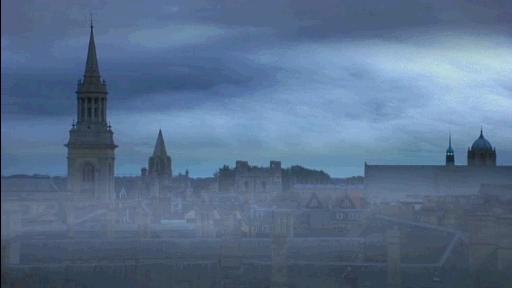
Oxford, Halloween night and under a full moon

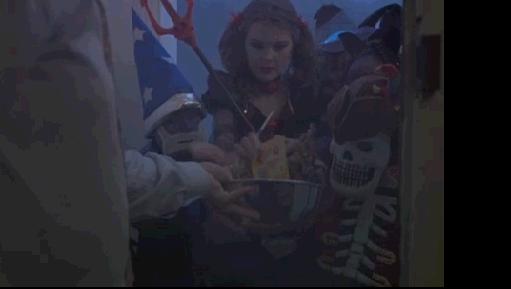
Falling Darkness, the final episode of season 3 of Inspector Lewis on PBS Masterpiece Mystery! begins on Halloween Eve, a night when the moon is full and young goblins go from house to house trick or treating.

Tiny hobgoblins trick or treating at Lewis's door

The viewer is witness to Inspector Lewis’s playful reaction as children in costume arrive at his doorstep. But all too soon Hathaway appears at his doorstep to halt all the fun and announce a murder.

Lewis greeting Hathaway

The victim, Ligeia Willard, is found with a stake through her heart and garlic in her mouth. Could it be witchcraft? Or revenge? for Dr. Willard is a renowned scientist at a stem cell research institute and “not overly popular with the spiritually certain.”

The stem cell research institute was being picketed. Could a protester have killed Dr. Willard?

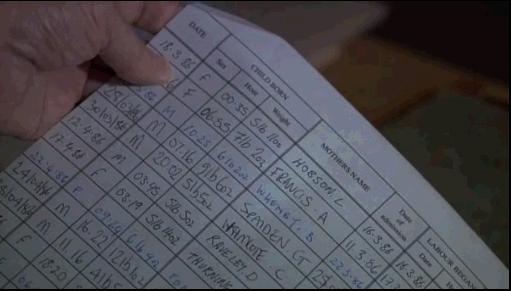
Dr. Willard, as it turns out, was also Laura Hobson’s good friend and college house mate years ago. They shared their house with another friend, Ellen, and two male friends, Alec and Peter.

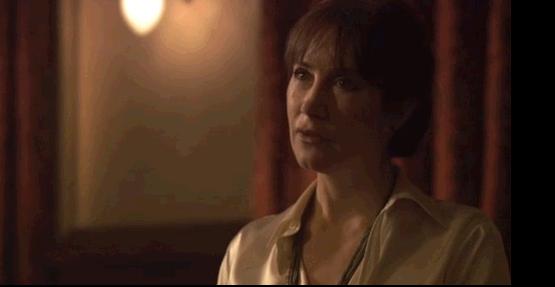
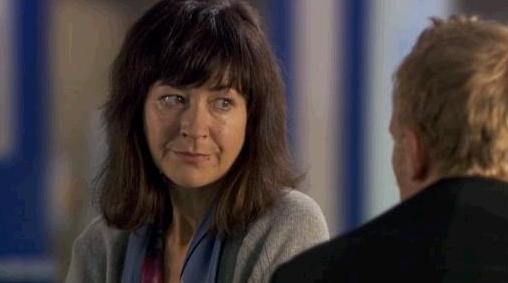
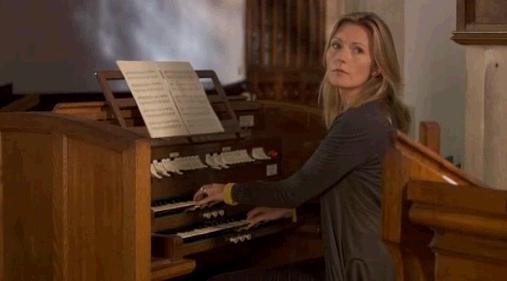
Dr. Laura Hobson (Clare Holman) at home, dealing with her friend's death

Griefstricken over her friend’s death, Laura removes herself from the investigation. When another murder of a young woman, Rowena, occurs in that same house, the string of clues lead to Laura as the main suspect.

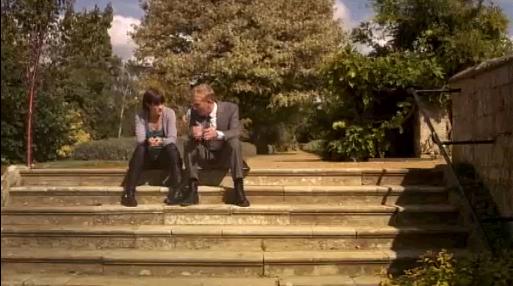
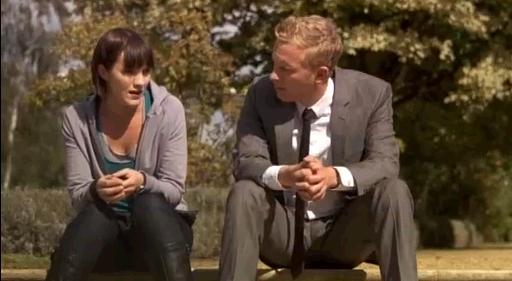
Rupert Graves as Alec Pickman, one of Laura's former housemate

The plot of Falling Darkness revolves around Laura Hobson and events in her past that might solve the mystery. This is an unwelcome development for Inspector Lewis, who must follow correct investigative procedure and check out Laura’s alibis.

Hathaway (Laurence Fox) follows the clues.

The incomparable Rupert Graves, whose portrayal of Freddie in A Room With a View I shall never forget, makes an appearance as Alec Pickman, a hopeless alcoholic, former lothario, and one of the men who shared the house with Laura and her friends.

Ursula Van Tessel, psychic, assures Lewis that "She didn't suffer," causing him to wince

In this plot we learn more about Laura’s past as Hathaway and Lewis work furiously to solve the murders and clear her name. On a personal level, season III ended strongly with this episode, for Lewis and Laura have developed their relationship to the point where they can hold hands in public, but I did not feel that all the ends had been neatly tied and addressed, such as the reason Rowena was murdered. Neglecting such a detial is bad murder mystery form.

The clues keep leading to Laura

I will miss Lewis and Hathaway and the setting of Oxford tremendously, but with Wallander slated to air next week, I will be amply compensated for their absence.

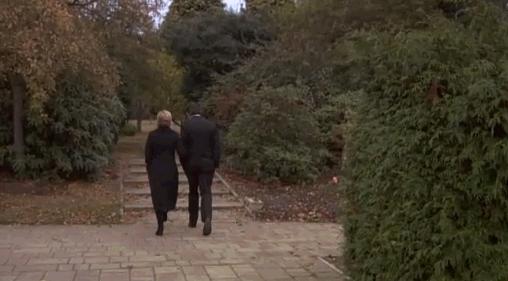
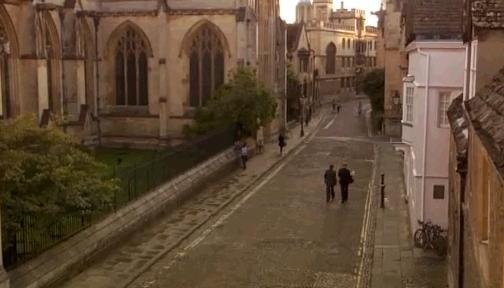
Lewis and Hathaway walk through Oxford

Watch Falling Darkness online at this link for two weeks starting Monday, September 28th, through October 26th, 2010.

Laura thanks Lewis for his help

Last episode of the season, and until next year, The End

Read Full Post »

Dr. Patricia Meyer Spacks

Inquiring Reader: This interview is with Patricia Meyer Spacks, the editor of Pride and Prejudice: An Annotated Edition. Dr. Spacks, the Edgar F. Shannon Professor of English at the University of Virginia, has written a number of books, including ”The Adolescent Idea,” ”The Female Imagination,” “Desire and Truth: Functions of Plot in Eighteenth-Century English Novels,” “Reading Eighteenth-Century Poetry (Blackwell Reading Poetry),” “The female imagination,” and various studies of 18th-century literature. Her most recent undertaking, the annotation of Jane Austen’s most beloved and popular novel, resulted in a beautiful and elucidative book. I know that Jane Austen lovers will find this illustrated volume a useful and informative addition to their book collection.

How old were you when you first read Jane Austen and which book was it? Were you instantly taken by her writing, or did you develop an appreciation for her over time? Why?

I was probably ten or eleven years old when I first read Pride and Prejudice. I wish I remembered what I saw in it then; I’ve often had the same wondering about college students of mine who read the book early, because now it and the rest of Austen’s novels seem to me very much books intended for grown-ups. For some reason, though–perhaps because of its plot’s resemblance to those of familiar fairy tales–I loved P and P on first reading and read it several times more before ever studying it. As for “develop[ing] an appreciation”: one of the wonderful things about Austen (and other great writers) is that you can appreciate her novels in different ways over time and develop gradually wider areas of appreciation. This is one reason, I think, why many people frequently reread Austen, even as often as every year. Like many others, I have appreciated her for different reasons as I keep rereading her novels.

Image in the book: Carlton House, Blue Velvet Room, Charles Wild, 1816. From the Royal Collection*

How did you come up with the idea of writing this book? What were some of the challenges in researching the information?

The book wasn’t my idea. John Kulka, who became my editor at Harvard University Press, came up with the idea and persuaded me to execute it. That indeed took some persuasion, because I was engrossed with another project at the time he proposed it, but I finally agreed because I had read the novel probably 40 or 50 times; had taught it to college freshmen, sophomores, juniors, seniors, and graduate students, as well as one faculty seminar; and thought I could pretty much annotate it out of my head. Big mistake! I learned a great deal in the course of annotating it, but I don’t recall any particular challenges. Every time I decided that something needed annotating, I had no difficulty finding the information I needed.

I am curious how you decided which sections of Pride and Prejudice required annotation, and how much explanation a term or concept needed. Also, how did you decide on which images to include?

As I said earlier, I’ve taught Pride and Prejudice many times; therefore I had a good idea what words were likely to cause students difficulty. So I started there, annotating language, with special attention to words that we still use but that meant something different in Austen’s time. Beyond that, it was just a matter of paying attention to the text and of thinking about how Austen’s knowledge and assumptions differed from our own. Sometimes one thing led to another. For example, I started wondering why the novel specified Brighton as the place where the militia were stationed. I read a book on eighteenth-century Brighton and learned that because of the nature of the harbor, that was the locale thought the most likely for invasion from France. That made me think about the Napoleonic Wars, which Austen is thought to have ignored, and I was able to discover and annotate a number of references to war that it’s easy to miss.

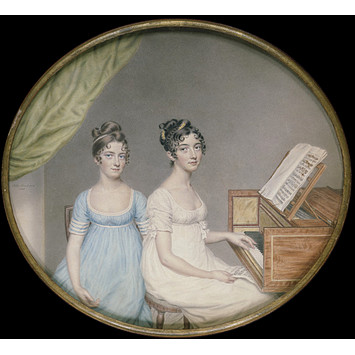
One of the images in the book: Miss Harriet and Miss Elizabeth Binney, by John Smart. Image from V&A Collection.**

In this kind of book, though, it’s not always a matter of how much explanation is “needed.” I had plenty of room to annotate whenever I thought of something about the text that struck me as interesting, and room to include quotations from other critics that suggested points of view different from my own. Many of the notes suggest connections between Pride and Prejudice and other works of Austen, including her letters.

About the images: John Kulka, my wonderful editor, found most of them. I came across some in my own reading. For instance, in establishing a text I used a first edition of Pride and Prejudice in the Houghton Library at Harvard. The books–the novel was in three volumes–had belonged to Amy Lowell and contained her bookplate. Moreover, they originally belonged to a circulating library and had the original wrappers, specifying the fees for different levels of borrowing and the rules of the establishment. I very much wanted images of the cover, the bookplate, and the text—and they’re in my book. As with the notes, necessity didn’t govern the choices: we looked for images that were beautiful in themselves and that illuminated some aspect of Austen’s period.

What were some of your favorite sources for information and where or how did you access them? Which of them do you think a serious Janeite should absolutely have in her library collection?

I used the internet, the Harvard University libraries, and my personal library as sources. The only “favorite” source I can think of is the OED, the Oxford English Dictionary, which was indispensable–and I suppose I think it’s indispensable for any serious student of any literature from the past. It’s available on line now, and the on line edition is both more flexible and more up-to-date than the printed one. Otherwise, I used many many different sources, and I can’t think of any that I think Janeites MUST have.

Which author/s among Jane Austen’s contemporaries do you think exerted the most influence on her while she was writing First Impressions/Pride and Prejudice?

Maria Edgeworth, Austen’s contemporary, and Frances Burney, her predecessor. Pride and Prejudice contains some apparent allusions to Burney’s novel, Evelina, and the title itself may come from Burney’s second novel, Cecilia. Austen praises Edgeworth in her letters, and although Pride and Prejudice doesn’t directly allude to any Edgeworth novel, it takes up some of the issues that interested Edgeworth.

Thank you so much for your illuminating thoughts, and good luck with the book!

Additional links for this post:

*Carlton House Blue Velvet Room – Royal Collection

**Victoria and Albert Collection: Miss Harriet and Miss Elizabeth Binney

Read Full Post »
Oxford University's campus is strangely empty in Your Sudden Death Question

The fourth installment of Inspector Lewis, Season III, starts off with an August Bank Holiday that has emptied Oxford University of professors, students and all but a handful of staff. A small group is assembling for a Bank Holiday Quizaholic Weekend.

Marcus Richards (Alan Davies) the quiz master

The members of the group introduce themselves in teams, including Ethan Croft, an obnoxious, boozing primary school teacher, whose once promising career as a linguist at Oxford U. was derailed by a sex scandal.

Nicholas Farrell and Timothy West play two Oxford professors on the Grey Guardian team

The teams include two older Oxford academics, two students, two young mothers, soldiers, and lawyers.

Alfie Wilkinson( Jack Fox) and Ava Taylor (Tabitha Wady) compete on Team "Toxic Debt"

The cash prize for winning the Quiz is £5,000 lbs, but before the first round even gets under way, Mr. Croft is found floating face down in an ornamental fountain. Lewis and Hathaway interview Jean Croft, the dead man’s stunned widow. She confesses to wanting to kill him for his infidelities. The viewer quickly eliminates her as a suspect, as do Lewis and Hathaway.

Susannah Doyle plays Jean Croft, grieving widow

They mull over the situation a bit more. Was the murder a crime of passion?

Pondering the murder suspects

Ethan’s old flame, Robyn, appeared at the event with her friend, Eve Rigby (Sally Bretton). Ethan is instantly smitten with Eve, and hardly gives Robyn a glance. Robyn realizes that he does not recall their relationship, when she was 14 to his 16. Later she appears to be angry. Could she have killed Ethan out of  jealous rage?

Could Robyn Strong (Ruth Gemmel), a lonely single mother, have killed the victim out of jealousy and passion?

Then Eve is killed, and Hathaway and Lewis must deal with a second body. They are convinced that the two murders are somehow connected. Could the two soldiers, British Army Lieutenant Diane Baxter and Color Sergeant Brian Kaye, have killed the victims on behalf of the government.

Diane Baxter makes an important admission.

As Lewis and Hathaway find out more about a secret project that Croft was involved with, it would not be out of line to suspect the soldiers of killing him on behalf of the Government.

Lewis informs the assembled suspects that they cannot leave until the murder is solved

Professor Milner’s young wife had the affair with Croft, which ended his career at Oxford.

Could Gwen Milner (Helen Grace) have a reason for murdering Croft?

As they wait for Hathaway and Lewis to solve the murders, the teams are allowed to compete in the Quiz game.

Sebastian Anderson (Alastair Mackenzie) and Jessica Neil (Emma Cleasby) are stuck on campus until the mystery is solved.

Different possibilities present themselves, including the Quiz organizer whose shady business practices might have been uncovered by Croft. Or was the mysterious project that he was working on as a linguist responsible for his death?

Lewis and Hathaway go over the clues.

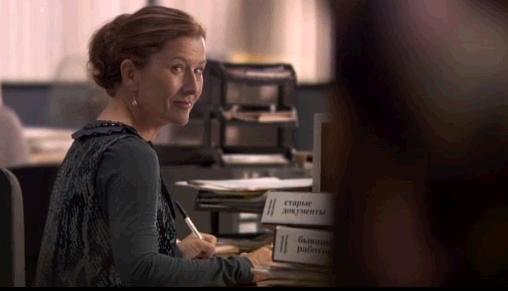
A translator is enlisted to read Croft's foreign language documents.

One by one, the clues tumble into place and before the 90 minutes are up, Lewis and Hathaway have solved the murders and the quiz contestants can go home – all save the killer.

Spoiler Alert!:

I loved this episode for the continued deepening of the relationship between Lewis and Dr. Laura Hobson, and Lewis and Hathaway. Their personal back stories are revealed slowly, like peeling the layers of an onion one story at a time.

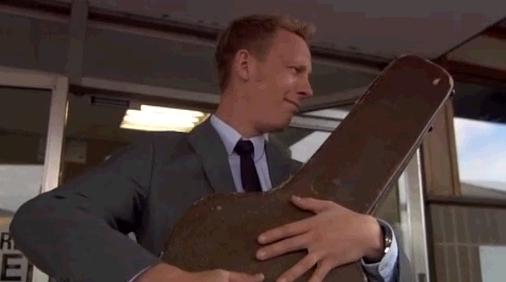
Hathaway retrieves his lovely guitar with the aid of Lewis.

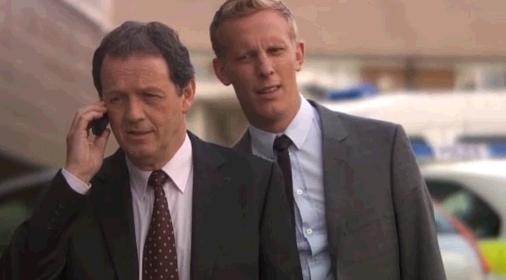
Hathaway eavesdrops as Lewis calls Laura Hobson.

Dr. Laura Hobson (Clare Holman) understands loneliness every bit as well as Lewis.

The mystery of Your Sudden Death Question was splendid, and this time around I did not solve the murder until the end. I give this episode of Inspector Lewis, written by Alan Plater, three out of three Regency fans! You can watch the episode online at this link from Monday, September 20 to October 19, 2010.

Inspector Lewis, Season III

Read Full Post »

« Newer Posts - Older Posts »