Feeds:
Posts
Comments

Archive for the ‘Regency Life’ Category

The Prince Regent – “Prinny” – made no secret of his reluctance to marry Princess Caroline of Brunswick. Some years before he had secretly married Mrs. Maria Fitzherbert, a Catholic widow and the woman he loved. But according to the Royal Marriage Act their union was illegal. Princess Caroline, the daughter of Prinny’s eldest aunt AND a Protestant, was considered a more suitable consort by King George III. This proposed union with his cousin went much against the Prince’s  wishes, and when he met the 27-year-old German Princess in 1795, he turned to Lord Malmesbury and said, “Harris, I am not well. Pray, get me a glass of brandy.”
The Prince of Wales had acquiesced to his father’s wishes only to clear his debts, which totaled £630,000 pounds, a staggering sum for that era, and for an increase in his yearly allowance. Although Prinny’s first impression of Caroline was unfavorable, she was thought to be quite pretty in her youth. The Prince, who was soft and fat,  made an equally distasteful first impression on the Princess, and thus the couple, both spoiled and eccentric (to put it mildly) were off to a bad start. During the ceremony Prinny continually looked at his mistress, Lady Jersey, instead of his wife, and at one point the King had to persuade the Prince to finish the ceremony.

The marriage ceremony proceeded as arranged, attended by his well pleased father, on the evening of 8th April, 1795 at the Chapel Royal at St. James’ Palace. The bride wore a elaborate dress of silver tissue and lace and a velvet robe lined with ermine. The distraught bridegroom spent his wedding night lying on the bedroom floor by the fireplace in a drunken stupor.

Prinny and his German bride (Image from the Georgian Index)

Although he was repelled by his wife, George eventually did his duty and brought himself to consummate the marriage and the Princess of Wales gave birth to a daughter and heir to the throne, Princess Charlotte, on 7th January, 1796.”  – English monarchs

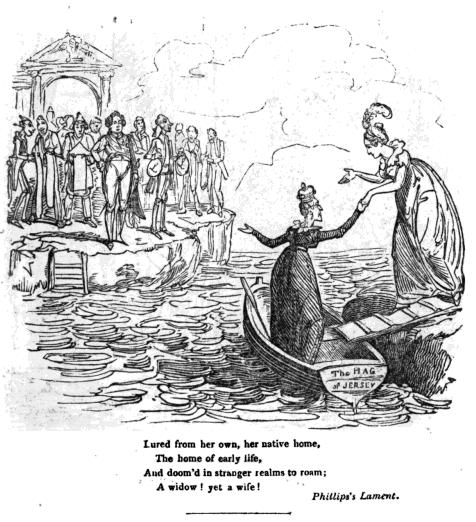
Although not entirely unattractive, Princess Caroline was neither graceful nor elegant, nor did she behave in a regal fashion. Her “clumsy deportment and jerky movements made one MP liken her to a “Fanny Royds” (a weighted Dutch doll with red cheeks that jumps up to standing position)” – Historicizing Romantic Sexuality. Her German manners and demeanor never quite came up to English royal expectations or their level of “sophistication.” Lady Jersey, the Prince’s mistress at the time, was cruel enough to wear a pair of pearl bracelets in front of Caroline that the Prince had originally presented to his bride as a wedding gift. He then took the jewelry back and gave the bracelets to Lady Jersey. The cartoon in the first image, which is sympathetic towards Caroline’s marital situation, shows Lady Jersey as an old hag welcoming a virginal Caroline to England.
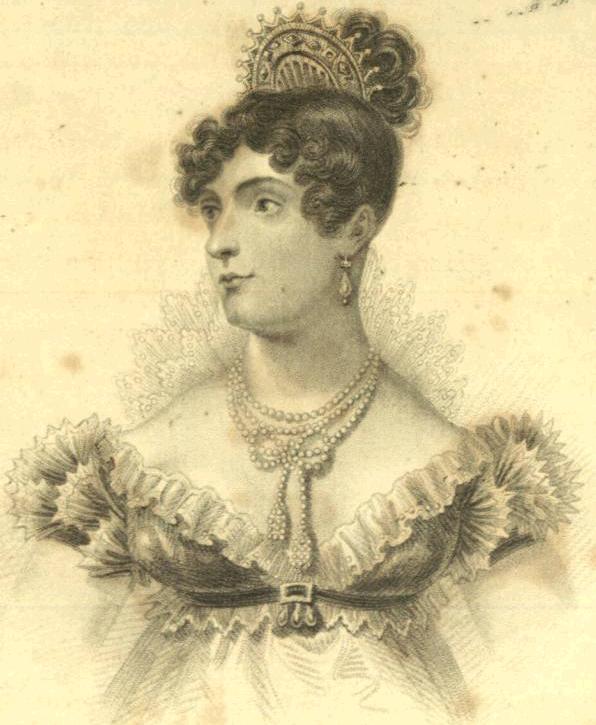
Caroline, Princess of Wales (Image from LIFE)

In her youth Caroline could look quite presentable. A contemporary described her as being

… above the middle height, extremely spread for her age, her bosom full but finely shaped, her shoulders large, and her whole person voluptuous, but of a nature to become soon spoiled; and without much care and exercise she will shortly lose all beauty in fat and clumsiness. Her skin is white but not a transparent white. There is little or no shade in her face, but her features are very fine. Their expression like that of her general demeanour is noble. Her feet are rather small, and her hands and arms are finely moulded She has a hesitation in her speech amounting almost to a stammer … – Memoirs of the Court of England During the Regency (1811-1820)

Observers did agree on several aspects about Caroline: her manners could be coarse and gruff, and her taste in dress was atrocious. Mary Berry described the princess in her journal: “Such an over-dressed, bare-bosomed, painted eye-browed figure one never saw”.  She flouted convention,  “even if this meant exposing her decidedly lustful nature”; this rebellious streak, accompanied by her “outlandish ways and bizarre dress sense” combined to give Caroline an eccentricity not becoming in a female member of the British court, let alone its royal family.” – Elizabeth Fay, Historicizing Romantic Sexuality. As Caroline aged, her penchant for wearing virginal gowns made her look ridiculous and she became a target for satirists, as in the image below.

Caroline tended to dress too youthfully for her age and often cut a ridiculous figure in public.

Caroline, who flaunted her unconventional and ribald tastes, surrounded herself with people of questionable morality.

The Princess evidently preferred gay company, a certain sprinkling of intelligence with a good flow of animal spirits being the ordinary passports to her society. No questions appear to have been asked of either sex; it is therefore not surprising that several of the favoured circle were celebrated more or less for their independence of moral obligations.” – Memoirs of the Court of England During the Regency (1811-1820)

The Duke of Buckingham and Chandos observed of her childhood: “Her faults have evidently never been checked nor her virtues fostered.” The Princess remained capricious and lewd all her life, and her risque conversations kept her attendants  in daily dread of her impetuous pronouncements.

Portrait of Caroline by Thomas Lawrence

Caroline was  –  in her husband’s eyes – expendable. He thought her an unfit wife and mother and permitted her to see her daughter Princess Charlotte only once a week. Prinny’s reluctance to live with his wife and daughter, his politics, and his profligate ways made him unpopular with the public. Princess Caroline made the most of this situation, publicly playing the role of victim, even though by contemporary accounts she did not demonstrate much affection for her daughter. The Queen’s Matrimonial Ladder, published in 1820, demonstrates how sympathetic many were to her plight as the Prince Regent’s ostracized wife. Jane Austen famously wrote:  “Poor woman, I shall support her as long as I can, because she is a Woman and because I hate her Husband.”

Sartiric Cartoon: Princess Caroline shows up at the King's Theatre during the performance of Don Giovanni, reminding the Prince that he is married

Banned from the social gatherings at the Prince’s lodgings and at Carlton House, Caroline established a rival court at Kensington Palace and Blackheath. The strange marriage between this eccentric couple provided an endless source for gossip, for Caroline’s indiscretions (as well as Prinny’s)  were public knowledge:

… her Royal Highness had associates of an infinitely lower grade to whom she often devoted herself with an abandonment of self respect that equally perplexed and disgusted the ladies of her suite.  With such a Court, as may be imagined, the pursuits of the Princess were not remarkable for dignity were often remarkable for its violation.” – Memoirs of the Court of England During the Regency (1811-1820)

In 1814, Caroline moved to Europe, traveling to Germany and Switzerland, and living for some time in Italy.  The Prince sent agents to spy on her in order to prove not only her unfitness as mother and wife, but the burden she placed on the privy purse as well. Her every movement was reported back to England. And there was much to report, for her randy behavior was shocking, so much so that the members of her English entourage left her one by one. She dyed her blond hair black, favored short, diaphanous dresses that were designed for women half her age (she was in her forties), bared her bosom and arms, and danced and partied until the wee hours of the morning. Caroline loved spectacles and grand entrances:

At Genoa, [she] drove through the streets in a phaeton with a child dressed as a cupid leading two tiny horses who pulled the shell-shaped carriage. Caroline was dressed in a body-revealing pink gauze bodice, short white skirt and pink-feathered headdress.” – Historicizing Romantic Sexuality

Lady Bessborough wrote a description of Caroline at a ball during this period:

The first thing I saw in the room was a short, very fat, elderly woman, with an extremely red face (owing, I suppose, to the heat) in a girl’s white frock looking dress, but with shoulder, back, and neck, quite low (disgustingly so) down to the middle of her stomach; very black hair and eyebrows, which gave her a fierce look, and a wreath of light pink roses on her head…I could not bear the sort of whispering and talking all round about…” – The Prince of Pleasure, J.B. Priestley

Caroline and Pergami in the Bath

When she arrived in Milan, the peripatetic Caroline met Bartolomeo Pergami, a tall and handsome ex-soldier who became her chamberlain. She began an affair with him, treating him more like her consort than lover. Their brazen relationship opened an investigation into her behavior. Thirty-one Italian witnesses were called, resulting in the conclusion that Caroline had engaged in continued adulterous intercourse. The Two Green Bags illustration (below) comes with the following interpretation: “In this iconic caricature, George and Caroline are depicted as a pair of fat green bags, a clear reference to the green bags that contained the evidence collected against Caroline by the Milan commission. George is much fatter than Caroline, and his bag is girded by a garter belt, part of which hangs down in the manner of a limp penis.” Wikimedia Commons. The truth was that the Princess was happy with Pergami and would have been content to remain in Italy had she been provided with a handsome enough income. (At that time she received 35,000 pounds per year.)
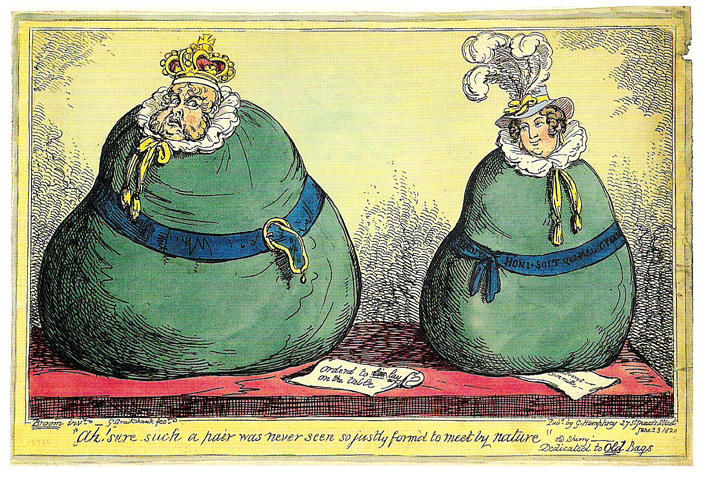
Two green bags

Prinny, who did not bother to hide his many scandalous affairs from the public, was excessively cruel to Caroline when their daughter, Princess Charlotte, died in childbirth. Instead of contacting Caroline directly, she heard about her daughter’s death through secondary sources. When King George III finally died, Caroline returned to England to claim her rights as Queen. Arriving in Dover in June 1820, she was cheered by crowds as she traveled in triumph to London.  The irony was that despite her outlandish behavior abroad, the public so hated George IV that they supported her with wild (almost blind) loyalty, burning bonfires in her honor and setting off illuminations. Caroline took full advantage of her popularity, showing up at public events as often as possible. Her celebrity did not deter George from seeking a formal separation and a divorce from his much loathed wife.

Caroline returns to England against much winded opposition (image from The Queen's Matrimonial Ladder)

He persuaded Lord Liverpool and his government to bring in an Act of parliament to deprive her of the title Queen and to declare the marriage “for ever wholly dissolved, annulled and made void”. The Whigs opposed the measure and their were public demonstrations against the new king.” – Historicizing Romantic Sexuality
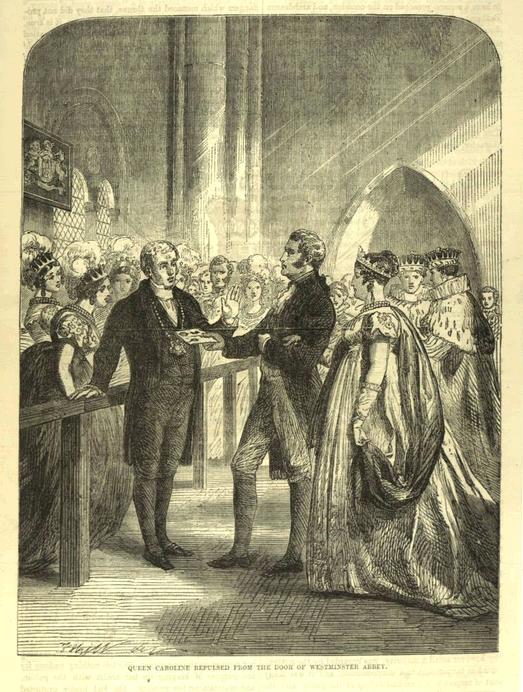
Queen Caroline repulsed from Westminster Abbey (LIFE magazine image)

The bill to deprive Caroline from her right, privileges, and pretension to Queen Consort was thrown out after weeks and weeks of political wrangling. Caroline, who was no fool, said: “No one cares for me in this business.” She appeared fully and royally dressed at King George’s coronation but was turned away from the doors of Westminster Abbey a number of times, as she tried repeatedly to enter several entrances with no success. This outrageous action resulted in further public demonstrations that ended when Caroline died suddenly on August 7th in 1821 of an unknown gastric disorder. She was 53.

Queen Caroline in 1820, (LIFE Magazine image)

More on the Topic

Read Full Post »

Juliette Wells (L) and Christine Stewart (R)

Gentle Readers: Chris Stewart has contributed her recent thoughts to my blog. She has Embarked on A Course of Study regarding Jane Austen, a most fascinating journey that has her interviewing Janeites, dancing country dances, studying Jane Austen’s life and novels, and interviewing Jane Austen Scholars like Juliette Wells. Here then is Christine’s most recent contribution:

(A post in which I complain about everything I’m reading.)

Sometimes I really love my job. And sometimes it sucks the life out of my life. Between it and the fact that more furloughs are on the way so I’ve decided to rent out my house, move in with my sister, and save money (travel to the UK is also on the agenda), my focus has been elsewhere. There’s work to do on the house, documents to file with the property manager, packing. I just haven’t felt like reading anything taxing. I wanted book candy, so I reread Shannon Hales’ Austenland. Which is just as fabulous as I remember. See? I am committed – even my fluff reading is Austen-related.

So back to why I love my job. Stick with me, I do have sort of a theme going here. I’m the program director for literary arts with my state’s arts council and that meant, last month, I was able to make a site visit to Frederick to hear Elizabeth Gilbert (Eat, Pray, Love) speak. It was hosted by an organization that may apply for funding and I needed to attend an event, get a feel for what type of events they present, what type of audience attends, etc.

Before I go further, let me say that I think I’m the only person on the planet who didn’t fall for Eat, Pray, Love. It was just too ‘precious’ a story and didn’t have enough grit. It was all just too perfect for me. And the book/trip was planned. It didn’t just happen. That takes the magic out of it.

It made me think that maybe the pilgrimage thing is now officially ‘done.’ I mean, there’s EG’s book, and there’s Lori Smith’s book, A Walk With Jane Austen. Thankfully, though, after reading Lori smith’s book, I realize it’s not ‘done’ when it comes to Austen.

I really wanted to like the book. Lori and I see things similarly sometimes; I often found myself thinking she was going to say something and she then said it. I think that’s good. Or it might be predictable. I can’t decide. I was leaning on the side of trying to connect with her as a good reader should.

But there’s very little joy in the book. Most of it is either about God (there’s A LOT of Christianity in this book), or regurgitating Jane Austen info that we can find anywhere, or dissecting a non-existent relationship with a guy named Jack, that she meets at the start of the trip. None of these are positive musings, except the Jane part, as we love Jane, but I would have preferred less rehashing of known info.

And there’s very little in the way of a sense of humor in this book – a ‘make the best of it, find the humor in it’ mentality. I mean, she’s in freakin’ England visiting Austen sites. What is there not to be happy about??? She has an ongoing illness, which I am sorry about, but if it was going to drag her down as much as it does physically, mentally, emotionally (and us with her), then maybe she shouldn’t have gone.

Tina Fey

She also makes a huge error in judgment in the beginning of the book with a man she meets, inexcusable in one who is supposedly so well versed in Austen’s novels, which I go into more detail about in my post.

I don’t really have a connection to Tina Fey here, except that she strikes me as a 21st century Austen in her medium – television. She’s the edgy, sarcastic, funny, sometimes bitter side of all of us. As Elizabeth Gilbert is the open, loving, spiritual, innocent side. I think we should do justice to both. Plus, my best friend swears Tina Fey reminds her of me. I’m taking that as a compliment.

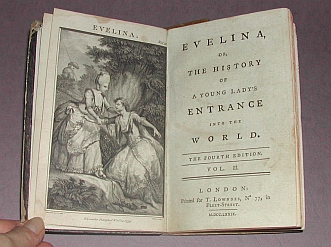
Evelina by Frances Burney

I haven’t just been completely idle; I have started Evelina by Fanny Burney and have decided two things.

You’ll have to go to the website to find out what they are: Embarking on a Course of Study

More Posts on the Topic

Read Full Post »

Emma, Lady Hamilton is best known by the casual history fan for her love affair with Lord Nelson. Born in poverty, she first plied her alluring wares in a brothel before becoming Sir Harry Fetherstonhaugh’s mistress. When she became pregnant, he unceremoniously dumped her. But Emma was too stunningly beautiful to live a life of squalor, and the Honorable Charles Greville next picked her to become his mistress. It was through Greville’s connections that she met painter, George Romney, whose obsession with her beauty resulted in a score of memorable paintings. (He continued to paint her portrait even after she left England.)

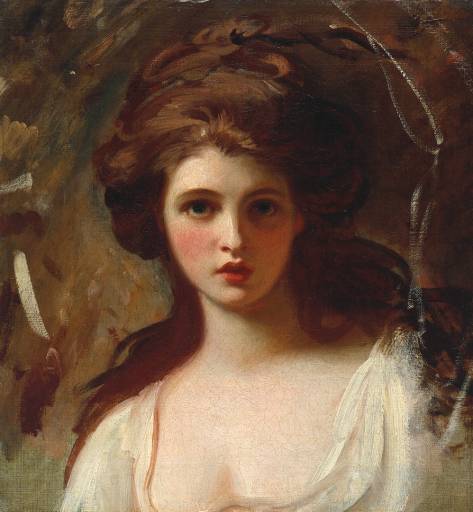
Emma as Circe, George Romney

Emma loved Charles, but he needed money, so when he met a woman of means in 1786,  he trundled Emma off to his widowed uncle in Naples, Italy, and thus Emma’s association with Sir William Hamilton began. Sir William was a diplomat and an avid art collector of classical statuary, urns and vases, which filled his villa in Portici overlooking the Bay of Naples. A connoisseur, he deeply appreciated Emma’s beauty, intelligence and special talents, not the least among which were her acting skills, hostessing abilities, and aptitude for learning new languages.

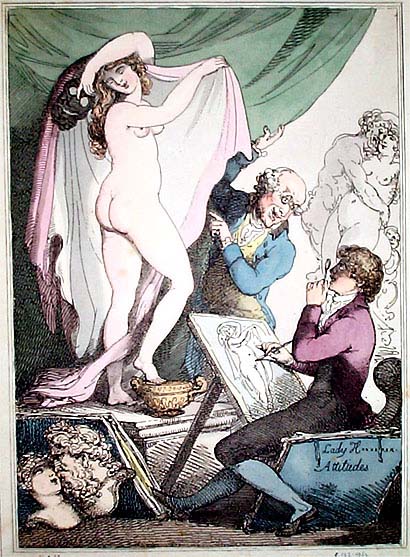
Caricature of Emma Hamilton as an artist’s model posing in an “Attitude”, Thomas Rowlandson

Sir William Hamilton

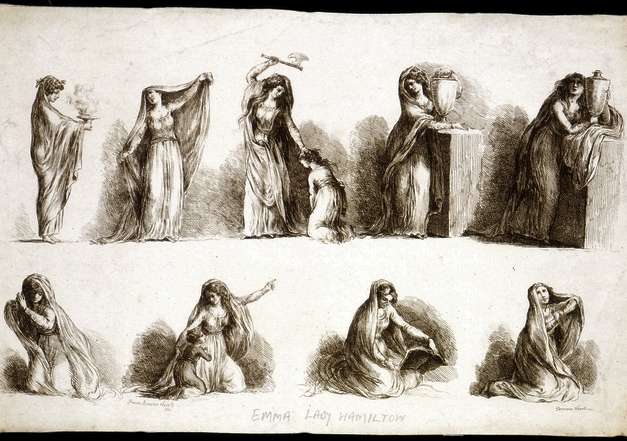
Emma’s stint as Romney’s model had given her experience posing in various classical guises. She’d also had the dubious distinction earlier in her career in London, of having worked as a scantily clad model and dancer – or “Goddess of Health” –  at Dr. Graham’s Temple of Health and Hymen, which claimed to cure the reproductive and sexual problems of couples. Emma  used her “theatrical” experiences to develop her “Attitudes”.  In helping Emma design her act, Sir William, whose knowledge of the imagery on classical vases was authoritative, used ancient Roman pantomimes as a model. The result of their collaboration was a silent performance that combined poses, classical dance and acting with Emma’s special allure. Emma gave her first showing in spring of 1787 to a group of European guests. Sir William held the lights and introduced his wife, as he would do for all her theatrics.

The Attitudes of Lady Hamilton, 1791, Novelli

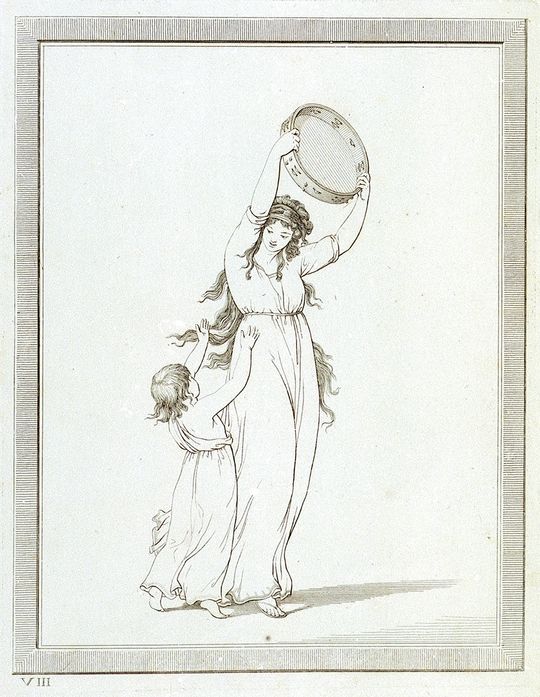
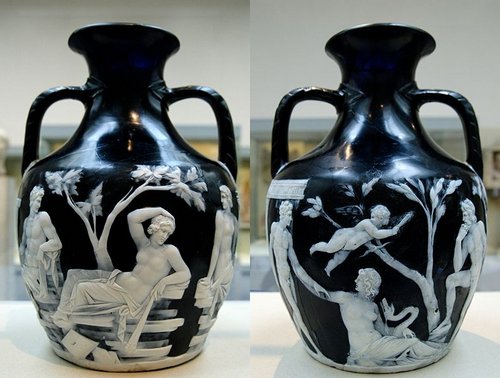
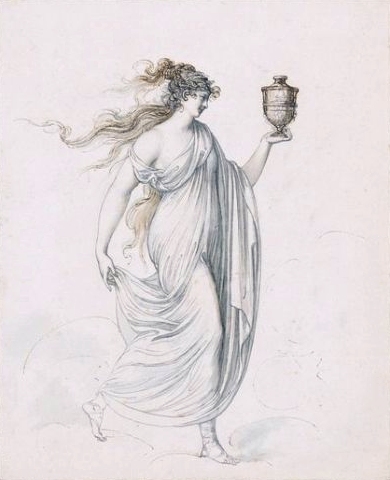
The poses were an immediate hit. Emma moved through her routine within a tall black box surrounded by a gold picture frame, using only a shawl or urn for a prop. (Although she must have occasionally used a child, as included in these images.) For her “Attitudes”, Emma  wore simple white-draped garments that fitted loosely and allowed her long hair to flow free. Her dresses were modeled on those worn by peasant women in the Bay of Naples. Sitting, standing, leaning, or kneeling, or posing as Medea or Cleopatra, she seemed to step right off the antique vases that her husband collected.

Portland Vase, British Museum, once owned by Sir William Hamilton

Emma’s repertoire was large and made up of at least 200 poses. During a performance she moved from one silent tableau to the other with great rapidity, delicacy. and deliberateness in what one writer termed ‘bursts of stillness.’ The private and select audiences would attempt to guess the names of the classical characters and scenes from stage and literature that she pantomimed, and stare in awe at Emma’s ability to transform her moods and the scene in an instant. Out of necessity, earlier viewings remained private, for Sir William and Emma were not married.

The couple did eventually marry  in London in 1791 at St. George’s Church in Hanover Square. Sir William was 61 and his wife was 26. After their wedding, the Hamiltons returned to their home in Italy. They continued to perform the “Attitudes, but now they could publicly and conspicuously invite a much larger and more diverse audience. Johann Wolfgang von Goethe, the German poet, had been invited to watch a performance during a visit to Naples. Impressed, he wrote:

The Chevalier Hamilton so long resident here as English Ambassador, so long too connoisseur and student of Art and Nature, has found their counterpart and acme with exquisite delight in a lovely girl, English, and some twenty years of age. She is exceedingly beautiful and finely built. She wears a Greek garb becoming her to perfection. She then merely loosens her locks takes a pair of shawls, and effects changes of postures, moods, gestures, mien, and appearance that make one really feel as if one were in some dream. Here is visible complete and bodied forth in movements of surprising variety, all that so many artists have sought in vain to fix and render. Successively standing, kneeling, seated, reclining, grave, sad, sportive, teasing, abandoned, penitent, alluring, threatening, agonised. One follows the other and grows out of it. She knows how to choose and shift the simple folds of her single kerchief for every expression, and to adjust it into a hundred kinds of headgear. Her elderly knight holds the torches for her performance, and is absorbed in his soul’s desire.

Lady Emma Hamilton as the Goddess of Health, 1790, Cosway

There must have been something titillating and erotic about Emma’s act, for her poses, although inspired by classical motifs, also drew upon her earlier experiences as a “Goddess of Health” in London and her erotic performances dancing naked for Sir Harry Fetherstonhaugh’s friends on his dining table. Her fame spread far and wide, and Emma, Lady Hamilton’s “Attitudes” became a big draw on Europe’s Grand Tour. Painters and writers sought out her performances, which charmed aristocrats and royals as much as artists and the literary set.  Élisabeth-Louise Vigée-Le Brun observed:

“Nothing was more curious than the faculty that Lady Hamilton had acquired of suddenly imparting to all her features the expression of sorrow or joy, and of posing in a wonderful manner in order to represent different characters. Her eyes alight with animation, her hair strewn about her, she displayed to you a delicious bacchanale, then all at once her face expressed sadness, and you saw an admirable repentant Magdalene.” – Elizabeth Vigee-Lebrun

Lady Emma Hamilton, 1794, Rehberg

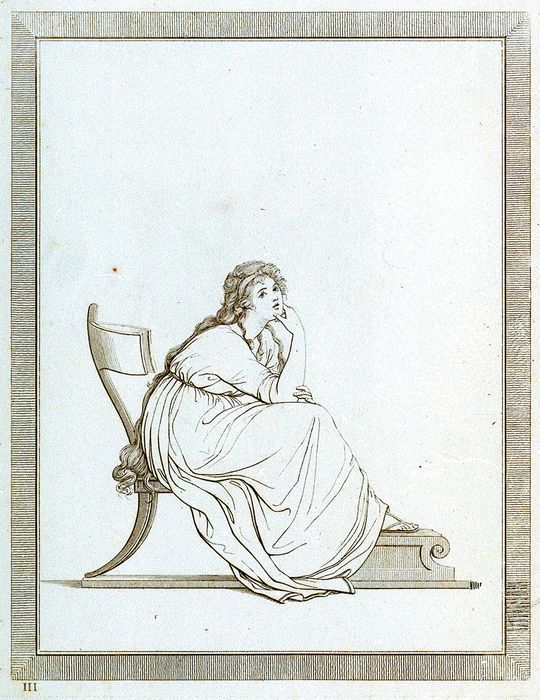
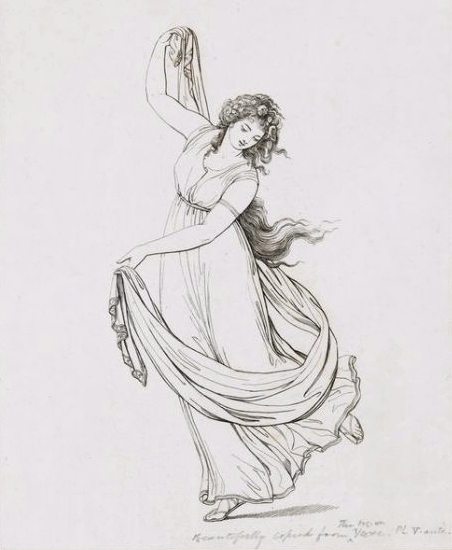
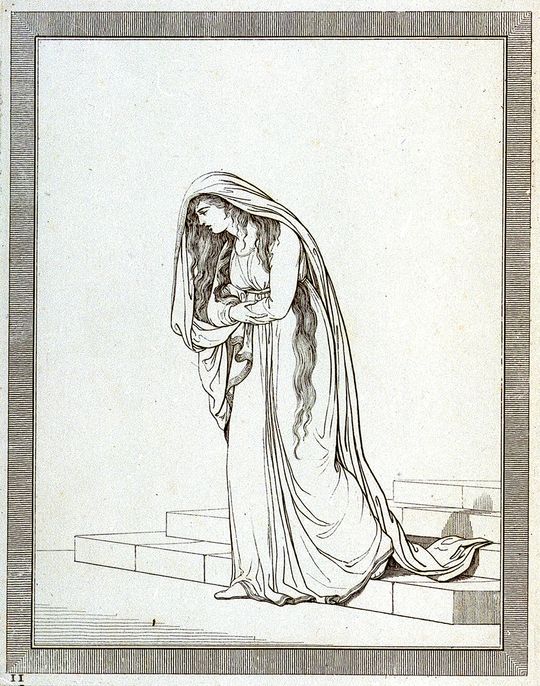
The black and white Rehberg illustrations featured in this post and commisioned by Sir William,  are drawn with simple, graceful and classical lines and freeze a particular “Attitude”. Their idealistic poses are among the few visual reminders that remain of Emma, Lady Hamilton as a performance artist. As the images show, Emma was a voluptuous, well-formed and beautiful woman. Her love for food and drink was no secret, and she would gain a substantial amount of weight over time, until at 47 she was described as being fat. But for a number of magical years, art, performance and beauty combined to create a series of tableaus that are still remembered today for their freshness and originality.

Emma Hamilton, 1794, Friedrich Rehberg, engraver and Tommaso Piroli, illustrator

Read about Lady Hamilton’s later years and sad death in this link.

To learn more about Emma’s fascinating skills, watch a lecture by John Wilton-Ely. His talk is on the ” performances by Lady Emma Hamilton, one of the most celebrated beauties of her era and a remarkable pioneer in developing performance art.”  Click here to watch the lecture. (A little over an hour long but well worth the time.)

More on the topic:

Add to DeliciousAdd to DiggAdd to FaceBookAdd to Google BookmarkAdd to RedditAdd to StumbleUponAdd to TechnoratiAdd to Twitter

Read Full Post »

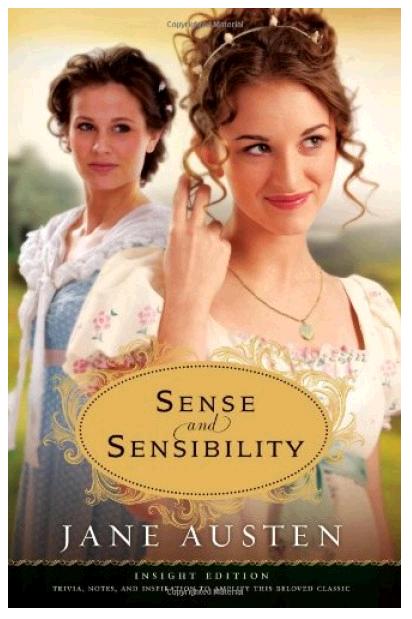
Sense and Sensibility by Jane Austen, the Insight Edition from Bethany House is a lovely annotated version of this classic novel. The intended audience is obviously a young Christian girl or someone who is reading the novel for the first time. The notes sit in the margins; they are not too obtrusive or overly verbose, but they do add a dimension to reading the book. Symbols indicate what sort of comment to expect. For example, a feather tells us that we will learn a tidbit about Jane Austen’s life. A small cross will indicate themes of faith drawn from the novel or her life; a small crown leads to historical facts. (“Consumption: tuberculosis; once referred to as consumption because it “consumed” the body. P. 189.)  Smiley faces tell us about parts of the novel that make the reader smile, and frownies assure us that the character has become nothing but irritating. (On page 133, “ranking our dislike: 1. Fanny; 2. Lady “Passive-aggressive” Middleton, 3. ..”etc.)

Many of the annotations deal with scenes from film adaptations, which help to clarify them in relation to the book (look for the camera symbol). With the inclusion of these film annotations, Bethany House rightly assumes that many people reading Jane Austen for the first time seek out her novels only after seeing a movie based on her novel.

The foreword by Julie Klassen is short and to the point, and the book group questions in the back are neither pompous nor difficult to discuss. In short, this book provides a wonderful introduction to Sense and Sensibility, one of Jane Austen’s earlier novels and, next to Pride and Prejudice and Northanger Abbey, the most accessible to her new fans. Bethany House also offers a Pride and Prejudice edition, which I surmise must contain similar annotations and book group questions.

I highly recommend this book to new readers of Jane Austen, especially those who possess only a cursory knowledge about her life or the Regency era. Before purchasing the book for yourself or a friend or loved one, you should aware of the many notes that pertain to faith. The quotes are informative and not preachy, as on p. 145: “The hard core of morality and even of religion seems to me to be just what makes good comedy possible…where there is no norm, nothing can be ridiculous…” C.S. Lewis, “A Note on Jane Austen, Essays in Criticism.” This edition of Sense and Sensibility points out how Jane’s faith informs her writing and her life, which is natural given that her father and two of her brother were men of the cloth.

In reading this book I am enjoying my revisit with Marianne and Elinor, and the shenanigans of the devious Lucy Steele and mean-spirited Fanny Dashwood. I still find Willoughby’s conduct reprehensible for a man in love, but Colonel Brandon, though a tad boring, makes my heart patter with his devotion and strength of character . The margin notes, written by Jane Austen fans (not scholars)  have enriched my enjoyment of this edition, and thus I give it three out of three Regency fans.

About Bethany House: Bethany House Publishers, a division of Baker Publishing Group, has been publishing Christian fiction books for 50 years. Nearly 120 titles are published annually, including historical and contemporary fiction, Christian living, family, health, devotional, children’s, classics, and theology subjects.

Sense and Sensibility, insight ed. by Jane Austen
ISBN: 978-0-7642-0740-2
Price: $14.99
Format: Paperback
Division: Bethany House

Read Full Post »

Caroline Norton 1833

Until the mid 1800s, married women in England had no legal rights. By law a husband could prevent his wife from seeing their children. He also had control over all her income, including any earnings she might make. Caroline Norton (1808-1877), who was married to an abusive man and who had been barred from seeing her three sons after they divorced, successfully challenged these laws.

Caroline was the granddaughter of a playwright Richard Brinsley Sheridan and the daughter of novelist Caroline Henrietta Sheridan. Caroline’s father died when she was eight years old, which left the family in financial straits. When Caroline had turned 16, George Norton, a Tory member of parliament for Guildford,  spotted her and asked for her hand in marriage. But she was too young to marry. Though a renowned beauty, Caroline had no dowry. Still, she hesitated to marry George Norton, but her mother eventually supported the match and thus she wed him at 19.

George Norton turned out to be a violent and unfaithful husband. He beat Caroline repeatedly, even in her third trimester of pregnancy. The marriage, though a failure, lasted long enough for Caroline to bear three sons. There were repeated estrangements and reunions, but the marriage finally ended in 1836. Caroline’s travails had just begun. Her reputation was in tatters as a divorced woman, and she was not allowed to see her sons. She was to write:

What I suffered on my children’s account, none will ever know or measure. “The heart knoweth its own bitterness,” and God knew mine! The days and nights of tears and anguish, that grew into the struggle of yearsit is even now a pain to me to look back upon; even now, the hot agony of resentment and grief rises in my mind, when I think of the needless tyranny I endured in this respect. Mr Norton held my children as hostages; he felt that while he had them, he still had a power over me that nothing could control. Baffled in the matter of the trial and damages, he still had the power to do more than punishto torturethe wife who had been so anxious to part from him – Caroline Norton, English Laws for Women in the 19th Century

Caroline’s story is more convoluted and complicated than presented here, and well worth reading. Suffice it to say that Caroline challenged the law that favored men over women, and her writing was instrumental in having The Child Custody Act of 1839 passed. Sadly for Caroline, her husband still denied her access to her children. Her youngest boy fell from a horse and died, and only after this tragedy were her two other boys allowed to live with her.

His cruel carelessness was afterwards proved, on a most miserable occasion. My youngest child, then a boy of eight years old, left without care or overlooking, rode out with a brother but little older than himself, was thrown, carried to the house of a country neighbor, and died there of lock jaw, consequent on the accident. Mr Norton allowed the child to lie ill for a week,–indeed to be at death’s door,–before he sent to inform me. Sir Fitzroy and Lady Kelly were staying with Mr Norton in the country. Lady Kelly (who was an utter stranger to me) met me at the railway station. I said–”I am here,–is my boy better?” “No,” she said–”he is not better,–he is dead.” And I found, instead of my child, a corpse already coffined.
Mr Norton asked my forgiveness then, as he had asked it often before; he sent his elder child to plead for him,–for well he knew what my children were to me; he humbled himself, and grieved for an hour, till he changed into pity the horror and repugnance I had expressed at the idea of seeing him;–and then he buried our child, and forgot both his sorrow and his penitence.

Caroline Norton

When George Norton caught wind that Caroline had been left a small legacy by her friend, Lord Melbourne and a small sum that her mother had left her, he stopped support payments for her and the children. Caroline fought him in court but lost. She campaigned to have the laws changed, and her victory resulted in the Matrimonial Act of 1857. Caroline remarried just months before her death in 1877, but not before two more crucial laws were passed that protected the rights of women and children, the Infant Custody Acts of 1873 (and 1886) and The Married Women’s Property Acts of 1870 (and 1882).

More on the topic:

Read Full Post »

« Newer Posts - Older Posts »