Feeds:
Posts
Comments

Archive for the ‘Regency Life’ Category

By Brenda S. Cox

“I would rather do anything than be teacher at a school” — Elizabeth Watson in The Watsons

No doubt you’ve heard how restrictive Austen’s world was for women. When a woman got married, all her wealth became the property of her husband (unless she had a good lawyer who arranged things differently). A lady without money or a husband might end up a governess (Jane Fairfax compares that to slavery) or a teacher at a girl’s school (Elizabeth Watson would “rather do anything than be a teacher at a school”). A man could divorce his wife by accusing her of adultery (even if there wasn’t what we would consider clear proof), but a woman was almost never able to divorce her husband.

Despite all that, there were outstanding women of the Georgian era who broke through those barriers. Some were widows, some were single, some were married.

Two fascinating books tell us about some of these boundary-breaking women. Mike Rendell’s Trailblazing Women of the Georgian Era (Pen & Sword 2018) brings us seventeen women from the eighteenth-century who made outstanding contributions in Arts & Literature; The Scientific World; Business & Commerce; and Reform and Education. Rendell explains the legal position of women in Austen’s world, and after each short biography gives a wider picture. For example, at the end of the chapter on Lady Mary Wortley Montagu, who promoted smallpox inoculation in England, we learn more about smallpox, “the most dreadful scourge of the human species” (according to Edward Jenner, who developed vaccinations). At the end of Trailblazing Women, Rendell continues the saga of women’s achievements in England, into the present.
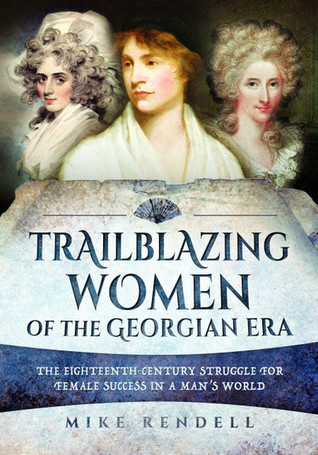
Trailblazing Women of the Georgian Era, by Mike Rendell, tells the story of 17 boundary-breaking women.

In a complementary book, What Regency Women Did For Us (Pen & Sword 2017), Rachel Knowles shares the lives of twelve Regency women who made an impact on their communities and on our world today. Knowles does not give such wide coverage as Rendell, but tells the fascinating story of each woman in more depth. She is more focused on the Regency period, while Rendell adds earlier women from the 18th century.
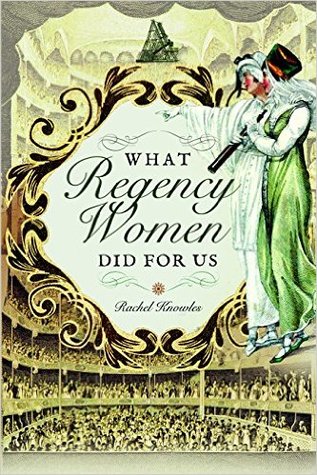
What Regency Women Did For Us, by Rachel Knowles, tells the stories of a dozen Regency women who impacted our world today.

Rendell and Knowles chose some of the same women and some different ones. Both introduce actress Sarah Siddons, scientific book writer Jane Marcet, engineer/inventor Sarah Guppy, artificial stone manufacturer Eleanor Coade, and prison reformer Elizabeth Fry. Rendell adds businesswomen, writers, an anti-slavery campaigner (Lady Middleton), and others, while Knowles adds mountaineer Mary Parminter, fossilist Mary Anning, astronomer Caroline Herschel, our own Jane Austen, and more.

Let’s look at a few of my favorites, out of all these fascinating women.

Jane Marcet: Author of Science Books for Women

Rendell identifies Jane Marcet as a “scientific book writer,” while Knowles calls her “Faraday’s teacher.” I love that Marcet wrote science books for girls and women in an age when many thought that reading and arithmetic, embroidery and music, were all that women needed to know. I can imagine Fanny Price reading Marcet’s books and developing her love for the natural world.

Like Jane Marcet, I love chemistry, and I love to write about complex issues, making them clear and understandable. So Marcet seems like a kindred spirit to me. Her husband was a doctor who enjoyed chemistry. They attended lectures together at the Royal Institution in London to hear Humphry Davy explain the latest chemical discoveries. Jane Marcet had been given a basic grounding in science at home and even learned some Latin, which Regency girls rarely studied.  However, she still needed her husband’s help in understanding the scientific vocabulary that Davy and other lecturers used.
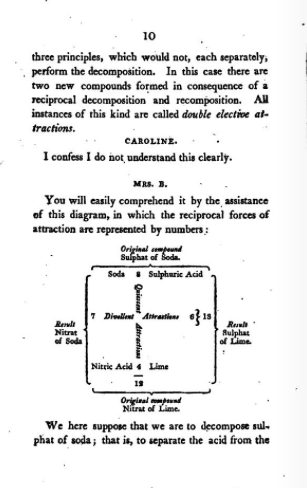
A page from Jane Marcet’s Conversations in Chemistry, which taught science to young women and many young men, using discussions, pictures, and everyday examples.

Marcet wrote a book, Conversations on Chemistry, to help other women understand those lectures. In dialogues between a woman teacher and two female students, Marcet explains basic chemical concepts in clear language with everyday illustrations. Practical experiments, questions and answers, and Jane Marcet’s own illustrations make the book even easier to understand. She published it anonymously in 1805 (as Jane Austen published her books anonymously), but her name was later added to it. The book was very popular in both England and America.

Conversations on Chemistry became a standard school textbook for teaching science to girls, as well as for teaching at home. But Marcet’s book didn’t just benefit girls. Boys without access to much schooling also learned from it. Marcet’s book introduced Michael Faraday, who had little formal education, to chemistry. Faraday went on to make major discoveries in chemistry and electricity and also lectured to the public at the Royal Institution.

Jane Marcet went on to write popular books teaching economics, natural philosophy (science), and botany, as well as Conversations on the Evidences of Christianity. She helped revolutionize education, particularly for women, making these subjects accessible to all.

Hester Bateman: Silversmith and Business Owner

When I visited colonial Williamsburg during the 2019 JASNA AGM, I was surprised to learn that most eighteenth-century trades included women. In England, Hester Bateman was a well-known silversmith, with her own company. Like many Georgian women who made names for themselves, her career began when her husband died. He was a silver worker who taught his wife to assist him. She was illiterate herself, but he bequeathed his tools to her, rather than to their sons, and she immediately took over the business, calling it “Hester Bateman and Company.” She registered her own mark, “HB,” which still identifies her work today.

Hester Bateman developed beautiful, simple, classical designs for the dining rooms and tea tables of the upwardly-mobile middle classes. Her family business expanded into  a workshop across the backs of three houses. She and her company produced many thousands of silver objects. Her sons, daughter-in-law, and grandchildren eventually took over the prosperous business. But Hester herself ran the company until she died at age 82.
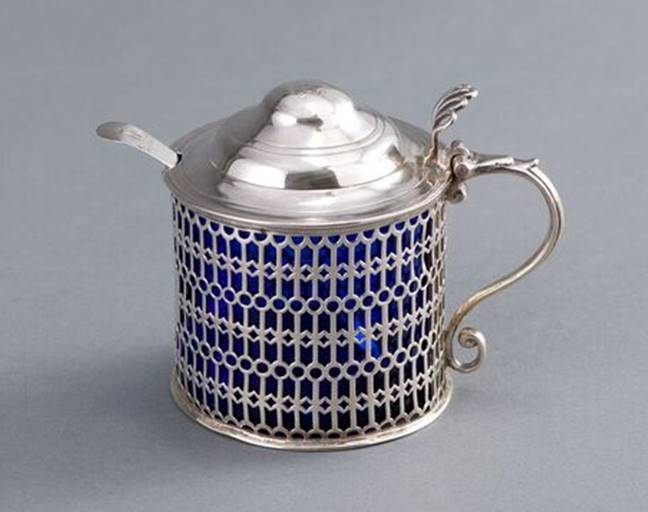
This mustard-pot is lined with blue glass so the mustard does not react with the silver. It was made in 1774 by Hester Bateman, a lady silversmith with her own mark. Lauren Rogers Museum of Art, gift of Thomas M. and Harriet S. Gibbons, used by permission.

In Trailblazing Women of the Georgian Era, Rendell tells us about other Georgian businesswomen who made lace, sold stocks, manufactured artificial stone (used for anything from tiny ornaments to giant statues), owned a print shop, wrote and sold cookbooks, and manufactured chocolates. He even includes a “bigamist, litigant and courtesan,” Teresia ‘Con’ Phillips, as a businesswoman, to show the limited avenues available for women. He wonders why there were not more Georgian businesswomen. However, I’m impressed that, despite the restrictions on women owning property and having their own money, there were so many Georgian businesswomen that we still know about today.

Madame Tussaud: Artist and Businesswoman

Rachel Knowles calls Marie Tussaud “Entrepreneur Extraordinaire.” Madame Tussaud was a talented artist and craftswoman as well as a smart and creative businesswoman.The wax museums she developed are still popular today.
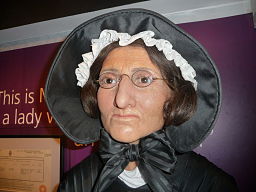
Waxwork of Marie Tussaud, at Madame Tussaud’s in London. Photo by Immanuel Giel, CC BY-SA 3.0 via Wikimedia Commons

Marie’s mother was housekeeper to a Swiss doctor, Philippe Curtius, who adopted Marie as his daughter. Curtius made wax models to show the anatomy of the human body. His models were so successful that he left medicine and set up a waxworks in Paris. He taught Marie how to make wax models and how to run a business. During the French Revolution, Marie and Curtius made wax models of the royal family, of people who had been guillotined, and of prisoners and revolutionaries. Marie took impressions of people’s heads shortly after they were cut off—quite a gruesome job.

When Curtius died, he left his waxworks and other property to Marie. She married François Tussaud, but her marriage settlement ensured that she kept control of her own property—that was unusual in France, as in England. It was a good move, since her husband turned out to be irresponsible with money. In 1802 she moved her exhibition to England. Her husband stayed in France, and she eventually gave him her French property, but she kept the waxworks and her income from it.

After some difficult years and an unprofitable partnership with an English businessman, Madame Tussaud developed her exhibition into a popular traveling show. In 1833 she set up a permanent exhibit in London. Her sons took it over—she transferred it into their names to keep her husband from getting it.  The waxworks survived the centuries and Madame Tussaud’s is still one of the most popular attractions in London, with related wax museums around the world.

In What Regency Women Did for Us, Knowles includes other women with unusual stories, such as Harriet Mellon, the penniless Irish peasant who became a wealthy banker and left a fortune to a Victorian woman philanthropist. Mary Parminter, another unusual Regency woman, took the Grand Tour of Europe (usually a men’s activity) with her cousins while they were unmarried, and climbed mountains. Mary stayed single, keeping control of her extensive fortune and using it to build a lovely chapel and provide homes for independent single women.

If you have been thinking that teaching and writing were the only occupations open to Georgian and Regency women, these two books will open your eyes. Many women pushed outside the boundaries of societal expectations and left lasting legacies. In both Mike Rendell’s Trailblazing Women of the Georgian Era and Rachel Knowles’ What Regency Women Did For Us you will meet many such women and enjoy their exciting stories.

You can find Mike Rendell at Georgian Gentleman. Rendell has written books on other aspects of Georgian society, including Journal of a Georgian Gentleman.

You can find Rachel Knowles at Regency History. For an additional review of What Regency Women Did For Us, see “Women of Science, Women of Faith.” Rachel has also written a fun Regency novel, A Perfect Matchand is about to release a second book in the series, A Reason for Romance.

You can connect with Brenda S. Cox, the author of this article, at Faith, Science, Joy, and Jane Austen or on Facebook.

Read Full Post »

Inquiring readers, I once enjoyed afternoon tea in Fortnum and Mason’s in London. It was an exquisite, elaborate, and unforgettable experience. It was so elegant that I thought of it as high tea, but its presentation and intent had nothing in common with high tea in Jane Austen’s day, or in our present time. This post is meant to complement Rachel Dodge’s excellent post entitled “Jane Austen’s Regency Women: A Day in the Life , Part 1.” 

Afternoon tea:

The tradition of tea in the afternoon as we understand it began in 1840 with the Duchess of Bedford (1783-1857). She requested light food with tea and a few refreshments in mid-afternoon to stave off hunger pangs before dinner, which was served at 8 p.m. The Duchess soon began to invite friends to her rooms to join her in taking tea, and so a tradition began. This custom, which we celebrate to this day, began years after Jane Austen’s death in 1817.

High tea:

High tea was generally known as dinner or supper by the working classes.

For workers in the newly industrialized Britain, tea time had to wait until after work. By that hour, tea was generally served with heartier dishes which were substantially more than just tea and cakes. Workers needed sustenance after a day of hard labor, so the after-work meal was more often hot and filling and accompanied by a pot of good, strong tea to revive flagging spirits.”- Lemm

It seems that the term ‘high tea’ had more in common with furniture than a lofty service.

“Today, the evening meal in working-class households is still often called “tea” but as working patterns have changed yet again, many households now refer to the evening meal as supper. The addition of the word “high” to the phrase “high tea” is believed to differentiate between the afternoon tea that is traditionally served on low, comfortable parlor chairs or relaxing in the garden and the worker’s after-work high tea that is served at the table and seated on high back dining chairs.” – Lemm

Afternoon tea was therefor served on comfortable chairs in a drawing room or lady’s sitting room, or as a refreshment in the garden.

“Afternoon tea, also known as “low tea,” is the most often taken a a low table, like a coffee table in the sitting room before a warm fire. (Of course, it can also be served at a dining table.) High tea gets its name from its tendency to be served at a high table, like a dining table or high counter at the end of the workday.” – Brown

Breakfast:

Jane Austen was in charge of her family’s tea and sugar stores. She made her family’s breakfast at 9 a.m. The simple repast consisted of toast, rolls, or muffins and butter. Jane toasted the bread over a fire using a long handled fork or a metal rack that held the bread in place.

The typical ‘tea and toast’ breakfast that Jane Austen enjoyed was a relatively new invention. Traditionally, British breakfasts had consisted of hearty fare that often included beef and ale.” – Wilson, p. 21

Evening tea:

Tea was also served one or two hours after dinner. The time was variable, because people during the Regency era ate dinner at different times. Some ate early in the afternoon, as Jane Austen’s parents did when they were younger; some at 3 p.m., like the Bennets in Pride and Prejudice; the Bingleys dined at the more fashionable hour of 6 p.m.; and the Duchess of Bedford, a trendsetter, dined at 8 p.m. Kim Wilson quotes Captain Harry Smith in 1814 as saying, “I breakfast at eight, dine at three, have tea in the evening…” People who did not follow the latest fashion in dining kept the earlier dinner hours they and their families had always adhered to.

Confusing the issue further is that people of the time referred to all hours before dinner as ‘morning’, and the period between dinner and teas as ‘afternoon’, even if it fell in what we now call the evening. To them, ‘evening’ started after tea.” – Wilson, p. 91

In the evening after dinner, the assembled guests returned to the drawing-room. Tea was made by the ladies of the house to prevent servants from taking portions of this expensive commodity for their own use. After tea, “…when the tea-things were removed, and the card-tables placed” (Pride and Prejudice) the diners would play games, such as riddles or charades, or read to each other and partake of other pleasures. In Hartfield, “Mr. and Mrs. Weston and Mr. Elton sat down with Mr. Woodhouse to cards.”- (Emma)

Tea was also provided at balls, when suppers were served at midnight, in private alcoves in pleasure gardens, on visits when “Mr. Woodhouse was soon ready for his tea; and when he had drank his tea he was quite ready to go home” (Emma), and at musicales —”The first act was over. Now she hoped for some beneficial change; and, after a period of nothing-saying amongst the party, some of them did decide on going in quest of tea” (Persuasion).

A lady at a public assembly ball was dependent on a gentleman to escort her to the tea-room.

At a grand ball in Bath, Catherine Moreland of Northanger Abbey, and her friend Mrs. Allen, feel awkward and out of place until “they received an offer of tea from one of their neighbors; it was thankfully accepted, and this introduced a light conversation with the gentleman who offered it…”-Martyris

So many unanswered questions remain about tea taking in the Regency era, especially among the working classes and this post does not begin to address them or pretend to. Tea was so universal during this age, that anyone who could afford it (or smuggle it in) drank it, including Emma’s Mrs. Bates, who was “almost past every thing but tea and quadrille.

Sources:

Read Full Post »

Inquiring readers, 

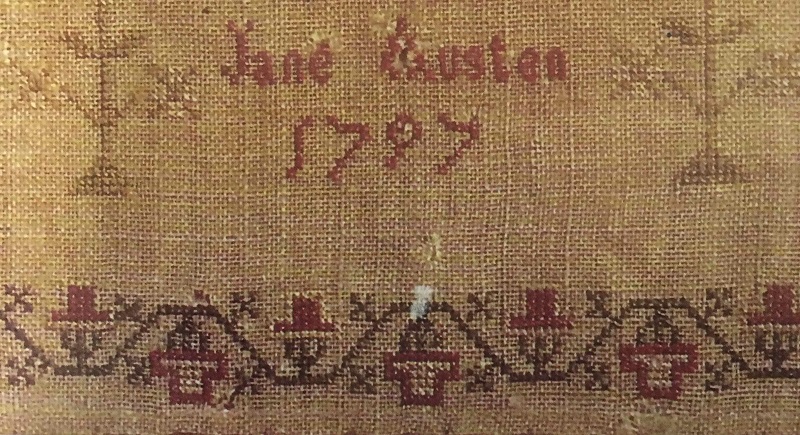
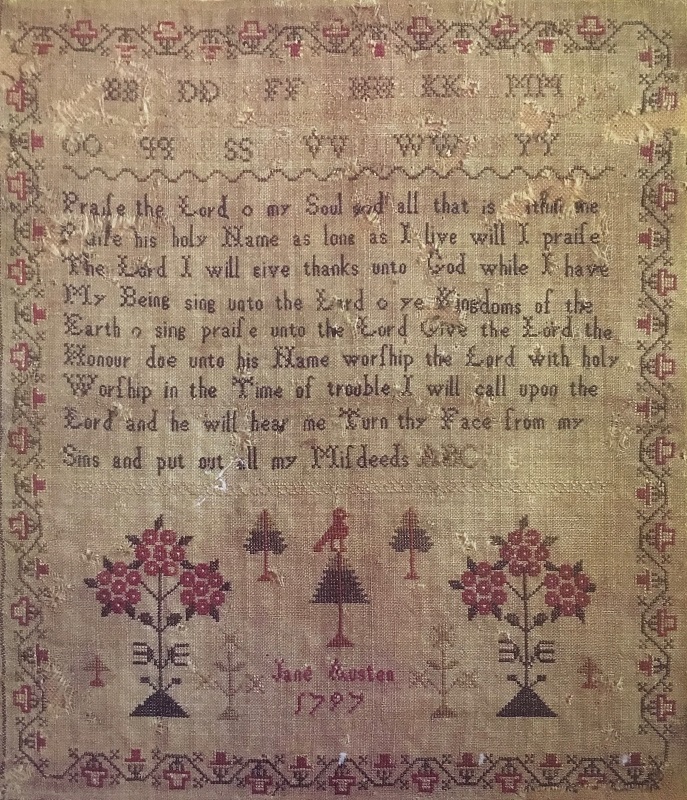
Last April Brenda Cox shared a thought-provoking post about  a Jane Austen Sampler. Click here to read the article. Mrs. Cox writes that Deirdre Le Faye, an expert on Jane Austen, believes that the stitcher was another Jane Austen, probably a second cousin of the author of ‘Pride and Prejudice.’

Picture 1 Austen Sampler

Mrs. Cox has continued her research into this fascinating topic, and writes:

A few years ago, I bought a printed copy of the “Jane Austen sampler” at the Jane Austen Centre in Bath. In 2018 I posted thoughts on my blog about that “Jane Austen Sampler.” However, I had no idea whether “our” Jane Austen had stitched it or not.

Then Deirdre Le Faye saw that post and directed me to her article for the Jane Austen Society. She speculated, for various reasons, that the sampler may have been done by a cousin of Jane Austen’s. In 2019 I wrote about her ideas in Jane Austen’s World. At the end of that article I asked if some genealogist might try to track down the history of the sampler.

Now the plot continues to thicken. Months later, Alden O’Brien, curator of the DAR Museum in Washington, D.C. saw those posts and wrote to me for details. She then did extensive research based on her specialties: the history of needlework and genealogical research. Exactly what we needed!

Ms. O’Brien posted her conclusions which I highly recommend you read: “Is This Jane Austen’s Sampler?

Sampler purportedly embroidered by Jane Austen

In summary:

For it to be “our” Jane Austen’s sampler, we need to assume that it originally said 1787 and stitches were pulled out to make it say 1797. Deirdre Le Faye thought this was highly unlikely. Alden O’Brien thinks it even more unlikely. From the photos we have (which admittedly are not great), there is no evidence in the fabric that stitches were removed. And O’Brien compared it to Cassandra Austen’s sampler which includes all the numbers. Presumably the sisters would have been using the same style of numbers. The “9” in the “Jane Austen sampler” looks much like Cassandra’s 9, but not completed. Cassandra’s 8 is a different shape, so it’s unlikely that the original said 1787.

Even more conclusively, O’Brien was able to trace the provenance given for the sampler. She found clear records from the sampler’s previous owners back to a Jane Austen who would have been about 12-14 in 1797, the right age for making such a sampler. It appears that this Jane grew up to marry the owner of a pub. One of her sons was a servant, and her daughter married an oyster fisherman. So she was from a lower social class than the author Jane Austen. O’Brien points out that even young women of this class often went to schools where they might produce samplers like this one.

The Mr. Frederick Nicholls of Whitstable who once owned the sampler is claimed to be “a grandson of a cousin of Jane Austen.” However, from this evidence, it appears he actually was a grandson of this (alternate) Jane Austen.

So, the bad news is that the sampler almost certainly was not sewn by the author Jane Austen. Still, it did come from her time period. And unraveling the mystery has been a story in itself!


Read Full Post »

Photo of Crystal Clarke as Miss Lambe

Crystal Clarke as Miss Lambe

Miss Lambe, introduced in Episode 1 at the assembly ball, is an intriguing character – a new one for Jane Austen that she intended to explore in depth before she abandoned her manuscript due to illness. By the Regency era, the British Empire had spread the world over. The term “Black” in England during that time denoted any skin color other than “white.”  This included people from Africa and the East Indies and West Indies, such as Antigua, the land of Georgiana Lambe’s birth.

Georgiana is the ward of Sidney Parker, who, after she voices her displeasure at his power over her, reminds her that her father wanted her to take a place in polite society, that she was far richer than all of them put together. Neither relish his role, but both understand that because of her fortune she must be managed.  It’s a mystery how Sidney achieved this position, but we’ll assume that an explanation of how his work in the West Indies led him to become Georgiana’s guardian will be given in future episodes.

The viewer instantly understands Georgiana’s views on her position when she angrily lashes out at Sidney that she is “not your slave to be served up as your general amusement.” She gestures dramatically and adds in mock tones, “Here’s a negress, rich and black as treacle. – feast your eyes!”

Photo of actress Anne Reid as Lady Denham

Anne Reid as Lady Denham

In the quest to cozy up to Georgiana, Lady Denham hosts a luncheon to introduce her to Sanditon society. Instead of behaving like a gracious hostess, she says the crudest, uncivil statements imaginable. As Georgiana makes her entrance, Lady D. turns to Sir Edward Denham, who is in need of a wife with a fortune, and says, “Edward, there’s your quarry. Hunt her down!”

Before anyone takes a bite of food, she addresses Georgiana, gesturing to a pineapple that was placed at the center of the table in her honor. Offended, Georgiana employs a thick island accent to indicate that pineapples are not grown in Antigua. The pair are off to a bad start. 

During the soup course, Lady D asks, “Miss Lambe, what are your views on matrimony? —“An heiress with a 100,000 must be in want of a husband.”

And we’re off to the insult races!

Georgiana gives her a sideways glance: “I don’t care to be any man’s property.”

“Oh, hoity toity! … Was not your mother a slave?”

Pregnant pause.

“She was. But being used as a thing and liking it are not the same, my lady.”

“No, I’m beginning to think that you’re a very opinionated young lady, Miss Lambe.”

Georgiana wins the riposte, but she remains deeply unhappy and unsuccessfully attempts to escape to London by coach. Charlotte happens upon a despondent Georgiana standing dangerously close to the sea cliff’s edge and crying. She comforts her and the two lonely young women become friends. 

Episode 3 presents many new revelations and developments, which will be addressed in a later review.  Miss Lambe makes only two appearances. The first in a painting class to demonstrate her rebelliousness, and the other in a scene with Sidney to show her contrition for bad behavior. The episode ends with Georgiana examining a locket with a portrait of a young Black man and kissing it before finishing a letter.

My, oh, my! How the plot has thickened.

I’ve concentrated on Georgiana Lambe in this week’s review because she is such an unusual character in the Jane Austen canon. Jane visited her brother Henry in London on many occasions and to meet with her publishers. She would have noticed the many Blacks who lived in Britain, most notably in London and major port cities. By some estimates, around 15,000 Blacks lived in England at the end of the 18th century, 20% of whom were women. Around 10,000 Blacks lived in London. 

Slavery was legal in Britain until 1772. While servitude there was preferred over life on a West Indies plantation, Black lives were not easy. After the slaves were freed, males and females found work as servants. During the Napoleonic wars, many Black males enlisted in the navy and army. Once the wars were over, these sailors and soldiers were no longer enlisted and stayed in the port cities they knew so well. 

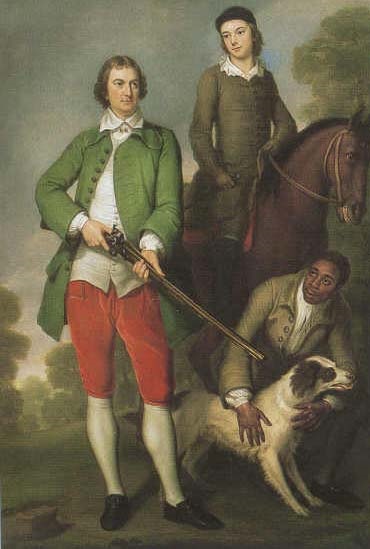
Portrait of The Hon. John Spencer, his son the 1st Earl Spencer, and their slave, Caesar Shaw, ca 1744. Wikimedia Commons. This work is in the public domain.

The Hon. John Spencer, his son the 1st Earl Spencer, and their slave, Caesar Shaw, ca 1744. Wikimedia Commons. This work is in the public domain.

Overt racism was rampant. Servants of the rich were beautifully dressed, but treated like possessions (much like a brood stallion or a rare antique vase.) Portraits would show noble women and a Black servant, be it a child or adult, sitting at the edge of the painting, which served to increase the contrast of the female’s creamy white skin to the ebony complexion of the other sitter. The power differential between males and their Black servants was also evident.

In 1847’s Vanity Fair, William Makepeace Thackery created two characters – Mr. Sambo, the Sedley’s male servant, and Miss Swartz, which means black in German and Dutch. Miss Swartz was described as a “rich, woolly-haired mulatto from St. Kitt’s,” as well as a Belle Sauvage, a dark paragon, and a dark object of conspiracy. George Osborne, her suitor, described her as “elegantly decorated as a she chimney-sweep on May-day.” 

George might not have given Miss Swartz respect, but he and his family had a healthy regard for her money, which made her an acceptable prize. Lady Denham viewed Miss Lambe with much of the same interest and contempt, but this did not fool Miss Lambe, who was proudly not for sale. Her personal experience of society’s disdain for Blacks (such as in the stage coach scene) fuels her anger, combativeness, and sadness. She has nothing to lose by meeting the offensiveness of others head on.

The Advertisement for a Wife, illustration by Thomas Rowlandson. Internet Archive

The Advertisement for a Wife by Thomas Rowlandson. Internet Archive. University of California Libraries. No visible notice of copyright; stated date is 1903.

For The Third Tour of Dr. Syntax In Search of a Wife: A poem by William Combe, Thomas Rowlandson illustrates  “The Advertisement for a Wife, in which a Black woman is placed prominently at the front and center of a group of spinsters. Dr. Syntax had asked an acquaintance, Mrs. Susanna Briskit, an “eccentric creature full of vivacity,” to help him find a wife. She embarked on a “scheme of fun” and invited a room full of loud, insistent females and their chaperones to apply for the position. The scene as written by Combe is funny and I imagine the inclusion of a Black lady heightened the comedy, but probably had a cruel undertone.

Portrait of Dido Elizabeth Belle Lindsay (1761-1804) and her cousin Lady Elizabeth Murray (1760-1825), David Martin. Wikimedia Commons. This work is in the public domain

Portrait of Dido Elizabeth Belle Lindsay (1761-1804) and her cousin Lady Elizabeth Murray (1760-1825), David Martin. Wikimedia Commons. This work is in the public domain

Not all is misery for Georgian Blacks.  This portrait of Dido Elizabeth Belle Lindsay and Lady Elizabeth Murray by David Martin in the late 18th century depicts a genuine friendship between the two women. Dido, an heiress, was born illegitimately  in the British West Indies of a British navy captain, Sir John Lindsey, and Maria Belle, an African woman whom he captured from a Spanish ship. Dido was sent to England as a child and brought up by Sir John’s uncle, Lord Mansfield and his wife, who were childless. Elizabeth Murray, Dido’s cousin, was motherless. The two girls were raised together, but Dido, while beloved, was not always invited to dine with guests. In the film “Belle,” Dido expresses the same sentiments as a governess–her position was too high to eat with servants and too low to eat with guests. Dido eventually married, had 3 children, and died in 1804 at 42. Compared to most of her Black contemporaries, she led an idyllic life. 

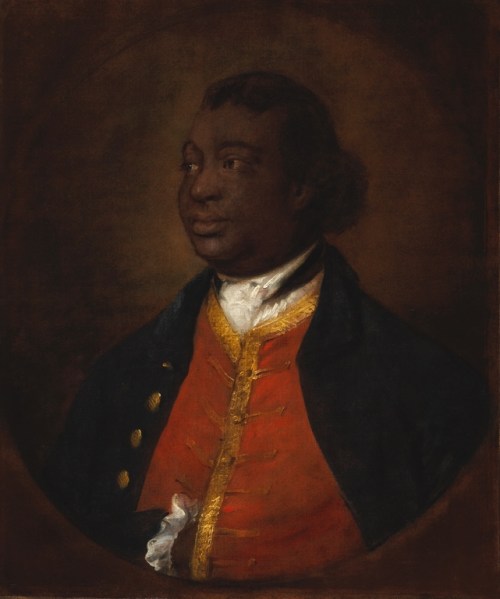
Portrait of Ignatius Sancho, 1768 by Thomas Gainsborough, National Gallery of Canada. Wikimedia Commons. This work is in the public domain.

Ignatius Sancho, 1768 by Thomas Gainsborough, National Gallery of Canada. Wikimedia Commons. This work is in the public domain.

There were other success stories, such as the boxer Bill Richmond, or Ignatius Sancho. Born on a slave ship, Sancho became a protege of the Duke and Duchess of Montagu. While working in their household, he had access to their books and taught himself to read. Today he is celebrated as a writer, composer, shopkeeper and abolitionist. 

It would have been interesting to know how Jane Austen would have fully developed Miss Lambe and what information she learned about the West Indies and Blacks in the navy from her sailor brothers.

Post Note: In The World of Sanditon (see sidebar), Sara Sheridan writes of Austen’s romantic entanglement with Dr. Samuel Blackall, a minister. In a letter to Frank, her brother, Austen describes him as “a piece of perfection.” Nothing was to come of her infatuation. Years later, Blackall married a Miss Lewis of Antigua.

Sheridan concludes that this story “provides an intriguing real-life parallel to the world of Sanditon, as does the idea of a love interest with West Indian connections.”

More sources:

The First Black Britons: Sukhdev Snadhu, History, BBC,2011-02-17. Downloaded 2/20/2020.

Black People in Late 18th Century Britain: Histories and Stories, English Heritage. Downloaded 2-20-2020

Black lives in England: Historic England Blog, Research tab. Downloaded 2-20-2020.

Read Full Post »

Inquiring readers,

Many of you have noticed my absence for a long time. If it weren’t for the efforts of Rachel Dodge and Tony Grant, this blog would have remained silent for most of the previous twelve months. Thank you, both, dear friends, for your contributions.

Two years ago I realized my heart and soul were no longer in my work and that it was time to retire.  Since then, I have been in the process of getting my house ready for sale, selling it, and packing my belongings to move to north Baltimore to be near family. Luckily or unluckily, I sold my house the moment my realtor planted the “coming soon” sign on my lawn. This meant that I had to move two months earlier than anticipated, since the new owners were anxious to move into my beloved abode.

My new place, however, was not ready. Currently, all my possessions, save for summer clothes and necessities, are in storage, and so I am living in limbo as a guest with friends until the end of August.

Starting September 1, I will be traveling between Richmond and Baltimore for four months, waiting for my new place to be approved by a house inspector and working remotely at a distance (with frequent travels via I-95 to attend bi-monthly meetings down south). January 1st is the date of my retirement. Ah, the modern life!

As I anticipate my schedule this fall and early winter, my thoughts often turn to Jane Austen. She had immense pleasure of living the first 25 years of her life in Steventon, a small village in Hampshire.

Outside there were fields where Mr Austen farmed and his wife grew potatoes (at that time quite an innovation), formal gardens with a turf walk, sundial, strawberry beds, and a grassy bank down which the young Jane, possibly enjoyed rolling as a child, like Catherine Morland in Northanger Abbey. – http://www3.hants.gov.uk/austen/deane-parsonage/steventon-village.htm, Hantsweb, Hampshire County Council

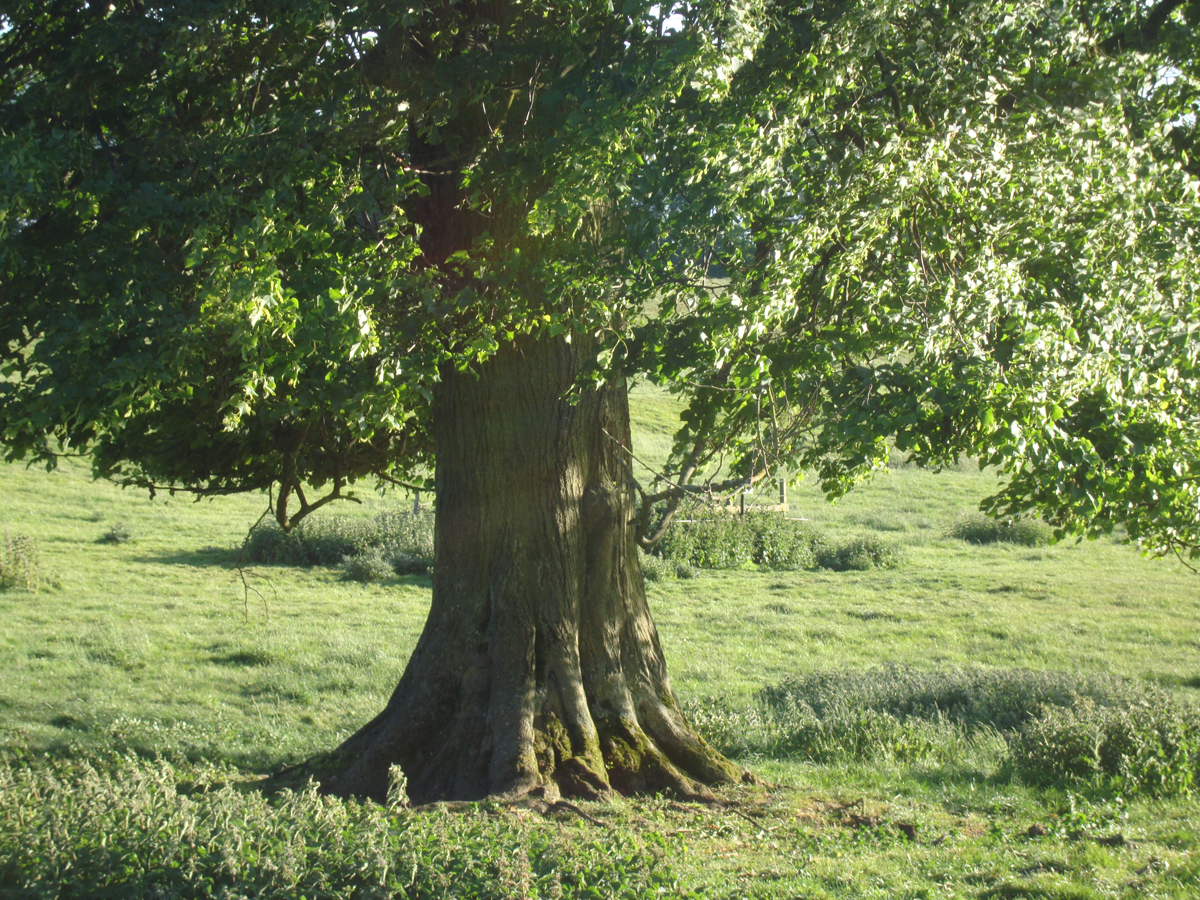
The old rectory site where the parsonage once stood. A well (inside the enclosure in back of the tree) is the only visible remnant of that house. Image @Tony Grant

The old rectory site where the parsonage once stood. A well (inside the enclosure in back of the tree) is the only visible remnant of that house. Image @Tony Grant

The Austens also ran a boarding school for young men out of the parsonage house to augment the reverend’s yearly income of £230. His extensive library of 300 – 500 volumes was amazingly large for that era, since books were frightfully expensive. Rev. Austen encouraged Jane and her sister, Cassandra, to read from his library, an unusual encouragement for females in that time.

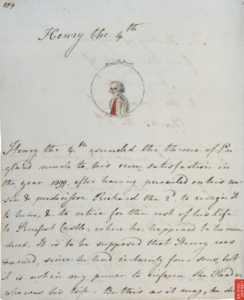
Image of a page of the History of England by Jane Austen and illustrated by Cassandra Austen of Henry the 4th, the British Library

Image of a page of the History of England by Jane Austen and illustrated by Cassandra Austen of Henry the 4th, The British Library

Jane enjoyed an extremely close relationship with her older sister, Cassandra, and they supported each other in their respective strengths and talents. Jane’s talent, as well as Cassandra’s, were nurtured by their doting family, as evidenced by the History of England, written by Jane and illustrated by Cassandra, and the plays and stories of juvenilia a young and playful Jane wrote for family gatherings.

At the age of 25, after enjoying a bucolic childhood that any woman of her era would have envied, Jane’s parents announced the Reverend’s decision to retire and leave Steventon. It was said that, upon hearing the news, Jane fainted. I can only imagine what went through her mind as she imagined the life she adored evaporating as she saw her family’s possessions reduced to the amount that one or several moving carts could hold.

(See slideshow of 18thcentury carts and wagons in Williamsburg of sample carts. I tend to think the blue covered wagon would be similar to one or two vehicles the Austen family would have contracted to move their belongings: http://www.history.org/foundation/journal/spring09/carts_slideshow/)

These days I empathize with the painful decisions the Austen family must have made regarding their possessions. After paring my own book collection down from around 4,000 volumes to 600 and getting rid of or giving away 90% of my furniture, and after living almost 30 years near a beautiful river and leaving my favorite house, ever, I can imagine Jane’s despair as beloved friends and family and favorite walking paths and shops were left behind for a city she didn’t particularly love (or so Claire Tomalin surmised). As the moving wagon and carriage that carried the Austen family and their possessions turned the corner away from the parsonage, Jane must have been overcome with nostalgia, sadness, and a bit of fear all at once.

And so for the next five years Jane began a restless, peripatetic lifestyle, one that influenced her inability to write any meaningful work for a long time. (Houses in Bath Where Jane Austen Lived, KleurijkJaneAusten, May 28, 2011)

The Austen family’s first house in Bath was located at number 4 Sydney Place.

“No. 4 Sydney Place was a good, well-proportioned, newly build terraced house. It was well placed outside the crowded centre of Bath, but within easy walking distance over Pulteney Bridge.” – Claire Tomalin, Jane Austen: A Life

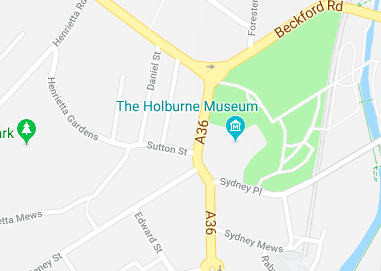
Canal and walks, Sydney Gardens 19th C.This address, opposite Sydney Gardens, allowed Jane easy access to the walking paths along its beautiful grounds, a sop to her country heart. (See image on the right.)

Map of Sydney Gardens and Sydney Place, Bath

Sydney Gardens and Sydney Place

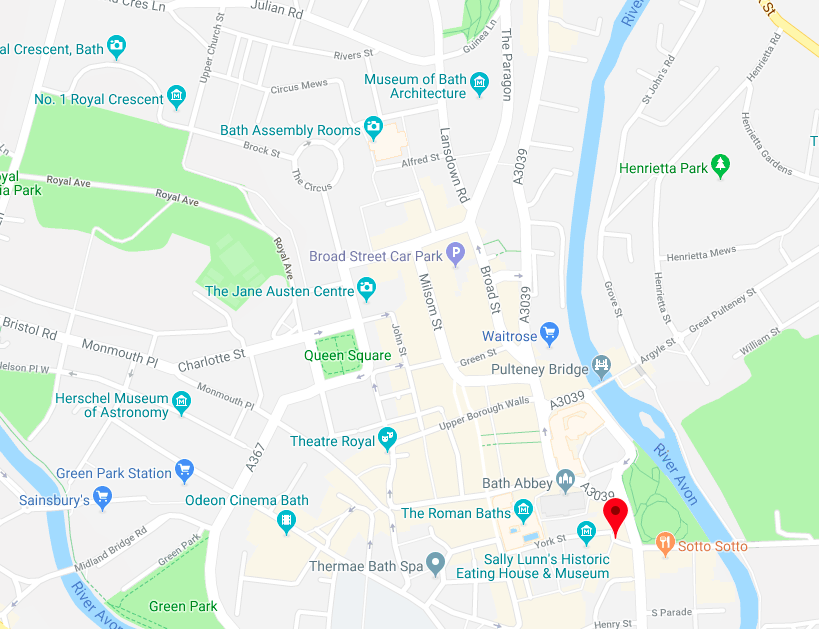
Map of Bath

Main city of Bath, across the Pulteney Bridge from Sydney Place

“Whether you go to see, or to be seen, At Sydney Gardens you’ll be pleased, I ween, Whatever your taste, for prospects or good cheer, Cascades or rural walks, you’ll find them here…”
– Anon, 27 August 1795, poem in local newspaper
–“The History of Sydney Gardens” by Catherine Pitt, The Bath Magazine

Life in the city of Bath was vastly different from life in the country. In Steventon, Mrs Austen oversaw an extensive garden, and used fresh milk from a milk cow and fresh eggs from her chickens to create simple but good food from scratch. She worked alongside her servants in the kitchen and kitchen garden to provide wholesome meals for her family and young boarders, as well as clean clothes and a tidy house. She was a creative poet and a few of her recipes in verse still survive.

If the vicar you treat,
You must give him to eat,
A pudding to hit his affection;
And to make his repast,
By the canon of taste,
Be the present receipt your direction.

First take two pounds of Bread,
Be the crumb only weigh’d,
For the crust the good house-wife refuses;
The proportion you’ll guess,
May be made more or less,
To the size that each family chuses…

(Find the rest of this delightful recipe on this blog at https://janeaustensworld.wordpress.com/2011/04/23/a-receipt-for-a-pudding-by-mrs-austen/)

Imagine the shock this country family felt at having to walk to the green grocer daily, acquire milk from cows kept in city stalls and that was often cut with water, all in an age before refrigeration.


“When proud pied April, dress’d in all his trim,
Has put a spirit of youth in everything.”

yet for the rest of the year the coarse grass is carted to their stalls, or they devour what the breweries and distilleries cannot extract from the grain harvest. Long before “the unfolding star wakes up the shepherd” are the London cows milked; and the great wholesale vendors of the commodity, who have it consigned to them daily from more distant parts to the various railway stations in the metropolis, bear it in carts to every part of the town, and distribute it to the hundreds of shopkeepers and itinerants, who are anxiously waiting to receive it for re-distribution amongst their own customers. It is evident that a perishable commodity which everyone requires at a given hour, must be so distributed.

” –  — from A History of the Cries of London, Ancient and Modern, by Charles Hindley, Project Gutenberg, p 141

This situation for “not so” fresh milk, meat, and vegetables was as similar for the citizens of London as for a small city, like Bath. The Austen’s maid of all work and Austen women purchased “fresh” food on a daily basis, food that was both expensive and often past its “due date.” (Drinking Milk in Regency London, Jane Austen’s World, 2008)

Obtaining decent food supplies in Bath must have been costly for a family living on a parson’s pension. The incessant street cries of the baker, the milkmaid, and other food sellers, even across the Pulteney Bridge in a quieter section of town, must have cut into Jane’s peaceful hours. No wonder her creative juices stalled after her father’s death, as the family moved from place to place (after his pension to his family had been cut off), and before she and her mother and sister found refuge in Chawton Cottage. (Where Jane Lived, Gotta Keep Movin’ blog.)

I confess I possess not a smidgeon of Jane Austen’s writing genius, but the disruption in my life, starting with the years of my father’s slow dying and his death in 2014, and my sweet dog’s sudden fatal illness in 2016, blocked my creative input, both at work and at home.

To be near family, I am moving from a small city with many friends to the suburb of a much larger city., where I know few people. In the process, I am leaving my favorite, unique foodie haunts, small local theater productions, historic city neighborhoods, a short and easy ride to work, and white water rafting downtown on the James River to live in a land of manicured lawns, malls, congested traffic, and national restaurant chains.

Riverside Drive, Richmond, VA

My river walk along the James

Until I regain my footing in early 2019, I don’t anticipate devoting myself to this blog full-time just yet. Thank you, readers, for your understanding. Thank you, Rachel and Tony, for your support.

Vic

Sources:


Read Full Post »

« Newer Posts - Older Posts »