Feeds:
Posts
Comments

Archive for the ‘Regency Period’ Category

Copyright (c) Jane Austen’s World. Inquiring reader: Tony Grant sent me images of Hans Place by way of a personal tour. I am sure he won’t mind my sharing his photos of one of the areas that Jane Austen stayed in when she visited her brother Henry in London. In addition, I have elaborated on other places where Jane Austen lodged when she spent time in London.

Jane visited London as early as 1796. Constance Hill writes in her 1901 book, Jane Austen: Her Homes and Her Friends:
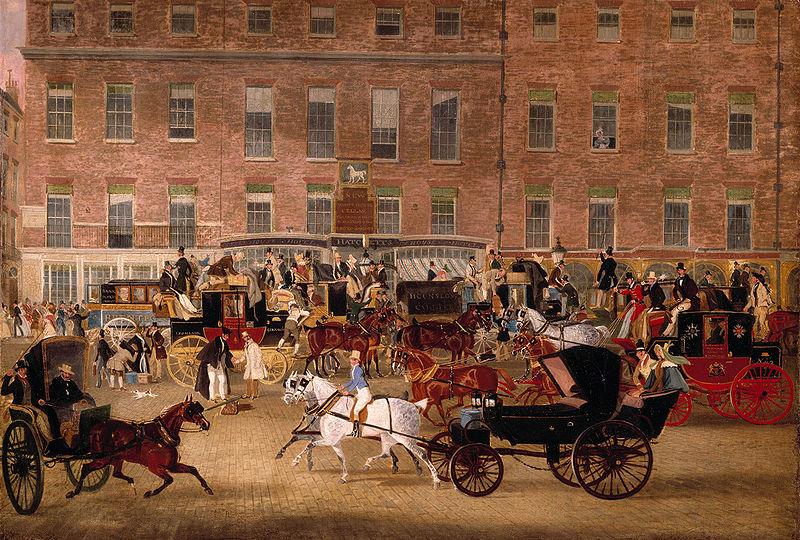
The White Horse Cellar, Piccadilly, by James Pollard

MISS JANE AUSTEN’S acquaintance with London began at an early date, as she frequently passed a few days there when journeying between Hampshire and Kent.
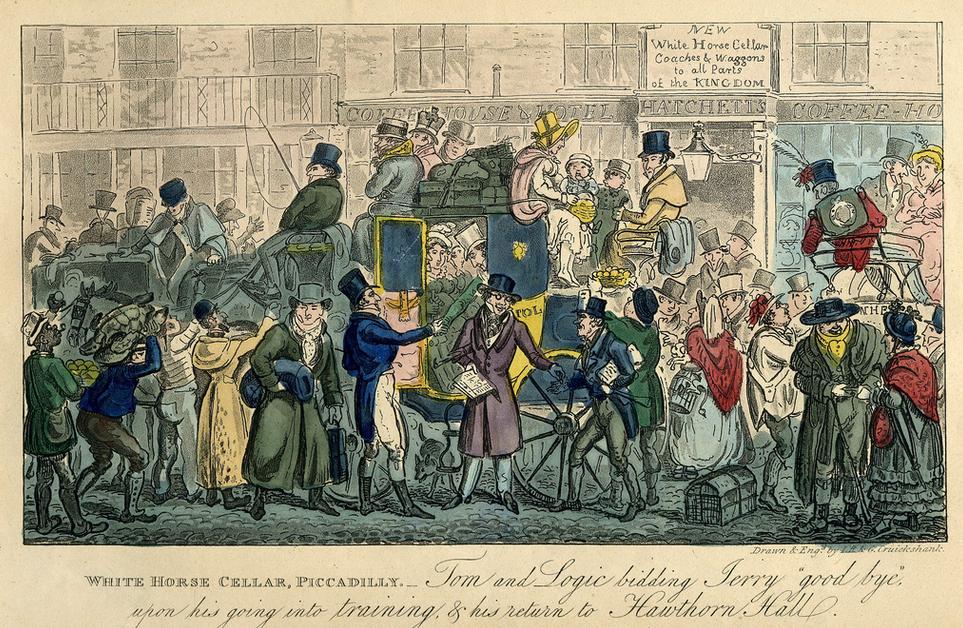
We have mentioned her sleeping at an inn in Cork Street in 1796. Most of the coaches from the south and west of England set down their passengers, it seems, at the “White Horse Cellar” in Piccadilly, which stood near to the entrance of what is now the Burlington Arcade. Jane and her brothers, therefore, probably alighted here and they would find Cork Street, immediately behind the “White Horse Cellar,” a convenient place for their lodging.

Jane visited Town on numerous occasions and stayed with her favorite brother, Henry, and his wife Eliza. Henry not only actively supported his sister’s writing career, but served as her agent, negotiating on her behalf with publishers and printers. When a book required editing and proofing, Jane would visit Henry to accomplish these ordinary, rather time-consuming tasks, Kathryn Sutherland’s opinions notwithstanding.

This post details her visits through Henry’s many moves as he experiences successes and tribulations in his professional and married life. In his varied career Henry served as a soldier in the Oxfordshire militia (1793-1801), a London banker (1801?-1816), and as a curate at Chawton from 1816.

Jane’s visit to Sloane Street, 1811
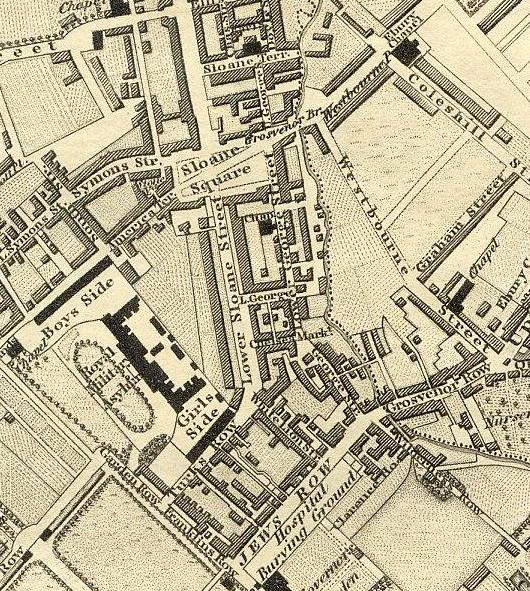
Greenwood's Map, 1827, of Lower Sloane St, Sloane Terrace, and Sloane Square

When Jane Austen visited her brother Henry in 1811, he lived in Sloane Street (today behind Harrods in Knightsbridge). At the time, the street was a wide thoroughfare that connected Knightsbridge with the west part of Pimlico and the east end of Chelsea. The area was still quite rural, for there was no development at the east side of Sloane Street before 1790.  In the late 18th century, the approach to London from this side was still regarded as a dangerous, for the area was rural and dimly lit. Chelsea, in fact, had just recently begun to be engulfed by a burgeoning London, but during Jane Austen’s day, the area was still quite bucolic and rural, as these images attest.
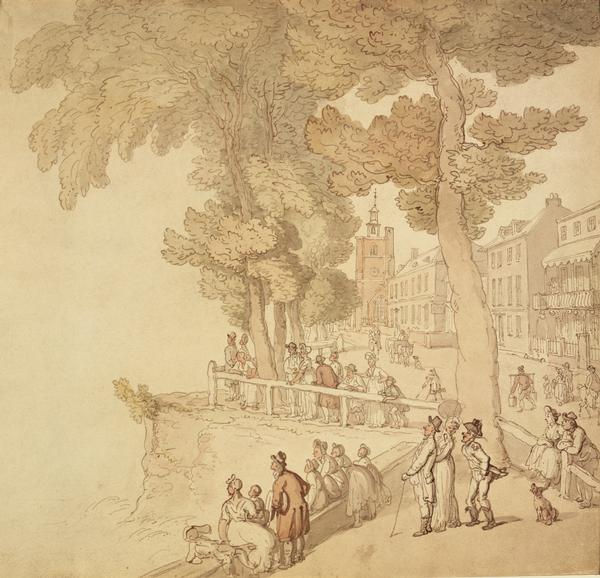
Cheyene Walk, London, late 18th c., early 19th century, People strolling by the banks of the River Thames, in the distance is Chelsea Old Church

In 1796, the Old Dairy was erected, for cows still grazed nearby. The community was filled with gardens, in particular the Physic Garden founded in 1673 by the Worshipful Company of Apothecaries. Throughout these spacious grounds, apprentices learned to identify plants.
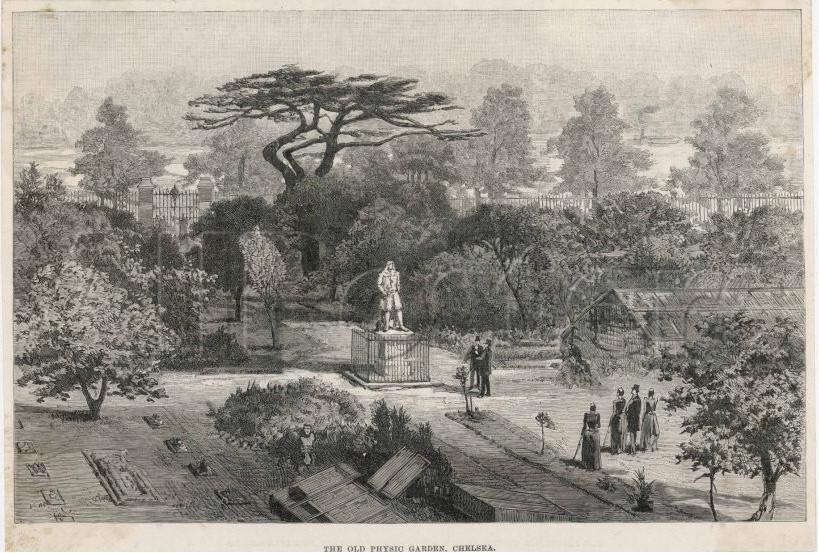
Chelsea, Old Physick Garden

Ranelagh Gardens opened to the public in 1742 as a premier pleasure garden, popular with the wealthy and anyone who could afford a ticket.
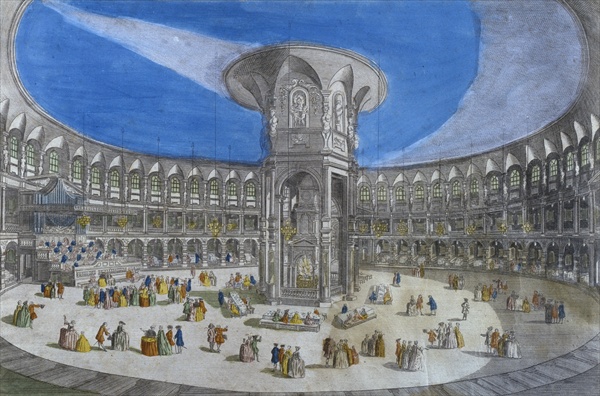
Rotunda, Ranelagh Gardens

King’s Road, so named in the day of  King Charles IIs, was actually a private road that dated back to 1703. It connected Westminster to Fulham Palace, where he took a boat to Hampton Court.  King Charles also used the road to visit his mistress Nell Gwyn. At this time, the royal palace was at Hampton Court and Chelsea was known as the Hyde Park on Thames.
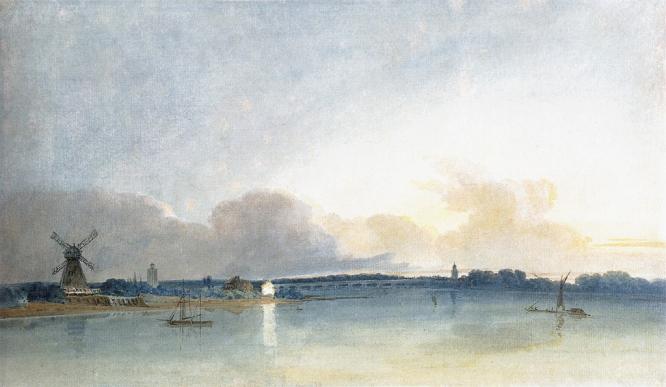
The White House at Chelsea, 1800, Thomas Girtin

By the time Henry Austen moved to Sloane Street the neighborhood had changed enough for Jane to experience pleasant society, although ten years after Jane’s death, Greenwood’s Map (1827) still showed many empty lots and gardens in the vicinity. (See map above.)

While living in Sloane Street, Henry was a successful man:

Henry and two associates had founded a banking institution in London sometime between 1804 and 1806. Austen, Maunde and Tilson of Covent Garden flourished and enabled Henry and Eliza to move from Brompton (where Jane Austen had found the quarters cramped during a visit in 1808) to a more fashionable address and larger house at 64 Sloane Street. Jane’s visits here in 1811 and 1813 were happy events, filled with parties, theatre-going, and the business of publishing Sense and Sensibility and Pride and Prejudice. – Henry Austen: Jane Austen’s “Perpetual Sunshine” by J. David Grey

When visiting her brother, Jane would venture into Town to shop and visit the theatre (Read Tony Grant’s article about Jane Austen and the Theatre).  Henry and Eliza were a fun-loving  and popular couple, and from Jane’s description in a letter below,  they knew how to throw a party:
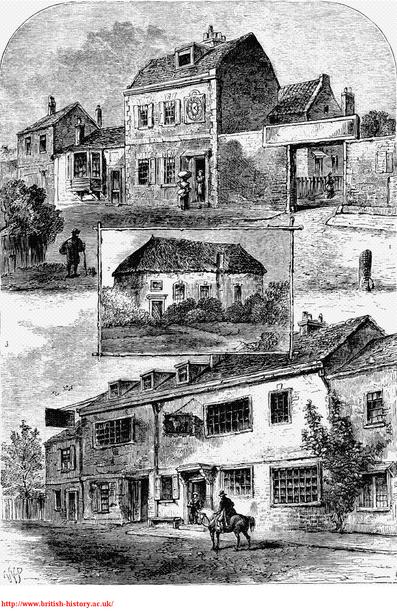
Old Chelsea, 1750. Clock House, Moravian Chapel, White Horse Inn Image from @BritishHistoryOnline

“Our party went off extremely well. The rooms were dressed up with flowers, &c., and looked very pretty. . . . At half-past seven arrived the musicians in two hackney coaches and by eight the lordly company began to appear. Among the earliest were George and Mary Cooke, and I spent the greatest part of the evening very pleasantly with them. The drawing-room being soon hotter than we liked, we placed ourselves in the connecting, passage, which was comparatively cool, and gave us all the advantage of the music at a pleasant distance, as well as that of the first view of every new comer. I was quite surrounded by acquaintance, especially gentlemen.”

She went on to describe the music as extremely good and “included the glees of ‘Rosabelle,’ ‘The Red Cross Knight,’ and ‘Poor Insect.’ Wiepart played the harp and Miss Davis, all dressed in blue, sang with a very fine voice.”
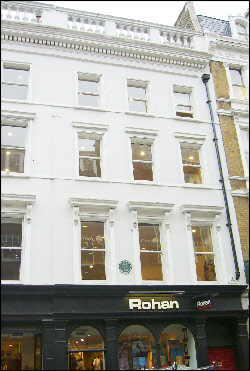
Henrietta Street today

Henrietta Street, 1813

In 1813, Henry, who was four years older than Jane, lost his wife after a painful and debilitating illness. In contrast, his Uncle Leigh Perrot and brother Edward helped to secure his appointment as Receiver-General for Oxfordshire,  a most definite honor. Soon after Eliza’s death, Henry moved to rooms over Tilson’s bank on Henrietta Street in Covent Garden, a location more centrally located in London.

Both Jane and Fanny Knight, their niece, visited him there in the spring of 1814, when Mansfield Park was with the publisher.
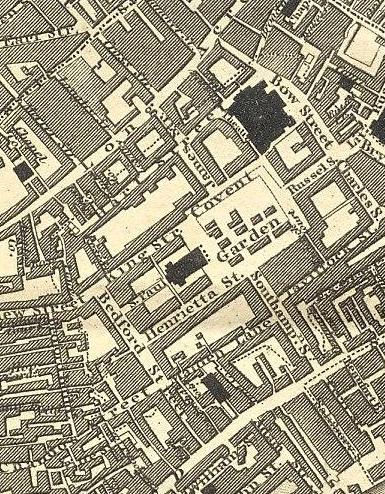
Henrietta Street Covent Garden 1827

As was the custom, Jane brought lists of items to purchase  in Town for those who had remained behind in the countryside. In her biography, Constance Hill writes about Jane’s shopping experience:

“I hope,” she writes to her sister, “that I shall find some poplin at Layton and Shear’s that will tempt me to buy it. If I do it shall be sent to Chawton, as half will be for you; for I depend upon your being so kind as to accept it . . . It will be a great pleasure to me. Don’t say a word. I only wish you could choose it too. I shall send twenty yards.” Layton and Shear’s shop, we find, was at 11, Henrietta Street, Covent Garden.

Hans Place, 1814

In 1814, Henry moved from his rooms above his bank to a house he purchased in Hans Place in Knightsbridge. The area was situated near his old quarters on Sloane Street, where he and his wife had spent such a pleasurable time together.
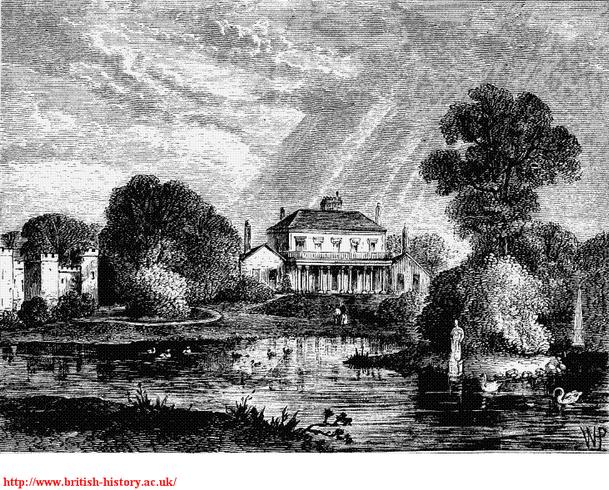
Hans Place, The Pavillion, 1812. Image @British History Online

Today, the area, developed by Henry Holland, looks much different than when Jane and Henry knew it (see the image below), but the gardens are not much changed.
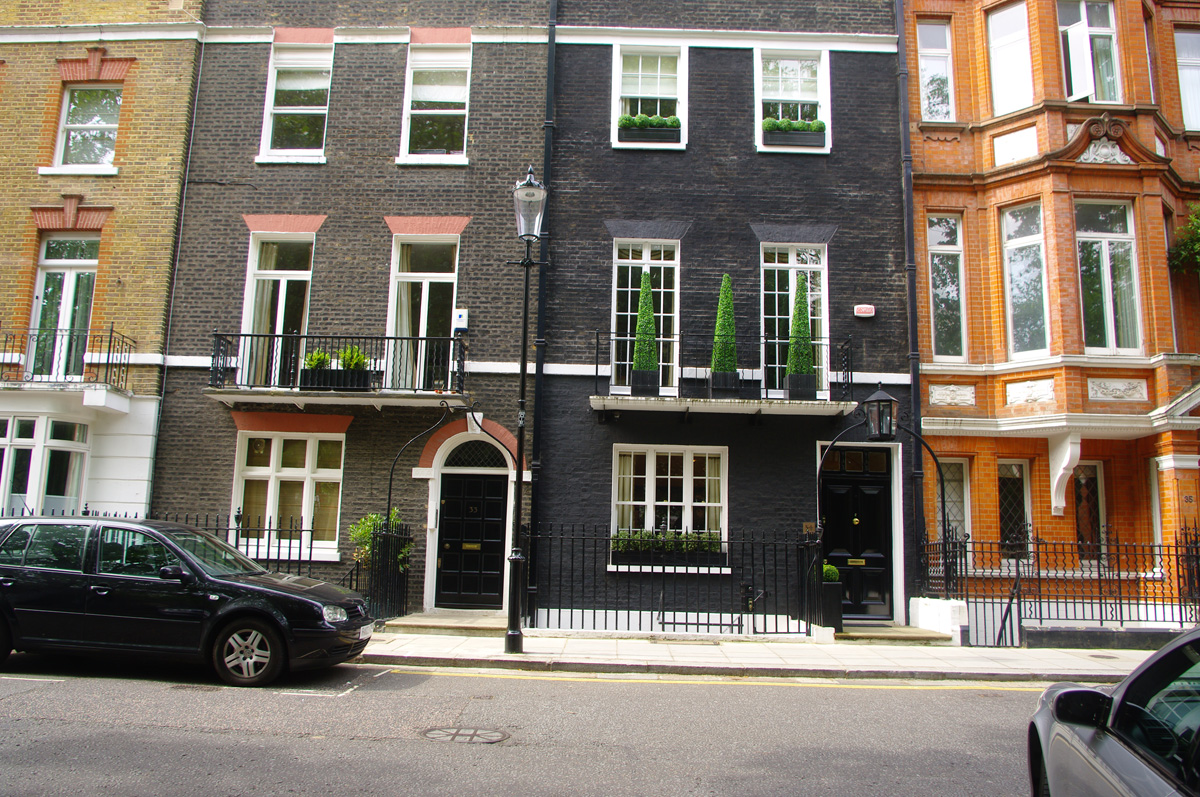
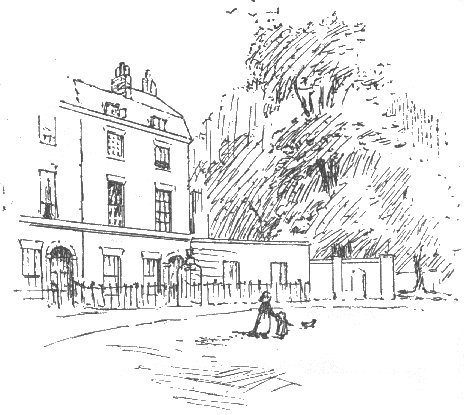
How Henry Austen's house must have looked. Image @TonyGrant
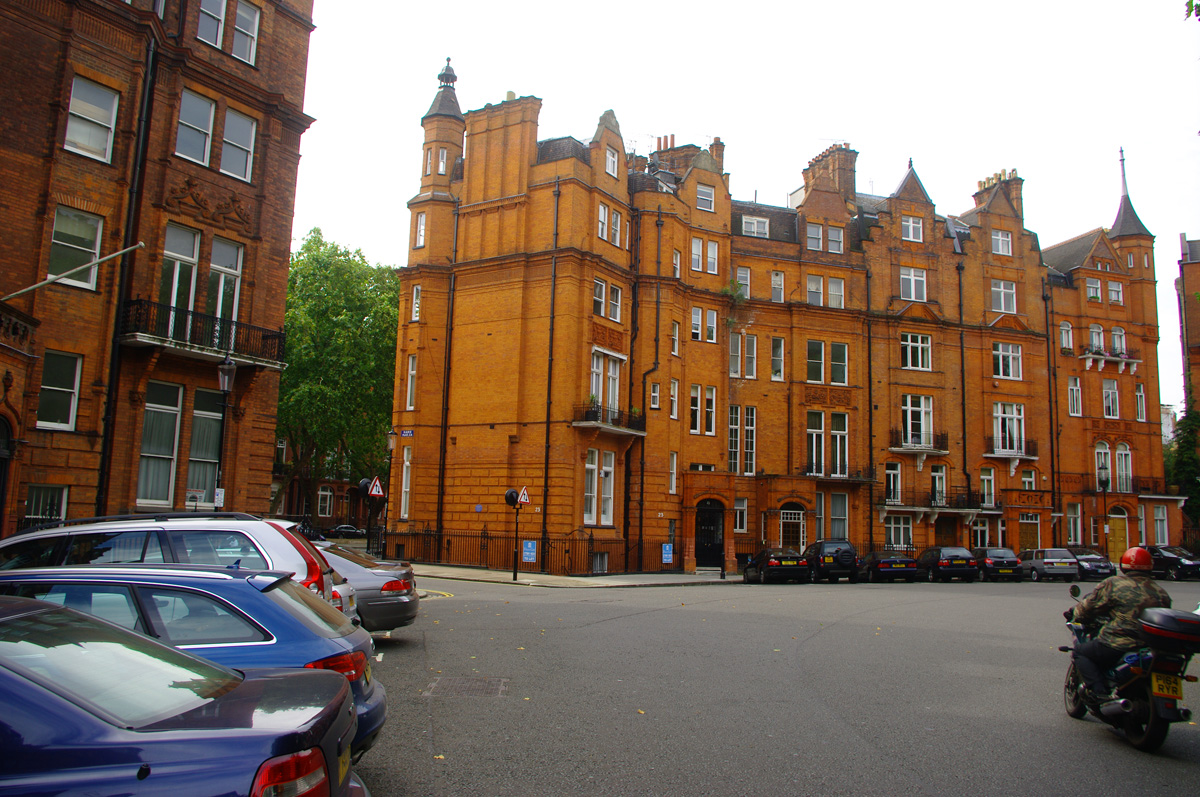
#23 Hans Place is on the corner. The location today.

Jane found #23 Hans Place delightful and Henry’s new house more than answered her expectations. She also admired the garden greatly. In the early part of the 19th century, Sloane Square was an open space enclosed with wooden posts, connected by iron chains. (British History Online)
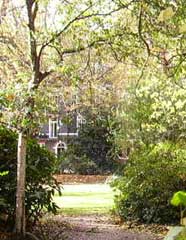
Hans Place garden

In Hans Place, Jane had the use of a downstairs room that opened onto the garden, and she describes her pattern of working indoors, then taking a break in the garden: “I go & refresh myself every now & then, and then come back to Solitary Coolness.” I like Claire Tomalin’s comment in her biography of Jane Austen (1997) that this is “very much what someone settling down to write does, getting up, pacing, thinking, returning to the page she is working on.” – My Long Jumble, Sarah Emsley
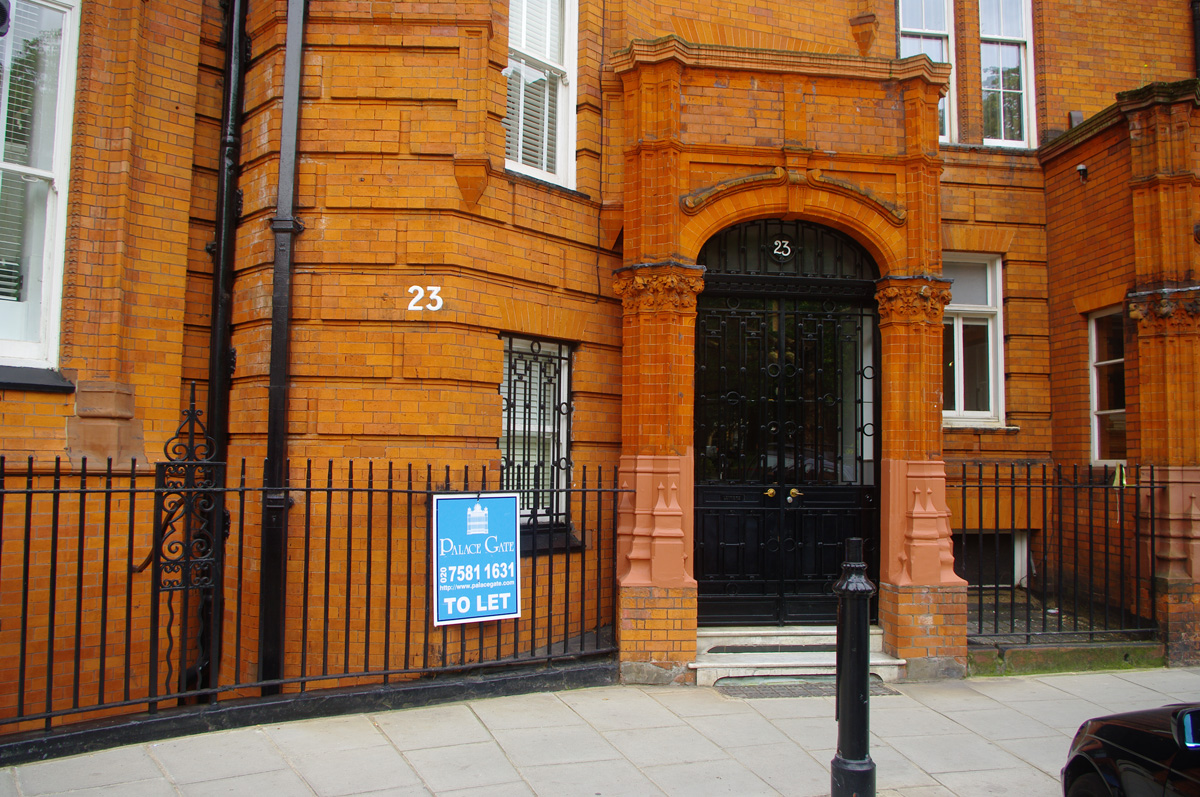
Door to #23 Hans Place today. Image @TonyGrant

Jane visited Henry in Hans place twice, once in 1814, and for a more extended period from October to December in 1815, when she was preparing Emma for publication. During this visit, Henry became seriously ill and Jane nursed him back to health. She also famously visited the Prince Regent’s library at Carlton House during Henry’s recuperation.
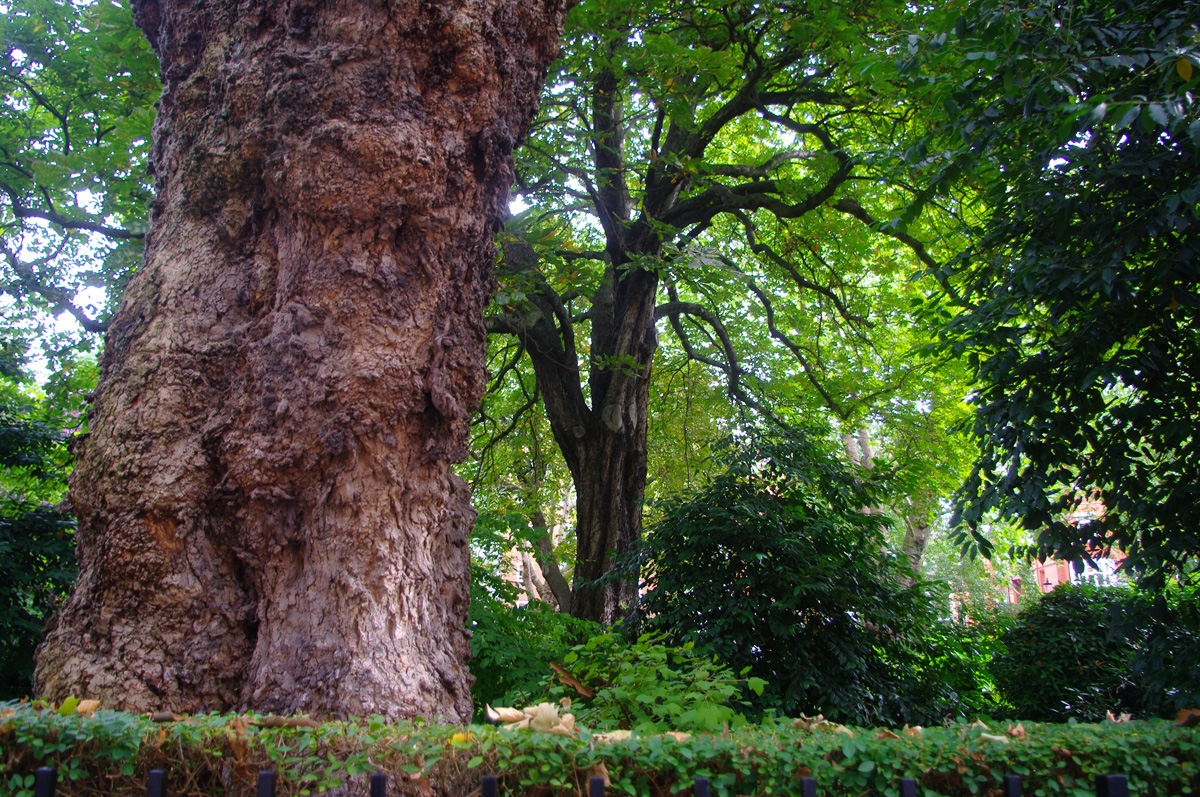
London plane trees in Hans Place, image @TonyGrant

Constance Hill writes in her biography: “… we are also told “that Hans Place” was then “nearly surrounded by fields…We hear of a small evening party to be given in Hans Place whilst Fanny is staying there with her aunt. After describing the morning engagements, Jane writes: “Then came the dinner and Mr. Haden [the apothecary who was instrumental in arranging Jane’s invitation to Carlton House] , who brought good manners and clever conversation. From seven to eight the harp; at eight Mrs. L. and Miss E. arrived, and for the rest of the evening the drawing-room was thus arranged: on the sofa the two ladies, Henry and myself, making the best of it; on the opposite side Fanny and Mr. Haden, in two chairs (I believe, at least, they had two chairs), talking together uninterruptedly. Fancy the scene! And what is to be fancied next? Why that Mr. H. dines here again to-morrow. . . Mr. H. is reading ‘Mansfield Park’ for the first time, and prefers it to P. and P.”
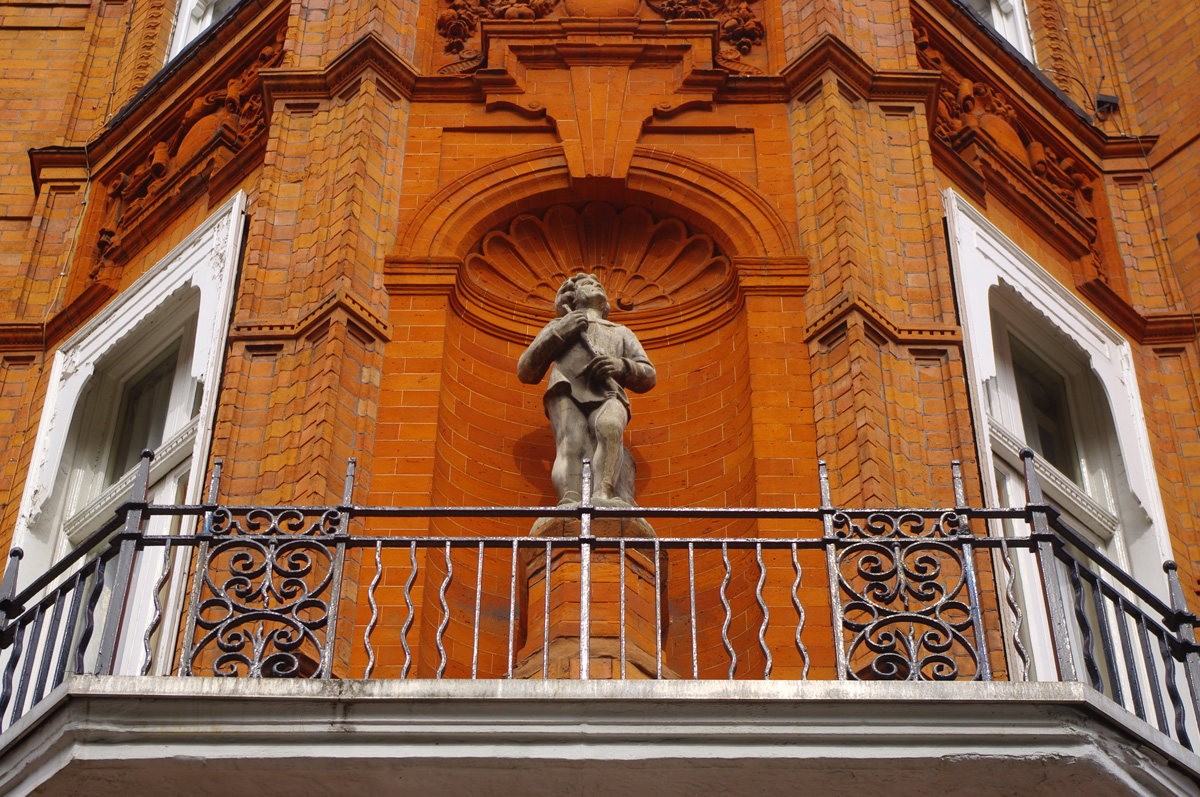
Corner of #23 Hans Place. Image @TonyGrant
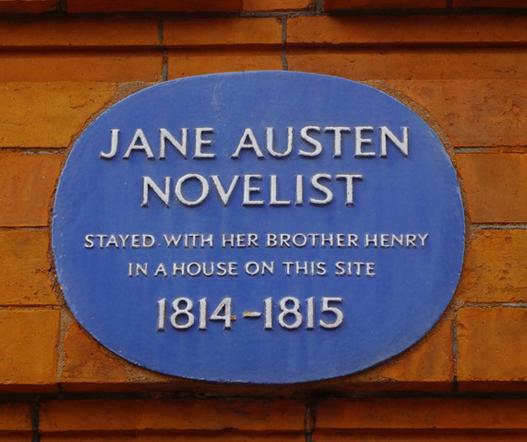
Since Henry lived in #23, Hans Place has been redeveloped. Only numbers 15, 33 and 34 still survive as they once were, but the garden that Jane liked so much remains largely intact in its arrangement. The original railings, however, no longer survive, having been molten down for their iron in World War II.
Only months after Henry recovered from his illness, his bank crashed, bankrupting him and placing a number of his Austen siblings in financial distress. Henry soon became a curate at Chawton. After this period, no more visits by Jane to London are recorded. Today, two of Henry’s residences, the one on Henrietta Street and #23 Hans Place, are  still easy for visitors to tour during a short London excursion.
More on the topic:

Houses in Hans Place drawn by Ellen G. Hill, 1901
Read Full Post »

Copyright (c) Jane Austen’s World. A fine mist and cool air will  greet my dog and me on our morning walk. I intend to put on a thick short coat and scarf, and faux fur lined boots. How would my Regency counterpart have dressed in November, 1810, precisely 200 years ago?

More elegantly, I decided. While I putter on my computer in my jammies and robe, and sip coffee upon first rising, my Regency counterpart would have sipped hot chocolate from a delicate china cup and written letters, read from a book, or practiced on the pianoforte, as Jane Austen was wont to do in the early morning.

The maid would have started a fire in the morning room, but the house overall would have felt much cooler than it did even a month ago. A Rumford stove, which was becoming quite popular, would have retained  more heat, but as you can see, our Regency miss is swathed in a cap, long sleeved dress, and a high-necked chemisette. She wears gloves, stockings, and thin slippers. Layered as she is (for she probably wore a corseted petticoat underneath her ensemble and perhaps even a chemise), she would have felt comfortably warm. Had she still felt cold, she could opt to throw a thick shawl around her shoulders and a small throw over her lap.

Morning dress, or undress, were dresses worn by ladies who expected to be seen only by close members of the family or guests in the home. They were never meant to be seen by visitors. Undress outfits, especially in more modest households where women worked alongside their servants, preparing vegetables or overseeing household duties, gardening and the like, were covered by aprons and pinafores.

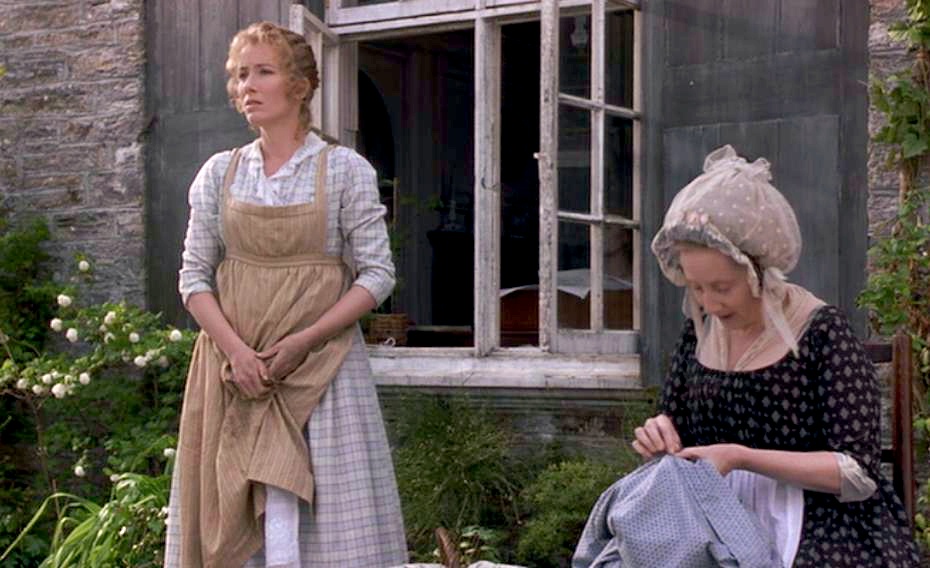
In this image from Sense and Sensibility 1996, Elinor and Mrs. Dashwood are shown wearing undress. As soon as Edward Ferrars nears the house, the women tidy themselves, taking off their aprons, and making sure they look neat and presentable. They would not have had time to change into nicer outfits, nor would they have likely had many choices of dress to choose from.

Some Regency ladies who stayed at home all day would remain in a state of undress until dinner, when they changed into a gown suitable for the dinner table. Others would change their outfit much sooner, when they were ready to leave the house or if they had arranged to receive visitors. After I finish writing this post, I shall put on my half-dress, replacing my morning robe with a walking outfit consisting of a hooded sweatshirt, long-sleeved t-shirt, jeans a short coat and a scarf. I’ll exchange these outdoor exercise clothes with a more formal office look for work, which means that I will have worn three outfits by nine a.m.

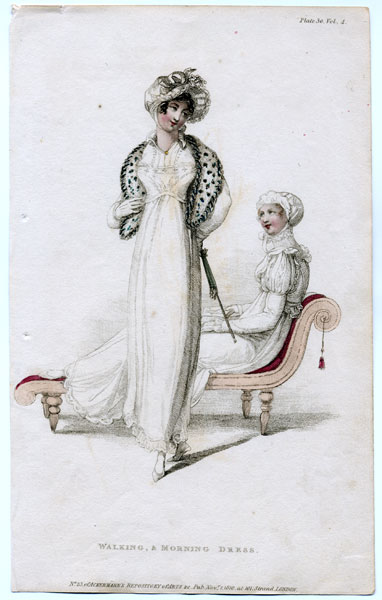
My Regency counterpart would also change her outfit. A lady of fashion would look vastly more elegant  in her walking outfit with its little fur tippet artfully arranged over a long-sleeved spencer jacket than me in my walking suit. If she was married or a spinster, she would place her  jaunty hat with its  soft capote crown over a cap, whose lace trim would peep out from beneath the hat’s brim. Sturdier leather slippers, leather gloves, a reticule and umbrella or parasol would complete the ensemble.

A middle class lady would look less modish than the idealized women depicted in Ackermann’s Repository, which was the Vogue magazine of its day. She would have fewer clothes to choose from, and most likely possessed only one walking outfit instead of a variety, and certainly not in the first stare of fashion.

Whatever her social background, our Regency lady was now ready to meet the world and visit friends, go shopping, or generally run errands outside of the house. The walking outfit in the Ackermann plate provided sufficient layers for a lady to stay warm during her walks and errands. Should the November day turn particularly windy and wet, she would most likely trade the tiny fur tippet for a more substantial shawl or cloak. The middle class Regency lady might trade her shawl for her only cloak, which she would keep for years until its usefulness was outworn.

More on the topic:

Read Full Post »

“Now, Edward,” said [Marianne], calling his attention to the prospect, “here is Barton valley. Look up it, and be tranquil if you can. Look at those hills! Did you ever see their equals? To the left is Barton park, amongst those woods and plantations. You may see one end of the house. And there, beneath that farthest hill, which rises with such grandeur, is our cottage.”

“It is a beautiful country,” he replied; “but these bottoms must be dirty in winter.”

“How can you think of dirt, with such objects before you?”

“Because,” replied he, smiling, “among the rest of the objects before me, I see a very dirty lane.”

“How strange!” said Marianne to herself as she walked on.

“Have you an agreeable neighbourhood here? Are the Middletons pleasant people?”

“No, not at all,” answered Marianne, “we could not be more unfortunately situated.”

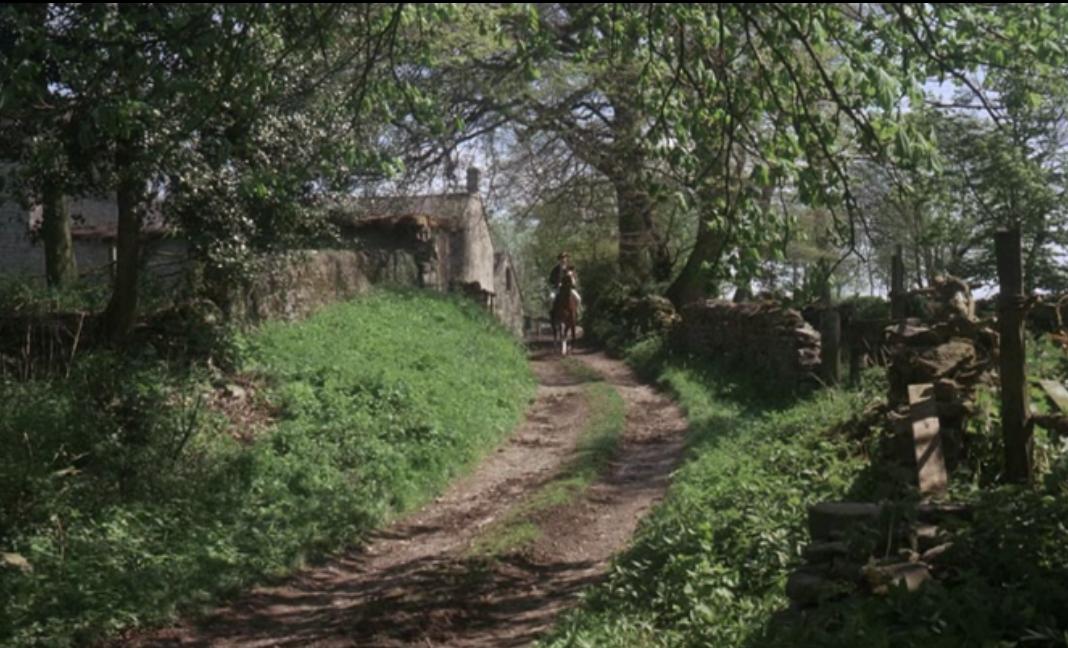
Country lane, Barry Lyndon

I had the leisure of viewing Stanley Kubrick’s Barry Lyndon the other day, I say leisure, for the film is over three hours long and I took the opportunity to pull images. These two stills of country roads reminded me forcibly of the difference between Marianne’s histrionic behavior in Sense and Sensibility and Edward’s reactions during a time when both characters are experiencing extreme disappointment in their love lives.

Marianne has completely given over to her emotions after Willoughby departs, and Edward struggles to hold up his chin, knowing he is in love with Elinor but is bound by his engagement to Lucy Steele. His view of the landscape is utilitarian. He sees none of the sweep of grandeur and only the practical aspects of the scene below and can only imagine it in the winter, when roads are rutted and muddy. Throughout Sense and Sensibility, Marianne expresses picturesque point of views. In this scene in particular, she also demonstrates her youth and immaturity, giving Edward a churlish answer about their new neighbors, which, while perhaps  true, the sensible Elinor would never admit.

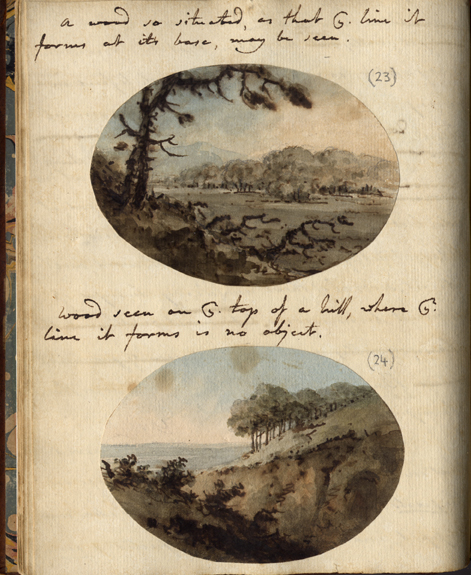
William Gilpin was instrumental in promoting the Romantic picturesque movement, which defines an aesthetic sensibility of a charming or quaint scene. Marianne Dashwood, whose personality tends towards the melodramatic, embraces the fashion for the picturesque ideal, whereas both Elinor Dashwood and Edward Ferrars represent a more practical viewpoint which depends less on the sublime and relies more on what their experiences and restrained personalities tell them to feel.

Gilpin's watercolor shows how best to achieve a picturesque effect through the clumping of trees.*

The following quote about William Gilpin’s influence on this new aesthetic movement is from the aptly titled, Penny cyclopaedia of the Society for the Diffusion of Useful Knowledge, Volumes 11-12, Charles Knight, London, 1838, p. 222:

But Mr Gilpin was a person of a remarkably refined taste, as is evinced by writings of his, of a class entirely distinct from those we have enumerated. These are his volumes in which he has illustrated, both by his pencil and his pen, the picturesque beauty of some parts of England, and generally the principles of beauty in landscape. The first of these works was published in 1790 in two volumes 8 vo; it was entitled Observations relative chiefly to Picturesque Beauty, made in the year 76 in several parts of Great Britain, particularly the Highlands of Scotland. This was followed by two other volumes of the same character, the greater part of them relating to the lake country of Cumberland and Westmoreland. Two volumes more on Forest Scenery succeeded. Besides these there are his Essays on Picturesque Beauty, Picturesque Travels, and the Art of Sketching Landscapes; Observations on the River Wye; and Picturesque Remarks on the Western parts of England. These form a body of works which were well received by the public at the times of their appearance, and which are now gathered into the libraries of the tasteful and the curious, so that copies rarely present themselves for public sale.”

The picturesque ideal expressed itself in literature, poetry, and paintings, and its influence could still be felt in the romantic paintings that depicted the natural beauty of America’s vast landscapes, such as the Hudson River School of painting.

Excellent posts about the topic are found in the following blogs:

*William Gilpin, How to Clump Trees, Bodlein Library

Read Full Post »

What can be more appropriate than to discuss body snatching on the very weekend of All Hallow’s Eve, when witches and goblins and ghosts wander throughout the night? This post will offer a variety of facts about grave robbers, resurrectionists, and sack-em-up gentlemen who haunted cemeteries, waiting for a fresh body to snatch.

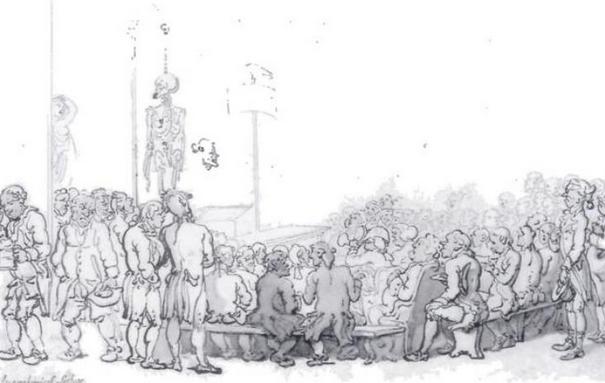
Anatomical Lecture, Thomas Rowlandson

Since the 15th century, British anatomists have been on the hunt for fresh cadavers to dissect and study. By the 18th century medical students were expected to gain practical knowledge of the human body through dissection as a pre-requisite for becoming licensed surgeons. It was the custom to study the corpses of criminals who had been executed for murder, but with the proliferation of medical schools, demand for anatomical specimens outpaced the supply. Medical students turned to stealing corpses for their own use, and thus, during this early period of body snatching, grave robbers belonged primarily to the class of ‘gentlemen’.

Reconstruction of Inigo Jones's Barber Surgeons anatomy hall, 1636

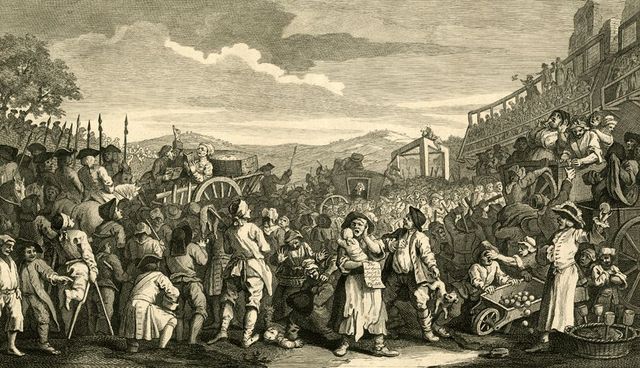
“By 1820 statutes defining crimes with capital punishments numbered over two hundred. In the words of barrister Charles Phillips, “We hanged for everything- for a shilling- for five shillings- for five pounds- for cattle- for coining- for forgery, even for witchcraft- for things that were and things that could not be”. An act of Parliament during 1752 further outraged the public by making hanging in chains or dissection of those condemned to death for murder mandatory. – Canadian Content

Executions of murderers provided fresh fodder for anatomists

“The gruesome trade [of Resurrectionists] was driven by laws which only permitted the bodies of executed criminals to be used for medical science at the height of the Enlightenment. But with only about 50 executions being carried in London every year and a lack of refrigeration meaning that specimens rapidly putrefied, demand for about 500 bodies each year far outstripped supply.” – The Independent

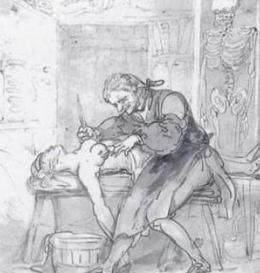
Thomas Rowlandson, The Persevering Surgeon

The laws for grave robbing had not quite caught up with the times, for those who carried away an unclothed body could not be touched, but if they so much as took one sock or piece of clothing with it, they could be hung. The corpse was hastily stuffed in a sack, and hauled to the nearest medical school before the robbery was detected.

Rowlandson, The Resurrectionists, 1775

Medical students and their professors snatched bodies throughout the 18th and 19th centuries, but due to a lucrative business, an entirely new criminal element emerged: the resurrection men or gang of grave robbers. Many of these men made quite a tidy living. Resurrectionists were so efficient and became so indispensible to anatomists, that prominent physicians and surgeons would often exert their influence to keep them out of jail:

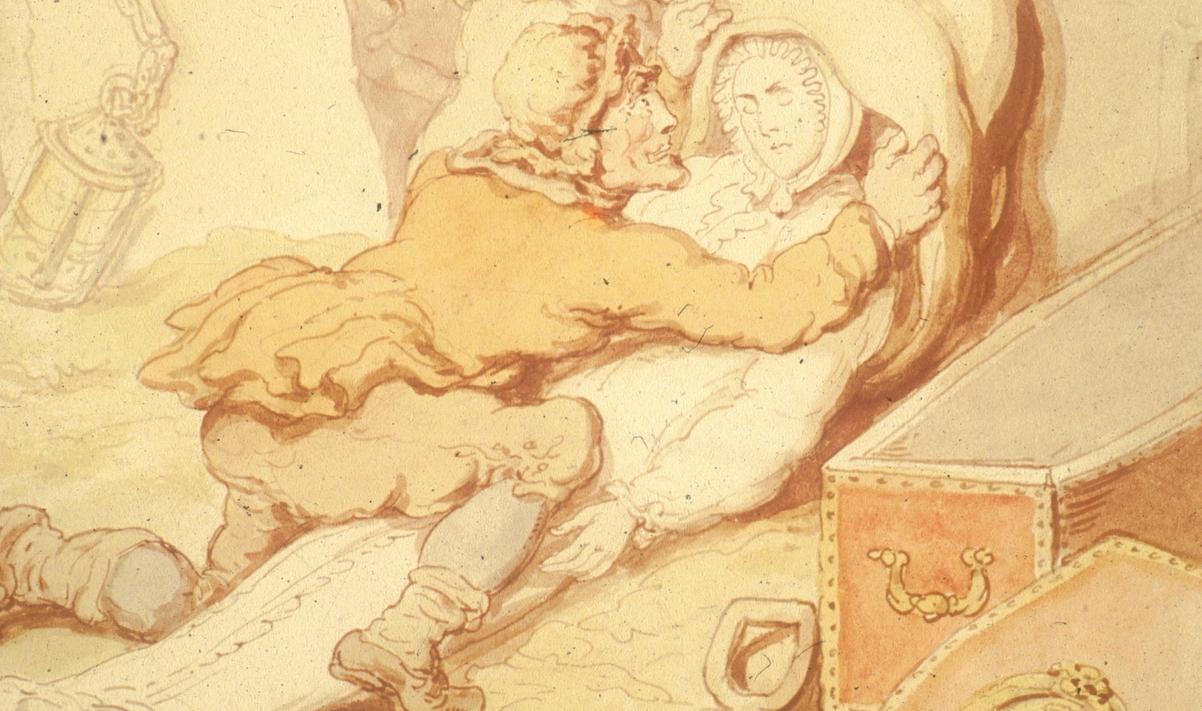
Detail of The Resurrrectionists by Rowlandson

“Typically, a member of the gang, or his wife, would spend the day loitering in a likely graveyard waiting for a funeral…At night, two members of the gang would appear and, after carefully laying a sheet on the ground, would uncover the head portion of the grave, dumping the loose dirt on the sheet. The body would be pulled from the coffin head first with ropes, the shroud stuffed back in the grave, and the dirt carefully replaced.” – Body Snatching: A Grave Medical Problem, p 401

The business of selling bodies was such a good money maker that some people even kidnapped and murdered children in order to sell their bodies to the highest bidder.  One such prolific grave robber was John Bishop, who was actually tried and convicted of murdering a 14 year old boy for the purposes of selling him to a surgeon. All together Bishop admitted to stealing between 500 and 1000 corpses and of murdering 3 people to sell their bodies, although that number could be higher.  – Histatic blog

Lamp in Mallusk Cemetery for relatives who stood watch over the dead.

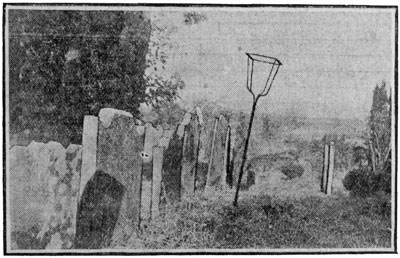
Look out posts in cemeteries were common, and relatives took turns watching the graves to protect their recently buried loved ones. “In the centre of the ancients have it all to themselves. Here we are in a bygone age. There is a thin iron standard with a lamp frame — a famous relic of the body-snatching days. They had no watch-house here, and so the relatives of the recently-interred lighted the lamp and sat by the graveside every night for the usual period.” –  Mallusk Burying Ground

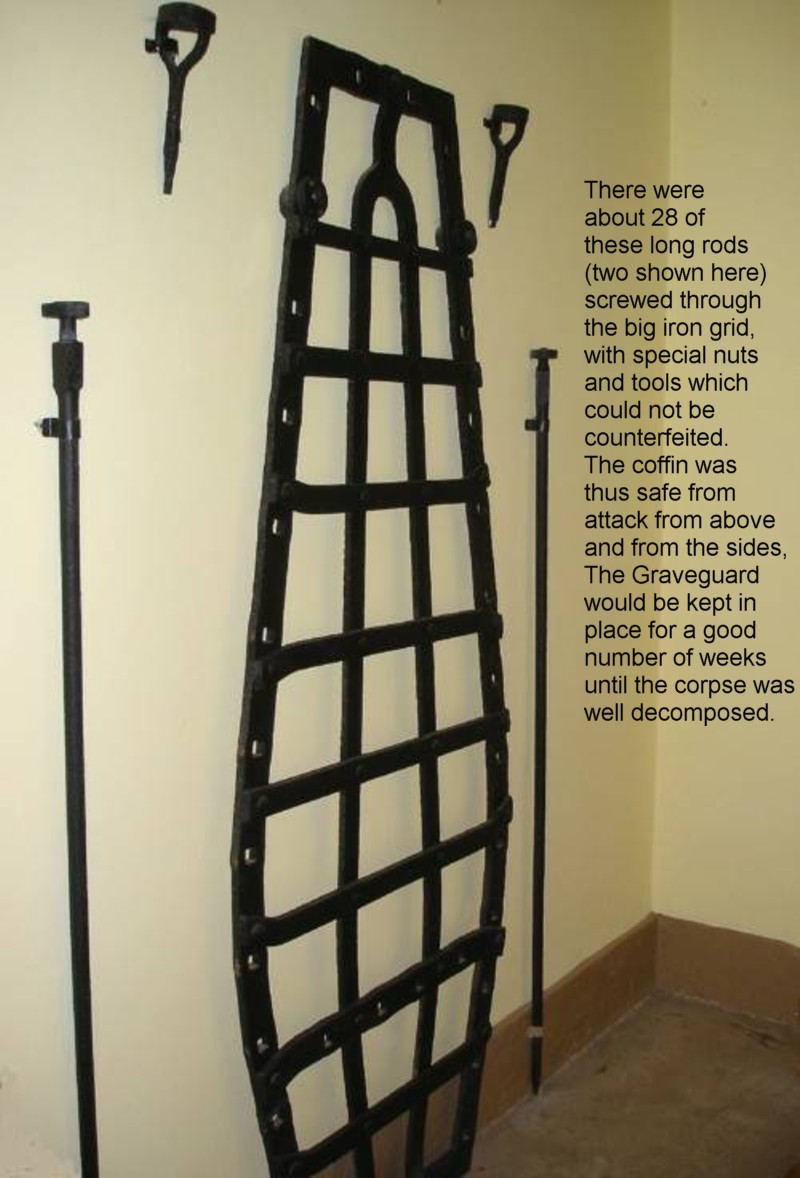
Iron grill to detract body snatchers

The families of the dead tried to purchase robber-proof coffins made with metal. There was a catch, however. Only the very rich owned the land in perpetuity in which they were buried. While their vaults could be secured and reinforced, ordinary people were buried in plots of land that were reused time and again. Thus, wrought iron and metal coffins designed to stave off grave robbers made the practice of recycling bodies in one plot impossible, and many cemeteries began to refuse such reinforced coffins.

Inventions to protect the dead.**

“Opposition to the body-snatchers took many forms. Mourners often set spring guns and other booby traps over fresh graves to discourage the body-snatchers, and it was not uncommon for relatives to mount a night watch over a fresh grave for 2 or 3 weeks until the body had decomposed sufficiently to be useless for dissection.” – A Grave Medical Problem, p. 403

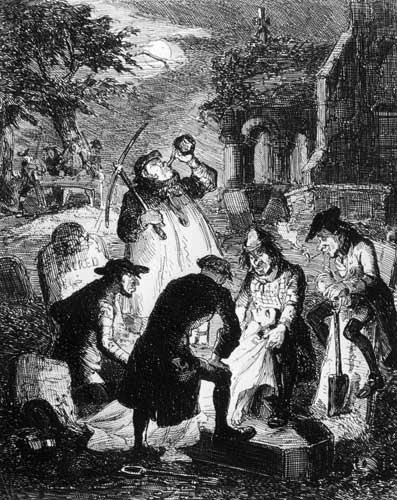
Resurrectionists at work

In Richmond, Virginia, 19th century Resurrectionists had only 10 days in which to procure a newly buried body. If the robbers waited longer, the body would be too putrid to be useful. The best months for grave robbing and dissection in Richmond were between October and March, when the weather was cool enough to slow down the rate of decomposition.

Robbing a body under stealth of night

One assumes that the bodies were dead before they were delivered to anatomists. This was not always the case, as in this incident in 1816, when the subject delivered to Mr. Brooke’s Theatre of Anatomy was still very much warm and alive:

“October 21st Marlborough Street.  It was stated yesterday that a most extraordinary affair happened at Mr Brooke’s The Theatre of Anatomy Blenheim Street. On Sunday evening a man, having been delivered there as a subject, a technical name for a dead man for dissection in a sack, who, when in the act of being rolled down the steps to the vaults, turned out to be alive, and was conveyed in a state of nudity to St James’s Watch house.

Curiosity had led many hundreds of persons to the watch house, and it was with difficulty the subject could be conveyed to this Office, where there was also a great assemblage. The Subject at length arrived. He stated his name to be Robert Morgan, by trade a smith. John Bottomley, a hackney Coachman, was charged also with having delivered Morgan tied up in the Sack. The Subject appeared in the sack in the same way in which he was taken, with this difference, that holes had been made to let his arms through.

The evidence of Mr Brookes afforded much merriment. He stated that on Sunday evenin,g soon after seven o clock, his servant informed him, through the medium of a pupil, that a coachman had called to inquire if he wanted a subject from Chapman, a notorious resurrection man. Mr B agreed to have i,t and in about five minutes afterwards a Coach was driven up to the door, and a man answering to the description of Bottomley brought Morgan in a sack as a dead body, laid him in the passage at the top of the kitchen stairs, and walked away without taking any further notice. On Harris witness’s servant taking hold of the subject’s feet, which protruded through the bottom of the sack, he felt them warm and that the subject was alive.

Here the prisoner Morgan, who seems to have enjoyed the narrative with others, burst out into a fit of laughter.

Mr Burrowes, the Magistrate – ” Is it usual, Mr Brookes, when you receive a subject, to have any conversation with the parties who deliver it?”

Mr Brookes – ” Sometimes, but dead bodies are frequently left, and I recompense the procurers at my leisure.”

Mr Brookes resumed his evidence, and stated that he put his foot upon the sack ,upon being called by his servant, and kicked it down two steps, when the subject called out: “I m alive,”  and forcing half his naked body out of the sack threw the whole house into alarm. –  Social England Under the Regency, Vol 2, John Ashton, 1816, p 114

Burke and Hare turned to killing their victims in order to supply medical schools with fresh fodder

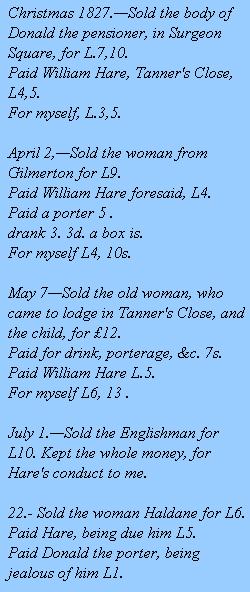
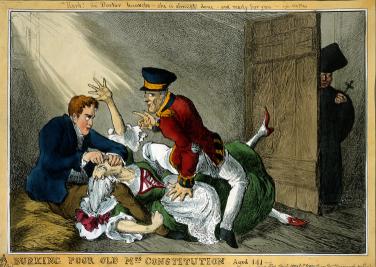
William Burke and William Hare, infamous body snatchers from Edinburgh, Scotland, delivered bodies that were remarkably fresh. It turns out that in their zeal to earn a quite comfortable living, they murdered at least 17 victims.

Partial account of the bodies Burke disposed of and sold*

Over time, anatomists began to recognize the bodies the two men delivered but kept silent about their suspicions. Burke tempted fate one time too often. On Halloween night in 1827, he met Mrs. Docherty at a bar and persuaded her to drink with him at his lodgings. After much jollying and merriment, he killed the woman (his favorite method was suffocation, so as not to leave a mark).

Burke and Hare hard at work

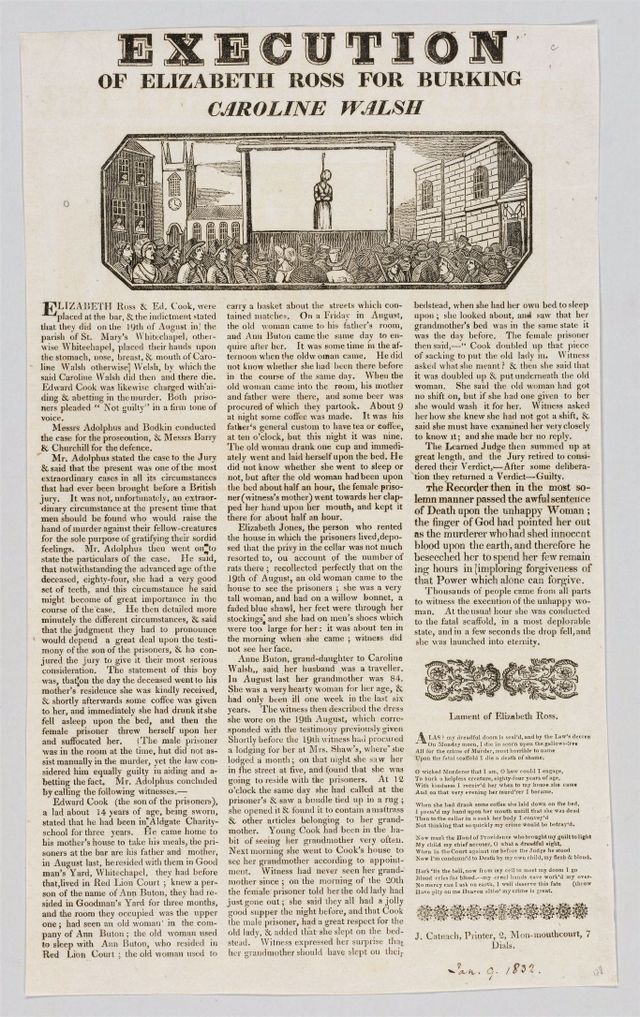
But Burke was so drunk and addled that he was unable to dispose of her body in a timely manner. His landlady and neighbors discovered poor Mrs. Docherty’s body the following day, and Burke was made to stand trial. The public was incensed upon learning that Burke and Hare killed their subjects, and from then on the act of killing people to obtain biological specimens for anatomists was known as Burking.

Burking became a verb. Click on image to read the article

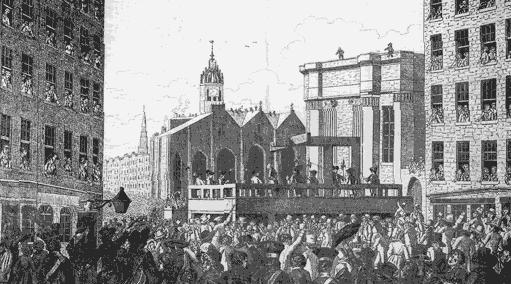
Burke and Hare were arrested in 1828. Hare turned king’s evidence, and Burke was found guilty and hanged at the Lawnmarket, the Royal Mile, on the 28th January 1829. Burke’s body was publicly dissected at the Edinburgh Medical College and his skeleton, death mask, and items such as a leather wallet made from his tanned skin are now displayed at the Royal College of Surgeon’s museum. –   Burke and Hare

Execution of William Burke

The story is so fascinating, that it has been filmed and covered in the press repeatedly. Watch this preview of a film on Burke and Hare by John Landis that will make its debut in the UK first.

Over time, public outrage over body snatching and the abuses with the Royal College of Surgeons and the hospitals in relation to the resurrectionist trade became such that Parliament passed the Anatomy Act in 1832, which sanctioned the delivery of the corpses of any unclaimed dead to anatomy schools. During this period, hospitals were considered death houses, and all but the most desperately ill people avoided going to them. People also avoided dying in workhouses for fear of having their bodies claimed for dissection. While the practice of dissection was legitimized by this act, poor people were still fearful of having their bodies “snatched”, albeit legally.

Burke's skeleton on view. As justice would have it, his body was studied by anatomists.

More on the topic:

Read Full Post »

( A discussion about what friendship might be. A few thoughts and considerations while writing about Jane and Martha. You might agree. You might not. I am open for criticism. Guest writer Tony Grant of London Calling)

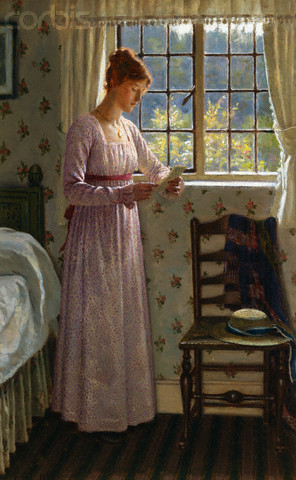
The Letter, Edmund Blair Leighton

Jane Austen didn’t marry. There are suggestions she did have love affairs but they did not come to fruition. Did this make her human experience less than those who have the love of another human? She had the love of her family and especially her sister Cassandra. She had the love of Martha Lloyd her best friend. She experienced love from other human beings and she gave love to others.

Lets have a look at what we can find out about Jane’s relationship with Martha Lloyd, her best friend.

Who was Martha Lloyd?

Martha Lloyd was born in 1765. Her mother, Martha Craven, had been the daughter of the Royal governor of South Carolina. Martha Craven , although coming from a wealthy background, married an obscure country vicar called the Reverend Nowis Lloyd who was the rector of Little Hinton, Wiltshire and who also, in 1771, became the vicar of Enborne near Newbury in Berkshire. After the Reverend Nowis died Martha and her two sisters, Mary and Eliza were left with their cruel and some say insane mother. They escaped by going to live with an aunt who lived in Newbury. They also have a brother but he died in a smallpox epidemic. Martha and Mary were both left scarred for life by the same epidemic. The younger sister, Eliza, is supposed to have escaped the epidemic unscathed. She married

It is not known how exactly the Lloyd family and the Austen family met but they had many acquaintances in common. The two families became very close after the Reverend Nowis died in 1789. The Reverend Austen gave the widow and her three daughters his unused parsonage at Deane a mile from Steventon. So Jane and Cassandra lived very close to the Lloyd sisters and they saw a lot of each other. There were not many chances to form close acquaintances in the countryside and the daughters of both families all became close friends, especially Martha Lloyd and Jane Austen. Jane was ten years younger than Martha but they obviously got on very well. Martha became like a second sister to Jane.

When James Austen married in 1792 he took over the parish at Deane and so required the parsonage there. The Lloyd family had to move out and went to Ibthorpe, a small hamlet near Hurstbourne Tarrant in Hampshire, fifteen miles further away. This must have been hard for Jane and Martha. They had no independent transport to visit each other.

Mary Lloyd, the younger of the two sisters, married James Austen as his second wife, after his first wife died.

The Reverend George Austen died on January 21st 1805 in Bath. Martha’s mother died soon after. Mrs Austen, Cassandra, Jane, and Martha decided to pool their resources and live together. They first moved to Southampton together to live with Jane’s brother Frank’s wife Mary, in Castle Square. Frank and Mary had only just got married and Frank had to go away to sea. The arrangement was beneficial to all concerned. Apparently they all got on well together.

On July 7th 1809 Jane, her mother, her sister Cassandra and Martha moved to the cottage at Chawton on their brother Edward Knight’s estate.

Martha knew all about Jane’s writing exploits, something Jane kept secret from most people. She even dedicated some early works to Martha, her friend. A sure sign of Jane’s close trusting affinity with Martha.

Jane’s letters show evidence of her easy and close relationship to Martha. Her comments are often teasing and full of fun about Martha but always show love for her friend. Sometimes there are mere asides mentioning Martha within a discussion about other people or other things. Martha’s opinion or what Martha is doing at the moment of writing. It’s as though she is always in Jane’s mind and presence.

Tuesday 11th June 1799, writing from Queen Square, Bath, to Cassandra.

“ I am very glad You liked my Lace, & so is Martha-& we are all glad together.-I have got your cloak home, which is quite delightful!….”

Again on Friday 9th December 1808 from castle Square to Cassandra.

“ Our Ball was rather more amusing than I expected, Martha liked it very much, & I did not gape until the last quarter of an hour.-It was past nine before we were sent for & not twelve when we returned…”

Jane Austen Invites, Sue Humphreys.* A Theatre Someone production ‘Jane Austen invites…’ written by Susan Leather, Lesley Sherwood & Sue Humphreys.

Jane’s letters have many short references to Martha. She is always present.

Other letters tell more detailed stories about Martha. While living in Castle Square, Southampton, the Austen’s attended services at All Saints church in the High Street where Dr Mant was the vicar. Dr Mant was well known in Southampton. He had been the headmaster of King Edward VII’s Grammar School in the town . He had also been a professor of Divinity at Oxford and written religious discussion pamphlets. He was a super star in the firmament of vicars. He was a very charismatic preacher too. Dr Mant had his following of inspired young ladies. Martha was apparently a besotted member of this clan.

Tuesday 17th January 1809 from castle Square to Cassandra.

“ Martha and Dr Mant are as bad as ever, he runs after her for having spoken to a Gentleman while she was near him the day before.- Poor Mrs Mant can stand it no longer; she is retired to one of her married daughters.”

This story sounds quite scandalous. One wonders what is Martha’s attractiveness. She obviously has a passionate heart and is prone to,”love.” A certain, young girlish tendency towards infatuation. And, poor Mrs Mant, what of her, indeed. Scandal is in the air or is Jane being creative with the truth? She feels free to be personal. She definitely has a relaxed attitude towards her dear friend. She is being very personal in this letter. Being able to get that close to somebody and maybe even play with their emotions is a sign of something close in a relationship.

Another letter highlights this playfulness again.

Tuesday 11th June 1799 form Queen Square to Cassandra.

“ I would not let Martha read First Impressions again upon any account,& am very glad that I did not leave it in your power.- She is very cunning , but I see through her design;-she means to publish it from memory & one more perusal will enable her to do it.”

And then there is the close affection and freedom each feels in the others presence expressed in this story of a night spent together. You can imagine the enjoyment of each others presence in this letter. Jane is full of fun and teasing.

Wednesday 9th January 1799 from Steventon to Cassandra.

“ You express so little anxiety about my being murdered under Ash Park Copse by Mr Hulbert’s servant that I have a great mind not to tell whether I was or not,&shall only say that I did not return home that night or the next, as Martha kindly made room for me in her bed, which was the shut up one in the new nursery.-Nurse and the child slept on the floor;&there we all were in some confusion& great comfort;- the bed did exceedingly well for us, both to lie awake in and talk till two o’clock,& to sleep in the rest of the night.-I love Martha better than ever …….”

These are two girls having the time of their lives. Totally at one, relaxed and full of fun with each other.

There are only four letters in existence that Jane wrote to Martha. The first, written in 1800 has two parts. Jane’s letters are always full of news about people and places she and the recipient of the letter have in common and in some ways we the present day reader of those letters are left out of this private world unless we find out for ourselves about her references. This first letter we have to Martha is partly taken up with this sort of news about people and places. However what makes this letter different is the opening, where Jane expresses her wish to be with Martha. There is an intensity shown in these words maybe even a passion to see her friend, revealed here.

Martha Lloyd lived long enough to be photographed

To Martha Lloyd, Thursday 13th November 1800 from Steventon:

“-You are very good at wishing to see me at Ibthorpe so soon, & I am equally good in wishing to come to you; I believe our merit in that respect is much upon a par, our Self denial mutually strong.-Having paid this tribute of praise to the Virtue of both, I shall have done with Panegyric & proceed to plain matter of fact.-In about a fortnights time I hope to be with you; I have two reasons for being not being able to come before; I wish so to arrange my visit to spend some days with you after your mother’s return, in the 1st place that I may have the pleasure of seeing her, & in the 2nd, that I may have a better chance of bringing you back with me.- Your promise in my favour was not quite absolute, but if your will is not perverse, You & I will do all in our power to overcome your scruples of conscience.- I hope we will meet next week to talk all this over, till we have tired ourselves with the very idea of my visit before my visit begins.”

Compare this to an exchange between Romeo and Juliet.

Act III Scene V Capulet’s Orchard:

Juliet:
Art thou gone so? Love, lord, ay husband, friend! I must hear from thee every day in the hour
For in a minute there are many days!
O, by this count I shall be much in years
Ere again I behold my Romeo!

Romeo:
Farewell! I will omit no opportunity
That may convey my greetings, love, to thee.

Juliet:
O thinks thou we shall ever meet again?

Romeo:
I doubt it not; and all these woes shall serve
For sweet discourses in our time to come.

The two situations are not exactly the same. There is no added angst of the forbidden meeting driving on the will to meet between Martha and Jane but there is the want brought about by separation.

Friendship indeed.

Is this what it’s all about?

Are we hard wired to get the friends we have? Hard wired meaning, made to relate with and find love with a certain person or type of person.

How do we get a friend? We choose friends, or do we? They have to come into our proximity, live near us, or be near us for part of our lives so we can actually meet. We could meet them at school, or university. They could be neighbours, attend a club we go to, work in a place we work in or be introduced to us. We have to make regular contact for some time in our life, with them, for the friendship to take wing and fly. So finding friends is accidental to a certain degree. But, we meet many people accidentally. They don’t all become our friends. So what is it, this friendship thing?

My opening question asked, “Are we hard wired to get the friends we have?” Our personality, our way of thinking, what we say, how we say it, our sense of humour, our moods, all these intangible things that make us the individual we are must in some way meld with these intangible things found in another person and somehow they are illuminated, expanded, ignited with this coming together.
Is friendship love? We love our husband , wife or partner. We love our children. We do love our friends. What are these different aspects of love? Or, are they different? Aren’t they the same?

Our children come from our bodies. Marriage is formalised in a church ceremony or a civil ceremony. Partners are people we at some stage decide to stay with. But do these guarantee love, friendship, a close relationship? A loving relationship of whatever label is beyond the label. The labels are just signs. But signs can be false. Do we all really love our husband, wife or partner all the time, part of the time or never? Do we really love our children because they come from us? Don’t we fall out drift apart, sometimes? Relationships can be split and the name friend, partner, wife, husband loses it’s meaning. So a real deep love and friendship is beyond the outward signs and words.

Why do we need a loving relationship?
They take us beyond ourselves. They take us beyond and out of ourselves. Phrases come to mind, “I love them more than life itself. I love them more than myself.” And there are other phrases, which describe it.

What is it all about? It’s a sort of searching and if we are lucky, a finding of something that necessary, life ennobling, deep within ourselves and even outside of ourselves. But is a husband, wife, partner, son, daughter, friend, enough and finally necessary? Do those relationships go deep enough? Does our real need go deeper?

What about those who stay single or people whose relationships are broken? Or consider the contemplative monk or nun who hardly ever speak, the celibate in or out of the religious life, the rejected and dejected, the drug addict, alcoholic, the tramp, the drop outs from society, those who have nobody, is their human experience less and are they denied love somehow because they don’t appear to have a close loving human relationship with someone? How deep can we go with this love thing? Is there something more infinitely deeper than the merely human side of it? Are human relationships, human love, really just a taste of something deeper and even more profound? Human relationships can be fickle, wither and dry up. People also die. Is the need and search for love within us naturally there? Are we born with the desire and need for it? What could it all be out? I don’t know.

But Jane had her friend.

Other posts by Tony Grant

*Image from Theatre Someone

Read Full Post »

« Newer Posts - Older Posts »