Feeds:
Posts
Comments

Archive for the ‘Regency Period’ Category

Gentle readers, this incredible panorama was found in an attic in Rhinebeck, New York. Forgotten and neglected in a barrel, filthy, and badly torn, this painting c. 1810 revealed itself to be over eight feet long when it was unrolled. Click here to see a magnified version of the painting. The details are staggering. I even see a fire! Can you spot other details? Like cannon fire? Or is this my imagination?

London panorama, unknown artist, c. 1810

The ‘Rhinebeck’ Panorama of London, c.1810. Facsimile publication (no.125) of the London Topographical Society, 1981. Stk ++ DA 683 RF396.
 

Read Full Post »

Dressing in a 1790s round gown is a short 23 second clip.

This video of getting into an 1805 gown has been around longer, but is worth revisiting. Koshkacat has a fabulous site. In this video one can see why a maid’s (or a relative’s) help is required.

At the bottom of this web page by Wm Booth Draper, you will see the sort of straight pins that were used to close gowns.

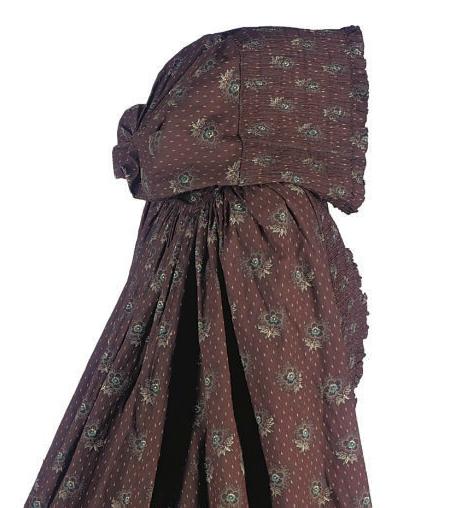
This chocolate brown chintz cloak from 1790 has a cream and turquoise floral print. The hood and edges are deeply pleated, and the entire garment is lined in cream flannel with a scarlet floral print and a tan print cotton. Images@Christie’s.

Read Full Post »

French paintings of ladies dressing and at their toilettes provide us with an insight of  how dressing rooms were once constructed and used. While we think of dressing as a private affair, William Hogarth demonstrates in his painting, Marriage à-la-mode: The Countess’s Morning Levee, how a woman of means with a large elaborate dressing room would entertain visitors while she was completing her toilette.

Image @Wikipedia

In reality, the toilette became a ritual in 18th century France for the very rich, one that had both intimate and public elements. A maid would groom and sponge bathe her lady in private, but then her mistress would devote hours to having her hair dressed, eating her breakfast from a tray, writing letters, entertaining friends, and picking the clothes she would wear for the day. The wealthier the woman, the more elaborate her morning ritual. As Hogarth showed, the custom of entertaining guests in one’s dressing room was also popular in England. In the image below, a shameless young lady is entertaining her spiritual adviser in her boudoir. His expression is priceless.

The Four Times of Day: Morning, Nicholas Lancret, 1739. Image@National Gallery, London

Wikipedia provides a history of the word “toilet”. The word did not have the same meaning back then as it does today.:

It originally referred to the toile, French for “cloth”, draped over a lady or gentleman’s shoulders while their hair was being dressed, and then (in both French and English) by extension to the various elements, and also the whole complex of operations of hairdressing and body care that centered at a dressing table, also covered by a cloth, on which stood a mirror and various brushes and containers for powder and make-up: this ensemble was also a toilette, as also was the period spent at the table, during which close friends or tradesmen were often received. The English poet Alexander Pope in The Rape of the Lock (1717) described the intricacies of a lady’s preparation:

“And now, unveil’d, the toilet stands display’d
Each silver vase in mystic order laid.”

These various senses are first recorded by the OED (Oxford English Dictionary) in rapid sequence in the later 17th century: the set of “articles required or used in dressing” 1662, the “action or process of dressing” 1681, the cloth on the table 1682, the cloth round the shoulders 1684, the table itself 1695, and the “reception of visitors by a lady during the concluding stages of her toilet” 1703 (also known as a “toilet-call”), but in the sense of a special room the earliest use is 1819, and this does not seem to include a lavatory.

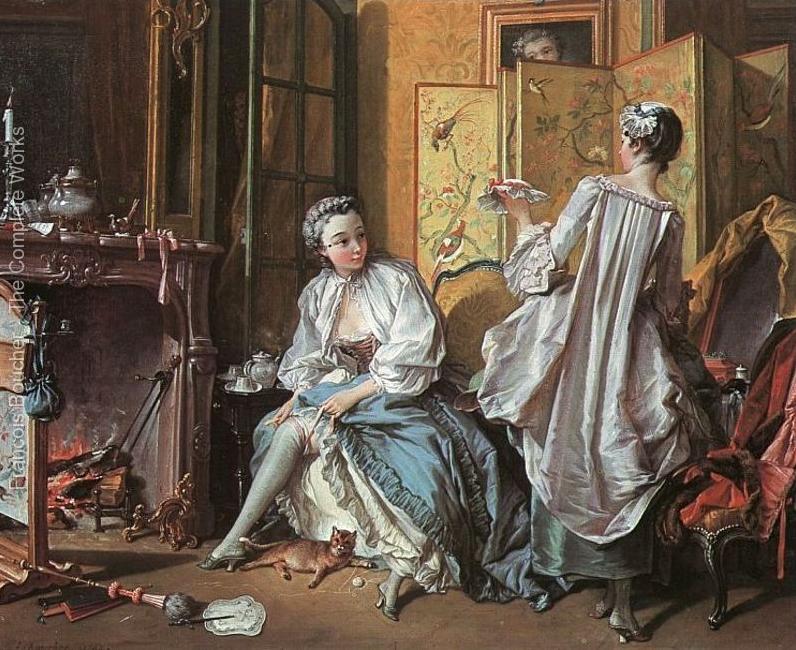
La Toilette, Boucher, 1742. Image@francoisboucher.org

Woman’s Fashions of the 18th Century fully describes the above painting by Boucher, in which the seated woman, probably a courtesan, is tying a garter over her stocking while wearing a short jacket to protect her outfit from particles of applied makeup and the powder on her wig. No visitors invade this intimate scene, which clearly shows a tray with refreshments and a decorative dressing screen behind the chair.
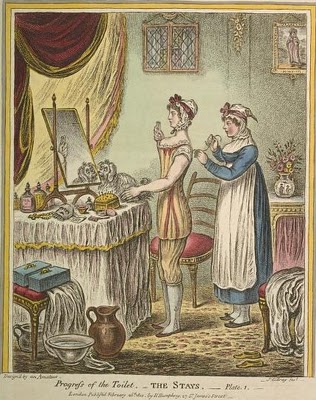
James Gillray portrays the progress of the toilet. Note the wash basin and water urn on the floor.

Women did use their dressing rooms at more intimate and private moments, when one presumed they would be alone. The washing of one’s face, feet and hands was a daily ritual, while bathing one’s entire body was not.  Such ablutions were done privately.  People would wash in basins. A portable hip bath would be placed in the dressing room if they decided to bathe completely.
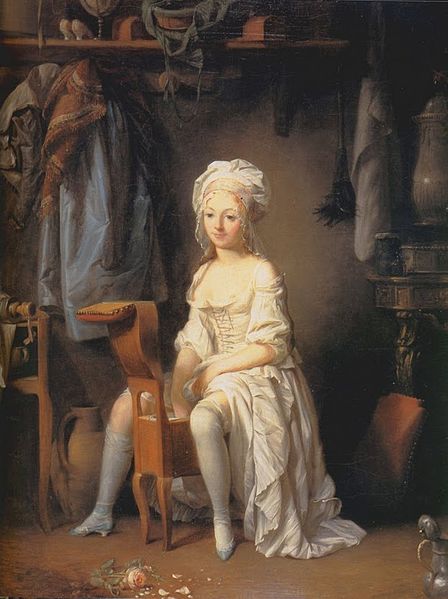
Boilly, La Toilette Intime ou la Rose Effeuille. Image @Wikimedia Commons

While outhouses were common, the wealthy tended to use elaborate potty chairs (see image below). The French used bidets inside their dressing rooms, as shown in Boilly’s painting above. Invented by the French, their earliest recorded use was in 1710. If one wonders how women in elaborate costumes managed to go to the bathroom, this image by Boucher provides a glimpse. The handling of the bowl and upright posture was possible, for women during that era wore no underdrawers.
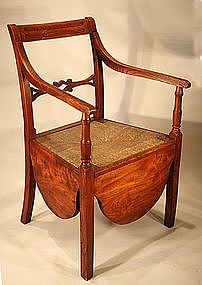
18th century Sheraton potty chair

Dressing rooms remained popular for a long time. In Can You Forgive Her?, Lady Glencora invites Alice Vavasor to have tea in her dressing-room, saying “You must be famished, I know. Then you can come down, or if you want to avoid two dressings you can sit over the fire up-stairs till dinner-time.” Alice follows Lady Glencora into the dressing-room, “and there found herself surrounded by an infinitude of feminine luxuries. The prettiest of tables were there;–the easiest of chairs;–the most costly of cabinets;–the quaintest of old china ornaments. It was bright with the gayest colours,–made pleasant to the eye with the binding of many books, having nymphs painted on the ceiling and little Cupids on the doors.” Lady Glencora goes on to explain, “I call it my dressing-room because in that way I can keep people out of it, but I have my brushes and soap in a little closet there, and my clothes,–my clothes are everywhere I suppose, only there are none of them here.”

Dressing room with chamber pot chair, 1765. Image@Morris Jumel House, Manhattan.

Anthony Trollope made an interesting point. During the 1860’s, when his novel was written, wealthy women changed their wardrobes more often for different functions during the day than Regency women. She invites Alice to linger in her dressing room, presumably to rest, read, and drink tea, rather than change into yet another set of clothes to join the company downstairs. Lady Glencora also indicates that the dressing room could also be a refuge away from visitors and prying eyes.

Jane Austen's bedroom. The closet with wash basin and potty sits to the left of the fireplace.

A wealthy couple might have two bedrooms (his and hers) with an adjoining sitting room. Each person would have their own dressing room. Simpler households did not have the luxury of such space. In Chawton Cottage, Jane Austen and her sister, Cassandra, shared one bedroom. Their potty and wash basin where stored in a closet.

Today’s walk in closets with adjoining bathroom most closely approximate the dressing room of yore, although people today do not tend to entertain their visitors in their closets.

Other posts on the topic:

Read Full Post »

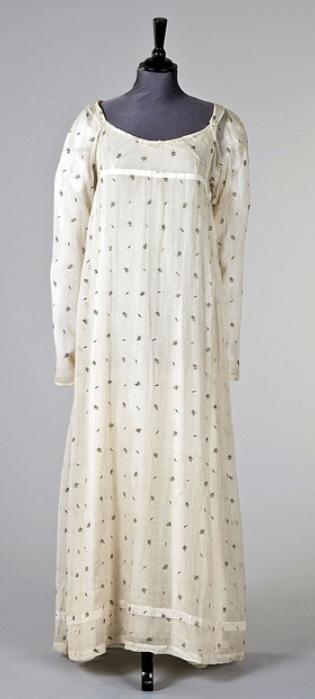
We’ve all come to associate Regency women’s fashion with delicate white muslin fabrics – sprigged muslin, spotted muslin,  checked and striped muslin, and embroidered muslin. Henry Tilney, the hero in Northanger Abbey, was well-acquainted with muslins through his sister, who wore only white.

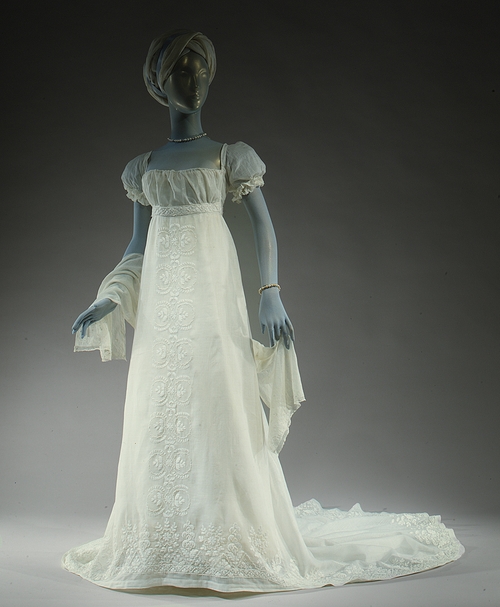
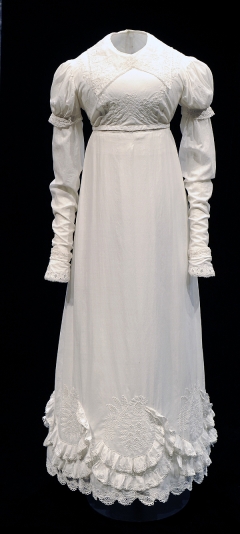
Sheer white muslin gown with whitework embroidery. Image @Vintage Textile

In the 17th century and until the late 18th century, England imported muslin, a thin cotton material, from India.  The British East India Company traded in Indian cotton, silk fabrics, and Dacca (Dhaka or modern-day Bangladesh) muslins. Muslins from Bengal, Bihar and Orissa were also imported. The delicate cloth, which first originated in the Middle East in the 9th century, was perfect for clothing and curtains in hot, arid countries. – Muslin: Encyclopedia Britannica

Muslin gown, 1816

Muslin was a finely woven light cotton fabric in plain weave without a pattern, and had identical warp and weft threads. The fabric selection is quite flexible, coming in a wide variety of weights and widths. It accepts dyes and paints so successfully that today it is often used for theatrical backdrops and photographic portraits. One observation must be made: muslins of the past were made of much finer, more delicate weave than today’s muslins. –  How Is Muslin Fabric Made?

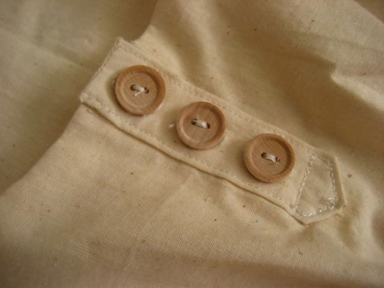
Buttons on a modern muslin fabric

Muslin gown circa 1815, Bath museum

An important feature of muslin fabrics is its ability to drape. Regency fashions were based on robes and garments from antiquity. The ability to drape and maneuver the fabric on the figure was an important feature of this cloth. Today, designers use muslin as a test garment for cutting and draping a design before creating the final dress from more expensive fabrics.

Another excellent feature of muslin is its ability to take dye, paints, and embroidery. The cloth accepted many patterns, motifs and designs that made it versatile and unique. Textile as Art

Plus the white fabric was a mark of gentility. White was difficult to keep clean or required constant cleaning. It was one thing for an aristocratic lady like Eleanor Tilney to wear white, but another for a maid to presume to wear such a high maintenance garment. Mrs Norris, that awful woman from Mansfield Park, approved of Mrs. Rushworth’s housekeeper’s action of turning away two housemaids for wearing white gowns.

Muslin evening dress. Image @Metropolitan Museum of Art

Embroidery transformed the simple white muslin gown into works of art. Whitework embroidery was particularly striking, but colored threads could be equally beautiful. The draping quality of the cloth lent itself well to columnar-shaped empire waist gowns.

Indian sprigged muslin gown, 1800. Image@Kelly Taylor Auctions Trouvais

Muslin was imported from the Far East for centuries. Then the weavers in west Scotland, who were proficient in spinning fine cottons such as linen, cambric, and lawn, began to pay attention to weaving a finer, more delicate cloth.

Sheer muslin gown, 1800. Image @Victoria & Albert Museum

Muslins, therefore (plain for the most part in Glasgow, and fancy ornamented in Paisley),were among the earliest and principal cotton fabrics produced on the looms of the west of Scotland. About the year 1780 James Monteith, the father of Henry Monteith, the founder of the great printworks at Barrowfield, and of the spinning and weaving mills at Blantyre, warped a muslin web, the first attempted in Scotland; and he set himself resolutely to try to imitate or excel the famous products of Dacca and other Indian muslin-producing centres. As the yarn which could then be produced was not fine enough for his purposes, he procured a quantity of “bird-nest” Indian yarn, “and employed James Dalziel to weave a 6-4th 12” book with a handshuttle, for which he paid him 2Id. per ell for weaving;. It is worthy of remark that the same kind of web is now wrought at 2|d. per ell The second web was wove with a-fly shuttle, which was the second used in Scotland. The Indian yarn was so difficult to wind that Christian Gray, wife of Robert Dougall, bellman, got 6s. 0 J. for winding each pound of it. When the web was finished Mr Monteith ordered a dress of it to be embroidered with gold, which had presented to Her Majesty Queen Charlotte.”1

1817 Muslin day dress. Image @Bowes Museum

Once fairly established, the muslin trade and various other cotton manufactures developed with extraordinary rapidity, and diverged into a great variety of products which were disposed of through equally numerous channels. Among the earliest staples, along with plain book muslins, came mulls, jacconets or nainsooks, and checked and striped muslins. Ginghams and pullicats formed an early and very important trade with the West Indian market, as well as for home consumption. These articles for a long period afforded the chief employment to the hand-loom weavers in the numerous villages around Glasgow and throughout the west of Scotland. The weaving of sprigged or spotted muslins and lappets was subsequently introduced, the latter not having been commenced till 1814. Although the weaving of ordinary grey calico for bleaching or printing purposes has always held .and still retains an important place among Glasgow cotton manufactures, it has never been a peculiar feature of the cotton industry; and the very extensive bleaching and print-works of the locality have always been supplied with a proportion of their material from the great cotton manufacturing districts of Lancashire. – p 501, The Encyclopaedia Britannica: a dictionary of arts, sciences, and general literature, Volume 6, Thomas Spencer Bayne, 1888.

Embroidered muslin round gown, 1795. Image @Cathy Decker

More on the topic:

Read Full Post »

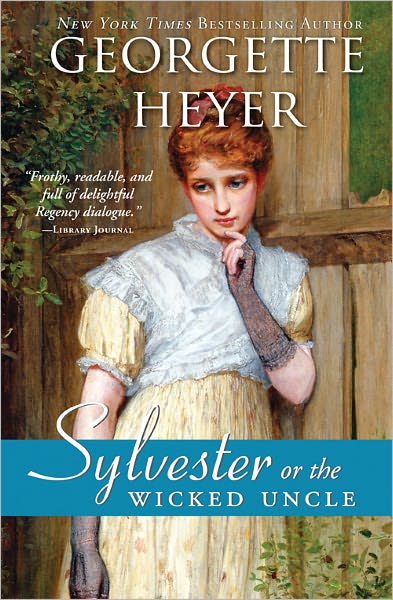
Gentle readers: Please leave a comment if you wish your name to be be eligible for a drawing of Sylvester, or the Wicked Uncle, a wonderful Regency romp by Georgette Heyer. The drawing will be held the moment electricity is restored in my house. My best estimate is that this will take another week. Only U.S. and Canadian residents are eligible. (So sorry, but the book is being sent by the publisher, who has requested this geographic restriction.) Update: Contest closed. Congratulations Rebeka! You have won a copy of Sylvester.

Sylvester, Duke of Salford thinks quite highly of himself and is pleased by his impeccable manners and easy smile, which easily influences servants to do his bidding. But Phoebe Marlow, whose mousy manner hides her bright mind and talents as an equestrienne and a writer, was not so impressed when she first met him during her coming out season. She is even less enthralled with the Duke when he arrives for a visit at her father’s estate to look her over as a possible bride.

Sylvester’s fond Mama also harbors concerns for her son, especially when Sylvester announces his intentions to marry and begins to discuss his preference for a bride with her:

‘But I’m inclined to think now that is is more important that she should be intelligent. I don’t think I could tolerate a hen-witted wife. ‘Besides I don’t mean to foist another fool on to you.’

‘I am very much obliged to you!’ she said, a good deal entertained. ‘Clever, but not beautiful: very well! Continue!’

‘No, somedegree of beauty I do demand. She must have countenance, at least, and the sort of elegance which you have, Mama.’

‘Don’t try to turn my head, you flatterer! Have you discovered among the debutantes one who is endowed with all these qualities?’

‘At first glance, I suppose a dozen, but in the end only five.’

‘Five!’

At this point Sylvester’s mama becomes concerned, for she realizes that he is choosing his life’s mate with his head, not his heart. The woman who immediately springs to her mind for her son is Phoebe Marlow, and so our cluelessly haughty (yet kind) Duke collides with the novel’s heroine, who is not in the least willing to spend any time with him, at least not until circumstances throw them together and she gets to know him better.

The plot revolves around Phoebe’s big SECRET: she has authored a book in which Sylvester, with his saturnine brows, is featured prominently as the villain. The more Phoebe gets to know Sylvester, the more she realizes how wrong she was about him and the more she worries about the book’s effect on their budding friendship (for Phoebe was uncannily accurate in her representation about certain aspects of Sylvester’s life).

Georgette Heyer takes us from the cozy settings of country mansions, to London in High Season, to Dover and over to France. A colorful array of her usual characters add liveliness to a somewhat improbable plot, including Phoebe’s good friend Tom, Sylvester’s dodo bird of a sister-in-law, Ianthe, and a supremely idiotic and over-indulged fop named Sir Nugent.

In my opinion, if you are a Georgette Heyer fan and haven’t read this book yet, you will be well advised to do so now. I give it four out of five Regency tea cups!

For a chance to win this book, leave a comment about your favorite Georgette Heyer book! Contest closed. The winner is: Rebeka!

Read Full Post »

« Newer Posts - Older Posts »