Feeds:
Posts
Comments

Archive for the ‘Regency style’ Category

I can’t believe it’s been a day since the excitement of my first JASNA (Jane Austen Society of America) Annual Meeting. This one was held in Brooklyn, which turned out to be a fabulous place for this Janeite, for I walked over half of the Brooklyn Bridge between sessions and loitered in Brooklyn Heights, a truly wonderful neighborhood in which to while away one’s time. Then there were the plenary sessions, break out sessions and the EMPORIUM, where money flowed from my pocket into the vendors’. (I had to ship my loot back!)

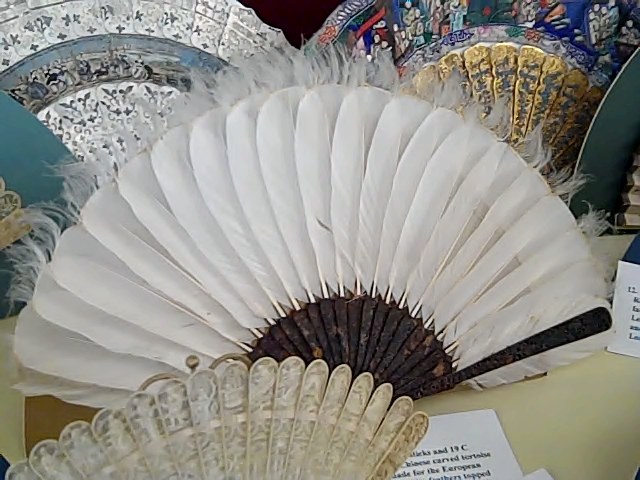
Feather fan. Only some discoloration and one blemish flaw this otherwise remarkably preserved fan.

One of the loveliest displays was the antique fan exhibition presented by Dr. Abbey Block Cash. The variety of fans was astounding. One, made entirely of feathers, was in almost pristine condition (see image). The fans were so delicate that I would be afraid to handle them and many were hand painted. One in particular caught my eye … a puzzle fan from 1820:

The fan is made of French brise with blond horn sticks. The four images that open in four directions are:

  • Bouquet of flowers
  • Marriage proposal
  • Farm house
  • Planting scene

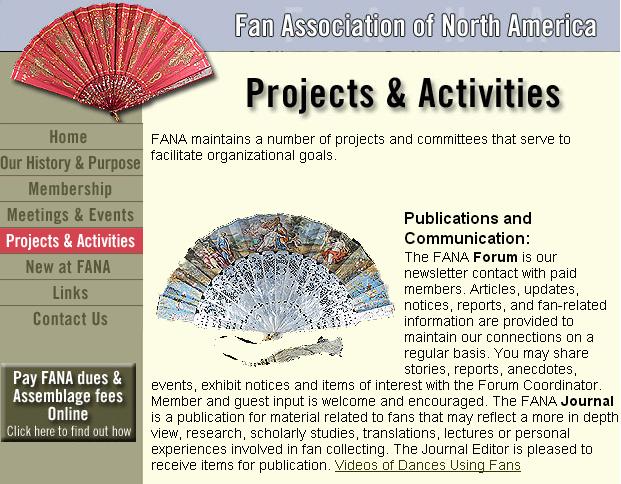
I went to the website suggested in the brochure, the Fan Association of North America at this link. Information on this site was varied and practical. What I liked in particular were the links to other fan sites. FANA is well worth a visit and exploration if you are interested in these beautiful yet practical accessories.

Not all the fans belonged to the Regency Era. As you can see, most are hand painted with exquisite scenes. The last fan in this video was made ca. 1910 (I hope my memory serves me right) and depicts scenes painted by Kate Greenaway. It is obvious from the quality of the fans that all were destined for the upper crust. I did not see a fan of the sort that the lower classes could afford, such as those with advertisements. (Because I did not see such fans, does not mean that they were absent.)

I wish I had the presence of mind to ask about the language of the fan, for there are so many myths swirling around that topic, but those of you who have been to an AGM know how much there is to see and do, and how many people one MUST meet NOW.

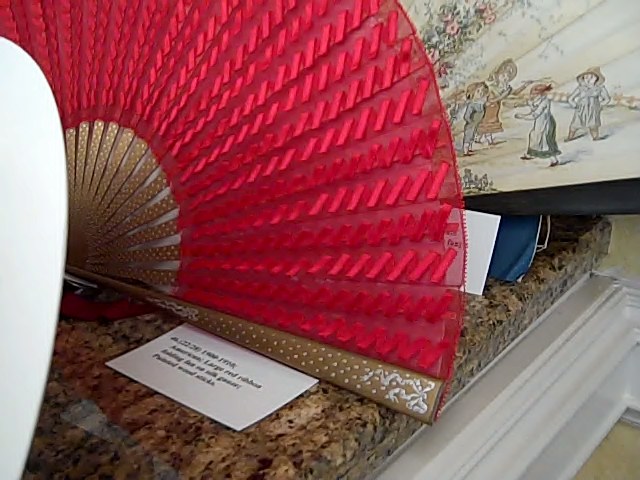
The red fan was exquisite and dramatic. The fan in back of it sports Kate Greenaway images of children.

There were some notable absences at this year’s AGM: I so wanted to meet my frequent blog partner Laurel Ann Nattres (editor of Jane Austen Made Me Do It and Austenprose) and Margaret Sullivant (editrix of Austenblog), but alas they did not come this year. You will see over the coming weeks the people I DID meet, such as Joan Klingel Ray, Susannah Fullerton, Deb Barnum (my lovely roommate), Lori Smith, Syrie James, and Dianah Baycich. Some of us fell all over each other like twins separated at birth. Every Janeite should make at least one JASNA Meeting. You simply will not be disappointed. I must add that the folks from JASNA NY did a splendid job of putting this complex (and largest) JASNA conference together. Kudos to all.

Read my other post from the AGM:

Read Full Post »

Men of fashion began to wear short and more natural hair at the end of the 18th century, sporting cropped curls and long sideburns in a classical manner much like  Grecian warriors and Roman senators. Before this period, a balding Louis XIII had made powdered wigs popular at the French court and consequently throughout Europe. The often elaborate and expensive gray wigs lent an air of wisdom and authority to their wearers.

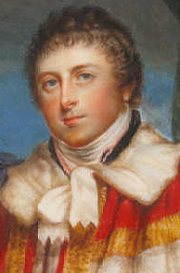
William Pitt the Younger – Attributed to Thomas Gainsborough (c. 1804)
Prime Minister 1783 – 1801; Chancellor of the Exchequer 1804 – 1806

A scarcity of flour in 1795, combined with William Pitt’s attempt to raise revenue through a hair powder tax, brought the fashion for wigs and powder to a screeching halt. Men protested and a new more natural hair style became fashionable.

The 5th Duke of Bedford. Image @ Wikipedia

The Bedford Crop was a style of hair favored by the Duke of Bedford, who, in protest to the tax, abandoned his wigs in favor of a short cropped and unpowdered hairstyle. He challenged his friends to do the same.  His natural looking crop was parted on the side with a dab of hair wax.Wikipedia)

Pitt eventually reduced this unpopular tax on hair powder, which never quite generated the revenue he predicted, but by then it was too late. Gentlemen had discovered the comforts of going au naturel, and by 1812, few men still wore wigs. There were some holdovers – older men, military officers, and those in conservative professions such as lawyers, judges, physicians, and some servants for the very rich (footmen and coachmen) retained their wigs and powder. Formal court dress also still required powdered hair.

Beau Brummel’s Brutus hair style in 1805. Notice how it is brushed forward and volumized on top of his head.

By and large men took their cue from classical Greek and Roman art. The romantic movement also influenced a natural, unpretentious aesthetic. A dry disordered look that used very few artificial products began to rule.  Beau Brummel’s influence cannot be discounted. His own grooming included shorter hair and a clean-shaven face. Every morning he examined his face in a dentist mirror and plucked any remaining stray hairs with tweezers. By 1813, almost all Regency men sported both long or short sideburns; they rarely wore mustaches or beards.

In Pride and Prejudice 1995, Colin Firth as Mr. Darcy wore his hair somewhat longer than the Bedford Crop and affected a slightly unruly hairdo, probably known as the Brutus.  (I confess I never liked Firth’s hairstyle for Mr. Darcy.)

Colin Firth as Mr. Darcy. His rather long, wild hairstyle now makes sense to me.

Upon seeing the following images, I can now see why the film’s hair stylist settled on this slightly wild do for Mr. Darcy, which seems to be a compromise between a severe clipped hair style and the stylish “frightened owl” hairdo below.

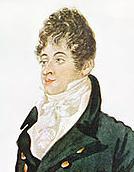
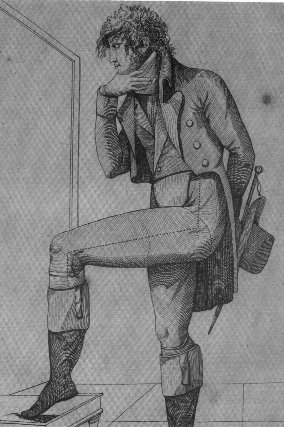
Young man by an unknown artist, c. 1800, from the book The Tie. Image @Jessamyn’s Regency Costume Companion

The  “frightened owl” hairstyle was achieved through infrequent hair washing (as infrequently as every few months) and the use of hair wax, which helped to create the wild and unruly volume.

The models for Regency men’s hairstyles: Caesar, Titus, and Brutus

Popular styles in the late 18th century were the Caesar, Titus, and Brutus. The Coup au Vent was short at the back and worn long over the eyes at the front.

Caesar cut. You can almost see the laurel leaves on his head with this brushed forward Caesar cut. Portrait of an unnamed man, ca. 1810-20

The Cherubin, like the Bedford Crop, sported short curls all over (the Caesar was clipped even closer.)

Bernier by Ingres, 1800. You can see the all over cropped unruly look. The sideburns in all these images are long, but the men are clean shaven.

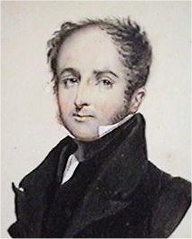
The Classically influenced Titus was cropped short everywhere but at the front with curls combed forward onto the forehead to resemble the Roman Emperor Titus.

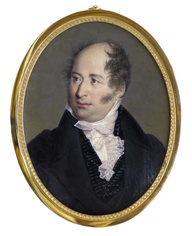
Balding men benefited from the close cropped, forward brushed styles. c.1815. Louis Francois Aubry. Monsieur Rivio Baritone in Paris Opera. Image courtesy of A Private Portrait Miniature Collection. (Update:) Mr. Phillips, who oversees the blog, lists the date of the portrait as 1840.

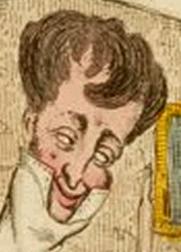
The more severe Brutus was even more clopped than the Titus. One of the most popular hair styles of the day, though, was the Brutus, a disheveled style that Beau Brummell and his followers wore.

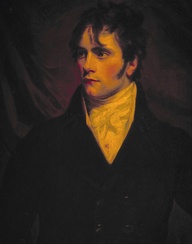
John Opie’s 1802 portrait of Edmund Lenthal Swifte shows a few artfully arranged locks over the forehead.

These hairstyles  took a great deal of time and patience to achieve. Men used an oil or pomade made of bear fat to achieve a natural “tamed” wildness. (Scented pomades were called Pomade de Nerole and Pomade de Graffa.)  Since hair was rarely washed, night caps were worn to prevent soiling pillows and doilies protected the backs of chairs.
The height on top with the artfully arranged curls take precedence in this hairstyle. Friedrich Wilhelm Schelling, 1801.

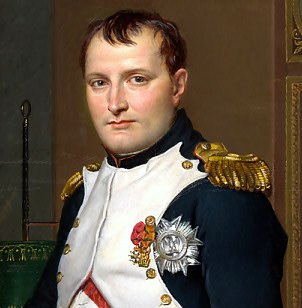
Napoloeon Bonaparte’s classic Caesar cut sported  longer locks down the forehead.

This dandy sports a Titus.

Arnauld de Beaufort ca 1818 (by Pierre Paul pPrud’hon). His hair is noticeably brushed forward, lending his features a saturnine look.

Regency hairstyles gave men a natural, romanticized look. (Portrait of an Artist by Unknown Artist) is part of the collection of the Michele and Donald D’Amour Museum of Fine Arts, Springfield, Massachusetts.

Gericault’s 1816 self-portrait shows a wildly romantic and unruly hairstyle.

Additional Information:

Please note: All green links in this post are WordPress Ads.

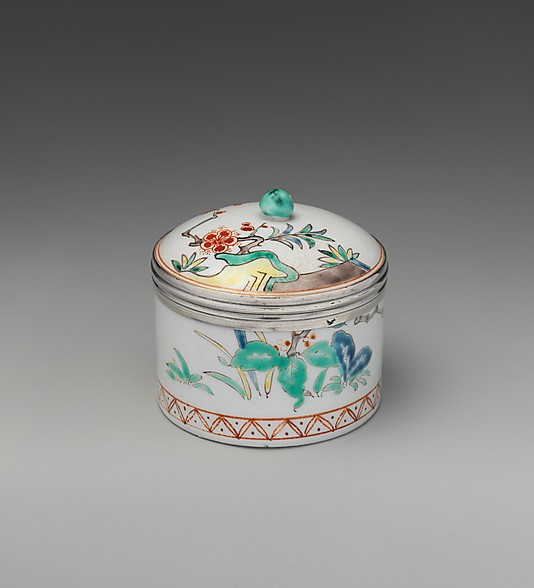
Covered porcelain pomade pot. Mid 18th Century. Image@Metropolitan Museum of Art

Read Full Post »

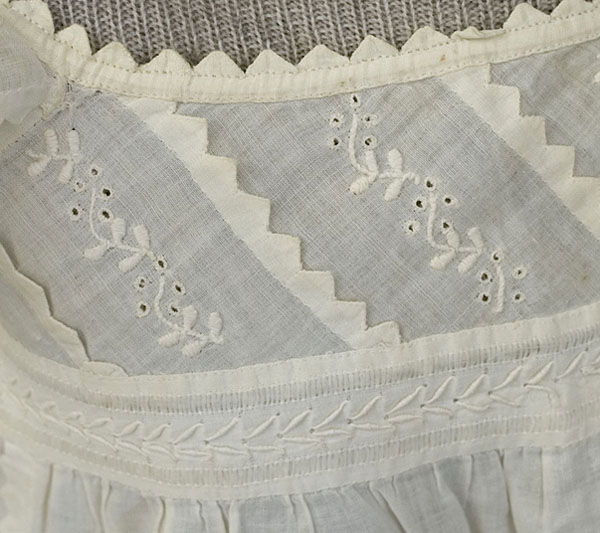
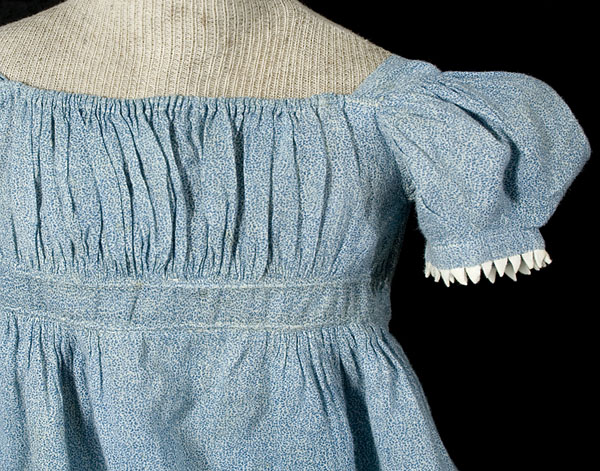
Infant’s hand-embroidered dress, c. 1815-1820. Image @Vintage Textiles.

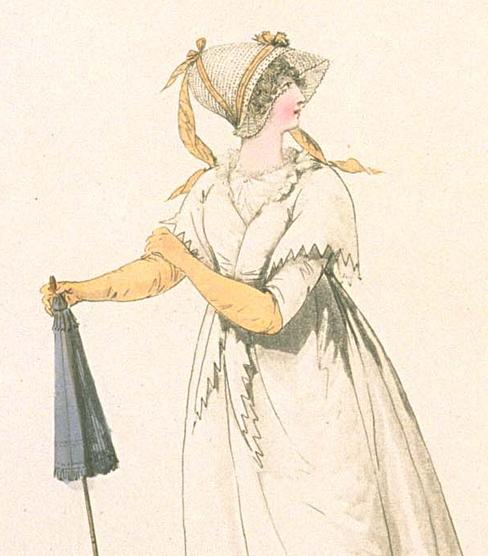
Whenever I view fashion plates and clothes from 200 years ago with Vandyke points, my gaze always lingers. I love these deeply indented trims and decorations, whether they are made of lace or cloth. These are sewn by hand! Imagine the work that went into them.

Vandyke points on the sleeves of a girl’s dress, 1815-1820. Image @Vintage Textile

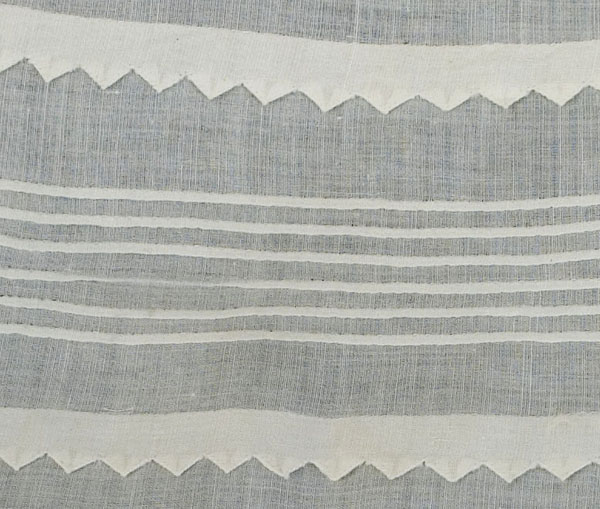
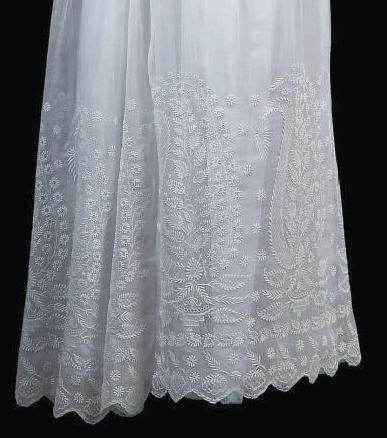
Delicate muslin border. Image @Vintage Textile

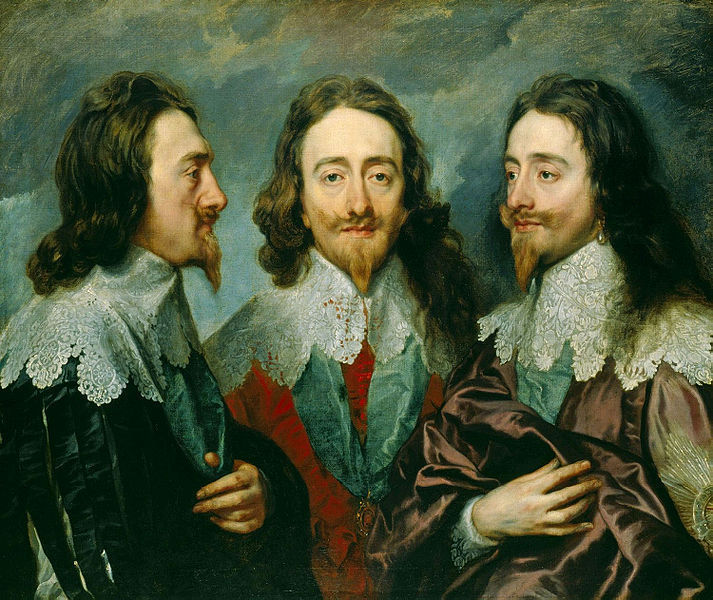
These trims were named after Sir Anthony Van Dyck, a 17th-century Flemish painter (and popular portraitist for British royalty and the upper crust), who was known for painting elaborate V-shaped lace collars and scalloped edges on both his male and female sitters. The pointed vandyke beard was named after him. You can see an example of both in the portrait of Charles I below.

Anthony Van Dyck’s triple portrait of Charles I. Notice the scalloped edge lace collars and pointed vandyke beard.

Vandyke points are labor intensive. The edges you see in the sample of a child’s dress are sewn by hand, as are the tucks. One can only imagine how much time it took, but the results are striking.

Notice the Vandyke points. Love this Heideloff fashion image, 1794-98.

All of the lade edges were once hand-tatted; they are now machine made, but no less spectacular.

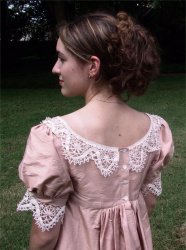
Modern reproduction of a regency gown using lace with vandyke points

Vandyke points edged skirts:

Muslin dress with vandyke edging, 1820-1825. Image @Christie’s

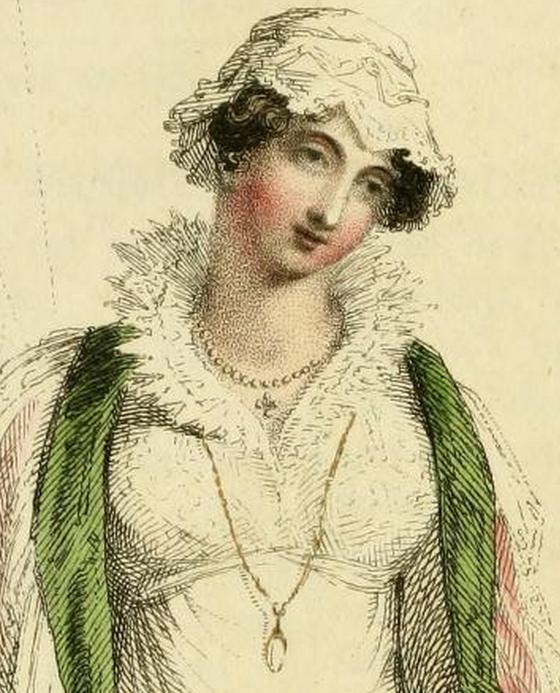
They embellished lace caps and collars:

Vandyke points on lace cap and on collar, detail of an Ackermann plate, morning gown, April 1812.

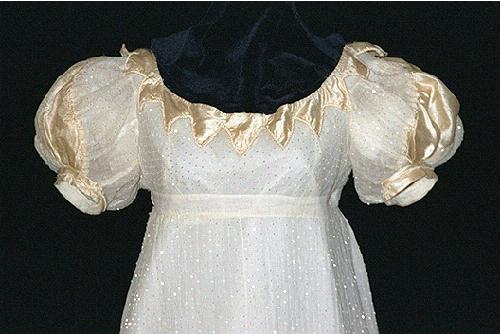
And edged necklines:

1818 ballgown with satin vandyke points edging

They were used to decorate hems:

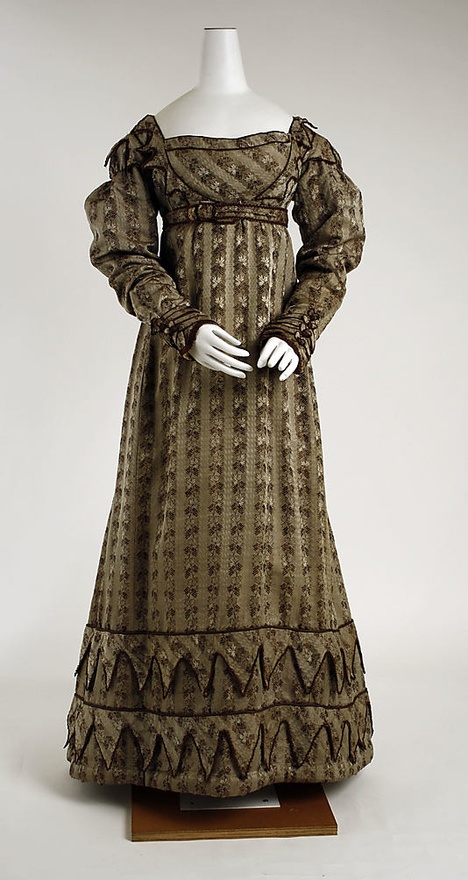
Silk European dress, ca. 1819-22. Image @MetMuseum

And are still made for modern edgings:

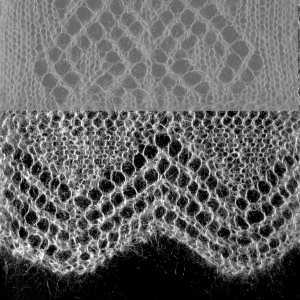
Modern lacy knit with vandyke points

17th century antique clothes looked rich and splendid with these added lace embellishments:

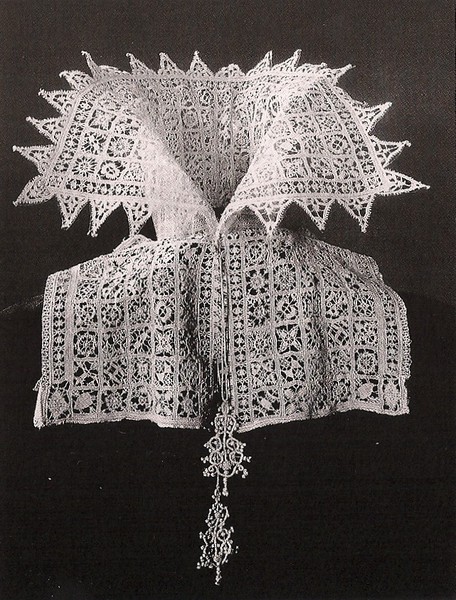
Italian collar with sharp lace points, 1610

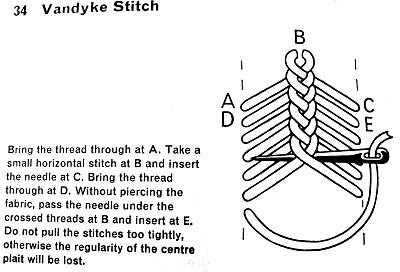
For embroidery stitches and lace tatting, click on the following link: Van Dyke online tatting: This article demonstrates how to tat your own Vandyke point lace. Warning. Time consuming. And the link in the caption to the image below:

Vandyke embroidery stitch – a nice way to fill in leaves and flowers. Image @Windy River embroidery stitch tutorial

More on the topic:

Rolinda Sharple’s painting of the Cloakroom at Clifton shows a number of dresses with vandyke points. This one demonstrates several rows of lace with scalloped edges, and sharp-edged embroidery patterns.

Please note: Green links are WordPress Ads.

Read Full Post »

Vic at 22 on a sailboat, reading a Georgette Heyer novel. Look at those chubby Dutch cheeks!

I stumbled upon Georgette Heyer during a golden time of my life after college graduation when I had three precious free months before I began school again. Bursting with youthful energy, I didn’t know what to do with my time. And so I hit the books, but this time for pleasure. In those days, I could gobble up a book a day if I was so inclined, and I sped through Jane Eyre. Wuthering Heights. Tess of the d’Urbervilles. Rebecca. Father and Sons, by Ivan Turgenev, one of my favorite authors, and Pride and Prejudice (for the second time in my life). That last novel with its sparkling wit and clear view of village life seemed like a breath of fresh air after the heightened emotions of the Victorian authors.

To me, Mr. Bennet was the image of my father, whose wry statements always made me pause before I could figure out if he was making sport of me, himself, or some other unwitting target. Mrs. Bennet reminded me of my crazy Dutch grandmothers – both of whom were slightly hysterical and VERY demanding. I read Pride and Prejudice twice that summer (and began a tradition of reading it every summer for the next twenty years). Greedily I reached for more Jane Austen novels until there were none left. I railed against the illness that carried Jane off before she could produce enough novels to assuage my addiction. Where to turn?

The library, of course.

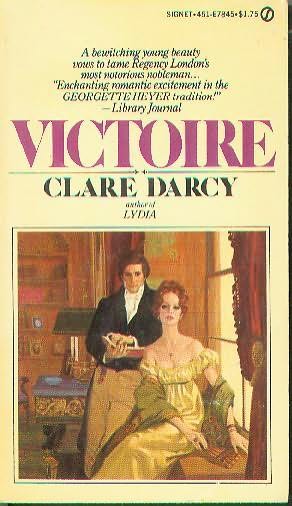
I looked up Regency novels and found … Clare Darcy. Ok, I thought. I’ll give her a try and picked up a copy of Victoire, a most logical choice given my given name, and read the book in one long sitting. How to state it nicely: Clare Darcy is to Jane Austen what a sputtering candle is to the sun at high noon.

My quest was not over.

My apartment roommie, also a Janeite, discovered the Flashman novels by George MacDonald Fraser. She LOVED them. But budding little feminist me wanted books written by humorous females, not a man with no interest in the goings on of small town families and their courtship rituals, and silly clergy, and strong heroines who were able to learn a thing or two. And so I continued my search.

One day I found a Barbara Cartland novel. Hahahahahahahaha! Tossing aside her cheesy book about a 16-year-old-heroine with a heart-shaped face, I wondered if I could charge her for wasting my precious life.

I continued my search.

And there it was. On the bottom shelf at the library. Arabella. It was a pathetic excuse of a book – dog-eared, blemished, and torn partially in the spine. I read the front cover – Arabella by Georgette Heyer – then sat on the floor and began to read. Witty words leapt from the pages. I laughed with delight. Before long I checked out the book and proceeded to read it in one long sitting. My roommie, who had started her new job two weeks after college, came home from work to find me engrossed. “I found a new author,” I said, telling her she could read the book when I was done. I gave it to her that night.

We were both instantly hooked on Georgette Heyer.

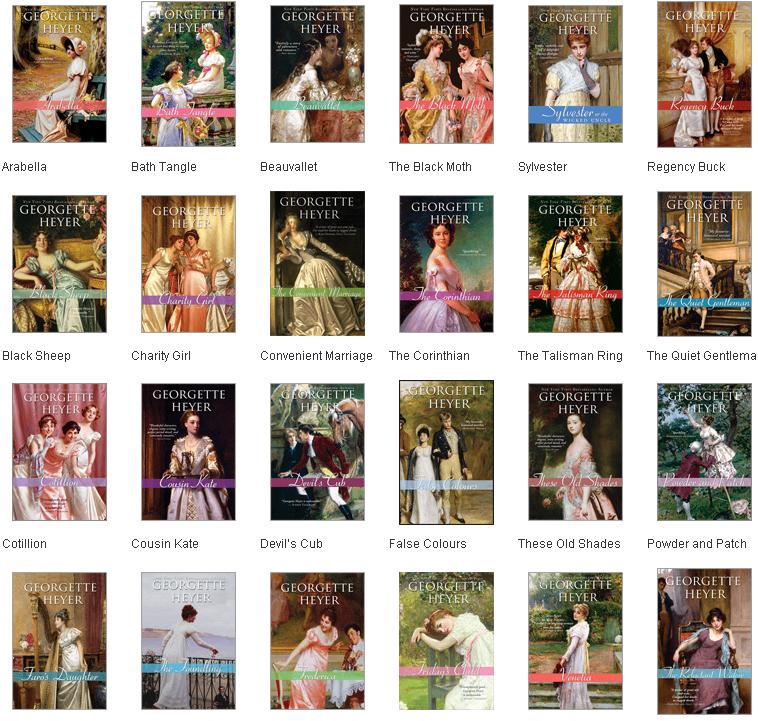
I returned to the library and checked out all the Georgette Heyers I could find. My roommie and I fell in love with Arabella, but we became die-hard fans when we encountered Venetia, The Grand Sophie, Sylvester, and Frederica. By summer’s end we had read ALL the GHs we could lay our hands on, even the mysteries and histories. (Thankfully, Georgette was prolific.)

My roommie and I were two young and hopeless romantics. We loved the glittering, detailed descriptions of the characters, the clothes they wore from expensive shops, and the houses, towns, and cities they inhabited. We learned about Regency London and the manners and mores of the Ton. Georgette Heyer characters spoke in cant, and thus we affected British accents and used cant-speech at every opportunity. Our boyfriends, while a bit mystified, played along, even debating which weapon was more effective in a fight – the epee or the sword.

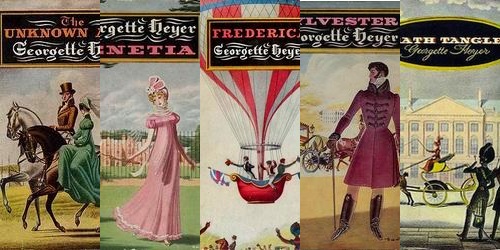
Vintage GHs

But then life intruded and my intense love affair with Georgette Heyer had to take a back seat. I returned to school and began to read academic books again. I left my obsession behind, except for my yearly date with Pride and Prejudice.

Flash forward a number of decades when Sourcebooks began to republish Georgette Heyer novels. Once more I began to read them regularly, only this time I reviewed them as well.  I discovered that my tastes had changed and that I was more attracted to other novels like The Reluctant Widow and The Convenient Marriage. I never reread Arabella, for I did not want to revisit my first love only to discover that she had flaws.

I savor my memory of first discovering Georgette Heyer and thank Sourcebooks for the opportunity to relive that Golden Summer. I keep about 10 GH books on my Nook and Kindle (yes, I have both) so I am not ever very far from one of my favorite authors. If you are intrigued, all of GH s novels are available at Sourcebook’s Discover a New Love Website at http://www.discoveranewlove.com.

WIN A FREE BOOK! Those who leave a comment, have an opportunity to win a Georgette Heyer novel! Just let me know why you love to read Regency romances and/or Jane Austen! Contest ends on August 16th, (Contest ended!)which is Georgette Heyer’s 110th Birthday! Happy Birthday, GH, and thanks for the memories. Congratulations winners, Jan and Ginger, chosen through Random Number Generator! Thank you all for making a comment!

More on the topic: 

Read Full Post »

Among the principle gifts in 1908 may be mentioned: – suit of clothes, &c., formerly belonging to Mr Thomas Coutts, the founder of Coutts Bank, died 1822, given by Francis Coutts, Esq., Announcement for The Victoria & Albert Museum

Shirt. Image @Metropolitan Museum of Art

This cryptic announcement does not tell the whole story of how a number of important museums around the world came into the possession of several portions of Mr. Coutt’s wardrobe. In her excellent book, Four Hundred Years of Fashion, Natalie Rothstein (curator of silks at the Victoria & Albert Museum) recounted how the clothes that had once been worn by Thomas Coutts, successful banker, came to be passed down for several generations in the family and divided among a number of major museums in 1908 and 1912.  The collection was unusual, for it consisted of the entire wardrobe of a gentleman who lived in the early 19th century, that included:

the considerable number of cloth costumes, articles of hosiery and underclothing left by Mr Thomas Coutts at the time of his death, 24th February 1822 . . . The cloth suits are all of a plain black and of precisely the same cut, so that only one is necessary for exhibition.”

One of the ten wigs in the “brutus” style. One wonders if Mr. Coutts is wearing one in the illustration below! Image @The Metropolitan Museum of Art

Top hat

Additional clothes in the collection include: 57 items of underwear made of linen or wool,  46 shirts made of a fine cambric and with and without frills, four spotted nightgowns, several plain nightgowns, 13 pair of leather and wool gloves, ten wigs and three beaver hats. Such a large, intact group of clothes from one source was rare and unique. Ironically for the museums, according to Strandlines, “Thomas Coutts seems to have been an eccentric man, who preferred to dress scruffily and to hide his wealth, rather than display it.”

Thomas Coutts. {From an engraving by R. W. Sievier of an oil painting by Sir W. Beechey, R.A.)

Coutts was not a wit himself or the cause of wit in others. There are, indeed, two or three anecdotes, ” duplications,” in the argot of the Higher Criticism of the same legend, which turn upon the piquant incongruity of his garb with his gear. He is dressed in a threadbare coat, “the costume of a decayed gentleman,” and a benevolent stranger of limited means presses a guinea into his hand, and then to his dismay learns that he has ” pouched ” the wealthiest man in England. It may have been so. A dean once complained to the present writer that he was often mistaken for the verger, and offered a shilling for his services as guide to the Cathedral. It is possible that before the days of Harriot Mellon, Coutts was sometimes ” attired in very faded, worn-out clothes,” but his wardrobe, which his widow preserved in camphor, was, like Alice Fell’s new cloak, as stout and ” warm as man can sell.” A select portion is preserved at the Victoria and Albert Museum, and may be inspected by the curious. He had, too, some five or six ” Brutus ” wigs, which were of the finest make and the costliest description. Even if these legends are founded on fact, they are hardly worth the re-telling.” – The life of Thomas Coutts, bankerErnest Hartley Coleridge (1920).

Harriot Mellon Coutts and the future Duchess of St. Albans, painted by Sir William Beechey in 1817-1818. She preserved her husband’s wardrobe.

It was fortuitous that Coutt’s second wife, Harriot Coutts, nee Mellon, was the daughter of a wardrobe-keeper in a company of strolling players. One can only imagine that when she was made a widow the preservation of her husband’s wardrobe would come naturally to her. The Victoria & Albert Museum eventually acquired three suits, several sets of the underwear, two of the spotted nightgown, and some accessories. The rest of Coutts’s wardrobe was (sadly) divided among a number of museums, including The Metropolitan Museum of Art in New York, The Royal Ontario Museum, The Royal Scottish Museum, Bristol Museum and Art Gallery, and more. All but one of the museums would receive a black suit. With vast understatement, Ms. Rothstein (who laments the break up of such an intact collection) writes:

The clothes worn by Mr Coutts were probably not the height of fashion but rather conservative. There is no mention of any trousers for instance, in the full list of his clothes. All his suits had breeches. The cut of his coats is consistent with the current fashions: his tailor was probably as conservative as his customer. None of his coats had a waist seam. – Four Hundred Years of Fashion, Natalie Rothstein, p. 62

Black wool day suit. Image @ Victoria & Albert Museum

Since the late 16th century, middle-class professionals like doctors, lawyers, clergymen, academics, merchants, and businessmen have worn these stark black suits. This tradition continued through the 19th century and well into the 20th. “The sombre colour of this suit befits the sober profession of its wearer, Thomas Coutts (1735-1822), the founder of Coutts Bank., including the old-fashioned breeches, which suited his age. Top hat made in Great Britain, ca. 1800-1817. Cotton shirt, (1800-1820) made in England. (Text from the V&A.)

Detail of one of Coutts’s nightgowns. Image @Victoria & Albert Museum

Nightgown. Image @V&A

Nightgown. Image @V&A

Nightgowns were worn over shirt and breeches, in the privacy of home before noon or late at night.  The tufts of black wool on the cream wool fabric are meant to imitate ermine. These nightgowns come from the wardrobe of Thomas Coutts (1735-1822), the founder of Coutts Bank. (Text from the V&A.)

More on the topic:

Read Full Post »

« Newer Posts - Older Posts »