Feeds:
Posts
Comments

Archive for the ‘Regency style’ Category

Lady Maria Hamilton, 1802, by Thomas Lawrence.

Lady Maria Hamilton, 1802, by Thomas Lawrence.

Inquiring Reader: You’ve probably seen the necklaces dozens of times without noticing them. I have. These beautiful single string coral necklaces worn by Regency ladies escaped my attention until my friend and blogging partner on Jane Austen Today, Laurel Ann of Austenprose, sent me some spectacular images, such as the one of Lady Maria Hamilton, who died in 1814 unmarried. Coral has enjoyed a long and ancient tradition, first worn as a talisman and later for its color and beauty. One of my favorite drawings by Peter Paul Rubens depicts his son with a coral necklace. At the time coral was thought to protect the wearer.
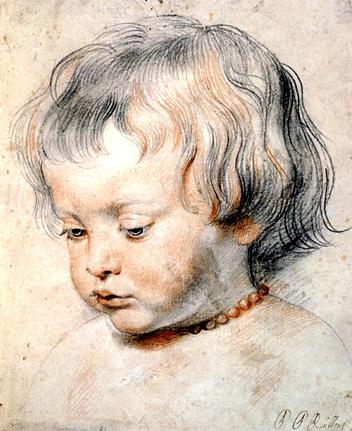
Nicolaas Rubens Wearing a Coral Necklace, Peter Paul Rubens, Red and black chalk heightened with white and some black ink on paper, c. 1619

Nicolaas Rubens Wearing a Coral Necklace, Peter Paul Rubens, Red and black chalk heightened with white and some black ink on paper, c. 1619

The tradition of giving children coral necklaces continued through the 19th century, as shown in this detail of a late 18th century John Hoppner painting of one of the Sackville girls. The gemstone was considered a guardian of sorts, protecting children from illnesses like stomachaches, fever, typhus, smallpox, and rickets. The mala beads were polished to a smooth sheen and matched in color. Bead sizes could be similar or gradated from small to larger stones that were strung in the center.

The Sackville Children, detail, John Hoppner, 1796

The Sackville Children, detail, John Hoppner, 1796

Handmade jewellery created during the late Georgian Era (1760-1837) is extremely hard to find today.  As styles changed, the pieces were remade rather than tossed out or sold. Until the latter part of the 18th century, coral was harvested from the sea largely by dredging. Fine quality red coral came from the Mediterranean – Algeria, France, Italy, Morocco, Spain, Tunisia and the islands of Corsica, Sardinia and Sicily, with some saying that the best corals came off the coasts of Algeria and Tunisia. Eighteenth century coral was a rich warm red and is unavailable today. In fact, original antique jewellery made with dark red coral is so difficult to find that it has become a highly prized collectible.
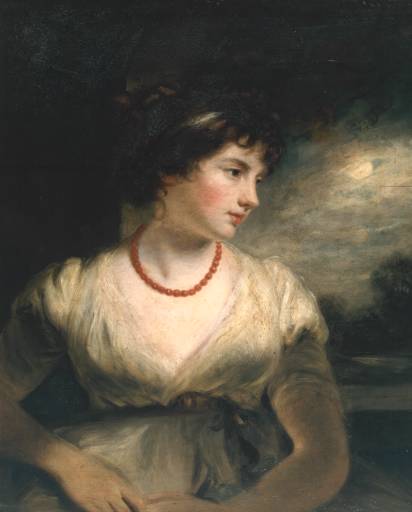
Jane Elizabeth, Countess of Oxford, John Hoppner, 1797
Jane Elizabeth, Countess of Oxford, John Hoppner, 1797

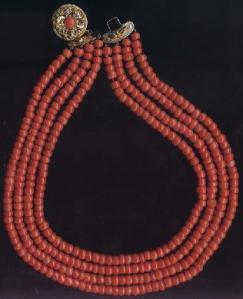
Early 19th century red coral necklace

Early 19th century red coral necklace

Simple round necklaces, like the one worn by the Countess of Oxford, were popular and complimented low necklines, but chokers were also fashionable, like the Georgian Cannetille Sardinian red coral four strand necklace on the left. Coral is made up of the skeletal material built up by small animals that live in slow growing colonies in the sea. Colors range from vivid orange, red, and white, to salmon and pale pink (called angelskin coral). In jewelry making coral is either carved into beads, cameos, and other forms, or is left in its natural branch-like form and simply polished. (My mother had such a necklace, which I played with as a child.) The most sought after color (and the rarest) is a deep red, as in the necklace at left.  Coral manufacturing during the Regency Period consisted primarily of filing beads of smoothed coral and stringing necklaces. Because coral consists of calcium carbonate, it is extremely sensitive to chemicals,  perfumes, and body acids. Like pearls, the necklaces must be washed with a damp cloth (no detergents) and restrung periodically.

Little boy placing a coral necklace on a dog's neck, Martin Drolling
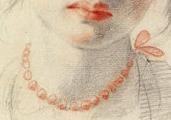
Little boy placing a coral necklace on a dog's neck, Martin Drolling

detail of Jacopo Vignali's Head of a Young Woman, 17th c

Many mystical and medicinal properties were attributed to coral, among them vitality, physical strength, stronger marital relationships, wealth, increased sensuality, and protection while out to sea. Coral was also used as a medicinal powder. Primitive physics believed that coral oxides mixed with honey made a person strong. Mix it with betel leaf and it made a potent cure for cough and heart disease. Coral powder is still a popular aphrodisiac in India today, which prompts avaricious collectors to dynamite coral reefs, putting fragile reefs in acute danger. In the detail of a 17th century drawing by Jacopo Vignali at right, one can easily see why this semi-precious stone was considered to have sensual qualities. The combination of the coral necklace and her full lips make the young woman look both fragile and seductive. Thank you, Laurel Ann, for introducing me to this fascinating topic! As you can see, I got a little carried away.

More information about corals can be found in these links:
Read Full Post »

picnic-at-box-hill-frank-saw-emma-first-in-march-2

The wretchedness of a scheme to Box Hill was in Emma’s thoughts all the evening. How it might be considered by the rest of the party, she could not tell. They, in their different homes, and their different ways, might be looking back on it with pleasure; but in her view it was a morning more completely misspent, more totally bare of rational satisfaction at the time, and more to be abhorred in recollection, than any she had ever passed. – Emma, Jane Austen, Chapter 44

  • Re-reading Box Hill: Reading the Practice of Reading Everyday Life offers five articles on the topic of Box Hill. How astounding. Click here to enter the site.

Read Full Post »

Inquiring readers,

This fashion plate and accompanying description come from La Belle Assemblée Or, Bell’s Court Fashionable Magazine, August 1807, Volume III edition. The descriptions about dress are directly from the magazine. The publication featured quality engravings and advice about women’s fashions that became an essential part of the magazine, and also offered a special supplement of advertisements in the back that became a permanent record of commerce and fashion of the time. – A Magazine of Her Own, Margaret Beetham, p. 32. By the 1830’s, La Belle Assemblee, which had been such a force during the mid-18th to early 19th centuries, had merged with Lady’s Magazine before quietly dropping out of sight.

kensington-garden-dresses-1807-august

Text not available
La Belle Assemblée Or, Bell’s Court and Fashionable Magazine

We scarcely ever witnessed a period when taste and fashion were more perfectly in unison, nor any season when elegance and grace shone with such unrivalled fascination. Not only amidst the ranks of assemblies and opulence, but in those simple unobtrusive adornments appropriated to the intermediate station — in those chaste habits becoming such as move in a more domesticated sphere, have our fair country women exhibited testimonies of their advancement in taste and the graces of life.

The era is long since past when the daughters of our Isle condescended to turn copyists; and the females of a neighbouring kingdom are now happy to aid their exhausted inventions by adopting the correct graces of English style.

Frocks of coloured muslin or Italian crape with a painted border of shells in Mosaic worn over white sarsnet slip, are a new and elegant article; and French veils of coloured gauze forming at once the head dress and drapery are considered as most graceful ornaments. They are usually worn with a plain white sarsnet or muslin gown, with flowers or wreaths in front of the hair, placed towards the left side so as nearly obscure the eyebrow. La Belle Assemblée Or, Bell’s Court and Fashionable Magazine, 1807

Fronticepiece of the magazine

Fronticepiece of the magazine

Read Full Post »

“Hot Cross Buns, Hot Cross Buns,
One a penny, two a penny,
Hot Cross Buns.”

– Street Cry on Good Friday in England

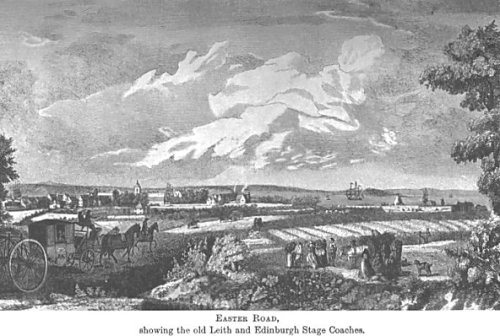
easter_road

  • Easter Fun at Chawton House this year will depend on good weather. Then again, there’s nothing like a sturdy pair of Wellies and an umbrella to deal with spring showers.
  • Here is a fun project on Belly Timber to make decorative boxes that will hold your Easter eggs or candy.

Jane Austen mentions Easter in a peripheral way. Fanny Price pines for Mansfield Park hoping to return soon to the Bertrams after her ‘exile’ to Portsmouth. However, by Easter she still has not received a summons to come ‘home.’:

Easter came particularly late this year, as Fanny had most sorrowfully considered, on first learning that she had no chance of leaving Portsmouth till after it. It came, and she had yet heard nothing of her return–nothing even of the going to London, which was to precede her return. Her aunt often expressed a wish for her, but there was no notice, no message from the uncle on whom all depended. She supposed he could not yet leave his son, but it was a cruel, a terrible delay to her. The end of April was coming on; it would soon be almost three months, instead of two, that she had been absent from them all, and that her days had been passing in a state of penance, which she loved them too well to hope they would thoroughly understand; and who could yet say when there might be leisure to think of or fetch her? – Mansfield Park, Chapter 45

Happy Easter One and All.

Read Full Post »

A person who can write a long letter with ease, cannot write ill.”- Jane Austen

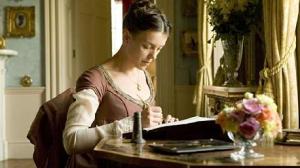
jane-writesIn Miss Austen Regrets, Olivia Williams as Jane Austen is seen at her sloped writing box writing her novels or composing letters during her visits to Chawton House. While portable writing desks similar to Jane’s were popular all through the 19th century, they did not become widespread until travel became more convenient for the middle and upper classes in the late 18th century. Writing boxes were versatile and portable and could easily be carried. They were placed on a table or one’s lap, and were as personal as a diary, containing  paper, pens, ink, and hidden compartments.

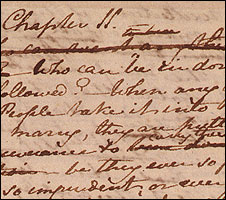
Sample of Persuasion in Jane Austen's handwriting

Sample of Persuasion in Jane Austen's handwriting

Today, Jane Austen’s writing box, spectacles, and the History of England and two cancelled chapters of Persuasion can be viewed at the John Ritblat Gallery at the British Library. Jane was a careful and meticulous writer, and the two chapters that have survived in her own hand show her creative mind at work. Crossed out lines and revisions and margin notes are quite evident. At Chawton, Jane placed her writing slope on a tiny round table next to a window in the sitting room.  (View images here and here on flickr)

Austen did not like to write in front of other people, and would hide her work as soon as the squeak of her door announced the presence of a visitor. She wrote Persuasion on very small pieces of paper so she could easily conceal the pages when interrupted. Jane Austen in London

The little round writing table at Chawton.

The little round writing table at Chawton.

Jane’s father most likely purchased the writing slope for her in December of 1794. I have wondered if he gave it to her on her birthday.

Jane's window

Jane's window

Hidden for generations, the desk resurfaced in 1999 when Joan Austen-Leigh, the great-granddaughter of Jane’s biographer and nephew, James Austen-Leigh, donated it to the British library. The desk had been kept by the family for over 40 years in a suitcase in a closet in Canada. (Jane Austen for Dummies)

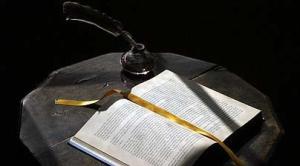
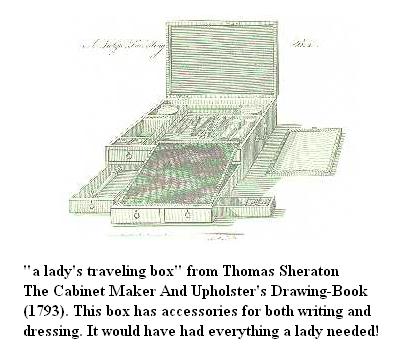
writing-box1The wood rectangular box opened to reveal a sloped writing surface embossed in leather. Compartments stored writing implements like paper, pens, ink, stamps, sealing wax, etc. From the black and white image of Jane’s writing desk, hers seems to be a simpler model than the Sheraton writing box depicted above.
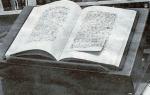

Image of Jane’s writing slope from JASA

Read Full Post »

« Newer Posts - Older Posts »