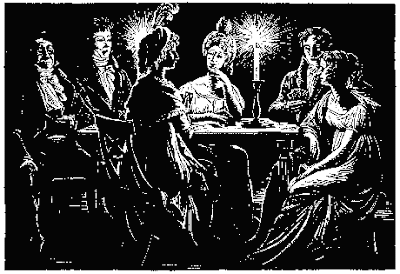
Illustration from the Jane Austen Society of Australia Website
(Post Updated: May, 2008): Until the last two centuries, adequate interior lighting was difficult to achieve. Oil lamps, around since ancient times, were smelly, and fish oil had an especially unpleasant odor. Rushlights dipped in tallow were commonly used, since candles were prohibitively expensive. It was the custom for families to sit near the fireplace at night as a group, reading, doing needlework, or telling stories, but generally people rose with the light and went to bed shortly after sunset. Only the more affluent members of society could afford to burn a large number of candles at a time, and their homes were characterized by spacious windows and well placed reflectors and mirrors.
“Traditionally in England, candles were used in great halls, monasteries and churches of medieval times. In addition, candles were used to light cottages and shops. King Alfred of England stuck torches in walls to supply lighting. The simplest (and smelliest) candles known as rush light were made by dipping rushes in leftover kitchen fat. For many centuries, candles were considered expensive items in Europe. Town-made candles from the wax-chandler were available for those who could afford them. These candles were made of wax or animal fat and were placed in silver, wooden or pewter candlesticks.”

Until the 19th century tallow candles and rushlights were the principal form of light for the poor. The slaughter of one bullock provided enough tallow for three years’ worth of candles and a well organised household could produce 300 or so at a candle making session. The Newsfinder Website: A Short History of Candles discusses how lighting remained essentially unchanged for hundreds of years until the early 19th century. Then, “the growth of the whaling industry in the late 18th century brought the first major change in candlemaking since the Middle Ages, when spermaceti – a wax obtained by crystallizing sperm whale oil – became available in quantity. Like beeswax, the spermaceti wax did not elicit a repugnant odor when burned, and produced a significantly brighter light. It also was harder than either tallow or beeswax, so it wouldn’t soften or bend in the summer heat. Historians note that the first “standard candles” were made from spermaceti wax.” From Cierra Candles
In Light Fittings in Georgian and Early Victorian Interiors, Jonathan Taylor writes,
“Candles were used sparingly. Even in the homes of the wealthy, when the family was not entertaining guest, only the minimum number of candles were used in a room at any one time, and these were positioned close to where the light was most needed. A single candle was carried to light the way from one room to another. Everyday lighting was therefore moveable, and not part of the architectural design of the interior.”
 George III Regency Mirror, circa 1810, with Two pairs of ormolu candle arms
In The Transformation of Lanhydrock House, Cornwall, 1758–1829: a paper presented to the CHN Conference 2002: The Country House, the authors describe the architectural parts of a house’s lighting:
“The main lighting in the eighteenth century house was by ‘2 glass lanterns’ one in the Prayer Room Passage and the other on the Staircase. The Dining Room was well illuminated by a ‘pier glass with chandelier’, ‘2 girandola in white carved frames’ and candle branches over the chimney. By c.1829 Wedgwood candlesticks and glass candelabra were replacing the more traditional candle branches and Corinthian pillared candlesticks. The emphasis towards quality lighting was displayed through the use of Spermaceti candles that were running low in stock by 1802. 26 There was no evidence by 1829 of oil lighting in the house. This reflects the often slow adherence to some aspects of contemporary technology.”

After the turn of the century, there was an explosion in candlemaking technology, as the Newsfinder website describes.
In 1709 in Britain, candles were taxed and people forbidden from making their own. This punitive tax was eventually repealled in 1831, resulting in a renaissance of decorative candles. It was not until new alternatives were looming when frenchman M. Chevereul purified tallow by treating it with alkali & sulphuric acid thus creating a clean-burning stearin candle which was long-lasting.
M. Cambaceres another Frenchman devised the plaited wick in 1825. This he steeped in mineral salts to make it curve on burning, thereby obviating the need to trim wicks.
In 1834 Joseph Morgan created a candle making machine which could produce up to 1500 candles an hour. In 1850, parrafin wax appeared, shortly followed in 1857 with the combination of stearin & the plaited wick resulting in a bright affordable candle.
The nineteenth century brought the development of patented candlemaking machines, making candles available for the poorest homes. In an attempt to protect the industry, England passed a law forbidding the making of candles at home without purchase of a special licence. At this time, a chemist named Michel Eugene Chevreul made an important discovery. He realized that tallow was not one substance but a composition of two fatty acids, stearic acid and oleic acid, combined with glycerine to form a neutral non-flammable material.”
By removing the glycerine from the tallow mixture, Chevreul invented a new substance called “stearine.” Stearine was harder than tallow and burned brighter and longer. It is this substance known today as stearin or stearic acid that led to the improvement of candle quality. Stearin also made improvements in the manufacture of wicks possible. It put an end to the constant round of snuffing and trimming wicks once they were lit. Instead of being made of simply twisted strands of cotton, wicks were now plaited tightly; the burned portion curled over and was completely consumed, rather than falling messily into the melting wax.
More improvements such as the addition of lime, palmatine, and paraffin developed in commercial candle manufacture. Paraffin wax was extracted from crude oil . It equalled beeswax and spermaceti candles for brightness and hardness and were cheaper. Paraffin wax is still widely used today in commercial candlemaking.”
 Rushlight Stand
For more resources on lighting, see
For a more detailed history of historical lighting, click on Early Lighting, a fabulous site filled with photos, illustrations, and definitions.
Candlelight reflectors
Read Full Post »








 Jane Austen's World