Feeds:
Posts
Comments

Archive for the ‘Regency’ Category

Lady Caroline Lamb

Caroline Ponsonby married William Lamb in 1805 with the expectation of inheriting wealth and riches, but her father-in-law was still living at the time of her death in 1828.

A woman of independent character who rarely conformed to society’s expectations, “Caro” still provokes strong reactions to her life and work, and affair with Lord Byron in 1812.

“As a child she was a tomboy – and a spirit of recklessness and disdain for convention never left her. She had no formal education and was unable to read until late adolescence. But she was intelligent and witty; as an adult, she wrote poetry and prose and drew portraits. She was the first woman of Byron’s class to captivate the poet completely. He treated Caroline badly after the grand infatuation faded. But while it lasted, he was demanding and possessive, goading her to admit she loved him more than her husband. He pursued her with abandon, once planning to flee England with her. Caroline’s reaction to the break-up is understandable; Byron led her to believe he loved her. It was her sad fate to discover Byron’s interpretation of love – a mad, passionate obsession which is abandoned as soon as curiosity and desire are sated.” From English History net.

Byron described Caroline as “the cleverest most agreeable, absurd, amiable, perplexing, dangerous fascinating little being that lives now or ought to have lived 2000 years ago.” Their brief but intense affair lasted only from March until August 1812, but it was to have longer lasting consequences for both of them.


Melbourne Hall, Home of Lady Caroline Lamb

Lady Caro’s body of literary work has not fared well with critics over the ages. Of Glenarvon, her first novel in 1816, she wondered why “everybody wishes to run down and suppress the vital spark of genius I have, and in truth, it is but small (about what one sees a maid gets by excessive beating on a tinder-box). I am not vain, believe me, nor selfish, nor in love with my authorship; but I am independent, as far as a mite and bit of dust can be.” Those who have judged her novels and poetry have treated them as an extension of her personality: at best the production of a neurotic mind, and at worst a devious attempt to hurt Byron.


Lady Caroline Ponsonby Lamb)(dghtr of Henrietta Spencer and Frederic Ponsonby, erd Earl of Bessborough, spouse of William Lamb, 2nd Visc. Melbourne)-painted by Sir Thomas Lawrence

Lady Caroline certainly suffered when Byron ended their affair. She was threatened with a straitjacket several times subsequently. After Byron left England, however, her life did not devolve into complete histrionics. She published three novels, two accomplished parodies of Byron’s poetry, several poems in literary journals, and a number of songs — besides having worked up three other novel projects and a “pocket-diary” called Penruddock that she printed in England and sought to publish in Ireland. ”

According to Wikipedia, “In 1824, she accidentally came across Byron’s funeral cortège on its way to his burial place, and this incident drove her to a nervous breakdown, and rumoured insanity. She lived her last years in seclusion at Brocket Hall.”

Learn more about Lady Caroline here.

Caro: The Lady Caroline Lamb Website

Lady Caroline Lamb

Byron

The Literacy Encyclopedia

Lord Byron: Letter to Lady Caroline Lamb


Lady Caro’s letter to Lord Byron

Read Full Post »


Jane Austen’s characters attended assemblies, routs, and parties so often that one is left to wonder: Did these people never stay home?

When the social whirl was in full swing during the London social season, a well-connected, rich, well-born, or idle person could attend several gatherings in one night. Here is a first-hand description of an assembly by Louis Simond, a transplanted Frenchman in America, inveterate traveler, and author of An American in Regency England (p. 31):

“Great assemblies are called routs or parties; but the people who give them, in their invitations only say, that they will be at home such a day, and this some weeks beforehand. The house in which this takes place is frequently stripped from top to bottom: beds, drawers, and all but ornamental furniture is carried out of sight, to make room for a crowd of well-dressed people, received at the door of the principal apartment by the mistress of the house standing, who smiles at every new comer with a look of acquaintance. Nobody sits; there is no conversation, cards, no music; only elbowing, turning, and winding from room to room; then, at the end of a quarter of an hour, escapting to the hall door to wait for the carriage, spending more time upon the threshold among footmen than you had done above stairs with their masters. From this rout you drive to another, where, after waiting your turn to arrive at the door, perhaps, half an hour, the street being full of carriages before the house–then every curtain, and every shutter of every window wide open, shewing apartments all in a blaze of light, with heads innumerable, black and white (powdered or not), in continual motion. This custom is so general, that having, a few days agao, five or six persons in the evening with us, we observed our servants had left the windows thus exposed, thinking, no doubt, that this was a rout after our fashion.”

Indeed, with such a throng of people inside an enclosed space and candles blazing on hot spring and summer nights, the rooms would have been stifling. Had the windows and doors not been kept open, the heat and lack of fresh air would have been insufferable. People often needed to step outside to the terrace or gardens to gain some relief from candle smoke, body odor, and fetid air.

As you can see from this illustration of the Assembly Room in Bath by Thomas Rowlandson, the public assemblies also provided opportunities for dancing. One must surmise that private and public assemblies differed in character. The size of a hostess’s house and her budget must also have dictated whether she could also provide music and dancing at her gathering.

Read Full Post »


A penny isn’t what it used to be, as you’ll discover on the following sites. For fuller explanations on the relative value of incomes and the cost of goods during the regency, read my other posts on the topic: Pride and Prejudice Economics and In Jane Austen’s Own Words: Economic Sense and Sensibility.

For more links on costs during this period, click on the following:

Read Full Post »

Austen Blog

Austen Blog seems to be mostly about movies and books about Jane, but the site is worth a visit.

Read Full Post »

Welcome to the Regency Era

Ah, the Regency Era! Through the eyes of Jane Austen we have become intimately acquainted with this short period in English history. We admire the outrageous behavior and sparkling wit of their characters, as well as the era’s clothes, furniture, and architecture.

Unsated, we reread the same six Austen novels over and over, hoping to turn up additional nuggets of information from Jane’s keen insights. Thank God for the Internet, which puts us within an ames-ace of historical details.

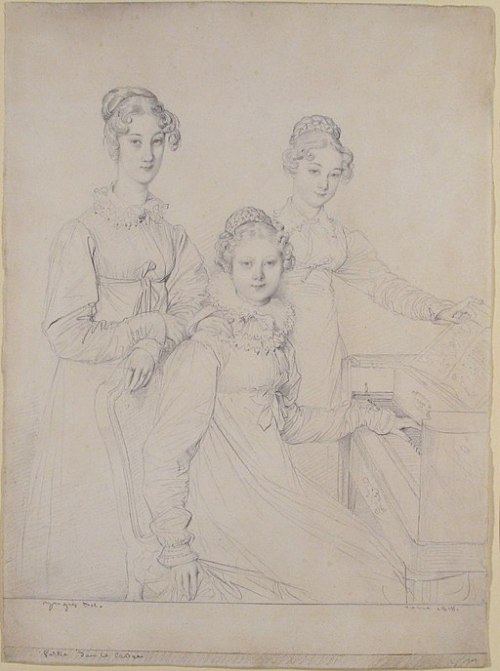
The Kaunitz Sisters (Leopoldine, Caroline, and Ferdinandine), drawing, 1818, Jean Auguste Dominique Ingres (Public Domain, MET, 1998.21)

The delicate drawings and crystal clear paintings of Jean Auguste Dominique Ingres embody the refined sensibilities of the era. As we examine them, we are reminded that the English of the period revered all things French, despite Bonie’s tiresome habit of killing British soldiers on the Continent.

Read Full Post »

« Newer Posts