Feeds:
Posts
Comments

Archive for the ‘Sanditon’ Category

Inquiring readers,

When Sanditon Season 1 first aired, I reviewed every episode in such detail that I now realize I can no longer reclaim the hours I lost watching and rewatching the program, researching the actors and locations, and writing down my thoughts, albeit tongue in cheek. 

By Season 2, I had learned my lesson. I bundled the episodes together for fewer reviews  (tongue still firmly planted in cheek).

My tongue and cheek begged me not to use them for Season 3. Alas and alack, I could not make such a promise. Spoiler alert (and trigger warning for those who are still developing an appreciation for comedy, irony and sarcasm): I am giving my full-blown and personal opinion based on how many times Jane Austen rolled in her grave when her spirit realized how her unfinished novel was given the 21st century commercial, rom-com, Regency treatment. As I watched the 6 episodes back to back, with power naps inbetween, my essential question was: “Where’s Jane in all of this?” 

The season opens with Sir Eddy Denham suffering a Regency-style water rehabilitation (torture) treatment to unlearn his shifty and criminal ways. Jack Fox, who plays Lady Denham’s nephew, looks thin and wan, as if he’s been forced to fast every other day. Lady Denham (Anne Reid) sits on her silk sofa like a corseted spider who has woven a web so tight that Sir Eddy cannot escape his destiny – that of a loser. While his self-abasement is fueled by avarice and greed, this viewer wonders why his tired old storyline has been hauled out for the 3rd time. 

Charlotte Heywood arrives in style to Sanditon in the same carriage that spirited her bereaved self away at the end of Season 2. She’s still engaged to the young farmer her father thought would become a suitable husband. Cai Brigden plays Ralph Starling, a handsome enough fiancé, who’s besotted with his betrothed. Ah, but has she forgotten Mr Colbourne? Or Sydney Parker for that matter? At this point I decided to use my Before-During-After critical thinking teacher strategies to examine Season 3’s plot. 

Screen Shot 2023-05-15 at 3.47.41 PM

Before

Season 1: Charlotte fell passionately in love with the incomparable Sydney Parker. Alas, the actor, Theo James, saw richer beach resorts on his horizon, and left poor Char forlorn, for she would never see such a beautifully sculpted naked man rising from the sea again. (Neither will we, for that matter.) In that season, Sanditon was just a mishmash of old cottages, new buildings, and muddy roads. Its story line more or less followed Austen’s script for 15-20 minutes. Then the deviation from her plot had me laughing so hard, that the wine I was drinking snorted out of my nose. I must say that Rose Williams as Charlotte is lovely and likable, and a realistically feisty miss. But I wondered after the end of Season 1 – what now?

During 

Season 2: Of course the script writers had to kill Sydney off (Still, I asked: What if Theo changed his mind and wanted to come back? And what has become of young Stringer?) Oh, well. Charlotte’s journey without Sydney leads her to cold stiff Alexander Colbourne (Ben Lloyd-Hughes). He’s rich, I’ll give him that, but no amount of bronzer will make his body shine in glittering sunset-lit waters like Sydney’s. Sigh. 

In her grief, Char seeks work as a governess. She lands at the doorstep of Alexander Colbourne, a widower with a child, Leonora, and his charge, Augusta. From the moment they meet, Char and Alex dislike-hate each other. He’s too opinionated and stubborn. She’s too opinionated and stubborn. When she’s finally had enough of his strict ways, she stomps out of his mansion, nearly slamming the door in his self-important face. He follows her on his splendid steed and basically says, “Hey, come back. See ya tomorrow.” As for the girls, one is unruly, the other repellent, but Char’s no quitter. In no time, Alex begins to desire her, and her knowledge of horses seals the deal. Did everyone see this coming? Of course. I must confess being so bored by their predictable storyline that I fell asleep. I did have one question, for my nap prevented me from following the plot closely: “Why, gentle readers, did she leave him to go home to her family at the end of S2 and get engaged to a mere farmer?”

Season 3: (We’re still in the During phase of this 3-part tale.) At the beginning of season 3 Char is still engaged to her daddy’s choice of a fine working husband. While I’m sure Ralph is a nice guy, he’s out of his comfort zone and her league, and all but disappears. He shows his discomfort and  jealousy of the fine friends she’s made. Char’s only returned to Sanditon to celebrate Georgiana Lambe’s (Crystal Clarke) birthday. It is an auspicious occasion, for Georgiana will come into her substantial inheritance. Impoverished fortune hunters are waiting to crawl out of their expensive, unaffordable Sanditon boarding rooms to woo her.

Screen Shot 2023-05-15 at 3.48.49 PM

But let’s leave the ho-humness of these stale plots and examine the sidebar romances, which added some spice and much excitement this season.

Sidebar Romance #1

The torturer in charge of Sir Eddy’s rehab is Dr Fuchs, who was practically invisible in Season 2. Rev Hankins, the second person employed by Lady D to change Sir Eddy into a nicer person, is working on our villain’s soul. The reverend’s long suffering sister, Beatrice, abides by his edicts, for as a spinster with no home of her own she must suffer his insufferability. She has no choice unless she wants to make baubles like Mrs Smith of Persuasion fame. When Rev Hankins and Beatrice leave church, Dr Fuchs (rhymes with mucks) chances upon the pair. He makes goo goo eyes at her and she simpers in return. Rev Hankins will have none of that! Well, you know how that will go. This romance weaves many comedic moments throughout the season. More importantly, their awkward flirting kept me semi-awake.

Sidebar Romance #2 (A Triple Romance with a Twist)

Ah, who would have guessed that Arthur Parker (Turlough Convery) and Edward Lord Harry Montrose (Edward Davis) would provide the truest sidebar romance in this overlong adaptation of Austen’s unfinished novel? To ward off pesky fortune hunters, Georgiana Lambe agrees to a pretend engagement to the Duke, whose family is penniless (unbeknownst to her.) She knows, though, that the Duke is attracted to his own sex. And that’s alright with her. (This means mitts off her nubile body.) Harry wants Arthur. Arthur wants Harry, but cannot hurt Georgiana. Georgiana just wants to keep up the pretense until she’s in full control of her fortune. Edward’s momma is ecstatic at the thought of her son’s union with an heiress and the replenishment of the family fortune. Lord Harry’s spinster sister, Lydia’s, situation reminds me of Beatrice’s, but Lydia has more status and has kept a secret meant to keep us on the edge of our seats. The red herring in her plot is with Alex Colbourne, but we savvy viewers know better. Both have better chemistry with their horses than each other.

Sidebar Romance #3 Lady Denham (Anne Reid) and Rowleigh Pryce (James Bolam)

I won’t spend much time on this “romance.” Two aged, irascible and unlikable characters duke it out with each other. He left her at the altar when she was still nubile; she leaves him at the altar when he can still father a child and she can’t bear one. Lady Denham is based on Lady Catherine de Bourgh, Mrs Norris, and Mrs Ferrars (mother of that odious Fanny Dashwood) – all rolled into one. The “romance” ends with an agreement that they will still see each other regularly, but as little as possible. 

Sidebar Romance #4 Augusta Markham (Eloise Webb) and Sir Eddy (Jack Fox)

Would anyone like to shout Lydia and Wickham and Georgiana Darcy and Wickham in Pride and Prejudice when following the trajectory of this unlikable couple? Yes, Sir Eddy at first only pretends to redeem himself to Lady D, but then he meets the attractive and intriguing Augusta Markham. He learns/knows of her fortune, woos her, twirls her susceptible cookies, AND absconds with her. Augusta is older than the very young Georgiana Darcy, and she can’t wait for Sir Eddy to hop in the sack with her. But seeing her eagerness, he suffers a sudden crisis of conscience. (Those water torture baths are finally working!) And so he rejects her. Ouch. Augusta languishes. He languishes but manages to keep a heroic stiff upper lip. Oh, dear, I think, as I awaken from my power nap, what will next happen to this hapless couple?

Romance #5  The Prince Regent Changes His Mind, and So Does his Mistress

Mature love in the form of Sophie Winkleman as Lady Susan and Liam Garrigan as Samuel Colbourne has been given an unroyal treatment. Lady Susan, taken out of mothballs from Season 1, has really no role other than to walk arm in arm with Char, look elegant and beautiful, and meet Samuel, Alexander’s brother. I must admit I was nodding off during his introduction, so I still have no idea why/how his presence was introduced into the plot. I believe, and please correct me if I am wrong (yes, this happens often) that he’s a lawyer or accountant of sorts. Lady Susan and Samuel banter in friendly exchanges at first and then experience such irresistible hots for each other that they kiss on a public beach! What if someone, like a fisherman or bather, saw them? Qu’elle horreur! After Samuel decides he’s finally found the woman of his dreams, the Prince Regent requests his former mistress’s return to London. Lady Susan, supposedly a sensible woman, plans to hie it back to her fat princely hedonist and leave the love of her life. Whaaaa?!! Samuel is bereft. She’s sad. As devotees of rom-com plots, let’s all together guess the ending! Hint: We are all correct.

Non Romantic Plot Developments:

Tom and Mary: Tom Parker (Kris Marshall) and Rowleigh Pryce unite in a common vision to build a luxury hotel in Sanditon, bulldozing anything standing in their way. 

Achieving their goal means demolishing fishermen cottages that sit on a stretch of beach with a splendid view. Meanwhile, Tom’s wife Mary (Kate Ashfield) has been tending to the poor, including a fisherman’s widow who has little income for herself or her children. Much like Emma Woodhouse, Mary visits the widow frequently with baskets of food and clothes, often accompanied by Char. Mary is horrified by Tom’s plans and they engage in a major row. Tom is adamant, as is Mary.

Then (shades of Marianne Dashwood lying on her deathbed), Mary falls mysteriously ill and, you guessed it, lies on her deathbed. A grieving Tom can only recall his last harsh words towards his beloved. After much hand wringing, Dr Fuchs tells the assembled family members and friends to prepare for the worst. Then, miracle of miracles – as if Mary’s mother hastened to her bedside à la Mrs Dashwood – Mary awakens. Tom turns into a precursor of Ebenezer Scrooge after the three visits from the spirits. Chastened, he follows Mary’s advice. In short order, Tom ditches his plans for the hotel, as well as Rowleigh Pryce, and promises Mary he’ll improve the fishermen’s cottages (and his sex life, no doubt) and the cottagers’ lives.Trifecta! Mary is now hale, hearty, and happy to have her dutiful Tom under her sensible thumb again.

The last is a story line I’ve entitled: “She Loves Me, I trust Her. She Loves Me Not, I’ll Ditch Her, She Still Loves Me.” This plot involves Georgiana’s momma, her sudden appearance, and the shell necklace that proves her motherhood.

We are so lucky in this century, for DNA tests proves irrefutably to whom we are related. But during the Regency one had to rely on one’s instincts. Georgiana, one smart cookie when it comes to defending herself from fortune hunters, practically melts into the arms of a woman who appears out of the Caribbean Blue to claim the closest kinship any orphaned child could want – a mother. The proof? A shell necklace that brings Georgina to tears and conjures memories of Antigua so ancient they might not be true. (I’ve made a number of shell necklaces that look remarkably like Momma’s proof.) After a few conversations and memory prompts, Georgiana cries “Momma!” and throws herself into her arms. Lord Harry’s avaricious Momma, hellbent on making sure her son marries rich Georgiana and wanting to keep her entire fortune, finagles to bribe Georgiana’s mother with enough money to make her disappear. Ah, but love is blind and conquers all. Georgiana’s momma ditches the money and tells her daughter she is more priceless than all the gold on earth. Oh, happy reunion. 

(If I’ve not mentioned that creep artist, Charles Lockhart, it was on purpose.)

After:

Major Sugar Overload

Diabetics should be warned to take their metformin or insulin before watching the treacly epilogue. The cynic in me guffawed my way through those last 10 minutes. Every major plot and most subplots were tied up neatly with pastel colored ribbons and rose colored glasses. I’m sure Jane A. rolled over in her grave once again. While we had indications that some couples in her novels reached marital nirvana (Lizzy and Darcy and Anne and her Captain, for example), most of her stories ended at the wedding. Jane hinted at some unhappy consequences. Well, hint is a weak word when we think about the character arcs she introduced in her novels. I could write an entire post about them, starting with Wickham and Lydia and Charlotte Lucas’s compromise marriage to Mr Collins to oversee her own household. (Me? I’d rather roll naked in hot tar than tolerate that man.) 

At the end:

  • Char marries Alex, becomes a school teacher, and has a baby.
  • Georgiana, through the machinations of her mama, marries her true love, Otis Molineux.
  • Lady Susan and her Samuel sit in bliss at Char’s wedding.
  • Lady Denham keeps her title and fortune, and relishes bossing Mr Pryce around every other month or so.
  • Augusta becomes a governess. Hahahahahah.

On and on. 

  • Unhappy is Char’s ex fiance, Ralph. And I still have one question – whatever happened to young Stringer?

More about Sanditon on this blog: Jane Austen’s World reviews, Seasons 1-2: https://janeaustensworld.com/category/sanditon/

Read Full Post »

Inquiring readers: This season the writers for the adaptation of Jane Austen’s Sanditon did their best to disguise how events would unfold to keep viewers guessing. I had fun picking up the clues, whether they made sense or not.

Char

Charlotte Heywood, Image @ PBS Masterpiece

Episode Two opens with Charlotte walking past the militia, who are making a colorful splash on the beach. Col Lennox notices her immediately, for he admires her candor and independence. They chat, and she explains she has a new governess position with a family that is expecting her. As they part, he tells her to look for an invitation to an event; she smiles and walks away carrying her strapped leather portfolio over her shoulder..

Tom and Arthur discuss poor dead Sidney and that it turned out he did not neglect Miss Lambe’s financial affairs in Antigua. They look at the future plans for Sanditon in Tom’s study. Arthur excitedly tells his brother about his idea of building a Theatre Royal as the next step. But Tom has other plans. He and Arthur walk along the promenade with Colonel Lennox. Tom, in an attempt to convince the colonel to remain in Sanditon with his militia, discusses building permanent barracks for them. Arthur remains quiet, thinking his plan is more sensible and looks disappointed.

Georgiana, ever the instigator, invites Alison to visit the militia’s camp unchaperoned to surprise the men. While Captain Carter is charmed, Captain Fraser is not. Indicating that this is no place for ladies, he escorts them away.

Charlotte arrives at Alexander Colbourne’s manse, an impressive pile of stone, and is greeted by Mrs Wheatley, the housekeeper, who, as it turns out, has waged a shilling certain that this new governess will last longer than the many previous failures. Others are betting she will not last. What trap has Char walked into? Augusta’s rude and disrespectful behavior gives us the first clue: Leonora’s preference to dress and behave like a boy is the second. However, on Char’s first day the girls are dolled up like ladies and await her in the school room. While practicing their embroidery skills, Augusta is especially cruel, but Char, who helped to oversee eleven siblings, does not rise to the bait. At lunchtime, Augusta pointedly tells Char she must eat in the kitchen. ‘Yeah!’ thinks Char, who must have been ecstatic to be free of this sour pus and have the supportive Mrs Wheatley for company.

After lunch, Char takes the children outdoors for their lesson and returns with a variety of jars filled with water and water snails. Leonora (Leo) runs into her father’s study to find a magnifying glass, interrupting him. Charlotte explains that Leo wanted to explore the creatures more closely, and the child pipes up, “We’re being malacologists!” When she leaves the room, Colbourne sternly reminds Char she’s been engaged to make young ladies out of the girls. Char points out how engaged the girl is, and turns to leave. He then says, “Planorbis carinatus, keeled ram’s horn. If you’re going to be a malacologist, you might as well use the correct terminology.”

‘What an overbearing prig,’ I thought. This man’s not intriguing enough to be a possible suitor for Char, but neither is Colonel Lennox for that matter. But what do I know? I’m still infatuated with godawfullyhandsome Sidney, who’s sadly dead.

There’s no redeeming E-d, pronounced Eh deee, Lady D’s disinherited heir, whose creepiness exudes from every pore of his skin. E-d lurks in broad daylight in a shop’s alcove along the promenade. When he sees Lady Bab, he hurries across the street, then pretends surprise to see her. “This must be fate.”

No fool she, Esther gives him the evil eye. “Fate has nothing to do with it,” she answers. “It’s a contrivance, you’re fooling no one, least of all me”

He pretends to be taken aback. “What will it take to convince you I’m truly repentant?”

The priceless Lady Bab answers, “Try drowning yourself,” before she sashays away.

Meanwhile, as Arthur Parker sleeps on the beach near the promenade, Charles Lockhart sketches him. When he awakens and sees Lockhart’s drawing, he forges a friendship with the painter, who tells Arthur he has a ‘rare masculine beauty.’ Arthur’s chest puffs up with the compliment. Lockhart then shares his desire to paint Miss Lambe, a woman he barely knows, but with whom Arthur has a trusting friendship. Having found an admirer and possible friend, Arthur is more than willing to facilitate an introduction.

Wanting to thank the townspeople for their warm welcome, the colonel and his men have arranged a dinner and ball in the resort’s assembly rooms. The table is exceptional with gleaming silverware, fine porcelain china, and glittering crystal goblets. If you recall, gentle reader, I decried the poor production values in Season 1, but this season has upped its visual awesomeness. For starters, three drummers drum in a first floor alcove as footmen wearing red regimentals carry heaps of food towards the diners. This was a spectacle indeed. One would surmise from all this sumptuousness that the colonel and his militia made whopping fortunes from the spoils of war.

Before the diners enter the room, Arthur secretly switches name cards so that Mr. Lockhart is placed next to Miss Lambe. Her ennui is evident, for she is not as enthralled by the display as the others. After Colonel Lennox toasts the King, Mr Lockhart stands to toast Napoleon’s abolishment of slaverly in 1814, thereby shocking the assembly. As many slap the table and chant ‘out, out, out,’ Lockhart’s smug smile shows he’s made an impression on Georgiana.

The guests then dance – and showcase some lovely moves. A dance in an Austen film is a must-have activity, else the time spent watching a Regency soap opera would be ill spent! Colonel Lennox escorts Char onto the floor and apologizes for her placement at the far end of the table meant for spinsters. She demurs sweetly.

Alison is as infatuated with her handsome rescuer as ever. In fact her heart is all aflutter, which I can’t understand because he looks all of 15 years of age. As they dance, a lovesick Alison stares at him starry eyed like a Regency groupy. She’s as smitten as Marianne Dashwood was with Willoughby, only Alison’s hero spent 10 calories raising her up from the beach whilst Willoughby must have expended 10,000 carrying a hefty Marianne a quarter of a mile or so to Barton Cottage.

Arthur dances with Georgiana. They are a cute platonic couple and I’m ever so hopeful that this friendship will blossom into something more romantic, but then I wanted Char to fall for Young Stringer in Season One and that never happened.

The scene switches to Miss Lambe and Mr. Lockhart on the balcony. (There’s something icky about the artist, but I can’t put my brush to it.) His talk about independence and his preference to live according to his own rules captivates her, especially when he advises her that it would take a brave lambe to wander from the flock. Mary Parker, her chaperone, observes their interaction with concern. Wise woman she.

Meanwhile, Col. Lennox ensnares Tom Parker into a game of dice. Arthur’s brain screams “No!” as he watches his brother win the bet. ‘Oh, fly-invested merde,’ he thinks. ‘This will not bode well.’

Lady D informs E-d that she’s invited Colonel Lennox for tea the following day to show off her brother’s medals. (Gentle readers, we know that Lady D only wants to learn the Colonel’s unvarnished opinion about his protege). Upon hearing this news, Lady Bab’s wooden expression is that of a patient anesthetized with enough painkillers to fell a horse. She awakens, however, when she sees an opportunity to test if E-d has truly changed his ways. Esther asks him to dance with Rev Hankins’ spinster sister, Beatrice, for she herself would rather be drawn and quartered and have her liver boiled in oil than dance with the fiend. Having no choice, he acquiesces to her request. The dance scene, with E.d’s snobbish reluctance contrasted against Beatrice’s innocent pleasure, is a delight to watch. As the cad squirms and the spinster revels in his inattention, Lady D and Lady Bab resemble two cats who have cornered a fat mouse, for they now know far he’ll lower himself to prove he’s human.

As the assembled guests leave the ball, the viewers learn many tidbits of information. Lockhart invites Arthur to his abode for a glass of port (and more information?). Georgiana collects Alison, who reluctantly leaves baby-faced Captain Carter. That unrefined young man in turn approaches Captain Fraser as a friend and fellow officer for help to impress Alison. He knows his knowledge of culture is a wasteland and he needs Fraser’s help in pretending he knows more about Cowper’s poetry than merely pronouncing the poet’s name, and to polish him with the cultural refinement he lacks. Poor Fraser. He’s developed a tendre for Alison (heaven knows why – she’s too silly-young) but feels loyalty to his comrade in arms and will honor the request.

As she says goodbye to Colonel Lennox, Char tells him that Mr Colbourne is her employer. The colonel’s resting angry face changes into an even angrier one.

In the next scene, the camera pans to a CGI view of Sanditon with the promenade and the beach in the foreground. Georgiana and Mary Parker are seen walking along a particular portion of the beach that viewers have witnessed repeatedly. The actors cannot walk far towards the camera, for if they do so, they will hit their heads on a wall. (See link to Episode One). Georgiana assures a worried Mary that her opinion of Lockhart has not changed. “He’s all conceit and affectation.” She’s also had her fill of suitors and would like Mary’s hunt for a husband to stop.

Colonel Lennox explains to Lady D that he’s askeds E-d to accompany him on his visit, for her nephew was “keen to hear about his late uncle.” Yes, Lady D remarks facetiously. “E-d has always taken a keen interest in family matters.” Lennox is not surprised, for E-d in his estimation has proved himself to be exemplary, honorable, courageous, and disciplined. Hearing this, Lady Bab nearly upchucks her lunch. When the colonel discusses E-d’s sincere desire to atone, her eyes roll up. Lady D quickly escorts the colonel to view her brother’s portrait, leaving Lady Bab and E-d alone. He once more attempts to apologize, but Esther turns away and thinks of 50 ways to kill her former lover.

We next see Char and Augusta sitting at a table, with the young girl spewing her nastiness at our heroine. Char remains kind and understanding and tries to elicit a conversation with her young charge. In the course of their conversation, Augusta convinces Char to visit a room containing a locked spinet, and entices her to unlock the instrument by giving her a key. She then asks Char to play something LOUD. On hearing the music, Colbourne angrily charges into the room demanding to know who had given Char permission to play his late wife’s instrument. Char takes full blame for her actions. At that moment, Leo, dressed as a boy, runs through the room. Colbourne chastises Char for losing control of both girls: She bravely points out his inattention and absence as a father. After her outburst, Char assumes she’s fired, but he unexpectedly tells her he’ll see her the next day. The housekeeper collects her shilling from Colbourne, and Augusta and Leo begin to soften towards Char.

On a relaxing evening, as Lady D and Lady Bab enjoy each others’ company, someone comes knocking at the door. Surprise! Clara Brereton with a belly the size of a wine barrel enters the Denham mansion. Both ladies are in genuine shock, for they thought they’d gotten rid of the minx forever. When Clara announces she’s carrying E-d’s child, we viewers rub our hands in glee. What unholy deliciousness do the writers have in store for us next?

Read Sanditon Season 2, Episode 1 on this site

Read Full Post »

Inquiring readers, I caution those who unconditionally love Sanditon, the TV edition, that this belated review is guided by my tongue firmly planted in my cheek. My fingers had no choice but to obey its command, for my brain is still processing what I saw. I must admit to liking this season more than the previous one, for it has lost almost all pretensions of adhering to Austen’s last work.

________

Well, here we go again, just when I thought Sanditon had been laid to rest with Sydney Parker leaving poor Charlotte to marry his rich bride in order to save brother Tom, the series rears its confused head once more. Thanks (or no thanks) to the pleading of millions of devoted fans, the streaming services of Britbox and PBS ordered up two more seasons. Andrew Davies’ S 1 deviated so much from Jane Austen’s unfinished novel in both plot and character that I rolled on the floor with laughter, or wept copiously from the changes the writers made, most notably with Sir Edward Denham’s egregious transformation from an insufferable but clueless literature spouting buffoon (with social aspirations) to a ruthless villain.

This year, the writers left any semblance of Jane’s intentions behind (well, they had no choice) and embarked on a plot more in Georgette Heyer’s style, with a nod to Austen here and there. Don’t get me wrong. I love Heyer’s novels and have read them all. She is historically accurate and, unlike Jane, detailed in her descriptions of countenances and expressions, architecture, fashions, carriages, and landscapes. Heyer’s heroes, heroines, villains, and villaineses are a delight to visit for a few hours of entertainment, but I don’t reread her novels over and over. (As a friend once remarked, her books are great to read when on vacation or in need of some light entertainment.) Most of Heyer’s characters follow stereotypes and one can almost tell from the start how their trajectories will lead to their logical end.

Jane Austen, on the other hand, has given me something new and fresh to ponder throughout the stages of my life. These days I reread her novels with a renewed understanding, and former cherished passages and novels have made a place for new favorites.

This season, a few cast members — Sydney Parker, Lord Babington, and Young Stringer — have left Sanditon for other favorable acting shores. New characters, notably Alison Heywood as Charlotte’s younger sister; a group of 100 red-coated militia led by Colonel Francis Lennox; and a reclusive widower, Mr Alexander Colbourne, who is distant from his young daughter, Leonora (Leo), and orphaned niece, Augusta Markham, spiff up the plot.

It’s been some years since Sanditon graced our screens. Season 1 left loyal viewers robbed of a happily-ever-after ending for Charlotte. When that season’s last episode ended, I yelled, ‘What the Fudge!’ and threw popcorn at my screen. Unhappy viewers, in a tizzy of persuasive letter writing, aided Davies in his campaign to extend Sanditon’s seasons from 1 to 3. (Britbox and PBS are paying the moolah up front.)

This season, Tom Parker’s vision of a successful seaside resort has come to life. Ugly scaffolds, unsightly structures, and the sound of incessant hammering have given way to pastel colored houses and a variety of shops that line a wide seaside promenade, whose center boasts a picturesque pavilion or band stand. Below are two images I took of my TV screen. Please hover your cursor over them for a description.

Sanditon’s journey from a working fisherman’s village has been transformed into a respectable Georgian seaside resort. (Such improvements in cities, towns, and villages all over England were common between the 1790s and 1830s. Roads were widened and straightened to accommodate carriages; and in many cases markets were moved from urban centers to outlying areas, so that new citizens living in the “smart” part of town were not subjected to the incessant sound of clopping hooves and bellowing animals, or the smell of their droppings as drovers marched them to their final destination.)

The camera lovingly pans to visitors parading past buildings and chatting in groups… but, I ask myself, why is no one entering those seaside shops or emerging from them? Are they mere facades to make us think such a town exists? The answer, had I known it existed before wasting my time speculating, lies in the video at the bottom of this review.

Episode One:

The first scene opens with a coffin lowered into the ground in a tropical location; the camera then pans to Charlotte having the time of her life dancing in a barn. She’s wearing a white muslin gown and laughs gaily. Her hair remains wild and unbound as a handsome young man looks on. ‘Oooooh’, I think, now there’s a feast for a maid’s eye and perhaps a new suitor. Drat. That was his first and last appearance. He’s mentioned briefly later by Charlotte’s sister, but not in a way that would get our hopes up, for he is a mere yeoman farmer admired by Char’s parents.

Mary Parker, dressed in black, appears suddenly to talk to Charlotte. Drums roll ominously in my mind as our poor Char learns that Sydney is dead and buried in Antigua.

We next observe an excited Alison Heywood, Charlotte’s younger sister, sitting beside her in a carriage. Both wear their hair loose and wild under their bonnets. Tsk. Tsk. Even Mills and Boon authors know better than to make such a fashion faux pas. As was stated in Season 1, Sanditon screen writers merely wanted to show the Heywood girls as natural, unaffected beauties. But, hey, why not try for some historical accuracy?

Sanditon S2

MASTERPIECE “Sanditon” Season 2 – Premieres Sunday, March 20, 2022 at 9/8c on MASTERPIECE on PBS – promo Shown: Charlotte Heywood (ROSE WILLIAMS) For editorial use only. Photographer: James Pardon (C) Red Planet (Sanditon 2) Ltd

The contrast between the sisters is obvious in their personalities, as well as their hair color. At the prospect of visiting Sanditon, Alison’s eyes sparkle as eager as a puppy’s and she practically twitches with excitement. Charlotte’s demeanor is world-weary. The oldest child in the family, she’s had to grow up fast and, while she’s still a practical woman, her optimism has been severely tried. The sisters are visiting Tom and Mary Parker for the summer. Trafalgar House, the Parker’s abode, now stands amidst spruced up buildings sporting facades of soft white stone a la Bath and Brighton.

This visit is meant to lift Charlotte’s spirits, but, let’s face it, the reminders of falling in love with Sydney and then enduring the humiliation of his leaving will haunt her while she lives in that resort town. (I find Sidney’s voice overs a bit creepy when Charlotte recalls him. This is the actor’s only appearance and explains his inclusion in this episode’s credits.)

Meanwhile, Georgiana Lambe has turned into a feisty young thing. Her internal radar can spot a fortune hunter from 100 paces away, and her treatment of hopeful swains is uncommonly rude. Mary Parker, who escorts her (whenever Miss Beatrice Hankins, the rector’s sister, cannot), is worried that unless Georgiana tones down her rebuffs, she will burn too many manly bridges behind her. Miss Lambe feels that she has the upper hand, for she has a massive fortune and her swains do not. They’re the beggars; she’s the chooser. Besides, she’s aware that the power she now holds over them will disappear once she marries. My alarm antenna begins to buzz slightly. What do the writers have in store for her? But I’m distracted by the thought that her hair is covered by a bonnet. That’s at least one young lady who still follows proper sartorial conventions.

Georgiana’s story line includes Charles Lockhart, an artist who pursues her to paint her authentic portrait. He demonstrates his bohemian side early, strutting from the beach to the promenade with an open robe that leaves his puny chest bare in the presence of ladies. Not a good look or introduction, but a typical Davies hallmark.

The scene switches to a forest where a company of 100 men in red and white uniforms arrive on horseback or in wagons carting equipment. Colonel Lennox, a manly man with a stern visage, heads the unit astride his beautiful steed. Alongside the colonel we glimpse Edward Denham, the slime ball cast out by Lady Denham and disinherited from her fortune. Drums beat an ominous rhythm in my brain, and I wonder, “What the Dr Fuchs is he doing there!?”

The Parker brothers (not of the Monopoly game) are once again in the center of town at the center of the plot. Mary, Tom’s wife, plays a more prominent role this season as a chaperone and sounding board. Arthur is featured more positively – not so much as a bumbler, but as a supporter of Tom and Georgiana. His presence adds sweet comedic touches and always brightens a scene, but his optimism is both a curse and a blessing, as we shall see in future episodes. In one important discussion with his bro, Arthur promotes a Theatre Royal as the next major building to develop, but Tom, worried about finances, cannot afford to gamble (hah!) and hopes to convince the militia to build a permanent barracks near town. (Colonel Lennox fought at Waterloo in 1815. Austen wrote her novel fragment in 1817, when the militia still defended British shores, but in considerably diminished numbers.)

We soon see Lady Denham again and she has not changed a smidgen. She’s still a Lady-Catherine-de-Bourgh-lite character, looking down at one and all, and knowing more than anyone about everything. Her clothes are so similar to those she’s worn before that I wonder if the wardrobe department is ‘gasp’ recycling costumes. She’s Tom Parker’s primary investor in Sanditon, or so she believes. One can imagine her delight over the town’s booming business, but for how long?

A short scene shows her heaping 5-6-7, well, 3 teaspoons of sugar into a tiny cup of tea. Sugar addict, anyone? Why show this scene? Curious minds want to know.

Lady Esther Babington, who I shall henceforth name Lady Bab, seems as strangely sad as Charlotte. Why? She’s rich, she’s a bonafide lady (uhm…let’s just say that her way to that exalted position was a bit circuitous), but she lives in fine houses and wants for nothing. Plus she’s Lady D’s heiress. What worries could beset her to put her in such doldrums, other than that Lord Bab is nowhere to be found?

We find her sitting in church, as sad-faced as a hound dog, when Miss Hankins and her brother, the ever forgettable Reverend Hankins, encounter her. After a cryptic conversation, Lady Bab leaves. Miss Beatrice follows her and tells her she “recognizes her need,” and suggests that she visit Mrs Potter, a midwife who helps women who have ‘struggled.’ Uh, oh, methinks, here’s another plot development.

We discover Lady Bab’s problem soon enough when Dr Fuchs attends to her, after huffing and puffing up three sets of stairs. Lady Bab, had followed Beatrice’s advice and is wan from swallowing the midwife’s crazy concoctions. She can barely lift her head from her pillow and has summoned Dr Fuchs, despite Lady D’s protestations that the man is USELESS!

We learn that Lady Bab’s first pregnancy ended badly 5 1/2 months into gestation, and that her baby girl did not survive. She was also warned that a second pregnancy could possibly be fatal. Dr Fuchs (rhymes with nooks, not mucks) promises to do his best. Lady Bab, grasping at anything that might help her produce a child, begs Dr F to prepare a tincture for her condition. Uh oh. Does she really mean for Dr Fuchs to work as a chemist? My plot development antennas are on full alert.

Next, a cocky disinherited Edward saunters into Lady D’s mansion to apologize for past misbehaviors and to avow he’s seen the error of his ways. Lady D, no fool she, tells him to keep his mitts off Lady Bab and to leave them alone. As he withdraws from the house, he sees Lady Bab on the stairway and with his usual unctuous B.S. tries to sweet talk her. She doesn’t believe a lying word he says and orders him to leave her the H alone.

Meanwhile, a grieving Charlotte decides that the only recourse open to her after Sidney’s death – for with him went all her hopes, dreams, and aspirations – is to become a governess. Now, those of us who have read Austen and Heyer novels, and Mills & Boon pulp romances, know that this is one of the worst situations for a lady. A governess is neither here nor there – not a servant nor part of the family – she’s simply a nebbish, a nobody, a “baby in the corner” (Reference to Dirty Dancing) as Augusta Markham reminds her in Episode 2, but I get ahead of myself.

Char’s decision upsets her sister Alison, who looks forward to parties, balls, and long promenades with handsome young men, and introductions to a potential husband, (for what is a woman without a man beside becoming a useless spinster, especially if that woman is poor with few prospects)? Alison wants her pretty sister as a companion, not some wannabe governess, which would be a “bad” look, but Charlotte remains firm in her conviction to earn her own way as an independent woman.

For show, the Colonel’s company arranges a dramatic military parade through town to announce their stay for the summer. Loving a spectacle, citizens and visitors line the promenade. The colonel and his men look suitably splendid. Lady D and Lady Bab pay court to friends and acquaintances in the pavilion/band stand. Georgiana and supporters hand out anti-sugar leaflets to the crowd, for our young heiress resents that her fortune was made on the backs of hard-working slaves.

(Please hover your cursor over the images for a description.)

A child dressed in uniform shadows the company; a teenage girl follows her unobserved. It turns out the child is a tomboy named Leonora and the girl is her cousin, Augusta. In her excitement, Leonora steps in front of the horses and Char jumps in to save her. This heroic action attracts the eye of Colonel Lennox, who admires her bravery. Char, no wuss, avows that anyone with some gumption would have done the same thing, which intrigues him.

And so we see Char in the Parker’s carriage taking two surly children home. Neither is particularly grateful, but Charlotte knows a thing or two about unruly young-uns. She knocks on the door and is greeted by the housekeeper, Mrs Wheatley, a dignified woman from the West Indies. After a short conversation, the housekeeper mentions that the master is looking for yet another governess. “They seem to drop like flies. Go figure.” A sudden idea strikes Charlotte – “Mon dieu! I could apply for this position and teach these ungovernable children as badly as any governess!” She returns to Sanditon excited.

Before you can say “hire”, Char, carrying her portfolio, returns to Mr Colbourne’s mansion on foot for an interview. The gardens and path towards the house are beautiful and suitably grand. Mrs Wheatley ushers Charlotte to her master’s study. Mr Colbourne, a handsome enough man, but not off-puttingly so, seldom looks up from his desk as he tests Charlotte in her knowledge of maths, geography, French, ladies deportments, and the like. (I would have been turned away after maths.)

He questions her background and abilities, thereby raising her hackles. AS IF he’s had any success keeping a governess for a mere fortnight! While Char might not have the boarding school qualifications for this position, she oversaw the studies of 11 younger siblings, thank you very much. When Colbourne sniffs at that bit of news and questions her further, Miss Char, who’s arrived with no references, decides she’s had enough of this obnoxious interview and of his opinions, especially when he demands that his girls receive a tepid education in embroidery, dance, and deportment, for those are the only qualities a wife needs. Char tells him what for and that every young lady deserves a REAL education. She grabs her portfolio and walks off in a huff.

We next see her walking along a beautiful shoreline when, in a minute, 5 minutes or 15 minutes or so, Mr Colbourne catches up with her on horseback and asks, “You left too early. When can you start?”

“Uh, like when do you want me?”

“ASAP.”

When he turns to leave, Charlotte slaps a high five in the air and imagines her parents shouting, “You go girl!”

Meanwhile, another rebellious young woman, Miss Lambe “borrows” a carriage from a wanna be suitor she’s already rejected and enlists young Alison Heywood to join her in watching the soldiers on the beach. The girl, delighted with the invitation, hops on board.

As they approach the soldiers at breakneck speed, Georgiana loses control of the horse. An axle gives way, tossing poor young Alison on her keister. Q’uelle horreure! A buff soldier approaches. Young. Blonde. Handsome. He proffers his hand and raises her up with such tenderness and manners, that cupid’s arrow instantly strikes Alison’s heart.

My JA copycat sensor is on alert, for this scene is remarkably similar to Willoughby’s manly rescue of Marianne Dashwood in Sense and Sensibility. That young girl, too, was instantly smitten with her hero. To be honest, Willoughby’s carrying a well-fed Marianne over a great stretch of land required more muscular effort than Captain Carter’s gallantry of proffering his hand and pulling Ms Alison up from her keister, but who am I to judge? How can one pit a robust JA Willoughby against a Davies Willoughby-light and come up with a just verdict?

Then I asked myself: Did Georgiana also fall on her bum? And who rescued HER? And who tended to that poor dear horse? Informed minds were left wondering, for the camera panned to a new scene.

At the last, we learn from Tom that, after reading a letter he recently received from Antigua, Sidney’s interests were on Georgiana’s behalf. As Episode One ends, we are left in anticipation and on the edge of our chairs, seats, or sofas for the next installment. I drain a last glass of wine. Drat! As I look over my schedule, my reviews shall have to continue in early June.

More on Episode One

On set with Arthur Parker:

Had I known of this video, I would not have spent so much time figuring out when I was viewing CGI enhanced sets or real locations, or a combination of both. I had figured out that the shops lining the High Street along the promenade were fronts. I could see no one entering or leaving through the door. Actors walked along the promenade, lounged against walls, or chatted in groups. Some even stood outside on balconies. Not a one walked in or out, except for the Parker family, who entered Trafalgar House and exited from it. This video will show you what’s inside that hallway! And how the beach and ocean are CGI’d in.

Another review

Funny review from GBH Boston PBS – Worth the read!

Regarding Comments

Gentle readers, feel free to agree or disagree with me or others in your comments, but please remain respectful of each others’ opinions. Thank you for your support and thoughtfulness. This blog has provided a safe haven for comments by Janeites across the world. Respectfully yours, Vic

Read Full Post »

by Brenda S. Cox

“Of these three, and indeed of all, Miss Lambe was beyond comparison the most important and precious, as she paid in proportion to her fortune. She was about seventeen, half mulatto, chilly and tender, had a maid of her own, was to have the best room in the lodgings, and was always of the first consequence in every plan of Mrs. Griffiths.” – Sanditon

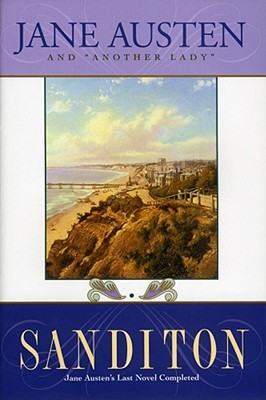
This is the only time Jane Austen clearly introduces a black or mixed-race character in her fiction. And we don’t know what direction she was going to go with this young lady. (Though obviously the producers of Sanditon have made their own speculations, as have the authors of completions of the novel. My favorite completion, by the way, is here.)

My favorite completion of Jane Austen’s Sanditon is by Jane Austen and “Another Lady.”

Austen’s inclusion of a mixed-race character raises questions for us today:

  • How many black and mixed-race people were there in Austen’s England?
  • Is she likely to have known any of them?
  • What were their lives like?
  • How did Austen’s society view them and treat them?

I’ve been doing a lot of reading on this topic, and it’s hard to find solid answers. However, the series of posts that I’m starting today will look at the question from different angles. We’ll start today with some indications from fiction of Austen’s time. Then we’ll look at statistics from official records, using Kathleen Chater’s Untold Histories.  We’ll also look at what art of the time can tell us, and consider the lives of some individual black and mixed-race people. Each of these lenses will give us a little clearer picture of black people’s lives in Austen’s England.

Miss Lambe

Miss Lambe is “half mulatto.” Nowadays “mulatto” is an offensive term, as it is based on the word “mule”; mixed-race people were believed to be sterile like mules. (Though there must have been plenty of evidence to the contrary!) But I don’t think Austen is using it pejoratively. She is simply describing Miss Lambe’s background. It sounds like Miss Lambe had a parent who was half-black and half-white, most likely her mother, and a white parent. Such pairings were quite common in the West Indies. A plantation owner might well leave his wealth to a mixed-race child.

Austen calls Miss Lambe “chilly and tender.” “Chilly” probably meant that the weather of England was too cold for her, compared to the West Indies where she grew up. “Tender” probably meant that she was delicate, easily becoming ill. Though as I imagine Miss Lambe, I like to think that “tender” also meant she was kind and gentle.

Austen sometimes describes people, such as Marianne Dashwood and Henry Tilney, as having a “brown” complexion. There’s been some speculation that she may mean to imply mixed racial backgrounds. That’s possible, but it seems a little unlikely to me. It sounds like Austen is just describing minor variations in skin tones. She usually pairs “brown” skin with dark eyes and dark hair. In one other reference, Miss Bingley says Elizabeth Bennet has become “brown and coarse.” Darcy says she is tanned from traveling in the summer.

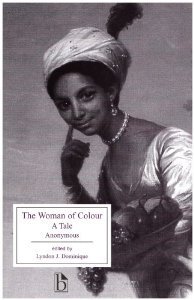
The Woman of Colour is an anonymous novel published in 1808 about an heiress like Miss Lambe. The modern version edited by Lyndon J. Dominique includes much helpful background information and excerpts from other fiction and nonfiction of the time.

Back to Miss Lambe. We can get some idea of what her life might have been like from a novel of the time. The Woman of Colour: A Tale  was published anonymously in London in 1808, nine years before Austen began writing Sanditon. Professor Lyndon J. Dominique has edited a modern version, full of helpful background information.

Modern scholars speculate that the writer was herself a “woman of colour,” the mixed-race daughter of a West Indies planter, but we don’t know for sure who wrote the book. “People of color” may be used today to describe people of various races. However, eighteenth-century British people used it to refer to certain groups of free people in the Americas. Some included free black people, but others used the term only for those of mixed race (p. 21 in The Woman of Colour).

The novel is a series of letters from Olivia Fairfield to her former governess in Jamaica. Olivia, the daughter of a white plantation owner and a black slave, is on her way to England. Her loving father knows that because of her skin color she will never be treated as an equal by the planters of Jamaica. So he arranges that after his death she will travel to England. In England, laws and attitudes toward mixed-race people were less harsh, and tender-hearted Olivia wouldn’t have to see the suffering of the black people she identifies with. Her father, in his will, has arranged for her to marry her cousin, who will then inherit her fortune.

Already we find an interesting contrast. While black people were often treated horrifically in the West Indies, they found more acceptance in England itself.

Prejudices

The story shows some examples of prejudices that black and mixed-race people experienced in England at this time. Olivia and her black maid are called names, and yet they earn a place in society.

At her first English ball, Olivia is “an object of pretty general curiosity” (84). She says, “My colour, you know, renders me remarkable” (84). People stare at her “as if they had been invited purposely to see the untamed savage at a shilling a piece!” However, one gentleman, who calls her a “native,” adds, “In native elegance unrivalled! . . . More grace, more expression, more characteristic dignity, I never yet beheld in one female figure!” His friend calls her a “sable goddess.” Olivia enjoys the dancing, but complains that rather than rational people, she finds only “folly and dissimulation” (88).

Olivia’s maid Dido is a black woman. Though not enslaved, she seems the stereotype of the faithful black slave. She speaks in “half-broken language” (57), presumably a Jamaican dialect. She loves Olivia dearly and serves her faithfully. Olivia also loves Dido. In town, Dido says she is called names like “blacky” and “wowsky” and “squabby” and “guashy,” “and all because she has a skin not quite so white,–God Almighty help them all.” (“Wowski” was the name of an American Indian woman in a novel of 1787; “Quasheba” was the name of dark-skinned characters in novels of 1767 and 1798.) Dido says even a maid treats her like a slave. But she looks forward to their home in the countryside, where she will be the housekeeper and be in charge. Once in the country, she wins the affection of the “peasants” with her warm heart (105).

Olivia’s husband’s young nephew George thinks Olivia’s skin is “dirty” and Dido’s even dirtier. Olivia explains to him, “The same God that made you made me . . . the poor black woman—the whole world—and every creature in it! A great part of the world is peopled by creatures with skins as black as Dido’s, and as yellow as mine. God chose it should be so, and we cannot make our skins white, any more than you can make yours black” (79).

They go on to discuss the evils of slavery. The child has heard the coachman saying that “black slaves are no better than horses over there,” and Olivia explains, “Those black slaves are, by some cruel masters, obliged to work like horses . . . but God Almighty created them men, equal with their masters, if they had the same advantages, and the same blessings of education.” Olivia says that human feelings and religious principles, as well as “kindred claims,” impel her to pray for the end of slavery, the emancipation of her brethren (80-81).

Once Olivia is married and living in the countryside, she meets “East Indian Nabobs,” a family who made their fortune in India, and finds them proud and selfish. However, she is completely accepted into the social circles of her area. The most prejudice she experiences is from her sister-in-law, who is a conniving, selfish woman.

The Woman of Colour: A Tale  shows some of the prejudices against black and mixed-race people in England. Nevertheless, it also implies that people of color were fully accepted in English society, particularly if they had wealth, like Austen’s Miss Lambe.

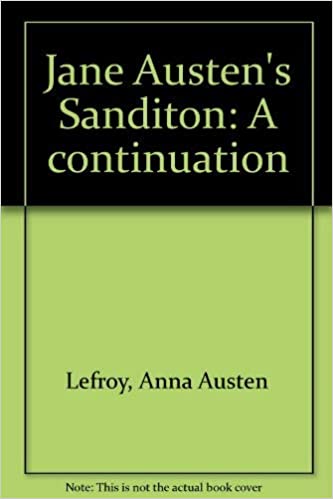
Jane Austen’s niece Anna Austen Lefroy made the earliest attempt to complete Sanditon.

Religious Themes

The novel has many Christian themes. At this time, Christians in England, led by William Wilberforce’s “Clapham Sect,” were pushing strongly to abolish the slave trade and then slavery. Literature was one of their most important means of raising public awareness and calling for compassion for oppressed people. Evangelical Hannah More was writing tracts like “The Sorrows of Yamba: or, The Negro Woman’s Lament,” a story about an enslaved woman whose baby died in her arms on a slave ship. William Cowper, Jane Austen’s beloved poet, wrote poems condemning slavery. Cowper wrote, “We have no slaves at home – then why abroad? . . . 
Slaves cannot breathe in England; if their lungs Receive our air, that moment they are free,
They touch our country and their shackles fall.” (This wasn’t strictly true, in legal terms, but was widely believed. It does point out the radical difference, though, between British colonies where slavery was part of the economy, and Britain itself.) While we don’t know who wrote The Woman of Colour, the book seems to fit with other such literature that put a human face on enslaved peoples and called for Christian compassion toward them.

Olivia’s mother was her father’s slave and his mistress. He taught her Christian faith, which she accepted eagerly. But she also learned from the church that her relationship with him was wrong, since they weren’t married. She confronted him, but he was too proud and too prejudiced to marry her. She died in childbirth. Olivia’s father raised her, gave her a good education, then sent her to England.

Her cousin Augustus, a good man, is at first repelled by Olivia’s dark complexion. However, he soon realizes that she has “a noble and dignified soul.”

Olivia is “a stranger in a strange land, where she is more likely to receive contumely [contempt] than consideration . . . a superior being, and . . . the child of humanity, the citizen of the world, with a heart teeming with benevolence and mercy towards every living creature!—She is accomplished and elegant; but her accomplishments are not the superficial acquirements of the day,–they are the result of application and genius in unison” (102-3).

In fact, Augustus and Olivia, both epitomes of beauty, intelligence, and virtue, seem to be made for each other. They marry and live happily. But—I won’t spoil it—something happens to destroy their happiness. Interestingly, the person who destroys their marriage is motivated by greed, jealousy, and class prejudices, not racial prejudices.

Olivia ends up alone, but she bears it well and peacefully. Throughout the story, she turns to God in all her trials and fears. The story ends by spelling out the moral: In times of calamity, we should seek God. Faith in God can enable us to become resigned to any hard situation.

The original editor adds that if the book can “teach [even] one skeptical European to look with a compassionate eye towards the despised native of Africa—then, whether Olivia Fairfield’s be a real or an imaginary character, I shall not regret that I have edited the Letters of a Woman of Colour!” (189)

Another cover for Sanditon completed by “Another Lady”; other completions are also available by other authors.

Other Fiction of Austen’s Time

Lyndon J. Dominique, who edited the modern version of The Woman of Colour: A Tale, provides a timeline of “Women of Color in Drama and Long Prose Fiction” from 1605 to 1861. He lists 37 publications during Austen’s lifetime with black or mixed-race characters, including Sanditon. It seems likely that as an avid reader, Austen was probably familiar with some of these, or earlier ones.

Dominique includes excerpts from a few of these works, including:

Lucy Peacock’s “The Creole” (1786). A creole heiress (who may be white or mixed-race) loses her fortune to an unscrupulous husband. Only her “honest negroes” console her (196). Again there is a Christian message. The creole lady writes, “Surely . . . we have no right to tyrannize over, and treat as brutes, those who will doubtless one day be made partakers with us of an immortality. Have they not the same faculties, the same passions, and the same innate sense of good and evil? Should we, then, who are enlightened by the holy precepts of Christianity, refuse to stretch forth the friendly hand, to point these human affections to the most laudable purposes, the glory of God, and the real advantage of society?” (196) She frees her slaves.

Agnes Musgrave’s Solemn Injunctions (1798).  At a boarding school, a girl is jealous of a talented, amiable young lady from the West Indies. So she “insinuates” that the girl has black ancestry and should be rejected. The other West Indian girls bring the prejudices of the islands with them to school. “In the West Indies the distinction is kept up by the women with so scrupulous an exactness, as never to mix, on equal terms, with people so descended”: they would not mix with any “child of mixed blood whose ancestors within the fourth degree of descent were negroes” (215). Here again the prejudices of the West Indies are much stronger than the prejudices of England.

Other stories include mixed-race heiresses like Olivia who are beautiful, well-educated, and virtuous Christians. They also include people who condemn “vulgar” black people. It appears that some of these stories, like The Woman of Colour, were written at least partly to help counteract prejudices and support anti-slavery causes.

I suspect Jane Austen’s Miss Lambe would have been a more balanced character then those we find in other novels of the time. Austen did not write stereotypes. However, Austen was strongly opposed to slavery* and probably would have presented Miss Lambe positively.

The Woman of Colour also includes nonfiction excerpts of the time which confirm some of the attitudes and situations represented in the novel. For example, a copy of a Jamaican planter’s will, leaving his fortune to his “reputed daughters” born of his black mistress, shows that there were mixed-race West Indian heiresses.

Next month we’ll look at who the black people in England were at this time, how they got there, and what social classes they belonged to. Scholar Kathleen Chater searched through a huge number of primary sources to find that information, so I’ll share some of that with you, from her book Untold Histories.

If you are familiar with other fiction of Austen’s era that includes black characters, tell us about those characters! Or, if you’ve read The Woman of Colour, what did you learn from it or think about it?

Learning More

On Friday, April 9, from 5:00 – 6:30 PM EDT, Professor Dominique will be giving an online seminar on “Political Blackness in The Woman of Colour,” discussing the novel he edited. You can sign up at Jane Austen & Co. The recorded talk is now available there.

If you want to start exploring more on this topic on your own, in the tabs above, under History, scroll down until you find the section I’ve added on Black History, or see Resources. It will give you a wide variety of resources to start investigating.

*I don’t intend to look at slavery in the British colonies, or abolition, in this series, but you’ll also find sources addressing those areas among the resources listed. “Austen and Antigua—Slavery in Her Time”  is a good discussion of Jane Austen’s comments on slavery and her family’s connections with slave plantations.

You can connect with Brenda S. Cox, the author of this article, at Faith, Science, Joy, and Jane Austen or on Facebook.

Read Full Post »

by Brenda S. Cox

“Here, sir,” taking out his pocket book, “if you will do me the favor of casting your eye over these advertisements which I cut out myself . . .”—Mr. Parker in Sanditon

What did ladies carry in those beautiful little reticules? In Part 1 we looked at some of the items that author Candice Hern has collected. We began with the necessary items: a fan, a vinaigrette, and a coin purse. Then we added some optional items: a perfume étui (a little container for a perfume bottle) and a cosmetics case. What else might ladies have carried in their reticules?

Books

Candice says they carried books in their reticules! That sounds right up my alley. I often carry a book or my Kindle in my purse. But these were very specific kinds of books, made very small to fit in the reticule. Candice showed us two types, pocket books and almanacs.

Pocket Books

The pocket book, perhaps like Mr. Parker’s, was the Regency version of a Day-Timer®. It was about 3” by 5”, usually covered with leather. A foldover flap kept it closed in the reticule. Many publishers produced these, so apparently they were a popular item.

Each began with a title page and a foldout fashion plate. Most pages showed a week’s calendar on one page, opposite a page to list expenses for that week. The lady might list items she bought, losses at cards, and gifts to poor people. A tiny pencil would probably accompany the pocketbook.

Pocket books also included short stories, essays, poetry, and even games. I hope these ladies had good eyes!

This English Ladies Pocket Book was published in Birmingham in 1803. The foldout shows ladies in some interesting bonnets. The book also includes calendar pages, expense pages, and things to read. Photo courtesy of Candice Hern. 

Almanacks

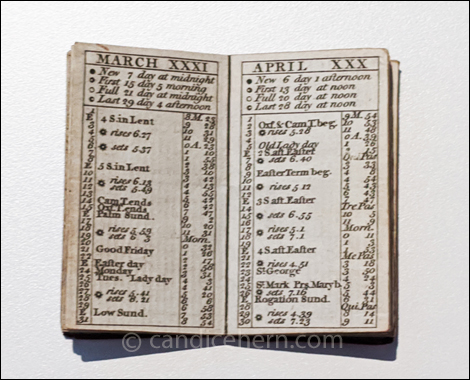
Another book that might be in a ladies’ reticule was a miniature almanac (or, as they would have written it, almanack). These were published yearly from 1690 to 1885. You could buy them at stationers’ shops and give them as Christmas gifts. Or, your dressmaker or milliner might give you one if you were a regular customer, as companies today might give out calendars.

These almanacs were either 1 1/8” square, or 1 1/8” by 2 ¼”. They included pictures; calendars showing holidays, phases of the moon, etc.; lists of the Kings and Queens of England and the Lord Mayors and Sheriffs of London; and information about coins and currency.

By the way, do you know why phases of the moon were important? Most evening visiting was done when the moon was full, so there was enough light to travel in your carriage by night. For example, in Sense and Sensibility when Sir John Middleton wants to invite a lot of people over, he wasn’t able to because “it was moonlight and every body was full of engagements.” So the phases of the moon were part of people’s social planning.

This miniature almanac from 1788 shows phases of the moon, dates of holidays, the church calendar, and dates for terms at Oxford and Cambridge Universities.

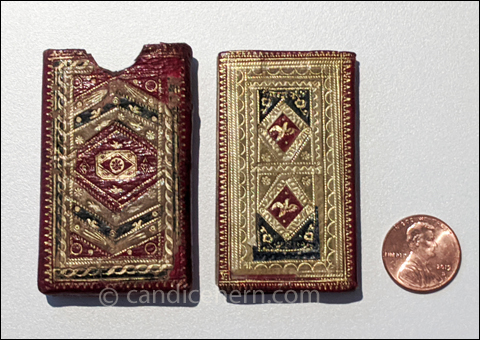
The tiny almanac came in a lovely case of tooled and gilded leather, to protect it in the reticule. Photos courtesy of Candice Hern. 

What else might have been in a ladies’ reticule?

A few years ago I had the privilege of attending the first few days of the Jane Austen Festival in Bath. Way up in Upper Camden Place, near where the Elliots lived in Persuasion, Jane Tapley gave a fascinating talk called “Rummaging Through the Reticule.” She added many more ideas on what might have been in the reticule. Of course reticules were not just carried to parties and visits. They were also used for travel; perhaps they had larger ones for that purpose. Besides some of the items Candice showed, Jane Tapley suggested that the reticule might have included:

  • dressy shoes (silk, satin, or starched cotton), so they wouldn’t get dirty or scuffed on the way to and from the party
  • ostrich feather for your hat (so it didn’t blow away on the way)
  • a small chamber pot if the lady was traveling; they would use it in a coach under their skirts, then dump it through a trap door in the bottom of the coach! Or they might bring one going out to dinner. It could also be carried in your muff. It would have been about the size and shape of a gravy boat.
  • cutlery (silver or wood), including a spoon, probably silver, to be used all during your lifetime
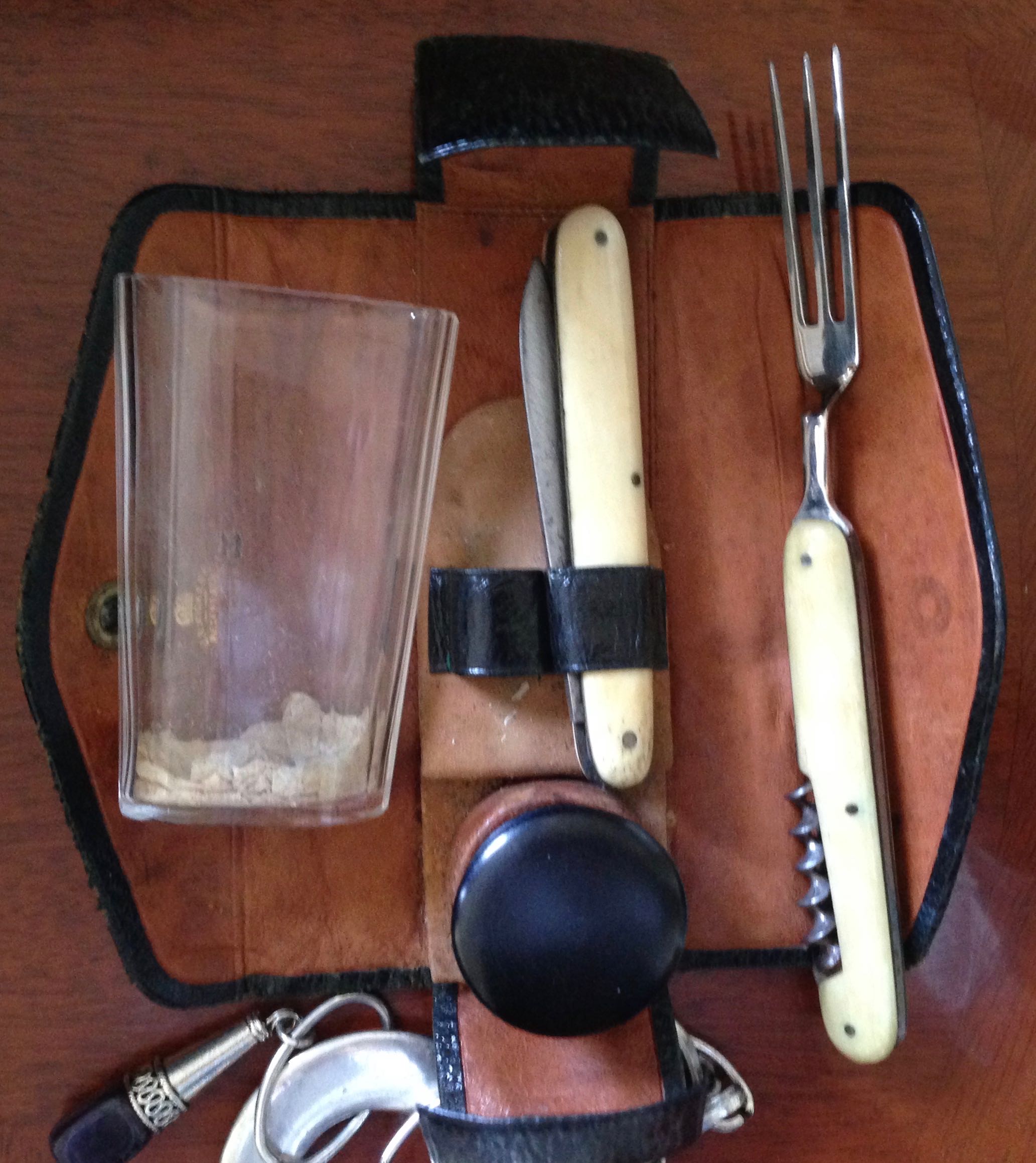
  • a cup, fork, corkscrew, and a little pot for mustard, salt, or pepper, all in a small set for traveling or visits
  • traveling drinking cup made of horn or silver

When traveling, a lady might carry her own cutlery and even salt. Items from Jane Tapley’s collection, photo by Brenda S. Cox

  • a small case (or étui) specifically for sewing. It might include a needle case, scissors case, ivory bobbin winder, silver thimble, ivory pincushion, and a little penknife for cutting thread, plus a box of colored beads and a fine needle for beading. A small sewing kit might be called a huswife or a housewife.
  • little lead pencils or a writing set
  • a tiny book like The Merchant of Venice
  • a silhouette of your sweetheart

Little books were made small enough to carry in the reticule. A silhouette was a way to carry a picture with you. (Items from Jane Tapley’s collection, photo by Brenda S. Cox)

  • glasses or magnifying glasses
  • lorgnettes (folding glasses on a string, worn on a chain around the neck)

Glasses, embroidered handkerchiefs, and sewing supplies might also come in handy in your reticule. (Items from Jane Tapley’s collection, photo by Brenda S. Cox)

  • a half sovereign case that carried two half-sovereigns
  • potpourri or pomanders to keep away body odors
  • handkerchiefs with fine embroidery
  • invitations

Now, imagine that you’re going with Jane Austen to an evening party. What will you carry in your reticule, out of these many options? Or, if you’re traveling with her to another town, what would you carry then?

To find out more about her and her work, look for her on:

Facebook

Twitter

Pinterest

Regency World

To see more of her lovely collections, go to her Regency Collections.

You can connect with Brenda S. Cox, the author of this article, at Faith, Science, Joy, and Jane Austen or on Facebook.

Read Full Post »

Older Posts »