Feeds:
Posts
Comments

Archive for the ‘Sanditon’ Category

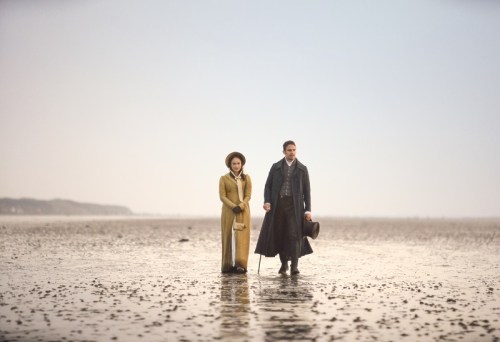
A good friend, after watching all episodes of Andrew Davies’ Sanditon, wrote to express the thought that Young Stringer was more suited for Charlotte than Sidney Parker. Young Stringer, played by Leo Suter, is an actor as handsome as Theo James, who played Sidney Parker, although Theo is darkly handsome, whereas Leo has a kinder face.

Young Stringer and CharlotteYoung Stringer

Young Stringer is an ambitious working man who aims to use his talents as a designer and architect to move up in life. Stringer ‘s infatuation with Charlotte reminds me of Robert Martin’s unquestioning love for Harriett Smith in Emma.The difference is that Charlotte is no one’s fool and so much smarter than Harriett. Her common sense and insights fascinate Sydney, who is attracted to her despite his inner misgivings.

At the time my friend chose Young Stringer over Sydney, I thought that the former was an invention of Andrew Davies and his team. It turns out I was wrong. Austen briefly describes him through Tom Parker. He says:

“But, my dear love, as to garden stuff, you were saying that any accidental omission is supplied in a moment by Lady Denham’s gardener. But it occurs to me that we ought to go elsewhere upon such occasions, and that old Stringer and his son have a higher claim. I encouraged him to set up, you know, and am afraid he does not do very well. That is, there has not been time enough yet. He will do very well beyond a doubt. But at first it is uphill work, and therefore we must give him what help we can. When any vegetables or fruit happen to be wanted—and it will not be amiss to have them often wanted, to have something or other forgotten most days—just to have a nominal supply, you know, that poor old Andrew may not lose his daily job—but in fact to buy the chief of our consumption from the Stringers.”

“Very well, my love, that can be easily done. And cook will be satisfied, which will be a great comfort, for she is always complaining of old Andrew now and says he never brings her what she wants.”

Old Stringer and his son are struggling fruit and vegetable farmers in Austen’s version. Tom and Mary Parker are discussing this situation as they pass by  their old, snug house, which they had abandoned in favor of an exposed location in Sanditon without protection from the sun and wind. Mary is nostalgic for the old days; Tom is a forward-looking enthusiast, an early 19thcentury term that meant someone who was full of enthusiasm for a cause or a passionate belief in something that has merit. In Tom Parker’s instance, it is Sanditon, the sort of seaside town that sprouted all over the Sussex Coast in late 18th– early 19thcentury Britain.

Tom Parker feels responsible for the Stringers’ situation, since he recruited them to set up business in Sanditon – a future town that is half finished and has yet to attract important clients. Mary agrees that purchasing their goods would provide some compensation. And that’s the end of the Stringers’ participation in Austen’s unfinished novel.

Andrew Davies and his team turned the farmers into builders, with Old Stringer employed as stone mason and foreman. Tom Parker has run out of funds, and thus Old Stringer works as a laborer to help get the job done. Young Stringer demonstrates his talent by designing a beautiful Pagoda that would be the centerpiece of the newly built crescent. He believes his talent will provide him with an upwardly mobile life. Sadly, Tom informs him that the pagoda will not be built and Young Stringer burns his plans in frustration. Every time he sees Charlotte, his face lights up. They have a casual friendship, mostly from her side since it is obviously that Young Stringer is hopelessly infatuated, but I can see how my friend still hopes that they will get together romantically.

Sidney ParkerSidney Parker

Now, onto Sydney Parker. In Emma, Austen built up the reader’s expectations of Frank Churchill by providing information about him in dribs and drabs and through Emma’s assumptions, many of which (upon a second reading of the novel) were erroneous and wrong. In a similar fashion, she built up the reader’s knowledge of Sidney in the novel fragment of Sanditon. In the first nine chapters the reader learns about him through his siblings Tom Parker and Diana as they conversed with each other and with others. Tom and his wife, Mary, first discussed Old Stringer’s financial situation. They then moved on to the old house, the family seat, which they had abandoned for Trafalgar House in Sanditon. Mary speaks nostalgically of the house and its snug situation, which sheltered the house from damaging winds and storms. On seeing her former home, she says to Tom and Charlotte, who they are taking to Sanditon in gratitude for the Heywood’s hospitality,

“There now the old house is quite left behind. What is it your brother Sidney says about its being a hospital?”

“Oh, my dear Mary, merely a joke of his. He pretends to advise me to make a hospital of it. He pretends to laugh at my improvements. Sidney says anything, you know. He has always said what he chose, of and to us all. Most families have such a member among them, I believe, Miss Heywood. There is someone in most families privileged by superior abilities or spirits to say anything. In ours, it is Sidney, who is a very clever young man and with great powers of pleasing. He lives too much in the world to be settled; that is his only fault. He is here and there and everywhere. I wish we may get him to Sanditon. I should like to have you acquainted with him. And it would be a fine thing for the place! Such a young man as Sidney, with his neat equipage and fashionable air. You and I, Mary, know what effect it might have. Many a respectable family, many a careful mother, many a pretty daughter might it secure us to the prejudice of Eastbourne and Hastings.”

Tom is certainly impressed by his younger, middle brother. Then in Chapter 5, Mr Parker looks over letters before dinner.

“Not a line from Sidney!” said he. “He is an idle fellow. I sent him an account of my accident from Willingden and thought he would have vouchsafed me an answer. But perhaps it implies that he is coming himself. I trust it may. But here is a letter from one of my sisters. They never fail me. Women are the only correspondents to be depended on. Now, Mary,” smiling at his wife, “before I open it, what shall we guess as to the state of health of those it comes from or rather what would Sidney say if he were here? Sidney is a saucy fellow, Miss Heywood. And you must know, he will have it there is a good deal of imagination in my two sisters’ complaints…and our youngest brother, who lives with them and who is not much above twenty, I am sorry to say is almost as great an invalid as themselves. He is so delicate that he can engage in no profession. Sidney laughs at him. But it really is no joke, though Sidney often makes me laugh at them all in spite of myself. Now, if he were here, I know he would be offering odds that either Susan, Diana or Arthur would appear by this letter to have been at the point of death within the last month.”

Jane has established that Sidney has no use for hypochondriacs and that he isn’t above making fun of his youngest brother and two sisters, who were condensed into one woman in Davies’ Sanditon. Later in the same chapter, Tom continues talking to Charlotte as he reads a letter from one of his sisters, Diana, most likely, who attempts to recruit women from a boarding school, including a West Indian from Surrey (Miss Lambe), in order to increase visitors to the practically empty town.

I have heard nothing of Sidney since your being together in town, but conclude his scheme to the Isle of Wight has not taken place or we should have seen him in his way. Most sincerely do we wish you a good season at Sanditon, and though we cannot contribute to your Beau Monde in person, we are doing our utmost to send you company worth having and think we may safely reckon on securing you two large families, one a rich West Indian from Surrey, the other a most respectable Girls Boarding School, or Academy, from Camberwell. I will not tell you how many people I have employed in the business—Wheel within wheel—but success more than repays. Yours most affectionately.”

“Well,” said Mr. Parker, as he finished. “Though I dare say Sidney might find something extremely entertaining in this letter and make us laugh for half an hour together.”

The reader receives the impression that Sidney is busy with his own schemes and is much admired by his siblings. Tom mentions Sidney one more time at the end of Chapter 9 and says gratefully:

“I got this man a hare from one of Sidney’s friends; and he recommended Sanditon.”

The reader finally meets Sidney in Chapter 12, just before Austen set the novel aside.

It was a close, misty morning and, when they reached the brow of the hill, they could not for some time make out what sort of carriage it was which they saw coming up. It appeared at different moments to be everything from a gig to a phaeton, from one horse to four; and just as they were concluding in favour of a tandem, little Mary’s young eyes distinguished the coachman and she eagerly called out, “It is Uncle Sidney, Mama, it is indeed.” And so it proved.

Mr. Sidney Parker, driving his servant in a very neat carriage, was soon opposite to them, and they all stopped for a few minutes. The manners of the Parkers were always pleasant among themselves; and it was a very friendly meeting between Sidney and his sister-in-law, who was most kindly taking it for granted that he was on his way to Trafalgar House. This he declined, however. He was “just come from Eastbourne proposing to spend two or three days, as it might happen, at Sanditon” but the hotel must be his quarters. He was expecting to be joined there by a friend or two.”

The rest was common enquiries and remarks, with kind notice of little Mary, and a very well-bred bow and proper address to Miss Heywood on her being named to him. And they parted to meet again within a few hours. Sidney Parker was about seven or eight and twenty, very good-looking, with a decided air of ease and fashion and a lively countenance. This adventure afforded agreeable discussion for some time. Mrs. Parker entered into all her husband’s joy on the occasion and exulted in the credit which Sidney’s arrival would give to the place.”

Austen’s build up of this potential hero (which is still in question among scholars) intrigues the reader. Would he turn out to be a disappointment like Frank Churchill, or a hero and love interest worthy of Charlotte? Unlike Austen, Davies introduces Sidney in the first episode and rushes his introduction to Charlotte. They clash at an assembly ball. While I found Austen’s introduction of Sidney intriguing, Davies’ treatment of Sidney resembles more the hero of a bodice ripping Harlequin romance novel than a complex Austen character.

What say you in this very simple poll? Sidney or Young Stringer? What are your thoughts of the series so far?

Read Full Post »

Inquiring readers,

We have reached episode four of Andrew Davies’ eight-episode mini-series on PBS Masterpiece.  Mr. Davies is a master cinematic storyteller.  Austen told her stories through words, while Davies takes advantage of showing dress, customs, manners, and settings visually.

The challenge in adapting the novel for a film is how to stay true to the source as you proceed to bend it into the medium of film. The first thing to consider is adapting prose to dramatic writing and the limitations of the screenplay format.” – Adaptation: From Novel to Film, by Judy Sandra, 27 November, 2017. Downloaded 1-25-20 @ https://www.raindance.org/adaptation-novel-film/

By episode four, Davies’ cinematic adaptation of Sanditon has strayed from Austen land and into Georgette Heyer territory. Not that this is a bad thing and it explains why so many Austen fans love his interpretation of Jane’s incomplete novel.

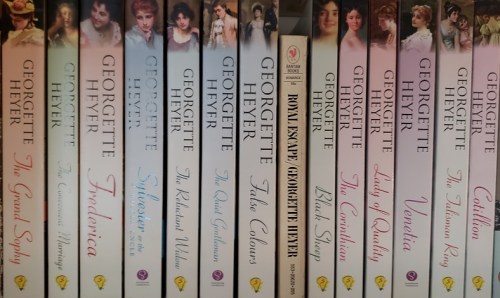
Image of Some of Vic's Georgette Heyer books in her collection.

Some of Vic’s Georgette Heyer books in her collection.

At 19 years of age, after reading Austen’s six novels, I wanted to read more Regency romance between heroes and heroines sparring verbally with wit and daring. I quenched my thirst by devouring all of Georgette Heyer’s delightful novels, even her mysteries.  Heyer knew the Regency and Georgian eras intimately. She and her husband lived in Mayfair, the London setting of so many of her books. Her details were historically accurate, and, best of all, she was a prolific writer. Heyer’s novels, set mostly in the highest circles of society, were as exciting as they were delightful. They were funny and romantic and brought the Regency era alive through her detailed descriptions and historical content.

Heyer’s best novelsThe Grand Sophy, Frederica, Venetia, Sylvester, Arabella (my first introduction to her work), The Corinthian, The Reluctant Widow described in great detail Regency customs, male and female fashions, social interactions (such as the use of calling cards), descriptions of White’s Club or Almack’s, Bow Street Runners, 19th century inventions, and all the minutia that Austen rarely bothered to mention. Through her sparkling stories, Heyer appeased my youthful cravings to inform me about Jane Austen’s regency world. Her often crazy plots offered pure escapism.

In a review of Heyer’s biography by Jennifer Kloester (which I also own), Rachel Cooke writes:

If you want fun – if you want elopements and quadrilles, velvet britches and sprig muslin gowns – you will have to go back to the novels, still in print, and still the greatest and most surprising of pleasures.

After viewing four episodes of Andrew Davies’ adaptation of Sanditon, I am reminded more of a Georgette Heyer plot (with added sex) than Austen’s unfinished manuscript. Which is OK. The melodrama makes for great television.

It just isn’t Austen.

Do you agree? Or not? Both opinions are welcome on this blog. Please feel free to leave your comments or take the poll:

Georgette Heyer and Jane Austen, Linnet Moss, May 2017. Downloaded: January 25, 2020:

Georgette Heyer and Jane Austen

Read Full Post »

Photo of Crystal Clarke as Miss Lambe

Crystal Clarke as Miss Lambe

Miss Lambe, introduced in Episode 1 at the assembly ball, is an intriguing character – a new one for Jane Austen that she intended to explore in depth before she abandoned her manuscript due to illness. By the Regency era, the British Empire had spread the world over. The term “Black” in England during that time denoted any skin color other than “white.”  This included people from Africa and the East Indies and West Indies, such as Antigua, the land of Georgiana Lambe’s birth.

Georgiana is the ward of Sidney Parker, who, after she voices her displeasure at his power over her, reminds her that her father wanted her to take a place in polite society, that she was far richer than all of them put together. Neither relish his role, but both understand that because of her fortune she must be managed.  It’s a mystery how Sidney achieved this position, but we’ll assume that an explanation of how his work in the West Indies led him to become Georgiana’s guardian will be given in future episodes.

The viewer instantly understands Georgiana’s views on her position when she angrily lashes out at Sidney that she is “not your slave to be served up as your general amusement.” She gestures dramatically and adds in mock tones, “Here’s a negress, rich and black as treacle. – feast your eyes!”

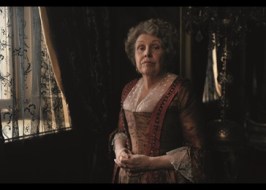
Photo of actress Anne Reid as Lady Denham

Anne Reid as Lady Denham

In the quest to cozy up to Georgiana, Lady Denham hosts a luncheon to introduce her to Sanditon society. Instead of behaving like a gracious hostess, she says the crudest, uncivil statements imaginable. As Georgiana makes her entrance, Lady D. turns to Sir Edward Denham, who is in need of a wife with a fortune, and says, “Edward, there’s your quarry. Hunt her down!”

Before anyone takes a bite of food, she addresses Georgiana, gesturing to a pineapple that was placed at the center of the table in her honor. Offended, Georgiana employs a thick island accent to indicate that pineapples are not grown in Antigua. The pair are off to a bad start. 

During the soup course, Lady D asks, “Miss Lambe, what are your views on matrimony? —“An heiress with a 100,000 must be in want of a husband.”

And we’re off to the insult races!

Georgiana gives her a sideways glance: “I don’t care to be any man’s property.”

“Oh, hoity toity! … Was not your mother a slave?”

Pregnant pause.

“She was. But being used as a thing and liking it are not the same, my lady.”

“No, I’m beginning to think that you’re a very opinionated young lady, Miss Lambe.”

Georgiana wins the riposte, but she remains deeply unhappy and unsuccessfully attempts to escape to London by coach. Charlotte happens upon a despondent Georgiana standing dangerously close to the sea cliff’s edge and crying. She comforts her and the two lonely young women become friends. 

Episode 3 presents many new revelations and developments, which will be addressed in a later review.  Miss Lambe makes only two appearances. The first in a painting class to demonstrate her rebelliousness, and the other in a scene with Sidney to show her contrition for bad behavior. The episode ends with Georgiana examining a locket with a portrait of a young Black man and kissing it before finishing a letter.

My, oh, my! How the plot has thickened.

I’ve concentrated on Georgiana Lambe in this week’s review because she is such an unusual character in the Jane Austen canon. Jane visited her brother Henry in London on many occasions and to meet with her publishers. She would have noticed the many Blacks who lived in Britain, most notably in London and major port cities. By some estimates, around 15,000 Blacks lived in England at the end of the 18th century, 20% of whom were women. Around 10,000 Blacks lived in London. 

Slavery was legal in Britain until 1772. While servitude there was preferred over life on a West Indies plantation, Black lives were not easy. After the slaves were freed, males and females found work as servants. During the Napoleonic wars, many Black males enlisted in the navy and army. Once the wars were over, these sailors and soldiers were no longer enlisted and stayed in the port cities they knew so well. 

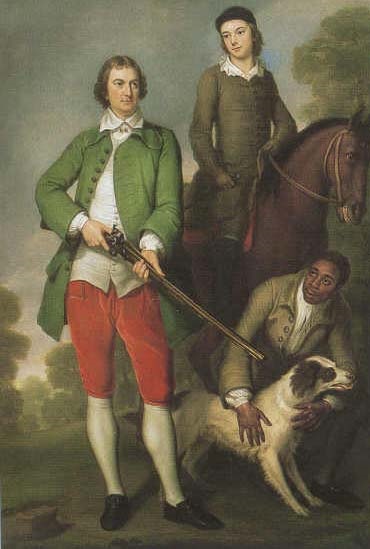
Portrait of The Hon. John Spencer, his son the 1st Earl Spencer, and their slave, Caesar Shaw, ca 1744. Wikimedia Commons. This work is in the public domain.

The Hon. John Spencer, his son the 1st Earl Spencer, and their slave, Caesar Shaw, ca 1744. Wikimedia Commons. This work is in the public domain.

Overt racism was rampant. Servants of the rich were beautifully dressed, but treated like possessions (much like a brood stallion or a rare antique vase.) Portraits would show noble women and a Black servant, be it a child or adult, sitting at the edge of the painting, which served to increase the contrast of the female’s creamy white skin to the ebony complexion of the other sitter. The power differential between males and their Black servants was also evident.

In 1847’s Vanity Fair, William Makepeace Thackery created two characters – Mr. Sambo, the Sedley’s male servant, and Miss Swartz, which means black in German and Dutch. Miss Swartz was described as a “rich, woolly-haired mulatto from St. Kitt’s,” as well as a Belle Sauvage, a dark paragon, and a dark object of conspiracy. George Osborne, her suitor, described her as “elegantly decorated as a she chimney-sweep on May-day.” 

George might not have given Miss Swartz respect, but he and his family had a healthy regard for her money, which made her an acceptable prize. Lady Denham viewed Miss Lambe with much of the same interest and contempt, but this did not fool Miss Lambe, who was proudly not for sale. Her personal experience of society’s disdain for Blacks (such as in the stage coach scene) fuels her anger, combativeness, and sadness. She has nothing to lose by meeting the offensiveness of others head on.

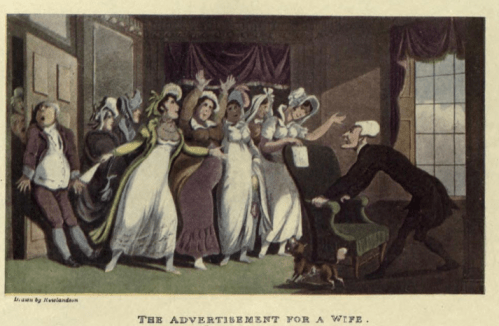
The Advertisement for a Wife, illustration by Thomas Rowlandson. Internet Archive

The Advertisement for a Wife by Thomas Rowlandson. Internet Archive. University of California Libraries. No visible notice of copyright; stated date is 1903.

For The Third Tour of Dr. Syntax In Search of a Wife: A poem by William Combe, Thomas Rowlandson illustrates  “The Advertisement for a Wife, in which a Black woman is placed prominently at the front and center of a group of spinsters. Dr. Syntax had asked an acquaintance, Mrs. Susanna Briskit, an “eccentric creature full of vivacity,” to help him find a wife. She embarked on a “scheme of fun” and invited a room full of loud, insistent females and their chaperones to apply for the position. The scene as written by Combe is funny and I imagine the inclusion of a Black lady heightened the comedy, but probably had a cruel undertone.

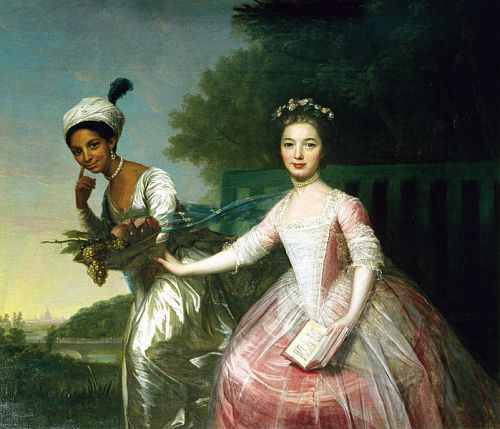
Portrait of Dido Elizabeth Belle Lindsay (1761-1804) and her cousin Lady Elizabeth Murray (1760-1825), David Martin. Wikimedia Commons. This work is in the public domain

Portrait of Dido Elizabeth Belle Lindsay (1761-1804) and her cousin Lady Elizabeth Murray (1760-1825), David Martin. Wikimedia Commons. This work is in the public domain

Not all is misery for Georgian Blacks.  This portrait of Dido Elizabeth Belle Lindsay and Lady Elizabeth Murray by David Martin in the late 18th century depicts a genuine friendship between the two women. Dido, an heiress, was born illegitimately  in the British West Indies of a British navy captain, Sir John Lindsey, and Maria Belle, an African woman whom he captured from a Spanish ship. Dido was sent to England as a child and brought up by Sir John’s uncle, Lord Mansfield and his wife, who were childless. Elizabeth Murray, Dido’s cousin, was motherless. The two girls were raised together, but Dido, while beloved, was not always invited to dine with guests. In the film “Belle,” Dido expresses the same sentiments as a governess–her position was too high to eat with servants and too low to eat with guests. Dido eventually married, had 3 children, and died in 1804 at 42. Compared to most of her Black contemporaries, she led an idyllic life. 

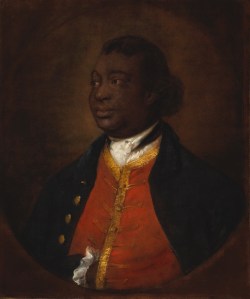
Portrait of Ignatius Sancho, 1768 by Thomas Gainsborough, National Gallery of Canada. Wikimedia Commons. This work is in the public domain.

Ignatius Sancho, 1768 by Thomas Gainsborough, National Gallery of Canada. Wikimedia Commons. This work is in the public domain.

There were other success stories, such as the boxer Bill Richmond, or Ignatius Sancho. Born on a slave ship, Sancho became a protege of the Duke and Duchess of Montagu. While working in their household, he had access to their books and taught himself to read. Today he is celebrated as a writer, composer, shopkeeper and abolitionist. 

It would have been interesting to know how Jane Austen would have fully developed Miss Lambe and what information she learned about the West Indies and Blacks in the navy from her sailor brothers.

Post Note: In The World of Sanditon (see sidebar), Sara Sheridan writes of Austen’s romantic entanglement with Dr. Samuel Blackall, a minister. In a letter to Frank, her brother, Austen describes him as “a piece of perfection.” Nothing was to come of her infatuation. Years later, Blackall married a Miss Lewis of Antigua.

Sheridan concludes that this story “provides an intriguing real-life parallel to the world of Sanditon, as does the idea of a love interest with West Indian connections.”

More sources:

The First Black Britons: Sukhdev Snadhu, History, BBC,2011-02-17. Downloaded 2/20/2020.

Black People in Late 18th Century Britain: Histories and Stories, English Heritage. Downloaded 2-20-2020

Black lives in England: Historic England Blog, Research tab. Downloaded 2-20-2020.

Read Full Post »

sanditon-first-look-icon-01-3200x1800Sanditon on PBS Masterpiece exceeded my expectations in some respects and not in others. It seems that a mixed reaction to this mini-series is not unusual. Many viewers in the UK loved it. Many did not. Some loathed it. Reading and hearing the opinions of my Janeite friends overseas, I approached reviewing this series with some trepidation. I had an extreme reaction to Episode One at first, then viewed all the episodes in two days’ time. Seeing them back to back gave me a new perspective.
First, I wondered why Andrew Davies, the writer, used so little of Austen’s actual material. In my copy of Sanditon, the unfinished manuscript is 75 pages long. Austen completed the first draft of 11 chapters and began the 12th, where both Sidney Parker and Miss Lambe made their first appearances. Before that, the readers knew them only through conversations from other characters. Mr. Davies admitted that he devoted half of Episode One to Jane Austen’s plot as he did not think there was enough “story material” in her manuscript for more. Persuasion’s length was 24 complete chapters. Could Davies not have stretched Austen’s excellent material to two episodes? Instead he tossed aside the complex themes she was developing in favor of straightforward cinematic storytelling, which explains why so many Janeites were disappointed with the series.

As I watched the mini-series, I realized that it wasn’t an Austen adaptation. This televised tale was inspired by a tantalizing beginning that Austen did not complete. Davies used the unfinished novel merely as an outline for his plot. In online interviews he spoke about modernizing the story and sexing it up. In his foreword to the official companion book to the series, The World of Sanditon, Davies was forthright about rushing through the first three episodes as he worked against a deadline. He states:

I’m thrilled with what we have achieved: a period drama that feels utterly fresh and modern – Jane Austen, but not as you knew her.”

If you keep this statement in mind, you will watch the series for what it is and what it was meant to be – entertainment with many references to Jane Austen’s other novels and characters.

Rose Williams, who plays Charlotte Heywood, is adorable. She resembles an adolescent Austen heroine. Fresh-faced, yet wise and well-read, with a young-sounding voice, she has the qualities that I imagined for Charlotte Heywood and Catherine Morland in Northanger Abbey. (Ms. Williams is 25 years old, but she looks and sounds much younger.)

I’ve read of complaints about Charlotte’s hair as being inauthentic in this series. At the assembly ball, however, and at formal gatherings, her hair and its accessories are appropriate for the occasion. I think that by keeping her hair loose and wild during walks, seaside outings, and less formal times, Davies is reminding viewers of her humble country origins. As a guest of the Parkers, she would have help from servants for formal occasions but would most likely be left on her own at other times.

Crystal Clarke as Miss Lambe, a woman of mixed-race, is given the delightful name of Georgiana, reminiscent of Mr. Darcy’s sister. Austen’s introduction of a West Indies heiress is a new development in her novels. The topic of mixed races and fantastic wealth achieved on plantations in Antigua is one she must have known well through her sailor brothers. I love the developing friendship between Georgiana and Charlotte.

I’ve not been as bothered by the music mentioned by some. Sanditon is located along the coastline of Sussex, a rural region, and the setting is not as fashionable or royal as Brighton, where fancy orchestras could find ample work. The folksy music complements the rustic, unfinished streets and buildings in Sanditon and supports the more modern treatment Davies sought.

The photography is lovely, the sets are lush, and I love how the costumes identify people by their wealth and status. Charlotte’s clothes are simple and homemade, although she owns more dresses than I though her parents with 11 children could afford. Miss Lambe, Miss Denham, and Clara Brereton wear clothes of a finer quality, and so forth.

Now we get to the part that I find problematic. I know Davies wanted to sex up the plot, but, really, a hand job? I was not amused. What if I wanted to introduce my young nieces to Jane Austen? How would I have explained that scene?

As to the nudity, male and female beaches were separated at the time. Both sexes knew the demarcation lines and where or where not to walk or swim. Charlotte happening upon Sidney Parker rising out of the ocean full frontal naked caused me to laugh, not out of embarrassment, but because the audience manipulation was so obvious. Jane Austen was no prude. A country woman, she had probably witnessed sex among animals, nursed her male relatives back to health, and helped family members and neighbors with birthing, but she was never crude. Ever.

Young Stringer, the foreman, is a likable character, but I thought almost from the start that he was created to be a “second stringer,” someone to throw us off in the romance department. His background and ambitions are suited to someone of Charlotte’s station, but Sidney Parker has been cast in the role of hero, and so Young Stringer’s purpose seems likely to go nowhere.

Theo James’s performance as Sidney Parker was quite good. He is a darkly handsome hero, one whose sparring with Charlotte in the first two episodes reminded me of Mr. Darcy and Elizabeth.

To sum up this review, Davies chose to follow his own instincts in developing this miniseries If viewers watch the first two episodes of Sanditon on their own merit and not as an Austen adaptation, they’ll enjoy the experience.

Sanditon for streaming and binge watchers

The debut episode of the series will begin streaming on the MASTERPIECE PRIME VIDEO CHANNEL on January 12, with new episodes debuting Sunday of each following week. On February 23, fans can binge-watch the program in its entirety.

The subscription rate for the PBS MASTERPIECE Prime Video Channel is $5.99/month with an Amazon Prime or Prime Video subscription. Every purchase helps supports public television for all.

See sidebar for links to PBS, a description of the full cast, and a link to the companion book.

Links to Music


Read Full Post »

Inquiring readers,

Happy New Year! Are U.S. Austen fans ready for the countdown to Sanditon on PBS? Only 11 days remain until this eight-episode mini-series based on Jane Austen’s final novel fragment airs on Sunday nights. You can also stream each episode. The subscription rate for the PBS MASTERPIECE Prime Video Channel is $5.99/month with an Amazon Prime or Prime Video subscription. On February 23, you can binge watch the entire series. The DVD is also on sale.

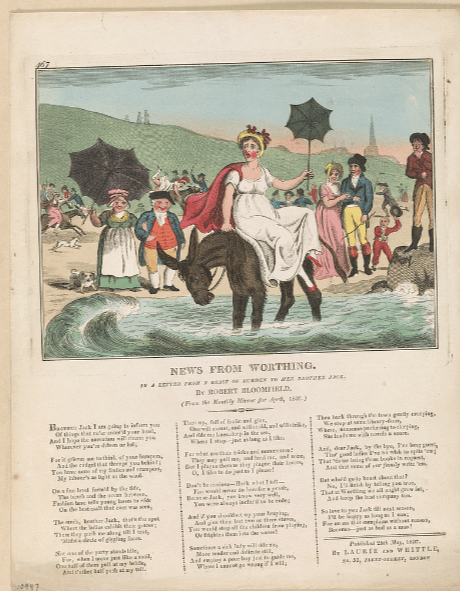
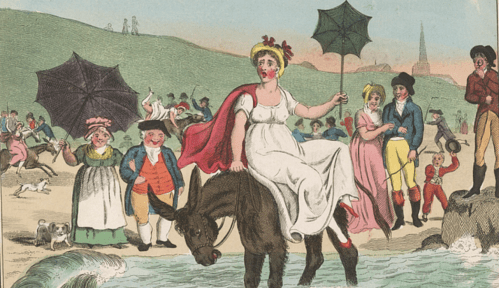
Now, on to the poem, written by Robert Bloomfield “In a Letter from a Beast of Burden to Her Brother Jack.” It’s a lovely early 19th century description from a beast of burden to her brother about her “work” in a seaside resort.

Image of Robert Bloomfield's Letter from a Beast of Burden to Her Brother Jack, 1807, along with an image by I. Cruikshank ?

Brother Jack I am going to inform you
Of things that ne’er enter’d your head,
And I hope the narration will charm you
Wherever you’re driven or led;

For it grieves me to think of your hampers,
And the cudgel that thumps you behind;
To have none of my frolics and scampers,
My labour’s as light as the wind.

On a fine level form’d by the tide,
The beach and the ocean between,
Fashion here tells young lasses to ride
On the best walk that ever was seen,

The sands, brother Jack, that’s the spot
Where the ladies exhibit their graces;
There they push me along till I trot,
‘Midst a circle of giggling faces.

Not one of the party stands idle,
For, when I move just like a snail,
One half of them pull at my bridle,
And t’other half push at my tail.

Then up, full of frolic and glee,
One will mount, and will scold, and will strike,
And ride me knee-deep in the sea,
Where I stop—just as long as I like.

For what are their tricks and manoevres?
They may pull me, and haul me, and teize,
But I plague them as they plague their lovers,
O, I like to do just as I please!

Don’t be envious—Hark what I tell—
You would never do her for a prude,
Because Jack, you know very well,
You were always inclin’d to be rude;

And if you should set up your braying,
And give them but two or three staves,(willow sticks?)
You would stop all the children from playing,
Or frighten them into the waves!

Sometimes a sick lady will ride me,
More tender and delicate still,
And employ a poor boy just to guide me,
Where I cannot go wrong if I will;

Then back through the town gently creeping,
We stop at some library-door,
Where, nonsense preferring to sleeping,
She loads me with novels a score.

And, dear Jack, by the bye, I’ve long guest,
Tho’ good ladies I’ve no wish to spite ‘em;
That ‘tis we bring these book in request,
And that some of our family write ‘em.

But who’d go to boast about that?
No, I’ll finish by telling you true,
That at Worthing we all might grow fat,
And keep the best company too.

So love to you Jack till next season,
I’ll be happy as long as I can;
For an ass that complains without reason,
Becomes—just as bad as a man!”

Published 25th May, 1807.
By Laurie and Whittle,
No. 53, Fleet Street, London

Detail of the illustration by I. Cruikshank (?) News from Worthingo In a Letter from a Beast of Burden to Her Brother Jack By Robert Bloomfield, 1807

Image detail. One can see the chaos in the background with asses that were uncooperative. The maid on the ass is obviously stuck and unhappy.  Chaos reigns, which the onlookers love. Notice the woman at the middle, who is about to be bounced off her ass. Cruikshank (?) shows her bare legs with high stockings. Women in that era did not wear underpants. Ooh la la! The muslin cloth of the woman’s white dress front and center indicates how thin it is as evidenced by her nipples. She is trapped in her position until the ass decides to move. Hah!

I especially like the reference to circulating libraries, which abounded in resort cities.

Many scholars think that Worthing, a seaside resort Jane Austen visited in 1805, could have been the inspiration for the town of Sanditon twelve years later.

  • This interesting article, “Could Worthing have been the inspiration for Jane Austen’s Sanditon?,” by Donna Fletcher Crow, Jane Austen UK, July 24, 2019, and downloaded 12/31/2019, is reproduced on the site by the author’s permission.

About the author: “Donna is a novelist of British history, and a traveling researcher who engages people and places from Britain’s past and present – drawing comparisons and contrasts between past and present for today’s reader. “

Sources:

  • Bloomfield, Robert. “News from Worthing. In a Letter from a Beast of Burden to Her Brother Jack,” Published 25th May, 1807, by Laurie and Whittle, No. 53, Fleet Street, London. Credit Line: Library of Congress, Prints and Photographs Division, Cartoon Prints, British. https://www.loc.gov/resource/ds.03595/. Rights Advisory:  No known restrictions on publication. (Color cartoon)

The rich and wealthy collected color cartoons. People not as flush in the pocket as purchased black and white cartoons, as shown in the following print from Yale University:

  • Bloomfield, Robert,  “News from Worthing: in a letter from a beast of burden to her brother Jack (from the Monthly mirror for April, 1807). Cruikshank, Isaac printmaker., Laurie, Robert and Whittle, James, publisher, 1807. Digital collection: Lewis Walpole Library. Downloaded 12/31/2019 at this link.

In addition: Jane Austen’s World links to


Read Full Post »

« Newer Posts - Older Posts »