Feeds:
Posts
Comments

Archive for the ‘Sense and Sensibility’ Category

Thanks to Netflix, my houseguests and I are watching the Vicar of Dibley and savoring each episode, for we are viewing the last season, in which (be still my beating heart) Richard Armitage plays Geraldine’s swain Harry, and Jane Austen’s novels become a point of discussion. Dawn French as Geraldine is at the top of her comedic game in this series, which was woefully short and had too few episodes to please this Dibley addict.

In the The Handsome Stranger, Harry and Geraldine discuss a scene in Sense and Sensibility. (Click on image.)

Richard Armitage and Dawn French in the Vicar of Dibley

Richard Armitage and Dawn French in the Vicar of Dibley

If you have a Netflix account or can watch the videos streaming somewhere, I highly recommend this funny, warm-hearted series. The fact that the Vicar is a Jane Austen fan put more icing on the cake for me.

Read Full Post »

Inquiring Readers: This post combines two of my passions: Jane Austen and the Regency Era and Project Runway. Emilio Sosa’s (Esosa’s) beautiful fashions earned him the runner up position in Project Runway Season 7. Two of his sketches  for the costumes of Sense and Sensibility the Musical are included below.

CASTING ANNOUNCED FOR

WORLD PREMIERE OF

“SENSE & SENSIBILITY THE MUSICAL”
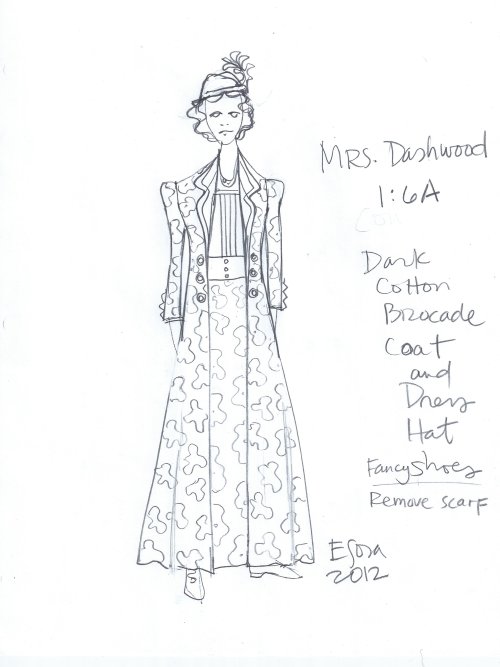
Image used with permission, @Carla Befera & Co.

Image used with permission, @Carla Befera & Co.


The Denver Center Theatre Company’s (DCTC) world premiere production of SENSE & SENSIBILITY THE MUSICAL,with book and lyrics by Jeffrey Haddow and music by Neal Hampton, will receive its world premiere production April 5 – May 26, 2013 in The Stage Theatre at the Denver Center for Performing Arts at 14th and Champa.

Starring in the pivotal Dashwood sister roles will be Stephanie Rothenberg as Elinor and Mary Michael Patterson as Marianne. Ms. Rothenberg made her Broadway debut last season as Rosemary opposite Nick Jonas in How to Succeed in Business Without Really Trying and then starred as Princess Anne in the Guthrie Theater’s world premiere musical, Roman Holiday. Ms. Patterson had her Broadway debut in the Roundabout Theatre Company’s Tony-winning revival of Anything Goes.

The sisters’ romantic entanglements will be portrayed by three of Broadway’s leading men. Nick Verina, seen as Young Ben in the recent Broadway revival of Follies with Bernadette Peters, will take on the role of Edward; Jeremiah James, who starred as Billy Bigelow in the West End revival of Carousel and as Curly in the first national tour of Oklahoma!, will portray Willoughby; and Robert Petkoff, Broadway’s recent Lord Evelyn Oakleigh opposite Sutton Foster in Anything Goes, will be the upstanding Colonel Brandon.

Additional Broadway talent joining the cast includes Ed Dixon (Anything Goes, Sunday in the Park with George, Mary Poppins, How the Grinch Stole Christmas) as Sir John; Ruth Gottschall (Mary Poppins, The Music Man, Funny Thing…Forum) as Mrs. Jennings, and Joanna Glushak (Sunday in the Park with George, Urinetown, Les Misérables) as Mrs. Dashwood/Mrs. Ferrars.

Logo used with permission, courtesy @Carla Befera & Co.

Logo used with permission, courtesy @Carla Befera & Co.

The production boasts a formidable production team, including Set Designer Allen Moyer, Tony nominee for Grey Gardens; Costume Designer ESosa,2012 Tony nominee for The Gershwin’s Porgy and Bess and “Project Runway” finalist; acclaimed Lighting Designer James F. Ingalls; Sound Design byCraig Breitenbach (world premiere of The Laramie Project); Music Supervisor David Loud, whose recent Broadway productions include The Gershwin’sPorgy and Bess and The Scottsboro Boys; Music Director and Conductor Paul Masse, whose Broadway credits include The Scottsboro Boys, as well asCurtainsChicagoAvenue Q42nd Street, and Gypsy, and Orchestrations are by Kim Scharnberg and Neal Hampton.

Producing Artistic Director Kent Thompson selected SENSE & SENSIBILITY THE MUSICAL after it became a runaway hit at the 2012 Colorado New Play Summit.

Esosa was one of the contestants in Project Runway 7, and won runner up. Image Credit: Lifetime Television

Esosa was one of the contestants in Project Runway 7, and won runner up. Image Credit: Lifetime Television

About ESosa, the Costume Designer

ESosa, costume designer for Sense & Sensibility The Musical, based on Jane Austen’s much loved first novel, moves effortlessly between the fashion world and the theatre world. This rising fashion star, better known as Emilio to his Project Runway fans, is also widely admired for finishing second in Season 7 as well as in the most recent Project Runway All-Stars. Yet ESosa has supported himself for much of his career by designing costumes for more than 75 productions regionally and on Broadway.

Today he sees himself as a fashion designer first: “I’ve had a wonderful career in theatre and I’m very blessed, but when I look in the mirror, I always see a fashion designer first and a theatre designer second. I use elements of both, because my fashion informs my theatre and my theatre informs my fashion. They go hand in hand.”

So when conceiving the costumes for Sense & Sensibility, he approached it as a time-travelling fashion designer working in 1810: “I start by designing clothing, and then I worry about theatricalizing the garments later.”  The Regency period of Austen’s novels, recognized most of all for the signature Empire waistline of the ladies’ dresses, provided an abundance of elements to work with: stripes which allow for the creation of chevrons and diamonds, but also florals, polka dots, brocades, lace, jewelry, chiffon. “What was big in this period was transparency. It was a very sexy period for women and men. Bosoms were big, and bosoms don’t go out of style.”

And of course color. On Project Runway ESosa became known for his bold use of color. Will any of that be on display?

“Oh yes, we’ll be playing with bolder colors. You have some characters that call for it, like Lucy. She’s more of a free spirit. For me color is an indication of personality.” The two Dashwood sisters will be dressed in blues (Elinor) and pinks (Marianne). One can only imagine the color palette he’ll come up with for Mrs. [Jennings], the boisterous and comic busybody.

How will this production differ from fastidiously researched film and TV versions of Austen’s oeuvre that periodically come to us from across the pond?

“We’re going to be true to the period,” says ESosa, “but we’re going to experiment with color and pattern and make it visually exciting.” Marcia Milgrom Dodge, director of the musical, wanted to bring his “fearless fashion sensibility” to the refined, stately Regency fashions. “The world of Jane Austen is often depicted in film and television with slavish authenticity,” she explains. “I wanted someone who would honor the period but also be bold and find modern gestures that will illuminate character and help the audience identify with them in a very immediate way.  With his keen fabric choices, witty accessories and smart use of color, ESosa is exactly that designer to bring these beloved characters to vivid life.”

As far as the men are concerned, the designer says he’ll be staying very true to the period’s silhouette—tailcoats and top hats—again taking some liberties with color and fabric selections: “Where I have my freedom is in the color combinations, the details that we add, the shaping. We will tweak it a little. My goal is always to make my actors feel and look good and able to tell the story.”

Oddly enough, ESosa says he is more often recognized as a former Project Runway contestant by theatre people than by people from the fashion industry. Perhaps more theatre people watch the show than those who do fashion for a living? But the show has helped raise his profile in both worlds. He believes a series like Project Runway can do a lot of good: “It’s a great platform for American fashion, and I’m a great proponent of Made in America. I think as a country we need to support our homegrown artists, especially in fashion.”
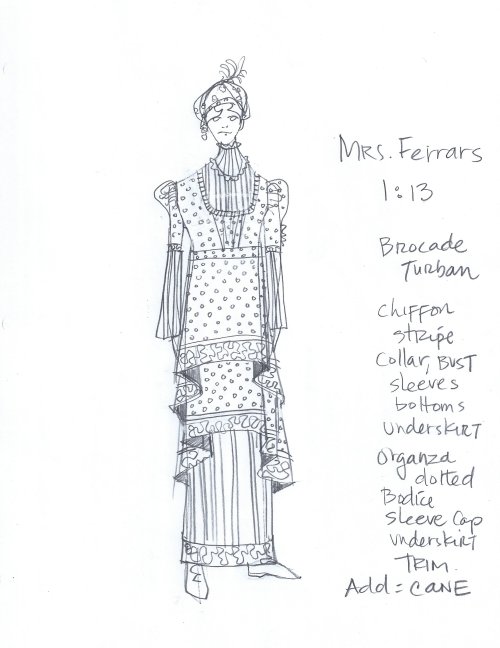
Mrs. Ferrars costume sketch
Born in the Dominican Republic and brought to the United States at age 3, ESosa was raised in Fort Apache, a tough area of the South Bronx. His interest in art and fashion eventually took him out of the Bronx, first to Manhattan’s High School of Art and Design and then to the Pratt Institute in Brooklyn. One of his early professional jobs was as a personal dresser for Judith Jameson and as an apprentice costume-maker for the Alvin Ailey American Dance Theatre.

The story about how he landed his first Broadway production, Suzan-Lori Parks’ Topdog/Underdog, shows the moxie underlying ESosa’s low-key demeanor. Running into Public Theater artistic director George C. Wolfe in the streets of New York, he summoned his courage and went up to him, announcing “Mr. Wolfe, I’m the best costume designer you’ve never worked with.”

“George likes that kind of bravado,” the designer explained. “He was interested. …They brought me in and I had a great, great meeting with him.” Needless to say he got the job and even went on to design Suzan Lori Park’s wedding dress.

ESosa’s two-track career continues full steam ahead. The fashion designer recently launched his own clothing line and has shown collections in New York, Miami and Paris. The costume designer won a Lucile Lortel award for Lynn Nottage’s By the Way, Meet Vera Stark and was nominated for a Tony Award for his work on Porgy and Bess. He feels that his burgeoning fashion fame will not pull him away from the theatre: “I will always have a presence in the theatre. It’s just a matter of finding the balance. It’s part of my life. It’s part of my DNA.”

More About ESosa

More About Sense & Sensibility The Musical

April 5 – May 26 • Stage Theatre
Producing Partners: The Anschutz Foundation, Joy S. Burns, Daniel L. Ritchie, June Travis
Sponsored by The Ritz-Carlton, Denver and U.S. Bank
Signed & Audio Described • May 19, 1:30pm

SENSE & SENSIBILITY THE MUSICAL is based on the novel by Jane Austen. Book and lyrics by Jeffrey Haddow, Music by Neal Hampton. Directed and choreographed by Marcia Milgrom Dodge. 


Performance Schedule

Tuesday, Wednesday, and Thursday performances at 6:30pm

Friday and Saturday evening performances at 7:30pm

Saturday and Sunday matinees at 1:30pm

No children under four admitted.


Tickets and Subscriptions

Tickets ($55 – $65) are available now by calling 303.893.4100 or 800.641.1222 (TTY 303.893.9582). Subscribers enjoy free ticket exchanges, payment plans, priority offers to Broadway shows, discounted extra tickets, a dedicated VIP hotline, free events including talkbacks and receptions, and the best seats at the best prices, guaranteed.

SENSE & SENSIBILITY THE MUSICAL is presented by special arrangement with Betty Ann Besch Solinger and Alice Chebba Walsh. This production of SENSE & SENSIBILITY THE MUSICAL, generously sponsored by U.S. Bank and The Ritz-Carlton, is part of the Denver Center Theatre Companyand Denver Center Attractions (DCA) 2012/13 seasons. SENSE & SENSIBILITY THE MUSICAL Producing Partners: The Anschutz Foundation, Joy S. Burns, Daniel L. Ritchie, June Travis. DCTC is generously supported by Larimer Square, The Steinberg Charitable Trust and Wells Fargo Advisors. DCA is generously supported by United Airlines and Vectra Bank. Media sponsors are The Denver Post and CBS4.  The Denver Center for the Performing Arts is supported in part by the Scientific and Cultural Facilities District.  Please visit our website at www.denvercenter.org

**Please be advised that The Denver Center for the Performing Arts – denvercenter.org – is the ONLY authorized online seller of tickets for Denver Center Attractions (the Broadway touring productions) and the Denver Center Theatre Company (the resident theatre company productions). Currently there are scalpers, also known as ‘second party vendors,’ selling tickets online at a rate more than double the standard price – and up. Tickets bought through these vendors MAY NOT BE VALID. You could not only be refused admission, but also lose your entire investment.

Read Full Post »
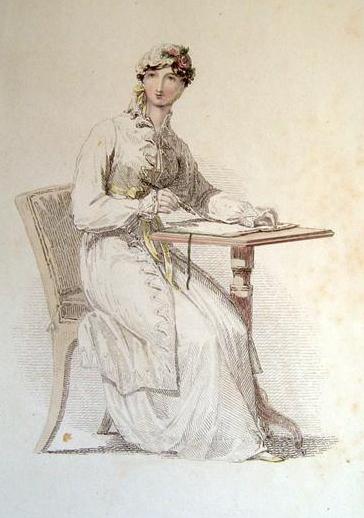
Lady writing at her desk, 1813, Ackermann fashion plate, morning dress.

It is a truth universally known that during her lifetime, Jane Austen published her novels as “a lady.”  While some in the family knew about her writing success – her brother Henry and sister Cassandra swiftly come to mind – many did not, including the cousins. When a genteel woman like Jane was described as being at “work”, the phrase meant needlework and sewing clothes for the poor basket. A lady simply did not sully her hands by toiling at a trade. Jane did not want it bandied about that she was the author of Pride and Prejudice or Sense and Sensibility, but her proud siblings, Henry in particular, couldn’t restrain themselves and bragged about their talented sister.  The word got out and the least well-kept secret was the name of the lady who wrote those delightful novels.

James Edward Austen, the son of Jane’s eldest brother James, and a favorite nephew of hers, discovered at school in 1813 that his favorite aunt was the author of two novels he had enjoyed immensely. The 11-12 year-old was so delighted with the news that he penned an enthusiastic poem about his discovery and sent it to her:

To Miss J. Austen

No words can express, my dear Aunt, my surprise
Or make you conceive how I opened my eyes,
Like a pig Butcher Pile has just struck with his knife,
When I heard for the very first time in my life
That I had the honour to have a relation
Whose works were dispersed throughout the whole of the nation.

I assure you, however, I’m terribly glad;
Oh dear! just to think (and the thought drives me mad)
That you made the Middletons, Dashwoods, and all,
And that you (not young Ferrars) found out that a ball
May be given in cottages never so small.
And though Mr. Collins, so grateful for all,
Will Lady de Bourgh his dear Patroness call,
‘Tis to your ingenuity he really owed
His living, his wife, and his humble abode.

James Edward Austen as a young man.

When Edward Austen-Leigh, as he became later known in life, was 72, he penned his now famous Memoirs of Jane Austen,  leaving a legacy of the memories that he and his cousins retained a half century after her death. Had Edward not embarked on this quest, his memories (he was 16 when Jane died), and those of Caroline Austen and Fanny Knatchbull, might not have been captured in print. While his book preserved those fading memories, they also “sanitized” his aunt Jane’s reputation, erasing much of her sharp tongue and wit and replacing it with sweetness of character:

The grave closed over my aunt fifty-two years ago; and during that long period no idea of writing her life had been entertained by any of her family. Her nearest relatives, far from making provision for such a purpose, had actually destroyed many of the letters and papers by which it might have been facilitated. They were influenced, I believe, partly by an extreme dislike to publishing private details, and partly by never having assumed that the world would take so strong and abiding an interest in her works as to claim her name as public property. It was therefore necessary for me to draw upon recollections rather than on written documents for my materials; while the subject itself supplied me with nothing striking or prominent with which to arrest the attention of the reader…

Edward Austen-Leigh at the time he wrote Memoirs of Jane Austen

The motive which at last induced me to make the attempt [to write this memoir] is exactly expressed in the passage prefixed to these pages. I thought that I saw something to be done: knew of no one who could do it but myself, and so was driven to the enterprise. I am glad that I have been able to finish my work. As a family record it can scarcely fail to be interesting to those relatives who must ever set a high value on their connection with Jane Austen, and to them I especially dedicate it; but as I have been asked to do so, I also submit it to the censure of the public, with all its faults both of deficiency and redundancy. I know that its value in their eyes must depend, not on any merits of its own, but on the degree of estimation in which my aunt’s works may still be held; and indeed I shall esteem it one of the strongest testimonies ever borne to her talents, if for her sake an interest can be taken in so poor a sketch as I have been able to draw.

Bray Vicarage:
Sept. 7, 1869.

Read Full Post »

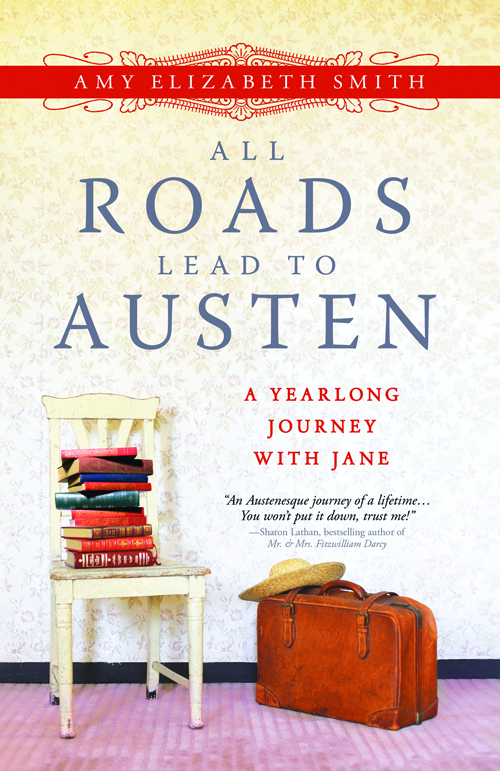
Inquiring Readers: All Roads Lead to Austen: A Yearlong Journey with Jane Austen by Amy Elizabeth Smith is now available through Sourcebooks. I will be reviewing this fabulous, intelligently written book later this week. Meanwhile, enjoy my interview with Ms. Smith about her Latin American adventure as she discusses Jane Austen’s novels en Español with Latin American book groups. All readers of this blog from any country can enter a contest to win a copy of this charming book. Please click on this link and leave your comment. Make sure to leave a way I can reach you. Contest is now closed!

Amy, I love that Jane Austen, a spinster who didn’t travel far or frequently in her lifetime, is so beloved the world wide over. Which country surprised you most in terms of her popularity there and why?

I found translations of Austen left and right in bookstores in Argentina. I met plenty of people there who’d read Austen and liked her or who’d seen film adaptations of her novels and enjoyed them. And the Jane Austen Society of Buenos Aires was the first Austen society in South America. But sometimes it’s hard not to be influenced by stereotypes about people — I’d heard that Chileans were “the English of South America,” so somehow I thought Austen would be popular in Chile. But when I was living in Santiago, the capital (which I absolutely loved), a number of people told me Austen’s not very well known in Chile.

As for Argentineans, I’d heard over and over from people in Mexico, Guatemala, Ecuador, and other places that Argentineans are, well, pretty arrogant. Other latinos kept passing on jokes like, “When Argentineans see lightening, what do they think is happening? They think it’s God, taking their picture!” So, I guess I got the idea that Argentineans might think Austen was stuffy or old fashioned or some such thing. But she’s popular, at least in Buenos Aires, according to my experiences.

What aspects of that particular culture do you think Jane would have enjoyed the most?

Bookstores, bookstores, bookstores. I had great experiences in bookstores all over Latin America, but Argentina — and Buenos Aires specifically — really is the bookstore capital of South America. It’s so easy for us now to take for granted that we can get our hands on just about any book we want, any time. We’ve got access to bookstores, next-day delivery with websites, and good public libraries. And electronic readers have made it easier than ever — just order whatever book you want, wherever you are on the planet! But imagine what it must have been like for an imaginative, inquisitive reader like Austen — how often did she ever set foot in a bookstore? How often could she afford to pay for books from a circulating library? How many books did her family or friends or neighbors actually own? I think Austen would have fainted from sheer pleasure at the sight of bookstore after bookstore on Avenida Corrientes in Buenos Aires.

Librerias Libertador: One of my favorite bookstores on Corrientes, in Buenos Aires

Jane Austen fans cross all religious boundaries. Can you identify any characteristics that Janeites share across the world, besides their obvious love for Jane Austen’s novels?

I honestly can’t speak for many places beyond Latin America (although I might try a next project in some other interesting countries!). But I suspect that there’s a kind of optimism that people — especially women — love about Austen. Her leading ladies find love, not in spite of being strong and intelligent, but because of it. That’s a pretty appealing idea in a world were, in many places, women are still told they’d better not appear too smart, or they’ll scare men off.

What were some of your most memorable experiences in writing this book?

I actually started the book while I was still traveling, although I didn’t finish it until after my trip was done. I wrote the first portion on Guatemala while I was living in Puerto Vallarta, Mexico. I was living well away from the tourist area, renting a partially-finished house that had glass in only one or two windows, so it was pretty noisy — street vendors would cruise by with loudspeakers, selling ice cream, vegetables, you name it. The people across the street had a huge bird caged outside their house that shrieked and chattered like a demon. And animals would wander in at will — there was one very persistent cat that kept making me jump out of my skin by appearing under my writing table with no warning.

There were animals all over the place in that neighborhood — no leash laws for dogs, and some of the neighbors had roosters and other farm animals. When I wanted a break from writing, I’d wander out to buy groceries or take my clothes to the laundromat. I always carried them in a plastic bag, and there was this goat a few houses down from me that was only tied up about half of the time. When it was loose, it usually ignored me, but when I had that plastic bag with laundry, it would come bolting after me — maybe its food came in a plastic bag, and it thought I had something good to eat? Or maybe it knew I had laundry and really wanted to eat my socks. Who knows. Sometimes I actually miss that goat — laundry day’s not the same without it.

A friendly neighborhood rooster from Puerto Vallarta, Mexico

Thank you, Amy, for your wonderful insights and good luck with your book. (I just love the cover!) Is there anything else you would like my readers to know about All Roads Lead to Austen?

Amy Elizabeth Smith

I had two main sources of inspiration for this book — Azar Nafisi’s Reading Lolita in Tehran, and my own Jane Austen students at the University of the Pacific, in California. Readers can enjoy All Roads as a fun opportunity to sit back and be an armchair traveler, but I’d also love it if the book inspired some other international journey I could sit back and read about. Austen in China? Turkey? Belgium? Bora Bora? I’d love to see somebody else take on a journey like this with Jane. Even if they don’t want to write a whole book about it — I’d love to have people share reading-on-the-road stories on my website (http://allroadsleadtoausten.com/). Consider that an official invitation! And thanks so much for letting me visit here at Jane Austen’s World!

To Enter the Contest: Please make sure to leave your comment on Jane Austen Today at this link. The first two comments left on this post will be included in the random number generator drawing at midnight EST USA time on June 11. Please leave all other comments on Jane Austen Today. Make sure to leave a way I can reach you. 

Read Full Post »

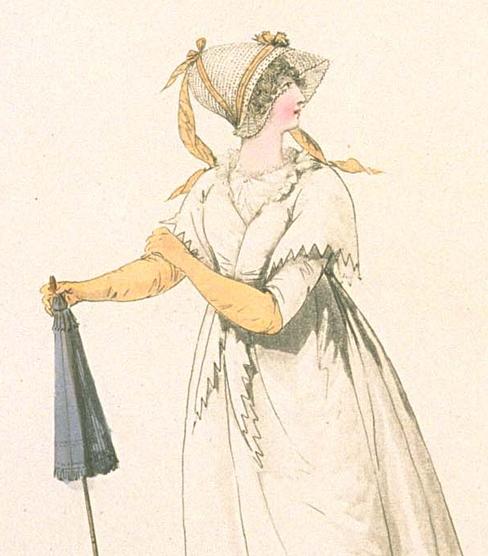
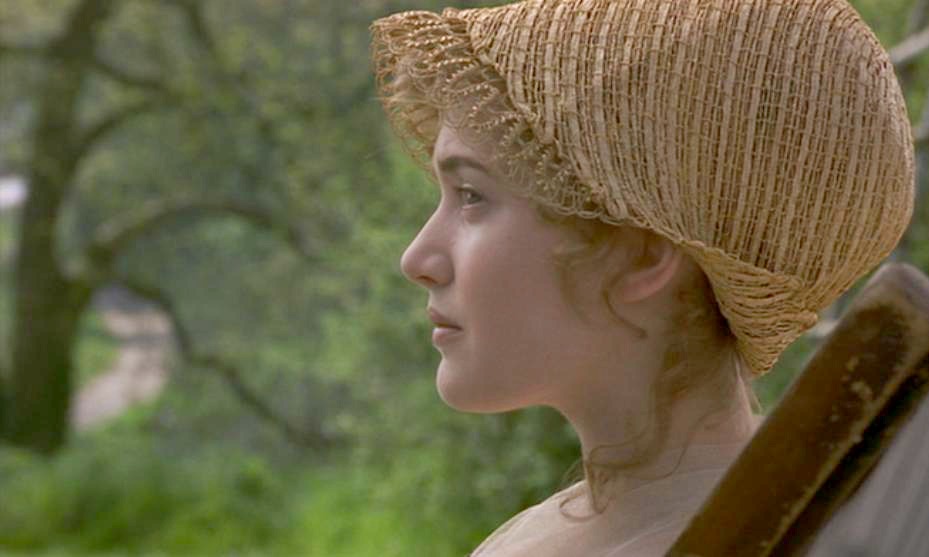
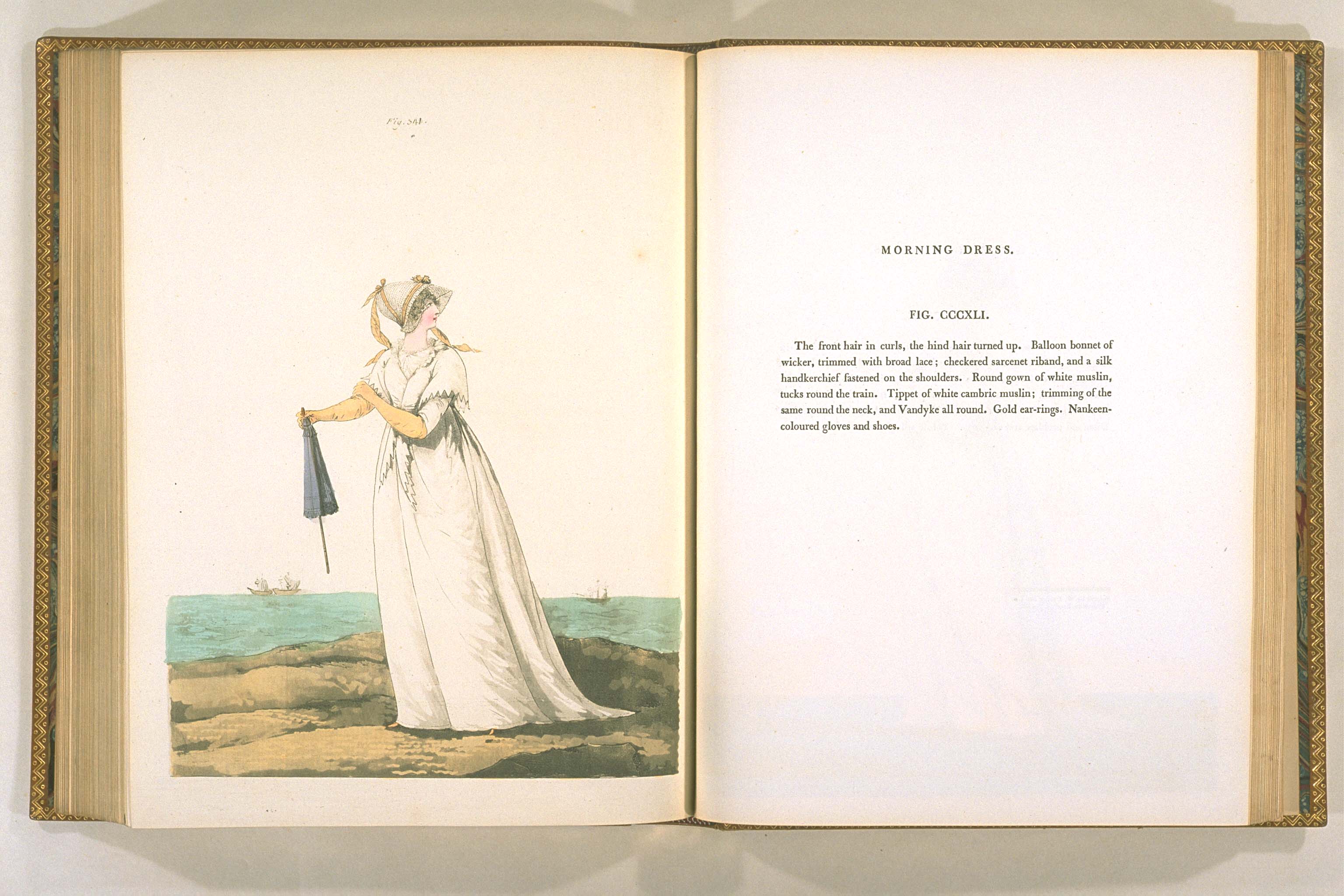
In Sense and Sensibility 1996, Kate Winslet as Marianne wears a charming straw sun bonnet as she recuperates from her illness. When I ran across the fashion plate of a morning dress from The Gallery of Fashion, 1794-1798, I was immediately struck by the similarity, although the brim in the fashion plate is more elaborate.

Detail of a morning gown and balloon bonnet, Heideloff, The Gallery of Fashion

The magazine described the head wear as a “balloon bonnet of wicker, trimmed with broad lace. The front hair is in curls, the hind hair is turned up.”  I suspect that Lydia Bennet would have wrapped ribbons around her capote much as in the above image.

Kate Winslet’s capote is simpler, but equally charming. Capotes, or scoop-shaped bonnets, were popular in the early Regency and first made their appearance in the 1790s. The hats accommodated the modish hair styles of that era, which were short or piled on top of the head.

Bonnet, 1805-1810. Image@The Victoria & Albert Museum

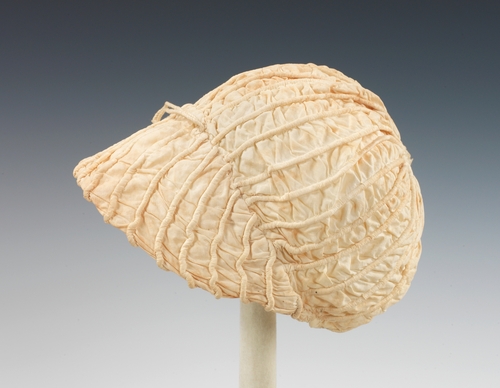
Generally made to be worn outdoors, capotes were also worn as evening headwear early in the 19th century. This evening capote is elaborately trimmed.

Infant bonnet, 1820. Image @Metropolitan Museum of Art

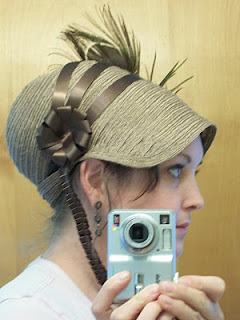
The charming bonnet was made for an infant.  Click here to read the description. The image below shows a modern interpretation of a Regency era capote bonnet. (Living With Jane)

Image @Living With Jane

The shape of the Capote bonnet changed as hairdos changed, and the hat crown shifted to accommodate the increased height of swept up hair. The poke, or brim, also became larger over time. This definition describes the Victorian capote: Close fitting bonnet with rigid brim, either of straw or boned into shape. Soft, shirred crown , ribbon bows tied under the chin, Victorian 19 c. with deep ruffle in back. Also poke bonnet, fanchon, scuttle bonnet, sun bonnet. – Glossary of hats, Village Hat Shop.

View images of the Victorian capote here http://www.metmuseum.org/collections/search-the-collections/80044650 and here http://www.metmuseum.org/collections/search-the-collections/80044657. You can see the vast difference between the two styles, yet they are still capotes.

This link leads to instructions for making a Capote Beguin, or Edwardian Era bonnet.

Make Your Own Regency Bonnet

More on the topic:


Read Full Post »

« Newer Posts - Older Posts »