Feeds:
Posts
Comments

Archive for the ‘Working class’ Category

Another book review so soon on this blog? Well, yes. This book from Shire Publications, Victorian and Edwardian Horse Cabs by Trevor May, is short, just 32 pages long, but it  is filled with many facts and rare images of interest to lovers of history. In Jane Austen’s day most people walked to work, town, church, and market square, or to their neighbors. Six miles was not considered an undue distance to travel by foot one way. The gentry were another breed. They either owned their own carriages or hired a public horse cab. These equipages were available as early as the 1620’s.

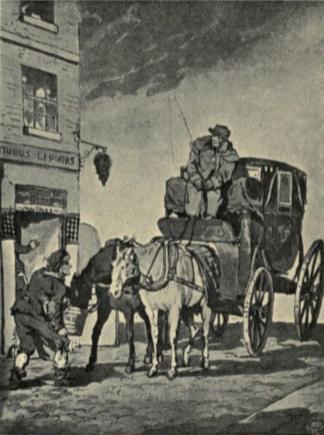
Hackneys, or public carriages for hire made their first significant appearance in the early 17th century. By 1694, these vehicles had increased to such a number that a body of Hackney Coach Commissioners was established in London. The commissioners dealt out licences, which was a bit of a joke, for a mere four inspectors were responsible for over 1,000 vehicles.

Hackney Coach 1680

Most of these licensed hackney coaches were purchased second hand. All that an enterprising person needed to establish his own hackney coach business was enough money for a used carriage and three horses, two that worked in rotation, and one that could be used as a replacement in case of injury or illness. The death of a horse could lead to a cab owner’s financial ruin. Another important ingredient was housing for the horses.

Hackney Coach 1800. Image @Wikimedia Commons

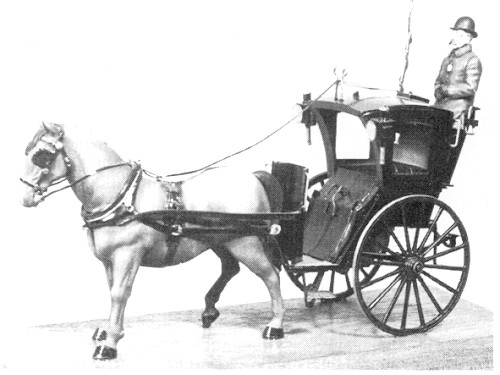
By, 1823, the lighter horse cabs began to replace cumbersome hackney coaches in great quantity, and by the mid 1830’s, the hansom cab set the new standard for modern horse cabs. Aloysius Hansom, an architect, designed the first carriage. When Hansom went bankrupt through poor investments, John Chapman took over, designing an even lighter, more efficient cab, one whose framework did not strike the horses on their backs or sides whenever a carriage ran over an obstacle in the road.

Hansom Cab

Commercial cab firms tended to be small, even as late as 1892. Only one or two proprietors provided a large number or variety of equipages, like Alfred Pargetter, whose concern advertised removal carriages, cabs, and funeral coaches for hire. While cabs were licensed, their drivers were not and the road could present a dangerous obstacle course. The video clip below shows how adroitly horses and carriages managed to avoid each other with seemingly few rules (mostly towards the end of the clip). Notice how some lucky individual horses pulled relatively light loads compared to other horses forced to pull heavy carts.

These two video clips, one from 1903 and the other from 1896 (unbelievable!) show the end of an era, for by 1914, motorized vehicles were rapidly replacing the horse-drawn cart.

I recommend this book to anyone with an insatiable appetite for a pictorial history on a particular topic. Trevor May is an expert on the Victorian era, and he has managed to squeeze more information about horse-drawn cabs in this short book (more a thick pamphlet) than I have read before. The images are simply splendid.

Read Full Post »

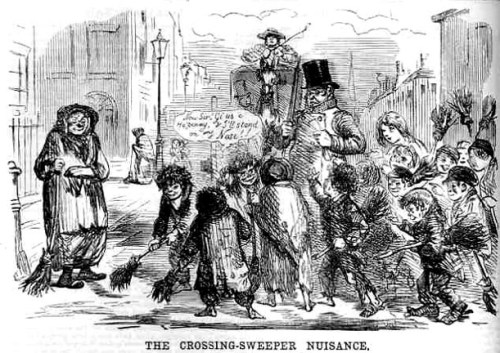
When horses drew every imaginable wagon in London, crossing sweepers were a common sight. In some areas of town they were regarded a nuisance, for often young boys would pester a pedestrian and sweep a clear path whether that person wanted their help or not. The practice of using crossing sweepers to clean the streets of horse manure, dust, and clinging mud lasted into the early 20th century. In the mid-19th century, Henry Mayhew chronicled the lives of working people in a series of volumes entitled London Labour and the London Poor. Mayhew described a system of cleaning streets, introduced by Charles Cochrane in 1843, that instituted a more orderly system than crossing sweepers, and in which former paupers were hired so that they could support themselves.

Crossing Sweepers, 1856

Crossing Sweepers, 1856

The first demonstration or display of the street orderly system took place in Regent street between the Quadrant and the Regent circus and in Oxford street between Vert street and Charles street The streets were thoroughly swept in the morning and then each man or boy provided with a hand broom and dust pan removed any dirt as soon as it was deposited The demonstration was pronounced highly successful and the system effective in the opinion of eighteen influential inhabitants of the locality who acted as a committee and who publicly and with the authority of their names testified their conviction that the most efficient means of keeping streets clean and more especially great thoroughfares was to prevent the accumulation of dirt by removing the manure within a few minutes after it has been deposited by the passing cattle the same having hitherto remained during several days. – London Labour and the London Poor, p. 259

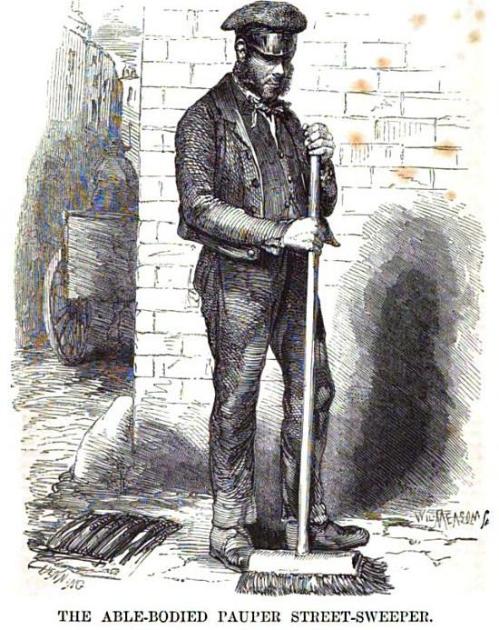
street sweeper

The groups of orderlies not only swept the street and removed dirt in a particular area of London (500 linear yards of a busy street, 2,000 yards of a quieter section, and 9 men in a busy intersection, like Cheapside), but they also acted as “the watchman of house property shop goods, the guardian of reticule,s pocket books, purses and watch pockets, the experienced observer and detector of pickpockets … more, he is always at hand to render assistance to both equestrian and pedestrian.” The report concluded that the street-orderly system would keep the streets of London and Westminster clean in a most satisfactory way. In return, the street-orderlies would earn a wage of 12s. Although this was a lower living wage than other workmen earned, the money lifted them out of their lives of squalor.

The system did not entirely replace the crossing sweepers, many of whom were depicted in caricatures as hounding pedestrians for services rendered. Read my article on Crossing Sweepers at this link.

Read Full Post »

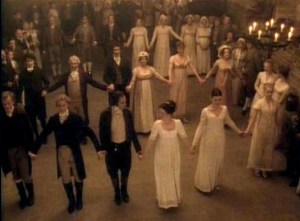
Mr. Knightley's Harvest Ball

Mr. Knightley's Harvest Ball

I prefer Kate Beckinsale’s Emma, written by Andrew Davies, because of the film’s depiction of ordinary life, such as farmers threshing grain before the Harvest Ball. These scenes were not written by Jane Austen, but they added authenticity to the film. When I saw this image, (Detail taken from the New York Public Library’s digital collection of the Costumes of Yorkshire, 1813-1814), I knew that the costumers and the director, Diarmuid Lawrence, had done their research. I loved the quality of the golden light that bathed the workers, lending the scene an antique, painterly feel. There are so many glorious visual moments in this film, which is well worth watching despite the script’s many variations from Jane’s plot.

Detail, Rape Threshing, 1813, The Costume of Yorkshire, New York Public Library

Detail, Rape Threshing, 1813, The Costume of Yorkshire, New York Public Library

By 1750, British agricultural practices were regarded as among the best in the world. The Industrial Revolution accelerated new practices in agriculture, in which animal power and human labor were aided by newly invented farm machinery. These inventions, as well as the new methods of food production, greatly increased the food supply.

harvest
Four-field rotation was practiced in England.  Specific crops were grown in a scientific sequence that managed the different nutrients in the soil. With this method, the continuous use of land was possible; more importantly, additional forage crops for livestock could be grown. This increase in the food supply could support livestock through the winter, which led to an improved diet year round. Even the poor could occasionally augment their bread with meat and dairy products, such as cheese.

harvest 2 (2)
While the Enclosure Acts from 1750-1831 drove many subsistence farmers off their small holdings of around 20 acres, the movement combined land into larger tracts for more efficient farming, and allowing portions of the fields to lie fallow. The traditional method of subdividing the land allowed farmers to feed their families, but their holdings were too small to follow the new method of crop rotation.  The larger holdings (which usually favored the richer land owners) applied modern methods of crop production. The unlucky farmer who lost his lands also lost the means to support his family independently. He and his family had no choice but to find work in the industrial north or in London. These burgeoning urban centers required an enormous amount of food to be brought in daily over long distances. One imagines that after Mr. Knightley set aside enough of the harvest for his own consumption, he transported the remainder to cities to be sold for profit.

harvest 3 (2)

More on the topic:

Read Full Post »

Biblical passages in workhouses reminded the poor of how lucky they were.

Biblical passages in workhouses reminded the poor how lucky they were.

There’s nothing romantic about PBS Masterpiece Classic’s excellent 2008 adaptation of Charles Dickens’ classic, Oliver Twist. Those of us who hold warm and fuzzy memories of the musical –  Oliver! – should put those singing and dancing images out of our minds. This film version depicts the seamy side of Victorian England that Dickens intended – purists will like it for staying true to the author’s gritty vision, and dislike it for the many changes in the plot, as with the character of Rose Maylie.

Oliver lost his mother within hours of his birth and began a twisted start.

Oliver lost his mother within hours of his birth and began a twisted start.

Oliver’s twisted start began not unlike the many orphans of unmarried mothers for whom charity was the only way to survive. In 1848, reformer Lord Ashley referred to the more than thirty thousand children living on the streets as, “naked, filthy, roaming, lawless, and deserted children.” They had no recourse but to live in workhouses, large industrial factories that needed a labor force.
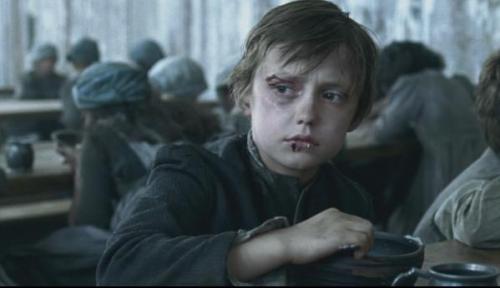
Badly treated workhouse boy.

Badly treated workhouse boy.

Back in the mid-19th century workhouses were no better than concentration camps. Conditions were made purposefully harsh to discourage the destitute from asking for help. Those unlucky enough to qualify were given just enough calories to stay alive for the harsh labor they were forced to perform breaking stones or picking oakum*. In addition to the brutal conditions, parents were separated from their children, and wives were separated from their husbands to prevent more breeding.

William Miller as Oliver Twist

William Miller as Oliver Twist

In 1834 the average age of death for a person in industrial cities like Leeds and Manchester was nineteen. Almost 1/3 of children had lost at least one parent by the age of 15. The odds that a young child would be orphaned was around 8%.**  Such was the world that Charles Dickens grew up in. The child of a debtor and forced into labor in a workhouse at the age of 12, he managed to escape a life of relentless poverty to become one of the most popular and successful authors of his time.

The Board of Guardians eat lavishly while showing Oliver no compassion.

The Board of Guardians eat lavishly while showing Oliver no compassion.

Oliver Twist experienced the horrors of the workhouse from birth. Formerly known as almshouses, these places were supervised by a Board of Guardians, local officials whose aim was to keep the poor out of the way of the middle and upper classes. As in the movie, they treated the poor with complete disdain.

Noah (Adam Gillen) taunts Oliver.

Noah (Adam Gillen) taunts Oliver.

Class was relative. Noah Claypole, who made coffins for Mr. Sowerberry, felt superior to Oliver because he had parents while Oliver did not, and Noah taunted him mercilessly.

Oliver's view of the Sowerberrys, Mr. Bumble, Noah, and Charlotte just before his hair raising escape from the undertaker's establishment.

Oliver's view of the Sowerberrys, Mr. Bumble, Noah, and Charlotte just before his hair raising escape from the undertaker

The workhouse was administered by unpaid bureaucrats, headed by the Beadle, an elected official. These civil servants treated workhouse residents with scorn and cruelty, reminding them with Biblical passages how lucky they were (“Blessed are the poor…”). The workhouse staff received a somewhat better class of lodging and food for their efforts. – Down and Out in Victorian London
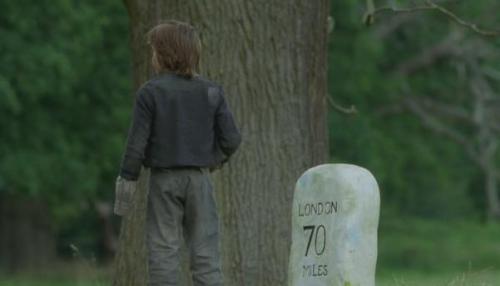
After his escape, Oliver walks to London 70 miles away.

After his escape, Oliver walks to London 70 miles away.

During his journey he spots a carriage that carries the mysterious Mr. Monk, who is searching for him.

During his journey he spots a carriage that carries the mysterious Mr. Monk, who is searching for him.

London streets are filled with noise and the clatter of carriages.

London streets are filled with noise and the clatter of carriages.

The lanes are narrow and crowded.
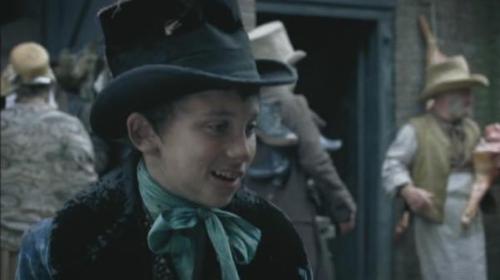
The lanes are narrow and crowded.

Oliver meets his first friendly Londoner, the Artful Dodger (Adam Arnold)

Oliver meetshis first friendly Londoner, the Artful Dodger (Adam Arnold)

For an orphan like Oliver or a woman without family or husband like Nancy, Victorian London was as equally harsh an environment as the workhouse. Newly arrived in town, the Artful Dodger is the only friendly face Oliver sees.
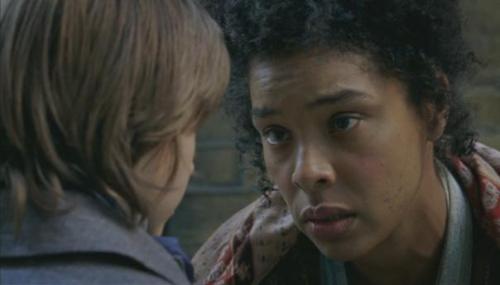
Sophie Okonedo as Nancy

Sophie Okonedo as Nancy

Nancy, a thief and prostitute, had worked for Fagin since the age of 12. She’s one of the few conflicted characters in Dickens’ plot, someone who is neither totally evil, like Sikes or Fagin, or totally good, like Oliver or Rose. Talented actress Sophie Okonedo plays Nancy – the prostitute and thief with a heart of gold – without sentimentality. Although Nancy was a white woman in the novel, black servants were common in Britain, and it’s not a far stretch to imagine that illegitimate mulatto offspring would be forced to make their own way in the world.
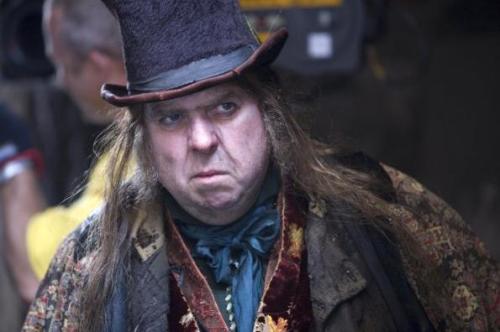
Fagin (Timothy Spall) might seem like a nicer character than the Beadle, but he represents oppression of a different kind.

Fagin (Timothy Spall) might seem like a nicer character than the Beadle, but he represents oppression of a different kind.

Fagin, played with relish by Timothy Spall, trained his boys as pickpockets in “foul’d and frosty dens, where vice is closely packed and lacks the room to turn.”  Bill Sikes – evil and completely merciless as written by Dickens and played by Tom Hardy – was probably a product of the London slums or workhouse.

As described by Dickens, Bill Sikes (Tom Hardy) was a violent man and dog beater who terrorized those around him.

As described by Dickens, Bill Sikes (Tom Hardy) was a violent man and dog beater who terrorized those around him.

The scene in which young Oliver was sentenced to the gallows was entirely believable. Punishments were uneven and unbelievably harsh. Children as young as twelve were sentenced to death or sent to the penal colony in Australia for minor crimes like pickpocketing, stealing a penny’s worth of paint, or being found in the company of gypsies.

Oliver walks 70 miles to London.

Oliver walks 70 miles to London.

The director of the film, Coky Giedroyc, takes advantage of setting and color to depict Oliver’s world. The workhouse is bleak and gray and the cinematic colors remains so when Oliver works for Mr. Sowerberry, the undertaker. The only bucolic scene is shot during Oliver’s long journey on foot to London, and even then it rains more often than not. London looks and feels crowded and claustrophobic as Oliver walks to the East End. When he enters Fagin’s den, surrounded by colorfully clad boys and stolen scarves, his world brightens, though it remains hemmed in.

Food and colorful scarves in Fagin's lair.

Food and colorful scarves in Fagin's lair.

Oliver wakes up in Mr. Brownlow’s house after being rescued from the gallows and his world brightens even more. Light floods over him and Rose and Mrs. Bedwin as they tenderly take care of him. This bright interlude in which Oliver gets a glimpse of another world is short lived. Before long he is plucked away from his sanctuary by Sikes and Fagin, who fear the young boy might reveal their names, location, and criminal operations.
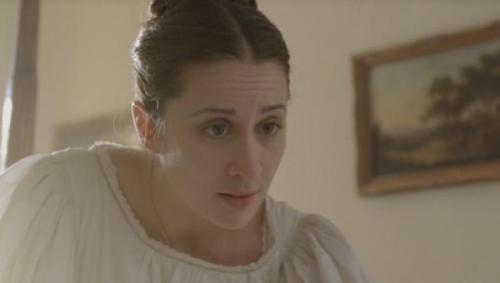
Oliver mistakenly thinks he's died when he wakes up and sees Rose's gentle but concerned face.

Oliver mistakenly thinks he's died when he wakes up and sees Rose's (Morven Christie) gentle but concerned face.

Written as a serialized novel, Oliver Twist is filled with colorful characters, unsuspected plot twists, and suspense, which translate well into film. The result is a remarkably modern plot that has the feel of a detective story.

The Artful Dodger is always on the make.

The Artful Dodger is always on the make.

Everyone was discussing Oliver Twist, from the newly crowned teenage Queen Victoria (who said she disapproved of the novel for younger readers, but read on herself anyway) to Prime Minister Lord Melbourne (“…all about workhouses and coffin makers and pickpockets… I don’t like that low and debasing view of mankind”) to those who could never afford to buy the novel whole, but who could readily identify with the reality it described. All England found itself caught up in the tale of the lonely and mysterious orphan at the mercy of the parish welfare system. – The Rise of the Killer Serial
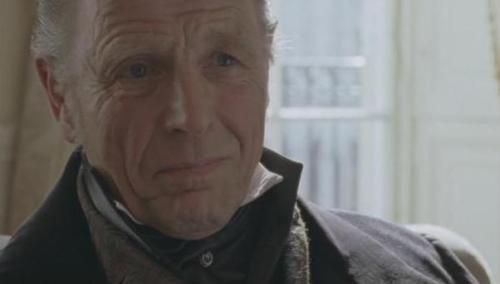
Mr. Brownlow (Edward Fox).

Mr. Brownlow (Edward Fox).

Mr. Brownlow, whose pocket was picked by the Artful Dodger, turns out to be Oliver’s grandfather. He gives Oliver shelter in his home after testifying on the boy’s behalf and saving him from the gallows. Only the reader/viewer knows early on about this coincidence. Rose Maylie is now Mr. Brownlow’s ward and lives with him – a plot change Dickensian purists will dislike. Edward, his grandson and Oliver’s half brother, walks a fine line between pretending concern over finding out what happened to Agnes, Oliver’s mother, and ordering his brother’s murder. Julian Rhind-Tutt plays Edward (Mr. Monk) with just the right amount of sleaziness, especially when courting Rose.

"We will find Agnes," the double talking Edward (Julian Rhind-Tutt) assures his grandfather.

"We will find Agnes," the double talking Edward (Julian Rhind-Tutt) assures his grandfather.

The first week’s episode ends with two shots fired in the dark and Oliver’s outcry. In Dickens’s tale, Rose Maylie lived in the mansion that Sikes was about to rob. Had this adaptation been more faithful to the book’s plot, she would have found Oliver and nursed him back to health, but Bill Sikes carries the wounded boy back to London instead, where Nancy nurses him. The tale ends with Oliver reunited with Mr. Brownlow and Rose; Nancy, Bill Sikes, and Fagin dead; Mr. Brumble marrying Mrs. Corney; and Edmund disgraced and disinherited.

Young William Miller, like all the Olivers before him, looks angelic. I found it strange, however, that despite being raised in the workhouse with the likes of Mr. Brumble and Mrs. Corney, his accent is so refined. And where did he learn his exquisite manners? Would nature truly be so triumphant over nurture in such a hard scrabble world? I think not, but this is not this production’s only failing.

Mrs. Corny tries to blackmail Monks.

Mrs. Corny tries to blackmail Monks.

While Mr. Brumble and Mrs. Corney do marry, as in the film, their tale does not end at the altar. They squander their ill gotten gains and wind up in the workhouse without hope of leaving and experiencing the same lack of compassion that they had meeted out.
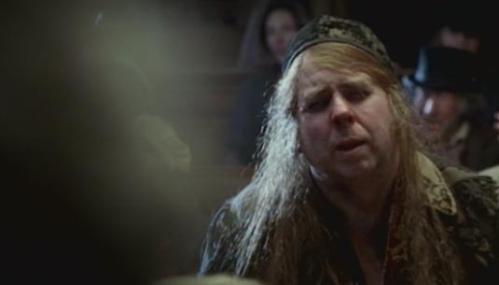
Fagin guilty on all counts

Fagin guilty on all counts

In the book Edward teams up with Fagin – a sinister character as Dickens describes him and without a hint of the lovable traits depicted by Timothy Spall – to hunt after Oliver. In Dickens’ plot, Edward (Mr. Monks) is not cast out without a penny. After receiving half his inheritance from Mr. Brownlow, who hopes he will redeem himself, Edward travels to America, where he squanders his fortune and dies destitute in prison. Seeing him grovel in the film just did not seem quite in character and I found the scene  distasteful and discordant.
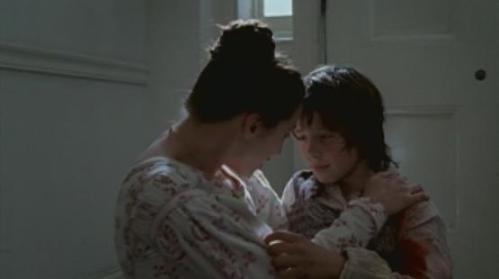
Oliver Returns

Oliver Returns

While the second half of this tale was much darker than the first installment, which was grim enough, the film’s pacing had me sitting on the edge of my seat towards the end. Fagin’s death was swift and merciless, and the deft visual touch of the Artful Dodger walking away with Bill Sikes’ dog showed how quickly life moves on. Before Fagin lay cold in his grave, his position had been replaced by one of the boys and his passing went largely unnoticed, except for the crowd. Such hanging scenes were common back then, and vendors sold food and drink as if the crowd was attending an entertainment, which in a strange way they were.  As for Sikes, in the book he dies in a gristly accident running from an angry mob. Death by his own hand seemed just a bit too merciful an ending for a merciless and inhumane man.

If you missed the second installment of this adaptation, click here to view it online. The video will be available on PBS’s site from Feb 23 – March 1.

More Links:

Read Full Post »

…dirt accumulated faster than all measures to contain it: Cattle were still driven through the streets to and from Smithfield Market until the mid-nineteenth century and horse-drawn vehicles added to the labours of the sweepers stationed at street crossings. Smoke from brick kilns and thousands of sea coal fires polluted the air. In 1813 Henry Austen’s new home above his offices at No. 10 Henrietta Street appeared to Jane to be ‘all dirt & confusion.’ – Jane Austen in Context, Edited by Janet Todd, p 207-208

During Jane Austen’s time and into the earliest days of the twentieth century, crossing sweepers made a living sweeping pedestrian crossings, stoops, and sidewalks of horse manure and litter. Before motorized transport, London boasted over 100,000 horses traversing its streets daily, each one eating a fibrous diet. The crossing sweeper’s job was to shovel the muck, keeping the streets clean for ladies whose long dresses and delicate slippers might get soiled and for gentlemen in their fine raiments.


During “Boney’s” time of terror (Napoleonic Wars), the job of crossing sweeper was often strenuous, and it was said that crossing sweepers could build up a considerable fortune to dig a “channel of viscous mud, a foot deep, through which, so late as the time when George the Third was king, the carts and carriages had literally to plough their way.” In those days, the crossing sweeper had to dig trenches to allow carriages and pedestrians to pass through poorly maintained and muddy roads. As the roads improved, so did the lot of the crossing sweeper, who earned less and less for a job that was to become relatively easier. A good crossing sweeper in an excellent location could still earn a decent living, however. – Chambers, Edinburgh Journal, No. 437, Volume 17, New Series, May 15, 1852

Henry Mayhew described the advantages of this lowly occupation for the London poor:

  • 1st, the smallness of the capital required in order to commence the business;
  • 2ndly, the excuse the apparent occupation it affords for soliciting gratuities without being considered in the light of a street-beggar;
  • And 3rdly, the benefits arising from being constantly seen in the same place, and thus exciting the sympathy of the neighbouring householders, till small weekly allowances or “pensions” are obtained. – Henry Mayhew, London Labour and the London Poor: Volume 2, Crossing-Sweepers

According to the Leeds Industrial Museum, “Children often had more than one way to make money. When it was dry and the streets were not muddy the crossing sweepers, for instance, would do occasional work like catching and opening cabs for people. In the evening they would go outside theatres and operas and tumble for money. Girls mixed ballade singing or lace selling.”

At one time there were so many crossing sweepers that a pedestrian was accosted for money on every stoop and corner, and it would cost a pretty penny to walk from one end of town to another. In 1881, Richard Rowe wrote in London Streets:

IF anyone wants to realize, as the phrase goes, the little army of crossing-sweepers we have in London, let him take a walk – say for a mile or two – on a muddy day, and give a penny to every one who touches hat, makes a bob, as if shutting up like a spy-glass, or trots after him, trailing broom in one hand, and tugging at tangled forelock with the other. I remember when it would have cost anyone, disposed to give in this way, between a shilling and eighteen- pence to walk from the Archway Tavern, Highgate Hill, to Highbury Cock and back. For anyone of a squeezable temperament, therefore, it was decidedly cheaper to take the bus. It is simply as a statistical experiment, just for once in a way, that I recommend this penny-giving. It would be a great misfortune if all crossing-sweepers had pennies given them indiscriminately. I would not make a clean sweep of the sweepers, but I should like to see their ranks thinned considerably – viz., by the elimination of the adults who are able, and the young who might be trained to do something better than what, in the most favourable instances, is little better than a make-believe of work, as a pretext for begging, either directly or by suggestion.


Crossing sweepers worked diligently on both sides of the Atlantic Ocean. In 1882, a New York matron lamented in a letter to the editor of the New York Times about a new regulation that prevented crossing sweepers from working (double click on the image to read it) :

To read more about this fascinating topic, click on the following links:

Click here for an interesting backlink to this post.

Read Full Post »

« Newer Posts - Older Posts »